MENU TRACKLIST ENGLISH TEXT TEXTE FRANÇAIS DEUTSCHE TEXT
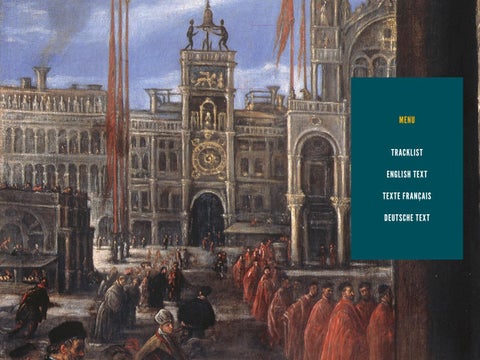
This recording was made with the support of the Fédération Wallonie-Bruxelles (Direction générale de la Culture, Service de la Musique). The Chœur de Chambre de Namur is sponsored by the Fédération Wallonie-Bruxelles (Direction générale de la Culture, Service de la Musique) and supported by the Loterie nationale, the Port autonome de Namur and the City and Province of Namur. www.cavema.be Recording Bolland, église Saint-Apollinaire, July 1998 Artistic direction, recording & editing: Jérôme Lejeune Pictures Cover: Francesco Bassano (1549-1592) Procession devant San Marco,Venice, Palazzo dei Dogi, © akg-images / Camerophoto Translations English: Peter Lockwood Deutsch: Silvia Berutti-Ronelt
GIOVANNI GABRIELI { C. 1555-1612}
IN FESTO SANCTISSIMAE TRINITATIS
CHŒUR DE CHAMBRE DE NAMUR: LA FENICE: JEAN TUBÉRY – direction with the participation of ROSA DOMINGUEZ – soprano ERIC MENTZEL – countertenor HANS JÖRG MAMMEL – tenor STEPHAN VAN DYCK – tenor
[1] In ecclesiis a 14 [2] Canzona seconda a 6 [3] Benedictus es Dominus a 8 [4] Toccata ottava (organo da chiesa) (Andrea Gabrieli) [5] Confitebor tibi Domine a 13 (in tre cori) [6] Ricercar quinto tono (organo da chiesa) (Andrea Gabrieli) [7] Benedicta sit sancta trinitas** [8] Canzon decimasettima a 12 (in tre cori) [9] Jubilate Deo a 10 [10] Canzon settima a 7 [11] Domine Dominus noster a 8 (in due cori) [12] Canzon per sonar primi toni a 8 (in due cori) [13] Dulcis Jesu patris imago – Sonata con voce a 20 [14] Canzon seconda (a due organi di legno) [15] Omnes gentes a 16 (in quatro cori)
** Motetto da G. L. Palestrina diminuito da Giovanni Bassano (Venezia, 1585)
MENU
7’15 3’49 4’43 1’43 5’26 2’56 5’16 3’41 4’46 3’27 3’44 3’48 6’50 2’52 3’20
CHŒUR DE CHAMBRE DE NAMUR Danièle Bodson*, Brigitte Chevigné, Myriam Sosson & Mikiko Suzuki – sopranos Bénédicte Fadeux & Els Janssens* – mezzo-sopranos Bernard Coulon & Carl Sansone – countertenors Vincent Antoine, Jacques Dekoninck, Thibaut Lenaerts* & Thierry Lequenne – tenors Étienne Debaisieux*, Philippe Favette, Benoît Giaux & Jean-Marie Marchal – basses * Soloists LA FENICE Jean Tubéry (1, 2, 7, 8, 10, 12), Gebhard David (1, 2, 5, 8, 9, 10, 11, 13, 15) & Frithjof Smith (1, 5, 8, 9, 10, 12, 13, 15) – cornets Enrico Parizzi (1, 2, 5, 8, 9, 10 ,12, 13, 15) & Roberto Falcone (5, 8, 9, 10, 12, 13, 15) – violins & viola Sophie Watillon (1, 5, 8, 9, 10, 12, 13, 15), Piet Strijckers (8, 13) & Liam Fennely (8, 13) – viols Stephan Legée (2, 5, 7, 8, 9, 10, 12, 13, 15), Christiane Bopp (1, 2, 3, 5, 8, 9, 10, 11, 12, 13, 15), Franck Poitrineau (1, 2, 3, 5, 8, 9, 10, 11, 12, 13, 15) & Simen Van Mechelen (8, 13) – trombones Jérémie Papasergio (2, 5, 8, 9, 10, 12, 13, 15) – bassoon Christina Pluhar (1, 10) – harp & theorbo Matthias Spaeter (1, 3, 5, 8, 9, 10, 12, 13) – archlute & chitarrone Jean-Marc Aymes – positive organ Jörg Andreas Bötticher – positive organ & great organ (organo da chiesea)
IN FESTO SANCTISSIMAE TRINITATIS From Christmas to Whitsuntide and from the Annunciation to the Assumption, the great feasts of the liturgical year as they were held at the basilica di San Marco della serenissima republica di Venetia were occasions onto which the incomparable splendours of the cathedral were brought to bear. Music formed the lion’s share of these and had almost a duty to be singular, full of marvels and splendid, the very image of the golden dome under which it echoed. Proud of its economic and political independence of the State and of its religious independence from Rome (the Catholic church had once excommunicated the city of Venice as a whole at the beginning of the 17th century), the traditional Venetian liturgy had preserved well-known differences with that of the Holy See, as was noted by Giovanni Stringa in his Venetia, città nobilissima e singolare in 1604: “It is the task of the master of rituals to take great care that the Divine Offices are recited according to the orders and rules that conform to the most ancient and venerable Alexandrine rite of the church of St. Mark, seeing that this is different from the Roman rite in many ways”. The Feast of the Trinity came to acquire much greater importance than usual and thereby gained a musical embodiment of the highest level, using the full choir, the instrumental ensemble and the two organs on opposite sides of the choir in the basilica: “a fine Mass of the Most Holy Trinity is sung with the oration for St. Mark [Deus qui beatum Marcum] and of the Doge [...] the instrumentalists played the piffari [reed instruments] after the Epistle behind the high altar; at the Elevation they played cornets or other instruments. On such high and holy days the singers sang and the instrumentalists played the organs.” The most particular elements of the rituals at St. Mark’s that attracted the most comment were the canonical hours of the ecclesiastical day, from Matins and Lauds to Vespers. The Codex Latinum III explains this unequivocally in its chapter Rituum ecclesiasticorum ceremoniale in these terms: “The diligent reader will indeed have found something in this description of the rites and ceremonies of the church of St. Mark the Evangelist of the illustrious city of Venice that differs from the rituals of other churches; he should not be astonished by this [...] as to the Divine Office as it is celebrated in the church of St. Mark, the great diversity and variance observed today in the celebration of the Divine Offices and the canonical hours has given rise to scandal and has nourished many arguments”. Musicologist Richard Charteris has studied the works of Giovanni Gabrieli for many years (cf The Performance of Gabrieli’s Vocal Works and A Thematic Catalogue of Giovanni Gabrieli) and his meticulous work has revealed the compositions that were particular to the liturgy of the Trinity at St. Mark’s: Benedictus es, Dominus and Confitebor tibi, Domine at Matins, Jubilate Deo and Omnes gentes plaudite at Lauds, Domine, dominus noster at Vespers etc. His work is also supported by David B. Bryant in his Liturgy, Ceremonial and Sacred Music in Venice at the time of the Counter-Reformation, Mr. Bryant’s work showing the decisive influence that liturgical allegory had on the texts of motets that were written for particular occasions, as can be seen in the motets In ecclesiis and Dulcis Jesu patris imago that are recorded here. The actual details go back to the third Sunday of July 1577, to the celebration of the end of a plague-ridden year with a votive Mass of the Holy Trinity in the church of the Redeemer
MENU
on the Giudecca. Our witness Francesco Sansovino evokes the traditional procession that took place: “On the third Sunday in July all go to the Giudecca to visit the church of the Redeemer, this in memory that the city was delivered from the horrible plague by our Lord and Redeemer in 1576... each year on this day the Doge proceeds to this church in the morning to hear Low Mass said by the priest of this parish, together with motets sung by the musicians of St. Mark’s at the Offertory and at the Elevation of the Most Holy Body of our Redeemer, before returning to St. Mark’s for High Mass”. It was more than a century and a half after the original event that a commemorative liturgy was established in 1722, replacing the improvised votive Mass of the Holy Trinity; the votive Mass had been in use since 1577. It is interesting to compare the text of In ecclesiis first with the liturgy of the Holy Trinity and then with the text of the Redentore of 1722. All of these elements lead us to the hypothesis that this motet was used during the ceremony (whether at the church of the Redeemer or at the Doge’s return to St. Mark’s) on the third Sunday in July during a period that stretched undoubtedly well beyond Gabrieli’s lifetime. Not only does the work’s text present similarities that reveal a direct influence of the 1722 liturgy, but, all things considered, the musical structure of the work with its alternating solos, duets, quartets, symphonies, choral refrains, homophonic tutti passages and chromatic harmonies seems to be more of a foreshadowing of the sacred cantata than an example of the late Renaissance motet as Gabrieli was still writing in 1597. The motet Dulcis Jesu, patris imago is of similar cut and has been preserved in one surviving manuscript copy in the Kassel library; this can be easily understood, given the links that existed between the Landgraf Moritz von Hessen-Kassel with Venice, as he had sent one of his protégés, one Heinrich Schütz, to study with the great Gabrieli there. The images of the father and the son of the Trinity are present even in the structure of the work, subtitled sonata con voce. The only two voices that join the instruments for the greater part of the work are those of the tenor (vox naturalis - the father) and the alto (high voice, the son). There are similar depictions of evil with discords on the word malo, of redemption with consonant harmonies on the word redemisti, of freedom with ternary rhythm as used in the motet In ecclesiis on the phrase libera nos, and of celestial eternity with a passage in 20 parts with sopranos and cornets added, evoking the heavenly hosts in celestial concert to the phrase ut digni reperiamur esse in caelis. It was thus that the liturgy of the time was presented to the Venetians of Gabrieli’s time, to their great happiness. Treating the decrees of the Papal chapel with disdain, the inhabitants of the city on the lagoon accompanied their facetious remarks with another constituent that they would not have had removed for anything in the world. This was their instrumental music, in which it was more or less impossible to state if St. Mark’s had obeyed St. Peter’s orders. Giovanni was the jewel in the city’s crown until the arrival of his famous successor Claudio Monteverdi, although he was never director of music as one would normally suppose; he was, however, organist at St. Mark’s, a highly desirable post onto which he held with great tenacity once he had obtained it, and remaining there for the last twenty-seven years of his life. His instrumental music was always an integral part of the services, whether it was for organ alone (one of the large organs in the choir, not the small positive organ that was sometimes used to accompany voices) or for instrumental ensemble.
This music could almost have been written using the same thematic material; the Canzon settima in seven parts utilises the theme of the in laetitia from the Jubilate Deo, a joyful dance theme that is transformed into general rejoicing in the final coda. The music director of the time would also not have shunned the Canzon decimasettima written by his leading organist in his search for music for the feast of the Trinity; it was written for three choirs, three violins and is in triple time and built on the triad of the tonic chord; even though its refrain is in duple time, it nevertheless reappears three times! Very busy with the composition of his toccate, ricercari and other intonatione d’organo, Gabrieli was also able to rely upon the maestro di concerto (head of instrumental music), one Giovanni Bassano who occupied the position from 1601 to 1617. We may well wonder if the ornamented version of the Introit of the Mass Benedicta sit sancta trinitas was even heard in the centre of the nave,“quando firmabatur processio in medio ecclesiae, et cantabatur introitus per cantores”, although Gabrieli would never have given up the use of the sonorous and deep Principal stop of the organ on the Epistle side of the church (in cornu epistolae). It is certain, on the other hand, that the motet Domine Deus noster with its perfect homophony perfectly deserves the type of improvised ornamentation demonstrated in Gabrieli’s collection entitled Passagi, cadenze... and published in Venice in 1585; we have resuscitated this extempore technique for this motet, this creating a very colourful reading that is in great contrast with the apparent simplicity of the score. We may also wonder if the Canzona seconda, heard here in a version for two organs, was really worthy of the musical sparring match that once involved Claudio Merulo and Giovanni Gabrieli in the venerable Basilica of St. Mark. The church’s golden cupola is silent on this subject, it seems that all the secrets of the site have been washed away by the waters of the urbs florentissima. The splendid music of the Gabrieli brothers did not simply die out in 1612; the finest of Gabrieli’s pupils, the one to whom Gabrieli had given his ring when on his deathbed, was continuing his master’s art beyond the Alps with the publication of his Psalmen Davids,“psalms for several choirs of voices and instruments” in 1619.These works were stated as being composed by Enricus Saggitarius; saggitarius is the Latin term for archer, while its German equivalent is Schütz. Gabrieli’s organ works were known all over Europe chiefly in the form of German tablatures, as we can see in the work of Bernhard Schmidt, whose works were published during his lifetime in Germany. Gabrieli’s vocal style spread through Europe thanks to his Danish pupils such as Nielsen and Pedersøn. It was only his instrumental music that seemed to die in the terrible plague of 1631; it carried away two-thirds of the population, including many cornettists and trombonists who left empty seats in the choir stalls of St. Mark’s. We must now take leave of this most golden of periods in the basilica’s history, closing with the events of 28 June 1585, when, during a visit of four dignitaries of the Church, it was stated that “la chiesa di San Marco era da ogni canto ripieno di gente in modo, che non si poteva mover il passo” (the church of St. Mark was filled with so many people on all sides that no-one could move one step).We may nevertheless console ourselves with the thought that this tradition, at least, is more alive than ever at the beginning of the third millennium! Jean Tubéry
MENU
IN FESTO SANCTISSIMAE TRINITATIS De la Nativité à la Pentecôte, de l’Annonciation à l’Assomption, les fêtes majeures de l’année liturgique furent pour la basilica di San Marco della serenissima republica di Venetia autant d’occasions de déployer ses incomparables fastes. La musique en composait la partie maîtresse et se devait d’y être unique, merveilleuse et resplendissante, à l’image de la coupole dorée sous laquelle on l’entendait résonner. Fière de son indépendance économique et politique vis-à-vis de la terra ferma autant que religieuse vis-à-vis de Rome (qui en était arrivée à excommunier toute la cité lacustre au début du XVIIe siècle...), la liturgie traditionnelle vénitienne avait conservé des différences notoires avec le Saint-Siège, ainsi qu’en témoigne Giovanni Stringa en 1604 dans Venetia, citta nobilissima et singolare : « Il incombe au maître des cérémonies de veiller avec grande prudence à ce que les offices divins soient récités dans l’ordre et la règle conformes au très ancien et vénérable rite alexandrin [byzantin] de l’église de Saint-Marc, étant en bien des choses différent du romain. » La fête de la très Sainte-Trinité se voyait accorder notamment une importance accrue qui lui conférait une présence musicale de premier rang, c’est-à-dire avec l’intervention du chœur, de l’ensemble instrumental et des deux orgues de tribune en vis-à-vis dans le chœur de la basilique : « On y chante une belle messe de la très Sainte-Trinité avec l’ovation de saint Marc [Deus qui beatum Marcum...] et du doge... et les instrumentistes jouent les piffari [instruments à anche] après l’épître derrière le grand autel, et à l’élévation ils jouent les cornets, ou d’autres instruments. Dans cette solennité majeure, ainsi qu’en toute autre, les chanteurs chantent et les instrumentistes jouent avec les [grandes] orgues. » Toutefois, les particularités cérémoniales les plus notoires à Saint-Marc semblent avoir concerné les heures canoniques de la journée ecclésiastique (des matines, laudes... jusqu’aux vêpres). Le Codex latinum III, dans son chapitre « Rituum ecclesiasticorum ceremoniale », nous le relate sans équivoque en ces termes : « Le lecteur avisé aura en effet trouvé dans cette description des rites et cérémonies de l’église de saint Marc l’évangéliste de l’illustre cité de Venise quelque chose de différent des rites des autres églises, et ne devra pas s’en étonner [...]. En effet, en regard à l’office divin célébré dans l’église Saint-Marc, la très grande multiplicité et diversité observée de nos jours dans la célébration des offices divins et des heures canoniques a conduit au scandale, et donné matière à bien des querelles. » Le travail minutieux du musicologue Richard Charteris, qui s’est penché durant des années sur l’œuvre de Giovanni Gabrieli (voyez The Performance of Gabrieli’s Vocal Works, & A Thematic Catalogue of Giovanni Gabrieli), a permis de mettre en lumière les œuvres inhérentes à la liturgie de la Sainte-Trinité à Saint-Marc : Benedictus es Dominus & Confitebor tibi Domine aux matines, Jubilate Deo et Omnes gentes plaudite aux laudes, Domine Dominus noster aux vêpres... De plus, son travail se trouve épaulé par le remarquable ouvrage de David D. Bryant, Liturgy, Ceremonial & Sacred Music in Venice at the Time of the Counter-Reformation. Ce dernier a mis en évidence l’aspect déterminant de l’allégorie liturgique sur des textes de motets de circonstance, tels In ecclesiis et Dulcis Jesu patris imago, présents dans cet enregistrement. Les faits remontent au troisième dimanche du mois de juillet 1577, où l’on célébra la fin d’une année de peste par une messe votive (in voto) de la Sainte-Trinité en l’église du Rédempteur, sur la Giudecca. Le témoin Francesco Sansovino évoque la traditionnelle
MENU
procession qui s’ensuivit : « Le troisième dimanche de juillet, on s’en va à la Giudecca [presqu’île en face du palazzo ducale di San Marco] pour visiter l’église du Rédempteur, et ceci pour mémoire, que cette ville fut libérée du Rédempteur notre Seigneur, de l’horrible peste de 1576 [...] chaque année de ce jour-là, le doge se déplace le matin à cette église pour y entendre une messe basse dite par le célébrant de cette paroisse, avec des motets chantés par les musiciens de Saint-Marc à l’offertoire, et à l’élévation du très saint Corps de notre rédempteur, avant de s’en retourner à Saint-Marc pour la grand-messe. » En 1722, près d’un siècle et demi après l’événement, une liturgie commémorative fut établie à la place de la messe votive ad hoc de la Sainte-Trinité, qui avait servi à cette occasion depuis 1577. Il est édifiant de comparer le texte d’In ecclesiis avec la liturgie de la Sainte-Trinité d’une part, et celle du Redentore de 1722 d’autre part. Tous les éléments convergent vers l’hypothèse de l’utilisation de ce motet lors de la cérémonie (à l’église du Rédempteur ou au retour du doge à Saint-Marc) du troisième dimanche de juillet, pour une période qui alla sans doute bien audelà du vivant de Gabrieli ; en effet, non seulement le texte de l’œuvre présente des similitudes qui révèlent une influence directe sur la liturgie de 1722, mais au demeurant, l’œuvre musicale à proprement parler, avec son alternance de solos, de duos, de quatuors, de symphonies, de refrains du chœur, de tutti homophones, d’harmonies chromatiques, relève plus de la cantate sacrée avant la lettre que du motet de la fin de la Renaissance, tel que Gabrieli le cultivait encore en 1597. Le motet Dulcis Jesu, patris imago présente des traits de caractère semblables. L’œuvre est conservée en manuscrit unicum à la bibliothèque de Cassel, ce qui peut aisément se comprendre vu les liens qu’entretenait le landgrave Moritz de Hesse-Cassel avec Venise, où il avait envoyé un de ses protégés (un certain Heinrich Schütz !) en séjour d’études auprès du grand Gabrieli. L’image du père et du fils de la Sainte-Trinité est présente dans la texture même de l’œuvre, intitulée Sonata con voce. Les deux seules voix qui se joignent aux instruments pour la majeure partie de l’œuvre sont celles de tenore (« vox naturalis », le père) et d’alto (voix aiguë, sa descendance, le fils). On y retrouve les mêmes notions de mal (malo : dissonances), de rédemption (redemisti : consonances), de libération (libera nos : mouvement ternaire identique au motet In ecclesiis) et d’éternité céleste (ut digni reperiamur esse in caelis : écrit à 20 voix avec force soprani et cornets, qui évoquent les cohortes célestes en un concert angélique...). Ainsi donc se présentait la liturgie à laquelle pouvaient assister, pour leur plus grand bonheur, les Vénitiens du temps de Gabrieli. Faisant fi des amendements de la chapelle pontificale, les facéties de la cité lacustre s’accompagnaient d’un autre volet que ses habitants n’auraient refermé pour rien au monde : la musique instrumentale, dont il y aurait peu ou prou à dire si San Marco s’était plié aux commandements de San Pietro. De fait, Giovanni Gabrieli, leur plus cher fleuron avant son illustrissime successeur Claudio Monteverdi, ne fut jamais maître de chapelle comme on aurait tendance à le supposer, mais bel et bien organiste à Saint-Marc, poste convoité que l’on tenait avec fierté une fois acquis (Gabrieli y passa les 27 dernières années de sa vie). Sa musique instrumentale, qu’elle soit pour orgue seul (un des deux grands du chœur, et non le positif que l’on rajoutait parfois pour soutenir les voix...) ou pour ensemble instrumental, faisait donc partie intégrante de l’office. Elle pouvait être écrite sur un même matériel thématique : la Canzon settima à sept voix reprend le thème du Jubilate Deo, « in laetitia », allégresse de la danse qui se transforme en véritable liesse collective, dans la coda finale. Dans le cadre de la liturgie de la trinité, le maestro di cappella n’aurait sans doute pas dénigré la Canzon decimasettima de son premier organiste ; en effet, celle-ci
est écrite à trois chœurs, pour trois cornets, trois violons, en mesure à trois temps, sur les trois notes de l’accord parfait ; si son refrain est écrit à deux temps, ce n’est que pour mieux réapparaître... à trois reprises. Très affairé à écrire ses toccate, ricercari et autres intonatione d’organo, l’organiste titulaire qu’était Giovanni Gabrieli pouvait s’en remettre au maestro di concerto, c’est-à-dire chef de la musique instrumentale, en la personne de Giovanni Bassano (qui occupa le poste de 1601 à 1617). La version ornée par ce dernier de l’introïtus de la messe Benedicta sit sancta trinitas a-t-elle été entendue au milieu de la nef, « quando firmabatur processio in medio ecclesiae, et cantabatur introitus per cantores » ? À moins qu’il n’eût renoncé pour rien au monde au registre de principale sonore et profond de l’orgue de tribune « in cornu epistolae » (du côté de l’épître) ? Il est sûr, en revanche, que le motet Domine Dominus noster, à l’homophonie parfaite, eût bien mérité les ornements improvisés prodigués dans sa méthode Passagi, cadenze… publiée à Venise en 1585 (pratique « ex tempore » que nous avons reconstituée sur ce motet, et qui en donne une lecture étonnamment bigarrée par rapport à la simplicité apparente de la partition). Quant à la Canzona seconda, entendue ici dans une version pour deux orgues, aurait-elle été digne de la joute organistique à laquelle se livrèrent jadis Claudio Merulo et Giovanni Gabrieli en leur vénérable basilique de Saint-Marc ? La coupole dorée reste muette à ce sujet, et il semblerait que tous les secrets aient été emportés par les eaux de l’urbs florentissima... La musique resplendissante des Gabrieli ne s’éteignit pas pour autant en 1612 : dès 1619, le plus cher élève de Giovanni, celui à qui il remit son anneau sur son lit de mort, perpétuait son art au-delà des Alpes avec la publication des Psalmen Davids, « psaumes à plusieurs chœurs de voix et d’instruments » dus à la plume d’Enricus Sagittarius (Schütz signifiant « sagittaire » en allemand). Les œuvres pour orgue s’expatrièrent également à travers l’Europe, notamment sous la forme de tablatures allemandes, telles celles de Bernhard Schmid, publiées du vivant du maître en Allemagne. Enfin, son style vocal se répandit jusqu’en Europe du Nord avec ses élèves danois, tels Nielsen et Pedersøn. Seule sa musique instrumentale, nécessitant des effectifs hors du commun (jusqu’à vingt-deux voix réparties en cinq chœurs), semble avoir rendu l’âme avec la terrible peste de 1631 ; celle-ci décima deux tiers de la population, dont moult cornettistes et trombonistes qui laissèrent à jamais leur place vacante sur les tribunes du chœur de Saint-Marc. Avec eux disparut l’époque la plus florissante de la basilique, comme en ce 28 juin 1585, où l’on apprenait, à l’occasion de la visite de quatre hauts dignitaires, que « l’église Saint-Marc était remplie de gens de tous côtés, de telle sorte que l’on ne pouvait plus faire un pas... » Consolons-nous : cette tradition, au tournant du troisième millénaire, est plus vivante que jamais !
Jean Tubéry
MENU
IN FESTO SANCTISSIMAE TRINITATIS Weihnachten, Pfingsten, Maria Verkündigung oder Christi Himmelfahrt, all die großen Feste des Kirchenjahres boten der Basilica di San Marco della serenissima republica di Venetia Gelegenheit, unvergleichliche Pracht zu entfalten. Die Musik hatte dabei eine Hauptrolle zu spielen und musste daher einzigartig, wunderbar und glänzend wie die vergoldete Kuppel sein, unter der sie erklang. Stolz auf ihre wirtschaftliche und politische Unabhängigkeit gegenüber der „Terra ferma“ sowie auf ihre religiöse Unabhängigkeit gegenüber Rom (das zu Beginn der XVII. Jahrhunderts so weit gegangen ist, die gesamte Lagunenstadt zu exkommunizieren …), hatte die traditionelle venezianische Liturgie bedeutende Unterschiede zum Heiligen Stuhl bewahrt, wovon Giovanni Stringa im Jahre 1604 in seiner Venetia citta nobilissima et singolare berichtet: „Es ist Aufgabe des Zeremonienmeisters, mit großer Vorsicht darüber zu wachen, dass die Gottesdienste in der Reihenfolge und Regel rezitiert werden, die dem sehr alten, verehrungswürdigen alexandrinischen (byzantinischen) Ritus der Markuskirche entsprechen, der sich in vielerlei Hinsicht vom römischen unterscheidet“. Dem Dreifaltigkeitsfest wurde eine besondere Bedeutung zugemessen, so dass ihm auch eine erstrangige Musik zustand, d.h. mit Chor, Instrumentalensemble sowie den zwei Orgeln, die sich auf den Emporen im Chor der Basilika gegenüberstanden: „man singt dort eine schöne Dreifaltigkeits-Messe mit einer Ovation für den heiligen Markus [Deus qui beatum Marcum] und für den Dogen […] und die Musiker spielen nach der Epistel hinter dem großen Altar auf den Piffari (Rohrblattinstrumente), während sie nach der Wandlung auf Zinken oder anderen Instrumenten spielen. Bei dieser so wie bei jeder anderen so besonderen Feierlichkeit singen die Sänger und die Musiker spielen mit den [großen] Orgeln.“ Die offenkundigsten Eigenheiten der Zeremonien in der Markuskirche scheinen allerdings die Stundenoffizien des Kirchentages (von den Matutinen und den Laudes … bis zu den Vespern) betroffen zu haben. Im Kapitel „Rituum ecclesiasticorum ceremoniale“ des Codex latinum III wird uns davon eindeutig mit folgenden Worten berichtet: „Der aufmerksame Leser wird in dieser Beschreibung der Riten und Zeremonien der Markuskirche in der berühmten StadtVenedig tatsächlich etwas finden, was sich von den Riten der anderen Kirchen unterscheidet und darf sich darüber nicht wundern. […] Was den Gottesdienst betrifft, der in der Markuskirche gefeiert wird, so haben nämlich die große Vielfalt und Verschiedenartigkeit, die heute bei der Feier der Gottesdienste und Stundenoffizien beobachtet wurden, zu einem Skandal geführt und waren Gegenstand vieler Streitigkeiten. Die sorgfältige Arbeit des Musikwissenschaftlers Richard Charteris, der sich jahrelang mit den Werken Giovanni Gabrielis beschäftigt hat (siehe The Performance of Gabrieli‘s Vocal Works, & A Thematic Catalogue of Giovanni Gabrieli) hat es ermöglicht zu klären, welche Werke zur Dreifaltigkeits-Liturgie der Markuskirche gehören: Benedictus es Dominus & Confitebor tibi Domine für die Matutinen, Jubilate Deo & Omnes gentes plaudite für die Laudes, Domine Dominus noster für die Vesper … Außerdem werden Charteris‘ Forschungen durch die bemerkenswerte Arbeit von David D. Bryant erweitert: Liturgy, Ceremonial & Sacred Music in Venice at the Time of the Counter-Reformation. In diesem Werk wird gezeigt, wie entscheidend die liturgische Allegorie für die Motettentexte des jeweiligen Festes ist, wie etwa bei In ecclesiis & Dulcis Jesu
MENU
patris imago, die auf dieser CD zu hören sind. Die Feierlichkeiten für das Dreifaltigkeitsfest gingen auf den dritten Sonntag im Juli 1577 zurück, an dem man das Ende eines Pestjahres mit einer Votivmesse (in voto) für die Dreifaltigkeit in der Erlöserkirche auf der Giudecca feierte. Der Zeuge Francesco Sansovino erwähnt folgende traditionelle Prozession: „ Am dritte Sonntag im Juli begibt man sich auf die Giudeca [Halbinsel gegenüber dem Dogenpalast am Markusplatz], um die Erlöserkirche zu besuchen, und zwar in Erinnerung daran, dass diese Stadt vom Erlöser, unserem Herrn, von der schrecklichen Pest des Jahres 1576 befreit worden ist […]. Jedes Jahr geht der Doge an diesem Tag morgens in diese Kirche, um dort eine stille Messe zu hören, die vom Zelebranten dieser Pfarre gelesen wird, wobei die Musiker der Markuskirche zum Offertorium und zum Emporheben des sehr heiligen Körpers unseres Erlösers Motteten singen, bevor sie für das Hochamt in die Markuskirche zurückkehren“. Im Jahre 1722, d.h. fast eineinhalb Jahrhunderte nach diesem Ereignis, wurde eine Gedenkliturgie anstelle der dafür bestimmten Dreifaltigkeits-Votivmesse eingeführt, die seit 1577 zu diesem Anlass gedient hatte. Es ist aufschlussreich, den Text von In ecclesiis mit der Liturgie der heiligen Dreifaltigkeit einerseits und mit der des „Redentore“ von 1722 andererseits zu vergleichen. Alle Elemente bekräftigen die Hypothese, dass diese Motette bei der Zeremonie des dritten Sonntags im Juli (in der Erlöserkirche oder bei Rückkehr des Dogen in die Markuskirche) benutzt wurde, und zwar in einer Zeitspanne, die zweifellos weit über die Lebzeiten von Gabrieli hinausging. Tatsächlich weist der Text des Werkes Ähnlichkeiten auf, die einen direkten Einfluss auf die Liturgie von 1722 verraten, aber im übrigen gehört das eigentliche musikalische Werk mit seinen abwechselnden Soli, Duos, Quartetten, Symphonien, Chorrefrains, homophonen Tutti und chromatischen Harmonien eher zur Gattung der geistlichen Kantate – ehe es diesen Begriff überhaupt gab – als zur Motette der ausgehenden Renaissance, wie sie Gabrieli noch 1597 pflegte. Die Motette Dulcis Jesu, patris imago weist ähnliche Züge auf. Das Werk ist im UnicumManuskript der Bibliothek von Kassel erhalten, was nicht verwunderlich ist, wenn man an die Beziehungen denkt, die der Landgraf Moritz von Hessen-Kassel mit Venedig unterhielt. Er hatte einen seiner Schützlinge (einen gewissen Heinrich Schütz) zu Studienzwecken zum großen Meister Gabrieli nach Venedig gesandt. Das Bild von Vater und Sohn der Dreifaltigkeit ist in der Struktur des Werkes mit der Bezeichnung Sonata con voce präsent. Die einzigen Stimmen, die sich im Großteil des Werkes zu den Instrumenten hinzugesellen sind die Tenorstimme (Vox naturalis, der Vater) und die Altstimme (hohe Stimme, sein Nachkomme, der Sohn). Man findet darin auch dieselben Begriffe des Bösen (Malo: Dissonanzen), der Erlösung (Redemisti: Konsonanzen), der Befreiung (Libera nos: einem dreizeitigen Satz, der mit der Motette In ecclesiis identisch ist) und der himmlischen Ewigkeit (Ut digni reperiamur esse in caelis: für 20 Stimmen geschrieben, unter denen die zahlreichen Soprane und Zinken die himmlischen Heerscharen bei einem Engelskonzert darstellen). So sah also die Liturgie aus, der die glücklichen Venezianer zur Zeit Gabrielis beiwohnen konnten. Sie verschmähten die von der päpstlichen Kapelle vorgeschriebenen Veränderungen, wobei die Lagunenstadt ihren Eigenwilligkeiten noch einen anderen Aspekt hinzufügte, auf den ihre Einwohner um nichts in der Welt verzichtet hätten: nämlich die Instrumentalmusik, über die weit weniger zu sagen wäre, wenn sich die Markuskirche den Anordnungen der
Peterskirche unterworfen hätte. Eigentlich war Giovanni Gabrieli, ihr größter Meister vor seinem berühmten Nachfolger Claudio Monteverdi, nie Kapellmeister, wie man annehmen könnte, sondern einfach Organist der Markuskirche, was aber ein begehrter Posten war, den man mit Stolz bekleidete, wenn man ihn erst einmal innehatte (Gabrieli verbrachte in dieser Stellung die letzten 27 Jahre seines Lebens). Seine Instrumentalmusik, sei sie nun nur für eine Orgel (eine der beiden großen Orgeln des Chors und nicht das Positiv, das man manchmal zur Unterstützung der Stimmen hinzufügte …) oder für ein Instrumentalensemble geschrieben, war also ein integrierender Bestandteil des Gottesdienstes. Sie konnte auf ein und dasselbe Themenmaterial komponiert sein: so übernimmt etwa die siebenstimmige Canzon settima das Thema von Jubilate Deo, „in laetitia“, mit der Fröhlichkeit eines Tanzes, die in der Endkoda in einen richtigen kollektiven Jubel ausbricht. Im Rahmen der Dreifaltigkeitsliturgie hätte der Maestro di cappella die Canzon decimasettima seines ersten Organisten bestimmt nicht verachtet; sie ist nämlich für drei Chöre, drei Zinken, drei Geigen, in einem Dreiertakt auf die drei Noten des Dreiklangs geschrieben; und wenn der Refrain auch im Zweierrhythmus komponiert ist, so hört man ihn nur umso besser, wenn er wieder auftaucht und zwar … dreimal. Der Titularorganist Giovanni Gabrieli, der mit dem Komponieren seiner Toccate, Ricercari und anderer Intonatione d‘organo äußerst beschäftigt war, konnte sich auf seinen Maestro di Concerto, d.h. auf den Chef der Instrumentalmusik in der Person von Giovanni Bassano (der diesen Posten von 1601 bis 1617 innehatte) verlassen. Ob man Bassanos verzierte Fassung des Introitus der Missa Benedicta sit sancta trinitas in der Mitte des Kirchenschiffes gehört hat, „quando firmabatur processio inmedio ecclesiae, et cantabatur introitus per cantores“? Oder hätte er um nichts in der Welt auf das klangvolle, tiefe „Principale“-Register der Orgel auf der Empore „in cornu epistalae“ (auf der Seite der Epistel) verzichtet? Sicher ist jedenfalls, dass die Motette Domine Dominus noster in ihrer perfekten Homophonie die improvisierten Verzierungen verdient hat, von denen ausführlich in seiner Methode Passagi, cadenze... (Venedig 1585) die Rede ist (eine „Ex-tempore“-Methode, die wir bei dieser Motette nachvollzogen haben, was im Gegensatz zur scheinbaren Einfachheit der Partitur eine erstaunlich farbige Interpretation ergibt). Was die Canzona seconda betrifft, die hier in einer Fassung für zwei Orgeln zu hören ist, so stellt sich die Frage, ob sie würdig war, für ein Organistenduell zu dienen, wie es sich Claudio Merulo und Giovanni Gabrieli zu ihrer Zeit in der ehrwürdigen Markuskirche geliefert hatten? Die goldene Kuppel verrät uns nichts darüber, und es scheint, als ob die Wasser der „Urbs florentissima“ alle Geheimnisse mit sich fortgeschwemmt hätten. Die herrliche Musik der Gabrielis erlosch aber dennoch nicht im Jahre 1612: ab 1619 setzte Giovannis Lieblingsschüler, dem er auf dem Totenbett seinen Ring vermacht hatte, seine Kunst mit der Veröffentlichung der Psalmen Davids jenseits der Alpen fort: „Psalmen für mehrere Gesangsund Instrumentalchöre“ aus der Feder von Enricus Sagittarius (wobei „Sagittarius“ eine Übersetzung von „Schütz“ ist). Auch die Orgelwerke verbreiteten sich in ganz Europa, vor allem in Form der deutschen Tablaturen, wie sie z.B. von Bernhard Schmid geschrieben und noch zu Lebzeiten des Meisters in Deutschland veröffentlicht wurden. Sein Vokalstil schließlich verbreitete sich mit seinen dänischen Schülern, wie Nielsen und Pedersøn, bis nach Nordeuropa. Nur die Instrumentalmusik, die außergewöhnlich große Besetzungen
MENU
erforderte (bis zu zweiundzwanzig Stimmen, die auf fünf Chöre aufgeteilt waren), scheint erloschen zu sein, als die furchtbare Pest des Jahres 1631 die Bevölkerung um zwei Drittel dezimierte. Unter den Opfern befanden sich zahlreiche Zinken- und Posaunenspieler, deren Plätze auf den Emporen der Markuskirche leer blieben. So endete die blühendste Zeit der Basilika, jedenfalls die des 28. Juni 1585, an dem vier hohe Würdenträger die Stadt besuchten, wovon berichtet wird, dass „die Markuskirche von allen Seiten mit Leuten gefüllt war, so dass man keinen Schritt mehr machen konnte“. Aber trösten wir uns: diese Tradition ist an der Wende zum dritten Jahrtausend lebendiger denn je! Jean Tubéry