MENU TRACKLIST ENGLISH TEXT TEXTE FRANÇAIS DEUTSCHE TEXT
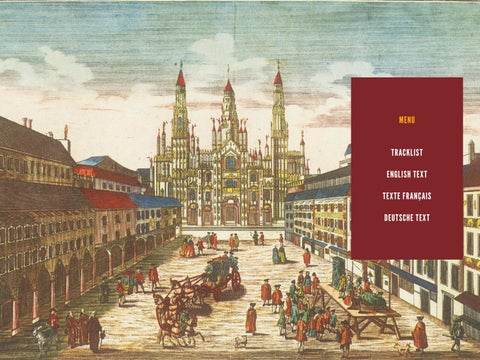
This recording was made with the support of the Fédération Wallonie-Bruxelles (Direction générale de la Culture, Service de la Musique). The Chœur de Chambre de Namur is sponsored by the Fédération Wallonie-Bruxelles (Direction générale de la Culture, Service de la Musique) and supported by the Loterie nationale, the Port autonome de Namur and the City and Province of Namur. www.cavema.be Recording Namur, église Saint-Loup, November 2001 Artistic direction, recording & editing: Jérôme Lejeune Pictures Cover: Georg Balthasar Porbst: Prospect des vorderen Theils der Dom-Kirche zu Meyland (1750), © akg-images Translations English: Peter Lockwood Deutsch: Silvia Berutti-Ronelt
JOHANN CHRISTIAN BACH { 1735-1782}
GLORIA IN EXCELSIS DEL SIG. GIO BACH A QUATTRO CONCERTATA CON SINFONIA
VALÉRIE GABAIL – soprano BARBARA HÖLZL – alto LLUIS VILAMAJO – tenor STEPHAN MACLEOD – bass CHŒUR DE CHAMBRE DE NAMUR: LES AGRÉMENS: WIELAND KUIJKEN – direction
Gloria in G major [1] Gloria in excelsis Deo (Allegro di molto) : coro [2] Laudamus te (Andante): soprano & tenor [3] Gratias agimus tibi (Andante): alto [4] Domine Deus (Allegro con spirito): soprano, alto & bass [5] Qui tollis peccata mundi, miserere nobis (Largo): soprano [6] Qui tollis peccata mundi, suscipe deprecationem (Andante): coro [7] Qui sedes ad dexteram Patris (Allegro): tenor [8] Quoniam tu solus sanctus (A tempo giusto): bass [9] Cum Sancto Spiritu (Allegro): Coro
5’27 5’12 4’24 4’46 8’26 4’12 4’48 5’11 2’33
CHŒUR DE CHAMBRE DE NAMUR Choirmaster: Olivier Opdebeeck Danièle Bodson, Élisabeth Goethals,Veerle Lindemans, Isabelle Poncelet, Myriam Sosson – sopranos Véronique Gosset, Christine Petit, Laurence Renson,Vinciane Soille – altos Vincent Antoine, Jacques Dekoninck, Thierry Lequenne, Michel Loncin – tenors Étienne Debaisieux, Philippe Favette, Jean-Marie Marchal, Koen Meynckens – basses
LES AGRÉMENS Mira Glodeanu – concertmeister [10] Kyrie in d minor: Rainer Arndt, Benoît Douchy, Blaï Justo, Michio Kondo, Sara Kuijken, Izumi Sato, Kyrie eleison - Christe eleison - Kyrie eleison: soprano, tenor & coro 5’59 Johann Van Aken, Marie Verveyen – violins Hajo Bäss, Catherine Meeùs – violas Credo in C major Hervé Douchy, Bernard Woltèche – cellos [11] Credo in unum Deum: coro 2’24 Éric Mathot – double bass [12] Et incarnatus es (Largo) - Crucifixus (Andante): coro 2’55 Danielle Étienne, Kiomi Suga – flutes [13] Et resurrexit (Allegro): coro 4’26 Vincent Robin, Stefaan Verdegem – oboes Rainer Johanssen – bassoon Denis Maton, Piet Dombrecht – horns Xavier Deprez – organ
MENU
RELIGIOUS MUSIC BY THE MILAN BACH The youngest son of Johann Sebastian Bach, Johann Christian Bach was born in Leipzig in 1735. He was only fifteen years old at the time of his father’s death, a fact that may well provide the explanation why he was so much less influenced by this father than were his elder brothers, Wilhelm Friedemann and Carl Philipp Emanuel in particular. We should also not forget that Johann Sebastian Bach was already fifty years old when his youngest son was born, adding another element to the explanation of why Johann Christian Bach was musically and stylistically the furthest removed from his father’s model. He must nevertheless have received a somewhat severe basic training, as we can gather from the following anecdote that he related to his friends Wendling and Cannabich in Mannheim: I was improvising completely mechanically on the harpsichord and I stopped on a six-four chord. My father was in bed and I thought that he was asleep, but he jumped out of bed and boxed my ears; I resolved my six-four chord. Johann Christian Bach travelled to Berlin after his father’s death to stay with his brother Carl Philipp Emanuel, harpsichordist at the court of Frederick the Great. It is clear that this contact with the new music that he heard there was a great shock to the adolescent who had just left the house of the composer of the Musical Offering and the Art of Fugue. He there discovered what is today termed the style galant, Italian influences and, above all else, the operatic style. Thanks to contacts that he made in Berlin, he found a position in Milan as composer in the service of Count Litta and then also became organist for the Cathedral. In order to secure this position he had also to convert to Catholicism; he had indeed travelled great distances both literally and figuratively in a short time with regard not only to his music but also to his family’s traditions. He developed his musical skills under Padre Martini in Bologna. We should add that Johann Cristian Bach was not the first German composer to assimilate the Italian style with such facility; Handel and Hasse had travelled this path before him. His reputation grew rapidly and he composed equally well for the church as for the opera house. His successes in the opera house were the cause of his invitation to London; a European career then began for him, the only one of J.S. Bach’s sons ever to have set foot outside his native land. His works were played in Paris, in Mannheim and in London, where he was to base his career; he there founded a concert organisation in collaboration with his compatriot Carl Friedrich Abel. Johann Christian Bach’s Milan career lasted from 1754 until 1762. He was obliged to compose sacred works for the Cathedral as well as acting as its organist; the great majority of his compositions date from this period, including many motets and several separate sections of the Mass. The scores of these works were preserved in manuscript form alone. Four Mass sections have survived: the Kyrie in D major, the Gloria in G major and the Credo in C major that are recorded here, as well as another large-scale Gloria in D major. It could well be the case that he simply did not compose the Sanctus and Agnus Dei sections, this being a practice common in Italy at that time. It nevertheless seems clear that, in spite of certain stylistic similarities (in the orchestral writing in particular), the three movements grouped together here were not intended as parts of a larger, even if fragmentary, Mass. The three different keys are the first obstacle to such a conflation, whilst the dimensions of the various sections argue against this even more. Both the Kyrie and the Credo seem to belong to more straightforward works, whilst the extremely long Gloria seems to have been written for a special occasion and
MENU
for a much more elaborate type of Mass. There is no way of knowing the occasion for which this Gloria was composed, or even if it was composed for the Milan Cathedral, for it seems that orchestras were not allowed to accompany the Mass there! The Gloria stands in clear contrast to the purely functional aspect of the Kyrie and the Credo. It is not just its length but also the role given to the orchestra that is surprising. Each part of the work begins with a long orchestral introduction, although we should also mention in this respect that the Kyrie also begins with a double-themed orchestral introduction that states the thematic material of the two Kyries and the Christe. This principle of a doublethemed introduction is therefore also to be found in several of the introductions to verses of the Gloria. What is more, a number of these introductions feature various orchestral solo instruments: these passages can be linked to the sinfonia concertante style that began in Mannheim and then spread throughout Europe from the 1760s; the solos for two violins and cello in the Qui tollis peccata mundi are a striking example of this. The colours of the different verses are also carefully arranged with the alternation of oboes and flutes, with solo concertante passages for the organ, with the doubling of the alto line in the Gratias agimus and the Quoniam that thereby creates five-part string writing, and also by the choice of horns in different keys, notably the brilliant horns in high C in the Domine Deus. The writing for choir is homophonic in the main, although we may note the quality of the fugal writing and that of the Suscipe deprecationem in particular. We may well ask ourselves whether this might be a remnant of his father’s influence or rather of Padre Martinis, skilled contrapuntist that he was. We should note in this fugue that the first violins double the alto part at the upper octave. Putting aside the three choral interventions at the beginning, centre and end of the piece, each verse is entrusted to one or more soloists, allowing one aria for each voice as well as a duet (SA) and a trio (SAB). These arias are conceived exactly like concerto movements and end with a cadenza that the soloist must invent. It is clear, although this will be a surprise to no one, that the vocal style is very close to the operatic style. The theatrical aspect of the piece is also reinforced in the Domine Deus, it evoking a duel between opposing forces that are represented on one hand by the energetic passages for the bass and on the other by the sweeter answers provided by the duet of the soprano and alto voices. These three compositions were transcribed from manuscripts in the Einsiedeln Monastery in Switzerland.The manuscripts were previously held at the Bellinzona Collegium at the very moment that J.C. Bach was departing for England. It seems that these works were played only in this Swiss monastery during the course of the 18th century, after which time they were forgotten. It is clear that these religious works today provide proof of the great quality of J.C. Bachs works, and that they were already masterpieces in the early years of his career. He composed skilfully for soloists and mastered the orchestra perfectly. Knowing the works by the young Mozart, we can as a result better understand the influence that J.C. Bachs work must have had on the young prodigy. When Johann Christian Bach died in London in 1782, by which date Mozart had already discovered the compositions and especially the fugues by Johann Sebastian Bach, he cried out “What a loss for the world of music!” for according to Mozart, the great Bach was not Johann Sebastian, but Johann Christian! Jérôme Lejeune
MUSIQUE RELIGIEUSE DU BACH DE MILAN Fils cadet de Johann Sebastian Bach, Johann Christian Bach est né à Leipzig en 1735. Il n’a que quinze ans à la mort de son père, ce qui explique qu’à l’inverse de ses frères aînés, principalement Wilhelm Friedemann et Carl Philipp Emanuel, il est bien moins qu’eux influencé par son père. De plus, on ne doit pas oublier que Johann Sebastian a déjà 50 ans lorsqu’il naît. Ces éléments expliquent sans doute que c’est Johann Christian qui s’est musicalement et stylistiquement le plus éloigné du modèle paternel. Néanmoins, il doit en recevoir une formation de base assez stricte, dont témoigne cette jolie anecdote qu’il a racontée à ses amis de Mannheim, Wendling et Cannabich : « J’improvisais au clavecin de manière tout à fait mécanique et je m’arrêtai sur une quarte et sixte. Mon père était au lit et je croyais qu’il dormait, mais il sauta de son lit, me donna une gifle et je résolus ma quarte et sixte. » À la mort de son père, Johann Christian se rend à Berlin auprès son frère Carl Philipp Emanuel, claveciniste à la cour de Frédéric le Grand. Il est certain que ce contact avec la musique « nouvelle » que l’on peut y entendre est sans aucun doute un choc important pour cet adolescent qui sort de la maison de celui qui vient d’écrire l’Offrande musicale et L’Art de la Fugue ! Il y découvre ce que l’on nomme aujourd’hui le style galant, l’influence de l’Italie et principalement le langage de l’opéra. Grâce à des contacts noués à Berlin, il trouve un emploi à Milan comme compositeur au service du comte Litta et devient, de plus, organiste de la cathédrale. Enfin, pour pouvoir obtenir ce poste, il se convertit au catholicisme. Quel chemin parcouru en si peu de temps ! Quelle audace par rapport à la tradition familiale ! C’est à Bologne, auprès du Padre Martini, qu’il approfondit son métier. À vrai dire, Johann Christian Bach n’est pas le premier Allemand à assimiler avec autant de facilités le style italien ; Händel et Hasse ont déjà ouvert la voie. Sa réputation s’installe rapidement et il compose avec le même talent pour l’église et l’opéra. Ce sont d’ailleurs ses premiers succès à l’opéra qui vont provoquer une invitation à Londres. Dès lors, le chemin européen est tracé pour ce fils du cantor de Leipzig, le seul de ses fils à avoir un parcours hors des frontières de la patrie natale. Ses ouvrages sont joués à Paris, à Mannheim et c’est principalement à Londres qu’il fait carrière, y fondant une société de concerts en compagnie de son compatriote, Carl Friedrich Abel. C’est donc entre 1754 et 1762 que se déroule la carrière milanaise de Johann Christian Bach. À ses fonctions d’organiste de la cathédrale est associée l’obligation de composer des œuvres religieuses. C’est d’ailleurs de cette période que datent l’immense majorité de ces compositions, qui comportent de nombreux motets et quelques mouvements de messe isolés dont les partitions sont conservées uniquement en manuscrits. En ce qui concerne les mouvements de messe, ils sont au nombre de quatre, les Kyrie en ré majeur, Gloria en sol majeur et Credo en ut majeur enregistrés ici, ainsi qu’un autre grand Gloria en ré majeur. Il se pourrait qu’il n’ait pas composé de Sanctus ou d’Agnus Dei, conformément à une pratique courante en Italie. Néanmoins, il semble évident que, malgré certaines similitudes stylistiques (entre autres dans l’écriture orchestrale), les trois mouvements réunis ici ne constituent pas une « messe », même fragmentaire. Si les trois tonalités différentes constituent le premier obstacle à cet « assemblage », les dimensions confirment ce fait.Tant le Kyrie que le Credo semblent appartenir à une liturgie plus commune, tandis que le très long Gloria ne peut nous apparaître que comme
MENU
une œuvre exceptionnelle, écrite pour une cérémonie bien plus imposante. Laquelle ? On n’en sait rien. De plus, rien ne permet de confirmer que cette œuvre fut écrite pour la cathédrale de Milan où, semble-t-il, la présence d’un orchestre n’était pas autorisée ! À l’aspect fonctionnel du Kyrie et du Credo, le Gloria apporte un contraste évident. Outre sa longueur, c’est le rôle confié à l’orchestre qui étonne. Chaque partie de l’œuvre débute par une importante introduction orchestrale ; il faut toutefois signaler que, dans le même esprit, le Kyrie commence par une introduction orchestrale bithématique exposant les matériaux thématiques des deux Kyrie et du Christe. Ce principe d’une exposition bithématique se retrouve ainsi dans plusieurs introductions des versets du Gloria. De plus, certaines de ces introductions mettent également en valeur les solistes de l’orchestre : leurs interventions peuvent parfois s’assimiler au principe de l’écriture des symphonies concertantes dont la mode, originaire de Mannheim, s’est imposée dans l’Europe entière dès les années 1760 : les solos des deux violons et du violoncelle dans le Qui tollis peccata mundi en sont un exemple frappant. La couleur des différents versets est aussi soigneusement recherchée par l’alternance des hautbois et des flûtes, par les solos concertants confiés à l’orgue, par le dédoublement des parties d’alto (Gratias agimus, Quoniam), portant ainsi l’écriture des cordes à cinq voix, et aussi par le choix des tons différents des cors, dont le brillant ut aigu (Domine Deus). En ce qui concerne l’écriture chorale, si elle est majoritairement homophonique, on peut constater la qualité d’écriture des fugues et tout particulièrement celle du Suscipe deprecationem. Est-ce là l’héritage de son père ou celui du contrapuntiste averti qu’était le Padre Martini ? Il faut remarquer dans cette fugue que les premiers violons doublent les voix d’alto à l’octave supérieure. Mis à part les trois interventions du chœur (début, milieu et fin), chaque verset est confié à un ou plusieurs solistes, réservant un air à chaque voix ainsi qu’un duo (SA) et un trio (SAB). Ces airs sont conçus exactement comme des mouvements concertants se terminant par une cadence que doit inventer le soliste. Évidemment, mais ce n’est en aucun cas une surprise, ce style vocal est proche de celui de l’opéra. L’aspect théâtral est encore renforcé dans le Domine Deus qui évoque un duel de forces opposées, représentées d’une part par les interventions énergiques de la basse et d’autre part par les réponses plus douces du duo des voix de soprano et alto. Ces trois compositions sont tirées de manuscrits conservés au monastère d’Einsiedeln en Suisse. Auparavant, ces manuscrits étaient au Collegium de Bellinzona, au moment même du départ de Johann Christian Bach pour l’Angleterre. Il semble donc que ce soit uniquement dans ce monastère suisse que ces œuvres furent jouées au XVIIIe siècle, jusqu’à ce qu’elles tombent dans l’oubli. Il est évident que ces compositions religieuses sont aujourd’hui le témoignage de la grande qualité d’écriture de Johann Christian Bach, et ce, dès les premières années de sa vie professionnelle. Il compose avec aisance pour les solistes, maîtrise parfaitement l’orchestre. Connaissant la musique du jeune Mozart, on peut encore mieux comprendre l’importance que l’œuvre de Johann Christian Bach dut exercer sur le jeune prodige. Et lorsque Johann Christian décéda à Londres en 1782, date à laquelle Mozart avait déjà découvert les compositions et surtout les fugues de Johann Sebastian Bach, ne s’écria-t-il pas : « Quelle perte pour le monde musical » ? Car pour Mozart, le grand Bach, ce n’était pas Johann Sebastian, mais bien Johann Christian ! Jérôme Lejeune
DIE GEISTLICHE MUSIK DES MAILÄNDER BACH Johann Christian Bach ist also jüngster Sohn Johann Sebastian Bachs 1735 in Leipzig geboren. Als sein Vater stirbt, ist er erst fünfzehn Jahre alt, was erklärt, dass er viel weniger als seine Brüder und zwar vor allem als Wilhelm Friedemann und Carl Philipp Emanuel von seinem Vater beeinflusst ist. Außerdem ist zu bedenken, dass Johann Sebastian bei seiner Geburt bereits fünfzig Jahre alt ist. Diese Tatsachen erklären zweifellos, dass sich Johann Christian in musikalischer und stilistischer Hinsicht am meisten vom väterlichen Modell entfernte. Dabei hatte er vom Vater eine recht strenge Grundausbildung erhalten, von der folgende hübsche Anekdote zeugt, die er seinen Mannheimer Freunden Wendling und Cannabich erzählte: „Ich improvisierte ganz mechanisch auf dem Cembalo und hörte mit einem Quartsextakkord auf. Mein Vater war im Bett, und ich dachte, er schläft, doch er sprang aus seinem Bett, gab mir eine Ohrfeige und ich löste meinen Quartsextakkord auf.“ Nach dem Tod seines Vaters begab sich Johann Christian nach Berlin zu seinem Bruder Carl Philipp Emanuel, der am Hof Friedrichs des Großen Cembalist war. Sicher war der Kontakt mit der „neuen“ Musik, die man dort zu hören bekam, ein großer Schock für den Jugendlichen aus dem Hause des Meisters, der eben Das Musikalische Opfer und Die Kunst der Fuge geschrieben hatte! Johann Christian entdeckte dort den Stil, den man heute galant nennt, den Einfluss Italiens und vor allem die Oper. Dank der in Berlin geknüpften Kontakte fand er eine Stelle als Komponist im Dienst des Comte Litta in Mailand und wurde dort außerdem Domorganist. Um diesen Posten zu erhalten, trat er zum Katholizismus über. In kürzester Zeit erlebte er somit größte Veränderungen und zeigte sich unglaublich kühn in Hinblick auf die Familientradition! In Bologna vertiefte er seine beruflichen Kenntnisse bei Padre Martini. Johann Christian Bach war allerdings nicht der erste Deutsche, der den italienischen Stil mit solcher Leichtigkeit übernahm; Händel und Hasse hatten ihm bereits den Weg geebnet. Johann Christian Bachs Ruf breitete sich rasch aus und er komponierte mit ebenso großem Talent für die Kirche wie für die Oper. Auf grund seiner ersten Opernerfolge wurde er übrigens nach London eingeladen. Damit war der europaweite Weg dieses Sohns des Leipziger Kantors vorgezeichnet. Er war der einzige unter seinen Geschwistern, der eine Laufbahn außerhalb der Grenzen seines Heimatlandes antrat. Seine Werke wurden in Paris wie in Mannheim gespielt, doch machte er hauptsächlich in London Karriere, wo er gemeinsam mit seinem Landsmann Carl Friedrich Abel eine Konzertgesellschaft gründete. Die Mailänder Karriere Johann Christian Bachs fand zwischen 1754 und 1762 statt. Zu seinen Funktionen als Domorganist gehörte auch die Verpflichtung, geistliche Werke zu komponieren. Aus dieser Zeit stammt übrigens die überwiegende Mehrheit dieser Kompositionen, zu denen zahlreiche Motetten und einige einzelne Messsätze gehören, deren Partituren nur handschriftlich erhalten sind. Die vier Messsätze sind ein Kyrie in D-Dur, ein Gloria in G-Dur und ein Credo in C-Dur, die hier aufgenommen sind, sowie ein großes Gloria in D-Dur. Es könnte sein, dass Johann Christian Bach, wie es in Italien üblich war, kein Sanctus oder Agnus Dei komponiert hat. Dennoch scheint es trotz gewisser stilistischer Ähnlichkeiten (unter anderen im Orchestersatz) eindeutig, dass die drei hier vereinten Sätze keine „Messe“ bilden, nicht einmal eine fragmentarische. Schon die drei verschiedenen
MENU
Tonarten bilden ein Hindernis für eine solche Zusammenstellung, doch auch die Ausmaße bestätigen diese Tatsache. Sowohl das Kyrie als auch das Credo scheinen einer gewöhnlicheren Liturgie anzugehören, während das sehr lange Gloria nur als außergewöhnliches Werk betrachtet werden kann, das für eine imposantere Zeremonie geschrieben wurde. Allerdings wissen wir nicht, für welche. Außerdem erlaubt nichts die Behauptung, dass dieses Werk für den Mailänder Dom komponiert wurde, in dem anscheinend Orchester nicht genehmigt waren! Zum funktionellen Aspekt des Kyrie und des Credo bildet das Gloria einen deutlichen Kontrast. Abgesehen von seiner Länge überrascht es durch die dem Orchester anvertraute Rolle. Jeder Teil des Werkes beginnt mit einer bedeutenden Orchestereinleitung; allerdings möchten wir darauf hinweisen, dass im selben Geist auch das Kyrie mit einer zweithematischen Orchestereinleitung beginnt, die das Themenmaterial der zwei Kyrie und des Christe vorstellt. Dieses Prinzip einer zweithematischen Exposition findet sich auch in mehreren Einleitungen der Versikel des Gloria. Außerdem bringen einige dieser Einleitungen auch die Solisten des Orchesters zur Geltung: ihr Spiel entspricht manchmal dem Kompositionsprinzip der konzertanten Symphonien, deren aus Mannheim stammende Mode sich ab den Jahren 1760 in ganz Europa durch gesetzt hat: die Soli der zwei Geigen und des Cellos im Qui tollis peccata mundi sind ein sprechendes Beispiel dafür. Die Klangfarben der verschiedenen Versikel werden auch durch das abwechselnde Spiel der Oboen und Flöten, durch die der Orgel anvertrauten konzertanten Soli, durch die Verdoppelung der Bratschenpartien (Gratias agimus, Quoniam), was den Streichersatz auf fünf Stimmen erhöht, sowie durch die Wahl der verschiedenen Tonarten der Hörner (darunter die strahlenden hohen Hörner in C, Domine Deus) sorgfältig erarbeitet. Was die Behandlung des Chores betrifft, so ist sie zwar zum Großteil homophon, doch kann man gleichzeitig die hohe Qualität der Fugenkompositionen feststellen, darunter ganz besonders die der Suscipe deprecationem. Ist hier das Erbe des Vaters zu erkennen oder das des großen Kontrapunkt-Kenners Padre Martini? Zu bemerken ist, dass die ersten Geigen in dieser Fuge die Bratschenstimmen eine Oktave höher verdoppeln. Abgesehen von den drei Chorstellen (Anfang, Mitte und Schluss) ist jeder Versikel einem oder mehreren Solisten anvertraut, wobei jede Stimme auch eine eigene Arie hat, und es außerdem auch ein Duett (SA) und ein Terzett (SAB) gibt. Diese Arien sind genau wie konzertante Sätze konzipiert und enden mit einer Kadenz, die der Solist erfinden muss. Natürlich ist dieser Vokalstil dem der Oper sehr verwandt, doch ist das keinesfalls überraschend. Noch stärker tritt der theatralische Aspekt im Domine Deus zu Tage, das den Kampf entgegengesetzter Kräfte schildert, die einerseits durch das energische Eingreifen des Basses und andererseits durch die sanfteren Antworten des Duetts von Sopran und Alt dargestellt werden. Diese drei Kompositionen stammen aus Handschriften, die im Schweizer Kloster Einsiedeln erhalten sind. Davor befanden sich diese Handschriften im „Collegium“ von Bellinzona, und zwar genau zu der Zeit, als J.C. Bach nach England abreiste. Es scheint daher, dass diese Werke nur im genannten Schweizer Kloster im 18. Jahrhundert gespielt wurden, bis sie in Vergessenheit gerieten. Selbstverständlich sind diese geistlichen Werke heute Zeugen des großen kompositorischen Könnens von Johann Christian Bach und der ersten Jahre seines
Berufslebens. Er komponierte mit Leichtigkeit für die Solisten und beherrschte auch das Orchester vollkommen. Wenn man die Musik des jungen Mozart kennt, kann man den bedeutenden Eindruck, den das Werk Johann Christian Bachs auf das Wunderkind ausübte, noch besser verstehen. Als Johann Christian Bach im Jahre 1782 in London starb, hatte Mozart bereits die Kompositionen und vor allem die Fugen Johann Sebastian Bachs entdeckt, rief aber dennoch aus: „Welch Verlust für die Musikwelt,“ denn „der große Bach“ war für Mozart nicht Johann Sebastian, sondern Johann Christian! Jérôme Lejeune
MENU