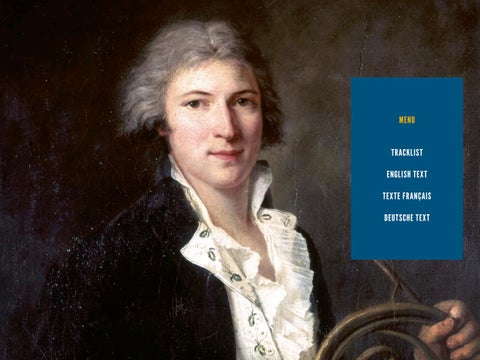
MENU TRACKLIST ENGLISH TEXT TEXTE FRANÇAIS DEUTSCHE TEXT
Recording Ancienne abbaye de Stavelot, May 1998 Artistic direction, recording & editing: Jérôme Lejeune Pictures Anonymous, Portrait of Frédéric-Nicolas Duvernoy, Paris, Bibliothèque de l’Opéra, © B. N. Translations English: Peter Lockwood Deutsch: Silvia Berutti-Ronelt
THE ROMANTIC FRENCH HORN
CLAUDE MAURY – natural horn (Marcel Auguste Raoux, Paris, early 19th century) & 2 valves horn (Louis Müller, Lyon, c. 1840)
SOPHIE HALLYNCK - harp GUY PENSON – piano (Broadwood, London, c. 1845 RICERCAR ACADEMY: TEUNIS VAN DER ZWART, RAPHAEL VOSSELER, GILLES RAMBACH, DENIS MATON, PIET DOMBRECHT – natural horns
Frédéric Duvernoy (1765-1838) [1] Deuxième Nocturne pour cor et harpe Allegro assai - Andantino - Allegro 7’09 Claude Maury: natural horn
Jacques François Gallay (1795-1874) [11] Caprice op. 32 no. 1 ([Introduction] – Allegro)
Sophie Hallynck: harp
Charles Gounod (1818-1893) Six Mélodies [12] Larghetto bien posé [13] Andantino [14] Andante [15] Larghetto [16] Andante cantabile [17] Andante ben marcato
Jacques François Gallay (1795-1874) [2] Caprice op. 32 no. 10 (Attaca forte – Maestoso)
1’50
Claude Maury: natural horn Gioacchino Rossini (1792-1868) [3] Prélude, thème et variations pour cor et piano
10’23
Claude Maury: natural horn Guy Penson: piano Jacques François Gallay (1795-1874) [4] Caprice op. 32 no. 12 (Thème et variations)
Claude Maury: 2 valves horn Guy Penson: piano 4’03
Claude Maury: natural horn Louis-François Dauprat (1781-1868) [5] Premier Sextuor (Introduction – Allegro) [6] Deuxième Sextuor (Minuetto) [7] Troisième Sextuor (Andante) [8] Quatrième Sextuor (Minuetto) [9] Cinquième Sextuor (Adagio) [10] Sixième Sextuor (Finale: Allegro moderato)
Claude Maury, Teunis van der Zwart, Raphael Vosseler, Gilles Rambach, Denis Maton, Piet Dombrecht: natural horns
MENU
7’04 4’48 5’35 3’51 5’25 4’08
2’17
Claude Maury: natural horn
4’11 3’20 2’40 4’27 3’23 4’57
THE HORN IN FRANCE IN THE ROMANTIC PERIOD “Dedicated from its beginnings and for several centuries since then to Diana’s noble sport, having made hunting calls and the triumphant sounding of the quarry echo round the mountains, the horn has now been called to a higher destiny, passing from the hands of the hunter into those of Apollo’s chosen few. Once the terror of woodland animals, its rough and savage voice has now been gentled to delight us with its pleasing sounds. The art of a Punto, a Duvernoy or a Dauprat has given the instrument a new lease of life and has enriched it with many more tones than nature originally seemed to have been willing to provide. Brilliant and sonorous in music that recalls its original function, the horn is also tender and filled with pathos in the cantabile; no honey is sweeter, nor is any day fairer than the horn’s delicious melody. Although it utilises all the notes of the scale with great agility in solo passages, we may nonetheless regret the lack of variety in its use in the orchestra, in which its stopped tones are almost never to be heard. These sounds are often used, it is true, but are they less pleasant because of this? The simple and straightforward sounds and the constant brotherhood that reigns between the two horns, their thirds and their rich fifths, fine-sounding and extravagant, possess a charm that is always new. I have heard such sounds time after time and if I were to hear them again, I would still experience the same joy. Does one become tired of seeing the roses in the spring or of savouring their delicious perfume?” These words appear in the article devoted to the horn in the Dictionnaire de Musique moderne (1828) by Castil-Blaze. The article makes no mention of the new valve mechanisms that had already been invented, even though they had first appeared in Germany just before 1820. It is precisely this technical aspect of the construction and the playing of the horn that is one of the most exciting aspects of its development during the Romantic era. Partisans of the new valve instruments and of the old tradition of the natural horn were to be at loggerheads with each other until the beginning of the 20th century. To return briefly to a somewhat earlier age, the use of the horn in France had developed greatly since the end of the 17th century. Firstly, its repertoire of hunting calls had been clarified by the composition of specific fanfares by various horn players of Louis XV’s court such as the Marquis de Dampierre. Orchestral compositions also associated this new instrument with the new symphonies. Works by Jean-Joseph Mouret and Michel Corrette remained faithful to the original conception of the horn as an instrument for the hunt, although new ideas from Mannheim and Vienna of what an orchestra should be were to provide the horn with a completely new destiny, one that was exemplified in Rameau’s orchestral use of the instrument. The stopped note technique had broadened the instrument’s chromatic possibilities, but had also modified its sound. A Czech horn virtuoso named Jan Vaclav Stich gained great renown under the Italianised name of Giovanni Punto towards the end of the 18th century; Mozart composed his Sinfonia concertante for wind instruments for him and for the other wind soloists of the famous Mannheim orchestra. Punto enjoyed great success in Paris and had the opportunity of playing an instrument made by the French maker Lucien-Joseph Raoux. Punto was certainly a role model for young horn players of the time, one of whom was Frédéric Duvernoy.
MENU
Frédéric Duvernoy “DUVERNOY (DUVERNOIS), Frédéric; born in Montbéliard (Haut-Rhin) on October 15, 1771 according to Choron and Fayalle’s Dictionnaire historique, although according to the Opéra’s records he was born on October 16, 1765.This latter date is the more probable, given that Duvernoy played a horn concerto at one of the Concerts Spirituels on August 6, 1788. Opinion is united as to his compositions; the solo passages do not sound well and the accompaniments are badly written. His works have now been completely forgotten. He wrote twelve concerti, three quintets for horn, two violins, viola and cello, trios for horn, violin and cello, three duets for two horns, several books of sonatas and studies, solos, duos for piano and horn, and a Méthode de cor mixte. All of these works were published both in Paris and in Germany. Duvernoy died in Paris on July 19, 1838” (Fétis, Biographie universelle des musiciens). Fétis’ judgement was undoubtedly rather too harsh on Duvernoy, given his great popularity at that time.The poster for the première of Spontini’s La Vestale in 1807 announced, after having listed the vocal soloists, that “M. Frédéric Duvernois will play the horn solos”. Duvernoy had already stated in his Méthode pour le cor (1802) that the student should specialise in the technique required for the cor aigu or the cor grave, although in his own playing he made us of the technique for the cor mixte, himself abandoning the idea of the separate cor aigu and cor grave. His compositional style was in perfect harmony with the musical taste of the period; chamber music at the beginning of the 19th century in France was rich in blends of new sonorities, as can be seen in the body of music that was written for harp and piano. The marriage of the harp and the horn was not surprising in such a climate: works for this combination were written by horn players and harpists such as such as Duvernoy and Nadermann respectively. Castil-Blaze also recommended this combination for the Nocturne in his Dictionary: “The nocturne is an instrumental piece composed for harp and horn, oboe and piano, or flute and piano. To tell the truth, a nocturne is merely a fantasy in dialogue form”. Duvernoy’s conception of the form was on a somewhat larger scale; he composed a sonata in three movements in which the harp often goes far beyond its function as an accompanying instrument. Duvernoy’s music was identified with the sounds that filled the drawing-rooms of the Consulate and of the Empire; Louis-François Dauprat’s ambitions, however, were very different. Louis-François Dauprat “DAUPRAT, Louis-François; a famous professor of the horn and composer for the same instrument, born in Paris on May 24, 1781. Dauprat trained a large number of pupils, most of whom became artists of great merit. They included Rousselot, who had a sureness of attack and a power of execution that was extremely rare; Gallay, who became known thanks to his fine and well-balanced sound and his elegant and pure style; Norbert, Méric (husband of the singer Méric-Lalande), Banneux, Bernard, Jacquemin, Meifred, Urbain, Paquis and Nagel, as well as several fine amateur players” (Fétis, Biographie universelle des musiciens). With Dauprat, we arrive at the generation of players who were active during Berlioz’s lifetime. Dauprat’s compositions for the horn show a skilled musician who sought to exploit all the instrument’s possibilities. His volume of Trios, Quatuors et Sextuors pour cors de différents tons was published in Paris and gives clear proof of his mastery of the instrument, although its title page, however, simply describes the volume as being useful to composers.
The pieces for six horns are grouped under the general title of Sextuors. They are indeed six individual compositions, but assume the form of a divertimento when played together; they consist of an Allegro in sonata form preceded by a slow introduction, a Minuet and Trio, Andante, Minuet and Trio, Adagio and Finale. The difficulty of the parts for the first horn (in C at the octave) lies principally in the music’s very high range, with the player’s lip strength being severely put to the test. It was for this reason that Dauprat suggested that the pieces be performed separately, naming them Sextet I, Sextet II etc. Proof of this can be seen in the annotation “the First Sextet was performed by Messrs. Petit, the Collin brothers, the Mengal brothers and the author at the annual concert of the Société académique des Enfants d’Apollon on May 15, 1817”. Each strand of the counterpoint in these pieces is allotted to a horn in a particular key, each voice changing key in each piece according to the tonality. In accordance with the techniques of the natural horn, the players had to prepare their instrument before the performance by using the relevant crook that would allow them to tune the horn in the desired key. Dauprat’s genius lay in his idea of using horns tuned in different keys together, a technique that would later be adopted by Berlioz in particular; this permitted music to be written that employed a rich harmonic language, whilst such effects would have been impossible is horns in the same key had been used. Even though Dauprat was very conscious of the difficulties of playing the instrument, he did not hesitate to push such problems to their extremes, demanding great prowess from his performers in the notes that they had to reach; some of them were purely hypothetical, especially in the lower ranges in which he had specialised. He was greatly appreciated as a teacher and also wrote a Méthode pour cor alto et cor basse, thereby prolonging the tradition of the instrument’s two separate registers. A complete musician, he also wrote a Cours d’harmonie that has remained unpublished. It is probable that the harmonic richness of this Sextet was also the result of his studies with Reicha, a native of Prague, who had known Haydn and Beethoven in Vienna. Reicha then moved to Paris, where he became professor of composition at the Conservatoire; his other pupils included Berlioz, Franck and Gounod. The two-valved horn had already made its appearance at the time of the Symphonie fantastique (1830). It seems, however, that many musicians preferred to use the special sound of the stopped notes rather than employ the valves. This is the reason for Berlioz’s annotation to the horn players in the score of the Symphonie fantastique that they should use the stopped sounds made by the hand without employing the valves. Dauprat was certainly one of those who continued to teach the older technique; he had many pupils, one of whom was JacquesFrançois Gallay, who continued to teach the same technique. Jacques-François Gallay “GALLAY, Jacques-François; a virtuoso performer on the horn and professor of his instrument at the Paris Conservatoire, was born in Perpignan (Pyrénées-Orientales) on December 8, 1795” (Fétis, Biographie universelle des musiciens). Gallay continued to teach the traditional technique of the natural horn without valves, as can be seen from his Méthode complète pour le cor (1845). The Caprices that he wrote for the horn are indisputably the most daring challenge ever made to the horn’s chromatic possibilities,
MENU
pushing the horn to the limits of what is physically possible. These are works of great mastery that allow the virtuoso to employ several different types of expression; they range from slow pieces to fast pieces, some of which are provided with introductions in the style of unbarred preludes. The twelfth Caprice is a Theme and Variations: its score abounds in detailed markings concerning interpretation, phrasing and tempo. Around Rossini It is clear that virtuoso repertoire written specifically for the horn is essentially music that was written by the virtuosi themselves. Composers planned certain solo passages in their works in consideration of a particular player’s qualities, as we have seen quoted above in connection with Spontini’s La Vestale. Opera composers took particular delight in writing solos in which singers would exchange phrases with the solo instrument, in this case the horn. Rossini, however, took this even further; he played several instruments including the natural horn. He was never to forget the instrument, often entrusting it with important thematic material in his operas, one such instance being Lindoro’s aria Languir per una bella in his L’Italiana in Algeri. When Rossini decided to retire from musical life after having composed Guillaume Tell, Rossini did not abandon the horn; as well as composing the Rendez-vous de chasse for four horns, a piece clearly referring to the horn’s hunting past, he also wrote the virtuoso Prélude, Thème et Variations for it that is to be found in his Péchés de vieillesse. Structured in the same way as a full bel canto scena, the prelude is followed by a theme with variations; the music is interrupted at one point by a recitative; with the humour typical of him at that time, Rossini includes a “variation for the lazy” in the final variation — a variation intended for players who do not wish to take too many risks. Dated 1857, the piece is dedicated to Eugene Vivier, a horn virtuoso born in Corsica in 1817 and who died in Paris in 1900. Fétis allotted him also an important place in his biographies: “His father had been a tax official in several areas and demanded that his son too should take up the same profession [...]. One thing alone pleased his son, and that was music; in music, all that he cared about was the horn that chance had put into his hands [...]. It is not known who taught him to play, although it seems that he had several lessons from Gallay in Paris [...].Vivier attracted great public attention by the discovery of an acoustic phenomenon that no-one has yet (1865) been able to explain satisfactorily, consisting of producing several sounds at once on the horn to make a balanced harmony.” It must be said that this effect that Fétis describes was not actually new at the time; it had already been attributed to the famous horn player Stich (1746-1803) (see above), who had impressed Mozart and Beethoven with his playing. The effect was created by the player producing sounds in his throat at the same time that he played, the resulting sounds being harmonics. We may well suppose that Fétis’ opinions on Vivier’s playing were dictated by a certain ill-will on his side; he also stated in his article that “The newspapers have greatly aided him, for no other person has known how to use their publicity as well as he”. Rossini’s work, however, provides unequivocal proof of Vivier’s great technical skills. The valves horn Gounod’s 6 / MÉLODIES / pour le COR à [2] pistons / avec Accompagnement de
Piano / composées et dédiées / à son ami A. RAOUX / Artiste du Théâtre royal italien, Facteur de Cors du ROI were published by Colombier in Paris in 1839, just after Gounod had won the Prix de Rome; this was followed the same year or in 1840 at the latest by a Méthode de cor à [2] pistons. Like Meifred at that time, Gounod advocated the use of the right hand in the bell of the horn so that certain notes would remain stopped: “Given that the valves do not change either the tuning or the sonority of the horn in any way, if one wishes, one can play a solo written for natural horn on the valve horn: we do not therefore forbid the use of the right hand in the bell of the horn to create stopped notes, although the valve horn can play the same notes open. Indeed, we believe that this hand technique is indispensable in passages to be played at great speed, or in phrases when the player wishes to accent a particular note in a phrase. In the majority of cases, however, when the melodic line or one of its climactic notes should require one of the horn’s less perfect notes, then the use of the valves will render each note of the scale equal in intensity” (Gounod, Méthode de cor à pistons). This short but clear Méthode de cor à pistons, however, seems to have been composed in homage to Marcel-Auguste Raoux, not only the dedicatee of these pieces but also a horn maker, although we cannot know to what point he may himself have been involved; this publication may well have been intended to create interest in the new type of horn: “It was thanks to the zeal and perseverance of Mr. Raoux, horn maker and supplier to the King, and the only maker of wind instruments to win the silver medal for industrially created products, the 2-valved horn has gained the reliable tuning and all the sonority that could be desired” (Gounod, Méthode de cor à pistons). Another pupil of Dauprat’s was much more interested in the valve horn: this was PierreJoseph Meifred from Alsace, who presented one of his compositions for the new instrument at the Conservatoire de Paris in 1828. He was later made professor of the valve horn at the Conservatoire de Paris in 1832. This class ceased to exist at his death in 1864 and was only reopened officially in 1903.The use of the valve horn had, however, not yet become general in France.When Paul Dukas composed his Villanelle pour cor et piano for the Concours of 1906, he had to make use of both horn techniques; he therefore had to write a part of the work so that it could be played as if on the natural horn, without using the valves! Jérôme Lejeune
MENU
LE COR ROMANTIQUE FRANÇAIS « Consacré dès son origine, et pendant plusieurs siècles, aux nobles jeux de Diane, après avoir fait redire aux échos des montagnes le bruyant halali, le chant triomphal de la curée, le cor, appelé à de plus hautes destinées, a passé des mains du chasseur dans celles des favoris d’Apollon. Cette voix rauque et sauvage, la terreur des hôtes des bois, s’est adoucie au point de nous ravir par des sons flatteurs. L’art des Punto, des Duvernoi, des Dauprat, lui donnant une nouvelle existence, l’a enrichie d’une multitude de tons que la nature semblait lui vouloir refuser. Brillant et sonore dans tout ce qui lui rappelle sa destination primitive, le cor est tendre et pathétique dans le cantabilé ; le miel n’est pas plus doux, le jour n’est pas plus pur que sa délicieuse mélodie. Quoique, dans le solo, il parcourt avec agilité tous les degrés de la gamme, on lui reproche le peu de variété de ses traits d’orchestre, dans lesquels les tons artificiels ne se font presque jamais entendre. Ces traits se reproduisent souvent, il est vrai, mais sont-ils moins agréables pour cela ? Ces accents simples et pleins de candeur, cette fraternité constante qui règne entre les deux cors, ces tierces, ces quintes riches, harmonieuses et redondantes, ont des charmes toujours nouveaux. Je les ai entendus mille et mille fois ces traits, et, quand on me les offrira de nouveau, j’éprouverai les mêmes sensations. Se lasse-t-on jamais de voir les roses printanières et de savourer leur délicieux parfum ! » Voilà ce que l’on apprend à la lecture de l’article consacré au cor dans le Dictionnaire de Musique moderne de Castil-Blaze, publié en 1828. Cette notice ne parle pas de l’invention des pistons, alors qu’ils ont déjà fait leur apparition en Allemagne avant 1820. C’est justement cet aspect technique de la fabrication et du jeu du cor qui est l’un des éléments les plus passionnants de son évolution durant l’époque romantique. Partisans du nouveau système à pistons et de l’ancienne tradition du cor naturel s’opposeront jusqu’au début du XXe siècle. Mais revenons quelque temps en arrière. Depuis la fin du XVIIe siècle, l’usage du cor s’est développé de façon très importante en France.Tout d’abord, son répertoire de chasse a été mieux défini par la composition de fanfares spécifiques, dues à divers « sonneurs » de l’entourage de Louis XV, tel le marquis de Dampierre. Les compositions orchestrales associent aussi ce nouvel instrument aux « symphonies ». Certes, les œuvres de Jean Joseph Mouret ou de Michel Corrette restent fidèles au caractère cynégétique de l’instrument, mais les nouvelles conceptions de l’orchestre venues de Mannheim ou de Vienne confèrent au cor une toute nouvelle destinée dont témoigne son utilisation dans l’orchestre de Jean-Philippe Rameau. La technique des sons bouchés a amplifié les possibilités chromatiques de l’instrument, mais a aussi modifié sa sonorité. Parmi les virtuoses du cor de la fin du XVIIIe siècle figure un musicien d’origine tchèque, Jan Vaclav Stich, qui s’est fait connaître surtout sous le nom italianisé de Giovanni Punto. C’est pour lui et d’autres solistes du célèbre orchestre de Mannheim que Mozart a écrit une Symphonie concertante pour instruments à vent. Punto a connu un très grand succès à Paris et a eu l’occasion de jouer un instrument construit par le facteur français Lucien-Joseph Raoux. Pour les jeunes musiciens français, il a certainement été un véritable modèle. Parmi ceux-ci, il faut citer tout particulièrement Frédéric Duvernoy. Frédéric Duvernoy « DUVERNOY, Frédéric, ou plutôt DUVERNOIS, né à Montbéliard (Haut-Rhin), le 15 octobre 1771, suivant le Dictionnaire historique de Choron et Fayolle, mais suivant les registres
MENU
de l’Opéra, le 16 octobre 1765, ce qui est plus vraisemblable, car Duvernoy exécuta un concerto de cor au Concert spirituel, le 6 août 1788 [...]. Quant à ses compositions, le chant en est commun, les traits peu élégants et les accompagnements mal écrits ; elles sont déjà tombées dans un profond oubli. Ces compositions consistent en douze concertos, trois quintetti pour cor, deux violons, alto et basse, des trios pour cor, violon et violoncelle, trois œuvres de duos pour deux cors, plusieurs livres de sonates et d’études, des solos, des duos pour piano et cor, enfin une Méthode de cor mixte. Tous ces ouvrages ont été gravés à Paris et en Allemagne. Duvernoy est mort à Paris, le 19 juillet 1838 » (Fétis, Biographie universelle des musiciens). Sans doute le jugement de Fétis est-il quelque peu sévère à l’égard de Duvernoy. Celui-ci a acquis une très grande popularité. Ainsi, l’affiche de la première de La Vestale de Spontini en 1807 annonce, à côté de la distribution vocale, que « M. Frédéric Duvernois jouera les solos de cor ». Dans sa Méthode pour le cor, publiée en 1802, il insiste déjà sur le fait que l’étudiant doit se spécialiser dans la technique du cor « aigu » ou du cor « grave », alors que paradoxalement, Duvernoy est celui qui défend dans son jeu ce qu’on a appelé le « cor mixte », c’est-à-dire le reniement même du cor aigu et du cor grave. Le style de ses compositions est en parfait accord avec le goût musical de l’époque. La musique de salon de ce début de XIXe siècle est d’ailleurs riche en mariages sonores nouveaux. Ainsi, tout un répertoire est écrit pour harpe et piano. L’association du cor et de la harpe n’est pas plus exceptionnelle. On la trouve dans les compositions des cornistes comme Duvernoy et des harpistes comme Nadermann. C’est d’ailleurs la première instrumentation proposée par Castil-Blaze dans son dictionnaire pour les Nocturnes ! « Nocturne est encore une pièce instrumentale écrite pour harpe et cor, hautbois et piano, flûte et piano. Ces nocturnes ne sont, à proprement parler, que des fantaisies dialoguées. » À vrai dire, le projet de Duvernoy est plus ample. Il s’agit d’une sonate en trois mouvements, où la harpe dépasse bien souvent ses fonctions d’accompagnatrice. Si cette musique peut s’identifier à celle qui a animé les salons du Consulat ou de l’Empire, les ambitions de LouisFrançois Dauprat sont bien différentes. Louis-François Dauprat « DAUPRAT, Louis-François, célèbre professeur de cor et compositeur pour cet instrument, est né à Paris le 24 mai 1781 [...] M. Dauprat a formé un grand nombre d’élèves, dont la plupart sont devenus des artistes de beaucoup de mérite. Parmi eux, on remarque M. Rousselot, qui possédait une sûreté d’attaque et une puissance d’exécution fort rares ; M. Gallay, devenu célèbre par sa belle et égale qualité de son, et son style élégant et pur ; et MM. Norbert, Méric (époux de la cantatrice Méric-Lalande), Banneux, Bernard, Jacqmin, Meifred, Urbain, Paquis et Nagel, ainsi que quelques amateurs distingués » (Fétis, Biographie universelle des musiciens). Avec Dauprat, nous abordons la génération de l’orchestre de Berlioz. Ses compositions pour le cor laissent percevoir un musicien très habile et cherchant à exploiter toutes les possibilités de l’instrument. Son édition des Trios, Quatuors et Sextuors pour cors de différents tons, publiée à Paris, témoigne de cette maîtrise de l’instrument. La page de garde indique d’ailleurs « Ouvrage utile aux Compositeurs ». Les pièces à six cors sont groupées sous le titre de Sextuors. Il ne s’agit apparemment pas d’une œuvre, mais bien de six compositions séparées. Néanmoins, leur succession les réunit
sous la forme d’un Divertimento : Allegro de forme sonate précédé d’une Introduction lente, Menuet et trio, Andante, Menuet et trio, Adagio et Finale. La difficulté de la partie de premier cor (en ut aigu) réside principalement dans cette écriture très aiguë pour laquelle la résistance des lèvres du corniste est mise à rude épreuve. C’est la raison pour laquelle l’auteur suggère par ces intitulés de 1er Sextuor, 2e Sextuor etc... des exécutions séparées des différents mouvements de cette composition. En témoigne cette indication : « Le 1er Sextuor a été exécuté au concert annuel de la Société académique des Enfants d’Apollon, par MM. Petit, Collin frères, Mengal frères et l’auteur, le 15 mai 1817. » Dans ces pièces, chaque voix de la polyphonie est prévue pour un cor de tonalité différente, et cela varie également de pièce en pièce selon la tonalité. Ainsi, conformément à la pratique du cor naturel, les musiciens doivent, avant de jouer, préparer leur instrument en utilisant les portions de tube amovibles qui permettent d’accorder le cor dans le ton souhaité. L’originalité de Dauprat est évidemment d’avoir imaginé d’utiliser des cors de tons différents, idée reprise plus tard notamment par Berlioz. Cette variété permet ainsi d’écrire une musique aux harmonies très riches, ce que l’utilisation de cors de même ton aurait rendu impossible. Il faut toutefois reconnaître que, conscient pourtant des difficultés techniques de l’instrument, Dauprat n’a pas hésité à pousser les difficultés à leur plus haut point, demandant à ses interprètes de véritables prouesses dans l’obtention de notes tout compte fait assez hypothétiques, principalement dans les parties graves dont il était spécialiste. Pédagogue très apprécié, il est aussi l’auteur d’une Méthode pour cor alto et cor basse, prolongeant ainsi cette tradition du jeu des deux tessitures de l’instrument. Artiste complet, il a aussi écrit un Cours d’harmonie resté manuscrit. Il est probable que la richesse harmonique de ces Sextuors est aussi le résultat de ses études auprès d’Anton Reicha. Originaire de Prague, celui-ci, après avoir connu Haydn et Beethoven à Vienne, s’est installé à Paris où il est devenu professeur de composition au Conservatoire. Il a d’illustres élèves, comme Berlioz, Franck et Gounod. À l’époque de la Symphonie fantastique (1830), le cor à deux pistons a déjà fait son apparition. Mais il semble que, pour des raisons esthétiques, beaucoup de musiciens préfèrent encore les sonorités particulières des sons bouchés plutôt que l’usage des pistons. Ainsi, dans la partition de la Symphonie fantastique, Berlioz indique-t-il « faites les sons bouchés avec la main sans employer les cylindres » ! Dauprat doit certainement faire partie de ceux qui préservent l’ancienne technique. Dauprat a plusieurs disciples, dont fait état Fétis, et parmi eux, JacquesFrançois Gallay, qui utilisera également cette technique. Jacques-François Gallay « GALLAY, Jacques-François, virtuose sur le cor, et professeur de son instrument au Conservatoire de Paris, est né à Perpignan (Pyrénées-Orientales), le 8 décembre 1795. Il a succédé à son maître Dauprat, comme professeur au Conservatoire de Paris » (Fétis, Biographie universelle des musiciens). Et dans cet esprit, Gallay persévère dans la tradition du cor naturel, sans pistons, dont témoigne sa Méthode complète pour le cor (vers 1845). Les Caprices qu’il écrit pour le cor constituent certainement la contribution la plus audacieuse au jeu chromatique du cor, poussant l’instrument jusqu’aux limites de ses possibilités. Ce sont des œuvres de grande maîtrise qui
MENU
permettent au virtuose d’aborder plusieurs genres expressifs, des pièces lentes aux pièces rapides, précédées ou non d’introductions dans l’esprit des « préludes non mesurés ». Le Douzième Caprice est un thème et variations. La partition abonde en indications d’interprétation, d’attaques ou de tempo. Autour de Rossini... Il est évident que le répertoire spécifique au cor virtuose est essentiellement l’affaire des virtuoses eux-mêmes. C’est en pensant à eux que les compositeurs imaginent certains solos dans leurs œuvres, comme ce fut le cas, déjà cité, de La Vestale de Spontini. Les compositeurs d’opéra s’intéressent très souvent aux solos dans lesquels les chanteurs peuvent, à certaines occasions, dialoguer avec les instruments, dont le cor. Le cas de Rossini est assez particulier. En effet, celui-ci joue de plusieurs instruments et notamment du cor. Évidemment, son instrument est le cor naturel. Il ne l’oubliera jamais, lui confiant très souvent un rôle important dans ses opéras, comme dans le très bel air de Lindoro, « Languir per une bella », dans L’Italienne à Alger. Lorsqu’il décide de se retirer de la vie musicale après Guillaume Tell, Rossini n’oubliera pas le cor ; outre le Rendez-vous de chasse pour quatre cors, écrit dans l’esprit des pièces de chasse, il lui dédie, dans ses Péchés de vieillesse, ce très virtuose Prélude,Thème et variations. Construite comme une grande scène belcantiste, cette composition comprend, après le prélude, un thème varié interrompu par un « Recitativo » ; avec l’humour typique du compositeur à cette époque, la dernière variation propose une « variante pour les paresseux », c’est-à-dire pour ceux qui ne veulent pas prendre trop de risques... Datée de 1857, cette œuvre est dédiée à Eugène Vivier, virtuose né en Corse en 1817 et décédé à Paris en 1900. À ce dernier, Fétis réserve également une place importante dans sa Biographie universelle des musiciens : « son père qui fut successivement receveur des contributions dans plusieurs départements exigea qu’il entrât dans l’administration des finances [...]. Une seule chose lui plaisait, c’était la musique, et dans la musique, le cor que le hasard avait mis entre ses mains [...]. Les noms des maîtres qui lui enseignèrent à jouer de cet instrument ne sont pas connus ; il paraît, cependant qu’il reçut à Paris quelques leçons de Gallay. [...] Vivier fixa tout à coup l’attention publique sur lui par la découverte qu’il fit d’un phénomène acoustique dont il n’a point été donné, jusqu’à ce jour (1865) une explication satisfaisante : ce phénomène consiste dans la production de plusieurs sons simultanés par le tube du cor, lesquels font harmonie constante. » À vrai dire, ce fameux effet vanté par Fétis n’est pas une véritable nouveauté. On attribuait déjà cet artifice au célèbre corniste Johann Stich (1746-1803), mieux connu sous le nom italianisé de Giovanni Punto, qui avait impressionné par son jeu Mozart et Beethoven ! Effectivement, il produisait des sons par la gorge en même temps qu’il soufflait et il en résultait des sons harmoniques. Quant à l’avis de Fétis sur les qualités de virtuose de Vivier, on peut supposer de sa part une certaine malveillance à son encontre : « Les journaux l’ont puissamment secondé, car personne n’a autant usé que lui de la réclame. » L’œuvre de Rossini, elle, témoigne sans équivoque des grandes capacités techniques d’Eugène Vivier. Le cor à pistons C’est en 1839, juste après son Prix de Rome, que Gounod publie chez Colombier à Paris ses 6 / MÉLODIES / pour le COR à [2] pistons / avec Accompagnement de Piano /
composées et dédiées / à son ami A. RAOUX / Artiste du Théâtre royal italien, Facteur de Cors du ROI, suivi la même année ou au plus tard en 1840 d’une Méthode de cor à [2] pistons. Comme Meifred à la même époque, Gounod préconise de garder l’utilisation de la main droite dans le pavillon pour garder certaines notes bouchées : « Les pistons n’altérant en aucune manière la justesse et la sonorité du cor, il en résulte que si l’on veut on pourra jouer sur le cor à pistons un solo de cor ordinaire : nous nous garderons donc de proscrire de l’emploi du cor à pistons l’usage de la main qui forme dans le pavillon des notes bouchées que les pistons pourraient rendre ouvertes ; nous pensons même que ce travail de la main est indispensable dans les traits d’une grande rapidité, ou selon l’accent que l’on veut donner dans le chant à certaines notes. Mais dans le cas (très fréquent du reste) où le repos de la mélodie ou une de ses notes importantes tomberait sur une des mauvaises notes du cor, l’emploi des pistons y supplée à l’instant en égalisant le volume de sons entre les différentes notes de la gamme » (Gounod, Méthode de cor à pistons). Du reste, cette Méthode de cor à pistons, succincte, semble écrite comme un hommage à Marcel-Auguste Raoux, dédicataire des 6 Mélodies, mais également facteur de cors, sans savoir à quel point il y aurait lui-même participé, comme si cette publication était ce qu’on appellerait aujourd’hui un « plan com’ » : « Grâce au zèle persévérant de Mr RAOUX facteur de Cors et fournisseur du Roi qui seul de tous les facteurs d’instruments à vent a obtenu cette année aux produits de l’industrie la médaille d’argent, le Cor à pistons (deux pistons) a acquis toute la justesse et la sonorité désirables » (Gounod, Méthode de cor à pistons). Un autre élève de Dauprat, l’Alsacien Pierre-Joseph Meifred, s’intéresse de façon plus poussée au cor à pistons. En 1828, il présente une de ses compositions pour le nouvel instrument au Conservatoire de Paris. Et en 1832, il reçoit la charge de professeur de cor à pistons dans cette même institution. Cette classe disparaît à son départ en 1864 et ne sera rouverte officiellement qu’en 1903. Et cependant, l’usage du cor à pistons ne s’est pas encore complètement imposé en France. Aussi, lorsque Paul Dukas écrit sa Villanelle pour cor et piano pour le Concours de 1906, il doit, pour servir les deux traditions encore concurrentes, écrire une partie de l’œuvre pour la faire jouer comme sur le cor naturel, sans l’usage des pistons ! Jérôme Lejeune
MENU
DAS HORN IN DER FRANZÖSISCHEN ROMANTIK „Das Horn, das von seinem Ursprung an und mehrere Jahrhunderte hindurch dem edlen Spiel der Diana geweiht war, ließ die Echos der Berge vom lauten Halali, dem triumphalen Gesang der Jagd, widerhallen, bevor es, zu einem höheren Schicksal berufen, von den Händen der Jäger in die der Lieblinge Apolls überging. Diese raue, wilde Stimme, die der Schrecken der Waldbewohner war, ist sanfter geworden, so dass sie uns mit ihren schmeichlerischen Tönen entzückt. Die Kunst von Meistern wie Punto, Duvernoi oder Dauprat verlieh dem Instrument eine neue Existenz und hat es mit einer Vielzahl von Tönen bereichert, die ihm die Natur anscheinend vorenthalten wollte. Während das Horn glänzend und klangvoll ist, wo es an seine ursprüngliche Bestimmung erinnert, ist es zärtlich und pathetisch im Cantabile; Honig ist nicht süßer, das Tageslicht nicht reiner als seine liebliche Melodie. Obwohl es als Soloinstrument zügig alle Stufen der Tonleiter durchläuft, wirft man ihm in seinen Orchesterpassagen, in denen die künstlichen Töne fast nie zu hören sind, zu wenig Abwechslung vor. Diese Passagen kehren zugegebenermaßen oft wieder, aber sind sie deshalb weniger angenehm? Die einfachen Töne voll von Arglosigkeit, die beständige Bruderschaft zwischen den zwei Hörnern, die Terzen und die reichen, harmonischen, weitschweifigen Quinten haben immer neuen Charme. Ich habe diese Passagen tausendmal gehört, und spielt man sie mir erneut vor, werde ich die gleichen Gefühle wiederempfinden. Wird man sich je des Anblicks der Rosen im Frühling und ihres lieblichen Dufts überdrüssig?“ All das erfährt man im Artikel über das Horn, der im Dictionnaire de Musique moderne (Wörterbuch der modernen Musik) von Castil-Blaze 1828 veröffentlicht wurde. Hier ist von der Erfindung der Ventile nicht die Rede, obwohl sie in Deutschland schon um 1820 aufgetaucht sind. Aber gerade dieser technische Aspekt der Hornherstellung und seines Spiels ist einer der interessantesten seiner Entwicklung in der Zeit der Romantik. Die Anhänger des neuen Ventilsystems und die der alten Tradition des Naturhorns standen bis ins beginnende zwanzigste Jahrhundert hinein zu einander in Opposition. Doch gehen wir zeitlich noch ein wenig weiter zurück. Seit dem Ende des 17. Jahrhunderts entwickelte sich der Gebrauch des Horns in Frankreich stark. Zunächst wurde sein Jagdrepertoire dadurch besser definiert, dass verschiedene „Bläser“ aus der Umgebung von Ludwig XV., wie z.B. der Marquis de Dampierre, spezifische Fanfaren komponierten. Was die Orchesterkompositionen betrifft, so wurde dieses neue Instrument auch bei „Symphonien“ eingesetzt. Zwar blieben die Werke von Jean Joseph Mouret oder Michel Corrette dem Jagdcharakter des Instruments treu, doch die neuen, aus Mannheim oder Wien gekommenen Orchesterkonzeptionen verliehen dem Horn ein ganz neues Schicksal, von dem seine Verwendung im Orchester Jean-Philippe Rameaus zeugt. Die Technik der Stopftöne hatte die chromatischen Möglichkeiten des Instruments erweitert, doch auch seinen Klang verändert. Unter den Hornvirtuosen des ausgehenden 18. Jahrhunderts befand sich ein Musiker tschechischer Herkunft, Jan Václav Stich, der vor allem unter seinem italienisierten Namen Giovanni Punto bekannt wurde. Für ihn und für andere Solisten des berühmten Mannheimer Orchesters schrieb Mozart eine Sinfonia concertante für Blasinstrumente. Punto war sehr erfolgreich in Paris, wo er die Gelegenheit hatte, auf einem Instrument des französischen
MENU
Instrumentenbauers Lucien-Joseph Raoux zu spielen. Sicher sahen die jungen französischen Musiker in ihm ein Modell. Unter ihnen ist Frédéric Duvernois erwähnenswert. Frédéric Duvernoy „DUVERNOY, Frédéric oder vielmehr DUVERNOIS, wurde laut dem Dictionnaire historique von Choron und Fayolle am 15. Oktober 1771 in Montbéliard (Oberelsaß) geboren, laut den Registern der Oper aber am 16. Oktober 1765, was wahrscheinlicher ist, da Duvernoy am 6. August 1788 ein Hornkonzert bei dem Concert spirituel spielte. Was seine Kompositionen betrifft, so ist ihre Melodie gewöhnlich, die virtuosen Stellen sind nicht sehr elegant und die Begleitungen schlecht komponiert; sie sind bereits in tiefe Vergessenheit geraten. Diese Kompositionen bestehen aus zwölf Konzerten, drei Quintetten für Horn, zwei Geigen, Bratsche und Bass, aus Trios für Horn, Geige und Cello, aus drei Duos für zwei Hörner sowie aus mehreren Sonaten- und Etüdenbänden, Soli, Duos für Klavier und Horn und schließlich aus einer Schule für cor mixte. All diese Werke wurden in Paris und Deutschland gedruckt. Duvernoy ist am 19. Juli 1838 in Paris gestorben“ (Fétis, Biographie universelle des musiciens). Zweifellos ist Fétis’ Urteil über Duvernoy etwas streng. Duvernoy erfreute sich großer Beliebtheit. So kündete das Plakat zur Premiere der Vestalin von Spontini im Jahre 1807 neben der Besetzung der Sänger auch an, dass „Hr. Frédéric Duvernois die Hornsoli spielen“ werde! In seiner 1802 veröffentlichten Méthode pour le cor (Hornschule) bestand er bereits darauf, dass sich der Student auf die Technik des „hohen“ oder des „tiefen“ Horns spezialisieren muss, während Duvernoy paradoxerweise selbst mit seinem Spiel für das sogenannte „cor mixte“ („gemischte Horn“) eintrat, d.h. sich entschieden vom hohen und tiefen Horn lossagte. Der Stil seiner Kompositionen entspricht vollkommen dem musikalischen Geschmack seiner Zeit. Die Salonmusik des beginnenden 19. Jahrhunderts war übrigens reich an neuen Klangzusammenstellungen. So wurde etwa ein ganzes Repertoire für Harfe und Klavier geschrieben. Die Zusammenstellung von Horn und Harfe war nicht außergewöhnlicher. Man findet sie in den Kompositionen der Hornisten wie Duvernoy oder der Harfenspieler wie Nadermann. Diese Zusammenstellung ist übrigens die erste Instrumentierung, die von Castil-Blaze in seinem Dictionnaire für die Nocturnes vorgeschlagen wird! „Nocturne ist ein Instrumentalstück, das für Harfe und Horn, Oboe und Klavier, Flöte und Klavier geschrieben wurde. Diese Nocturnes sind eigentlich nichts anderes als Fantasien in Dialogform.“ Ehrlich gesagt ist Duvernoys Projekt umfassender! Es handelt sich um eine Sonate in drei Sätzen, in der die Harfe sehr oft über ihre Rolle als Begleitinstrument hinausgeht.Wenn diese Musik mit jener gleichgesetzt werden kann, die in den Salons des Konsulats oder des Empires gespielt wurde, so sind die Ziele von Louis-François Dauprat ganz anderer Art. Louis-François Dauprat „DAUPRAT, Louis-François, der berühmte Hornlehrer und Komponist für dieses Instrument, wurde am 24. Mai 1781 geboren [...]. Dauprat bildete eine große Anzahl Schüler aus, von denen die meisten verdienstvolle Künstler wurden. Unter ihnen sind Rousselot zu erwähnen, der einen sicheren Anstoß und eine Klangfülle hatte, wie man sie nur selten hört; Gallay, der durch seine schöne, gleichmäßige Tonqualität und seinen eleganten, reinen Stil berühmt wurde; Norbert, Méric (Gatte der Sängerin Méric-Lalande), Banneux, Bernard,
Jacqumin, Meifred, Urbain, Paquis und Nagel sowie einige hervorragende Laien“ (Fétis, Biographie universelle des musiciens). Mit Dauprat kommen wir auf die Generation des Orchesters von Berlioz zu sprechen. Seine Kompositionen für Horn lassen einen sehr geschickten Musiker erkennen, der versucht, alle Möglichkeiten des Instruments auszunutzen. Seine in Paris veröffentlichten Trios, Quatuors et Sextuors pour cors de différents tons (Trios, Quartette und Sextette für Horn in verschiedenen Tonarten) zeugen von seiner Beherrschung des Instruments. Das Vorsatzblatt der Ausgabe gibt übrigens an „Ein Werk, das Komponisten nützlich ist“. Die Stücke für sechs Hörner sind unter dem Titel „Sextuors“ zusammengefasst. Es handelt sich also anscheinend nicht um ein Werk, sondern um sechs getrennte Kompositionen. Dennoch entsteht aus ihrer Aufeinanderfolge eine Divertimento-Form: ein Allegro in Sonatenform, dem eine langsame Einleitung vorangeht, ein Menuett mit Trio, ein Andante, ein Menuett mit Trio, ein Adagio und ein Finale. Die Schwierigkeit der Stimme des ersten Horns (im hohen C gestimmt) besteht vor allem darin, dass die hohe Tonlage den Lippenwiderstand des Hornisten einer harten Belastungsprobe aussetzt. Aus diesem Grund schlägt der Autor durch seine Benennung 1. Sextett, 2. Sextett usw. separate Aufführungen der verschiedenen Sätze dieser Komposition vor. Davon zeugt auch folgender Hinweis: „Das 1. Sextett wurde beim Jahreskonzert der Société académique des Enfants d’Apollon von den Herren Petit, den Brüdern Collin, den Brüdern Mengal und dem Komponisten am 15. Mai 1817 aufgeführt“. In diesen Stücken ist jede Stimme der Polyphonie für ein Horn von unterschiedlicher Tonart vorgesehen, wobei die Instrumente auch von Stück zu Stück ihre Tonart ändern. So müssen die Musiker, bevor sie spielen, gemäß der Technik des Naturhorns ihr Instrument vorbereiten, indem sie austauschbare Rohre verwenden, durch die das Horn in der gewünschten Tonart gestimmt werden kann. Dauprats Originalität besteht natürlich darin, Hörner in verschiedenen Tonarten zu verwenden, eine später vor allem von Berlioz wieder aufgegriffene Idee. Das ermöglicht ihm, eine Musik mit sehr reichen Harmonien zu schreiben, was bei Hörnern in derselben Tonart unmöglich gewesen wäre. Dennoch muss man zugeben, dass sich Dauprat zwar der technischen Schwierigkeiten des Instruments bewusst war, aber nicht zögerte, die Schwierigkeiten bis aufs Äußerste zu treiben, und von seinen Interpreten zur Hervorbringung der Töne wahrhafte Kunststücke forderte, deren Gelingen im Grunde genommen vor allem in den tiefen Parts ziemlich zweifelhaft ist. Dauprat war ein sehr geschätzter Pädagoge und auch Autor einer Méthode pour cor alto et cor basse (Schule für Althorn und Basshorn), mit der er die Tradition fortsetzte, das Instrument in den zwei Tonlagen zu spielen. Als vielseitiger Künstler hatte er auch einen Cours d’harmonie (Harmoniekurs) geschrieben, der allerdings nie veröffentlicht wurde. Es ist wahrscheinlich, dass der harmonische Reichtum dieses Sextetts auch das Ergebnis seines Studiums bei Anton Reicha war. Der aus Prag stammende Reicha hatte sich, nachdem er in Wien Haydn und Beethoven gekannt hatte, in Paris niedergelassen, wo er am Konservatorium Professor für Kompositionslehre wurde. Er hatte berühmte Schüler wie Berlioz, Franck und Gounod. Zur Zeit der Symphonie fantastique (1830) gab es bereits ein Horn mit zwei Ventilen. Doch scheinen viele Musiker aus ästhetischen Gründen die besonderen Klangfarben der Stopftöne vorgezogen und auf die Ventile verzichtet zu haben. So gab Berlioz in der Partitur der Symphonie fantastique an: „Erzeugen Sie mit der Hand Stopftöne, ohne die Ventile zu verwenden.“ Und
MENU
Dauprat gehörte sicherlich zu denjenigen, die die alte Technik aufrecht erhielten. Dauprat hatte mehrere Schüler, die Fétis erwähnt. Diese traditionelle Technik wurde von Jacques-François Gallay weitergeführt. Jacques-François Gallay „GALLAY, Jacques-François, Hornvirtuose und Professor für dieses Instrument am Pariser Konservatorium, wurde am 8. Dezember 1795 in Perpignan (Pyrénées-Orientales) geboren. Als Professor am Pariser Konservatorium war er Nachfolger seines Lehrers Dauprat“ (Fétis, Biographie universelle des musiciens). In diesem Geist führte Gallay die Tradition des Naturhorns ohne Ventile weiter, wovon seine Méthode complète pour le cor (Vollständige Methode für das Hornspiel) (um 1845) zeugt. Die Caprices, die er für Horn schrieb, sind sicher der gewagteste Beitrag zum chromatischen Hornspiel, da sie die Technik des Naturhorns bis an die Grenzen des Möglichen ausnutzen. Es handelt sich um Werke, die von großem Können zeugen und dem Virtuosen erlauben, sich mit verschiedenen Ausdrucksarten in langsamen bis schnellen Stücken auseinanderzusetzen, wobei diesen Stücken manchmal Einleitungen im Geist der „Präludien ohne Takteinteilung“ vorangehen. Die zwölfte Caprice ist ein Thema mit Variationen. Die Partitur ist voll von Hinweisen auf die Interpretation, die Anstöße und die Tempi. Rossini ... Es ist offensichtlich, dass das spezifische virtuose Hornrepertoire vor allem von den Virtuosen selbst geschrieben wurde. Die Komponisten denken an sie, wenn sie bestimmte Soli in ihren Werken zu schreiben gedenken, wie das bei der bereits genannten Vestalin von Spontini der Fall war. Die Opernkomponisten hatten sich oft für Soli interessiert, bei denen die Sänger bei gewissen Gelegenheiten mit den Instrumenten, also auch mit dem Horn, ein Zwiegespräch führen können. Dabei stellt Rossini einen Sonderfall dar. Rossini spielte nämlich mehrere Instrumente, darunter auch Horn, und zwar natürlich Naturhorn. Er vergaß dieses Instrument nie und vertraute ihm sehr oft in seinen Opern eine wichtige Rolle an, wie das in der sehr schönen Arie des Lindoro „Languir per una bella“ in der Italienerin in Algier der Fall ist. Als Rossini beschloss, sich nach seinem Wilhelm Tell aus dem Musikleben zurückzuziehen, vergaß er das Horn jedoch nicht; abgesehen vom Rendez-vous de chasse für vier Hörner, das im Geist der Jagdstücke geschrieben ist, widmete er ihm in seinen Péchés de vieillesse (Alterssünden) das sehr virtuose Prélude, thème et variations. Diese Komposition, die wie eine große Belcantoszene aufgebaut ist, besteht aus einem Präludium, auf das ein variiertes Thema folgt, das von einem Recitativo unterbrochen wird; der letzten Variation fügte der Komponist mit seinem in dieser Zeit typischen Humor eine „Variante pour les paresseux“ (Variante für Faulpelze) hinzu, das heißt für diejenigen, die nicht so viele Risiken eingehen wollen … Dieses auf 1875 datierte Werk ist Eugène Vivier gewidmet, einem Virtuosen der 1817 in Korsika geboren wurde und 1900 in Paris starb. In seiner Biographie des Musiciens misst Fétis auch Vivier große Bedeutung zu: „Sein Vater, der in mehreren Departements nacheinander Finanzbeamter war, verlangte, dass er in die Finanzverwaltung eintrat […]. Eine einzige Sache gefiel ihm, nämlich die Musik und in der Musik das Horn, das ihm zufällig in die Hände gekommen war […]. Die Namen der Lehrer, die ihm Unterricht im Hornspiel gaben, sind nicht bekannt; es scheint allerdings, dass er in Paris
einige Stunden bei Gallay nahm […]. Vivier zog plötzlich die Aufmerksamkeit des Publikums auf sich, da er ein akustisches Phänomen entdeckte, für das man bis heute (1865) noch keine zufriedenstellende Erklärung gefunden hat: Dieses Phänomen besteht darin, dass mehrere Töne durch das Rohr des Horns gleichzeitig erzeugt werden und eine gleichbleibende Harmonie bilden.“ Ehrlich gesagt, ist dieser großartige, von Fétis gerühmte Effekt keine richtige Neuheit. Man schrieb ihn bereits dem berühmten Hornisten Johann Stich (1746-1803) zu, der unter seinem italienisierten Namen Giovanni Punto bekannter ist und mit seinem Spiel Mozart und Beethoven beeindruckt hatte! Tatsächlich brachte er mit dem Hals Töne hervor und blies gleichzeitig, wodurch Obertöne entstanden. Was Fétis’ Meinung über die Fähigkeiten Viviers als Virtuosen betrifft, so kann man annehmen, dass er ihm wissentlich feindlich gesinnt war: „Die Zeitungen haben ihn mächtig unterstützt, denn niemand hat so sehr wie er von der Reklame Gebrauch gemacht.“ Das Werk Rossinis dagegen zeugt eindeutig von den großen technischen Fähigkeiten Eugène Viviers. Das Ventilhorn ... Im Jahr 1839 veröffentlichte Gounod, gleich nachdem er den Prix de Rome [Rompreis] erhalten hatte, bei Colombier in Paris seine 6 / MÉLODIES / für Horn mit [2] Ventilen / mit Klavierbegleitung / komponiert für und gewidmet seinem Freund A. RAOUX / Künstler am Königlichen Italienischen Theater, KÖNIGLICHER Hornhersteller. Darauf folgte im selben Jahr oder spätestens 1840 eine Schule für Horn mit [2] Ventilen. Gounod empfahl wie Meifred in der selben Zeit, den Einsatz der rechten Hand im Trichter beizubehalten, um weiterhin einige Stopftöne zu verwenden: „Die Ventile verändern keineswegs die Intonation und den Klang des Horns, woraus sich ergibt, dass man, wenn man will, auf dem Ventilhorn ein Solo für ein normales Horn spielen kann: Wir hüten uns daher, bei der Verwendung eines Ventilhorns den Gebrauch der Hand im Trichter zur Erzeugung von Stopfnoten zu untersagen, die durch die Ventile offen klingen könnten; wir meinen sogar, dass diese Arbeit der Hand bei sehr raschen Läufen oder für Betonungen unabkömmlich ist, die man bestimmten Noten im Laufe des Gesangs geben möchte. Doch im (übrigens sehr häufigen) Fall, in dem die Grundlage der Melodie oder eine ihrer wichtigen Noten auf eine der schlechten Noten des Horns fiele, gleicht der Einsatz der Ventile dies sofort aus, indem er die Lautstärke der Töne zwischen den verschiedenen Noten der Tonleiter einander angleicht“ (Gounod, Méthode de cor à pistons). Übrigens scheint Gounod diese knappe Ventilhorn-Schule als eine Hommage auf MarcelAuguste Raoux geschrieben zu haben, der der Widmungsempfänger der 6 Mélodies, aber auch Hornhersteller war. Allerdings weiß man nicht, inwieweit Raoux nicht selbst daran mitarbeitete, da diese Veröffentlichung ein Kommunikationsplan war, wie man heute sagen würde: „Dank der beharrlichen Bemühungen von Mr. Raoux, Hornhersteller und königlicher Lieferant, der als einziger unter allen Herstellern von Blasinstrumenten in diesem Jahr die Silbermedaille für industrielle Erzeugnisse erhielt, errang das Ventilhorn (zwei Ventile) vollkommene Reinheit und den erwünschten Klang“ (Gounod, Méthode de cor à pistons). Ein andere Schüler Dauprats, der Elsässer Pierre-Joseph Meifred, interessierte sich ebenfalls für das Ventilhorn. Im Jahre 1828 spielte er am Pariser Konservatorium eine seiner Kompositionen für das neue Instrument. Und im Jahre 1832 erhielt er eine Stelle als Professor
MENU
für Ventilhorn am Konservatorium von Paris. Als er diese Stelle 1864 verließ, wurde die Klasse aufgelöst und offiziell erst 1903 wieder eröffnet. Dabei hatte sich der Gebrauch des Ventilhorns in Frankreich noch nicht vollkommen durchgesetzt. Als Paul Dukas für die Hornprüfung im Jahr 1906 seine Villanelle pour cor et piano komponierte, musste er, um den beiden immer noch konkurrierenden Traditionen Rechnung zu tragen, einen Teil des Werkes so schreiben, dass man es auf dem Naturhorn ohne Verwendung von Ventilen zu spielen hatte! Jérôme Lejeune