MENU EN FR DE
MENU
—
TRACKLIST ENGLISH FRANÇAIS DEUTSCH LYRICS
P. 4 P. 6 P. 15 P. 24 P. 33
2
This recording has been made with the support of the Fédération Wallonie-Bruxelles (Direction générale de la Culture, Service de la Musique)
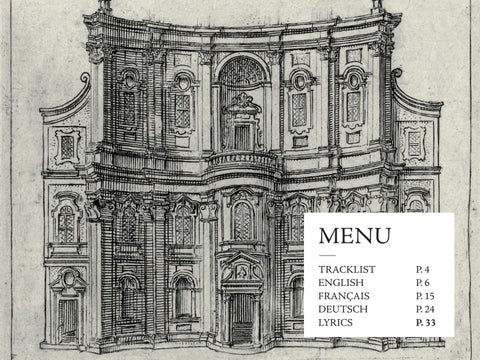
Recording: Trevi, Chiesa museale di San Francesco, 9-11 January 2018 & & Bolland, église Saint-Apollinaire, 18-20 September 2018 Artistic direction & recording: Rainer Arndt (Trevi), Aline Blondiaux (Bolland) Editing & mastering: Lambert Colson & Hugues Deschaux Production: Jérôme Lejeune Illustration of the cover: Gian Lorenzo Bernini, Rape of Proserpina (detail), Rome: Borghese gallery © akg-images / Andrea Jemolo Cover of the booklet: Dominique Barrière (c. 1622-1678), Oratorio dei Filippini (1637-1650; Arch.: Francesco Borromini) Berlin, Sammlung Archiv für Kunst und Geschichte, © akg-images
Penitential music in the Chiesa Nuova in Rome arround 1610
—
MENU EN FR DE
TEATRO SPIRITUALE
Alice Foccroulle: soprano (solo: 1, 11,14) Reinoud Van Mechelen: tenor (solo: 4, 9) Stéphanie Leclercq: mezzo-soprano Olivier Coiffet: tenor Guillaume Olry: bass Guy Hanssen, Susanna Defendi, Charlotte van Passen & Bart Vroomen: trombones Rodney Prada & Noelia Reverte Reche: lirone Simone Vallerotonda & Christoph Sommer: theorbo & archlute Marc Meisel: organ & harpsichord Lambert Colson: cornett, mute cornett & direction
www.inalto.be
3
INALTO
1. De Profundis clamavi (Ps. 129)* 2. Sinfonia 3. Satiati huomo carnale 4. Domine ne in furore tuo (Ps. 37)* 5. Ritorn’al tuo pastor smarrit’agnella 6. Come ti veggio 7. Cappriccio sopra Ré, Fa, Mi, Sol*
4
8. Emendemus in melius 9. Domine exaudi orationem meam (Ps. 142)* 10. Crudele, acerba, inesorabil morte 11. Miserere mei Deus (Ps. 50)* 12. S’alhor che più sperai 13. Toccata quarta per l’organo da sonarsi alla levatione* 14. Domine ne in furore tuo (Ps. 6)* 15. Canzon quinta a 4 16. Signor, io t’ho confitto 17. Recercata 19 a 4 * Trevi, chiesa museale di San Francesco
Anonymous Emilio de’ Cavalieri (1550-1602) Paolo Quagliati (c. 1555-1628) Anonymous Giovanni Francesco Anerio (1569-1630) Francisco Soto de Langa (1534-1619) Giovanni de Macque (1550-1614) Antonio Cifra (c. 1584-1629) Anonymous Luca Marenzio (1553-1599) Anonymous Paolo Animuccia (?-c. 1563) Girolamo Frescobaldi (1583-1643) Anonymous Girolamo Frescobaldi Giovanni Francesco Anerio Paolo Quagliati
3'45 2'04 2'50 8'20 3'09 2'33 5'25 2'54 5'08 2'46 9'07 1'51 5'08 4'49 3'40 3'10 5'27
Vocal Giovanni Francesco Anerio – Signor, io t’ho confitto (Roma, Biblioteca Vallicelliana, ms. Z.I22-I30) Giovanni Francesco Anerio – Ritorn’al tuo pastor smarrit’agnella (Roma, Biblioteca Vallicelliana, ms. Z.I22-I30) Paolo Quagliati – Satiati huomo carnale (Canzonette spirituali de diversi autori, Roma 1595) Antonio Cifra – Emendemus in melius (Motecta quadernis vocibus, Roma 1620) Francisco Soto de Langa – Come ti veggio (Nuove laudi ariose della Beatissima Vergine scelte da diversi autori a quattro voci da Giovanni Arascione, Roma 1600) Paolo Animuccia – S’alhor che più sperai (Nuove laudi ariose della Beatissima Vergine scelte da diversi autori a quattro voci da Giovanni Arascione, Roma 1600) Anonymous - Salmi Penitenziali – (Biblioteca Nazionale Centrale di Roma, Mss musicali 133)
MENU EN FR DE
Sources
Emilio de’ Cavalieri – Sinfonia, Rappresentatione di Anima, et di Corpo (Nicolo Mutii, Roma 1600) Luca Marenzio – Crudele, acerba, inesorabil morte (Nono libro de madrigali, Gardano, Venezia 1599) Paolo Quagliati – Recercata à 4 (Libro primo a quattro voci, Nicolo Muti, Roma,1601) Girolamo Frescobaldi – Canzon Quinta à 4 (Canzoni, Paolo Masotti, Roma 1628) Girolamo Frescobaldi – Toccata quarta per l’organo da sonarsi alla levatione (Toccate e partite d'intavolatura, Libro 2, Nicolò Borboni, Roma, 1637) Giovanni de Macque – Cappriccio sopra Ré, Fa, Mi, Sol (London, British Library, MS Add. 30491)
The music on this recording is dedicated to Eriko Semba and Louis Soria, who departed this world earlier this year.
5
Instrumental
MENU FR DE 6
CONVERTED COUNTERPOINT: MUSIC AND PENITENCE AT THE ROMAN ORATORY — In the complex and variegated landscape of early modern Catholicism, the Oratory of St. Philip Neri (officially established in Rome in 1575) is known for its sunny and positive approach to spirituality. Neri himself had brought to the Papal city from his native Florence a taste for wit, a healthy irony against the vain excesses of rigorism, and a penchant for the collective singing of devotional songs—the famous laude. Both his contemporaries and ours emphasize these aspects, as the titles of early and recent writings dedicated to the saint make clear: in 1591 his friend and admirer Cardinal Agostino Valier wrote a dialogue called Philippus, sive de christiana laetitia (Philip, or about Christian joy), and a short Italian monograph of 1999 styles him Il profeta della gioia, the prophet of joy. Still, we should not forget that the apparently distant spirituality of the Dominican friar Girolamo Savonarola (1452–1498), with its heavy ascetic and penitential overtones, was also part of Neri’s Florentine heritage—his father had been one of the so-called piagnoni, the supporters of Savonarola. The penitential aspect, in fact, with its sister attitude, the contemptum mundi (contempt for the world), was considered essential in any itinerary of conversion and in any Christian walk of life at the time. How did these elements find expression in the Oratorian environment? How were they appropriated by the exuberant Oratorian creativity? The highly original programme of this recording, which includes many pieces extracted from the Roman archives for the first time after centuries, will allow us to explore this less known side of the Oratorian life and culture. The apparently disagreeable topic need not scare us: the aesthetic pedagogy embraced by the followers of Philip Neri was able to turn virtually every theme, including the most austere ones, into the subject of an enticing “spiritual theatre”—a way of experiencing higher truths through the senses and a cathartic journey of introspection mediated by art. The name of the Oratory itself derives from the daily gatherings promoted and gently masterminded by Neri, gatherings in which he and his followers would pray (the Latin word oratorium literally means “place for prayer”), listen to more or less improvised sermons, and sing or listen to devotional songs.
*** The Sinfonia from Emilio de’ Cavalieri’s Rappresentatione di Anima, et di Corpo sets the mood for our musical meditation. Not only do its sorrowful descending lines and sequentially ascending motives
7
The gatherings started in an informal way, but became progressively more organized as the number of participants increased. The formula, however, did not change: an alternation of prayers, readings from spiritual books, sermons, and music. These extraliturgical meetings were decisive in shaping the Oratorian community and its spirituality. Music played an important role in the process also because some of the best musicians in Rome, including members of the papal chapel, attended and—contrary to their usually mercenary habits—accepted to perform free of charge. If we cannot track back any of the pieces included in this recording to specific occasions, surely in their diversity—from simple note-against-note laude to small-scale concertato motets, and from instrumental arrangements to recitative Psalms—they formed part of the musical apparatus of para- ad extraliturgical meetings during the first decades in the life of the Congregation. Borrowing a tool for meditation dear to Ignatius of Loyola (popularly labelled as Neri’s ‘main competitor’ on the religious market of sixteenthcentury Rome), let us embark on a ‘composition of place’ (compositio loci): We can easily imagine, for instance, a Lenten devotional gathering in an unpretentious room adjacent to the Oratorians’ mother church, Santa Maria in Vallicella (the splendid Oratorio by Borromini will be built only in the 1640s). The best seats are reserved for cardinals and prelates, but the audience is fairly mixed, as a consequence of the Founder’s wide-reaching and cross-social appeal. According to the character of this period in the liturgical year of the Catholic Church, the various readings and meditations proposed to the faithful insist on such themes as the necessity of conversion and the vanity of mundane affairs, and increasingly focus on Christ’s Passion, in vibrant depictions of his salvific sufferings. Interspersed among the readings, the sermons, and the silences, are instrumental and vocal pieces, possibly composed for the occasion or drawn from the repertory that has been accumulating over the years. The multimedia device of Oratorian devotion starts, thus, to work: acquiring graphic vividness thanks to the power of music and the moving performance, the concepts already repeatedly proposed for reflection become now uniquely able to affect the meditants’ intellect, kindle their memory, and activate their will towards conversion.
8
mirror the dyadic rhetoric of contrasts adopted by contemporary preachers, but its very presence in the programme alludes to what can be considered the apex of the sixteenth-century Oratorian tradition in matters of ‘preaching through poetry and music’. The “Representation of Body and Soul”, staged during the Holy Year 1600, combined a libretto by the Oratorian poet Agostino Manni with the forward-looking ‘recitative’ music by Cavalieri (not devoid, however, of masterly borrowings from the lauda tradition): while setting new standards for spiritual entertainment, and generally for musical theatre, it epitomized the Oratorian capacity of miscere utile dulci (to blend the useful with the pleasant). If the Rappresentatione is like a large fresco depicting the Body and Soul’s progress among the three reigns of Earth, Hell, and Heaven, the earlier canzonetta Sàtiati huomo carnale by Paolo Quagliati (1585) insists on similar themes within the space of a miniature. The canzonetta text urges the “carnal man” to cease from his depraved behaviour, threatening him, otherwise, of perpetual weeping in Hell. It resonates with the widespread theme of vanity (vanitas vanitatum, one of the defining cultural tropes of the period) and implicitly recalls, ex contrario, the “gift of tears”, often considered, within and without the Oratorian milieu, as “the sensory manifestation of a mystic experience” (A. Piéjus). The somber mood, the expressive use of semitones (on such words as piangendo, “weeping”), and the simple device of repetitions and reduplications in imitation—further multiplied by the stanzaic structure—lend the canzonetta an impressive power of persuasion. Its quasi-hypnotic character is mitigated by the varied scorings of the different stanzas in performance: an approach perfectly in line with contemporary descriptions and prescriptions, but too often forgotten by modern performers. Antonio Cifra’s Emendemus in melius (1620), a concertato motet for four voices and basso continuo, has a clear association with Lent: its text coincides with that of a well-known responsory sung on Ash Wednesday. Its subject is once again the need of creating a “space for repentance” (spatium poenitentiae) in the present, in order not to be surprised by the sudden irruption of the Four Last Things (Death, Judgment, Heaven, and Hell, according to the traditional Christian doctrine) in the future. Cifra’s rendering, with the perceptive sectionalisation and the clever balance between local expressive effects and global structure, is representative of the post-Palestrinian small-scale motet. The interaction between the voices, in the ever-changing textures, makes audible the collective stimulus to conversion proposed by the
9
text, and the homorhythmic passage on attende Domine (“hearken, O Lord”) enhances the solemn tone of the concluding prayer for God’s mercy. On the one hand, as we have seen, the evocative power of the music combined with and was supported by the other ingredients of the communal spiritual exercises. On the other, the mere fact of seeing (and hearing) singers and musicians participating in these practices of devotion was considered edifying by early modern Catholics. As we learn, for instance, from Jesuit reports concerning popular missions in Southern Italy, musicians were often seen as a category morally at risk: their active conversion, therefore, was hailed as nothing short of a miracle. St. Philip Neri, as already mentioned, was able to draw into his circle quite a few musicians, with their families: such was the case of Giovanni Francesco Anerio (1569–1630), whose parents were among Neri’s first Roman followers. Anerio’s Ritorn’al tuo pastor smarrit’agnella is preserved in an early-seventeenth-century manuscript from the Oratorian headquarters at the Vallicella. The text, first published in a different setting in the Third book of laude of 1588 and undoubtedly penned by one of the Oratorian fathers, ingeniously merges the Gospel parable of the lost sheep and the scene of Christ’s Crucifixion, thus providing a subtle and imaginative interpretation of the Crucifixion itself. Christ is the Good Shepherd who, moved by love, climbs the cross in order to sight the lost soul (there is an echo here of another parable too, that of the prodigal son in Luke’s Gospel). Jesus’s last cry on the cross is, then, his ultimate call for the soul to repent. In the first decades of the seventeenth century Anerio repeatedly set devotional texts by Oratorian poets (including Manni), experimenting with different musical means, from semi-recitative solo pieces to four-voice canzonettas, and from terse dialogues to dense spiritual madrigals, until his most ambitious project, the Teatro armonico spirituale of 1619, which aimed to provide a systematic series of dialogic and half-dramatized vocal-instrumental pieces for the Oratorian meetings. In Ritorn’al tuo pastor we find Anerio’s scrupulous attention for the metrical configuration of the text, mirrored in ductile rhythmic structures, and a typically Roman synthesis between the verve of the canzonetta and the more solemn pace of the spiritual madrigal. Interestingly, the musical meditation remains suspended, and we do not learn about the lost soul’s answer: the twin piece by Anerio from the same manuscript, however, can be read in that perspective. Once again derived from a previous lauda text, the stanzas of Signor, io t’ho confitto
10
propose a twofold first-person immersion in the scene on the Golgotha. In the first part, the speaking sinner pleads morally guilty of Christ’s Crucifixion, whereas in the second he expresses the desire to take the place of the Saviour, as the one who really deserves to be punished. In line with this poignant subject, Anerio’s setting mostly proceeds in long values and insists on minor sonorities and dissonant counterpoint, giving the lauda text the gravity of a spiritual madrigal. The Oratorian culture relied heavily on the reuse, adaptation, and reworking of pre-existing texts (and, sometimes, melodies). One of the favourite technique was that of contrafactum, i.e. the more or less extensive re-texting of a previous (and normally successful) song. The two pieces from the Nuove laudi ariose della Beatissima Vergine (1600) exemplify this practice. The lauda S’allor che più sperai dal Ciel conforto derives in fact from Paolo Animuccia’s (secular) madrigal S’allor che più sperai da voi conforto, included in his First book of madrigals published in Rome half a century before (1555). A parallel reading of the two texts illustrates better than any explanation the procedure of turning a despised lover’s song into “the outburst of a troubled soul … invoking Saint Mary of Mercy” (as reads the lauda’s subtitle): S’allor che più sperai da voi conforto, S’allor che più sperai dal Ciel conforto Flori, m’avete morto, Freddo mi giacqui e smorto, Che posso più sperare Che poss’io più sperare, Al mio fedel servire, In tanto mio soffrire, Se non vederm’odiare Se non vedermi alzare Fuor di ragion l’ardente mio desire, Di Dio la man ch’accresca il mio martire, Onde n’ho da morire? Ondio venga’a morire? Ma pria ch’io mora griderò ch’a torto, Ma pria ch’io mora griderò: “O bontade, Flori, m’avete morto. Vergin, ohimè, pietade!”. In turn, the lauda by the Spanish singer and composer Francisco Soto (1534–1619), member both of the papal chapel and of the Congregation of the Oratory, Come ti veggio, ohimè, di dolor cinta is the Marian (and anti-Calvinist) contrafactum of another lauda, Come ti vedo, ohimè, di sangue asperso, a dialogue between the Soul and the Crucified Christ dating back to 1577.
DANIELE V. FILIPPI
11
With the anonymous settings of the Penitential Psalms (from another early-seventeenth-century Oratorian manuscript), we leave the concise simplicity of the lauda to contemplate an altogether different approach—and probably to discover the most exquisite gems in this recording. Written in a recitative style which at times recalls that of Cavalieri, these impressive solo settings give voice to a highly personal reading of the Psalms and employ all sort of musical devices to attain intensity of expression: abstract patterns of recitative tones and angular melodies with extremely wide leaps, madrigalesque word-painting and daring chromaticisms, dramatic rests and ingenious harmonic concatenations, static segments and nervous flares of rhythmic energy. The Penitential Psalms—these milestones of biblical spirituality and classic texts for the meditation and prayer of generations of Christians—are thus illuminated of a new light, a light which scrutinizes each word and phrase and vividly projects their meaning onto the inner screen of the meditant’s conscience. Among the instrumental pieces, the rendering of Marenzio’s Crudele, acerba inesorabil morte is especially worth singling out at the conclusion of these notes. The original vocal piece was included in the master’s Ninth book of madrigals of 1599, one of the most sublime achievements in this quintessential genre of the Italian Renaissance. Its text, obviously missing in the instrumental version but nonetheless surely recognizable for many contemporary listeners, is the second stanza from Petrarch’s sestina Mia benigna fortuna e ’l viver lieto (no. 332 in the Rerum vulgarium fragmenta). The influence of Petrarch on many aspects of early modern culture—in Italy and beyond—can hardly be overestimated, and the spiritual reading of his lyrics was a widespread practice dating back at least to Girolamo Malipiero’s Petrarca spirituale of 1536. The “cruel death” of Laura mourned in this stanza, therefore, could easily be construed as that of the Saviour on the cross, worth to be contemplated and bewailed with the tears of an entire life (cagion … di menar tutta mia vita in pianto). Moreover, the adamantine instrumental version further transfigures Marenzio’s composition, bristling with agonizing dissonances and tortured contrapuntal geometries, in an absolute emblem of ‘holy melancholy’.
Introspection and its expression
12
It was during InAlto’s earlier recording of Un Cornetto a Roma (PAS 1033), released in November 2017, that I was once again able to consult my notes on the Papal city. During one period I spent in the city, a colleague had given me a copy of the manuscript around which we have slowly but surely constructed this recording: it consists of a cycle of anonymous psalm settings, the manuscript of which is kept in Rome’s Biblioteca Nazionale Centrale. An anonymous manuscript can sometimes inspire a dream—but the music that this one contained continued to pique my curiosity. We have here a cycle of penitential psalms in Latin that are set in recitar cantando; the music is studded with astonishingly daring harmonic progressions. The works were created for the Chiesa Nova, the renowned church and birthplace of the oratorio genre, where Emilio de’ Cavalieri’s Rappresentatione di Anima, et di Corpo was first performed. I therefore hastened to make some happy assumptions and imagined, given that the musical project set out in the manuscript before me seemed to be highly ambitious on many fronts, that this might be a new source of works by Cavalieri or by another leading composer of the period. The musicologist Rosemarie Darby defended her doctoral thesis The Liturgical music of the Chiesa Nuova, Rome (1575-1644) at the University of Manchester in December 2018; in her thesis she suggests that this manuscript be attributed to Dorisio Isorelli, maestro di cappella of the Congregation of the Oratory between 1599 and 1604. Isorelli is known for having copied and completed a manuscript (MS O.31) preserved in the Biblioteca Vallicelliana that contains lamentations and responses for Holy Week by one maestro Emilio; Isorelli was most likely a favoured pupil. Going beyond the above question of attribution, my research consisted of exploring the possible contexts in which such a cycle of penitential psalms could have been heard. I knew of similar cycles by Roland de Lassus, Alexander Utendal, Leonhard Lechner, and Giovanni Croce, although none of these were in any way comparable to the contents of our mysterious manuscript. I would very much like to thank Noel O’Regan, Ignace Bossuyt, and Daniele Filippi (author of the liner notes to this recording) for their valuable help in developing this programme, given that it was conceived without a specific liturgical setting as a succession of rituals on the theme of penitence, to be
LAMBERT COLSON TRANSLATION PETER LOCKWOOD
MENU FR DE 13
performed during Lent and most probably in the days preceding Holy Week. From the 16th century onwards, and despite the Counter-Reformation and the seeming austerity of its cappelle, many extra singers and musicians were employed to take part in the musical activities of the Congregations during Lent. Cornetts, trombones, lutes, the lirone, the organ and keyboard instruments of every kind would have doubled or accompanied the vocal lines and would also have performed instrumental works with style and aplomb. I think here in particular of Luigi Zenobi, the great cornett virtuoso who visited Rome several times around the turn of the century and who was in contact with all of the greatest composers of the period; he will be the subject of a future recording. For the continuo I have followed Cavalieri’s indications in the preface to his Rappresentatione di Anima et di Corpo, notably the two separate groupings of organ and theorbo or of harpsichord, lirone and theorbo. Within the psalms themselves, I had the idea of passing from one continuo group to the other according to the psalm texts. The magnificent organ of San Francesco in Trevi that was built by Paolo Pietro di Paolo di Montefalco in 1509 here accompanies all the sections in which the sinner addresses God directly. The harpsichord, the lirone and the theorbo accompany the moments of introspection and of emotion contained. It is easy here to imagine that one hears the first traces of what later was to become the French leçons de ténèbres. Once again, Rome does not disappoint. This CD provides proof of the unbelievable musical growth that occurred at the beginning of the 17th century. Music was not only cutting-edge but also highly popular and simple in character, although it could also attain great contrapuntal complexity, as well as being humble and flamboyant by turns. The great attention paid to colour and to the continually changing emotions that are nonetheless always true move me greatly. Here is the path of repentance as it moves from an interior journey towards the secular world, communicating just as much with the world as with itself.
14
Alice Foccroulle Š Cici Olsson
Reinoud Van Mechelen Š Anna Besson
MENU EN DE
Dans le paysage complexe et varié du catholicisme de la première modernité, l’Oratoire de saint Philippe Néri (officiellement établi à Rome en 1575) est connu pour son approche solaire et positive de la spiritualité. Néri lui-même avait apporté à la cité papale, depuis sa Florence natale, un goût pour l’esprit, une ironie saine contre les vains excès du rigorisme et un penchant pour le chant collectif des chants de dévotion – les fameuses laude (laudes). Ses contemporains comme les nôtres soulignent ces aspects, comme le montrent les titres d’écrits consacrés au saint, qu’ils soient de l’époque ou récents : en 1591, son ami et admirateur le cardinal Agostino Valier écrivit un dialogue intitulé Philippus, sive de christiana laetitia (Philippe, ou à propos de la joie chrétienne), et une courte monographie italienne de 1999 le qualifie d’« il profeta della gioia », le prophète de la joie. Il ne faut cependant pas oublier que la spiritualité apparemment éloignée du frère dominicain Girolamo Savonarola (1452-1498), avec ses lourdes connotations ascétiques et pénitentielles, faisait également partie de l’héritage florentin de Néri – son père avait été l’un des « piagnoni », les partisans de Savonarola. L’aspect pénitentiel, en effet, avec l’attitude qui lui était associée, le contemptus mundi (mépris du monde), était à l’époque considéré comme essentiel dans tout processus de conversion et dans tout chemin de vie chrétien. Comment ces éléments trouvèrent-ils à s’exprimer dans l’environnement oratorien ? Comment l’exubérante créativité oratorienne se les appropriait-elle ? Le programme particulièrement original de cet enregistrement, qui comprend de nombreuses pièces exhumées pour la première fois des archives romaines, nous permettra d’explorer cet aspect moins connu de la vie et de la culture oratorienne. Ne soyons pas effrayés par le sujet à première vue un peu rébarbatif : la pédagogie esthétique adoptée par les adeptes de Philippe Néri sut transformer à peu près chaque thème, même le plus austère, pour en faire l’objet d’un séduisant « théâtre spirituel », une manière de vivre des vérités supérieures à travers les sens et un voyage cathartique d’introspection avec l’art pour médiateur. Le nom de l’Oratoire trouve son origine dans les rassemblements quotidiens encouragés et orchestrés avec douceur par Néri, lors desquels lui et ses adeptes priaient (le mot latin « oratorium » signifie « lieu de prière »), écoutaient des sermons plus ou moins improvisés et chantaient ou écoutaient des chants de dévotion.
15
CONTREPOINT CONVERTI : MUSIQUE ET PÉNITENCE À L’ORATOIRE ROMAIN —
16
Les réunions étaient d’abord informelles, puis devinrent peu à peu plus organisées à mesure que le nombre de participants augmentait. La formule, cependant, resta inchangée : une succession de prières, de lectures de livres spirituels, de sermons et de musique. Ces réunions extraliturgiques furent décisives pour la formation de la communauté oratorienne et de sa spiritualité. La musique y jouait également un rôle important : certains des meilleurs musiciens de Rome, dont des membres de la chapelle papale, y assistaient et acceptaient de s’y produire gratuitement, contrairement à leurs pratiques mercenaires habituelles. Pour aucune des pièces de cet enregistrement, nous ne pouvons remonter jusqu’à des événements spécifiques, mais dans leur diversité – de la laude simple « note contre note » aux petits motets concertato, et des arrangements instrumentaux aux psaumes récitatifs –, elles s'adaptaient bien à l'appareil musical des rassemblements para- et extraliturgiques durant les premières décennies de la vie de la congrégation. Empruntant un outil de méditation cher à Ignace de Loyola (populairement qualifié de « principal concurrent » de Neri sur le marché religieux de la Rome du XVIe siècle), engageons-nous dans une « composition de lieu » (compositio loci) : nous pouvons facilement imaginer, par exemple, un rassemblement de dévotion pour le carême dans une salle sans prétention adjacente à l’église mère des oratoriens, Santa Maria in Vallicella (le splendide oratoire de Borromini ne sera construit que dans les années 1640). Les meilleurs sièges sont réservés aux cardinaux et aux prélats, mais le public est assez mélangé, en raison de l’attrait multiple et transsocial du fondateur. Selon le caractère de cette période de l’année liturgique catholique, les différentes lectures et méditations proposées aux fidèles insistent sur des thèmes comme la nécessité de la conversion et la vanité des affaires mondaines et se concentrent de plus en plus sur la Passion du Christ, dans des représentations vibrantes de ses souffrances salvifiques. Entre les lectures, les sermons et les silences, des pièces vocales et instrumentales, peut-être composées pour l’occasion ou tirées du répertoire accumulé au fil des ans. Le dispositif multimédia de la dévotion oratorienne commence ainsi à opérer : en acquérant une vivacité graphique grâce au pouvoir de la musique et au caractère émouvant de la prestation, les concepts déjà soumis à maintes reprises à la réflexion peuvent désormais et de manière unique affecter l’intellect des méditants, éveiller leur mémoire et activer leur volonté de conversion. *** La Sinfonia de la Rappresentatione di Anima, et di Corpo d’Emilio de’ Cavalieri donne le ton de notre méditation musicale. Ses lignes descendantes douloureuses et ses motifs ascendants successifs reflètent
17
la rhétorique dyadique des contrastes adoptée par les prédicateurs contemporains, et sa présence dans ce programme illustre ce qui peut être considéré comme le sommet de la tradition oratorienne du XVIe siècle en matière de « prédication par la poésie et la musique ». La « Représentation de l'âme et du corps », donnée au cours de l’année sainte 1600, associe un livret du poète oratorien Agostino Manni et la musique « récitative » avant-gardiste de Cavalieri (cependant non dépourvue d’emprunts magistraux à la tradition de la laude) : tout en fixant de nouvelles normes pour le divertissement spirituel et de façon générale pour le théâtre musical, elle incarne la capacité oratorienne de « miscere utile dulci » (mêler l’utile à l’agréable). Si la Rappresentatione est comme une grande fresque représentant les progrès du corps et de l'âme entre les trois règnes de la Terre, de l’Enfer et du Ciel, la canzonetta Sàtiati huomo carnale de Paolo Quagliati (1585) insiste sur des thèmes similaires dans l’espace d’une miniature. Le texte de la canzonetta exhorte l’« homme charnel » à cesser son comportement dépravé, le menaçant, s’il n’obtempère pas, de pleurs perpétuels en Enfer. Centrée sur ce thème très courant de la vanité (« vanitas vanitatum », l’un des tropes culturels majeurs de l’époque), elle rappelle implicitement, a contrario, le « don des larmes », souvent considéré, dans le milieu oratorien mais aussi au-dehors, comme la « manifestation sensible d’une expérience mystique » (A. Piéjus). L’humeur sombre, l’utilisation expressive de demi-tons (sur des mots comme « piangendo », « pleurer ») et le dispositif simple de répétitions et de redoublements en imitation – encore multipliés par la structure strophique – confèrent à la canzonetta un formidable pouvoir de persuasion. Son caractère quasi hypnotique est atténué par la variété des arrangements des différentes strophes dans la présente interprétation : une approche parfaitement conforme aux descriptions et prescriptions contemporaines, mais trop souvent oubliée par les interprètes d’aujourd’hui. Emendemus in melius d’Antonio Cifra (1620), un motet concertato pour quatre voix et basse continue, est clairement associé au carême : son texte correspond à celui d’un célèbre répons chanté le mercredi des Cendres. Il porte à nouveau sur la nécessité de créer un « espace de repentance » (spatium poenitentiae) dans le présent afin de ne pas être surpris par l’irruption soudaine des quatre dernières choses (mort, jugement, ciel et enfer, selon la doctrine chrétienne traditionnelle) dans le futur. La réalisation de Cifra, avec sa perspicace mise en sections et l’équilibre subtil entre les différents effets expressifs et la structure globale, est représentative du petit motet postpalestrinien. L’interaction entre les voix, dans des textures toujours changeantes, rend audible le stimulus collectif
18
à la conversion proposé par le texte, et le passage homorythmique sur « attende Domine » (« écoute, Seigneur ») renforce le ton solennel de la prière finale pour la miséricorde divine. Comme nous l’avons vu, le pouvoir évocateur de la musique était accompagné et soutenu par les autres éléments des exercices spirituels communautaires. Par ailleurs, le simple fait de voir (et d’entendre) des chanteurs et des musiciens participer à ces pratiques de dévotion était considéré comme édifiant par les premiers catholiques modernes. Ainsi, nous apprenons de rapports de missions jésuites populaires dans le Sud de l’Italie que les musiciens étaient souvent considérés comme une catégorie moralement en danger : leur conversion active, dès lors, était saluée comme un véritable miracle. Comme déjà mentionné, saint Philippe Néri réussit à attirer dans son cercle bon nombre de musiciens avec leurs familles : c’est le cas de Giovanni Francesco Anerio (1569-1630), dont les parents étaient parmi les premiers adeptes romains de Néri. Ritorn’al tuo pastor smarrit’agnella d’Anerio est conservé dans un manuscrit du début du XVIIe siècle provenant du siège oratorien à Vallicella. Le texte, d’abord publié dans un contexte différent dans le Troisième Livre de laudes (1588) et sans doute écrit par l’un des pères oratoriens, mêle ingénieusement la parabole évangélique de la brebis perdue et la scène de la crucifixion du Christ, offrant ainsi une interprétation subtile et imaginative de la crucifixion elle-même. Jésus-Christ est le bon pasteur qui, poussé par l’amour, grimpe sur la croix pour voir l’âme perdue (voici l’écho d’une autre parabole, celle du fils prodigue dans l’Évangile de Luc). Le dernier cri de Jésus sur la croix est ainsi son ultime appel au repentir de l’âme. Dans les premières décennies du XVIIe siècle, Anerio mit en musique à plusieurs reprises des textes de poètes oratoriens (dont Manni), expérimentant différents moyens musicaux, de la pièce solo en semirécitatif à la canzonetta à quatre voix et du dialogue laconique au dense madrigal spirituel et jusqu’à son projet le plus ambitieux, le Teatro armonico spirituale (1619), visant à fournir une série systématique de pièces vocales-instrumentales dialogiques et semi-dramatiques aux réunions oratoriennes. Dans Ritorn’al tuo pastor, on retrouve l’attention scrupuleuse portée par Anerio à la configuration métrique du texte, reflétée dans des structures rythmiques ductiles et une synthèse typiquement romaine entre la verve de la canzonetta et l’allure plus solennelle du madrigal spirituel. Il est intéressant de noter que la méditation musicale reste suspendue, et nous n’apprenons rien de la réponse de l’âme perdue ; la pièce jumelle d’Anerio dans le même manuscrit peut cependant être considérée dans cette perspective. Une fois encore dérivée d’un précédent texte de laude,
19
les strophes de Signor, io t’ho confitto proposent une double immersion à la première personne dans la scène du Golgotha. Dans la première partie, le pécheur qui parle plaide moralement coupable pour la crucifixion du Christ, alors que dans la seconde, il exprime le désir de prendre la place du Sauveur comme celui qui mérite d’être réellement puni. Dans la lignée de ce sujet poignant, la mise en musique d’Anerio se déroule principalement en valeurs longues et insiste sur les sonorités mineures et un contrepoint dissonant, donnant au texte de la laude la gravité d’un madrigal spirituel. La culture oratorienne se basait largement sur la réutilisation, l’adaptation et le remaniement de textes (et parfois de mélodies) préexistants. L’une des techniques préférées était celle du contrafactum, à savoir l’adaptation plus ou moins poussée d’un nouveau texte à une chanson ancienne (et généralement appréciée). Les deux pièces des Nuove laudi ariose della Beatissima Vergine (1600) en sont un bon exemple. La laude S’allor che più sperai dal Ciel conforto est basée sur le madrigal (profane) S’allor che più sperai da voi conforto de Paolo Animuccia, tiré de son Premier Livre de madrigaux publié à Rome un demi-siècle auparavant (1555). Une lecture parallèle des deux textes illustre mieux que toute explication le procédé permettant de transformer une chanson d’amour méprisée en « l’explosion d’une âme troublée… invoquant sainte Marie de la Miséricorde » (selon le sous-titre de la laude) : S’allor che più sperai da voi conforto, S’allor che più sperai dal Ciel conforto Flori, m’avete morto, Freddo mi giacqui e smorto, Che posso più sperare Che poss’io più sperare, Al mio fedel servire, In tanto mio soffrire, Se non vederm’odiare Se non vedermi alzare Fuor di ragion l’ardente mio desire, Di Dio la man ch’accresca il mio martire, Onde n’ho da morire? Ondio venga’a morire? Ma pria ch’io mora griderò ch’a torto, Ma pria ch’io mora griderò: “O bontade, Flori, m’avete morto. Vergin, ohimè, pietade!”. À son tour, la laude Come ti veggio, ohimè, di dolor cinta du chanteur et compositeur espagnol Francisco Soto (1534-1619), membre à la fois de la chapelle papale et de la congrégation de l’Oratoire, est le contrafactum marial (et anti-calviniste) d’une autre laude, Come ti vedo, ohimè, di sangue asperso, un dialogue entre l’âme et le Christ crucifié qui remonte à 1577.
20
Avec les mises en musique anonymes des psaumes de pénitence (tirées d’un autre manuscrit oratorien du XVIIe siècle), nous laissons de côté la simplicité concise de la laude pour observer une approche tout à fait différente – et découvrir les perles les plus exquises de cet enregistrement. Composés dans un style de récitatif qui rappelle parfois celui de Cavalieri, ces arrangements solos donnent voix à une lecture très personnelle des psaumes et recourent à toutes sortes de moyens musicaux pour atteindre à une telle intensité de l’expression : motifs abstraits de récitatif et mélodies anguleuses aux très grands sauts, peinture de mots madrigalesque et chromatismes osés, repos dramatiques et enchaînements harmoniques ingénieux, segments statiques et éruptions nerveuses d’énergie rythmique. Les psaumes de pénitence – ces jalons de la spiritualité biblique et des textes classiques pour la méditation et la prière de générations de chrétiens – sont illuminés d’une lumière neuve, qui scrute chaque mot et chaque phrase et projette avec éclat leur signification sur l’écran intérieur de la conscience du méditant. Pour conclure ce texte, Crudele, acerba, inesorabil morte de Marenzio mérite une attention particulière parmi les pièces instrumentales. La pièce vocale d’origine provient du Neuvième Livre de madrigaux (1599) du maître, l’une des réalisations les plus sublimes dans ce genre par excellence de la Renaissance italienne. Son texte, évidemment absent de la version instrumentale mais néanmoins reconnaissable par de nombreux auditeurs contemporains, est la deuxième strophe de la sextine de Pétrarque Mia benigna fortuna e ’l viver lieto (no 332 dans les Rerum vulgarium fragmenta). L’influence de Pétrarque, dans de nombreux domaines de la première modernité, en Italie et au-delà, peut difficilement être surestimée, et la lecture spirituelle de ses textes était une pratique répandue au moins depuis le Petrarca spirituale de Girolamo Malipiero (1536). La « mort cruelle » de Laura que l’on y déplore pourrait dès lors facilement être interprétée comme celle du Sauveur sur la croix, digne d’être contemplée et pleurée avec les larmes d’une vie entière (« cagion […] di menar tutta mia vita in pianto »). La version instrumentale adamantine transcende davantage encore l’œuvre de Marenzio, hérissée de dissonances insoutenables et de constructions contrapuntiques torturées, dans une icône absolue de « sainte mélancolie ». DANIELE V. FILIPPI TRADUCTION: CATHERINE MEEÙS
C’est en préparant le précédent enregistrement d’InAlto (Un Cornetto a Roma, Passacaille 1033, novembre 2017) que j’ai eu l’occasion de me replonger dans mes notes sur la cité pontificale. Lors d’un voyage, un collègue m’avait donné une copie du manuscrit autour duquel cet enregistrement s’était lentement construit, un cycle de psaumes anonymes, dont le manuscrit (Mss musicali 133) est conservé à la Biblioteca Nazionale Centrale de Rome. Les manuscrits anonymes nous font parfois rêver davantage… Mais surtout, la musique qu’il contient a continué à stimuler ma curiosité. Nous parlons ici d’un cycle de psaumes de pénitence en latin et composé en recitar cantando, truffé de hardiesses harmoniques particulièrement étonnantes et provenant à l’origine de la Chiesa Nuova, la célèbre église de la création de la Rappresentatione di Anima, et di Corpo d’Emilio de’ Cavalieri, véritable berceau de l’oratorio. Ma tête s’empressait alors de faire des raccourcis heureux et d’imaginer, parce que le « projet » musical entrepris dans le manuscrit que j’avais devant moi me semblait à bien des égards tout à fait ambitieux, qu’il pourrait s’agir d’une nouvelle source pour la musique de Cavalieri ou d’un autre compositeur d’avant-garde. Rosemarie Darby soutiendra en décembre prochain une thèse de doctorat à l’Université de Manchester (The Liturgical music of the Chiesa Nuova, Rome (1575-1644)) dans laquelle elle propose une attribution de notre manuscrit à Dorisio Isorelli, maître de chapelle de la congrégation de l’Oratoire entre 1599 et 1604 et connu pour avoir copié et complété un manuscrit (Ms 0.31) conservé à la Biblioteca Vallicelliana contenant les lamentations et les répons pour la Semaine sainte du maître Emilio, dont il était vraisemblablement le protégé. Au-delà des questions d’attribution, mes travaux ont consisté à explorer le possible contexte dans lequel un tel cycle de psaumes de pénitence pouvait être entendu. J’avais connaissance des cycles de Roland de Lassus, d’Alexander Utendal, de Leonhard Lechner, de Giovanni Croce, mais absolument rien de tout à fait comparable avec notre mystérieux manuscrit. Je tiens à remercier chaleureusement Noel O’Regan, Ignace Bossuyt et Daniele Filippi (auteur du texte musicologique qui accompagne cet enregistrement) pour leur aide précieuse dans l’élaboration de ce programme, construit en dehors de toute liturgie comme une succession d’exercices spirituels autour du thème de la pénitence, pendant le carême et très probablement dans les jours qui précèdent la Semaine sainte. Dès le XVIe siècle et malgré la Contre-Réforme qui nous ferait imaginer des chapelles plutôt austères,
21
L’expression de l’introspection
22
de nombreux musiciens « supplémentaires », chanteurs et instrumentistes étaient amenés à participer à la musique des congrégations pendant la période de carême. Dans cet environnement sonore très riche, cornets, trombones, luths, lirone, orgue et claviers en tous genres doublaient ou accompagnaient les parties chantées et interprétaient certainement le répertoire instrumental avec panache. Je pense notamment à Luigi Zenobi (qui fera l’objet d’un prochain enregistrement), grand virtuose du cornet, plusieurs fois de passage à Rome au tournant du siècle et en contact avec tous les plus grands compositeurs de son temps. Pour le continuo, j’ai choisi de suivre les indications de Cavalieri dans la préface de la Rappresentatione di Anima, et di Corpo, à savoir les deux associations distinctes orgue et théorbe ou bien clavecin, lirone et théorbe. Au sein des psaumes, j’ai imaginé passer d’une association à l’autre en suivant le texte. Le magnifique orgue de San Francesco à Trevi construit en 1509 par maestro Paolo Pietro di Paolo di Montefalco accompagne ici toutes les parties dans lesquelles le pêcheur s’adresse directement à Dieu. Le clavecin, le lirone et le théorbe accompagnent alternativement les moments d’introspection, d’émotion contenue. J’entendrais presque, dans notre manuscrit de psaumes, les premiers germes des leçons de ténèbres... Une fois de plus, Rome ne déçoit pas. Ce disque cherche à témoigner de l’incroyable effervescence musicale du début du XVIIe siècle. La musique y était à la fois avant-gardiste mais aussi populaire, très simple et parfois pourtant d’une grande complexité contrapuntique, tour à tour humble ou flamboyante… Ce soin apporté aux couleurs, aux émotions variées mais toujours justes me touche énormément : il s’agit là sans doute du chemin de la pénitence, du voyage intérieur du profane, communiquant autant avec le monde qu’avec lui-même. LAMBERT COLSON
MENU EN DE 23 Lambert Colson © Cici Olsson
MENU EN FR 24
KONTRAPUNKT DER INNEREN UMKEHR: MUSIK UND BUSSE AM RÖMISCHEN ORATORIUM In der komplexen, vielfältigen Welt des ersten modernen Katholizismus ist das (offiziell 1575 in Rom gegründete) Oratorium des heiligen Filippo Neri für seine sonnige, positive Herangehensweise an die Spiritualität bekannt. Neri selbst hatte der Papststadt aus seiner Geburtsstadt Florenz eine Vorliebe für den Geist, eine gesunde Ironie gegenüber den zwecklosen Exzessen des Rigorismus und einen Hang für den gemeinsamen Gesang frommer Lieder – der berühmten Laude – mitgebracht. Seine Zeitgenossen wie die unseren heben diesen Aspekt hervor, wovon die Titel der Schriften zeugen, die diesem Heiligen gewidmet sind, egal ob sie aus jener Zeit stammen oder neueren Datums sind: 1591 schrieb sein Freund und Bewunderer, der Kardinal Agostino Valier einen Dialog mit dem Titel Philippus, sive de christiana laetitia (Filippo oder über die christliche Freude), und eine kurze italienische Monographie aus dem Jahr 1999 bezeichnet ihn als „il profeta della gioia“, den Prophet der Freude. Allerdings darf man nicht vergessen, dass die anscheinend weit davon entfernte Spiritualität des Dominikanerbruders Girolamo Savonarola (1452-1498) mit ihren schweren Askese- und Bußkonnotationen ebenfalls Teil des Florentiner Erbes von Neri ist – sein Vater war einer der „Piagnoni“, der Anhänger von Savonarola. Der Bußaspekt wurde nämlich gemeinsam mit der damit verbundenen Haltung des Contemptus mundi (der Weltverachtung) in dieser Zeit als wesentlich bei jeder Bekehrung und auf jedem christlichen Lebensweg betrachtet. Wie fanden diese Elemente Ausdruck in der Umgebung des Oratoriums? Wie konnte die rege Aktivität des Oratoriums sie sich aneignen? Das besonders originelle Programm dieser Aufnahme mit vielen Stücken, die zum ersten Mal aus römischen Archiven ausgegraben wurden, bietet uns die Möglichkeit, diesen weniger bekannten Aspekt des Lebens und der Kultur des Oratorium zu erforschen. Lassen wir uns dabei nicht vom Gegenstand abschrecken, der auf den ersten Blick etwas mühselig scheint: Die von den Anhängern Filippo Neris angenommene ästhetische Pädagogik verstand es, fast jedes Thema, selbst das strengste, zu verwandeln, um daraus einen Gegenstand des verlockendsten „spirituellen Theaters“ zu machen, eine Art, die höheren Wahrheiten durch die Sinne und eine kathartische Introspektionsreise mit der Kunst als Vermittler zu erleben.
25
Der Name „Oratorium“ hat seinen Ursprung in den täglichen Zusammenkünften, die von Neri sanft gefördert und inszeniert wurden und bei denen er und seine Anhänger beteten (das lateinische Wort „Oratorium“ bedeutet „Ort des Gebetes“), mehr oder weniger improvisierte Predigten anhörten und fromme Gesänge sangen oder anhörten. Die Sitzungen waren zunächst informell und wurden dann nach und nach gemäß der zunehmenden Teilnehmerzahl immer mehr organisiert. Die Vorgehensweise blieb allerdings unverändert: eine Aufeinanderfolge von Gebeten, Lesungen geistlicher Bücher, Predigten und Musik. Diese außerliturgischen Versammlungen waren entscheidend für die Bildung der oratorischen Gemeinschaft und ihrer Spiritualität. Die Musik spielte dabei ebenfalls eine wichtige Rolle: Einige der besten Musiker Roms, darunter Mitglieder der päpstlichen Kapelle, nahmen daran teil und waren im Gegensatz zu ihren geschäftstüchtigen Gewohnheiten bereit, dort gratis zu spielen. Für keines der Stücke dieser Aufnahme können wir auf bestimmte Ereignisse zurückgehen, doch ihre Vielfalt – von der einfachen Lauda „Note gegen Note“ bis zu den kleinen Concertato-Motetten und von den Instrumentalbearbeitungen von rezitativen Psalmen – zeigt, dass sie während der ersten Jahrzehnte des Bestehens der Kongregation sicher zum musikalischen Zubehör von para- und außerliturgischen Versammlungen gehörten. Leihen wir ein Meditationsmittel aus, das Ignatius von Loyola schätzte (der volkstümlich als der „Hauptkonkurrent“ von Neri auf dem religiösen Markt Roms im 16. Jh. galt), und lassen wir uns in eine „Ortskomposition“ (compositio loci) ein: Wir können uns zum Beispiel leicht eine Andachtsversammlung für die Fastenzeit in einem schlichten Saal neben der Hauptkirche der oratorischen Gemeinschaft, Santa Maria in Vallicella, vorstellen (das prächtige Oratorium von Borromini wurde erst in den 1640er Jahren erbaut). Die besten Plätze sind den Kardinälen und den Prälaten vorbehalten, doch ist das Publikum aufgrund der vielfachen, transsozialen Anreize des Gründers recht gemischt. Gemäß dem Wesen dieser Zeit des katholischen Kirchenjahres, bestehen die verschiedenen Lesungen und Meditationen, die den Gläubigen geboten werden, auf Themen wie der Notwendigkeit der Umkehr und der Nichtigkeit der Mondänitäten. Auch konzentrieren sie sich mehr und mehr auf die Passion Christi in mitreißenden Darstellungen der erlösenden Leiden. Zwischen den Lektüren, den Predigten und den Momenten der Stille sind Vokal- und Instrumentalwerke eingeschoben, die vielleicht für diese Gelegenheit komponiert wurden oder aus dem Repertoire stammen, das im Laufe der Jahre gesammelt
26
wurde. Die multimediale Anlage der oratorischen Frömmigkeit beginnt so zu wirken: Indem sie dank der Macht der Musik und des ergreifenden Charakters der Darbietung graphische Lebhaftigkeit erlangen, können die bereits oftmals der Überlegung unterzogenen Konzepte dem Intellekt der Meditierenden nun in einzigartiger Weise nahegehen, ihr Erinnerungsvermögen wachrufen und ihren Willen zur Umkehr anfachen. *** Die Sinfonia von Rappresentatione di Anima, et di Corpo von Emilio de’ Cavalieri gibt den Ton unserer musikalischen Meditation an. Ihre absteigenden schmerzlichen Linien und die aufeinanderfolgenden aufsteigenden Motive spiegeln die dyadische Rhetorik der von den zeitgenössischen Predigern angenommenen Kontraste wider, wobei die Präsenz selbst dieses Stückes im vorliegenden Programm das veranschaulicht, was als der Gipfel der oratorischen Tradition des 16. Jh. im Bereich der „Predigt durch die Dichtkunst und die Musik“ betrachtet werden kann. Das „Spiel von Seele und Körper“, das im Laufe des Heiligen Jahrs 1600 stattfand, kombiniert ein Libretto des oratorischen Dichters Agostino Manni mit Cavalieris „rezitativischer“, avantgardistischer Musik (der allerdings bedeutende Anleihen bei der Tradition der Laude nicht fehlen): Sie setzt neue Normen für die geistige Unterhaltung und ganz allgemein für das Musiktheater, doch verkörpert sie auch die oratorische Fähigkeit des „miscere utile dulci“ (das Nützliche mit dem Angenehmen zu verbinden). Ist Rappresentatione wie ein großes Gemälde, das die Fortschritte des Körpers und der Seele zwischen den drei großen Reichen des Erde, der Hölle und des Himmels darstellt, so besteht die Kanzonetta Sàtiati huomo carnale von Paolo Quagliati (1585) auf vergleichbaren Themen in den Grenzen einer Miniatur. Der Text der Kanzonetta ermahnt den „fleischlichen Menschen“, sein verdorbenes Verhalten aufzugeben, und warnt ihn vor den ewigen Tränen der Hölle, wenn er nicht gehorcht. Auf dieses sehr gängige Thema der Nichtigkeit („vanitas vanitatum“, eine der kulturellen Haupttropen dieser Zeit) ausgerichtet, erinnert sie implizit a contrario an das „Geschenk der Tränen“, das oft im oratorischen Milieu, aber auch darüber hinaus, als die „spürbare Äußerung einer mystischen Erfahrung“ (A. Piéjus) betrachtet wird. Die düstere Stimmung, der expressive Einsatz von Halbtönen (auf Worte wie „piangendo“, „weinend“) und der einfache Gebrauch von Wiederholungen und Verdopplungen bei Imitationen – noch weiter vervielfacht durch den
27
strophischen Aufbau – verleihen der Kanzonetta ungeheure Überzeugungskraft. Ihr fast hypnotischer Charakter wird bei der vorliegenden Interpretation durch die verschiedenartigen Bearbeitungen der einzelnen Strophen gemildert: ein Ansatz der mit den zeitgenössischen Beschreibungen und Vorschriften vollkommen übereinstimmt, aber von den heutigen Interpreten allzu oft vergessen wird. Emendemus in melius von Antonio Cifra (1620), eine Concertato-Motette für vier Stimmen mit Basso continuo, ist eindeutig der Fastenzeit zuzuschreiben: Ihr Text entspricht einem berühmten Responsorium, das am Aschermittwoch gesungen wird. Sie behandelt wieder die Notwendigkeit, in der Gegenwart einen „Raum für die Buße“ (spatium poenitentiae) zu schaffen, um nicht in der Zukunft vom plötzlichen Auftauchen der vier letzten Dinge (laut der traditionellen christlichen Lehre: Tod, Gericht, Himmel und Hölle) überrascht zu werden. Mit seiner scharfsinnigen Einteilung in Abschnitte und dem subtilen Gleichgewicht zwischen den verschiedenen expressiven Effekten und der allgemeinen Struktur ist Cifras Werk repräsentativ für die kleine Motette nach Palestrina. Die Wechselwirkung zwischen den Stimmen in einer sich stets ändernden Satz macht den gemeinsamen Stimulus zu der vom Text angeratenen Umkehr hörbar, und die homorhythmische Passage über „attende Domine“ („höre, Herr“) verstärkt den feierlichen Ton des Schlussgebetes um das göttliche Erbarmen. Wie wir gesehen haben, wurde die Aussagekraft der Musik von den anderen Elementen gemeinsamer spiritueller Übungen unterstützt. Im übrigen betrachteten die Katholiken des 16. oder 17. Jh. allein schon die Tatsache als erbaulich, zu sehen (und zu hören), wie die Sänger und Musiker an diesen Andachtshandlungen teilnahmen. So erfahren wir aus den Berichten der volkstümlichen jesuitischen Missionen in Süditalien, dass die Musiker oft für eine moralisch gefährdete Kategorie gehalten wurden: Ihre aktive innere Umkehr wurde also als ein wahres Wunder begrüßt. Wie bereits erwähnt, gelang es dem heiligen Filippo Neri, für seinen Kreis viele Musiker und ihre Familien zu gewinnen: Das ist der Fall von Giovanni Francesco Anerio (1569-1630), dessen Eltern zu den ersten römischen Anhängern Neris zählten. Ritorn’al tuo pastor smarrit’agnella von Anerio ist in einem aus dem oratorischen Sitz von Vallicella stammenden Manuskript aus dem 17. Jh. erhalten. Der Text, der zunächst in einem anderen Kontext im Dritten Buch der Laude (1588) veröffentlicht wurde, stammt sicher aus der Feder von einem der Väter des Oratoriums und kombiniert geschickt das Gleichnis vom verlorenen Schaf aus dem Evangelium mit
28
der Kreuzigungsszene Christi, wodurch er eine subtile, fantasievolle Interpretation der Kreuzigung selbst bietet. Jesus Christus ist der gute Hirte, der aus Liebe das Kreuz besteigt, um die verlorene Seele zu sehen (hier ist ein Echo auf ein anderes Gleichnis zu erkennen, nämliche das des verlorenen Sohns aus dem Lukasevangelium). Der letzte Aufschrei von Jesus ist somit sein letzter Appel an die Seele zu bereuen. In den ersten Jahrzehnten des 17. Jh. vertonte Anerio mehrere Male Texte oratorischer Dichter (darunter von Manni) und probierte dabei verschiedene musikalische Mittel aus – vom Solowerk im SemiRezitativ bis zur vierstimmigen Kanzonetta und vom lakonischen Dialog über das komplexe geistliche Madrigal bis zu seinem ehrgeizigsten Projekt, dem Teatro armonico spirituale (1619), das darauf abzielte, zu den oratorischen Versammlungen mit einer systematischen Reihe von Vokal-/Instrumentalstücken in semi-dramatischer Dialogform beizutragen. In Ritorn’al tuo pastor findet man die gewissenhafte Aufmerksamkeit, die Anerio der metrischen Beschaffenheit des Textes schenkt, was sich in verformbaren rhythmischen Strukturen und einer typisch römischen Synthese zwischen dem Schwung einer Kanzonetta und dem feierlichen Stil des geistlichen Madrigals widerspiegelt. Interessant ist die Feststellung, dass die musikalische Meditation in Schwebe bleibt, und wir nichts über die Antwort der verlorenen Seele erfahren. Anerios Gegenstück dazu aus demselben Manuskript kann allerdings aus dieser Sicht betrachtet werden. Wieder aus einem früheren Laude-Text abgeleitet, bieten die Strophen von Signor, io t’ho confitto in der ersten Person ein doppeltes Eintauchen in die Szene von Golgota. Im ersten Teil bezeichnet sich der sprechende Sünder als an der Kreuzigung Christi schuldig, während er in der zweiten als der, der es wirklich verdient, bestraft zu werden, den Wunsch ausdrückt, den Platz des Heillands einzunehmen. In Übereinstimmung mit diesem ergreifenden Thema verläuft Anerios Vertonung hauptsächlich in langen Notenwerten und besteht auf Mollklängen und einem dissonanten Kontrapunkt, so dass der Texte der Lauda den Ernst eines geistlichen Madrigals erhält. Die oratorische Kultur fußte zum Großteil auf der Wiederverwendung, Bearbeitung und Umänderung bestehender Texte (manchmal auch Melodien). Eine der bevorzugten Techniken war dabei die der Kontrafaktur, d.h. der mehr oder weniger weit getriebenen Anpassung eines neuen Textes an ein altes (im allgemeinen geschätztes) Lied. Die beiden Stücke aus den Nuove laudi ariose della Beatissima Vergine (1600) bilden dazu ein gutes Beispiel. Die Lauda S’allor che più sperai dal Ciel conforto baut auf
Die Lauda Come ti veggio, ohimè, di dolor cinta des spanischen Sängers und Komponisten Francisco Soto (1534-1619), der sowohl Mitglied der päpstlichen Kapelle als auch der Kongregation des Oratoriums war, ist ebenfalls eine Marien-Kontrafaktur (u.zw. anti-kalvinistisch) einer anderen Lauda, Come ti vedo, ohimè, di sanguea sperso (1577), eines Dialogs zwischen der Seele und dem gekreuzigten Christus. Mit den anonymen Vertonungen der Bußpsalmen (aus einem anderen oratorischen Manuskript aus dem 17. Jh.) verlassen wir die knappe Einfachheit der Laude, um einen ganz anderen Ansatz zu beobachten – und die erlesensten Perlen dieser Aufnahme zu entdecken. In einem rezitativischen Stil komponiert, der manchmal an den Cavalieris erinnert, verleihen diese Solo-Bearbeitungen einer sehr persönlichen Interpretation der Psalmen Stimme und greifen auf alle möglichen musikalischen Mittel zurück, um eine solche Ausdrucksintensität zu erreichen: abstrakte Rezitativmotive und kantige Melodien mit sehr großen Sprüngen, madrigalistische Wortmalerei und gewagte Chromatik, dramatische Ruhemomente und einfallsreiche harmonische Verbindungen, statische Segmente und nervöse Ausbrüche voll rhythmischer
29
dem (profanen) Madrigal S’allor che più sperai da voi conforto von Paolo Animuccia auf und stammt aus seinem ein halbes Jahrhundert davor (1555) in Rom veröffentlichten Ersten Madrigalbuch. Besser als jede Erklärung veranschaulicht eine Gegenüberstellung der beiden Texte die Methode, die es erlaubt, ein verachtetes Liebeslied in „den Ausbruch einer verwirrten Seele ...“ zu verwandeln, die (dem Untertitel der Lauda gemäß) „die heilige Maria der Barmherzigkeit anruft“: S’allor che più sperai da voi conforto, S’allor che più sperai dal Ciel conforto Flori, m’avete morto, Freddo mi giacqui e smorto, Che posso più sperare Che poss’io più sperare, Al mio fedel servire, In tanto mio soffrire, Se non vederm’odiare Se non vedermi alzare Fuor di ragion l’ardente mio desire, Di Dio la man ch’accresca il mio martire, Onde n’ho da morire? Ondio venga’a morire? Ma pria ch’io mora griderò ch’a torto, Ma pria ch’io mora griderò: “O bontade, Flori, m’avete morto. Vergin, ohimè, pietade!”
30
Energie. Die Bußpsalmen – diese Meilensteine der biblischen Spiritualität und der klassischen Texte für die Meditation sowie das Gebet von Generationen von Christen – erscheinen in einem neuen Licht, das jedes Wort und jeden Satz zu durchdringen sucht und ihre Bedeutung mit Glanz auf den inneren Bildschirm des meditierenden Bewusstseins projiziert. Um diesen Text abzuschließen verdient Crudele, acerba, inesorabil morte von Marenzio unter den Instrumentalstücken besondere Aufmerksamkeit. Das ursprüngliche Vokalwerk stammt aus dem Neunten Madrigalbuch (1599) des Meisters und ist eines der überwältigendsten Werke dieser für die italienische Renaissance mustergültigen Gattung. Sein Text, der selbstverständlich in der Instrumentalfassung fehlt, war dennoch für viele zeitgenössische Zuhörer sicher erkennbar. Es handelt sich um die zweite Strophe von Petrarcas Sestine Mia benigna fortuna e ’l viver lieto (Nr. 332 in Rerum vulgarium fragmenta). Petrarcas Einfluss auf viele Bereiche der frühen modernen Kultur kann in Italien und darüber hinaus kaum überschätzt werden, und die spirituelle Interpretation seiner Texte war zumindest seit Petrarca spirituale von Girolamo Malipiero (1536) eine verbreitete Verfahrensweise. Lauras „grausamer Tod“, der darin beweint wird, könnte somit leicht als der des Heilands auf dem Kreuz interpretiert werden, der würdig ist betrachtet und mit den Tränen eines ganzen Lebens beweint zu werden („cagion [...] di menar tutta mia vita in pianto“). Die diamantene Instrumentalfassung verwandelt von Marenzios Werk, noch hinaus. Sie ist voll von schmerzlichen Dissonanzen und gequälten kontrapunktischen Konstruktionen, in einer vollkommenen Ikone „heiliger Melancholie“. DANIELE V. FILIPPI ÜBERSETZUNG: SILVIA BERUTTIRONELT
Als ich die vorige Aufnahme von InAlto (Un Cornetto a Roma, Passacaille 1033, November 2017) vorbereitete, hatte ich die Gelegenheit, mich wieder in meine Notizen über die Papststadt zu vertiefen. Bei einer meiner Reisen hatte mir ein Kollege die Kopie einer Handschrift gegeben, rund um die sich diese Aufnahme langsam aufbaute: ein Zyklus von anonymen Psalmen die Mss musicali 133, deren Handschrift in der Biblioteca Nazionale Centrale in Rom aufbewahrt sind. Anonymen Handschriften bringen uns manchmal besonders zum Träumen ... Doch war es vor allem die darin enthaltene Musik, die meine Neugierde reizte. Hier ist die Rede von einem Zyklus von Bußpsalmen in lateinischer Sprache, der im Recitar cantando komponiert und voll von besonders erstaunlichen harmonischen Kühnheiten ist. Er stammt ursprünglich aus der Chiesa Nuova, der berühmten Kirche, in der Emilio de’Cavalieris Rappresentatione di Anima, et di Corpo, der wahre Ausgangspunkt des Oratoriums, uraufgeführt wurde. Meine Gedanken beeilten sich also, aussichtsreiche Abkürzungen einzuschlagen, und da das begonnene musikalische „Projekt“ der Handschrift, die ich vor mir hatte, in vielerlei Hinsicht sehr ehrgeizig schien, stellte ich mir vor, dass es sich um eine neue Quelle der Musik Cavalieris oder irgendeines anderen Avantgarde-Komponisten handeln könnte. Rosemarie Darby wird im nächsten Dezember an der Universität Manchester über The Liturgical music of the Chiesa Nuova, Rome (1575-1644) promovieren. In dieser Doktorarbeit schlägt sie vor, die Handschrift Dorisio Isorelli zuzuschreiben, der zwischen 1599 und 1604 Kapellmeister der Congregazione dell‘oratorio war und bekannter dafür ist, dass er ein Manuskript (MS 0.31) der Biblioteca Vallicelliana kopierte und vervollständigte, das Klagegesänge und Responsorien für die Karwoche von Meister Emilio enthielt, dessen Schützling er wahrscheinlich war. Jenseits der Fragen über die Zuschreibung bestanden meine Arbeiten darin, den möglichen Kontext zu untersuchen, in dem man solch einen Bußpsalmenzyklus hören konnte. Ich wusste von Zyklen von Orlando di Lasso, Alexander Utendal, Leonhard Lechner, Giovanni Croce usw. Doch kannte ich absolut nichts, was mit dem geheimnisvollen Manuskript vergleichbar war. Ich möchte Noel O’Regan, Ignace Bossuyt und Daniele Filippi (dem Autor des musikwissenschaftlichen Textes, der diese Aufnahme begleitet) für ihre wertvolle Hilfe bei der Erarbeitung dieses Programmes herzlich danken. Es wurde
31
Der Ausdruck der Introspektion
MENU EN FR 32
jenseits von jeder Liturgie als eine Aufeinanderfolge geistlicher Übungen rund um das Thema der Buße für die Fastenzeit und sehr wahrscheinlich die Tage vor der Karwoche aufgebaut. Ab dem 16. Jh. nahmen trotz der Gegenreformation, durch die wir uns eher schmucklose Kapellen vorstellen, in der Fastenzeit viele „zusätzliche“ Sänger und Musiker an der Musik der Kongregationen teil. In dieser musikalisch äußerst reichen Umgebung verdoppelten oder begleiteten Zinken, Posaunen, Lauten, Lironi, Orgeln und Tasteninstrumente jeder Art die Gesangsparts und interpretierten sicher das Instrumentalrepertoire mit Beherztheit. Ich denke besonders an Luigi Zenobi (dem eine nächste Aufnahme gewidmet sein wird), einen großen Zinkvirtuosen, der öfters zur Jahrhundertwende in Rom vorbeikam und mit den größten Komponisten seiner Zeit in Verbindung stand. Für das Continuo beschoss ich, die Angaben Cavalieris im Vorwort zur Rappresentatione di Anima, et di Corpo zu befolgen, d.h. die beiden unterschiedlichen Zusammenstellungen: Orgel und Theorbe oder Cembalo, Lirone und Theorbe. Bei den Psalmen wollte ich je nach dem Text von einer Möglichkeit zur anderen übergehen. Die großartige Orgel von San Francesco Trevi, die 1509 von Meister Paolo Pietro di Paolo di Montefalco gebaut wurde, begleitet hier alle Teile, in denen der Sünder sich direkt an Gott wendet. Das Cembalo, der Lirone und die Theorbe begleiten abwechselnd die Momente der Introspektion, bzw. der damit verbundenen Emotion. In unserer PsalmenHandschrift könnte ich fast die ersten Keime der Leçons de ténèbres hören ... Wieder einmal enttäuscht uns Rom nicht. Diese CD versucht, vom unglaublich überschäumenden Musikleben zu Beginn des 17. Jh. zu zeugen. Die Musik war damals sowohl avantgardistisch als auch populär, sehr einfach und manchmal doch von großer kontrapunktischer Komplexität, manchmal bescheiden einfach, manchmal feurig ... Die Sorgfalt, die auf die Klangfarben und die verschiedenartigen, doch immer richtigen Emotionen angewandt wird, berührt mich sehr: Es handelt sich dabei zweifellos um den Weg der Buße, die innere Reise des Profanen, das ebenso mit der Welt als mit sich selbst in Verbindung steht. LAMBERT COLSON ÜBERSETZUNG: SILVIA BERUTTIRONELT
De profundis clamavi Du fond de l'abîme je t'invoque, ô Éternel ! Seigneur, écoute ma voix ! Que tes oreilles soient attentives à la voix de mes supplications ! Si tu gardais le souvenir des iniquités, Éternel, Seigneur, qui pourrait subsister ? Mais le pardon se trouve auprès de toi, afin qu'on te craigne. J'espère en l'Éternel, mon âme espère, et j'attends sa promesse. Mon âme compte sur le Seigneur, plus que les gardes ne comptent sur le matin. Israël, mets ton espoir en l'Éternel ! Car la miséricorde est auprès de l'Éternel, et la rédemption est auprès de lui en abondance. C'est lui qui rachètera Israël de toutes ses iniquités.
Satiati huomo carnale Satiati huomo carnale, D’ogn’hor commetter male, Che te n’andrai piangendo in parte poi Ov’à Dio pagherai gl’eccessi tuoi.
Satiati huomo carnale Satisfy yourself, o man of flesh, As you sin without cease, And you will go in tears to a region Where you will pay for your excesses to God.
Satiati huomo carnale Assouvis-toi, homme de chair, en commettant sans cesse le mal, et tu t’en iras en pleurant quelque part où tu paieras à Dieu tes excès.
Godi, core ostinato, Di star sempre in peccato, Che te n’andrai piangendo al foco eterno A pagar le tue colpe in sempiterno.
Rejoice, obstinate heart, Always to be in a state of sin, For you will go in tears to Hell Where you will pay for your faults in eternity.
Jouis, cœur obstiné, d’être constamment dans le péché, et tu t’en iras en pleurant au feu éternel où tu paieras infiniment tes fautes.
Segui pur, peccatore, D’offendere il Signore,
Continue then, o sinner, To offend the Lord,
Continue donc, pécheur d’offenser le Seigneur,
MENU EN FR DE
De profundis clamavi Out of the depths I have cried to thee, O Lord: Lord, hear my voice. Let thy ears be attentive to the voice of my supplication. If thou, O Lord, wilt mark iniquities: Lord, who shall stand it. For with thee there is merciful forgiveness: and by reason of thy law, I have waited for thee, O Lord. My soul hath relied on his word: My soul hath hoped in the Lord. From the morning watch even until night, let Israel hope in the Lord. Because with the Lord there is mercy: and with him plentiful redemption. And he shall redeem Israel from all his iniquities.
33
De profundis clamavi (Ps. 129) De profundis clamavi ad te, Domine; Domine, exaudi vocem meam. Fiant aures tuae intendentes in vocem deprecationis meae. Si iniquitates observaveris, Domine, Domine, quis sustinebit? Quia apud te propitiatio est; et propter legem tuam sustinui te, Domine. Sustinuit anima mea in verbo ejus: speravit anima mea in Domino. A custodia matutina usque ad noctem, speret Israel in Domino. Quia apud Dominum misericordia, et copiosa apud eum redemptio. Et ipse redimet Israel ex omnibus iniquitatibus ejus.
34
Che te n’andrai piangendo in loco rio Senza speranza di veder mai Dio.
et tu t’en iras en pleurant en un lieu And you will go in tears to a place terrible of terror Without any hope of ever seeing God. sans espérance de voir jamais Dieu.
Deh, pensa a i casi tuoi Hora che far lo poi, Che è gran folia, per breve, e falso bene Perder il cielo, e haver l’eterne pene.
Think, therefore, about your deeds Whilst there is still time; it is madness To lose Heaven and suffer eternal pain For a brief and illusory possession.
Allons, pense à tes actions maintenant qu’il est encore temps, car c’est grande folie, pour un bref et illusoire bien, de perdre le ciel et de subir les peines éternelles.
Domine ne in furore tuo (Ps. 37) Domine, ne in furore tuo arguas me, neque in ira tua corripias me: quoniam sagittae tuae infixae sunt mihi, et confirmasti super me manum tuam. Non est sanitas in carne mea, a facie irae tuae; non est pax ossibus meis, a facie peccatorum meorum: quoniam iniquitates meae supergressae sunt caput meum, et sicut onus grave gravatae sunt super me. Putruerunt et corruptae sunt cicatrices meae, a facie insipientiae meae. Miser factus sum et curvatus sum usque in finem; tota die contristatus ingrediebar. Quoniam lumbi mei impleti sunt illusionibus, et non est sanitas in carne mea. Afflictus sum, et humiliatus sum nimis; rugiebam a gemitu cordis mei. Domine, ante te omne desiderium meum, et gemitus meus a te non est absconditus. Cor meum conturbatum est; dereliquit me virtus mea, et lumen
Domine ne in furore tuo (Ps. 37) Rebuke me not, O Lord, in thy indignation; nor chastise me in thy wrath. For thy arrows are fastened in me: and thy hand hath been strong upon me. There is no health in my flesh, because of thy wrath: there is no peace for my bones, because of my sins. For my iniquities are gone over my head: and as a heavy burden are become heavy upon me. My sores are putrified and corrupted, because of my foolishness. I am become miserable, and am bowed down even to the end: I walked sorrowfully all the day long. For my loins are filled with illusions; and there is no health in my flesh. I am afflicted and humbled exceedingly: I roared with the groaning of my heart. Lord, all my desire is before thee, and my groaning is not hidden from thee. My heart is troubled, my strength hath left me, and the light of my eyes
Domine ne in furore tuo (Ps. 37) Éternel ! ne me punis pas dans ta colère, et ne me châtie pas dans ta fureur car tes flèches m'ont atteint. Et ta main s'est appesantie sur moi. Il n'y a rien de sain dans ma chair à cause de ta colère. Il n'y a plus de vigueur dans mes os à cause de mon péché. Car mes iniquités s'élèvent au-dessus de ma tête. Comme un lourd fardeau, elles sont trop pesantes pour moi. Mes plaies sont infectes et purulentes. Par l'effet de ma folie, je suis courbé, abattu au dernier point ; tout le jour je marche dans la tristesse. Car un mal brûlant dévore mes entrailles, et il n'y a rien de sain dans ma chair. Je suis sans force, entièrement brisé. Le trouble de mon cœur m'arrache des gémissements. Seigneur ! tous mes désirs sont devant toi, et mes soupirs ne te sont point cachés. Mon cœur est agité, ma force m'abandonne, et la lumière de mes yeux n'est plus
itself is not with me. My friends and my neighbours have drawn near, and stood against me. And they that were near me stood afar off: And they that sought my soul used violence. And they that sought evils to me spoke vain things, and studied deceits all the day long. But I, as a deaf man, heard not: and as a dumb man not opening his mouth. And I became as a man that heareth not: and that hath no reproofs in his mouth. For in thee, O Lord, have I hoped: thou wilt hear me, O Lord my God. For I said: Lest at any time my enemies rejoice over me: and whilst my feet are moved, they speak great things against me. For I am ready for scourges: and my sorrow is continually before me. For I will declare my iniquity: and I will think for my sin. But my enemies live, and are stronger than I: and they that hate me wrongfully are multiplied. They that render evil for good, have detracted me, because I followed goodness. For sake me not, O Lord my God: do not thou depart from me. Attend unto my help, O Lord, the God of my salvation.
même avec moi. Mes amis et mes connaissances s'éloignent de ma plaie, et mes proches se tiennent à l'écart. Ceux qui en veulent à ma vie tendent leurs pièges. Ceux qui cherchent mon malheur disent des méchancetés, et méditent tout le jour des tromperies. Et moi, je suis comme un sourd, je n'entends pas. Je suis comme un muet, qui n'ouvre pas la bouche. Je suis comme un homme qui n'entend pas, et dans la bouche duquel il n'y a point de réplique. Éternel ! c'est en toi que j'espère. Tu répondras, Seigneur, mon Dieu ! Car je dis : ne permets pas qu'ils se réjouissent à mon sujet. Qu'ils s'élèvent contre moi, si mon pied chancelle ! Car je suis près de tomber, et ma douleur est toujours devant moi. Car je reconnais mon iniquité. Je suis dans la crainte à cause de mon péché. Et mes ennemis sont pleins de vie, pleins de force. Ceux qui me haïssent sans cause sont nombreux. Ils me rendent le mal pour le bien. Ils sont mes adversaires, parce que je recherche le bien. Ne m'abandonne pas, Éternel ! Mon Dieu, ne t'éloigne pas de moi ! Viens en hâte à mon secours, Seigneur, mon salut !
35
oculorum meorum, et ipsum non est mecum. Amici mei et proximi mei adversum me appropinquaverunt, et steterunt; et qui juxta me erant, de longe steterunt: et vim faciebant qui quaerebant animam meam. Et qui inquirebant mala mihi, locuti sunt vanitates, et dolos tota die meditabantur. Ego autem, tamquam surdus, non audiebam; et sicut mutus non aperiens os suum. Et factus sum sicut homo non audiens, et non habens in ore suo redargutiones. Quoniam in te, Domine, speravi; tu exaudies me, Domine Deus meus. Quia dixi: Nequando supergaudeant mihi inimici mei; et dum commoventur pedes mei, super me magna locuti sunt. Quoniam ego in flagella paratus sum, et dolor meus in conspectu meo semper. Quoniam iniquitatem meam annuntiabo, et cogitabo pro peccato meo. Inimici autem mei vivunt, et confirmati sunt super me: et multiplicati sunt qui oderunt me inique. Qui retribuunt mala pro bonis detrahebant mihi, quoniam sequebar bonitatem. Ne derelinquas me, Domine Deus meus; ne discesseris a me. Intende in adjutorium meum, Domine Deus salutis meae.
Ritorn’al tuo pastor smarrit’agnella Return to your shepherd, lost lamb, You who wander by hill and by dale, Alone and innocent: you can neither Think or know of the cruel wolf, Nor at which river ford he awaits you, You are your own enemy and rebel against God.
Ritorn’al tuo pastor smarrit’agnella Retourne à ton berger, agnelle perdue, qui erres par monts et par vaux, solitaire et innocente : tu ne penses ni ne sais quel loup cruel t’attend et à quel gué, ennemie de toi-même et rebelle à Dieu !
Ma non vedend’ancor che tu ritorni, Al fin, qual uom che vuol veder lunge, Monta su l’alta croce, E, com’amor lo punge, Gridando in sul morir con maggior voce, Pur te chiama, pur te selvaggia e fella.
But, given that you have not yet returned, / This man who would see far into the distance Is borne aloft on the high cross; Whilst he is transpierced by Love And, crying aloud in a great voice until he dies, / He calls to you, o wild and ungrateful one!
Mais voyant que tu ne reviens toujours pas, cet homme qui veut voir de loin monte sur la haute croix. Tandis que l’amour le transperce, criant d’une voix immense, il t’appelle jusqu’à la mort, toi la sauvage et l’ingrate !
Come ti veggio [A Santa Maria di Tonone detta della Compassione, altrimente de i Sette Dolori, riscontro all’empia, & perfida Geneva. Pietoso Dialogo tra’il Catholico, & la B. Vergine]
Come ti veggio [To Saint Mary of Thonon, also known as Mary of the Compassion, and also of the Seven Sorrows, faced with faithless and impious Geneva. [A pious dialogue between the Catholic and the Blessed Virgin.]
Come ti veggio [À Sainte Marie de Thonon, dite de la Compassion, ou des 7 douleurs, face à l’impie et la perfide Genève. Dialogue pieux entre le catholique et la Bienheureuse Vierge.]
Catholico Come ti veggio oimè di dolor cinta, E’l volto tinta di color di morte! O Vergin forte, chi t’hà si piagata, Ben cruda è stata.
The Catholic Alas, I behold you filled with sorrow, Your face stained with the tints of death! / O steadfast Virgin, whoever has wounded you thus Has been truly cruel.
Le catholique Comme je te vois, hélas, ceinte de douleur et le visage teint des couleurs de la mort ! Ô Vierge forte, celui qui t’a blessée ainsi a eté bien cruel.
36
Ritorn’al tuo pastor smarrit’agnella Ritorn’al tuo Pastor, smarrit’agnella, Che per valli e per monti errando vai, Solinga e semplicetta, E non pensi e non sai Qual fiero lupo a qual varco t’aspetta, O nemica a te stessa, a Dio ribella.
The Virgin The impious, rebellious and evil people Who do not repent of their great sin Have wrung my heart and have transpierced it As they did the heart of my beloved son.
La Vierge Les gens impies, rebelles et scélérats qui ne se repentent pas de leur grave erreur m’ont serré le cœur et me l’ont transpercé comme celui de mon fils aimé.
Perfida gente al Sol di luce priva, Sempre più viva al mal'oprar'e intenta, Ch'a fede spenta il ben'oprar non vale, E al Ciel non sale.
The perfidious folk deprived of the Sun’s light, Perennially inclined towards evil deeds, / Whose faith is dead and who care not for good works, These will not ascend to Heaven.
Les gens perfides privés de la lumière du Soleil, toujours plus vivaces et enclins à mal agir, dont la foi est éteinte et pour qui bien agir est peu de chose, ces gens-là ne montent pas au ciel.
Hor la cagion tu senti, ond'io mi doglia, Che non si toglia al tenebroso loco Molto, né poco il denso oscuro velo, Per trarl'al Cielo.
You now understand the source of my pain, It is because the dark dense veil, To whatever extent, is not lifted from Hell To be transported to Heaven.
Tu comprends à présent la raison qui me peine pour laquelle on ne retire pas, en quelque mesure que ce soit, le sombre et dense voile de l’enfer pour le porter au ciel.
Emendemus in melius Emendemus in melius quae ignoranter peccavimus ne subito praeoccupati die mortis quaeremus spatium poenitentiae et invenire non possimus. Attende Domine et miserere quia peccavimus tibi
Emendemus in melius Let us make amends for the sins that we have committed out of thoughtlessness by living a better life, lest the moment of our death come unexpectedly, and we seek time to repent yet cannot find it. Hear us, o Lord, and have mercy on us, for we have sinned against you.
Emendemus in melius Amendons par une vie meilleure les fautes que par irréflexion nous avons commises, de peur que, saisis à l’improviste par le jour de la mort, nous ne cherchions le temps de faire pénitence sans pouvoir le trouver. Écoute, Seigneur, et aie pitié, car nous avons péché contre toi.
37
Vergine L'empia, ribela, e scelerata gente, Che non si pente del suo grav'errore, Strettomi'l core, a me trafisse'l petto, E al mio Diletto:
38
Domine exaudi orationem meam (Ps. 142) Domine, exaudi orationem meam; auribus percipe obsecrationem meam in veritate tua; exaudi me in tua justitia. Et non intres in judicium cum servo tuo, quia non justificabitur in conspectu tuo omnis vivens. Quia persecutus est inimicus animam meam; humiliavit in terra vitam meam; collocavit me in obscuris, sicut mortuos saeculi. Et anxiatus est super me spiritus meus; in me turbatum est cor meum. Memor fui dierum antiquorum; meditatus sum in omnibus operibus tuis: in factis manuum tuarum meditabar. Expandi manus meas ad te; anima mea sicut terra sine aqua tibi. Velociter exaudi me, Domine; defecit spiritus meus. Non avertas faciem tuam a me, et similis ero descendentibus in lacum. Auditam fac mihi mane misericordiam tuam, quia in te speravi. Notam fac mihi viam in qua ambulem, quia ad te levavi animam meam. Eripe me de inimicis meis, Domine: ad te confugi. Doce me facere voluntatem tuam, quia Deus meus es tu. Spiritus tuus bonus deducet me in terram rectam. Propter nomen tuum, Domine, vivificabis me: in aequitate tua, educes de tribulatione animam meam, et in misericordia tua disperdes inimicos meos, et perdes omnes qui
Domine exaudi orationem meam (Ps. 142) Hear, O Lord, my prayer: give ear to my supplication in thy truth: hear me in thy justice. And enter not into judgment with thy servant: for in thy sight no man living shall be justified. For the enemy hath persecuted my soul: he hath brought down my life to the earth. He hath made me to dwell in darkness as those that have been dead of old: And my spirit is in anguish within me: my heart within me is troubled. I remembered the days of old, I meditated on all thy works: I meditated upon the works of thy hands. I stretched forth my hands to thee: my soul is as earth without water unto thee. Hear me speedily, O Lord: my spirit hath fainted away. Turn not away thy face from me, lest I be like unto them that go down into the pit. Cause me to hear thy mercy in the morning; for in thee have I hoped. Make the way known to me, wherein I should walk: for I have lifted up my soul to thee. Deliver me from my enemies, O Lord, to thee have I fled: Teach me to do thy will, for thou art my God. Thy good spirit shall lead me into the right land: For thy name's sake, O Lord, thou wilt quicken me in thy justice. Thou wilt bring my soul out of trouble: And in thy mercy thou wilt destroy my enemies. And thou
Domine exaudi orationem meam (Ps. 142) Éternel, écoute ma prière, prête l'oreille à mes supplications ! Exaucemoi dans ta fidélité, dans ta justice ! N'entre pas en jugement avec ton serviteur ! Car aucun vivant n'est juste devant toi. L'ennemi poursuit mon âme, il foule à terre ma vie. Il me fait habiter dans les ténèbres, comme ceux qui sont morts depuis longtemps. Mon esprit est abattu au-dedans de moi. Mon cœur est troublé dans mon sein. Je me souviens des jours d'autrefois. Je médite sur toutes tes œuvres. Je réfléchis sur l'ouvrage de tes mains. J'étends mes mains vers toi. Mon âme soupire après toi, comme une terre desséchée. Hâte-toi de m'exaucer, ô Éternel ! Mon esprit se consume. Ne me cache pas ta face ! Je serais semblable à ceux qui descendent dans la fosse. Fais-moi dès le matin entendre ta bonté ! Car je me confie en toi. Fais-moi connaître le chemin où je dois marcher ! Car j'élève à toi mon âme. Délivre-moi de mes ennemis, ô Éternel ! Auprès de toi je cherche un refuge. Enseignemoi à faire ta volonté ! Car tu es mon Dieu. Que ton bon esprit me conduise sur la voie droite ! À cause de ton nom, Éternel, rends-moi la vie ! Dans ta justice, retire mon âme de la détresse ! Dans ta bonté, anéantis
wilt cut off all them that afflict my soul: for I am thy servant.
mes ennemis, Et fais périr tous les oppresseurs de mon âme ! Car je suis ton serviteur.
Miserere mei Deus (Ps. 50) Miserere mei, Deus, secundum magnam misericordiam tuam; et secundum multitudinem miserationum tuarum, dele iniquitatem meam. Amplius lava me ab iniquitate mea, et a peccato meo munda me. Quoniam iniquitatem meam ego cognosco, et peccatum meum contra me est semper. Tibi soli peccavi, et malum coram te feci; ut justificeris in sermonibus tuis, et vincas cum judicaris. Ecce enim in iniquitatibus conceptus sum, et in peccatis concepit me mater mea. Ecce enim veritatem dilexisti; incerta et occulta sapientiae tuae manifestasti mihi. Asperges me hyssopo, et mundabor; lavabis me, et super nivem dealbabor. Auditui meo dabis gaudium et laetitiam, et exsultabunt ossa humiliata. Averte faciem tuam a peccatis meis, et omnes iniquitates meas dele. Cor mundum crea in me, Deus, et spiritum rectum innova in visceribus meis. Ne projicias me a facie tua, et spiritum sanctum tuum ne auferas a me. Redde mihi laetitiam salutaris tui, et spiritu principali confirma me.
Miserere mei Deus (Ps. 50) Have mercy on me, O God, according to thy great mercy. And according to the multitude of thy tender mercies blot out my iniquity. Wash me yet more from my iniquity, and cleanse me from my sin. For I know my iniquity, and my sin is always before me. To thee only have I sinned, and have done evil before thee: that thou mayst be justified in thy words, and mayst overcome when thou art judged. For behold I was conceived in iniquities; and in sins did my mother conceive me. For behold thou hast loved truth: the uncertain and hidden things of thy wisdom thou hast made manifest to me. Thou shalt sprinkle me with hyssop, and I shall be cleansed: thou shalt wash me, and I shall be made whiter than snow. To my hearing thou shalt give joy and gladness: and the bones that have been humbled shall rejoice. Turn away thy face from my sins, and blot out all my iniquities. Create a clean heart in me, O God: and renew a right spirit within my bowels. Cast me not away from thy face; and take not thy holy spirit from me. Restore unto me the joy of thy salvation, and strengthen me with a
Miserere mei Deus (Ps. 50) Ô Dieu ! aie pitié de moi dans ta bonté. Selon ta grande miséricorde, efface mes transgressions. Lave-moi complètement de mon iniquité, et purifie-moi de mon péché. Car je reconnais mes transgressions, et mon péché est constamment devant moi. J'ai péché contre toi seul, et j'ai fait ce qui est mal à tes yeux, en sorte que tu seras juste dans ta sentence, sans reproche dans ton jugement. Voici, je suis né dans l'iniquité, et ma mère m'a conçu dans le péché. Mais tu veux que la vérité soit au fond du cœur. Fais donc pénétrer la sagesse au-dedans de moi ! Purifie-moi avec l'hysope, et je serai pur. Lave-moi, et je serai plus blanc que la neige. Annonce-moi l'allégresse et la joie, et les os que tu as brisés se réjouiront. Détourne ton regard de mes péchés, efface toutes mes iniquités. Ô Dieu ! crée en moi un cœur pur, renouvelle en moi un esprit bien disposé. Ne me rejette pas loin de ta face, ne me retire pas ton esprit saint. Rends-moi la joie de ton salut, et qu'un esprit de bonne volonté me soutienne ! J'enseignerai tes voies à ceux qui les transgressent,
39
tribulant animam meam, quoniam ego servus tuus sum.
perfect spirit. I will teach the unjust thy ways: and the wicked shall be converted to thee. Deliver me from blood, O God, thou God of mysalvation: and my tongue shall extol thy justice. O Lord, thou wilt open my lips: and my mouth shall declare thy praise. For if thou hadst desired sacrifice, I would indeed have given it: with burnt offerings thou wilt not be delighted. A sacrifice to God is an afflicted spirit: a contrite and humbled heart, O God, thou wilt not despise. Deal favourably, O Lord, in thy good will with Sion; that the walls of Jerusalem may be built up. Then shalt thou accept the sacrifice of justice, oblations and whole burnt offerings: then shall they lay calves upon thy altar.
et les pécheurs reviendront à toi. Ô Dieu, Dieu de mon salut ! délivremoi du sang versé, et ma langue célébrera ta miséricorde. Seigneur, ouvre mes lèvres, et ma bouche publiera ta louange. Si tu eusses voulu des sacrifices, je t'en aurais offert mais tu ne prends point plaisir aux holocaustes. Les sacrifices qui sont agréables à Dieu, c'est un esprit brisé. Ô Dieu ! tu ne dédaignes pas un cœur brisé et contrit. Répands par ta grâce tes bienfaits sur Sion. Bâtis les murs de Jérusalem ! Alors tu agréeras des sacrifices de justice, des holocaustes et des victimes tout entières. Alors on offrira des taureaux sur ton autel.
S’alhor che più sperai [Sfogamento d’anima tribolata, sconsolata, & afflitta da gravi & acerbi dolori, co’l Ricordo à S. Maria della Pietà.]
S’alhor che più sperai [An ejaculation of the soul in pain, disconsolate and afflicted with deep and bitter suffering, with a memory of S. Maria della Pietà.]
S’alhor che più sperai [Épanchement de l’âme troublée, éplorée et affligée par de graves et terribles souffrances, avec le souvenir de sainte Marie de la Piété.]
S’alhor che più sperai dal Ciel conforto, Freddo mi giacqui e smorto, Che poss’io più sperare In tanto mio soffrire Se non vedermi alzare Di Dio la man, ch’accresca il mio martire,
Though I had hoped more for Heaven’s comfort, I have remained here, Pale and cold; what more can I hope for, In my great suffering, Except to see God raise his hand And increase my martyr’s torment
Si, alors que j’espérais le plus de réconfort du Ciel, je suis resté là, pâle et froid, que puis-je espérer de plus dans ma grande souffrance, que de voir se lever la main de Dieu pour accroître mon martyr jusqu’à la mort ?
40
Docebo iniquos vias tuas, et impii ad te convertentur. Libera me de sanguinibus, Deus, Deus salutis meae, et exsultabit lingua mea justitiam tuam. Domine, labia mea aperies, et os meum annuntiabit laudem tuam. Quoniam si voluisses sacrificium, dedissem utique; holocaustis non delectaberis. Sacrificium Deo spiritus contribulatus; cor contritum et humiliatum, Deus, non despicies. Benigne fac, Domine, in bona voluntate tua Sion, ut aedificentur muri Jerusalem. Tunc acceptabis sacrificium justitiae, oblationes et holocausta; tunc imponent super altare tuum vitulos.
Mais avant de mourir, je crierai : « Ô bonté, Vierge, ah, pitié ! »
Domine, ne in furore tuo (Ps. 6) Domine, ne in furore tuo arguas me, neque in ira tua corripias me. Miserere mei, Domine, quoniam infirmus sum; sana me, Domine, quoniam conturbata sunt ossa mea. Et anima mea turbata est valde; sed tu, Domine, usquequo? Convertere, Domine, et eripe animam meam; salvum me fac propter misericordiam tuam. Quoniam non est in morte qui memor sit tui; in inferno autem quis confitebitur tibi? Laboravi in gemitu meo; lavabo per singulas noctes lectum meum: lacrimis meis stratum meum rigabo. Turbatus est a furore oculus meus; inveteravi inter omnes inimicos meos. Discedite a me omnes qui operamini iniquitatem, quoniam exaudivit Dominus vocem fletus mei. Exaudivit Dominus deprecationem meam; Dominus orationem meam suscepit. Erubescant, et conturbentur vehementer, omnes inimici mei; convertantur, et erubescant valde velociter.
Domine, ne in furore tuo (Ps. 6) O Lord, rebuke me not in thy indignation, nor chastise me in thy wrath. Have mercy on me, O Lord, for I am weak: heal me, O Lord, for my bones are troubled. And my soul is troubled exceedingly: but thou, O Lord, how long? Turn to me, O Lord, and deliver my soul: O save me for thy mercy's sake. For there is no one in death, that is mindful of thee: and who shall confess to thee in hell? I have laboured in my groanings, every night I will wash my bed: I will water my couch with my tears. My eye is troubled through indignation: I have grown old amongst all my enemies. Depart from em, all ye workers of iniquity: for the Lord hath heard the voice of my weeping. The Lord hath heard my supplication: the Lord hath received my prayer. Let all my enemies be ashamed, and be very much troubled: let them be turned back, and be ashamed very speedily.
Domine, ne in furore tuo (Ps. 6) Éternel ! ne me punis pas dans ta colère, et ne me châtie pas dans ta fureur. Aie pitié de moi, Éternel ! car je suis sans force. Guéris-moi, Éternel ! car mes os sont tremblants. Mon âme est toute troublée, et toi, Éternel ! jusques à quand ? Reviens, Éternel ! délivre mon âme. Sauve-moi, à cause de ta miséricorde. Car celui qui meurt n'a plus ton souvenir. Qui te louera dans le séjour des morts ? Je m'épuise à force de gémir. Chaque nuit ma couche est baignée de mes larmes, mon lit est arrosé de mes pleurs. Je m'épuise à force de gémir. Chaque nuit ma couche est baignée de mes larmes, mon lit est arrosé de mes pleurs. Éloignez-vous de moi, vous tous qui faites le mal ! Car l'Éternel entend la voix de mes larmes. L'Éternel exauce mes supplications. L'Éternel accueille ma prière. Tous mes ennemis sont confondus, saisis d'épouvante. Ils reculent, soudain couverts de honte.
MENU EN FR DE
Until I die? But before I die, I shall cry aloud: “O kindness, Virgin, alas, have pity!”
41
Ond’io veng’à morire? Ma pria ch’io mora, Gridarò: « O Bontade, Vergin’ oimè pietade! »
42
RIC 399