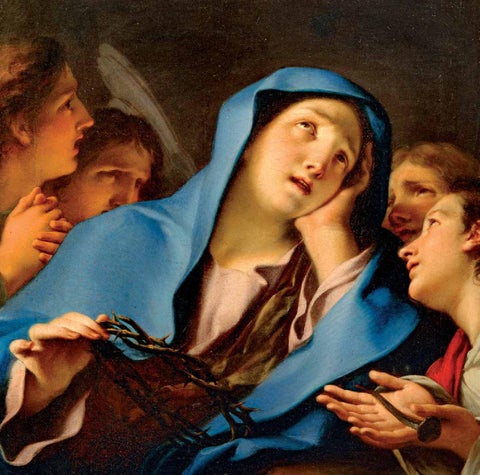
Recording: July 2007, église Saint-Apollinaire à Bolland, Artistic direction, recording & editing: Jérôme Lejeune English translations: Peter Lockwood Deutsche Übersetzungen: Silvia Berutti-Ronelt Cover illustration: Christoph Unterberger (1732-1798), The Virgin (Mater dolorosa) and angels, Paris, Musée du Louvre Photo: © akg-images / Erich Lessing
Domenico SCARLATTI (1685-1757)
Sacred works – Vox Luminis Zsuzsi Tóth, Sarah Abrams, Sara Jäggi, Helen Cassano: sopranos Paulin Bündgen, Jan Kullmann: counter-tenors João Sebastião, Robert Buckland: tenors Bertrand Delvaux, Lionel Meunier *: basses Anne Nissinen: organ Jan Cižmár: theorbo Ricardo Rodriguez Miranda: bass viol * artistic direction
Te Deum laudamus for 2 choirs (SJ, PB, JS, LM / ZT, JK, RB, BD) & basso continuo
1. Te Deum laudamus 2. Te ergo quaesumus
3’06 3’25 6'31
Salve Regina for soprano (SJ), counter-tenor ( JK) & basso continuo
3. Salve Regina (Adagio) 4. Ad te clamamus (Moderato) 5. Eja ergo (Moderato) 6. Et Jesum benedictum (Adagio) 7. O Clemens (Adagio)
2’08 1’25 0’52 1’46 2’00 8'11
8. Sonate d minor K. 417*
6’07
Stabat Mater for 10 voices & basso continuo
9. Stabat Mater dolorosa 10. Cujus animam gementem 11. Quis non posset 12. Eja mater, fons amoris 13. Sancta Mater, istud agas 14. Fac me vere tecum flere 15. Juxta crucem 16. Inflammatus et accensus 17. Fac ut animae donetur paradisi gloria / Amen
3’03 4’24 2’40 1’51 3’04 0’53 1’53 3’06 3’51 24'45
18. Sonate h minor K. 87* 19. Miserere
6’32 11’44
for 4 voices
Miserere mei Deus Et secundum multitudinem * Amplius lava me *** Quoniam iniquitatem * Tibi soli peccavi *** Ecce enim iniquitatem * Ecce enim veritatem *** Asperges me hyssopo * Auditui meo dabis gaudium Averte faciem tuam * Cor mundum crea in me *** Ne projicias me a facie * Redde mihi laetitiam Docebo iniquos vias * Libera me de sanguinibus Domine labia mea aperies * Quoniam si voluisses *** Sacrificium Deo spiritus * Benigne fac, Domine *** Tunc acceptabis sacrificium * Great positive organ Thomas (Abbaye de Maredsous) ** Gregorian (RB) *** Solos (SJ, PB, JS, LM)
FR
DE
FOUR ASPECTS OF THE SACRED MUSIC OF DOMENICO SCARLATTI There is nobody who has not come across one or another of Domenico Scarlatti’s 555 keyboard sonatas, for they are the most celebrated part of his body of work. Who, however, knows anything of the fifteen operas and the dozens of arias, duets and cantatas, or of his oratorios and various other sacred works? Supreme master of the keyboard that he was, Domenico Scarlatti was above all else the inheritor of a Neapolitan and Roman musical tradition in which vocal music in all its forms constituted the essential part of any composer’s creative activity. Today, the originality and clear modernity of his keyboard sonatas has eclipsed an important part of his work, one that may be considered at first sight as being closer to the conventions of the period and therefore possibly less interesting. The compositions of his father Alessandro and especially those of his contemporary Handel have allowed us to become acquainted with the Roman style at the beginning of the 18th century, with the result that we have often been happy enough to focus merely on the importance of Domenico Scarlatti’s keyboard sonatas. This recording raises a part of the veil that is drawn over Scarlatti’s sacred music and reveals several large surprises. We know very little about how Domenico Scarlatti, born in Naples on 26 October 1685, was trained. Was his father Alessandro his only teacher? His professional life began early, for he was already organist to the Royal Chapel in Naples at the age of 16. After a period spent in Florence, he moved to Rome, first as private composer to the exiled queen Maria Casimira of Poland, where he composed principally secular vocal works.
We should not need reminding how important music was in the city of the popes at that time. The opera houses, the churches and private salons — including those of several renowned cardinals — rivalled each other with concerts, theatre works and other musical diversions; there one could meet the most famous musicians of the period such as Arcangelo Corelli and Alessandro Scarlatti alongside such foreigners as the ‘furious Saxon’ himself, George Frideric Handel. This was the world in which Domenico took his first musical steps and measured himself against his elders. He was already well known as a keyboard virtuoso, although this was not his principal musical activity. Following a custom popular at the time, Scarlatti was invited to take part in a competition with Handel; we are told that Scarlatti was the victor on the harpsichord and Handel on the organ! Scarlatti was appointed maestro di cappella of the Basilica Giulia on 22 December 1713, where he would remain until his departure for Portugal in 1719. It is clearly tempting to consider that his sacred compositions therefore date from this period, but we know that he continued his activities as church musician during his time in first Lisbon and then in Madrid. Any exact dating of his sacred works is still highly dubious, given that the style of composition for the greatest part of them is very archaic and linked with the polyphonic tradition in many ways. The most famous sacred work by Domenico Scarlatti is of course the Stabat Mater for ten voices and continuo; the number of manuscript copies of the work that have survived is proof enough of the work’s reputation. All available evidence leads us to believe that it was composed in Rome for the Cappella Giulia. Its vocal layout is extremely surprising, as there is no question of any double choir format, but rather one ensemble of ten solo voices: 4 sopranos, 2 altos, 2 tenors and 2 basses. There is also no question of a group of 5 soloists and 5 ripieno singers; the ten voices are of equal importance and the score is unceasing in its demands for different combinations of the voices available. This variety of layout and organisation for groups of 2 to 10 voices endows the score with great
originality and never ceases to provide contrasting sonorities. The voices are grouped in pair in two places only, in passages for 5 parts at the beginning of the « Eja mater » and the finale of the « Amen ». The emotionally charged text of the Stabat Mater here finds one of its finest musical expressions, formed from extreme harmonic stresses and poetically tender passages, most of these being in slow tempi. Only two verses are marked allegro: the 8th verse « Inflammatus », with its virtuoso writing for the tenor and soprano and the 9th verse in fugato style « Fac ut animae donetur paradisi gloria » that introduce the brilliant concluding « Amen ». Given that Italian tradition in Stabat Maters of the 18th century (those of Pergolesi, Vivaldi, and later Boccherini) did not hesitate to use alternating contrasted tempi that were not necessarily always in direct correlation with the text, Scarlatti’s vision of the piece is darker and more meditative, more bound to the text in a way that is almost madrigalesque. It is only when the light of the entrance to Paradise is described that the music gains momentum, concluding with the undeniably dance-like character of the final 3/8 Amen. The Miserere was certainly a part of the repertoire of the Cappella Giulia. The style of writing here is totally different; four unaccompanied voices without continuo alternate with verses sung in Gregorian chant. Here we have an austerity and simplicity of style that places this Miserere in the direct tradition of music composed for the Papal chapel, following the line of Gregorio Allegri’s renowned Miserere. After the audacious polyphonic treatment of the Stabat Mater, we now have a decidedly severe contrapuntal style that shows that Domenico Scarlatti still knew how to compose in the old-fashioned Renaissance style. We must add that this style was still very much alive at that time; indeed the entrance examination to the renowned Accademia Filarmonica of Bologna was quite simply an exercise in composing in this style. It was exactly this same test that was put to a certain Wolfgang Amadeus Mozart in 1770. The Salve Regina for soprano, alto and continuo is undated, although it is not
impossible to imagine that this composition could well have come from Scarlatti’s Neapolitan period, or was at least inspired by the tradition of music in praise of Mary from this city, previous examples of which include his father Alessandro’s and Pergolesi’s Stabat Mater. This piece is in the same spirit and was written for the same voice types (castrati at that time) as well as, in the majority of cases, for the Confraternità dei Cavalieri della Vergine dei Dolori. The Te Deum, however, could well date from Scarlatti’s time in Portugal. Once more we have a completely different style of composition, with a real double choir in eight parts that uses responsorial and alternation effects between the two groups and a continuo group that has a more ‘instrumental’ effect thanks to its diminutions in running quavers. The Te Deum may well have been sung in Lisbon on 31 December 1721, as can be read in an article of the Gazeta de Lisboa of 1 January 1722: ‘on the final day of the year of 1721, an office of thanksgiving was celebrated in the church of Sao Roque in our city, for all the benefits that God has granted in the course of the year to this kingdom and to its inhabitants. During the office the hymn Te Deum laudamus was sung, remarkably composed by the renowned Domingo Scarlatti and divided up between several choirs of singers’. To return to the famous contest between Handel and Scarlatti, we know that these two virtuosi confronted each other on both the harpsichord and on the organ. No keyboard work by Domenico Scarlatti intended for the organ has survived, although it is clear that, among the 555 keyboard sonatas, there are some that suit the instrument particularly well thanks to their polyphonic character and their moderate tempo. Here now is one more way of showing this lesser-known side of Domenico Scarlatti, a composer who in counterpoint and fugue had absolutely no cause to be jealous of his illustrious contemporary Johann Sebastian Bach. JÉRÔME LEJEUNE
EN
DE
QUATRE VISAGES DE LA MUSIQUE SACRÉE DE DOMENICO SCARLATTI Qui ne connaît l’une ou l’autre des 555 sonates pour le clavier de Domenico Scarlatti ? Indiscutablement, elles constituent la part la plus célèbre de son œuvre. Mais que sait-on de la quinzaine d’opéras, des dizaines d’airs, duos et cantates, des oratorios et des compositions religieuses diverses ? Tout virtuose du clavier qu’il fût, Domenico Scarlatti était avant tout l’héritier d’une tradition musicale napolitaine et romaine, dans laquelle la musique vocale, sous toutes ses formes, constituait l’essentiel de l’activité créatrice d’un compositeur. De nos jours, l’originalité, voire l’évidente modernité de ses sonates de clavier a éclipsé une part importante de son œuvre que l’on a pu considérer, de premier abord, comme plus proche des conventions de l’époque, donc peut-être moins intéressante. Les compositions de son père Alessandro et surtout celles de son contemporain Haendel nous ont suffi à bien connaître la musique romaine du début du XVIIIe siècle et nous nous sommes souvent contentés, en ce qui concerne Domenico Scarlatti, d’insister sur l’importance de ses sonates. Cet enregistrement lève une partie du voile en ce qui concerne la musique sacrée. Et les surprises sont de taille. On sait bien peu de choses de la formation de Domenico Scarlatti, né à Naples le 26 octobre 1685. Son père Alessandro fut-il son unique maître ? Sa vie professionnelle commence tôt puisque, à seize ans, il est déjà organiste de la chapelle royale à Naples. Après un séjour à Florence, c’est à Rome qu’il s’installe, comme compositeur privé de la reine de Pologne exilée, Maria Casimira, où il écrit principalement des œuvres vocales profanes.
Faut-il rappeler l’importance de la musique dans la cité vaticane à cette époque ? Les théâtres d’opéra, les églises, les salons privés, dont ceux des célèbres cardinaux, rivalisent de concerts, spectacles et autres divertissements musicaux ; on y rencontre les plus illustres musiciens de l’époque, en commençant par Arcangelo Corelli et Alessandro Scarlatti, et les étrangers parmi lesquels le « saxon furieux », Georg Friedrich Haendel. C’est dans ce monde que Domenico fait ses premières armes et se confronte à ses aînés. Bien que cela ne soit pas sa principale activité, il est déjà bien connu comme virtuose du clavier. Selon une mode encore très fréquente à l’époque, il fut invité à participer à un concours avec Haendel. On dit que Scarlatti fut le gagnant au clavecin et Haendel à l’orgue ! Le 22 décembre 1713, il obtient le poste de maître de chapelle de la Basilica Giulia. Il y restera jusqu’à son départ pour le Portugal en 1719. On serait évidemment tenté de considérer que ses compostions religieuses datent de cette période. Mais l’on sait que durant ses séjours à Lisbonne, puis à Madrid, il a gardé une activité de musicien d’église. La datation de ses compositions liturgiques reste toujours très incertaine, d’autant plus que leur style d’écriture est, dans l’immense majorité, très archaïque et renoue, sous des aspects divers, avec la tradition de la polyphonie. La plus célèbre composition religieuse de Domenico Scarlatti est le Stabat Mater à dix voix et basse continue. Le nombre de copies manuscrites conservées atteste de sa réputation. Tout porte à croire qu’il fut écrit à Rome pour la Capella Giulia. La disposition vocale de l’ensemble est tout à fait surprenante. Il ne s’agit nullement d’une disposition en double chœur, mais bien d’un ensemble de dix voix solistes : 4 sopranos, 2 altos, 2 ténors, 2 basses. Il ne s’agit pas non plus d’un chœur de 5 solistes et d’un autre chœur de 5 « ripiénistes ». Les dix voix ont toutes le même rôle et la partition ne cesse de faire appel à toutes sortes de combinaisons entre elles ; cette variété d’assemblage entre des effectifs de deux à dix voix confère à cette partition une grande originalité et offre
sans cesse des sonorités contrastées. À deux reprises seulement, les voix sont réunies par paires en une écriture à 5 voix (début du «Eja Mater», et le finale sur «Amen »). Ce très émouvant texte du Stabat Mater trouve ici l’une de ses plus belles expressions musicales, faite de tensions extrêmes, de passages poétiques et tendres, majoritairement dans des mouvements lents. Seuls deux versets font mention d’un tempo « allegro » : le 8e verset «Inflammatus » qui fait apparaître une écriture virtuose confiée à une voix de ténor et une voix de soprano, et le 9e verset (fugato) « Fac ut animae donetur paradisi gloria », introduisant le brillant « Amen » final. Alors que la tradition italienne des Stabat Mater du XVIIIe siècle (Pergolesi, Vivaldi et plus tard Boccherini…) n’hésitait pas à utiliser des alternances de tempos parfois assez contrastés (et qui n’ étaient pas toujours en corrélation directe avec le texte), la vision de Scarlatti est nettement plus sombre, plus méditative, plus liée au texte… presque madrigalesque ! C’est seulement lorsque la lumière de l’accès au Paradis est évoquée que l’écriture s’anime pour se terminer avec une joie évidente dans l’Amen final en 3/8 à l’indéniable caractère dansant. Le Miserere fait certainement partie du répertoire de la Capella Giulia. Ici, l’écriture est totalement différente : un ensemble de quatre voix a capella, sans basse continue, alterne avec des versets chantés en plain-chant ; une austérité, une simplicité d’écriture qui placent directement ce Miserere dans la tradition de la musique de la chapelle pontificale, à la suite du célébrissime Miserere de Gregorio Allegri. Après les audaces polyphoniques du Stabat Mater, ce contrepoint nettement plus sévère montre que Domenico Scarlatti savait encore écrire dans le vieux style de la Renaissance. Il faut dire que cette tradition était bel et bien vivante à l’époque. L’examen d’entrée à la célèbre Académie Philharmonique de Bologne n’était-elle pas tout simplement un travail d’écriture dans ce style ? C’est cette épreuve qui fut encore soumise à un certain Wolfgang Amadeus Mozart en 1770. Le Salve Regina pour soprano, alto et basse continue n’est pas daté. Mais on peut imaginer que cette composition pourrait être sinon de l’époque napolitaine, du moins
inspirée de la tradition des musiques mariales de cette ville, parmi lesquelles se trouvent les Stabat Mater de son père Alessandro et celui de Pergolesi. C’est en effet dans le même esprit et pour ce duo de voix (castrats à l’époque) que furent écrites ces partitions à l’intention, dans la plupart des cas, de l’Archiconfrérie des Chevaliers de la Vierge des Sept Douleurs. Enfin le Te Deum pourrait être une composition de l’époque portugaise. Ici, à nouveau, une écriture toute différente. Un véritable double chœur à huit voix avec effets de réponses et d’alternance entre les deux groupes. Une basse continue nettement plus instrumentale avec ses traits diminués en croches. Ce Te Deum aurait été chanté le 31 décembre 1721 à Lisbonne, ainsi qu’en témoigne un article de la « Gazeta di Lisboa » du 1er janvier 1722 : « Le dernier jour de l’année 1721, un office d’action de grâce a été célébré dans l’église de Sao Roque de notre ville, pour tous les bienfaits que Dieu a octroyé au cours de cette année à ce royaume et à ses habitants. Au cours de cet office on a entonné l’hymne Te Deum laudamus que le célèbre Domenico Scarlatti a remarquablement mis en musique et réparti sur plusieurs chœurs de chanteurs… » Enfin, si l’on revient à ce fameux concours entre Haendel et Scarlatti, on sait que les deux virtuoses se sont confrontés au clavecin et à l’orgue. Nous n’avons conservé aucune partition de clavier de Domenico Scarlatti destinée à l’orgue. Mais il est évident que, parmi les 555 sonates, certaines, par leur côté polyphonique, par leur tempo modéré, conviennent particulièrement bien à cet instrument. Voilà une façon de plus d’illustrer cette facette moins connue de Domenico Scarlatti, celle d’un compositeur qui n’a rien à envier en ce domaine du contrepoint et de la fugue à son illustre contemporain : Johann Sebastian Bach. JÉRÔME LEJEUNE
EN
FR
VIER ASPEKTE DER GEISTLICHEN MUSIK DOMENICO SCARLATTIS Wer kennt nicht die eine oder die andere der 555 Cembalosonaten Domenico Scarlattis? Sie bilden unbestreitbar den berühmtesten Teil seines Werkes. Doch was weiß man schon von den fünfzehn Opern, den Dutzenden von Arien, Duetten und Kantaten, den Oratorien und seinen verschiedenen geistlichen Kompositionen? Obwohl Domenico Scarlatti ein großer Cembalovirtuose war, so schrieb er doch vor allem in der neapolitanischen und römischen Tradition, bei der die Vokalmusik in all ihren Formen den wesentlichen Teil im Schaffen eines Komponisten darstellte. In unserer Zeit hat die Originalität, ja die offensichtliche Modernität seiner Cembalosonaten einen bedeutenden Teil seines Werkes in den Schatten gestellt, da man diese Werke auf den ersten Blick mehr den Konventionen seiner Zeit entsprechend und daher vielleicht als weniger interessant betrachtete. Die Kompositionen seines Vaters Alessandro und vor allem die seines Zeitgenossen Händel genügten uns, um die römische Musik des beginnenden 18. Jh. gut zu kennen, und was Domenico Scarlatti betrifft, so gaben wir uns damit zufrieden, auf der Bedeutung seiner Sonaten zu bestehen. Diese Aufnahme lüftet den Schleier teilweise in Hinsicht auf die geistliche Musik. Und die Überraschungen sind dabei gewaltig. Über die Ausbildung Domenico Scarlattis, der am 27. Oktober 1685 in Neapel geboren wurde, wissen wir recht wenig. War sein Vater Alessandro sein einziger Lehrmeister? Seine berufliche Laufbahn beginnt früh, denn mit sechzehn Jahren ist er bereits Organist an der königlichen Kapelle von Neapel. Nach einem Aufenthalt in Florenz, lässt er sich in Rom nieder, und zwar zunächst als Privatkomponist der im Exil lebenden polnischen Königin Maria Casimira, wo er hauptsächlich profane Vokalwerke schreibt.
Muss daran erinnert werden, welche Bedeutung die Musik zu dieser Zeit im Roma hatte ? Die Opernhäuser, Kirchen, Privatsalons – darunter solche berühmter Kardinäle – rivalisierten mit Konzerten, Aufführungen und anderen musikalischen Vergnügungen; man traf dort die bedeutendsten Musiker der Zeit, etwa Arcangelo Corelli und Alessandro Scarlatti, außerdem Ausländer wie den „rasenden Sachsen“ Georg Friedrich Händel. In dieser Umgebung verdient sich Domenico seine ersten Sporen und sieht sich mit den älteren Musikern konfrontiert. Er ist bereits als Klaviervirtuose bekannt, obwohl dies nicht seine Hauptbeschäftigung ist. Nach einer damals noch sehr häufigen Mode wird er eingeladen, an einem Wettbewerb mit Händel teilzunehmen. Angeblich hat Scarlatti auf dem Cembalo und Händel auf der Orgel gewonnen! Am 22. Dezember 1713 erhält er den Kapellmeisterposten an der Basilica Giulia. Dort bleibt er bis zu seiner Reise nach Portugal im Jahre 1719. Man könnte natürlich versucht sein, zu denken, dass seine geistlichen Kompositionen aus dieser Zeit stammen. Doch ist bekannt, dass er während seines Aufenthalts in Lissabon und danach in Madrid weiterhin als Kirchenmusiker wirkte. Die Datierung seiner liturgischen Werke bleibt bis auf weiteres unsicher, umso mehr als ihr Kompositionsstil in der überwiegenden Mehrheit sehr archaisch ist und in verschiedener Hinsicht an die Tradition der Polyphonie anknüpft. Die berühmteste geistliche Komposition Domenico Scarlattis ist selbstverständlich sein „Stabat Mater“ für zehn Stimmen und Basso continuo. Die Anzahl der erhaltenen handschriftlichen Kopien bezeugt dessen Ruf. Alles deutet darauf hin, dass es in Rom für die Capella Guilia geschrieben wurde. Die Konzeption des Vokalensembles ist völlig überraschend. Es handelt sich keinesfalls um eine Aufteilung in einen Doppelchor, sondern um ein Ensemble von zehn Solistenstimmen: 4 Soprane, 3 Alti, 2 Tenöre, 2 Bässe. Ebensowenig liegt aber ein Chor von 5 Solisten und ein anderer Chor von 5 „Ripienisten“ vor. Die zehn Stimmen haben hier alle die gleiche Rolle, wobei es zu den verschiedensten Kombinationen zwischen den einzelnen Stimmen kommt; diese Vielfalt an Zusammenstellungen von zwei bis zehn Stimmen verleiht dem Werk große Originalität und bietet unentwegt kontrastreiche
Klänge. Zweimal nur vereinen sich die Stimmen paarweise in einem fünfstimmigen Satz (zu Beginn des „Eja Mater“ und zum Schluss beim „Amen“). Der ergreifende Text des „Stabat Mater“ findet hier eine seiner schönsten musikalischen Fassungen mit äuß ersten Spannungsmomenten und poetischen, zärtlichen Passagen hauptsächlich in den langsamen Sätzen. Nur zwei Verse geben das Tempo „Allegro“ an: der 8. Vers, „Inflammatus“, der virtuos komponiert wurde und einer Tenor- sowie einer Sopranstimme anvertraut ist, und der 9. Vers (Fugato), „Fac ut animae donetur paradisi gloria“, mit dem ein brillantes, abschließendes Amen eingeleitet wird. Während die italienische Tradition des „Stabat Mater“ im 18. Jh. (Pergolesi, Vivaldi und später Boccherini …) nicht zögerte, manchmal ziemlich kontrastierende Tempi abwechseln zu lassen (wobei diese nicht immer mit dem Text in Zusammenhang standen), ist Scarlattis Auffassung deutlich düsterer, meditativer, enger an den Text gebunden... fast madrigalistisch)! Erst als vom Licht beim Eintreten ins Paradies die Rede ist, kommt Leben in die Komposition, die mit einem Abschluss-Amen in offensichtlicher Freude und einem unbestreitbar tänzerischen 3/8-Rhythmus endet. Das „Miserere“ gehört sicher zum Repertoire der Capella Guilia. Die Kompositionsweise ist hier vollkommen verschieden: Vier Stimmen a cappella ohne Basso continuo antworten abwechselnd auf Verse, die im gregorianischen Choral gesungen werden. Seine Strenge und Einfachheit ordnet dieses „Miserere“ in der Nachfolge des hochberühmten „Miserere“ von Gregorio Allegri“ direkt in die Tradition der Musik der päpstlichen Kapelle ein. Nach den gewagten Polyphonien des „Stabat Mater“ finden wir hier einen weit strengeren Kontrapunkt, der zeigt, dass Domenico Scarlatti fähig war, noch im alten Renaissancestil zu schreiben. Zugegeben, diese Tradition war zu seiner Zeit noch sehr lebendig. Bestand die Aufnahmeprüfung an die berühmte Philharmonische Akademie von Bologna nicht etwa aus einer Komposition in diesem Stil? Dieser Aufgabe wurde noch ein gewisser Wolfgang Amadeus Mozart im Jahre 1770 unterzogen. Das „Salve Regina“ für Sopran, Alt und Basso continuo ist nicht datiert. Doch ist es
durchaus vorstellbar, dass diese Komposition, wenn sie nicht aus der neapolitanischen Zeit stammt, so wenigstens von der Tradition der Musik zur Marienverehrung dieser Stadt inspiriert ist, zu der das „Stabat Mater“ seines Vaters Alessandro und das Pergolesis gehören. Diese Werke wurden nämlich im gleichen Geist und für eben dieses Stimmenduett (damals Kastraten) in den meisten Fälllen für die adelige Bruderschaft der sieben Schmerzen Mariens geschrieben. Das „Te Deum“ könnte schließlich aus der portugiesischen Zeit stammen. Hier liegt wieder eine ganz andere Kompositionsweise vor. Ein echter achtstimmiger Doppelchor mit Antwortund Abwechslungseffekten zwischen den beiden Gruppen. Der Basso continuo ist mit seinen diminuierten Achtelläufen deutlich „instrumentaler“. Dieses « Te Deum » könnte am 31. Dezember 1721 in Lissabon aufgeführt worden sein, wie ein Artikel der « Gazeta di Lisboa“ vom 1. Januar 1722 berichtet: „Am letzten Tag des Jahres 1721 wurde ein Gnadengottesdienst in der Kirche Sao Roque unserer Stadt gefeiert für alle Wohltaten, die Gott im Laufe dieses Jahres diesem Königreich und seinen Bewohnern zukommen ließ. Im Laufe dieses Gottesdienstes wurde die Hymne „Te Deum laudamus“ angestimmt, die der berühmte Domingos Scarlatti bemerkenswert in Musik gesetzt und auf mehrere Chöre von Sängern aufgeteilt hat ...“ Kommen wir auf den viel zitierten Wettbewerb zwischen Händel und Scarlatti zurück: Es ist bekannt, dass sich die beiden Virtuosen auf dem Cembalo und auf der Orgel Konkurrenz gemacht haben. Dabei ist uns kein Orgelwerk Domenico Scarlattis erhalten geblieben. Es ist jedoch selbstverständlich, dass sich unter den 555 Sonaten einige durch ihren polyphonen Charakter und ihr mäßiges Tempo besonders gut für dieses Instrument eignen. So ergibt sich eine weitere Möglichkeit, diese weniger bekannte Facette Domenico Scarlattis aufzuzeigen, nämlich die eines Komponisten, der auf dem Gebiet des Kontrapunktes und der Fuge seinem berühmten Zeitgenossen Johann Sebastian Bach in nichts nachstand. JÉRÔME LEJEUNE
Te Deum Te Deum laudamus, te Dominum confitemur. Te aeternum Patrem, omnis terra veneratur.
Ô Dieu! nous te louons. Ô Seigneur, nous te glorifions. Père éternel, la terre entière te vénère.
Tibi omnes Angeli, tibi coeli et universae potestates, tibi Cherubim et Seraphim incessabili voce proclamant:
C'est pour toi que tous les Anges, les Cieux, et toutes les Puissances célestes, les Chérubins et les Séraphins chantent éternellement :
«Sanctus, Sanctus, Sanctus, Dominus Deus Sabaoth. Pleni sunt coeli et terra majestatis gloriae tuae. »
« Saint, Saint, Saint, le Seigneur Dieu des armées. Les cieux et la terre sont remplis de la majesté de ta gloire. »
Te gloriosus Apostolorum chorus, te Prophetarum laudabilis numerus te Martyrum candidatus laudat exercitus.
C'est toi que les Apôtres glorifient, toi que proclament les prophètes, toi dont témoignent les martyrs.
Te per orbem terrarum sancta confitetur Ecclesia, Patrem immensae majestatis; venerandum tuum verum et unicum Filium; Sanctum quoque Paraclitum Spiritum.
Dans toute l’étendue de l’univers, l’Église t’adore, Ô toi, Père d’infinie Majesté; et ton adorable Fils unique et véritable; et le Saint-Esprit consolateur.
Tu Rex gloriae, Christe. Tu Patris sempiternus es Filius. Tu, ad liberandum suscepturus hominem, non horruisti Virginis uterum.
Ô Christ, tu es le Roi de gloire; tu es le Fils éternel du Père. Pour t’incarner et nous sauver, tu n’as pas eu horreur du sein d’une Vierge.
Tu devicto mortis aculeo, aperuisti credentibus regna coelorum.
Brisant l’aiguillon de la mort, tu as ouvert à ceux qui croient le royaume des cieux.
We praise thee, O God, we acknowledge thee to be the Lord. All the earth doth worship thee, the Father everlasting.
Dir, o Gott, unser Lob! Dir, o Herr, unser Preis! Dir, dem ewigen Vater, huldigt in Ehrfurcht die ganze Erde.
To thee all Angels cry aloud, the heavens and all the powers therein. To thee cherubim, and seraphim, continually do cry:
Dir jauchzen die Engel all, dir die Himmel, dir alle Machte. Dir Cherubim und Seraphim ohn’ Ende jauchzen sie alle dir zu:
‘Holy, Holy, Holy, Lord God of Sabaoth. Heaven and earth are full of the majesty of thy glory.’
«Heilig, Heilig, Heilig! Herr, Gott der himmlischen’ Heere!» Himmel und Erde erfüllt deiner Herrlichkeit Größe.
The glorious company of the apostles praise thee, the goodly fellowship of the prophets praise thee. The noble army of martyrs praise thee.
Dich lobpreist der Apostel glorreicher Chor, dich der Propheten ruhmwürdige Schar, dich der Märtyrer strahlendes Heer.
The holy church throughout all the world doth acknowledge thee; the Father of an infinite majesty; thine honourable, true and only Son; also the Holy Ghost, the Comforter.
Dich bekennet über den Erdkreis hin die heilige Kirche: den Vater voll unermeßlicher Hoheit; deinen wahren und einzigen Sohn aller Anbetung würdig; deinen Heiligen Geist auch, den Tröster.
Thou art the King of Glory, O Christ; thou art the everlasting Son of the Father. When thou tookest upon thee to deliver man, thou didst not abhor the Virgin’s womb.
Du bist König der Glorie, Christus! Du des Vaters ewiger Sohn! Du scheutest nicht zurück vor dem Schoße der Jungfrau, um die Menschheit zu retten.
When thou hadst overcome the sharpness of death, thou didst open the Kingdom of Heaven to all believers.
Du hast besiegt den Stachel des Todes, und allen, die glauben, die himmlischen Reiche geöffnet. Du
Tu ad dexteram Dei sedes, in gloria Patris.
Tu es assis à la droite de Dieu, dans la gloire du Père.
Judex crederis esse venturus. Te ergo quaesumus, tuis famulis subveni, Quos pretioso sanguine redemisti. Aeterna fac cum sanctis tuis, in gloria numerari.
Nous croyons que tu viendras un jour juger l’univers. Nous te supplions donc de secourir tes serviteurs rachetés par ton sang précieux. Fais qu’ils soient comptés parmi tes Saints dans la gloire éternelle.
Salvum fac populum, Domine, et benedic haereditati tuae. Et rege eos, et extolle illos usque in aeternum.
Sauve ton peuple, Seigneur, et bénis ton héritage; conduis-le, et élève-le jusqu’à l’éternité.
Per singulos dies benedicimus te; et laudamus nomen tuum in saeculum et in saeculum saeculi.
Chaque jour, nous te bénissons; nous louons ton nom, maintenant et dans tous les siècles des siècles.
Dignare, Domine, die isto sine peccato nos custodire. Miserere nostri, Domine, miserere nostri.
Daigne, Seigneur, pendant ce jour, nous préserver de tout péché. Aie pitié de nous, Seigneur, aie pitié de nous.
Fiat misericordia tua, Domine super nos, quemadmodum sepravimus in te. In te Domine speravi: non confundar in aeternum.
Étends sur nous ta miséricorde, Seigneur, selon que nous avons espéré en toi. J’espère en toi, Seigneur : je ne serai pas confondu à jamais.
Thou sittest at the right hand of God, in the glory of the Father.
throntest zur Rechten Gottes, in der Glorie des Vaters.
We believe that thou shalt come to be our Judge. We therelore pray thee, help thy servants, whom thou hast redeemed with thy precious blood. Make them to be numbered with thy saints in glory everlasting.
Du wirst kommen als Richter, so bekennt unser Glaube. Dich nur flehen wir an: komme deinen Dienern zu Hilfe, die du erkauft um dein kostbares Blut. Unter die Schar deiner Heiligen lasse uns zählen, im Reiche der ewigen Herrlichkeit.
O Lord, save thy people, and bless thine heritage; govern them, and lift them up for ever.
Rette, o Herr, dein Volk, dein Eigentum segne; lenke uns, trag uns in Ewigkeit!
Day by day we magnify thee; and we worship thy name, ever world without end.
Tag für Tag preisen wir dich; ewiglich loben wir deinen Namen bis hinein in die Ewigkeit der Ewigkeit.
Vouchsafe, O Lord, to keep us this day without sin. O Lord, have mercy upon us, have mercy upon us.
Herr, bewahre uns heute huldvoll vor jeglicher Sünde. Erbarm dich unser, o Herr, erbarme dich unser.
O Lord, let thy mercy lignten upon us, as our trust is in thee. O Lord, in thee have I trusted; let me never ne confounded.
Laß dein Erbarmen, o Herr, über uns walten, wie wir von dir es erhoffen. Ja, Herr, du bist meine Hoffnung: nie wende ich zuschanden in Ewigkeit.
Salve Regina Salve Regina, Mater misericordiae, vita dulcedo et spes nostra, salve. Ad te clamamus, exsules filii Evae. Ad te suspiramus, gementes et flentes in hac lacrimarum valle. Eia ergo advocata nostra, illos tuos misericordes oculos ad nos con verte . Et Jesum, benedictum fructum ventris tui, nobis post hoc exsilium ostende. O clemens, a pia, o dulcis virgo Maria.
Salut à toi, Reine, Mère de miséricorde, notre vie, notre douceur et notre espoir, salut à toi. Vers toi montent nos cris, nous les fils d’Eve en exil. Vers toi nous soupirons, en gémissant et en pleurant dans cette vallée de larmes. Alors toi, notre secours, tourne vers nous tes yeux miséricordieux. Et après cet exil, montre nous Jésus, le fruit béni de tes entrailles. Ô vierge Marie, indulgente, sainte et douce.
Stabat Mater 1. Stabat mater dolorosa Juxta Crucem lacrimosa Dum pendebat filius
1. Debout, la Mère douloureuse Près de la croix était en larmes Devant son Fils suspendu.
2. Cujus animam gementem Contristatem et dolentem Pertransivit gladius.
2. Dans son âme qui gémissait Toute brisée, endolorie, Le glaive était enfoncé.
O quam tristis et afflicta Fuit illa benedicta Mater Unigeniti.
O qu’elle était triste et affligée La Mère entre toutes bénie, La Mère du Fils unique!
Quae merebat et dolebat Et tremebat cum videbat Nati penas incliti
Qu’elle avait mal, qu’elle souffrait, La tendre Mère, en contemplant Son divin Fils toumenté!
Hail Queen, mother of pity; our life, sweetness, and hope, hail. To thee we cry, the exiled sons of Eve. To thee we sigh, lamenting and weeping in this vale of tears. Therefore, our advocate, turn thy pitiful eyes upon us. And show us, after this exile, Jesus, the blessed fruit of thy womb. O merciful, O holy, O sweet Virgin Mary.
Heil Dir, Königin, Gnadenmutter; unser Leben, unsere Süße und Hoffnung, heil. Dich rufen wir an, wir, die verbannten Söhne Evas. Zu Dir seufzen wir, klagen und weinen in diesem Jammertal. Deshalb, Fürsprecherin, wende Deine gnädigen Augen uns zu. Und zeige uns, nach dieser Verbannung, Jesus, die geheiligte Frucht Deines Leibes. O barmhrezige, o heilige, o süße Jungfrau Maria.
1. The Mother of Sorrows stood weeping next to the Cross on which her Son was hung.
1. Christi Mutter stand mit Schmerzen Bei dem Kreuz und weint’ von Herzen, Als ihr lieber Sohn da hing.
2. A sword transfixed Her groaning soul, anguished and lamenting.
2. Durch die Seele voller Trauer, Seufzend unter Todesschauer, Jetzt das Schwert des Leidens ging.
O how sad and afflicted Was that blessed Mother, Mother of the Only-Begotten.
Welch ein Weh der Auserkornen, Da sie sah den Eingebor’nen, Wie er mit dem Tode rang!
She mourned and grieved and trembled when she saw her glorious Son in torment.
Angst und Trauer, Qual und Bangen, Alles Leid hielt sie umfangen Das nur je ein Herz durchdrang.
Quis est homo, qui non fleret, Christi Matrem si videret In tanto supplicio?
Quel est celui qui sans pleurer Pourrait voir la Mère du Christ Dans un supplice pareil?
3. Quis non possit contristari Piam matrem contemplari Dolentem cum filio.
3. Qui pourrait sans souffrir comme elle Contempler la Mère du Christ Douloureuse avec son Fils?
Pro peccatis sue gentis Vidit Jesum in tormentis, Et flagellis subditum
Pour les péchés de tout son peuple Elle le vit dans ses tourments Subissant les coups de fouet.
Vidit suum dulcem natum Morientem desolatum Dum emisit spiritum .
Elle vit son enfant très cher Mourir dans la désolation Alors qu’il rendait l’esprit.
4. Eia, Mater, fons amoris, Me sentire vim doloris Fac,ut tecum lugeam. Fac ut ardeat cor meum In amando Christum Deum Ut sibi complaceam. 5. Sancta Mater, istud agas, crucifixi fige plagas cordi meo valide. Tui nati vulnerati tam dignati pro me pati penas mecum divide.
4. Daigne, ô Mère, source d’amour, Me faire éprouver tes souffrances Pour que je pleure avec toi. Fais qu’en mon cœur brûle un grand feu Pour mieux aimer le Christ mon Dieu Et que je puisse lui plaire. 5. O sainte Mère, daigne donc Graver les plaies du Crucifié Profondément dans mon cœur. Ton enfant n’était que blessures, Lui qui daigna souffrir pour moi, Donne-moi part à ses peines.
Who is the man that could not weep if he should see the Mother of Christ in such agony? 3. Who could not feel compassion, contemplating the Holy Mother sorrowladen with her Son?
Wer könnt’ ohne Tränen sehen Christi Mutter also stehen In so tiefen Jammers Not? 3. Wer nicht mit der Mutter weinen, Seinen Schmerz mit ihrem einen, Leidend bei des Sohnes Tod?
She saw Jesus in torment, subjected to scourging for the sins of mankind.
Ach, für seiner Brüder Schulden Sah sie Jesus Marter dulden, Geißeln, Dornen, Spott und Hohn.
She saw her sweet Son dying forsaken as he yielded up the ghost.
Sah ihn trostlos und verlassen An dem blut’gen Kreuz erblassen, Ihren lieben einz’gen Sohn.
4. Blessed Mother, fount of love, make me feel the depths of thy sorrow that I may mourn with thee. Make my heart burn with love for Christ my God that I may please Him. 5. Holy Mother, do this for me, let the wounds of the Crucified be engraved deep upon my heart. Thy Son, wounded grievously, deigned to suffer for me; let me share his pain.
4. Gib, o Mutter, Born der Lieben Daß ich mich mit dir betrübe, Daß ich fühl die Schmerzen dein. Daß mein Herz von Lieb entbrenne, Daß ich nur noch Jesus kenne, Daß ich liebe Gott allein. 5. Heil’ge Mutter, drück die Wunden, Die dein Sohn am Kreuz empfunden, Tief in meine Seele ein. Ach, das Blut, das er vergossen, Ist für mich dahingeflossen; Maß mich teilen seine Pein.
6. Fac me vere tecum flere Crucifixo condolere Donec ego vixero.
6. Qu’en bon fils, je pleure avec toi, Qu’avec le Christ en croix, je souffre Chacun des jours de ma vie!
7. Juxta Cruce tecum stare Te libenter sociare In plantu desidero.
7. Etre avec toi près de la croix Et ne faire qu’un avec toi, C’est le vœu de ma douleur.
Virgo Virginum preclara Michi jam non sis amara Fac me tecum plangere. Fac ut portem Christi mortem Passionis eius sortem Et plagas recollere.
Vierge bénie entre les vierges, Pour moi ne sois pas trop sévère Et fais que je souffre avec toi. Que je porte la mort du Christ, Qu’à la Passion je sois uni, Que je médite ses plaies!
Fac me plagis vulnerati Cruce hac inebriari Ob amorem filii.
Que de ses plaies je sois blessé, Que je m’enivre de la croix Et de l’amour de ton Enfant!
8. Inflamatus et acensus Per te Virgo, sin defensus, In die judicii.
8. Pour ne pas brûler dans les flammes, Prends ma défense, Vierge Marie, Au grand jour du jugement.
Fac me Cruce custodiri Morte Christi premuniri Consoneri gratia
Fais que je sois gardé par la croix, Protégé par la mort du Christ En harmonie avec sa grâce.
Quando Corpus morietur 9. Fac ut anime donetur Paradisi gloria. Amen.
Au moment où mon corps mourra 9. Fais qu’à mon âme soit donnée La gloire du Paradis. Amen.
6. Let me truly weep with thee; may I suffer with Christ on the Cross for as long as I may live.
6. Laß mit dir mich herzlich weinen, Ganz mit Jesu Leid vereinen, Solang hier mein leben währt.
7. To stand with thee by the Cross and freely to join with thee in thy weeping.
7. Unterm Kreuz mit dir zu stehen, Dort zu teilen deine Wehen, Ist es, was mein Herz begehrt.
Virgin of virgins most blessed, do not be harsh with me; let me weep with thee. Grant that I may bear Christ’s death, let me share His Passion and think upon his wounds.
O du Jungfrau der Jungfrauen, Wollst in Gnaden mich anschauen, Laß mich teilen deinen Schmerz. Laß mich Christi Tod und Leiden, Marter, Angst und bittres Scheiden Fühlen wie dein Mutterherz.
Let me be wounded with His wounds, inebriated with the Cross for love of your Son.
Mach, am Kreuze hingesunken, Mich von Christi Blute trunken Nur aus Lieb’ zu deinem Sohn.
8. Inflamed and burning, may I be defended by thee, o Virgin, at the Last Judgement. May I be protected by the Cross, saved by the death of Christ and supported by His grace. When my body dies 9. may my soul be granted the glory of Paradise. Amen.
8. Daß nicht zu der ew’gen Flamme Der Gerichtstag mich verdamme, Sprech für mich dein reiner Mund. Frei, durch Christi Kreuz und Tod, Ist der Mensch von Erbschulds Not; Mache ihn an Gnaden reich. Jesus, wann mein Leib wird sterben, 9. Laß dann meine Seele erben Deines Himmels Seligkeit! Amen.
Miserere mei Deus Miserere mei Miserere mei, Deus, secundum magnam misericordiam tuam.
Aie pitié de moi, ô mon Dieu, selon ta grande miséricorde.
Et secundum multitudinem miserationum tuarum, dele iniquitatem meam. Amplius lava me ab injustitia mea, et a delicto meo munda me.
Et efface mon Iniquité, selon la multitude de tes bontés. Lave-moi de plus en plus de mes souillures, et purifie-moi de mon péché.
Quoniam iniquitatem meam ego cognosco, et peccatum meum contra me est semper.
Car je connais mon injustice, et mon crime s’élève sans cesse contre moi.
Tibi soli peccavi, et malum coram te feci: ut justificeris in sermonibus tuis, et vincas cum judicaris.
J’ai péché contre toi seul, et j’ai fait le mal devant toi: tu l’as permis, afin d’être reconnu fidèle dans tes promesses, et irréprochable dans tes jugements.
Ecce enim in iniquitatibus conceptus sum, et in peccatis concepit me mater mea.
J’ai été conçu dans l’iniquité, et ma mère m’a engendré dans le péché.
Ecce enim veritatem dilexisti: incerta et occulta sapientiae tuae manifestasti mihi.
Mais toi, Seigneur, tu aimes la vérité, et tu m’as manifesté les mystères cachés de ta sagesse.
Asperges me hyssopo, et mundabor; lavabis me, et super nivem dealbabor.
Tu m’arroseras avec l’hysope, et je serai purifié; tu me laveras, et je deviendrai plus blanc que la neige.
Auditui meo dabis gaudium et laetitiam, et exsultabunt ossa humiliata.
Tu feras entendre à mon oreille des paroles de consolation et de joie, et mes os brisés tressailliront d’allégresse.
Averte faciem tuam a peccatis meis, et omnes iniquitates meas dele.
Détourne tes regards de mes offenses, et efface toutes mes iniquités.
Have mercy upon me, O God, alter thy great goodness.
Gott, sei mir gnädig nach deiner Güte.
According to the multitude of thy mercies do away mine offences. Wash me throughly from my wickedness, and cleanse me from my sin.
Tilge meine Sünden nach deiner großen Barmherzigkeit. Wasche mich rein von meiner Missetat, und reinige mich von meiner Sünde.
For I acknowledge my faults, and my sin is ever before me.
Denn ich erkenne meine Missetat, und mein Sünde ist immer vor mir.
Against thee only have I sinned, and done this evil in thy sight; that thou mightest be justified in thy saying, and clear when thou art judged.
An dir allein habe ich gesündigt und übel vor dir getan, auf daß du recht behaltest in deinen Worten und rein dastehst, wenn du richtest.
Behold, I was shapen in wickedness, and in sin hath my mother conceived me.
Siehe, ich bin als Sünder geboren, und meine Mutter hat mich in Sünden empfangen.
But lo, thou requirest truth in the inward parts, and shalt make me to understand wisdom secretly.
Siehe, dir gefällt Wahrheit, die im Verborgenen liegt, und im Geheimen tust du mir Weisheit kund.
Thou shalt purge me with hyssop, and I shall be clean; thou shalt wash me, and I shall be whiter than snow.
Entsündige mich mit Ysop, daß ich rein werde; wasche mich, daß ich schneeweiß werde.
Thou shalt make me hear of joy and gladness, that the bones which thou hast broken may rejoice.
Laß mich hören Freude und Wonne, daß die Gebeine fröhlich werden, die du zerschlagen hast.
Turn thy face from my sins, and put out all my misdeeds.
Verbirg dein Antlitz vor meinen Sünden, und tilge alle meine Missetat.
Cor mundum crea in me, Deus, et spiritum rectum innova in visceribus meis.
Crée en moi un cœur pur, ô mon Dieu, et renouvelle dans mon âme l’esprit de droiture.
Ne projicias me a facie tua, et spiritum sanctum tuum ne auferas a me.
Ne me rejette pas de ta présence et ne retire pas de moi ton Esprit-Saint.
Redde mihi laetitiam salutaris tui; et spiritu principali confirma me.
Rends-moi la joie de ton salut; et affermis-moi par ton esprit souverain.
Docebo iniquos vias tuas, et impii ad te convertentur.
J’enseignerai tes voies aux méchants et les impies se convertiront à toi.
Libera me de sanguinibus, Deus, Deus salutis meae, et exsultabit lingua mea justitiam tuam.
Ô Dieu, Dieu sauveur, délivre-moi du sang que j’ai versé et ma langue célébrera ta justice.
Domine, labia mea aperies, et os meum annuntiabit laudem tuam.
Seigneur, tu ouvriras mes lèvres, et ma bouche chantera tes louanges.
Quoniam si voluisses sacrificium, dedissem utique; holocaustis non delectaberis.
Si tu avais voulu des sacrifices, je t’en aurais offerts; mais les holocaustes ne te sont point agréables.
Sacrificium Deo spiritus contribulatus; cor contritum et humiliatum, Deus, non despicies.
Le sacrifice qui plaît à Dieu, c’est une âme brisée de douleur; tu ne mépriseras pas, ô mon Dieu, un cœur contrit et humilié.
Benigne fac, Domine, in bona voluntate tua Sion, ut aedificentur muri Jerusalem.
Sois, Seigneur, dans ta bonté, propice à Sion, et que Jérusalem voie rebâtir ses murs.
Make me a clean heart, O God, and renew a right spirit within me.
Schaffe in mir, Gott, ein reines Herz, und gib mir einen neuen bestandigen Geist.
Cast me not away from thy presence and take not thy holy Spirit from me.
Verwirf mich nicht von deinem Angesicht, und nimm deinen heiligen Geist nicht von mir.
O give me the comlort of thy help again; and stablish me with thy free spirit.
Erfreue mich wieder mit deiner Hilfe, und mit einem willigen Geist rüste mich aus.
Then shall I teach thy ways unto the wicked and sinners shall be converted unto thee.
Ich will die Übertreter deine Wege lehren, daß sich’die Sünder zu dir bekehren.
Deliver me from blood-guiltiness, O God, thou that art the God of my health, and my tongue shall sing of thy righteousness.
Errette mich von Blutschuld, Gott, der du mein Gott und Heiland bist, daß meine Zunge deine Gerechtigkeit rühme.
Thou shalt open my lips, O Lord, and my mouth shall shew thy praise.
Herr, tu meine Lippen auf, daß mein Mund deinen Ruhm verkündige.
For thou desirest no sacrifice, else would I give it thee; but thou delightest not in burnt-offerings.
Denn Schlachtopfer willst du nicht, ich wallte sie dir sonst geben, und Brandopfer gefallen dir nicht.
The sacrifice of God is a troubled spirit; a broken and contrite heart, O God, shalt thou not despise.
Die Opfer, die Gott gefallen, sind ein geängsteter Geist; ein geängstetes, zerschlagenes Herz wirst du, Gott, nicht verachten.
O be favourable and gracious unto Sion; build thou the walls of Jerusalem.
Tu wohl an Zion nach deiner Gnade; baue die Mauern zu Jerusalem.
RIC 258
Listen to samples from the new Outhere releases on: Ecoutez les extraits des nouveautés d’Outhere sur : Hören Sie Auszüge aus den Neuerscheinungen von Outhere auf:
www.outhere-music.com
This is an
Production
The labels of the Outhere Group: Outhere is an independent musical production and publishing company whose discs are published under the catalogues Æon, Alpha, Fuga Libera, Outnote, Phi, Ramée, Ricercar and ZigZag Territoires. Each catalogue has its own well defined identity. Our discs and our digital products cover a repertoire ranging from ancient and classical to contemporary, jazz and world music. Our aim is to serve the music by a relentless pursuit of the highest artistic standards for each single production, not only for the recording, but also in the editorial work, texts and graphical presentation. We like to uncover new repertoire or to bring a strong personal touch to each performance of known works. We work with established artists but also invest in the development of young talent. The acclaim of our labels with the public and the press is based on our relentless commitment to quality. Outhere produces more than 100 CDs per year, distributed in over 40 countries. Outhere is located in Brussels and Paris.
Full catalogue available here
At the cutting edge of contemporary and medieval music
Full catalogue available here
The most acclaimed and elegant Baroque label
Full catalogue available here
Full catalogue available here
30 years of discovery of ancient and baroque repertoires with star performers
A new look at modern jazz
Full catalogue available here
Gems, simply gems
Philippe Herreweghe’s own label
Full catalogue available here
From Bach to the future…
Full catalogue available here
Discovering new French talents
Here are some recent releases‌
Click here for more info