Johann Sebastian Bach
Wo soll ich fliehen hin cellini consort
BLACK SERIES
Programme
Ensemble
English text
German text
French text
Imprint
^menu
Johann Sebastian Bach (1685–1750)
Wo soll ich fliehen hin TRANSCRIPTIONS FOR VIOL TRIO TRANSKRIPTIONEN FÜR GAMBENTRIO TRANSCRIPTIONS POUR TRIO DE VIOLES DE GAMBE
French Suite in G Major bwv 816 1 2 3 4 5
Allemande Courante Sarabande Gavotte Gigue
3:39 2:18 5:12 1:19 4:19
Fantasia and Fuge in D Minor bwv 905 6 7 8
Andante Fuga
Kommst du nun, Jesu, vom Himmel herunter bwv 650
2:03 3:25 4:10
9
Ach Gott und Herr bwv 692
2:02
Italian Concerto bwv 971 10 11 12
4:16 4:32 4:36
Allegro assai Andante Presto
13
Trio super: Nun komm’ der Heiden Heiland bwv 660
3:41
14
Wo soll ich fliehen hin bwv 646
2:26
Sonata in D Major bwv 1028 15 16 17 18 19
1:58 3:52 4:48 4:26
Adagio Allegro Andante Allegro
Wer nur den lieben Gott lässt walten bwv 691 total
2:25 65:44
^menu CELLINI CONSORT
TORE EKETORP
Five-string Pardessus de Viole (Quinton) Nicolas Harmand c. 1750 Bass Viol Judith Kraft 2006, after Guillaume Barbey
BRIAN FRANKLIN
Treble Viol Christian Brosse 1982, after Pieter Rombouts Tenor Viol Christian Brosse 2014, after Giovanni Paolo Maggini Bass Viol Christian Brosse 1984, after Barak Norman
THOMAS GOETSCHEL
Six-string Pardessus de Viole Serge Rinsoz 1999, after Nicolas Bertrand Tenor Viol Christian Brosse 2014, after Giovanni Paolo Maggini Bass Viol attr. Johann Christian Hoffmann c. 1720
www.celliniconsort.ch
4
Brian Franklin – Tore Eketorp – Thomas Goetschel
5
^menu The CELLINI CONSORT was founded in 2012 by three viol players, Tore Eketorp, Brian Franklin, and Thomas Goetschel. The success of their harmonic partnership and evident delight in playing together impressed audiences from the very first concert. The group’s first public appearance, at the Zürich Festival of Early Music, earned them an immediate offer of a CD recording co-produced by the Swiss broadcaster SRF 2 Kultur. The CD, Sweet Melancholy, has been released by Coviello Classics, and received a five-star appraisal in Fono Forum magazine (Germany, August 2016). The reviewer, Matthias Hengelbrock, praised the group’s “remarkable dedication to the music [...] over and above their clear subject knowledge and flawless performance technique”. The trio’s calling card is indeed a boundless enthusiasm for Renaissance and Baroque viol repertoire, backed by years of experience of historically informed performances of period repertoire, and reinforced by an intensive process of engagement with the works they perform. This foundation work gives the group great scope for spontaneity in concert performances, allowing the music to shine as freshly as if it was brand new. The Swedish viola da gamba player TORE EKETORP studied initially with Keren Bruce Westerlund in Stockholm before pursuing a postgraduate degree with Paolo Pandolfo at the Schola Cantorum Basiliensis, graduating with dinstinction in 2009. During his time at the Schola he also studied vielle and medieval music with Randall Cook. Tore’s musical activities have taken him to festivals and concert series across Europe, Asia and North and South America. He has won several international competitions and participated in numerous CD, television and radio recordings. BRIAN FRANKLIN, though born in the US, grew up in Toronto, Canada, and first encountered the viola da gamba there. He came to Switzerland to continue his studies with Jordi Savall at the Schola Cantorum Basiliensis (1977–82), and has been teaching at the Zurich University of the Arts (ZHdK) and Zurich Conservatory Music School (MKZ) since 1983. His activities as a performer encompass performing with a range of chamber ensembles, solo duties in Passions and cantatas, and a series of CD recordings. THOMAS GOETSCHEL, born and raised in Kloten, Swizterland, studied viol with Brian Franklin at the Zurich Conservatory of Music (1987–92), graduating with a teaching degree. He continued his studies with Vittorio Ghielmi at the Conservatorio della Svizzera Italiana in Lugano, passing his concert performance exam in 2004. As a member of a number of chamber groups, he has played every member of the viol family from the pardessus to the violone, and is also very active as a concert performer in Switzerland and abroad. He also offers freelance viol tuition in Zürich. 6
rearranged Bach’s Italian Concerto BWV 971 for our ensemble. As this turned out to be a highly effective transformation it was soon followed by Bach’s French Suite (BWV 816) and the solo from the Sonata in D Major (BWV 1028). Any final touches that were needed were polished off in rehearsal.
WO SOLL ICH FLIEHEN HIN Musicians and composers long regarded rearranging and reworking pieces – their own or other people’s – as an essential and ordinary aspect of their craft. It was also a side of music history that spent some time in near invisibility, as historically informed performance, which developed from a strictly historical view of past periods of music history, was virtually silent on the practice. Now, however, reuse is enjoying a renaissance, and has been reintegrated into training programmes. Research aimed at enabling performances that were as authentic as possible naturally uncovered sources which left no doubt about the importance of repurposing, and scholars realised how important copying and rearranging works written by others was to composers in the past, and in particular that it constituted a central practice in seventeenth- and eighteenth-century musical culture. From a contemporary viewpoint, one welcome effect of this discovery is that looking through this refocused historical performance lens produces fresh and original insights on well-known works. We have therefore decided to put together a programme of arrangements of Johann Sebastian Bach’s works under the deliberately playful title “Wo soll ich fliehen hin” (Where shall I flee), in the full knowledge that a viol trio was not their intended destination. The germ of this idea was sown in the summer of 2015, when Thomas Goetschel
Arranging Bach is an attractive idea partly because Bach himself was a prolific arranger. He was particularly active in transcribing for keyboard. In 1713, for example, Bach’s close study of Vivaldi’s violin concertos involved transcribing several of them for harpsichord or organ as part of analysing his contemporary’s style. These transcriptions served a dual purpose: they allowed him to get down to the nuts and bolts of music which evidently fascinated and inspired him, while also making them easier to perform. Bach could now play them on his own, without an ensemble, and could at the same time show off his colleague’s music in a new set of clothes. In a similar vein, many of Bach’s viola da gamba pieces are in fact rearrangements of his own works: take e.g. the Sonata in G Major (BWV 1027), which survives in an earlier version for two traversos and continuo. Bach’s other two sonatas for viola da gamba and harpsichord (in D Major, BWV 1028, and G Minor, BWV 1029) were also apparently originally written for other instruments, though the “original” exemplars 7
three seven-stringed bass viols. For the Sonata in D Major, we chose the closely paired sounds of the tenor and bass viol to play the harpsichord part, accompanying a second, “solo” bass viol. The combination really brings out the equal importance of all three voices.
so far remain undiscovered. The famous bass aria “Komm süßes Kreuz”, in the St Matthew Passion, previously existed as a lute piece. That does not necessarily mean that the process did not also go in the opposite direction. While at Weimar, Bach wrote extensively for low concertante instruments, and that interest may well underlie one of the pieces we have included in our programme, the organ trio super Nun komm, der Heiden Heiland (BWV 660). The fullness of the final chords, the nature of the two constantly crossing bass lines, which imitate each other in unison and are in other respects also written entirely unlike lower parts designed for keyboard, admit the conclusion that these were originally two bass viol lines, which feels very exotic within the world of Bach chorales.
It was important to us to make sure that we made as few changes to the pieces as possible. The only exception we made to that rule was in the second movement of the Italian Concerto, where we added a second line, significantly altering the piece as a whole. The inserted part uses the same motifs as the other parts and behaves like a Baroque line, pushing phrases to the fore or standing in contrapuntal echo to the other parts. We have also modified the harpsichord solo in the fourth movement of the D Major Sonata to create a more idiomatic tenor viol solo; the harmonies, however, are entirely those of the original, and the articulation largely so.
With the exception of the Sonata in D Major, our programme features solo keyboard works reworked for chamber ensemble, i.e. a direction which is consciously the opposite of what was typical for Bach as an arranger. Our particular interest was in seeing how the conversational nature and the different timbres of a chamber ensemble altered the shape of these pieces, and affected their essential quality.
Our dedication to Bach’s music and our fascination with the musical possiblities of a viol trio inspired us to combine the two to create a programme that is both unique and deeply personal.
True to its name, we recast the Italian Concerto as an Italianate trio sonata, for two upper voices and continuo. The fifth French Suite turns a darker shade of Baroque when performed on
Cellini Consort (Translation: Winnie Smith)
8
^menu Das CELLINI CONSORT wurde 2012 von den drei Gambisten Tore Eketorp, Brian Franklin und Thomas Goetschel gegründet. Es begeisterte seine Zuhörer vom ersten Konzert an durch intensive Spielfreude und harmonisches Zusammenspiel. Nach dem ersten öffentlichen Auftritt beim Festival Alte Musik Zürich erhielt das Cellini Consort sofort das Angebot einer CD-Aufnahme in Koproduktion mit SRF 2 Kultur. Mittlerweile ist die CD unter dem Titel Sweet Melancholy beim Label Coviello Classics erschienen; sie erhielt in der Fachzeitschrift Fono Forum (August 2016) die höchste Auszeichnung mit fünf Sternen. Der Kritiker Matthias Hengelbrock hörte »über klugen Sachverstand und perfekte Spieltechnik hinaus [...] eine bemerkenswerte Hingabe an die Musik«. Die drei Musiker zeichnen sich aus durch ihre große Leidenschaft für die Gambenmusik von Renaissance und Barock, durch ihre intensive Auseinandersetzung mit den Werken und ihrer Ausführung, sowie durch ihre langjährige Erfahrung im Bereich der historischen Aufführungspraxis. Dies lässt ihnen im Moment des gemeinsamen Konzertierens viel Raum für Spontaneität, wodurch die Musik wieder in ihrer ursprünglichen Frische erklingen kann. TORE EKETORP ist in Stockholm geboren, wo er Viola da Gamba bei Keren Bruce Westerlund studierte. Er absolvierte ein Aufbaustudium an der Schola Cantorum Basiliensis bei Paolo Pandolfo, welches er 2009 mit Auszeichnung abschloss. Während seiner Studienzeit erhielt er außerdem Unterricht in Fidel und Musik des Mittelalters bei Randall Cook. Seine Musikalische Tätigkeit hat Tore Eketorp zu den verschiedensten Festivals und Konzertreihen im europäischen, asiatischen, nord- und südamerikanischen Raum geführt. Er ist Preisträger mehrerer internationaler Wettbewerbe und wirkte bei vielen CD-, Fernseh- und Rundfunkaufnahmen mit. BRIAN FRANKLIN, gebürtiger US-Amerikaner, wuchs in Toronto (Kanada) auf, wo er Viola da Gamba zu studieren begann. 1977–1982 setzte er seine Studien bei Jordi Savall an der Schola Cantorum Basiliensis fort. Seit 1983 ist er Dozent an der Hochschule der Künste und an der Musikschule-Konservatorium in Zürich. Seine Tätigkeit als Interpret umfasst sowohl die Mitwirkung in verschiedenen Kammermusikformationen als auch solistische Aufgaben in Passionen und Kantaten, sowie CD-Aufnahmen. THOMAS GOETSCHEL, geboren und aufgewachsen in Kloten (Schweiz), studierte bei Brian Franklin am Konservatorium Zürich Gambe und schloss mit dem Lehrdiplom ab. Nach weiterführenden Studien bei Vittorio Ghielmi am Conservatorio della Svizzera italiana Lugano erhielt er 2004 sein Konzertdiplom. Als Mitglied verschiedener Kammermusikensembles, in denen er von Pardessus bis Violone spielt, führt ihn eine rege Konzerttätigkeit durch das In- und Ausland. Daneben unterrichtet er in Zürich freiberuflich Gambe. 9
Thomas Goetschel im Sommer 2015 mit der Bearbeitung des Concerto nach italienischem Gusto (BWV 971). Nachdem sich diese als sehr praktikabel erwiesen hat, folgten die Französische Suite (BWV 816) und die Solopassage aus der D-Dur Sonate (BWV 1028). In den Proben haben wir den Bearbeitungen dann jeweils den Feinschliff gegeben.
WO SOLL ICH FLIEHEN HIN Lange Zeit war das Bearbeiten und Umarbeiten fremder und eigener Werke ein wichtiger Teil des Alltags eines Musikers und Komponisten. Die sogenannte Historische Aufführungspraxis, die sich aus einer streng historischen Sichtweise auf vergangene Epochen der Musikgeschichte entwickelt hatte, ließ diese Form des Weiterverarbeitens von Kompositionen allerdings für eine längere Zeit fast ganz verschwinden. Heute erfreut sie sich einer Renaissance und ist mittlerweile Teil der musikalischen Ausbildung geworden. Dazu kam es, weil Forschungen mit dem Ziel einer möglichst authentischen Aufführungspraxis Quellen zu Tage förderten, die die Bedeutung der Bearbeitungspraxis offenbaren: Es wurde entdeckt, wie wichtig den Komponisten das Kopieren und Umschreiben fremder Werke war, dass es sich dabei um eine zentrale Praxis besonders des Musiklebens des 17. und 18. Jahrhunderts handelte. Dies ist aus heutiger Sicht insofern begrüßenswert, als durch die Wiederaufnahme der historischen Bearbeitungspraxis neue und individuelle Sichtweisen auf wohlbekannte Werke entstehen. So haben wir uns entschlossen, unter dem Titel »Wo soll ich fliehen hin?« – den wir in Bezug auf die nicht für ein Gambentrio geschriebenen Kompositionen durchaus mit einem Augenzwinkern verstehen – ein Programm mit Werken Johann Sebastian Bachs für unsere Besetzung umzuarbeiten. Den Anfang machte
Die Bearbeitung Bachscher Werke liegt insofern nahe, als der Komponist selber ausgiebig der Transkriptionspraxis gefrönt hat. Besonders viel hat er für Tasteninstrumente umgeschrieben: Als er sich um 1713 mit den Violinkonzerten Antonio Vivaldis beschäftigte, um dessen Kompositionsstil zu analysieren, arbeitete er einige dieser Konzerte kurzerhand für Cembalo oder Orgel solo um. Dies erlaubte ihm einerseits, diese Musik, die ihn zweifellos fasziniert und inspiriert hat, genau zu studieren, sie andererseits aber auch einfacher nutzbar zu machen. Er konnte die Stücke nun ohne weitere Mitmusiker zum Klingen bringen und gab ihnen bei dieser Gelegenheit auch ein ganz neues klangliches Kleid. In diesem Zusammenhang darf nicht unerwähnt bleiben, dass viele Bachsche Gambenwerke eigentlich Bearbeitungen eigener Kompositionen sind, man denke hier etwa an die Sonate G-Dur (BWV 1027), von der eine frühere Fassung für zwei Traversflöten und Continuo existiert. Auch die anderen zwei Sonaten für Gambe und Cem10
Dem Concerto nach italienischem Gusto gaben wir zu diesem Zweck stilistisch passend die Disposition der italienischen Triosonate mit zwei hohen Oberstimmen und Bass. Die Französische Suite Nr. 5 erhielt den dunklen Klang von drei siebensaitigen Bassgamben. Für die Sonate D-Dur wählten wir für den Cembalopart einen dichten Klang von Alt- und Bassgambe, die sich zur »solistischen« Bassgambe gesellen. Damit wird die Gleichwertigkeit der drei Stimmen besonders betont.
balo (D-Dur BWV 1028 und g-moll BWV 1029) sollen ursprünglich für andere Besetzungen komponiert worden sein, allerdings sind diese »Urfassungen« bis jetzt nicht bekannt. Ebenso existierte die berühmte Arie »Komm süßes Kreuz« aus der Matthäuspassion zuerst in einer Lautenfassung. Dennoch dürfte auch die umgekehrte Vorgehensweise eine Möglichkeit dargestellt haben: In seiner Weimarer Zeit befasste sich Bach intensiv mit tiefen konzertierenden Stimmen, und aus dieser Beschäftigung soll auch die Version des sich in unserem Programm befindlichen Orgeltrios über den Choral Nun komm der Heiden Heiland (BWV 660) stammen. Die vollgriffigen Schlussakkorde, die zwei sich im Unisono imitierenden, sich ständig kreuzenden und gar nicht in der Manier eines Tasteninstruments gehaltenen Bassstimmen lassen ursprünglich auf einen für zwei Bassgamben geschriebenen Satz schließen – was innerhalb der Bachschen Choralvorspiele sehr exotisch wirkt.
Natürlich war es uns ein Anliegen, die Werke so wenig wie möglich zu verändern. Einzig im zweiten Satz des Concerto nach italienischem Gusto haben wir eine zweite Stimme hinzugefügt, die das Stück in erheblicher Form verändert. Diese rankt sich in barocker Manier mit denselben Motiven vorausblickend oder nachhörend kontrapunktisch um die bereits vorhandene Stimme. Ebenfalls haben wir die Solostelle des Cembaloparts im vierten Satz der Sonate in D-Dur zu einem für die Altgambe idiomatischeren Solo umgearbeitet, wobei der Harmonieverlauf ganz und die Gestik in etwa dem Original entsprechen.
Für das hier eingespielte Programm wurden – außer der Sonate in D-Dur – Solowerke für ein Tasteninstrument zu Kammermusikstücken umgeschrieben, also gewissermaßen ein der typisch Bachschen Praxis entgegengesetzter Weg gewählt. Dabei legten wir unser Augenmerk insbesondere darauf, wie sich die durch den kammermusikalischen Dialog und die neuen Klangfarben veränderte Gestalt der Stücke auf deren Essenz auswirkt.
Unsere Faszination der klanglichen Möglichkeiten eines Gambentrios gepaart mit der Hingabe zur Bachschen Musik hat uns zu diesem außergewöhnlichen und persönlichen Programm geführt. Cellini Consort 11
^menu C’est en 2012 que les gambistes Tore Eketorp, Brian Franklin et Thomas Goetschel fondent le CELLINI CONSORT. Dès leur premier concert, le public est séduit par la jubilation et l’harmonie qui se dégagent de leur jeu d’ensemble. Immédiatement après sa première apparition publique au festival de musique ancienne de Zurich, le Cellini Consort se voit offrir l’opportunité de réaliser un enregistrement CD en coproduction avec SRF 2 Kultur. Le CD, Sweet Melancholy, sort sous le label Coviello Classics et est récompensé de 5 étoiles par le magazine allemand Fono Forum en août 2016. Le critique Matthias Hengelbrock y a entendu, « au-delà d’un savoir-faire intelligent et d’une technique de jeu parfaite [...], un remarquable dévouement à la musique ». Les trois musiciens se distinguent par leur grande passion pour la musique pour viole de gambe de la Renaissance et du baroque, par leur engagement marqué pour les œuvres et leur interprétation ainsi que par leur longue expérience dans le domaine de l’interprétation historique. Cela leur permet de laisser une grande place à la spontanéité au moment du concert, afin que la musique puisse se faire entendre dans toute sa fraîcheur originale. Né à Stockholm, TORE EKETORP commence ses études de viole de gambe avec Keren Bruce Westerlund au Kungliga Musikhögskolan de Stockholm. Après avoir obtenu son diplôme, il achève ensuite ses études avec distinction à la Schola Cantorum Basiliensis auprès de Paolo Pandolfo en 2009 ; il étudie également la vièle et la musique médiévale avec Randall Cook. Il se produit dans le cadre de nombreux festivals et séries de concerts en Europe, en Asie et en Amérique. Il remporte plusieurs prix lors de concours internationaux et participe à de nombreux enregistrements CD, radio et télévision. D’origine américaine, BRIAN FRANKLIN grandit à Toronto (Canada), où il commence la viole de gambe. Il étudie à la Schola Cantorum Basiliensis auprès de Jordi Savall de 1977 à 1982. Depuis 1983, il est professeur à l’école de musique et au Conservatoire de Zurich. Dans le cadre de ses activités de concertiste, il intègre différentes formations de musique de chambre, se produit en soliste dans des passions et des cantates et participe à des enregistrements CD. THOMAS GOETSCHEL est né et a grandi à Kloten (Suisse) et étudie la viole de gambe avec Brian Franklin au Conservatoire de Zurich de 1987 à 1992, où il obtient son diplôme d’enseignement. Il poursuit ses études avec Vittorio Ghielmi au Conservatorio della Svizzera italiana de Lugano, où il obtient son diplôme de concert en 2004. Il joue des instruments allant du pardessus de viole au violone dans de nombreux ensembles de musique de chambre, avec lesquels il se produit un peu partout en Europe. Il enseigne la viole de gambe en privé à Zurich. 12
écrites pour violes de gambe. Thomas Goetschel a commencé à l’été 2015 avec l’arrangement du Concerto italien (BWV 971). La transformation s’étant révélée un succès, ont suivi la Suite française no 5 (BWV 816) et le passage solo de la Sonate en ré majeur (BWV 1028). Nous avons ensuite peaufiné les arrangements pendant les répétitions.
WO SOLL ICH FLIEHEN HIN Pendant longtemps, l’arrangement et le remaniement d’œuvres, propres ou d’autres compositeurs, ont fait partie intégrante de la vie quotidienne des musiciens et des compositeurs. La pratique dite de l’« interprétation historiquement informée », qui s’est développée à partir d’une perspective strictement historique sur les époques révolues de l’histoire de la musique, a fait presque complètement disparaître ce type de traitement des compositions pendant longtemps. Aujourd’hui, il connaît une renaissance et fait partie intégrante de la formation musicale. En effet, les recherches visant à établir la pratique d’exécution la plus authentique possible ont mis en lumière des sources qui révèlent l’importance de la pratique de l’arrangement : on a découvert à quel point il était important pour les compositeurs de copier et de réécrire des œuvres, qu’il s’agissait d’une pratique centrale en particulier dans la vie musicale des XVIIe et XVIIIe siècles. D’un point de vue actuel, il faut s’en féliciter dans la mesure où de nouvelles visions individuelles d’œuvres bien connues émergent grâce à la réhabilitation de la pratique des arrangements historiques. C’est ainsi que nous avons décidé de construire un programme d’œuvres de Johann Sebastian Bach pour notre formation intitulé « Wo soll ich fliehen hin » (Où puis-je fuir ? ) – titre que nous prenons comme un clin d’œil au fait que les œuvres n’ont pas été
L’arrangement des œuvres de Bach est évident dans la mesure où le compositeur s’est lui-même largement adonné à la pratique de la transcription. Il a surtout beaucoup réécrit pour les instruments à clavier : vers 1713, alors qu’il étudiait le style de composition des concertos pour violon de Vivaldi, il en arrangea rapidement certains pour le clavecin ou l’orgue solo. Cela lui permit d’une part d’étudier dans le détail cette musique, qui le fascinait et l’inspirait sans doute, et d’autre part de la rendre plus facilement exploitable. Il pouvait ainsi faire entendre ces œuvres sans autre musicien et leur donna à cette occasion de nouveaux atours sonores. Dans ce contexte, il ne faut pas oublier que de nombreuses œuvres pour viole de gambe de Bach sont en fait des arrangements de ses propres compositions : c’est le cas de la Sonate en sol majeur BWV 1027, dont il existe une version antérieure pour deux flûtes traversières et continuo. Les deux autres sonates pour viole de gambe et clavecin (ré majeur BWV 1028 et 13
sol mineur BWV 1029) auraient également été composées à l’origine pour d’autres instruments, mais ces versions originales ne sont pas connues. De même, le célèbre air « Komm süßes Kreuz » de la Passion selon saint Matthieu existait d’abord dans une version pour luth. L’approche inverse aurait néanmoins pu être possible : à l’époque de Weimar, Bach se préoccupait beaucoup des voix basses concertantes, et la version du trio pour orgue sur le choral Nun komm der Heiden Heiland (BWV 660) de notre programme est également née de cette préoccupation. Les accords pleins à la fin, les deux voix de basse qui s’imitent à l’unisson, se croisant constamment et pas du tout à la manière d’un instrument à clavier suggèrent un mouvement écrit à l’origine pour deux basses de viole – ce qui semble très exotique pour les préludes de choral de Bach.
voix aiguës et une basse, que nous avons jugé stylistiquement approprié. La Suite française no 5 s’est vu conférer la sombre sonorité de trois basses de viole à sept cordes. Pour la Sonate en ré majeur, nous avons choisi la sonorité dense de la viole ténor et de la basse de viole pour la partie de clavecin, qui s’ajoute à la basse de viole « soliste ». Ceci permet de souligner l’équivalence des trois voix. Bien sûr, il était important pour nous de toucher le moins possible aux œuvres. Ce n’est que dans le deuxième mouvement du Concerto italien que nous avons ajouté une deuxième voix, ce qui modifie considérablement la pièce. La deuxième voix comporte les mêmes motifs, à la manière baroque, soit en prenant les devants, soit en répliquant de façon contrapuntique la voix existante. Nous avons également retravaillé la partie solo de clavecin dans le quatrième mouvement de la Sonate en ré majeur pour le rendre plus idiomatique pour la viole ténor, tout en conservant une progression harmonique et un geste proches de l’original.
Pour le programme enregistré ici – excepté la Sonate en ré majeur –, les œuvres pour instrument à clavier solo ont été réécrites pour ensemble de musique de chambre, dans une démarche opposée à la pratique habituelle de Bach. Nous avons porté une attention particulière à la façon dont la forme des pièces, qui a été modifiée pour correspondre au dialogue chambriste et aux nouveaux timbres, affecte leur essence.
Notre fascination pour les subtilités sonores qu’offre le trio de violes de gambe et notre amour pour la musique de Bach nous ont conduits à composer ce programme inédit et personnel.
Nous avons ainsi donné au Concerto italien l’effectif de la sonate en trio italienne, avec deux
Cellini Consort (Traduction : Catherine Meeùs) 14
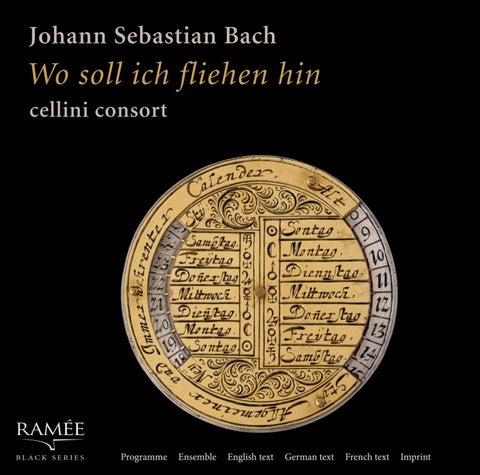
^menu Recorded 26–29 October, 2017 at the SRF Radiostudio, Zurich, Switzerland Production: Cellini Consort Executive production: Rainer Arndt Recording, editing, mixing & mastering: Michaela Wiesbeck Artwork: Eléonore Meeùs Layout: Rainer Arndt Photograph: © Elam Rotem (booklet) Cover: Perpetual Calendar, Germany, eighteenth century (© RMN-Grand Palais (Musée du Louvre) / Jean-Gilles Berizzi)
With the support of SRF 2 Kultur
RAM 1911 Ⓟ 2019 Cellini Consort, under exclusive licence to Outhere Music
© 2019 Outhere Music