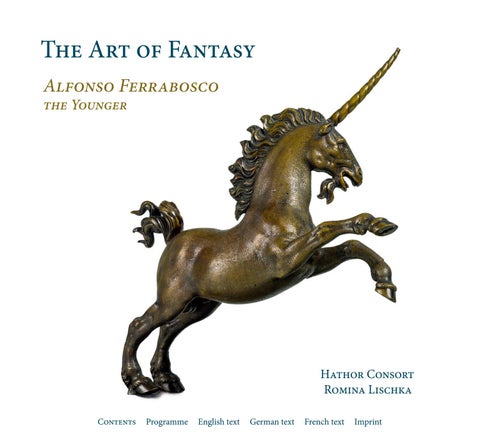
The Art of Fantasy Alfonso Ferrabosco the Younger
The Art of Fantasy Hathor Consort Romina Lischka Contents
Programme
English text
German text
French text
Imprint
The Art of Fantasy Music for Consort and Lyra Viol by Alfonso Ferrabosco the Younger (c. 1575-1628) Musik für Consort und Lyra-Viol von Alfonso Ferrabosco dem Jüngeren Musique pour consort et lyra viol d'Alfonso Ferrabosco le jeune
1.
Fantasia No. 2 à 6 (MB 81/30)
4:23
2.
Fantasia No. 15 à 4 (MB 62/15)
2:00
3.
Pavan No. 2 On Seven Notes à 5 (MB 81/7)
4:48
4.
Almaine No. 10 à 5 (MB 81/24)
2:03
5.
Galliard for two viols in the first tuning **
3:23
6.
Almain for two lyra viols in the first tuning **
2:40
7.
Fantasia No. 9 à 4 (MB 62/9)
3:18
8.
Fantasia No. 13 à 4 (MB 62/13)
3:07
9.
In Nomine No. 1 à 5 (MB 81/3)
3:01
10.
A Pavin for three viols in the second tuning ***
4:42
11.
Almain for one lyra viol *
3:54
12.
Coranto for one lyra viol *
1:46
13.
Fantasia No. 4 à 6 (MB 81/32)
3:29
14.
Ut re mi fa sol la – La sol fa mi re ut à 5 (MB 81/2a &b)
7:38
15.
Fantasia à 4 (MB 62 App. / VdGS No. 24)
2:13
16.
Fantasia No. 6 à 6 (MB 81/34)
3:18
17.
A Fancie for three viols in the third tuning ***
2:25
18.
Fantasia No. 11 à 4 (MB 62/11)
2:49
19.
In Nomine No. 3: Through All Parts à 6 (MB 81/28)
4:54
20.
Prelude for one lyra viol *
1:28
21.
Pavin for one lyra viol *
5:12
22.
Fantasia On the Hexachord à 6 (MB 81/25)
3:47
Sources: Four-Part Fantasias for Viols, Musica Britannica MB 62 Consort Music of Five and Six Parts, Musica Britannica MB 81 Lessons for 1. 2. and 3. Viols, London 1609
total
76:32
Hathor Consort Romina Lischka Elizabeth Rumsey Liam Fennelly Uri Smilansky Thomas BaetĂŠ Irene Klein
treble viol, tenor* and bass** lyra viol & artistic direction treble viol alto viol tenor viol bass & lyra viol*** consort bass & lyra viol**
Bram Peters, 2016 Pierre Jacquier, 1993 Pierre Van Engeland, 2001 Bram Peters, 2017 Marco Ternovec, 1991 John Pringle, 1983 Bram Peters, 2015 Robert Foster, 2001
Treble viol Treble viol Alto viol Tenor viol Bass viol Consort bass viol Lyra viol in g with resonance strings Lyra viol in d
4
5
^menu The Hathor Consort – named after Hathor, an ancient Egyptian fertility goddess – was founded in 2012 by its artistic director, Romina Lischka. Under Lischka's leadership, the ensemble focuses on the viol consort music of the Renaissance and Baroque. At the same time, the group is constantly searching for new ways of performing, creating interdisciplinary and cross-cultural concert programmes which combine the elegant chamber repertoire of the European tradition with music of the same period from other parts of the world, as well as with contemporary pieces, world music, and dance. The group's first recording, Lachrimae, featuring music by John Dowland, was released in 2014 with the Belgian label Fuga Libera to enthusiastic reviews. The staged version of Lachrimae pairs music – Dowland's pieces are interspersed with six interludes by the Belgian composer Annelies Van Parys – with dance, choreographed and performed by her compatriot Femke Gyselinck. The Hathor Consort's most recent project, Dhrupad Fantasia, blends Dhrupad, the oldest form of North Indian classical music, which flourished at the court of the Mughal Emperor Akbar the Great, with the music of the English court under Elizabeth I. The result is a new musical idiom which unites compositional elements and improvisation techniques from both musical styles. As the instrumental polyphony of viol consort repertoire relies on, and requires an understanding of vocal phrasing, the Hathor Consort regularly works with solo performers and vocal ensembles, including the PlutoEnsemble (Marnix De Cat) and the Collegium Vocale Gent (Philippe Herreweghe). The Hathor Consort's fresh and exciting programmes have resulted in invitations to perform at prestigious festivals and leading concert venues across Europe, including, among others, the Wigmore Hall, Wiener Konzerthaus, Warsaw Philharmonic, Bozar Brussels, Kölner Philharmonie, Philharmonie Essen, Festival Oude Muziek Utrecht, MA Festival Bruges, Musikfestspiele Potsdam, Opéra de Rouen, Muziekcentrum De Bijloke Ghent, and the York Early Music Festival. www.hathor-consort.eu www.rominalischka.eu
6
ber, supposedly for partaking in Catholic Mass at the French Embassy.
Alfonso Ferrabosco the Younger Alfonso Ferrabosco the Younger (c. 1575-1628), viol player at the courts of Elizabeth I, James I, and Charles I, was arguably the most innovative composer of his generation for viol consort. Over the course of his 36-year career at the English court, Ferrabosco occupied a variety of posts, enjoying the confidence of both James I and his son Charles.
After leaving England in 1578, Ferrabosco professed his Catholic faith; the Church, however, was sceptical, and imprisoned him on charges of treason and espionage. It was only through the intervention of Elizabeth I and Catherine de' Medici that the Pope released Ferrabosco from prison in 1580. Ferrabosco and his wife had been forced to leave their children, Alfonso the Younger and his younger sister, to the care of a Protestant musician from Antwerp, Gomer van Oosterwijk (Awsterwyke), who was a member of the Queen's flute consort. Van Oosterwijk lived in the same house as the Lupos, and it is therefore likely that the young Alfonso was taught by Peter Lupo, a member of the Queen's consort of strings. In 1582, Ferrabosco the Elder wrote a letter asking for his children to be sent over to Italy. Elizabeth I turned down his request, perhaps because she viewed the children as a security to ensure their father's return; in any case, however, Ferrabosco never came back to England. His Italian polyphonic style of composition made a considerable mark on his contemporaries. Whether he was a spy has never been proven. Like many others living in this turbulent age, Ferrabosco may well have faced conflicts of interest and inclination between his family, his employer, and his faith, but his music remains his most important legacy.
His first royal appointment came under the last of the Tudors, Elizabeth I, but Ferrabosco does not seem to have played a very active part in music at court during her reign. One reason for this may have been his father's reputation. Alfonso Ferrabosco the Elder had spent a number of years (1562-1578) as a musician and composer at Elizabeth's court, travelling back to his Italian homeland several times for reasons both personal and professional. His career as a musician brought the elder Ferrabosco into close contact with powerful figures on both sides of the (counter)-Reformation divide, and he himself seemed torn between Catholic Italy and Reformation England. Diplomatic relations between the two nations were at rock-bottom, and both sides suspected him of being a double agent. There is no doubt he delivered messages in Italy for Elizabeth I, who valued his diplomatic talents; on the other hand, it is not possible to exclude the possibility that the Catholic Church in Italy also made use of his position with the Queen. In 1577, Ferrabosco was stripped of his office as groom of the Privy Cham-
The accession of the first Stuart king, James I, opened up fresh possibilities for Ferrabosco's son. In 7
1604, Alfonso Ferrabosco the Younger was appointed as music and viol tutor to princes Henry and Charles, and later acquired the title of Extraordinary Groom of the Privy Chamber, allowing him access to the King's private quarters at any time. His influence soon made its mark on the princes' musical tastes. Prince Henry "loved Musicke, and namely good consorts of Instruments and voices joined together", but it was Prince Charles (the later Charles I) who caught his tutor's enthusiasm for viols and consort music. The younger Ferrabosco worked on a series of Masques with Ben Jonson, Shakespeare's closest rival, for a number of years from 1605 onwards, and made a name for himself as a composer of songs.
poser of the time), often as a complete set, indicating that they formed a cornerstone of the consort repertoire of the period, and were also popular with amateur musicians. Francis Tregian's manuscript is the earliest source, and is also the only one to date from the composer's own lifetime. Tregian may perhaps have known Ferrabosco the Younger, and, taking the date of his manuscript into account, it appears most likely that the four-part Fantasias were accomplished by 1610. Even though they were initially doubtless only intended for a small circle at court, their popularity and the demand for copies rose well into Charles I's reign, and the Fantasias became staples for domestic music-making at the Universities and in the houses of the nobility and well-to-do.
Prince Henry died suddenly in 1610, leaving Charles as the new Prince of Wales. Ferrabosco the Younger was one of the musicians in Charles' household, responsible for keeping the viols in working order and acquiring new instruments for the royal collection. During this period, the court appointed a permanent quartet of professional gambists, led by Ferrabosco, to perform regularly for and with members of the royal family.
Ferrabosco's four- and six-part fantasias are remarkable for their serious polyphony. They display a taste for formal symmetry and counterpoint-writing designed for and perfectly imitating the viols. Many of the fantasias consist of two main parts, each containing a theme (or pair of themes) presented as a simple or double fugue. Ferrabosco makes use of instrumental imitatio, borrowing elements of the Italian canzona and ricercar forms, but his strategic use of rhythmic augmentation and diminution (increasing and decreasing note-values) transforms them into elements which can be built into larger polyphonic structures. This in turn allows the elements to be varied harmonically within in a scheme that proceeds towards distant keys, resulting in a degree of formal inventiveness that appears to have been unprecedented in the England of
It is perhaps for this quartet (and its royal audience) that Ferrabosco composed his 23 four-part Fantasias. This theory gains credibility from two facts: the quartet, most unusually, appears as an extra group in the royal accounts, and there are no surviving five-part fantasias by Ferrabosco. The Fantasias are transmitted in 28 sources (more than for any other consort com8
along the way. In Nomine Ă 5 shows the influence of William Byrd, who was a contemporary of Ferrabosco the Elder and engaged in a friendly compositional rivalry with him.
1610, and arguably remains unique in the history of the viol consort genre. Ferrabosco the Younger thus embodies the intellectual side of the Jacobean fantasy (the so-called fugue or ricercar fantasy), which forms a counterpoint to the works of his colleagues John Coprario and Thomas Lupo, whose free-form, text-led fantasias were influenced primarily by the vocal lines of Italian madrigals.
As with the In Nomines, Ferrabosco's Ut re mi fa sol la is also built up over a cantus firmus. Two versions of this piece survive (one four-part, one five-part); it is likely that the four-part version was written first, with Ferrabosco adding an extra voice later. In the five-part version, the cantus firmus is carried in the alto. In the prima pars, the cantus consists of a series of eight rising hexachords, each a semitone higher than the last; in the secunda pars, the sequence descends in reverse order. In an age preoccupied with the occult, travelling through every note in the circle of fifths must have seemed like the music of the spheres, the feat of a musicus magicus.
This is particularly interesting since Ferrabosco was the only consort composer of his generation with an Italian background; nevertheless, he chose to write in a different style to his father. There is a certain irony in the fact that the elder Ferrabosco had been regarded as embodying the serious side of Italian music, but had made his name largely through madrigals. Ferrabosco the Younger studied both his father's music and that of Byrd and his Italian contemporaries closely, and in the end settled on a style that, though not overtly emotive, is underpinned by a serious polyphonic architecture. He earned the respect of his father's colleagues, and acted as a bridge between the musical cultures at the Tudor and Stuart courts.
Ferrabosco's Ut re mi fa sol la may have been written as a response to John Bull's Ut re mi fa sol la for harpsichord, or simply have arisen from his activities as a music teacher as a composition exercise. Its seven enharmonic equivalents and marked chromaticism (the piece involves the addition of seven sharps and seven flats) invite the question of which temperament would be best suited to the piece. Equal temperament might seem like the obvious solution, but we opted to play in a 1/6-comma meantone temperament. This naturally presents a number of difficulties, given the presence of enharmonic equivalents, but in addition to the fact that it is an interesting tuning exercise as a
At the same time, Ferraboso's In Nomine, written as a tribute to his father, helped the in nomine format, native to the viols, survive into the 17th century. The six-part In Nomine through all parts in particular achieves an impressive structural symmetry. The cantus firmus runs successively through all the parts from the treble through to the bass, passing through a number of transformations in harmony and rhythm 9
consort, it also introduces far more colour into different tonalities, since the difference between sharps and flats can really be heard.
were the first to notate lyra viol music in tablature, to get around the difficulty of playing instruments with different tunings.
Ferrabosco's Fantasia on the Hexachord à 6, by contrast, dispenses with the cantus firmus altogether. Instead, each part plays a rising and falling hexachord theme (a series of six rising and six falling notes) in canon, at different pitches and speeds. The result is a trance-like piece with a sense of revolving motion.
Ferrabosco's Lessons is the first collection devoted entirely to music for the lyra viol. It uses three tunings, some invented by him, at least in part: the "old Lyra way" (d'-a-f-c-F-C), the "Alfonso way" (d'-a-e-A-EAA), and the "eighths" or "octave way" (d'-a-d-A-DAA). Ferrabosco is known to have ordered new lyra viols for the royal household in 1623 and 1627, along with other instruments. However, it is not known whether these were bass viols in D or alto viols in G. We decided to use bass viols in D for the dances for two and three lyras, and an alto viol in G with additional resonance strings for the solo pieces. The extra strings create a more sonorous melody, and add resonance to the bass and supporting chords.
Ferrabosco's pavans, almains, galliards and corantos still bear the hallmarks of Elizabethan dance music; at the same time, they also frequently incorporate complex imitative counterpoint. In the Pavan on seven notes, for example, the treble plays a sevennote theme which is repeated a total of fourteen times. Some of Ferrabosco's dances survive in both a consort and a lyra viol version. 1609 saw the publication of his Lessons for 1. 2. and 3. Viols, a collection of pieces for lyra viol(s) dedicated to Shakespeare's patron Henry Wriothesley, 3rd Earl of Southampton.
Most of the dances in Ferrabosco's Lessons are arranged in pairs (galliard – coranto or almain – coranto). Some of the pavans and almains had previously existed in consort versions and were transcribed subsequently for the lyra viol (e.g. the fine Dovehouse Pavan – here recorded as Pavin for one lyra viol). The corantos, on the other hand, were intended exlusively for lyra viol. William Lawes, who owned a manuscript which included lyra viol compositions by Ferrabosco, based one of his divisions on a pavan and almain in his copy. Ferrabosco's influence on the young John Jenkins was particularly strong; the latter was evidently impressed by the architectural precision of the fanta-
André Maugars, a major viol virtuoso of the period who visited England from France in around 1625, noted that he had never heard anyone play "la Lyre" in a way to rival the magnificent "Farabosco d'Angleterre". An Italian sonnet even described him as a second Orpheus. In his Musick's Recreation on the Viol, Lyra-Way, Playford wrote that Daniel Farrant and John Coprario, along with Ferrabosco the Younger, 10
sias, which he took forward and developed for the next generation of musicians. A Fancie for three viols in the third tuning is a transcription of the four-part Fantasia No. 15. The different versions yield interesting contrasts of tempo and character, as three bass instruments played chordally need more time to develop a sound than a viol consort. Consort music reached its zenith under the patronage of James I and Charles I. The four composermusicians of the royal household, known collectively as Coprarios Music – John Coprario, Thomas Lupo, Orlando Gibbons and Ferrabosco the Younger – were encouraged to write new forms of music, and so the viol fantasy, which laid the foundation for instrumental chamber music in the 17th century, was born. The madrigal craze was at its height, and many were published as "apt for viols and voyces". This led to a boom in consort music, and gave the period its (modern) name of the Age of Plenty. After Coprario's death in 1624, Ferrabosco was appointed to his final post as the King's composer of musicke in ordinary, which he held until his death in 1628. Ferrabosco's legacy, a body of powerful, abstract instrumental chamber music, written idiomatically for viol consort, has earned him his reputation as the leading pioneer of the new Jacobean style of consort music. Romina Lischka Translation: Winnie Smith 11
12
^menu Das Hathor Consort – benannt nach Hathor, einer Muttergottheit des Alten Ägypten – wurde 2012 von Romina Lischka gegründet. Unter ihrer künstlerischen Leitung widmet sich das Consort der Musik der Renaissance und des Barock, in deren Zentrum ein Streicherensemble aus Gamben steht. Zugleich sucht es nach neuen Ausdrucksmöglichkeiten, in denen dieses raffinierte Kammermusikrepertoire europäischer Herkunft mit Alter Musik anderer Kontinente sowie zeitgenössischer Musik, Weltmusik und Tanz in multidisziplinären und interkulturellen Konzertformen verbunden wird. Die erste CD des Ensembles, Lachrimae, mit Musik von John Dowland erschien 2014 bei dem belgischen Label Fuga Libera und wurde von der Presse hoch gelobt. Das gleichnamige Bühnenprogramm verbindet die Musik Dowlands mit sechs Interludes der belgischen Komponistin Annelies Van Parys und einer Choreographie der belgischen Tänzerin Femke Gyselinck. In Hathor Consorts neuestem Projekt, Dhrupad Fantasia, verschmilzt Dhrupad, die älteste Form nordindischer klassischer Musik, wie sie am Hof des Großmogul Akbar I. florierte, mit der englischen Hofmusik Elizabeths I. zu einer neuen musikalischen Sprache, die sich durch eine Kombination von kompositorischen Elementen und gemeinsamen Improvisationen aus beiden Stilen zusammenfügt. Da ein vokales Verständnis für die instrumentale Polyphonie des Gamben-Consorts unverzichtbar ist, arbeitet das Hathor Consort regelmäßig mit Vokalsolisten oder -ensembles zusammen, unter anderem mit dem Pluto-Ensemble (Marnix De Cat) und dem Collegium Vocale Gent (Philippe Herreweghe). Das Hathor Consort gastiert mit seinen vielfältigen Programmen auf renommierten Festivals und in Konzerthäusern in ganz Europa, so z. B. dem Wiener Konzerthaus, der Warschauer Philharmonie, Bozar Brüssel, der Wigmore Hall London, der Philharmonie Köln, der Philharmonie Essen, dem Festival Oude Muziek Utrecht, dem MA Festival Brügge, den Musikfestspielen Potsdam, der Opera de Rouen, dem Muziekcentrum De Bijloke Gent, dem York Early Music Festival und vielen anderen. www.hathor-consort.eu www.rominalischka.eu
13
kann man nicht ausschließen, dass seine Position bei Elisabeth I. nicht auch von der katholischen Kirche in Italien ausgenutzt wurde. 1577 wurde er von Elisabeth I. von seinen Funktionen als extraordinary groom of the Privy Chamber (persönlicher Kammerdiener) entlassen, da er angeblich an der katholischen Messe in der französischen Botschaft teilgenommen hatte.
Alfonso Ferrabosco der Jüngere Alfonso Ferrabosco der Jüngere (ca. 1575-1628), Gambist am englischen Hof von Elisabeth I., Jakob I. und Charles I., war der wohl innovativste Komponist seiner Generation für das Gambenconsort. Im Laufe seiner 36jährigen Tätigkeit am englischen Königshof erhielt er eine Vielzahl unterschiedlicher Posten und genoss das Vertrauen von sowohl Jakob I. als auch von dessen Sohn Charles I.
Nachdem er England 1578 verließ, bekannte er sich zum katholischen Glauben, aber die Kirche war skeptisch und ließ ihn wegen Hochverrats und Verdacht auf Spionage ins Gefängnis sperren. Nur durch Elisabeths I. Bemühen und Caterina de' Medicis Intervention beim Papst wurde er 1580 wieder aus dem Gefängnis entlassen. Er und seine Frau mussten ihre Kinder Alfonso Ferrabosco d. J. sowie eine jüngere Tochter in England in der Obhut von Gommar van Oosterwijk, einem protestantischen Musiker aus Antwerpen und Mitglied des Queen's flute consort lassen. Diese teilten sich das Haus mit der Lupo-Familie und es ist anzunehmen, dass Ferrabosco d. J. von Peter Lupo, Geiger im königlichen Streicher-Consort, Musikunterricht erhielt. 1582 sendete Ferrabosco d. Ä. einen Brief mit der Bitte, seine Kinder nach Italien bringen zu lassen, aber die Königin lehnte dies ab. Es ist möglich, dass Elisabeth I. die Kinder als Garantie für seine Rückkehr in England hielt, aber er kehrte nie wieder zurück.
Seine erste Stelle als Hofgambist erhielt er von der letzten Königin der Tudor-Dynastie, Elisabeth I., schien aber in dieser Zeit wenig an der Hofmusik teilgenommen zu haben. Ein Grund dafür mag der Ruf seines Vaters, Alfonso Ferrabosco der Ältere, gewesen sein. Dieser verbrachte einige Jahre – von 1562 bis 1578 – als Komponist und Musiker am Hof von Elisabeth I. Mehrere Male kehrte Ferrabosco d. Ä. in diesen Jahren aus offiziellen und familiären Gründen in seine Heimat Italien zurück. Seine musikalische Karriere brachte ihn in die unmittelbare Nähe von mächtigen Figuren auf beiden Seiten der religiös geteilten (Gegen-) Reformation. Er selbst schien hin- und hergerissen zu sein zwischen dem katholischen Italien und dem reformierten England, deren Beziehungen in diesen Jahren einen Tiefpunkt erreicht hatten. Von beiden Seiten wurde er als Spion oder sogar Doppelspion verdächtigt. Einerseits überbrachte er in Italien Nachrichten von Elisabeth I. und wurde von ihr für sein diplomatisches Geschick geschätzt, andererseits
Als Komponist übte Ferrabosco d. Ä. mit seiner italienischen Polyphonie einen großen Einfluss auf seine musikalischen Zeitgenossen aus. Ob er wirklich 14
als Spion tätig war, ist nicht belegt. Wie viele andere in dieser turbulenten Zeit wurde er vielleicht mit Konflikten von Zuneigung und Loyalität gegenüber seiner Familie, der Königin und seinem Glauben konfrontiert, aber seine Musik bleibt seine wichtigste Hinterlassenschaft.
von Ferrabosco d. J. geleitet wurde und regelmäßig Consortmusik für und mit der königlichen Familie spielte. Ferrabosco d. J. komponierte seine 23 vierstimmigen Fantasien vielleicht für dieses Quartett und die königliche Familie. Die Tatsache, dass das Quartett ungewöhnlicherweise als Extragruppe in den königlichen Gehaltslisten geführt wurde und keine fünfstimmigen Fantasien von Ferrabosco d. J. erhalten sind, machen diese Theorie glaubhaft. Die Fantasien sind in 28 Quellen erhalten (mehr als von jedem anderen Consort-Komponisten seiner Zeit), oft als Gesamtkollektion – ein Zeichen dafür, dass diese Fantasien einen Grundstein für das Consort-Repertoire dieser Zeit bildeten und anscheinend auch in den bürgerlichen Amateurkreisen beliebt waren. Francis Tregians Manuskript ist die früheste Quelle, und es ist auch die einzige, die aus der Lebenszeit des Komponisten stammt. Es ist möglich, dass Tregian Ferrabosco d. J. kannte, und in Anbetracht des Entstehungsjahres seines Manuskripts ist es wahrscheinlich, dass die vierstimmigen Fantasien 1610 vollendet wurden. Auch wenn sie sicherlich zuerst nur für einen kleinen Kreis am Hof gedacht waren, stieg die Beliebtheit und die Nachfrage nach Kopien der Fantasien bis in Charles' I. Regentschaft, wo sie ein fester Bestandteil der Musikaktivitäten in den Häusern der Aristokratie und des Bürgertums sowie an den Universitäten wurden.
Mit dem ersten Stuart-König Jakob I. eröffneten sich für Ferrabosco d. J. neue Möglichkeiten. Ab 1604 wurde er als Musik- und Gambenlehrer von den Prinzen Henry und Charles angestellt und erhielt dort den Titel extraordinary groom of the Privy Chamber, welcher ihm den Zugang zu den königlichen privaten Gemächern jederzeit erlaubte. Sein Einfluss auf die Prinzen zeigte sich schon früh in deren musikalischem Geschmack. Prinz Henry »liebte Musik, und ganz besonders gute Instrumental- und Vokal-Consorts«, und besonders Prinz Charles (später König Charles I.) konnte er seine Leidenschaft für die Gambe und deren Consortmusik vermitteln. Mit dem Poeten Ben Jonson, Shakespeare's nächstem Rivalen, arbeitete er ab 1605 mehrere Jahre lang für diverse masques zusammen und machte sich als song-Komponist einen Namen. Nach dem plötzlichen Tod von Prinz Henry 1610 folgte Charles in die Funktion des Prinzen von Wales. Ferrabosco d. J. war als einer von Charles' Musikern für die Instandhaltung der Gamben sowie für die Anschaffung neuer Instrumente für den königlichen Haushalt verantwortlich. Während König Charles' I. Regentschaft wurde auch ein festes Quartett von professionellen Gambisten am Hof angestellt, das
Ferraboscos vier- und sechsstimmige Fantasien zeichnen sich vor allem durch eine seriöse Polyphonie 15
aus, mit einer Vorliebe für symmetrische Formen sowie einem perfekt auf die Gambe abgestimmten und imitierenden Kontrapunkt. Viele seiner Fantasien bestehen aus zwei großen Teilen, in denen jeweils ein Thema oder Themenpaar in einer Einfach- oder Doppelfuge präsentiert werden. Ferrabosco d. J. kreiert eine instrumentale imitatio, für die er Elemente aus den italienischen Formen Canzone und Ricercar entlehnt, transformiert allerdings die Themen mit einem strategischen Gebrauch von Augmentation und Diminution (rhythmischen Vergrößerungen und Verkleinerungen) und fügt sie in größere polyphone Teile ein, die eine Weiterentwicklung in einem harmonischen Plan zu entfernten Tonarten hin erlauben. Dieser Grad an formalem Einfallsreichtum schien neu im England von 1610 zu sein und bleibt vielleicht sogar einzigartig in der Geschichte des Gambenconsort-Genres. Ferrabosco d. J. erschafft hiermit die intellektuelle Seite der Jakobinischen Fantasie, die sogenannte Fugen- oder Ricercar-Fantasie, die einen Gegenpol zu den Kompositionen seiner Zeitgenossen John Coprario und Thomas Lupo bildet, die sich vor allem durch vokale italienische Madrigale beeinflussen ließen und sehr formfreie, vom Text geführte Fantasien komponierten.
vor allem durch seine Madrigale einen Namen. Ferrabosco d. J. studierte sowohl die Musik seines Vaters als auch die von Byrd und italienischen Zeitgenossen, entschied sich aber in seinen Kompositionen für einen wenig affektreichen, dafür architektonisch seriösen polyphonen Stil. Er wurde auch von den Zeitgenossen seines Vaters sehr geschätzt und bildete eine Brücke zwischen den Musikstilen an den Tudor- und StuartHöfen. Mit seinen In Nomine hinterließ Ferrabosco d. J. aber eine Hommage an seinen Vater und verhalf so dieser ausschließlich für Gamben komponierten Form im 17. Jahrhundert zum Überleben. Vor allem mit seinem sechsstimmigen In Nomine through all parts kreierte er eine beeindruckende architektonische Symmetrie. Der cantus firmus läuft durch alle Stimmen, angefangen bei den Diskanten bis hinab in die Bässe, wird rhythmisch verändert sowie harmonischen Transpositionen angepasst. Ferraboscos In Nomine à 5 zeigen Parallelen mit William Byrd, der auch ein Zeitgenosse seines Vaters war und mit diesem einen freundschaftlichen Kompositions-Wettstreit pflegte. Ähnlich wie in seinen In Nomines ist auch das Ut re mi fa sol la auf einem cantus firmus aufgebaut. Es bestehen zwei verschiedene Versionen des Stückes, eine vierstimmige und eine fünfstimmige – wahrscheinlich komponierte Ferrabosco d. J. die vierstimmige Fassung zuerst und erweiterte das Stück später um eine Stimme. In der fünfstimmigen Version spielt der Alt den cantus firmus, welcher in der prima pars
Dieser Fakt ist besonders interessant, da Ferrabosco d. J. der einzige Consort-Komponist seiner Generation war, der italienische Wurzeln hatte, sich aber von seinem abwesenden Vater in seinem Stil unterschied. Ferrabosco d. Ä. wurde zwar von seinen Zeitgenossen als Personifizierung der seriösen Seite der italienischen Musik betrachtet, machte sich aber 16
aus einer Serie von acht aufsteigenden Hexachorden besteht, jedes einen Halbton höher als das vorherige; in der secunda pars steigen die selben acht Hexachorde in umgekehrter Reihenfolge ab. Diese Reise durch alle Noten und den Quintenzirkel muss in einer Zeit von okkulten Interessen wie die Sphärenmusik eines musicus magicus erschienen sein.
Transpositionen und Rhythmen. Das Resultat ergibt ein tranceartiges Stück, das sich gleichsam im Kreis dreht. Ferrabosco's pavans, almains, galliards und corantos stehen noch im Zeichen der Elisabethanischen Tanzmusik, aber auch hier spielt er des öfteren mit einem sich komplex imitierenden Kontrapunkt. In seiner Pavan on seven notes zum Beispiel spielt die Sopranstimme durchgehend ein Thema aus sieben Noten, das vierzehn Mal wiederkehrt. Einige seiner Tänze bestehen in zwei Versionen, für lyra viol und als Consort-Version. 1609 wurden seine Lessons for 1. 2. and 3. Viols herausgegeben, eine Sammlung von Stücken für ein, zwei und drei lyra viols, die er Shakespeares Mäzen Henry Wriothesley, dem drittem Grafen von Southampton, widmete.
Ferrabosco d. J. komponierte Ut re mi fa sol la vielleicht als Replik zu einem Ut re mi fa sol la von John Bull für Cembalo, es könnte aber auch aus seiner Tätigkeit als Lehrer und somit als Kompositionsübung entstanden sein. Mit seinen sieben enharmonischen Verwechslungen und starker Chromatik (es werden sieben # und sieben b hinzugefügt) stellt sich die Frage, welches Stimmsystem für dieses Stück am geeignetsten wäre. Die gleichschwebende Stimmung ist sicher die erste logische Schlussfolgerung, wir haben uns aber entschieden, in einer abgeschwächten (1/6-Komma) mitteltönigen Stimmung zu spielen. Das bringt natürlich einige Schwierigkeiten mit sich, da es enharmonische Verwechslungen gibt, aber abgesehen davon, dass dies eine interessante Stimmübung für das Consort darstellt, bringt es auch viel mehr Farben in die verschiedenen Tonarten, da wirklich ein Unterschied zwischen # und b zu hören ist.
André Maugars, ein wichtiger Gambenvirtuose dieser Zeit, der um 1625 auf Besuch in England war, bezeugte, dass er noch nie einen Spieler der »la lyre« gehört hatte, den man mit dem großartigen »Farabosco d'Angleterre« vergleichen könnte. In einem zeitgenössischen italienischen Sonnet wurde er sogar als der »Erbe Orpheus'« gepriesen. Playford schrieb in seinem Musick's Recreation on the Viol, Lyra-Way, dass Daniel Farrant und John Coprario zusammen mit Ferrabosco d. J. die ersten waren, die ihre lyra viol-Musik in Tabulaturen notierten, um das Spiel in unterschiedlichen Stimmungen zu erleichtern.
In seiner Fantasia on the Hexacahord à 6 benutzt Ferrabosco d. J. keinen cantus firmus. Stattdessen spielt jede Stimme durchgehend ein Thema mit aufsteigendem und abfallenden Hexachord (sechs aufsteigende und sechs absteigende Töne) in verschiedenen
Ferraboscos Lessons ist die früheste Sammlung, die sich nur der Musik für lyra viol widmet. Er benutzt 17
ein interessanter Unterschied in Tempo und Charakter, da drei Bassinstrumente, die akkordisch gespielt werden, mehr Zeit zur Klangentwicklung brauchen als ein Consort.
drei Stimmungen, die old lyra way (d'-a-f-c-F-C), die Alfonso way (d'-a-e-A-E-A') und die eights oder octave way (d'-a-d-A-D-A'), die er zum Teil selbst erfand. Es ist dokumentiert, dass Ferrabosco d. J. 1623 und 1627 unter anderem neue lyras für den königlichen Haushalt bestellte. Ob diese Instrumente Bassgamben in d oder Altgamben in g waren, ist unklar. Für die Tänze für zwei und drei lyra viols haben wir uns für Bassgamben in d entschieden, für die Solo lyra viol Stücke für eine Altgambe in g mit zusätzlichen Resonanzsaiten, die ein längeres Erklingen sowohl der Melodie als auch des Basses und der Akkorde möglich machen.
Durch Jakobs I. und Charles' I. Mäzenat erlebte die Consort-Musik einen einzigartigen Höhepunkt: die vier Komponisten und Musiker des königlichen Haushalts John Coprario, Thomas Lupo, Orlando Gibbons und Ferrabosco d. J. – auch bekannt als Coprarios Music – wurden ermutigt, in neuen Formen zu komponieren: die Jakobinische Gamben-Fantasia war geboren und legte den Grundstein für die instrumentale Kammermusik des siebzehnten Jahrhunderts. Das Madrigal war auf dem Höhepunkt seiner Beliebtheit angekommen und viele wurden als »geeignet für Gamben und Stimmen« herausgegeben, was zu einem Boom des Consort-Genres führte, heute bekannt als Zeitalter des Überflusses (age of plenty).
Die meisten Tänze in der Sammlung Lessons sind als Paare von galliard – coranto oder almain – coranto aufgereiht. Während einige der pavans und almains zuerst als Consort-Version existierten und in der Folge für die lyra viol bearbeitet wurden (wie zum Beispiel die schöne Dovehouse Pavan – hier als Pavin for one lyra viol eingespielt), wurden die corantos ausschließlich auf der lyra viol gespielt. William Lawes besaß ein Manuskript mit unter anderem lyra viol-Musik von Ferrabosco d. J. und gründete eine seiner divisions auf eine pavan und almain von Ferrabosco. Aber vor allem den jungen John Jenkins beeinflusste Ferrabosco d. J. stark durch den architektonischen Aspekt seiner Fantasien, den besonders dieser in der nächsten Generation weiterentwickelte.
Nach Coprario's Tod 1624 bekam Ferrabosco d. J. seinen letzten Posten als composer of musicke in ordinary to his Majesty (Bestallter Musik-Komponist seiner Majestät), den er bis zu seinem Tod 1628 behielt. Er schuf eine ausdrucksstarke, abstrakte, instrumentale Kammermusik mit starkem Idiom für das Gambenconsort und wird deshalb als führender Pionier der neuen Jakobinischen Consort-Musik angesehen. Romina Lischka
A Fancie for three viols in the third tuning ist eine Transkription der vierstimmigen Fantasia No. 15. Durch die unterschiedlichen Arrangements ergibt sich 18
19
^menu Le Hathor Consort – du nom d'une déesse mère de l'Égypte ancienne – a été fondé en 2012 par Romina Lischka. Placé sous sa direction artistique, le consort se consacre à la musique de la Renaissance et baroque pour ensemble de violes. Il est également à la recherche perpétuelle de nouveaux moyens d'expression où mettre en lien ce délicat répertoire de la musique de chambre européenne avec la musique ancienne d'autres continents, mais aussi avec la musique contemporaine, les musiques du monde et la danse, dans des prestations multidisciplinaires et interculturelles. Le premier CD de l'ensemble, Lachrimae, consacré à la musique de John Dowland, est paru en 2014 sous le label belge Fuga Libera et a été largement encensé par la critique internationale. Le programme de concert éponyme associe la musique de Dowland avec six interludes de la compositrice belge Annelies Van Parys et avec une chorégraphie de la danseuse belge Femke Gyselinck. Le dernier projet du Hathor Consort, Dhrupad Fantasia, mêle le dhrupad, la plus ancienne forme musicale classique du Nord de l'Inde, florissante à la cour d'Akbar, le grand moghol, et la musique de cour anglaise de l'époque élisabéthaine, façonnant ainsi un nouveau langage musical né de la combinaison d'éléments composés et d'improvisations tirés des deux styles. Une fine intelligence vocale étant indispensable pour la polyphonie instrumentale du consort de violes, le Hathor Consort travaille régulièrement avec des chanteurs solistes et des ensembles vocaux, et notamment avec le Pluto-Ensemble (Marnix De Cat) et le Collegium Vocale Gent (Philippe Herreweghe). Le Hathor Consort se produit dans des festivals renommés et de grandes maisons de concert à travers l'Europe, pami lesquels le Konzerthaus de Vienne, la Philharmonie de Varsovie, Bozar à Bruxelles, le Wigmore Hall de Londres, la Philharmonie de Cologne, la Philharmonie d'Essen, le Festival Oude Muziek d'Utrecht, le MA Festival de Bruges, les Musikfestspielen de Potsdam, l'Opéra de Rouen, le Muziekcentrum De Bijloke de Gand et le York Early Music Festival. www.hathor-consort.eu www.rominalischka.eu
20
fut démis de ses fonctions d'Extraordinary Groom of the Privy Chamber par la Reine, semble-t-il pour avoir participé à la messe catholique à l'ambassade de France.
Alfonso Ferrabosco le jeune Alfonso Ferrabosco le jeune (c. 1575-1628), gambiste à la cour d'Élisabeth Ire, de Jacques Ier et de Charles Ier, fut probablement le compositeur pour consort de violes de gambe le plus novateur de sa génération. Au cours des 36 années qu'il passa à la cour royale anglaise, il occupa de nombreux postes et bénéficia de la confiance tant de Jacques Ier que de son fils Charles Ier.
Après avoir quitté l'Angleterre en 1578, il se déclara de foi catholique, mais l'Église restait sceptique et le fit emprisonner pour haute trahison et suspicion d'espionnage. Ce n'est que grâce aux efforts d'Élisabeth Ire et à l'intervention de Catherine de Médicis auprès du pape qu'il put être libéré en 1580. Sa femme et lui durent laisser leurs enfants, Alfonso ainsi qu'une fille plus jeune, en Angleterre sous la tutelle de Gommar van Oosterwijk, un musicien protestant originaire d'Anvers et membre du Queen's flute consort. Ils partageaient leur maison avec la famille Lupo et il est possible que le jeune Alfonso reçût des leçons de Peter Lupo, violoniste dans le consort d'instruments à cordes royal. En 1582, Ferrabosco l'ancien envoya une lettre demandant que ses enfants soient conduits en Italie, mais la Reine l'interdit. Peut-être les gardaitelle en garantie de son retour en Angleterre, mais il ne revint jamais.
C'est la dernière reine de la dynastie des Tudor, Élisabeth Ire, qui lui confia son premier poste de gambiste à la cour, mais il semble qu'à cette époque, sa participation à la musique de la cour fût quelque peu limitée, peut-être en raison de la réputation de son père, Alfonso Ferrabosco l'ancien. Celui-ci fut compositeur et musicien à la cour d'Élisabeth Ire durant plusieurs années (de 1562 à 1578). Il retourna à plusieurs reprises dans son pays natal, l'Italie, pour des raisons officielles et familiales. Sa carrière musicale le fit côtoyer des personnalités importantes des deux camps de la (Contre-)Réforme. Il semblait lui-même subir les forces contraires de l'Italie catholique et de l'Angleterre réformée, pays qui entretenaient à l'époque de très mauvaises relations. Des deux côtés, on le suspectait d'être un espion, voire un agent double. Il apportait en Italie des nouvelles d'Élisabeth, qui l'appréciait pour son habileté diplomatique ; en même temps, il n'est pas exclu que sa position auprès d'Élisabeth était exploitée par l'Église catholique en Italie. En 1577, il
La polyphonie italienne de Ferrabosco l'ancien exerça une grande influence sur ses contemporains. Comme beaucoup d'autres en cette époque troublée, il fut peut-être confronté à des conflits d'affection et de loyauté envers sa famille, la Reine et sa foi, mais sa musique reste son legs le plus important. Son rôle d'espion n'a jamais pu être prouvé. 21
Avec le premier roi Stuart, Jacques Ier, de nouvelles opportunités s'offrirent à Ferrabosco le jeune. Il fut nommé professeur de musique et de viole de gambe des princes Henry et Charles en 1604 et il reçut à son tour le titre d'Extraordinary Groom of the Privy Chamber, qui lui permettait d'accéder aux appartements royaux à tout moment.
Ferrabosco le jeune composa peut-être ses 23 Fantaisies à quatre parties pour ce quatuor et la famille royale. Le fait que le quatuor apparaisse de façon inhabituelle comme groupe supplémentaire dans les listes des salaires et qu'aucune fantaisie à cinq parties de sa main n'ait été conservée rend cette hypothèse plausible. Les fantaisies sont présentes dans 28 sources (plus que pour tous les autres compositeurs pour consort de l'époque), souvent en collection complète, ce qui indique que ces pièces formaient la pierre angulaire du répertoire pour consort de l'époque et étaient également appréciées des cercles bourgeois amateurs. La plus ancienne source est celle de Francis Tregian ; elle est également la seule contemporaine du compositeur. Il est possible que Ferrabosco le jeune ait connu Tregian, et compte tenu de la date du manuscrit de ce dernier, la date d'achèvement la plus probable des Fantaisies à quatre parties est 1610. Bien que certainement initialement destinées à un petit cercle à la cour, la popularité et la demande de copies des pièces ne cessèrent d'augmenter jusqu'à la régence de Charles Ier, où elles faisaient partie intégrante des activités musicales dans les maisons de l'aristocratie et de la bourgeoisie ainsi que dans les universités.
Le goût musical des princes témoigna tôt de son influence. Le prince Henry « aimait la musique, et en particulier les bons consorts d'instruments et de voix réunis » (« loved Musicke, and namely good consorts of Instruments and voices joined together »), et le prince Charles (le futur roi Charles Ier) hérita de sa passion pour la viole de gambe et la musique de consort. Il collabora à partir de 1605 et pendant plusieurs années à divers masques avec le poète Ben Johnson, le plus proche rival de Shakespeare, et se fit un nom comme compositeur de songs. Après la mort soudaine du prince Henry en 1610, le prince Charles lui succéda au titre de prince de Galles. Ferrabosco le jeune était l'un des musiciens de la maison de Charles et était responsable de l'entretien des violes de gambe ainsi que de l'acquisition de nouveaux instruments pour la maison royale. Pendant la régence du roi Charles Ier, un quatuor permanent de gambistes professionnels fut engagé à la cour, dirigé par Ferrabosco le jeune, qui jouait régulièrement de la musique de consort pour et avec la famille royale.
Ses fantaisies à quatre et à six parties sont principalement caractérisées par une polyphonie « sérieuse », avec une prédilection pour les formes symétriques ainsi que par un contrepoint imitatif, parfaitement adapté à la viole. Nombre de ces fantaisies se composent de deux grandes parties, dans chacune desquelles un thème ou une paire de thèmes sont présentés dans 22
une fugue simple ou double. Ferrabosco le jeune crée une imitatio instrumentale, pour laquelle il emprunte des éléments des formes italiennes de la canzone et du ricercar, mais il transforme les thèmes grâce à une utilisation stratégique des augmentations et des diminutions (élargissements et réductions rythmiques) et les insère dans des mouvements polyphoniques plus larges, permettant une progression harmonique vers des tonalités éloignées. Ce niveau d'ingéniosité formelle semble avoir été nouveau dans l'Angleterre de l'époque et reste peut-être unique dans l'histoire du genre du consort de violes de gambe. Ferrabosco le jeune forgea ainsi le côté intellectuel de la fantaisie de son époque, la fantaisie-ricercar ou la fantaisie-fugue, formant un contrepoint aux travaux de ses collègues contemporains John Coprario et Thomas Lupo, euxmêmes principalement influencés par le madrigal italien, qui composèrent des fantaisies de forme très libre, guidée par le texte.
Il était également très estimé par les collègues de son père et fit le lien entre la musique des Tudor et celle des Stuart. Avec ses In Nomine, Ferrabosco le jeune rendit hommage à son père et contribua ainsi à ce que cette forme exclusivement destinée à la viole de gambe survive au XVIIe siècle. La symétrie architecturale d'In Nomine through all parts à six voix en particulier est impressionnante. Le cantus firmus traverse toutes les parties, depuis l'aigu jusqu'à la basse, se modifie rythmiquement et s'adapte aux transpositions harmoniques. L'In Nomine à 5 présente des similitudes avec la musique de William Byrd, lui aussi contemporain de Ferrabosco l'ancien, avec qui il entretenait un concours amical de composition. Comme ses In Nomine, Ut re mi fa sol la est basée sur un cantus firmus. Il existe deux versions de l'œuvre, l'une à quatre parties et l'autre à cinq ; Ferrabosco le jeune composa vraisemblablement d'abord la version à quatre parties avant de lui ajouter une voix. Dans la version à cinq parties, l'alto joue le cantus firmus, qui dans la prima pars consiste en une série de huit hexacordes ascendants, chacun placé un demi-ton plus haut que le précédent ; dans la secunda pars, les mêmes huit hexacordes font le chemin inverse. Ce voyage à travers toutes les notes et le cycle des quintes doit être apparu, à une époque d'intérêts occultes, comme la musique des sphères d'un musicus magicus.
Ce fait est particulièrement intéressant, Ferrabosco le jeune étant le seul compositeur de musique pour consort de sa génération à avoir des racines italiennes, tout en se distinguant stylistiquement de son père absent. Ferrabosco l'ancien était considéré par ses contemporains comme la personnification du caractère sérieux de la musique italienne, mais se fit un nom surtout grâce à ses madrigaux. Ferrabosco le jeune étudia à la fois la musique de son père et celle de Byrd et des contemporains italiens, mais opta dans ses compositions pour un style polyphonique moins riche en affects, mais sérieux d'un point de vue architectural. 23
Ferrabosco le jeune composa Ut re mi fa sol la peut-être comme une riposte à un Ut re mi fa sol la de John Bull pour clavecin, mais la pièce peut aussi être née de son travail de professeur et donc comme exercice de composition. Avec ses sept substitutions enharmoniques et son puissant chromatisme (sept dièses et sept bémols ont été ajoutés), la question se pose de savoir quel système d'accord serait le plus approprié pour jouer cette pièce. Le tempérament égal est certainement la première conclusion logique, mais nous avons décidé de la jouer dans un tempérament mésotonique atténué (1/6 de comma). Cela pose évidemment quelques difficultés, en raison précisément de ces substitutions enharmoniques, mais outre le fait d'être un intéressant exercice d'accord pour le consort, cela apporte aussi beaucoup plus de couleurs aux différentes tonalités, puisqu'il existe une réelle différence entre le dièse et le bémol.
Certaines de ses danses existent en versions pour lyra viol et pour consort. En 1609 furent publiées les Lessons for 1. 2. and 3. Viols, une collection de pièces destinées à la lyra viol, qu'il dédia au mécène de Shakespeare, Henry Wriothesley, troisième comte de Southampton. André Maugars, un important virtuose de la gambe de l'époque, en visite en Angleterre en 1625, témoigna qu'il n'avait encore jamais entendu joueur de lyra viol comparable au grand « Farabosco d'Angleterre ». Dans un sonnet italien contemporain, il est même considéré comme l'« héritier d'Orphée ». Playford écrit dans Musick's Recreation on the Viol, Lyra-Way que Daniel Farrant et John Coprario furent avec Ferrabosco le jeune les premiers à noter la musique pour lyra viol en tablature, afin d'alléger les difficultés de jeu dans différents accords. Les Lessons de Ferrabosco sont la plus ancienne collection entièrement consacrée à la lyra viol. Elles font usage de trois accords, le lyra way ancien (ré3la2-fa2-do2-fa1-do1), l'Alfonso way (ré3-la2-mi2-la1mi1-la0) et l'eights ou octave way (ré3-la2-ré2-la1ré1-la0), qu'il inventa partiellement lui-même. Nous savons que Ferrabosco le jeune, entre autres choses, commanda de nouvelles lyras pour la maison royale en 1623 et 1627. Ce que nous ne savons pas, c'est si ces instruments sont des basses de viole en ré ou des violes de gambe alto en sol. Pour les danses pour deux et trois lyra viols, nous avons opté pour des violes en ré ; pour les pièces en solo, nous avons préféré la viole en sol avec des cordes sympathiques, qui permettent
Dans sa Fantasia on the Hexachord à 6, Ferrabosco le jeune n'utilise pas de cantus firmus. Au lieu de cela, chaque voix joue continuellement un thème avec un hexacorde ascendant et un hexacorde descendant dans différents rythmes et tonalités. La pièce est comme en transe, comme si elle tournait dans un cercle. Les pavans, almains, gaillards et corantos de Ferrabosco sont encore dominées par la musique de danse élisabéthaine, mais ici aussi, le compositeur joue souvent avec un contrepoint imitatif complexe. Dans sa Pavan on seven notes, par exemple, la voix de soprano joue un thème de sept notes qui revient quatorze fois. 24
encouragés à composer dans de nouvelles formes : la fantaisie pour viole « jacobienne » était née et jeta les bases de la musique de chambre instrumentale du XVIIe siècle. Le madrigal était arrivé au sommet de sa popularité et beaucoup de pièces furent publiées comme « apt for viols and voyces » (« appropriées pour les violes et les voix »), ce qui conduisit à l'essor du genre du consort, période connue aujourd'hui comme son âge d'or.
un son plus long pour la mélodie et pour la basse ainsi que pour les accords. La plupart des danses présentes dans la collection des Lessons vont par paire, gaillard et coranto ou almain et coranto. Tandis que certaines pavans et almains étaient à l'origine destinées au consort et furent ensuite transcrites pour la lyra viol (comme la belle Dovehouse Pavan, ici enregistrée comme Pavin for one lyra viol), les corantos étaient exclusivement jouées sur la lyra viol. William Lawes, qui possédait un manuscrit notamment de musique pour lyra viol de Ferrabosco le jeune, basa l'une de ses divisions sur une pavan et almain de ce dernier. Mais c'est surtout le jeune John Jenkins que Ferrabosco le jeune influença par l'architecture de ses fantaisies, aspect qui serait particulièrement développé dans la génération suivante par Jenkins.
Après la mort de Coprario en 1624, Ferrabosco le jeune obtint son dernier poste de Composer of musicke in ordinary to his Majesty, qu'il conserva jusqu'à sa mort en 1628. Il composa une musique de chambre instrumentale expressive et abstraite pour le consort de violes et fut ainsi considéré comme un pionnier de la nouvelle musique de consort jacobienne.
A Fancie for three viols in the third tuning est une transcription de la Fantasia à 4 No. 15. Grâce aux différents arrangements, toutes deux présentent une variété intéressante en termes de tempo et de caractère, les trois instruments de basse, qui jouent en accords, ayant besoin de plus de temps pour développer le son qu'un consort.
Romina Lischka Traduction : Catherine Meeùs
Grâce au patronage de Jacques Ier et de Charles Ier, la musique de consort atteignit des sommets inégalés : les quatre compositeurs et musiciens de la maison royale que furent John Coprario, Thomas Lupo, Orlando Gibbons et Ferrabosco le jeune – connus également sous le nom de Coprarios Music – furent 25
^menu Recorded in March, 2018 at the Begijnhofkerk, Sint-Truiden, Belgium Artistic direction, recording, editing & mastering: Aline Blondiau Executive production: Rainer Arndt / Outhere Graphic concept: © Laurence Drevard Design & layout: Rainer Arndt, Catherine Meeùs Cover: Unicorn, Hans Reisinger, Augsburg, b. 1589 Photos: © Grünes Gewölbe, Staatliche Kunstsammlungen Dresden / Jürgen Lösel (cover) © Robbrecht Desmet (pp. 5, 12 and 19) Special thanks to: Jérôme Gastaldo for lending us his wonderful bows, Nick Milne for his generosity and lending us his treble and tenor viols, Bram Peters for lending us his lyra viol. With the support of Kunsten en Erfgoed (Vlaamse Overheid), Barbara Begelsbacher and Brigitte Wiesenthal.
RAM 1806 www.ramee.org
2018 Outhere www.outhere-music.com www.facebook.com/outheremusic
Listen to samples from the new Outhere releases on: Écoutez les extraits des nouveautés d'Outhere sur : Hören Sie Auszüge aus den Neuerscheinungen von Outhere auf: www.outhere-music.com