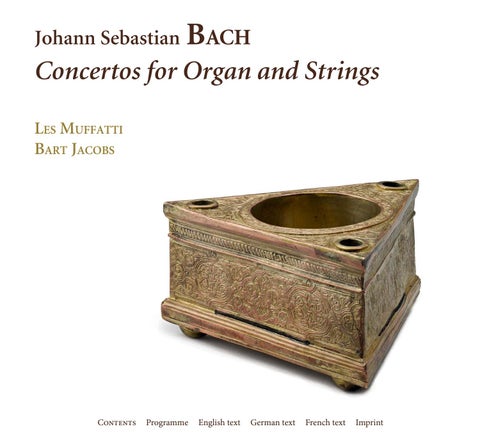
Johann Sebastian BACH
Concertos for Organ and Strings LES MUFFATTI BART JACOBS
Contents
Programme
English text
German text
French text
Imprint
Johann Sebastian Bach (1685-1750)
Concertos for Organ and Strings Reconstructions after Concertos and Cantatas Rekonstruktionen nach Konzerten und Kantaten Reconstructions d’après des concertos et des cantates
Concerto in D major after BWV 169 and BWV 49 1 2 3
(Allegro) Siciliano Allegro
Sinfonia from cantata BWV 169/1, without oboes Sinfonia from cantata BWV 169/5, without the alto solo Sinfonia from cantata BWV 49/1, transposed down a tone, without oboes
7:52 5:03 6:30
Concerto in D minor after BWV 146, BWV 188 and BWV 1052 4
(Allegro)
5 6
Adagio Allegro
Sinfonia from cantata BWV 146/1, without oboes, and with modifications in the violin parts Sinfonia from cantata BWV 146/2, without the chorale Reconstruction based on BWV 1052a (3rd movement), BWV 1052 and the sinfonia from BWV 188
7:49 6:13 8:08
7 Sinfonia in G major after BWV 156
2:39
8 Sinfonia in G major after BWV 75
2:25
9 Sinfonia in D major after BWV 29 and BWV 120a
3:41
Concerto in D minor after BWV 35 and BWV 1055 10 11
(Allegro) Larghetto
12
Presto
Sinfonia from cantata BWV 35/1, without oboes Larghetto from harpsichord concerto BWV 1055/2, transposed up a semitone Sinfonia from cantata BWV 35/5, without oboes
5:51 5:42 3:44
Concerto in G minor after BWV 1041 and BWV 1058 13 14 15
(Allegro) Andante Allegro assai String parts from harpsichord concerto BWV 1058, solo part from violin concerto BWV 1041, with adaptations from BWV 1058 TOTAL
3:55 6:33 3:45
79:59
REGISTRATIONS Concerto in D major after BWV 169 and BWV 49 Allegro Siciliano Allegro
I R8 O4 Q11/3 (bar 62 -Q11/3 +N3, D.C. +Q11/3) II G8 R4 I R8 Dulc8 II G8 I R8 O4 N3 Dulc8 (bar 137 -N3 -Dulc8) II G8 R4
P+II O8 P+II P+II O8
Concerto in D minor after BWV 146, BWV 188 and BWV 1052 (Allegro) Adagio Allegro
I O4 O2 (-8va) I P8 R8 I R8 O4 O2
II G8 II G8 II G8 R4
P+II S16 O8 P+II P+II S16 O8
II G8
P+II
II G8 R4
P+II O8
II G8 R4 Dulc8
P+II
Sinfonia in G major after BWV 156 I R8 R4 N3 +Trem
Sinfonia in G major after BWV 75 I R8 O4 N3 Tr8
Sinfonia in D major after BWV 29 and BWV 120a I P8 O4 O2 Mixt
Concerto in D minor after BWV 35 and BWV 1055 (Allegro) Larghetto Presto
I P8 I R8 I P8 R8 O4
II G8 O4 Gh2 II R4 Gh2 (-8va) +Trem II G8 O4 O2 N3 T13/5 Q11/3
P+I S16 P+I P+I + S16
Concerto in G minor after BWV 1041 and BWV 1058 (Allegro) Andante Allegro assai
I P8 R8 O4 N3 I (P8) R8 I P8 R8
II G8 R4 II O4 (-8va) +Trem II G8 O4 Gh2 N3 4
P+I S16 P+I S16 P+I S16
COMPOSITION OF THE THOMAS ORGAN IN BORNEM I Principal 8’ Rohrflöte 8’ Octava 4’ Rohrflöte 4’ Nasat 3’ Octava 2’ Tertia 13/5’ Quinta 11/3’ Dulcian 8’ Mixtur III Trompet 8’
II
Pedalboard
<–––––––––––––––––––––> Gedackt 8’ <––> Octava 4’ <––> Rohrflöte 4’ <––> Nasat 3’ <––> Octava 2’ Gemshorn 2’ <––> Tertia 13/5’ <––> Quinta 11/3’ <––> Dulcian 8’
Octavbass 8’
<–––––––––––––––––––––>
Trompet 8’ Fagott 16’ Subbass 16’
I + II / P + I / P + II / Tremulant a’ = 440 Hz
5
BART JACOBS organ & reconstructions
LES MUFFATTI Violin I Ryo Terakado (artistic direction) Marie Haag Catherine Meeùs
Violin II Marrie Mooij Laurent Hulsbosch Jorlen Vega García
Viola Manuela Bucher Sylvestre Vergez www.bartjacobs.eu
Cello Corentin Dellicour
Double Bass Benoît Vanden Bemden
Harpsichord Bart Rodyns 6
www.lesmuffatti.be 7
^menu BART JACOBS (born 1976) studied organ, harpsichord, chamber music and figured bass with Reitze Smits and Kris Verhelst at the Lemmensinstituut in Leuven, graduating with distinction. After his master’s degree in 2000 he was appointed organist to the cathedral choir in Brussels. Between 2006-2010 he garnered prizes at the international organ competitions in Alkmaar (1st prize, Schnitger competition), Amsterdam (3rd prize, Sweelinck competition), Bruges (4th prize, Musica Antiqua competition and Listener’s Choice award). In 2012 he was appointed chief organist of the Cathedral of St Michael and St Gudula, Brussels. He has toured extensively across Europe as a continuo player with a range of leading ensembles, including Les Muffatti, Vox Luminis, Currende, Il Gardellino, Ricercar Consort, BachPlus, Psallentes, and the Hathor Consort. He can also be heard live as a continuo player and accompanist for a wide variety of ensembles, choirs, and orchestras, both for early music and more recent repertoire. His impressive discography includes performances on both harpsichord and organ. He has also cooperated on All of Bach (www.allofbach.com), where he can be seen and heard interpreting Bach on the organ and harpsichord.
LES MUFFATTI were founded in 1996 by a group of young Brussels musicians out of a desire to equip themselves professionally for the world of orchestral baroque music. Above all, they wanted to give primacy to the pleasure of making music, while applying a deep exploration of the musical material itself, and paying scrupulous attention to the detail of its execution. After ten years working under conductor Peter Van Heyghen, the musicians assumed joint responsibility for the orchestra’s artistic direction. The musical direction for different projects has been entrusted to invited musicians, soloists, conductors or violin-leaders. The group is committed to programming a finely-judged balance between the great works of the established repertoire and newly discovered compositions. The ensemble’s name refers to Georg Muffat (1653–1704), cosmopolitan composer and essential source regarding the historical beginnings of the orchestra. He was one of the first to establish a detailed description of the principal characteristics differentiating the French and Italian styles. The group’s debut recording was dedicated to him. Les Muffatti’s discography so far comprises seven recordings on the Ramée label, all of which have met with universal acclaim. The recording of Reinhard Keiser’s Brockes-Passion with Vox Luminis received Belgium’s three top honours: as well as being named broadcast station Klara’s Recording of the Year, it received an Octave de la musique classique, and the Caecilia prize from the union of the Belgium musical press. All Les Muffatti’s recordings have been released by Ramée. Les Muffatti are supported by the Wallonia-Brussels Federation.
8
9
Diverse Concerte mit unterlauffender Doucen Instrumental-Music
was the Nikolaikirche where most of the cantatas were performed. Similarly, the theory that these organ contatas were written as an advertisement for the performance skills of his eldest son Wilhelm Friedemann, then 16, collapses when we learn that Friedemann was in Merseburg from July 1726 to April 1727, studying the violin with Johann Gottlieb Graun.
Although we know of at least five concertos J. S. Bach wrote for solo organ – mainly based on works by Vivaldi – we have no (surviving) Bach organ concertos with orchestral accompaniment. Contrast this with the 200+ cantatas: of these, 18 feature organ obbligato, which Bach uses as a solo instrument in arias (often in place of a melodic instrument), choral sections and sinfonias.
One possible explanation may lie in Dresden, where Bach had given a concert on the new Silbermann organ in the Sophienkirche in 1725. A newspaper report records that he performed a range of concertos as well as preludes, playing diverse Concerte mit unterlauffender Doucen Instrumental-Music (‘various concertos with sweet underlying instrumental music’). Although it is not entirely clear which works Bach played in the concert, it is not too far-fetched to think that, in addition to other organ works, he also performed organ concertos, or at least a few earlier versions of the sinfonias, with obbligato organ and strings in order to show off the organ. In the full score of the 1726 cantatas, which Bach used for conducting (as shown on p. 15), we can see that he transposed the obbligato organ line up into Chorton, a whole tone above the Cammerton for the strings, which makes a performance with Bach himself as the soloist extremely likely. The great German Bach specialist Christoph Wolff believes the sinfonias to cantatas BWV 169 and 49 were also intended for the Dresden concert.
The use of sinfonias as an instrumental opening to operas and other vocal works went back to the 17th century in the Italian and German traditions. Indeed, Bach’s early compositions from Mühlhausen and Weimar also contain brief, small-scale sinfonias acting as introductions to cantatas. Later, in Leipzig, these sinfonias became more ambitious in scope, evolving into larger-scale works of greater complexity. The most obviously conspicuous date to 1726. In May to November of that year, Bach composed several cantatas (BWV 146, 35, 169, 49, 170 and 194) which assign a prominent solo role to the organ. Most of these are reworkings of movements of lost violin and oboe concertos written during his time at Weimar and Köthen. Incidentally, he later reworked them once more, in around 1738, when writing his harpsichord concertos. Why Bach wrote such a number of obbligato organ cantatas in such a short period remains unknown. The idea that it was connected to work on the organ at the Thomaskirche is unconvincing, considering it
While we do not know whether Bach combined some or all of these sinfonias to stand-alone organ 10
this lost work is the harpsichord concerto BWV 1052a, in C. P. E. Bach’s hand. Later, J. S. Bach reworked the first and second movements in the sinfonia and chorale to BWV 146, and the third movement in the sinfonia to BWV 188; both are obbligato organ cantatas. Only the final bars of this last sinfonia survive, but they were included in our reconstruction. The concerto’s final incarnation was as the harpsichord concerto BWV 1052, in J. S. Bach’s hand.
concertos with orchestral accompaniment, it is perfectly possible to create a number of hypothetical reconstructions of three-movement organ concertos of this type from the cantatas mentioned above, along with the related violin and harpsichord concertos. On the analogy with the violin and harpsichord concertos, the oboe parts, which largely double the violins, have been omitted from the reconstructions. By using this method, we hope to bring the diverse Concerten mit unterlauffender Doucen InstrumentalMusic which Bach may have performed in Dresden in 1725 back to life on CD.
Sinfonia in G major after BWV 156 The sinfonia of the cantata Ich steh mit einem Fuß im Grabe BWV 156 for oboe and strings originates in the slow movement of a lost oboe concerto that Bach later reworked and used as the middle section of harpsichord concerto BWV 1056. Transferring it to the organ is in no way exceptional. Bach himself replaced a melody instrument with an organ part and vice versa from time to time, as in the soprano-alto duet from the cantata BWV 172/5, where Bach entrusted the oboe d’amore solo to the organ at a later performance.
The reconstruction of the concertos Concerto in D major after BWV 169 and BWV 49 This concerto, thought to be intended for a woodwind instrument, may in fact be an organ concerto performed as part of Bach’s organ recital in Dresden in 1725. Bach reworked its first two movements in cantata BWV 169, and, ten years after that, in the harpsichord concerto BWV 1053. The sinfonia to BWV 49 provided the material for the last part of the harpsichord concerto, and consequently also for the final movement of this reconstructed organ concerto.
Sinfonia in G major after BWV 75 In the sinfonia to the cantata Die Elenden sollen essen BWV 75, the tromba (natural horn) carries the melody of the chorale Was Gott tut, das ist wohlgetan to fugal string accompaniment. However, Bach was equally fond of having the organ play the chorale melody. One example is the cantata BWV 73/1, where Bach again substituted the organ for the original horn to play the chorale melody in a later performance. On this basis, we have here replaced the tromba with the
Concerto in D minor after BWV 146, BWV 188 and BWV 1052 The basis for this concerto is J. S. Bach’s lost violin concerto in D minor. The first surviving adaptation of 11
organ; the resulting sinfonia becomes a chorale prelude for organ in which the chorale melody is foreshadowed by imitative entries in the orchestra.
the harpsichord concerto BWV 1055, which may also originally have been written for oboe. Concerto in G minor after BWV 1041 and BWV 1058 This concerto’s model is the violin concerto BWV 1041, on which Bach based his first harpsichord concerto, BWV 1058. Our reconstruction for obbligato organ and strings is derived by analogy from Bach’s lost violin concerto in D minor, which provided the foundations for the harpsichord concerto BWV 1052 and the first two movements of the cantata BWV 146. The reconstruction gives the strings the violin parts from BWV 1058, which are identical but transposed a tone down from those in the violin concerto, and assigns the violin solo from BWV 1041 to the organ, with a few adaptations taken from the harpsichord concerto.
Sinfonia in D major after BWV 29 and BWV 120a The original model for this sinfonia is the Prelude from the Partita for solo violin BWV 1006. Bach later made a large-scale adaptation of this work for organ solo, strings, trumpets and timpani, more familiar as the sinfonia from the Ratswahl cantata Wir danken dir, Gott BWV 29. Somewhat earlier, in 1729, Bach also orchestrated the violin solo for inclusion in the wedding cantata Herr Gott, Beherrscher aller Dinge BWV 120a, adding strings and oboe only, i.e. omitting the trumpets and timpani. Though only the last eleven bars have survived, they are enough to show that the string parts are the same as in the later version, BWV 29. This allows us to reconstruct this sinfonia simply from the organ and string parts from BWV 29.
The organ as obbligato instrument Concerto in D minor after BWV 35 and BWV 1055 Both sinfonias to the cantata Geist und Seele wird verwirret BWV 35 appear to trace their roots back to a lost oboe concerto. In addition, some scholars assume that the cantata’s aria no. 2 served as the middle section. However, that is a particularly insecure assertion. Bach adapted the oboe concerto for harpsichord, but only nine bars survive, all from the opening movement. This fragment also reappears in the first sinfonia of the obbligato organ cantata BWV 35. For the middle movement of the concerto, we have here chosen for an arrangement for organ of the larghetto from
The organ parts in Bach’s sinfonias and cantatas for obbligato organ are notated on two staves, raising a whole host of questions for the organist about how best to perform them on the organ. Bach, after all, wasn’t playing on small portable organs, but large instruments with two or three manuals plus pedals. In addition, not all the cantatas were performed on the same instrument, and organists had to constantly adapt to the circumstances and the nature of the organ that was available in a particular church. Bach also provides little additional information in the organ 12
parts, meaning choices often have to be made about, for example, the use of different manuals and stops, the realisation of the figured bass, and the use of the pedals.
common to find that there is no figured bass written in at points where chords are absolutely necessary, meaning the organist is required to make choices once more.
Bach gives sporadic indications about manuals in arias and choir movements (e.g. Positivo, RückPositiv, BP (Brustpositiv), or Organo oblig. à 2 Clav.) which point to the use of a solo and / or accompanying manual. However, the obbligato organ parts in the sinfonias contain no such indication, despite the fact that the parts often cross in such a way as to make them unplayable on a single manual. The organist is therefore forced to make choices about which manuals to use.
Bach also never provided a third stave with the pedal notes in the organ parts of his cantatas, and there are few directions on pedal use. The sinfonia to BWV 146 (see image on p. 21) requires both hands to play the solo, meaning that the lower line can only have been played on the pedals. Incidentally, the opening chorale of the St Matthew Passion (BWV 244) poses the same issue. There, the organist’s right hand is occupied with the chorale melody, while the left hand is implicitly assigned the chords of the basso continuo. Again, there is no option than to play the bass on the pedals, albeit not with a 16’.
Stop selection is often similarly a matter of guesswork. Although arias and chorale sections contain a handful of indications (e.g. Sesquialtera, Posaune 16 fuss, 8 und 4 Fus Gedackt), there are no such registration markers for the solo-like organ parts in the sinfonias. The assumption evidently was that the organist would adapt to what was available on the instrument at hand.
In general, pedals were employed far more frequently than is often assumed. 18th-century music theorists often devote space to their use. If the bass line was too complicated to play on the pedals, it was even considered preferable to play only the harmonically important notes than to omit the bass altogether (see illustration on p. 14).
Occasionally, the organ parts also contain figured bass in the lower stave in addition to the solo line on the upper. This shows the organist was meant to play both the solo line and its continuo accompaniment. In the second half of the cantata BWV 161, Bach writes in the performance direction Sesquialtera ad Continuo: while the right hand plays the solo line, the left is to play the chords on another manual. But it is equally
The preceding paragraphs will have made clear that there is a lot of choice left to the organist when performing these two-voiced obbligato parts. There are no strict rules; instead, everything depends on the organ available, its registration, the acoustics, and the organist’s inventiveness and creativity. 13
The Thomas organ (2013) in the Church of Our Lady and St Leodegar, Bornem (Belgium)
Given these variables, this recording has made use of a large range of registrations in the organ part: solo in the right hand with figured bass chords in the left on different manuals, and frequent use of the pedals with and without a 16’ stop.
The Thomas organ in Bornem is based on a small instrument built by Gottfried Silbermann (1683– 1753) in 1721–22 for the Marienkirche in Rötha, one of the nearest Silbermann organs to Leipzig, which Bach must therefore undoubtedly have known.
Most organs in Bach’s time were tuned in Chorton (465 Hz), a whole tone above the Cammerton (415 Hz) of the strings, so that the organist’s part was played a whole tone down. On this recording, however, we have chosen to perform all works at the pitch of the Thomas organ in Bornem (440 Hz).
It makes use of transmissions which allow stops to be played on different manuals, thus providing an interesting way of extending the scope of a limited set of stops. Heinrich Gottlieb Trost, a contemporary of both J. S. Bach and Gottfried Silbermann, adopted this transmission system (though only between one manual and pedals) for his organ in Altenburg, which Bach visited in 1739. Silbermann was by contrast very strict in applying conventional design principles when building his organs. Bart Jacobs Translation: Winnie Smith
Detail of Musicalische Handleitung, Friedrich Erhard Niedt (Hamburg 1710) 14
Beginning of the Sinfonia from Cantata BWV 49 15
^menu BART JACOBS (*1976) studierte Orgel, Cembalo, Kammermusik und Generalbass am Lemmensinstitut in Löwen bei Reitze Smits und Kris Verhelst. Nachdem er im Jahr 2000 seinen Masterabschluss mit den höchsten Auszeichnungen erhielt, wurde er zum Organisten des Brüsseler Domchores ernannt. Zwischen 2006 und 2010 gewann er Preise bei internationalen Orgelwettbewerben in Alkmaar (1. Preis beim Schnitger-Wettbewerb), Amsterdam (3. Preis beim Sweelinck-Wettbewerb) und Brügge (4. Preis beim Musica Antiqua-Wettbewerb und Publikumspreis). Im Jahr 2012 wurde er zum Titularorganisten an der Kathedrale St. Michael und St. Gudula in Brüssel ernannt. Als Generalbass-Spieler konzertierte er europaweit mit mehreren renommierten Ensembles wie Les Muffatti, Vox Luminis, Currende, Il Gardellino, Ricercar Consort, BachPlus, Psallentes, Hathor Consort und anderen. Er ist auch als Begleiter zahlreicher Ensembles, Chöre und Orchester alter und neuer Musik zu hören. Seine umfangreiche Diskographie umfasst sowohl Orgel- als auch Cembaloaufführungen. Er wirkte bei All of Bach (www.allofbach.com) mit, wo er mit seinen Interpretationen Bachscher Orgel- und Cembalo-Werke zu sehen und zu hören ist.
LES MUFFATTI entstanden 1996 aus dem Bestreben junger Brüsseler Musiker, einen professionellen Rahmen für die Interpretation barocker Orchestermusik zu schaffen, der der Freude an der Musik einen zentralen Platz einräumt und gleichzeitig deren tiefgehende Erkundung sowie eine große handwerkliche Sorgfalt bei der Ausführung ermöglicht. Nachdem Peter Van Heyghen zehn Jahre die künstlerische Leitung des Ensembles innehatte, wird diese heute von den Musikern kollektiv ausgeübt. Mit ihren Projekten, deren musikalische Leitung Gastmusikern – Solisten, Dirigenten oder Konzertmeistern – anvertraut wird, suchen Les Muffatti ein subtiles Gleichgewicht zwischen den Werken des großen Repertoires und bisher verborgenen Schätzen zu verwirklichen. Der Name des Ensembles verweist auf den kosmopolitischen Komponisten Georg Muffat (1653–1704), dessen Werk eine unentbehrliche Quelle für die Anfänge der Orchestermusik darstellt: Muffat zeigte u.a. als einer der ersten sehr detailliert die wesentlichen Unterschiede zwischen dem französischen und dem italienischen musikalischen Stil auf. Die erste Einspielung des Ensembles ist diesem Komponisten gewidmet. Les Muffatti haben bisher sieben CDs für das Label Ramée eingespielt, die alle von der Kritik hoch gelobt und prämiert wurden. Die Aufnahme der Brockes-Passion von Reinhard Keiser, in Zusammenarbeit mit dem Vokalensemble Vox Luminis entstanden, erhielt 2014 die drei großen belgischen Musikpreise: sie wurde vom Radiosender Klara zur Klassik-CD des Jahres gekürt, mit dem Caecilia-Preis der Vereinigung der belgischen Musikpresse sowie mit der Octave de la musique classique ausgezeichnet. Les Muffattis werden von der Föderation Wallonie-Brüssel gesponsort.
16
Zusammenhang mit dem Abschluss der Arbeiten an der Orgel in der Thomaskirche ist zweifelhaft, da die meisten von ihnen in der Nikolaikirche aufgeführt wurden. Auch die Vermutung, dass diese »Orgelkantaten« zur Förderung seines ältesten Sohnes, des damals sechzehnjährigen Wilhelm Friedemann, als Organist komponiert worden wären, kann nicht zutreffen, da Friedemann von Juli 1726 bis April 1727 in Merseburg bei Johann Gottlieb Graun Violine studierte.
DIVERSE CONCERTE MIT UNTERLAUFFENDER DOUCEN INSTRUMENTAL-MUSIC Obwohl wir von J. S. Bach mindestens fünf Konzerte für Solo-Orgel kennen – hauptsächlich nach Werken von Vivaldi – sind von ihm keine Orgelkonzerte mit Orchesterbegleitung überliefert. Allerdings hat er in 18 von seinen mehr als 200 Kantaten die Orgel als obligates Soloinstrument in Arien – oft als Ersatz für ein Melodieinstrument –, Chorpassagen und Sinfonias verwendet.
Möglicherweise liegt der Grund dafür in Dresden, wo Bach 1725 ein Orgelkonzert in der Sophienkirche auf der neuen Silbermann-Orgel gab. Einem Zeitungsbericht zufolge hat er dort nicht nur Präludien gespielt, sondern sich auch in »diversen Concerten mit unterlauffender Doucen Instrumental-Music« hören lassen. Zwar ist nicht ganz klar, welche Werke Bach dort genau aufgeführt hat, doch ist es durchaus vorstellbar, dass er neben anderen Orgelwerken auch Orgelkonzerte oder zumindest einige frühere Versionen dieser Sinfonias mit obligater Orgel und Streichern zur Demonstration der Orgel spielte. In den Partituren der Kantaten von 1726, aus denen Bach dirigierte (siehe Abbildung S. 15), sehen wir, dass er die obligaten Orgelstimmen direkt in den Chorton transponierte (d.h. einen Ganzton höher als der Kammerton für die Streicher), was mit großer Wahrscheinlichkeit darauf hindeutet, dass er selbst als Solist die Orgel spielte. Dem großen deutschen Bach-Spezialisten Christoph Wolff zufolge waren die Sinfonias aus den Kantaten BWV 169 und 49 ebenfalls für dieses Konzert in Dresden gedacht.
Bereits im 17. Jahrhundert entstanden in Italien und Deutschland Sinfonias als instrumentale Einleitungen zu Opern und anderen Vokalwerken. Auch in Bachs Frühwerken aus Mühlhausen und Weimar finden sich einfache, kurze Sinfonias als Einführungssätze in seine Kantaten. Später in Leipzig wurden daraus anspruchsvollere Kompositionen mit komplexeren Formen und größeren Besetzungen. Die bemerkenswertesten Sinfonias stammen aus dem Jahr 1726: In der Zeit von Mai bis November komponierte Bach mehrere Kantaten (BWV 146, 35, 169, 49, 170 und 194), in denen er der Orgel eine wesentliche solistische Rolle zuteilte. Dabei handelt es sich meist um Bearbeitungen von Sätzen verlorener Geigen- und Oboenkonzerte, die Bach zuvor in Weimar oder Köthen komponiert hatte. Die gleichen Sätze überarbeitete er später, um 1738, erneut, als er seine Cembalokonzerte schrieb. Warum Bach in so kurzer Zeit mehrere Kantaten mit obligater Orgel komponierte, bleibt unklar. Ein 17
Konzert in d-Moll nach BWV 146, 188 und 1052 Grundlage für dieses Konzert ist J. S. Bachs verlorengegangenes Violinkonzert in d-Moll. Die erste erhaltene Bearbeitung dieses verlorenen Werkes ist das Cembalokonzert BWV 1052a von C. P. E. Bach. Später überarbeitete J. S. Bach den ersten und zweiten Satz zur Sinfonia und zum Choral der Kantate BWV 146, und den dritten Satz zur Sinfonia der Kantate BWV 188, nun jeweils mit obligater Orgel. Von der letztgenannten Sinfonia sind nur die letzten Takte überliefert; diese wurden in unserer Rekonstruktion verwendet. Seine letzte Bearbeitung findet dieses Konzert in der Form des Cembalokonzerts BWV 1052.
Obwohl wir nicht wissen, ob Bach diese Sinfonias oder zumindest einige von ihnen selbst zu eigenständigen Konzerten für Orgel mit Orchesterbegleitung zusammengeführt hat, ist es durchaus möglich, auf der Grundlage der oben genannten Kantaten und der entsprechenden Geigen- und Cembalokonzerte eine Reihe von hypothetischen Rekonstruktionen von dreisätzigen Konzerten für Orgel und Streicher vorzunehmen. Die Oboen, die die Geigen meistenteils verdoppeln, wurden in diesen Rekonstruktionen analog zu seinen Geigenund Cembalokonzerten weggelassen. Mit dieser CD hoffen wir, die »diversen Concerte mit unterlauffender Doucen Instrumental-Music«, die Bach möglicherweise 1725 in Dresden aufgeführt hat, wieder zum Leben zu erwecken.
Sinfonia G-Dur nach BWV 156 Die Sinfonia der Kantate Ich steh mit einem Fuß im Grabe BWV 156 für Oboe und Streicher entstammt ursprünglich dem Mittelsatz eines verlorengegangenen Oboenkonzerts, den Bach später in seinem Cembalokonzert BWV 1056 wiederverwendete. Eine Ausführung an der Orgel ist nicht unüblich, da Bach oft ein Melodieinstrument durch die Orgel ersetzt hat oder umgekehrt, wie z.B. in der Arie aus der Kantate BWV 172/5 für Sopran und Alt, deren Solo für Oboe d’amore der Komponist in einer späteren Aufführung auf die Orgel übertrug.
DIE REKONSTRUKTION DER ORGELKONZERTE Konzert in D-Dur nach BWV 169 und 49 Obwohl allgemein angenommen wird, dass dieses Konzert ursprünglich für ein Holzblasinstrument geschrieben wurde, ist es möglicherweise eines der im Rahmen von Bachs Orgelkonzert 1725 in Dresden aufgeführten Werke. Bach überarbeitete die ersten beiden Sätze für die Kantate BWV 169 und zehn Jahre später für das Cembalokonzert BWV 1052. Die Sinfonia nach BWV 49 diente als Vorlage für den letzten Satz des Cembalokonzerts und damit auch für den letzten Satz dieses rekonstruierten Orgelkonzerts.
Sinfonia G-Dur nach BWV 75 In der Sinfonia der Kantate Die Elenden sollen essen BWV 75 spielt die Tromba (Naturtrompete) die Choralmelodie »Was Gott tut, das ist wohlgetan« über einer fugierten Begleitung durch Streicher. Bach liebte es aber auch, Choralmelodien durch die Orgel spielen zu lassen. 18
So ersetzte er beispielsweise in der Kantate BWV 73/1 das Horn, das die Choralmelodie spielt, in einer späteren Bearbeitung durch die Orgel. In gleicher Weise wird in unserer Rekonstruktion die Tromba durch die Orgel ersetzt, so dass diese Sinfonia sozusagen zu einem Choralvorspiel für Orgel wird, wobei der Choralmelodie imitative Einwürfe des Orchesters vorausgehen.
ter für Cembalo bearbeitet, von welchem nur noch neun Takte aus dem ersten Satz erhalten sind. Dieses Fragment findet sich auch im ersten Satz der Kantate BWV 35 mit obligater Orgel. Als Mittelsatz dieses Konzerts wird hier eine Bearbeitung für Orgel des Larghettos aus dem Cembalokonzert BWV 1055 verwendet, das wahrscheinlich ebenfalls ursprünglich für Oboe komponiert wurde.
Sinfonia D-Dur nach BWV 29 und 120a Die ursprüngliche Vorlage für diese Sinfonia ist das Präludium der Partita für Violine solo BWV 1006, wovon Bach später eine große Bearbeitung für Orgel solo, Streicher, Trompeten und Pauken anfertigte, die wir als Sinfonia der Ratswahl-Kantate Wir danken dir, Gott BWV 29 kennen. Bereits 1729 orchestrierte Bach dieses Violinsolo für die Hochzeitskantate Herr Gott, Beherrscher aller Dinge BWV 120a, damals noch ohne Trompeten und Pauken, nur mit Begleitung durch Streicher und Oboen. Hiervon sind nur die letzten elf Takte erhalten geblieben, aus denen sich aber schließen lässt, dass die Streicherpartien die gleichen sind wie in der späteren Version aus BWV 29. Die Rekonstruktion dieser Sinfonia fußt daher auf der Orgelstimme und den Streicherstimmen von BWV 29.
Konzert in g-Moll nach BWV 1041 und BWV 1058 Die Vorlage für dieses Konzert ist das Violinkonzert in a-Moll BWV 1041, welches Bach später zu seinem ersten Cembalokonzert BWV 1058 umarbeitete. Die Rekonstruktion für obligate Orgel und Streicher entstand in Analogie zu dem verlorenen Violinkonzert in d-Moll (siehe oben). Die aus dem Cembalokonzert übernommenen Streicherpartien sind identisch mit denen aus dem Violinkonzert, jedoch einen Ganzton tiefer transponiert, während die Orgelstimme die Solopartie aus dem Violinkonzert mit einigen Anpassungen aus dem Cembalokonzert spielt.
Die Orgel als obligates Instrument Die Orgelstimmen in Bachs Sinfonias und Kantaten für obligate Orgel sind auf zwei Notensystemen notiert und stellen den Organisten vor zahlreiche Fragen zur Ausführung und zur Verwendung der Orgel. Bach spielte nicht auf kleinen Orgelpositiven, sondern auf großen Orgeln mit zwei oder drei Manualen und Pedal. Zudem wurden nicht alle Kantaten an dersel-
Konzert in D-Dur nach BWV 35 und 1055 Die beiden Sinfonias der Kantate Geist und Seele wird verwirret BWV 35 haben ihren Ursprung eventuell in einem verlorenen Oboenkonzert, wobei von einigen vermutet wird, dass die Arie Nr. 2 aus der Kantate als Mittelsatz gedient hätte. Diese Annahme ist jedoch höchst fragwürdig. Bach hat dieses Oboenkonzert spä19
bassbezifferung im Bass. Dies zeigt eindeutig, dass der Organist sowohl die Sololinie als auch die Generalbassbegleitung zu spielen hatte. Im zweiten Satz der Kantate BWV 161 schreibt Bach »Sesquialtera ad Continuo« – während die rechte Hand die Sololinie spielt, spielt die linke Hand die Akkorde auf einer anderen Tastatur. Aber es kommt ebenfalls vor, dass es an Stellen, an denen die Akkorde wirklich gebraucht werden, überhaupt keine Generalbassbezifferung gibt, und dann steht der Organist wiederum vor der Wahl.
ben Orgel aufgeführt, der Organist musste sich immer an die Gegebenheiten und die Disposition der Orgel in der jeweiligen Kirche anpassen. Überdies gibt Bach wenig Informationen in den Orgelstimmen, weshalb Entscheidungen in Bezug auf die Verwendung der verschiedenen Manuale und Register, die Aussetzung des Generalbasses und den Gebrauch des Pedals getroffen werden müssen. In Einzelfällen gibt uns Bach Anweisungen über den Gebrauch verschiedener Manuale in Arien und Chorsätzen, wie zum Beispiel »Positvo« und »RückPositiv«, »BP« (Brustpositiv) oder »Organo oblig. à 2 Clav.«, die auf die Verwendung eines Solo- und/oder Begleit-Manuals verweisen. In den obligaten Orgelstimmen seiner Sinfonias finden wir jedoch keinerlei Hinweis darauf, auch wenn die Orgelpartie aufgrund von Stimmkreuzungen oft nicht auf einem Manual gespielt werden kann. Hier muss der Organist zwischen den verschiedenen Manualen wählen.
Bach sah auch nie ein drittes Notensystem für das Pedal in den Orgelpartien seiner Kantaten vor, und Anweisungen zum Pedalgebrauch sind selten. In der Sinfonia der Kantate BWV 146 (siehe Abbildung S. 21) werden für das Solospiel beide Hände benötigt, was bedeutet, dass das untere System im Pedal gespielt werden muss. Ein weiteres Beispiel dafür ist übrigens der Eröffnungschor der Matthäus-Passion BWV 244. Hier spielt der Organist die Choralmelodie mit der rechten Hand, während der linken Hand die Akkorde des Basso continuo zugeordnet sind. Auch hier kann der Bass nur im Pedal gespielt werden, wenn auch ohne 16-FußRegister.
Auch bei der Wahl der Register müssen wir oft raten. Obwohl eine Handvoll Angaben wie »Sesquialtera«, »Posaune 16 fuss« oder »8 und 4 Fus Gedackt« in Arien oder Chorsätzen vorkommen, finden wir keine solchen Registrierungshinweise für die solistischen Orgelpartien in den Sinfonias. Es wurde offensichtlich davon ausgegangen, dass sich der Organist an die Möglichkeiten der zur Verfügung stehenden Orgel angepasste.
Das Pedal wurde in diesem Zusammenhang viel häufiger benutzt, als oft angenommen wird. Musiktheoretiker des 18. Jahrhunderts geben hierzu des öfteren Hinweise. Wenn der Basspart zu kompliziert war, um ihn auf dem Pedal zu spielen, fand man es noch immer besser, nur die harmonisch wichtigen Noten im Pedal zu spielen, als ihn ganz wegzulassen (siehe Abbildung S. 14).
Manchmal enthalten die Orgelstimmen neben der Sololinie für die rechte Hand auch die General20
Die Thomas-Orgel (2013) in der Liebfrauen- und Sankt Leodegar-Kirche zu Bornem (Belgien)
Die Verwendung der Orgel in diesen zweistimmigen obligaten Orgelpartien lässt dem Organisten demnach viele Gestaltungsmöglichkeiten. Es gibt keine strengen Regeln, und alles hängt von den Möglichkeiten der Orgel, der Instrumentierung, der Akustik und dem Ideenreichtum und der Kreativität des Organisten ab.
Die Thomas-Orgel in Bornem ist einem kleinen Instrument nachempfunden, das Gottfried Silbermann (1683-1753) in den Jahren 1721-22 für die Marienkirche in Rötha gebaut hat, und welches Bach aufgrund der geographischen Nähe zu Leipzig zweifellos kannte.
Basierend auf all diesen Aspekten wurde bei der Ausführung der Orgelpartien in dieser Aufnahme vielfältiger Gebrauch verschiedenster Registrierungen gemacht, mit der Solostimme in der rechten Hand und den Akkorden des Generalbasses in der linken Hand auf verschiedene Manuale verteilt, und unter häufiger Verwendung des Pedals mit oder ohne 16-Fuß-Register.
Sie ist mit Wechselregistern ausgestattet, die beim Spielen auf dem einen oder anderen Manual gezogen werden können und so die Möglichkeiten einer kleinen Disposition auf interessante Weise erweitern. Heinrich Gottlieb Trost, ein Zeitgenosse von J. S. Bach und G. Silbermann, verwendete dieses System (jedoch nur zwischen Pedal und Manual) in seiner Orgel in Altenburg, die Bach 1739 besuchte. Silbermann verfolgte bei der Gestaltung seiner Instrumente hingegen sehr strikt konventionelle Prinzipien.
Die meisten Orgeln der Bachzeit waren im Chorton gestimmt (465 Hz), einen Ganzton höher als der Kammerton der Streicher(415 Hz), so dass der Organist seine Stimme einen Ganzton tiefer spielte. Für diese Aufnahme wurde jedoch entschieden, alle Werke in der Stimmtonhöhe der Thomas-Orgel von Bornem aufzuführen (440 Hz).
Bart Jacobs Übersetzung: Rainer Arndt
Detail of the Sinfonia from Cantata BWV 146 21
The Thomas organ in Bornem 22
^menu BART JACOBS (né en 1976) étudie l’orgue, le clavecin et la basse continue à l’Institut Lemmens à Leuven auprès de Reitze Smits et de Kris Verhelst, où il obtient une maîtrise en orgue avec la plus grande distinction. Après son diplôme final en 2000, il est nommé organiste du chœur de la cathédrale Saints-Michel-et-Gudule de Bruxelles, puis organiste titulaire de la cathédrale en 2012. Entre 2006 et 2010, il remporte de nombreux prix lors de concours d’orgue internationaux : 1er prix du Concours Schnitger à Alkmaar, 3e prix du Concours international Sweelinck à Amsterdam, 4e prix et prix du public du Concours international d’orgue Musica Antiqua à Bruges… Actif à la fois dans les musiques anciennes et nouvelles, il se produit dans l’Europe entière avec des ensembles renommés comme Les Muffatti, Vox Luminis, Currende, Il Gardellino, Ricercar Consort, BachPlus, Psallentes, Hathor Consort, à l’orgue et au clavecin. Il a réalisé de nombreux enregistrements et a collaboré au projet All of Bach (www.allofbach.com), où on peut le voir et l’entendre dans des interprétations de Bach, sur l’orgue et sur le clavecin.
LES MUFFATTI sont nés en 1996 du désir de jeunes musiciens bruxellois de se doter d’un outil de travail professionnel qui, dans le domaine de l’interprétation de la musique orchestrale baroque, concède une place primordiale à la jouissance de la musique tout en autorisant l’exploration en profondeur de son contenu ainsi qu’une grande minutie artisanale dans son exécution. Après avoir travaillé pendant dix ans sous la baguette de Peter Van Heyghen, les musiciens de l’orchestre assurent désormais collectivement la direction artistique. Ils confient la direction musicale des différents projets à des musiciens invités, soliste, chef ou violon conducteur. Ils ont à cœur d’axer leurs projets sur un équilibre subtil entre œuvres du grand répertoire et réelles découvertes. Le nom de l’orchestre fait référence à Georg Muffat (1653-1704), compositeur cosmopolite et source incontournable pour l’histoire des débuts de l’orchestre ; il fut notamment l’un des premiers à établir de façon détaillée les principales caractéristiques différenciant les styles musicaux français et italien. Le premier album de l’ensemble lui est consacré. La discographie des Muffatti comprend à ce jour sept enregistrements, tous publiés par le label Ramée et unanimement salués par la critique. Leur enregistrement de la Brockes-Passion de Reinhard Keiser, réalisé en collaboration avec l’ensemble Vox Luminis, a remporté en 2014 les trois grands prix discographiques belges : il a été désigné disque classique de l’année par radio Klara, a été récompensé d’un prix Caecilia (Union de la presse musicale belge) et de l’Octave de la musique classique. Les Muffatti reçoivent le soutien de la Fédération Wallonie-Bruxelles.
23
Nous ne savons pas précisément pourquoi Bach composa tant de cantates avec orgue obligé sur une si courte période. Elles n’ont sans doute pas été écrites en suite des travaux réalisés sur l’orgue de l’église SaintThomas, la plupart d’entre elles ayant été données en l’église Saint-Nicolas. L’idée que ces « cantates pour orgue » auraient été composées pour promouvoir son fils aîné, Wilhelm Friedemann, alors âgé de 16 ans, comme organiste ne tient pas plus la route, puisque ce dernier était à Mersebourg entre juillet 1726 et avril 1727 pour y étudier le violon auprès de Johann Gottlieb Graun.
DIVERSE CONCERTE MIT UNTERLAUFFENDER DOUCEN INSTRUMENTAL-M USIC Nous connaissons au moins cinq concertos pour orgue solo de Johann Sebastian Bach, qui sont pour la plupart basés sur des œuvres d’Antonio Vivaldi, mais nous n’avons conservé aucun concerto pour orgue avec accompagnement orchestral qu’il ait réellement composé lui-même. Parmi ses plus de 200 cantates, 18 présentent un orgue obligé, qui est utilisé en soliste dans certains airs – souvent en lieu et place de l’instrument mélodique –, mouvements de chœur et sinfonias.
Il est possible que leur origine doive être cherchée à Dresde, où Bach donna un concert d’orgue en 1725, sur le nouvel instrument Silbermann de l’église SainteSophie. Selon la presse, il joua des préludes, mais aussi « diversen Concerten mit unterlauffender Doucen Instrumental-Music » (divers concerts avec douce musique instrumentale sous-jacente). On ne sait pas exactement quelles œuvres il interpréta à cette occasion, mais il n’est pas impensable qu’il joua notamment des concertos pour orgue ou au moins quelques versions antérieures des sinfonias avec orgue obligé des cantates de 1726, pour faire la démonstration des possibilités de l’instrument. Dans la partition complète des cantates de 1726 que Bach utilisa pour diriger (voyez l’illustration page 15), on peut effectivement voir qu’il transposa immédiatement les parties d’orgue obligé en Chorton (un ton entier plus haut que le Cammerton des cordes), ce qui indique très probablement qu’il tenait lui-même le pupitre de soliste. Selon
Au XVIIe siècle déjà, des sinfonias servaient, en Italie et en Allemagne, d’introduction instrumentale à des opéras et à d’autres œuvres vocales. Dans les premières œuvres de Bach, écrites à Mühlhausen et à Weimar, nous trouvons des sinfonias courtes et modestes en introduction de ses cantates. Plus tard, alors que le compositeur travaillait à Leipzig, ces œuvres devinrent plus ambitieuses, plus complexe et plus longues. Les sinfonias avec orgue les plus remarquables datent de 1726 : entre mai et novembre de cette année, Bach composa plusieurs cantates (BWV 146, 35, 169, 49, 170 et 194) où l’orgue tient une partie soliste importante. Il s’agit pour la plupart d’arrangements de mouvements de concertos perdus pour hautbois ou pour violon, composés à Weimar ou à Köthen. Le compositeur retravaillerait les mêmes mouvements plus tard, vers 1738, au moment d’écrire ses concertos pour clavecin. 24
le dernier mouvement du concerto pour clavecin ainsi que pour ce concerto pour orgue reconstitué.
Christoph Wolff, grand spécialiste du compositeur, les sinfonias des cantates BWV 169 et 49 furent également destinées à ce concert à Dresde.
Concerto en ré mineur d’après BWV 146, 188 et 1052 Ce concerto est basé sur le concerto perdu pour violon en ré mineur. Une première adaptation en a été réalisée pour le clavecin par Carl Philipp Emanuel Bach (BWV 1052a). Plus tard, Johann Sebastian en a réutilisé les deux premiers mouvements pour la sinfonia et le choral de la cantate BWV 146 et le troisième mouvement pour la sinfonia de la cantate BWV 188, chaque fois avec orgue obligé. Seules les dernières mesures de cette sinfonia BWV 188 ont été conservées. Celles-ci ont été utilisées dans notre reconstruction. La dernière adaptation de ce concerto est le concerto pour clavecin BWV 1052, réalisé par Johann Sebastian Bach lui-même.
Nous ne savons pas si Bach rassembla lui-même ces sinfonias, ou au moins un certain nombre d’entre elles, en concertos indépendants pour orgue avec accompagnement orchestral, mais il est tout à fait possible, sur la base des cantates et des concertos pour violon et pour clavecin précités, de réaliser des reconstructions de concertos en trois mouvements pour orgue et cordes. Les parties de hautbois, qui doublent largement les parties de violon, ont, par analogie avec ses concertos pour violon et pour clavecin, été omises dans cet enregistrement. Nous espérons ainsi faire revivre les diversen Concerten mit unterlauffender Doucen Instrumental-Music que Bach interpréta vraisemblablement à Dresde en 1725 !
Sinfonia en sol majeur d’après BWV 156 À l’origine, la sinfonia de la cantate Ich steh’ mit einem Fuß im Grabe BWV 156 pour hautbois et cordes était un mouvement d’un concerto perdu pour hautbois, que Bach réutiliserait plus tard comme mouvement central du concerto pour clavecin BWV 1056. La jouer sur l’orgue n’a rien d’étrange, sachant que Bach remplace souvent l’instrument mélodique par l’orgue ou vice versa : c’est notamment le cas dans l’air de la cantate BWV 172/5 pour soprano et alto, duquel Bach confierait plus tard le solo pour hautbois d’amour à l’orgue.
RECONSTRUCTION DES CONCERTOS POUR ORGUE Concerto en ré majeur d’après BWV 169 et 49 On suppose que ce concerto était à l’origine destiné à un instrument à vent, mais il est possible qu’il ait été joué par Bach en 1725 lors de son récital d’orgue à Dresde. Le compositeur a réutilisé les deux premiers mouvements dans la cantate BWV 169 et, dix ans plus tard, dans le concerto pour clavecin BWV 1053. La sinfonia de la cantate BWV 49 a servi de modèle pour 25
Sinfonia en sol majeur d’après BWV 75 Dans la sinfonia de la cantate Die Elenden sollen essen BWV 75, la tromba (trompette naturelle) joue la mélodie du choral Was Gott tut, das ist wohlgetan avec un accompagnement fugué aux cordes. Bach aimait pourtant faire jouer les mélodies de choral par l’orgue. Dans la cantate BWV 73/1, par exemple, il remplacerait plus tard la partie de cor, qui joue la mélodie de choral, par l’orgue. De la même manière, la tromba est remplacée ici par l’orgue ; cette sinfonia devient ainsi une sorte de prélude de choral pour orgue, où la mélodie de choral est précédée par des attaques imitatives à l’orchestre.
Concerto en ré mineur d’après BWV 35 et 1055 Les deux sinfonias de la cantate Geist und Seele wird verwirret BWV 35 trouvent leur origine dans un concerto perdu pour hautbois, dont certains supposent que le mouvement central aurait été basé sur l’aria no 2 de la cantate BWV 35. Cette affirmation est cependant très discutable. Bach fit une adaptation pour clavecin de ce concerto pour hautbois, dont seules neuf mesures du premier mouvement ont été conservées. Comme mouvement central du concerto, nous avons choisi un arrangement pour orgue du Larghetto du concerto pour clavecin BWV 1055, probablement composé à l’origine pour le hautbois.
Sinfonia en ré majeur d’après BWV 29 et BWV 120a Le modèle original pour cette sinfonia est le prélude de la partita pour violon seul BWV 1006, dont Bach a par la suite réalisé un vaste arrangement pour orgue solo, cordes, trompettes et timbales, que nous connaissons comme la sinfonia de la cantate « Ratswahl » Wir danken dir, Gott BWV 29. Plus tôt déjà, en 1729, Bach orchestra ce solo pour violon dans la cantate du mariage Herr Gott, Beherrscher aller Dinge BWV 120a, mais sans trompettes ni timbales, avec seul accompagnement de cordes et de hautbois. Nous n’en avons conservé que les onze dernières mesures, mais celles-ci nous montrent que les parties de cordes sont les mêmes que dans la cantate BWV 29. La reconstruction de cette sinfonia est donc simplement basée sur les parties d’orgue et de cordes de la cantate BWV 29.
Concerto en sol mineur d’après BWV 1041 et 1058 Le modèle original de ce concerto est le concerto pour violon BWV 1041, qui a servi de base au premier concerto pour clavecin BWV 1058. Cette reconstitution pour orgue obligé et cordes a été réalisée par analogie avec le concerto perdu pour violon en ré mineur, qui est à la base du concerto pour clavecin BWV 1052 et des deux premiers mouvements de la cantate BWV 146. La reconstruction a consisté à confier aux cordes les parties de violon du concerto BWV 1058, qui sont identiques mais écrites un ton plus bas que dans le concerto pour violon, tandis que l’orgue joue le solo de violon du concerto BWV 1041, avec quelques ajustements tirés du concerto pour clavecin.
26
Gedackt » apparaissent dans les arias et les chœurs, les parties d’orgue soliste dans les sinfonias ne contiennent aucune indication de registration. Le compositeur attendait manifestement de l’organiste qu’il s’adapte aux possibilités de l’instrument à sa disposition…
L’orgue comme instrument obligé Les parties d’orgue des sinfonias et cantates avec orgue obligé de Bach sont notées sur deux portées et confrontent l’organiste à de nombreuses questions portant sur l’interprétation et l’utilisation de l’instrument. Bach ne recourait pas aux petits orgues positifs, mais aux grands orgues avec deux ou trois claviers et pédalier. Toutes les cantates ne sont pas destinées au même orgue, et l’organiste doit toujours s’adapter aux circonstances et à la disposition de l’orgue présent dans l’église. Pour ajouter à la difficulté, Bach fournit peu d’informations dans les parties d’orgue et souvent, des choix doivent être faits quant à l’usage des différents claviers et registres, la réalisation de la basse continue et l’utilisation du pédalier.
Parfois, outre la ligne solo pour la main droite, les parties d’orgue contiennent un chiffrage de basse continue. Le but était clairement que l’organiste à la fois joue la ligne solo et réalise l’accompagnement de la basse continue. Dans le deuxième mouvement de la cantate BWV 161, Bach indique « Sesquialtera ad Continuo » : tandis que la main droite joue la ligne solo, la main gauche exécute des accords sur un autre clavier. Mais il arrive aussi qu’il n’y ait aucun chiffrage de basse continue là où des accords sont vraiment nécessaires ; des choix se posent à nouveau à l’organiste.
Concernant l’utilisation des différents claviers, Bach nous donne sporadiquement, dans les arias et les mouvements de chœur, des indications comme « Positvo » ou « Rück-Positiv », « BP » (« Brustpositiv ») ou « Organo oblig. à 2 Clav. », qui indiquent l’usage d’un clavier solo et/ou d’accompagnement. Cependant, dans les parties d’orgue obligé de ses sinfonias, nous ne trouvons aucune indication, alors que la partie d’orgue ne peut être jouée sur un seul clavier en raison des croisements de voix. L’organiste est tenu de faire des choix entre les différents claviers.
Dans les parties d’orgue de ses cantates, Bach ne fournit jamais de troisième portée pour le pédalier et les instructions à ce sujet sont rares. Dans la sinfonia de la cantate BWV 146 (voyez l’illustration page 21), deux mains sont nécessaires pour jouer le solo, la portée du dessous ne peut donc être destinée qu’au pédalier. Un autre exemple est celui du chœur d’ouverture de la Matthäus-Passion BWV 244. Ici, l’organiste joue la mélodie de choral à la main droite, tandis que la main gauche est supposée continuer à jouer les accords de basse continue. On ne peut faire autrement que de jouer la basse au pédalier, même sans registre de 16 pieds.
Les différents registres doivent également souvent être devinés. Bien qu’une poignée d’indications comme « Sesquialtera, Posaune 16 fuss, 8 und 4 Fus 27
L’orgue Thomas (2013) de l’église Notre-Dame et Saint-Léogare de Bornem (Belgique)
L’utilisation du pédalier dans ce contexte était en effet bien plus courante que ce que l’on croit généralement aujourd’hui. Les théoriciens de la musique du XVIIIe siècle donnent souvent des indications à ce propos. Si la partie de basse était trop compliquée pour être jouée sur le pédalier, il était préférable de ne jouer que les notes harmoniquement importantes au pédalier que d’omettre complètement la basse (voyez l’illustration page 14).
Le modèle de l’orgue Thomas de l’église NotreDame et Saint-Léogare de Bornem est celui d’un petit instrument de Gottfried Silbermann (1683-1753), construit en 1721-1722 pour l’église Sainte-Marie de Rötha, l’un des orgues Silbermann les plus proches de Leipzig, que Bach connaissait certainement.
Ces parties d’orgue obligé à deux voix laissent donc de nombreux choix à l’organiste. Il n’y a pas de règles strictes : tout dépend des possibilités qu’offre l’instrument, de la disposition, de l’acoustique et de l’inventivité et de la créativité de l’organiste.
Il utilise le système des jeux baladeurs, qui peuvent être actionnés sur l’un ou l’autre clavier et permettent ainsi d’élargir les possibilités d’une disposition restreinte de façon intéressante. Heinrich Gottlieb Trost, un contemporain de Johann Sebastian Bach et de Gottfried Silbermann, appliqua ce système – bien qu’à un seul clavier et pédalier – à son orgue d’Altenbourg, que Bach visita en 1739. Silbermann, quant à lui, suivait de très près les principes conventionnels pour la conception de ses instruments.
Compte tenu de tous ces éléments, nous avons souvent fait usage, pour l’exécution des parties d’orgue de cet enregistrement, de différentes registrations : solo à la main droite avec réalisation d’accords de basse continue à la main gauche, distribution sur différents claviers et utilisation fréquente du pédalier, avec ou sans 16 pieds.
Bart Jacobs Traduction : Catherine Meeùs
La plupart des orgues à l’époque de Bach étaient accordés en Chorton (465 Hz), un ton plus haut que le Cammerton (415 Hz) des cordes, de sorte que l’organiste jouait sa partie un ton plus bas. Pour cet enregistrement, nous avons choisi de jouer toutes les œuvres au diapason de l’orgue Thomas de l’église de Bornem, à savoir 440 Hz.
28
29
Recorded in May, 2018 at the Church of Our Lady and St Leodegar, Bornem, Belgium Artistic direction, recording, editing & mastering: Rainer Arndt Executive production: Rainer Arndt / Outhere Graphic concept: © Laurence Drevard Design & layout: Rainer Arndt, Catherine Meeùs Cover: Inkwell, guilded copper, Europe 18th century Photos: © RMN-Grand Palais (Musée de la Renaissance, château d’Ecouen) / Mathieu Rabeau (cover) © Corentin Dellicour (pp. 9 and 29), © Luk Bastiaens (p. 22) *** Les Muffatti are supported by the Wallonia-Brussels Federation
***
RAM 1804 www.ramee.org
2018 Outhere www.outhere-music.com www.facebook.com/outheremusic
^menu PREVIOUSLY RELEASED WITH LES MUFFATTI:
G. F. HANDEL, Arie per la Cuzzoni RAM 1501
R. KEISER, Brockes-Passion
J.-M. LECLAIR, Violin Concertos Op. 7
G. SAMMARTINI, Concertos & Overtures
RAM 1303
RAM 1202
RAM 1008
G. MUFFAT, Armonico Tributo
J. C. PEZ, Ouvertures – Concerti
G. BONONCINI, San Nicola di Bari
RAM 0502
RAM 0705
RAM 0806