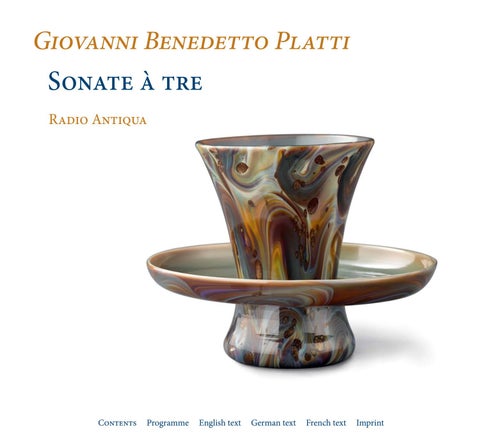
Giovanni Benedetto Platti
Sonate Ă tre Radio Antiqua
Contents
Programme
English text
German text
French text
Imprint
Giovanni Benedetto Platti (c. 1697–1763)
Sonate à tre Trio sonatas from the Schönborn-Wiesentheid collection Triosonaten aus der Sammlung Schönborn-Wiesentheid Sonates en trio de la collection Schönborn-Wiesentheid
SONATA FOR VIOLIN, VIOLONCELLO AND BASSO CONTINUO IN D MAJOR WD 681 Sonata à Violino, Violoncello, e Basso di Giovanni Platti 1. Grave 2. Allegro 3. Siciliana 4. Gigha
3:16 3:15 3:53 3:27
SONATA FOR OBOE, BASSOON AND BASSO CONTINUO IN C MINOR WD 695 Trio con Oboè, e Faghotto obligato Di Sigre Giovanni Platti 5. Adagio 6. Allegro 7. [Largo] 8. Allegro
2:26 2:59 1:41 2:07
SONATA FOR VIOLIN, VIOLONCELLO AND BASSO CONTINUO IN E MINOR WD 677 Sonata à Violine, Violoncello e Basso Di Gioi: Platti 9. Non tanto adagio 10. Alla breve 11. Largho 12. Presto
3:30 2:34 5:10 3:00
SONATA FOR VIOLIN, BASSOON AND BASSO CONTINUO IN C MINOR WD 694 Trio à 3 cioè Violino, Violoncello è Basso, di Giovanni Platti 13. Allegro 14. Adagio 15. Allegro
1:59 4:08 3:14
SONATA FOR VIOLIN, OBOE AND BASSO CONTINUO IN D MAJOR WD 682 Sonata à Violine, Oboè e Basso 16. Largho 17. Allegro 18. Largho 19. Non tanto presto
4:33 3:52 3:11 2:50
SONATA FOR VIOLIN, BASSOON AND BASSO CONTINUO IN D MINOR WD 687 Trio à Violino, e Violoncello, e Basso. Di Giovanni Platti 20. Largho 21. Presto 22. Largho 23. Gigha
3:01 2:08 3:26 2:39 TOTAL
72:32
RADIO ANTIQUA LUCIA GIRAUDO
Violin Benoît-Joseph Boussu, Brussels c. 1760
YONGCHEON SHIN
Oboe Pau Orriols, Vilanova i la Geltrú 2011 (after Thomas Stanesby Jr)
PETR HAMOUZ
Violoncello Johann Georg Hellmer, Prague 1730
ISABEL FAVILLA
Bassoon Pau Orriols, Vilanova i la Geltrú 2010 (after Gottlieb Wietfeldt)
HEN GOLDSOBEL
Violone Pierre Van Engeland, Brussels 2017
GIULIO QUIRICI
Theorbo Jaume Bosser, Santa Càndia-Orpí 2016
CLAUDIO RIBEIRO
Harpsichord Jan Kalsbeek, Zutphen 2014 (after Michael Mietke)
4
5
^menu RADIO ANTIQUA was founded in The Hague in 2012 with the aim of performing lesser-known repertoire for a unique combination of instruments. It aspires to that aim by constantly looking for new ways to communicate and interact with audiences, combining old favourites with forgotten gems and broadcasting its distinctive sound across various platforms. The ensemble’s accolades include First Prize and Audience Award at the Göttingen Händel Competition, Second Prize and Audience Award at the International Van Wassenaer Competition in Utrecht, and appearances at festivals including the Innsbrucker Festwochen der Alten Musik, Händel Festspiele Göttingen, Festival d’Ambronay, Pavia Barocca, Opus Amadeus Festival in Istanbul and the Thüringer Bachwochen. As part of the Emerging European Ensembles programme, the ensemble has been awarded artistic residencies at Centre Culturel d’Ambronay, Collegio Ghislieri in Pavia, Károlyi Kastély in Fehérvárcsurgó, and the Bucharest University of Music. The group also served as the tutor ensemble at the 21st European Baroque Academy during an extensive concert tour directed by Enrico Onofri. Radio Antiqua’s first CD, Treasures of the German Baroque, was released by Ambronay Editions in 2015. It received glowing reviews across Europe and was named Choix de France Musique. www.radioantiqua.com
6
restrict himself to the oboe but also performed on other instruments and even as a singer, and who made himself available on occasion for joint music-making. Ever adaptable, Platti responded to his noble patron’s requirements by “providing” compositions – in addition to his ordinary ouptut for worldly and spiritual occasions – for the cello, the Count’s favourite instrument. He wrote a dozen sonatas for cello and continuo, 28 concerti for cello and string accompaniment, 6 violin and cello duets, and over 21 trio sonatas, in which the second melodic instrument is not at the same height as the first (violin, oboe, or flute) above the continuo, but in a lower register.
Giovanni Benedetto Platti – Chamber Sonatas “Platti has been here with me for three days, and I would like to recommend this excellent young fellow to his Imperial Majesty’s Court music so that with all his art it can be heard in every way!” The man recommending Platti as a musician to the Imperial Court in Vienna, Rudolf Franz Erwein, Count of Schönborn (1677-1754), knew what he was talking about. For a number of years, from 1722 onwards, he had had the opportunity to observe Platti, the oboe virtuoso employed by his brother, Johann Phillip Franz von Schönborn, Prince-Bishop of Würzburg, at first hand. After the bishop’s death in 1724, he had also managed to secure him as a musician for his own household at his small residence in the county of Wiesentheid. Unlike most other Italian musicians at the court chapel, Platti had not moved elsewhere after its dissolution, but stayed on in Würzburg, from where he was able to cultivate his connection with Rudolf Franz Erwein.
How did Rudolf Franz Erwein acquire his penchant for Italian music? The young nobleman’s upbringing provides some of the answer. His parents, Melchior Friedrich and Maria Sophie von Schönborn, had provided their 7 sons and 7 daughters with an exemplary education. Learning to play instruments had been an explicit part of their domestic curriculum while the children were still at home. “Foreign exchanges” were also part of the programme, and Rome was the primary destination. Once there, they experienced the fascination of the musical life of the metropolis, met the stars of the day (including Arcangelo Corelli) and took further lessons on their instruments. Their experiences of Italian music, of which the journey to Rome and back, including visits to local opera houses along the way, were an integral part, were intended to influence the noble siblings’ taste for their entire life.
He had good reasons for doing so: the Count appears to have been a gifted and passionately interested musician who was able to appreciate Platti’s talents. The Count was constantly after new material to stoke his passion, since “something new must always be wanted for the exercise”. He obtained fresh fodder through various channels, including, from time to time, and probably with particular pleasure, from Würzburg’s resident Italian, who did not
In addition, European musical tastes were tuned to Italy across the board in the 17th and 18th centuries. 7
One need only look at the foreign destinations to which Italian musicians travelled and where their music fell on open ears: cf. e.g. Giuseppe Torelli, who made his way to Ansbach, Francesco Geminiani, who worked in London and Dublin, Francesco Maria Veracini, invited to London, Düsseldorf and Dresden, and Pietro Locatelli, who settled in Amsterdam.
where his father was a violetta player at St Mark’s. Platti himself must also have received a decent musical education there, and is listed as a member of the guild-like “arte di sonadori ”. By some equally weakly documented route he ended up in Würzburg, where he received his court appointment as an oboist and violinist on April 2nd 1722. He stayed on after the court chapel was dissolved in 1724 (the prince-bishop’s successor was a man of different priorities), albeit in a much reduced official capacity. This had the advantage of leaving him more time to cater for Rudolf Franz Erwein’s interests – the trio sonatas on this recording were probably written some time after this date.
The Bishopric of Würzburg was not immune from this enthusiasm, since Rudolf Franz Erwein and several of his brothers had been bitten by the Italian craze. Efforts were made to acquire the right kind of scores for their own music-making: “alcune delle piu nove e belle Cantate”, “Motetti di chiesa di piu nuovi e rinomati authori”, “una dozzena de più nuovi Concerti di Vivaldi, Lotti, Polarolo”, reads one order sheet. And at a joint session in 1716 the brothers’ music stands held music by Corelli, Albinoni, Mascitti and Vivaldi, as the end of a letter Rudolf Franz Erwein wrote to his brothers informs us. Johann Philipp Franz celebrated his election to prince-bishop of Würzburg in 1718 by hurrying to acquire “new people from Italy” for his court music. At last he had managed to set up his own “music all’italiana”, and next door in Wiesentheid Rudolf Franz Erwein gushed about “good Italian music” and “how it made the blood stir to hear such things once again.”
Almost all have movements arranged in a slow – fast – slow – fast sequence. WD 681 may serve as an example to describe the structure which appears, with variations, in most of the sonatas. The opening movement often sets up the bass and treble instruments in a quasi-fugal relationship to each other: the first comes in with the theme, accompanied by the basso continuo, followed by the second instrument in the dominant (1st movement, Grave) or in direct canon (2nd movement, Allegro). The movements are themselves frequently divided into two parts, with the order of the entries being swapped at the beginning of the second. The slow third movements are typified by a lyrical duet of both solo instruments over the bass (here a Siciliana), with a shift to minor if the sonata is major, or major if the sonata is minor; the final movements gallop along tumultuously (here as a Gigha). On reflection, it is remarkable how rarely the oboe is specified as the upper melody instrument. WD 676 does present a choice of “Violino overo Oboe”; perhaps in practice Platti’s
One of the “musicians obtained from Italy” was Giovanni Benedetto Platti. He was born in northern Italy (perhaps in or around Padua, perhaps in 1697; the date and place of Platti’s birth have still not yet been confirmed), and spent some of his childhood years in Venice, 8
main instrument was used more frequently, and indeed performances may have been improvised with whatever instruments were available depending on the circumstance.
tron, the prince-bishop Friedrich Carl. We know of them only through librettos which mention him as a composer (“Posto in Musica DA GIOVANNI PLATTI ” – put to music by Giovanni Platti).
Let us return to Platti’s biography. In 1729 another brother, Friedrich Carl von Schönborn, succeeded to the prince-bishopric and found new obligations to bind Platti more closely to Würzburg. This will have reduced his availability for Rudolf Franz Erwein, and the princebishops after Friedrich Carl continued to make sure of his services. In 1723, Platti had married a court soprano, Maria Theresia Lambrucker, with whom he had a growing family. It is likely they also lived in Bamberg for a while, as Friedrich Carl was at the head of both princebishoprics. Maria Theresia died in 1753. Platti, whose position and activities had earned him some respect, remained a member of the court chapel until his death on 11 January 1763.
The Wiesentheid collection thus acquires special significance, as it preserves a little over 60 of his works: the cello pieces mentioned above, three Masses, a Requiem, a Stabat Mater, two secular cantatas and an oboe concerto. All are manuscripts, many autograph, and with the exception of the oboe concerto, none are preserved elsewhere.
THE SCHÖNBORN-WIESENTHEID COLLECTION The music collection of the counts of SchönbornWiesentheid very probably consists, in its older, more significant, and more extensive portion, of the scores the musically minded Rudolf Franz Erwein acquired over his lifetime – his personal music library. A second, less extensive set of scores dating to around 1800, the younger portion, makes up the other part of this important historical music archive.
Platti’s compositions have met a chequered fate. In the 1740s he had succeeded in having flute sonatas and harpsichord sonatas and concerti published by Ulrich Haffner in Nuremberg. For a long time, the resulting copies were the only evidence of Platti’s activities as a composer. Larger-scale works appear to have been irretrievably lost. They include vocal works, e.g. an Applauso festoso (1729) and the oratorio FRANCONIA CHRISTIANA / OVERO / La vita e ’l Martirio / DI S.CHILIANO / Apostolo e Primo Vescovo in Franconia (Christian Franconia or the life and martyrdom of St. Kilian, Apostle, and first bishop of Franconia), which was dedicated to his new pa-
The older repertoire preserves 149 printed scores and almost 500 manuscripts of compositions spanning around 100 years, from the middle of the 17th to almost the middle of the 18th centuries, both secular and sacred. As early as by 1694, while studying in Rome, the 17-yearold Rudolf Franz Erwein had started collecting scores, acquiring Arcangelo Corelli’s SONATE DA CAMERA / A tre, doi Violini, Violone, ò Cimbalo (Op. 2), at the time 9
in its fourth edition as published by Macardi in Rome, in three part-books in contemporary type. The pride and pleasure he took in inscribing his name as the owner on the title page is almost palpable: Franciscus Ehrvinus Liber Baro di Schonborn (the Latinised form of his name may be connected to the fact that he was studying theology at the time). These objects are among his earliest documented acquisitions. They were followed by many more, whether printed or hand-copied. Manuscript copies were a standard form of dissemination at the time, whether made professionally or by house scribes. Thus we find Rudolf Franz Erwein asking his brother Friedrich Carl about music from the Imperial Court in 1730: “Thus may I most humbly hope to request a […] delivery [of material], which I would return as soon as copies had been made.” One of these copies is at once the oldest, and from today’s viewpoint also the most remarkable, piece in the collection: a Monteverdi Mass, which Rudolf Franz Erwein acquired in the 1730s in response to an offer by one of his deceased brother’s Italian singers in a manuscript copy from Venice.
We should also not omit to mention a number of non-Italian composers, sometimes musicians, who were obliged to the House of Schönborn in some way, and figures Rudolf Franz Erwein may have met on his diplomatic travels, perhaps at other courts. He need not also have acquired all of his scores – one or the other may have been given as a present, with a guess at his interests, or found its way into the collection as a dedicatory copy. A glance at the genres contained within the collection reveals both sacred and secular music. The sacred repertoire includes masses and motets, cantatas, psalms, and hymns; the secular pieces encompass operatic arias, concerti, overtures, and a large body of chamber music, with cello pieces featuring prominently. “When you get the opportunity of seeing the Kapellmeister down there, Ondrathschekh (Ondrácek), then do tell him that if he has written anything new for the violoncello, he should send it to me, because his taste has always been pleasing to me and because I would like to give him a recognition of that fact”, the 62-year-old Franz Erwein wrote to his son.
But does his perspective equal today’s? Among the host of names we find composers whose names are still familiar, e.g. Tomaso Albinoni, Antonio Caldara, Johann Joseph Fux, Pietro Locatelli, Antonio Vivaldi, and Antonio Lotti, but also a large number who were popular at the time, but whose names have since been largely or wholly forgotten. Indeed, more than a few of them are attested only through a single copy of a work preserved in the Wiesentheid collection.
Platti was presumably being kept busy in Würzburg at the time. Where would he have found the “three days” to go to Wiesentheid and play for and with Rudolf Franz Erwein? Ten years earlier finding them was a different story – luckily for us. Frohmut Dangel-Hofmann Translation: Winnie Smith
10
^menu RADIO ANTIQUA wurde 2012 in Den Haag mit der Absicht gegründet, weniger bekanntes Repertoire für seine einzigartige Besetzung aufzuführen. Um seinem Namen gerecht zu werden, ist Radio Antiqua ständig auf der Suche nach einer verstärkten Interaktion und Kommunikation mit seinem Publikum, indem es bekannte Melodien mit ungewöhnlichen Entdeckungen kombiniert und seinen unverwechselbaren Klang über verschiedene Kanäle zur Geltung bringt. Das Ensemble war Gewinner des Ersten Preises und des Publikumspreises beim Göttinger Händel-Wettbewerb, des zweiten Preises und Publikumspreises beim Internationalen Van-Wassenaer-Wettbewerb in Utrecht, und ist bei renommierten internationalen Festivals wie den Innsbrucker Festwochen der Alten Musik, den Händel-Festspielen Göttingen, dem Festival d’Ambronay, Pavia Barocca, dem Opus Amadeus Festival in Istanbul und den Thüringer Bachwochen aufgetreten. Im Rahmen des Programms Emerging European Ensembles erhielt das Ensemble künstlerische Residenzen am Centre Culturel d’Ambronay, am Collegio Ghislieri in Pavia, am Károlyi Kastély in Fehérvárcsurgó und an der Musikhochschule Bukarest. Radio Antiqua diente als Dozentenensemble der 21. Europäischen Barockakademie während einer ausgedehnten Konzerttournee unter der Leitung von Enrico Onofri. Die erste CD von Radio Antiqua, Treasures of the German Baroque, erschien 2015 bei Ambronay Editions. Diese Aufnahme war »Choix de France Musique« und hat in ganz Europa hervorragende Kritiken erhalten. www.radioantiqua.com
11
Musiker mit italienischem Ursprung, der sich neben der Oboe auch auf weiteren Instrumenten sowie als Sänger hervortat und sich zudem auch gelegentlich zum gemeinsamen Musizieren zur Verfügung hielt. Dieser stellte sich auch auf die Bedürfnisse des Adligen ein und »lieferte« als Komponist – neben weiteren Werken für weltliche und geistliche Anlässe – Musik für das Lieblingsinstrument des Grafen, das Violoncello: ein Dutzend Sonaten für Violoncello und Basso continuo, 28 Concerti für Violoncello und begleitende Streicher, 6 Duos für Violine und Violoncello, und über 21 Triosonaten, bei denen das zweite MelodieInstrument über dem Basso continuo nicht in gleicher Höhe wie das erste (Violine, Oboe oder Flöte), sondern in tiefer Lage musiziert.
Giovanni Benedetto Platti – Kammersonaten »Der platti ist bey 3 tagen hihr bey mihr gewesen und möchte ich diesen recht guthen bursch wohl zur Kayserl. M. Hoffmusic wünschen mit seiner kunst auch auf alle weis sich höhren lassen kann!« Der da den Musiker Platti für die Hofmusik des Kaisers in Wien empfiehlt, Rudolf Franz Erwein Graf von Schönborn (1677–1754), weiß, wovon er spricht: einige Jahre lang, ab 1722, hatte er Gelegenheit gehabt, den Oboenvirtuosen seines Bruders, des Fürstbischofs von Würzburg, Johann Philipp Franz von Schönborn, aus nächster Nähe zu erleben, und – nach dem Tod des Fürstbischofs 1724 – hatte er ihn auch als Musiker für sein eigenes Musizieren in seiner kleinen Residenz im Zentrum der Grafschaft Wiesentheid an sich binden können. Der »Virtuos Platti« war nicht, wie die meisten anderen italienischen Musiker der Hofkapelle, nach deren Auflösung woandershin gegangen, sondern in Würzburg geblieben, von wo aus er die Verbindung zu Rudolf Franz Erwein aufrechterhielt.
Wie war es zu der Leidenschaft Rudolf Franz Erweins für die italienische Musik gekommen? Einmal sicher durch den Werdegang des jungen Adligen. Die Eltern, Melchior Friedrich und Maria Sophie von Schönborn, hatten ihren 7 Söhnen und 7 Töchtern eine vorzügliche Ausbildung zukommen lassen. Schon zuhause hatte die Unterweisung im Spiel von Instrumenten einen ausdrücklichen Platz im Bildungsplan. Für die Studenten gehörten »Auslandssemester« dazu, und sie führten in erster Linie nach Rom. Dort erlebten die jungen Leute fasziniert das musikalische Leben der Metropole, begegneten beachteten Persönlichkeiten der damaligen Musikwelt (z. B. Arcangelo Corelli) und nahmen Unterricht auf ihren Instrumenten. Die italienischen Musik-Erfahrungen (zu denen auch die Reisen nach Rom und zurück mit
Mit gutem Grund: der Graf muss ein leidenschaftlicher und guter Musiker gewesen sein, der die Fähigkeiten Plattis zu schätzen wusste. Für seine Passion bedurfte er immer neuer Musikalien (»weillen es zum exercitio beständig ettwaß newes sey will«). Er erhielt die Literatur auf mancherlei Wegen, besonders angenehm zu Zeiten aber wohl durch den Würzburger 12
dem Besuch der Opernhäuser in den jeweiligen Städten gehörten) sollten den »gusto« der jungen Adligen nachhaltig prägen.
ten Wiesentheid schwärmte von der »guethen wälschen music« und davon, dass es »ein bluthspiel sei, so ettwaß wiederumb zu ohren zu bekhomen«.
Zum anderen war im 17. und 18. Jahrhundert der musikalische Geschmack in Europa vielfältig auf italienische Musik eingestellt; man bedenke, wie sich italienische Musiker ins Ausland auf den Weg machten, wo ihre Musik offene Ohren fand, so z.B. Giuseppe Torelli, der sich nach Ansbach wandte, Francesco Geminiani, der in London und Dublin wirkte, Francesco Maria Veracini, der nach London, nach Düsseldorf und nach Dresden eingeladen wurde, oder Pietro Locatelli, der sich nach Amsterdam begab.
Unter den »aus italien erhaltenen musicis« war auch Giovanni Benedetto Platti. Er war in Oberitalien geboren (vielleicht in oder um Padua, vielleicht 1697; Ort und Zeit der Geburt haben sich immer noch nicht nachweisen lassen können), hatte einige Jahre seiner Jugend in Venedig verbracht, wo sein Vater Violettaspieler an S. Marco war, und er selber eine wohl gediegene musikalische Ausbildung erfahren hatte; er erscheint als Mitglied der zunftartigen Vereinigung »Arte di sonadori«. Auf einem ebenfalls nicht eindeutig belegten Weg gelangte er nach Würzburg und erhielt am 2. April 1722 einen Anstellungsvertrag als Oboist und Geiger. 1724, nach der Auflösung der Hofmusik (der Nachfolger auf dem Thron des Fürstbischofs setzte andere Schwerpunkte) blieb er, wenn auch in einem sehr reduzierten Dienstverhältnis. Das hatte den Vorteil, dass mehr Zeit für die Interessen von Rudolf Franz Erwein blieb; in diesen Jahren nach 1724 sind wohl die hier zu hörenden Triosonaten entstanden.
Auch im Hochstift Würzburg war diese Sehnsucht zu spüren: Rudolf Franz Erwein und einige seiner Brüder waren der italienischen Musik verfallen. Man bemühte sich um entsprechende Noten für das eigene Musizieren (»alcune delle piu nove e belle Cantate«, »Motetti di chiesa di piu nuovi e rinomati authori«, »una dozzena de più nuovi Concerti di Vivaldi, Lotti, Polarolo« – nach einem Bestellzettel). Beim gemeinsamen Musikmachen der Brüder 1716 beispielsweise lagen Noten von Corelli, Albinoni, Mascitti und Vivaldi auf den Pulten (wie ein Briefschluss Rudolf Franz Erweins an die Brüder zeigt). Als dann Johann Philipp Franz 1718 zum Fürstbischof von Würzburg gewählt worden war, kümmerte er sich so schnell als möglich darum, »neue leuthe aus italien« zu seiner Musik zu bekommen. Nun endlich war die »music all’italiana eingericht«, und Rudolf Franz Erwein im benachbar-
Sie zeigen fast alle die Satzfolge Langsam – Schnell – Langsam – Schnell. An WD 681 sei eine Art grundsätzliches Muster der Machart kurz beschrieben, wie es in den meisten der Werke in Varianten wiederkehrt. Das hohe und das tiefe Instrument verhalten sich in der Eröffnung oft zu einander wie Fugen: dem Einsatz des ersten mit dem Thema, vom Basso continuo beglei13
tet, folgt das zweite in der Dominante (1. Satz, Grave), oder im direkten Kanon (2. Satz, Allegro). Oft sind die Sätze zweiteilig und tauschen zu Beginn des zweiten Teils die Reihenfolge der Einsätze; die langsamen dritten Sätze zeigen ein lyrisches Miteinander der beiden Solostimmen über dem Basso (hier Siciliana), bei Durtonart der Sonate oft nach Moll, bei Moll nach Dur wechselnd, während die Finalsätze temperamentvoll dahinjagen (hier Gigha). Eigentlich erstaunlich, dass die Oboe so selten als hohes Melodieinstrument gefordert ist. Immerhin wird für WD 676 die Wahl »Violino overo Oboe« freigestellt; denkbar, dass auch in der Praxis Plattis Hauptinstrument öfters zum Einsatz kam, wie vielleicht überhaupt mit der Verwendung der zur Verfügung stehenden Instrumente, den Verhältnissen entsprechend, improvisiert worden sein könnte.
Das kompositorische Werk Plattis hatte ein unterschiedliches Schicksal. In den 40er Jahren des 18. Jahrhunderts konnte er in Nürnberg bei Ulrich Haffner Cembalosonaten und -Concerti sowie Flötensonaten verlegen lassen; diese Drucke sind über längere Zeit hin der einzige Beleg für die Tätigkeit des Musikers als Tonsetzer gewesen. Kompositionen größeren Umfangs, auch Vokalwerke, nämlich eines »Applauso festoso« von 1729 sowie ein Oratorium FRANCONIA CHRISTIANA / OVERO / La vita e ’l Martirio / DI S.CHILIANO / Apostolo e Primo Vescovo in Franconia (»Christliches Franckenland / Oder / Das Leben / und Martyr / Deß Heiligen Kiliani / Apostels, und ersten Bischoffs in Francken«, mit einer Widmung an seinen neuen Dienstherrn, Fürstbischof Friedrich Carl, sind offenbar unwiederbringlich verloren; man weiß von ihnen nur durch gedruckte Textbücher, die ihn als den Komponisten ausweisen (»Posto in Musica DA GIOVANNI PLATTI / In Music verfaßt / Von Johann Platti«).
Zurück zur Vita Plattis: 1729 übernahm ein weiterer Bruder, Friedrich Carl von Schönborn, das Amt des Fürstbischofs und band Platti wieder stärker in die Würzburger Verpflichtungen ein; das wird die Verfügbarkeit des Musikers für Rudolf Franz Erwein reduziert haben. Auch die nachfolgenden Amtsträger versicherten sich seiner Dienste. Platti hatte 1723 die Hofsängerin Maria Theresia Lambrucker geheiratet; die Familie wuchs. Man lebte wahrscheinlich auch zeitweise in Bamberg, da Friedrich Carl an der Spitze beider Hochstifte stand. 1753 starb Plattis Frau. Der Musiker, der in seiner Position und in seinem Wirken zu einigem Ansehen gekommen war, blieb Mitglied der Hofkapelle, bis zu seinem Tod am 11. Januar 1763.
So kommt der Wiesentheider Sammlung ein besonderer Rang zu: hier sind etwas über 60 Werke aus seiner Feder aufbewahrt, neben den oben genannten Violoncello-Werken drei Messen, ein Requiem, ein Stabat mater, zwei weltliche Kantaten und ein Oboenkonzert. Es sind alles Handschriften, vielfach Autographe, und mit Ausnahme des letzteren Unikate.
14
gefolgt, ob Drucke, ob Abschriften – die Kopie war zu jener Zeit ein gängiges Mittel der Verbreitung, sei sie professionell oder von den Schreibern des Hauses angefertigt (so fragt Rudolf Franz Erwein bei Bruder Friedrich Carl wegen Musik des kaiserlichen Hofes an: »So wollte ich mir eine ... communication gehorsambst ausgebetten haben, gleich auch nach genommener Copien dieselbe restituieren würdte«, 1730). Eine Kopie ist auch das älteste und aus heutiger Sicht außergewöhnlichste Stück, eine Messe von Monteverdi, die Rudolf Franz Erwein in den 30er Jahren des 18. Jahrhunderts, auf das Angebot eines italienischen Sängers seines verstorbenen Bruders hin, als Partiturabschrift aus Venedig erworben hat.
DIE SAMMLUNG SCHÖNBORN-WIESENTHEID Die Musiksammlung der Grafen von SchönbornWiesentheid repräsentiert in ihrem umfangreicheren und wichtigeren Älteren Repertoire sehr wahrscheinlich den Notenvorrat, der sich im musikalisch ausgerichteten Leben Rudolf Franz Erweins angesammelt hatte, seinen »Notenschrank«, und bildet, zusammen mit einem weiteren, weniger umfänglichen Bestand aus der Zeit um 1800, dem Jüngeren Repertoire, diese bedeutende historische Musikbibliothek. Das Ältere Repertoire bewahrt in 149 Drucken und annähernd 500 Handschriften Kompositionen aus einem Zeitraum von ca. 100 Jahren, von der Mitte des 17. bis fast zur Mitte des 18. Jahrhunderts, Werke geistlichen und weltlichen Inhalts. Schon 1694, mit 17 Jahren als Student in Rom, hatte Rudolf Franz Erwein damit begonnen, sich Musikalien anzuschaffen, und so erwarb er die SONATE DA CAMERA / A tre, doi Violini, Violone, ò Cimbalo, op. 2 von Arcangelo Corelli, die damals in 4. Auflage als Druck des Hauses Mascardi in Rom erschienen waren, 3 Stimmbücher im zeitgenössischen Typendruck. Man meint geradezu, den Stolz und die Freude zu spüren, mit der er auf der Titelseite als Besitzvermerk seinen Namen einträgt: Franciscus Ehrvinus Liber Baro di Schonborn (die latinisierte Form des Namens könnte mit dem damaligen Studiengegenstand, der Theologie, zusammenhängen). Die Musikalie gehört zu den frühesten belegten Erwerbungen. Viele sind ihr anscheinend
Aus heutiger Sicht – aus damaliger Sicht? In der Fülle der Namen tauchen Autoren auf, die man heute durchaus kennt, wie Tomaso Albinoni oder Antonio Caldara, Johann Joseph Fux oder Pietro Locatelli, Antonio Vivaldi oder Antonio Lotti, aber auch eine Vielzahl von Komponisten, für die man sich damals interessierte, die heute aber weithin oder völlig vergessen sind. Nicht wenige von ihnen sind überhaupt nur durch eine Komposition belegt, die in der Wiesentheider Sammlung bewahrt wird. Nicht unerwähnt bleiben soll auch ein Anteil nicht-italienischer Komponisten, manchmal Musiker, die dem Haus Schönborn in irgendeiner Weise verpflichtet waren, oder Persönlichkeiten, die Rudolf Franz Erwein auf seinen Reisen in diplomatischen Missionen, z.B. an anderen Höfen, kennengelernt 15
haben könnte. Und nicht alle Musikalien musste er erwerben; das eine oder andere Stück dürfte auch als Geschenk – sein Interesse vermutend – oder als Widmungsexemplar in seinen Besitz gekommen sein. Ein Blick auf die musikalischen Gattungen der Bestände zeigt geistliche und weltliche Musik. Die Kirchenmusik umfasst Messen und Motetten, sowie Kantaten, Psalmen und Hymnen, im Bereich der weltlichen Musik geht es um Opernarien, um Concerti und Ouvertüren, und um einen großen Bestand an Kammermusik, wobei die Musik für Violoncello eine ganz herausragende Rolle spielt. »Wenn Du einmal die gelegenheit hast den druntigen Capellenmeister Ondrathschekh zu sehen, so sage Ihme doch, wann er ettwaß newes für das Violoncello gemacht hett, Er es mir schickhen möge, dann sein gusto mir allezeith gefallen hat und will ihme gerne eine Erkendlichkeit darzue geben«, erkundigt sich der 62-jährige bei seinem Sohn. Platti war zu dieser Zeit vermutlich in Würzburg vielfältig beschäftigt. Wo hätte er die »3 tage« hernehmen sollen, um in Wiesentheid mit und für Rudolf Franz Erwein Musik zu machen? Zehn Jahre zuvor waren sie noch möglich gewesen – zum Glück! Frohmut Dangel-Hofmann
16
^menu RADIO ANTIQUA a été fondé à La Haye en 2012 dans le but d’interpréter un répertoire peu connu pour un instrumentarium unique. Afin de faire honneur à son nom, l’ensemble est à la recherche permanente d’une interaction et d’une communication avec le public, mêlant airs populaires et trésors méconnus tout en faisant découvrir sa sonorité caractéristique via différents canaux. Premier prix et prix du public au Concours Händel de Göttingen, deuxième prix et prix du public au Concours international Van Wassenaer d’Utrecht, l’ensemble s’est produit lors de festivals prestigieux, parmi lesquels les Innsbrucker Festwochen der Alten Musik, les Händel Festspiele Göttingen, le Festival d’Ambronay, Pavia Barocca, Opus Amadeus Festival à Istanbul et les Thüringer Bachwochen. Dans le cadre du programme Emerging European Ensembles, l’ensemble a été en résidence artistique au Centre culturel d’Ambronay, au Collegio Ghislieri de Pavie, au Károlyi-Kastély à Fehérvárcsurgó en Hongrie et à l’Université de musique de Bucarest. Radio Antiqua a été l’ensemble tuteur de la 21e Academie baroque européenne au cours d’une tournée de concerts dirigée par Enrico Onofri. Le premier CD de l’ensemble, Treasures of the German Baroque, a été publié par les Éditions Ambronay en 2015. Cet enregistrement a été désigné « choix de France Musique » et a reçu d’excellentes critiques partout en Europe. www.radioantiqua.com
17
l’intermédiaire du musicien wurzbourgeois d’origine italienne, qui se distingue non seulement au hautbois, mais aussi sur d’autres instruments ainsi qu’au chant, et qui à l’occasion se rend disponible pour la musique d’ensemble. Il se met également à la disposition de l’aristocrate et « fournit », outre des œuvres pour des occasions profanes et sacrées particulières, de la musique pour l’instrument préféré du comte, le violoncelle – une douzaine de sonates pour violoncelle et basse continue, 28 concertos pour violoncelle et cordes, 6 duos pour violon et violoncelle et une vingtaine de sonates en trio, dans lesquelles le deuxième instrument mélodique ne joue pas à la même hauteur que le premier (violon, hautbois ou flûte), mais dans un registre plus grave.
Giovanni Benedetto Platti – sonates de chambre « Platti a été ici trois jours avec moi et je voudrais recommander ce très bon garçon pour la musique de la cour de sa majesté impériale, afin qu’avec tout son art il puisse être entendu de toutes les façons ! » C’est Rudolf Franz Erwein, comte de Schönborn (1677-1754), qui recommande Platti pour la musique de la cour impériale de Vienne, et il connaît bien son affaire : il a eu l’occasion de fréquenter le hautboïste virtuose durant plusieurs années à partir de 1722. D’abord alors qu’il était au service de son frère, le prince-évêque de Wurzbourg, Johann Philipp Franz von Schönborn, puis, après la mort de ce dernier en 1724, il a pu se l’attacher comme musicien de sa petite résidence au centre du comté de Wiesentheid. Le « virtuose Platti », à l’inverse de la plupart des autres musiciens italiens de la chapelle de la cour, n’est pas parti pour d’autres cieux après la dissolution de celle-ci, mais est resté à Wurzbourg, où il a gardé contact avec Rudolf Franz Erwein.
Comment est née la passion de Rudolf Franz Erwein pour la musique italienne ? Son éducation offre certainement des éléments de réponse. Ses parents, Melchior Friedrich et Maria Sophie von Schönborn, donnent à leurs 14 enfants (7 filles et 7 fils) une excellente éducation. Même à la maison, l’enseignement des instruments tient une place importante. Les « semestres à l’étranger » font également partie de l’éducation des enfants devenus étudiants, avec Rome comme première destination. Les jeunes y observent avec fascination la vie musicale de la métropole, y rencontrent des personnalités musicales respectées (et notamment Arcangelo Corelli) et y reçoivent des cours d’instrument. Ces expériences musicales (parmi lesquelles le voyage vers Rome et retour, avec des visites de maisons d’opéra dans les différentes villes le long
Et pour cause : le comte est un musicien passionné et compétent, en mesure d’apprécier les capacités de Platti. Pour assouvir sa passion, il lui faut en permanence de nouvelles partitions (« pour l’exercice, il voulait toujours quelque chose de nouveau »). Il se procure la littérature de différentes manières, et parfois, avec un plaisir probablement tout particulier, par 18
Giovanni Benedetto Platti fait également partie des « musiciens acquis d’Italie ». Né dans le Nord de l’Italie (peut-être à Padoue ou dans les environs, peutêtre en 1697 ; son lieu et sa date de naissance n’ont pas encore pu être attestés), il passe plusieurs années de sa jeunesse à Venise, où son père est joueur de violetta à San Marco et où il reçoit une formation musicale solide ; il apparaît parmi les membres de la guilde « Arte di sonadori ». Selon le peu que nous savons de sa vie, il arrive à Wurzbourg et est engagé le 2 avril 1722 comme hautboïste et violoniste. En 1724, après la dissolution de la musique de la cour (le nouveau prince-évêque a d’autres priorités…), il reste sur place, avec des fonctions très restreintes. Cela a l’avantage de lui donner plus de temps pour servir les intérêts de Rudolf Franz Erwein ; les sonates en trio reprises sur cet enregistrement sont probablement écrites dans ces années après 1724.
du chemin) auront une influence durable sur le gusto des jeunes nobles. Aux XVIIe et XVIIIe siècles, le goût musical européen est en outre très orienté vers la musique italienne ; à l’étranger, les musiciens italiens vont là où leur musique trouve oreilles ouvertes : ainsi, Giuseppe Torelli se rend à Ansbach, Francesco Geminiani travaille à Londres et à Dublin, Francesco Maria Veracini est invité à Londres, Düsseldorf et Dresde, Pietro Locatelli part pour Amsterdam. Cette attirance pour la musique italienne se fait sentir jusque dans le Hochstift de Wurzbourg : Rudolf Franz Erwein et quelques-uns de ses frères en sont férus. On se donne du mal pour trouver des partitions pour sa propre pratique (« alcune delle piu nove e belle Cantate », « Motetti di chiesa di piu nuovi e rinomati authori », « una dozzena de più nuovi Concerti di Vivaldi, Lotti, Polarolo », stipule un bon de commande). Lorsque les frères font de la musique ensemble, des partitions de Corelli, Albinoni, Mascitti ou Vivaldi se trouvent sur le pupitre (comme en atteste la fin d’une lettre de Rudolf Franz Erwein à ses frères). Une fois Johann Philipp Franz élu prince-évêque de Wurzbourg en 1718, il prend soin de faire venir aussi vite que possible de « nouveaux gens d’Italie » pour sa musique. La « music all’italiana » est installée, et Rudolf Franz Erwein, dans la Wiesentheid voisine, s’enthousiasme de la « bonne musique latine » et de ce que cela « réchauffe le sang d’entendre à nouveau de telles choses ».
Presque toutes ces œuvres présentent la séquence de mouvements lent – vite – lent – vite. La sonate WD 681 est exemplative de la structure qui apparaît, avec quelques variantes, dans la plupart des sonates. Dans l’ouverture, les deux voix mélodiques se comportent souvent l’une envers l’autre comme dans une fugue : l’entrée avec le thème du premier instrument, accompagné de la basse continue, est suivie par celle du deuxième à la dominante (premier mouvement, « Grave »), ou en canon direct (deuxième mouvement, « Allegro »). Les mouvements sont souvent divisés en deux parties, l’ordre d’entrée des instruments étant interverti au début de la deuxième partie ; le troisième 19
pour flûte ; ces publications resteront pendant longtemps la seule preuve de son activité de compositeur. Des œuvres de plus grande envergure et des œuvres vocales, et notamment Applauso festoso (1729) ainsi qu’un oratorio, FRANCONIA CHRISTIANA / OVERO / La vita e ’l Martirio / DI S.CHILIANO / Apostolo e Primo Vescovo in Franconia (La Franconie chrétienne ou La vie et le martyre de saint Kilian, apôtre et premier évêque de Franconie), dédié à son nouvel employeur, le prince-évêque Friedrich Carl, semblent aujourd’hui irrémédiablement perdus ; on ne les connaît que par les livrets de textes imprimés qui l’identifient comme le compositeur (« Posto in Musica DA GIOVANNI PLATTI » – « mis en musique par Giovanni Platti »).
mouvement lent (ici « Siciliana ») présente une imbrication des deux voix solos au-dessus de la basse, où la tonalité passe de majeur à mineur ou de mineur à majeur, tandis que le mouvement final (ici « Gigha ») est plein d’entrain. Il est étonnant que le hautbois ne soit pas spécifié plus souvent comme instrument mélodique supérieur. Toutefois, dans la sonate WD 676, le choix « Violino overo Oboe » est proposé ; on peut penser que dans la pratique, l’instrument principal de Platti est utilisé plus souvent, tout comme, du reste, il est sans doute improvisé avec les instruments à disposition selon les circonstances. Mais retournons à la vie de Platti. En 1729, un autre frère de Rudolf Franz Erwein, Friedrich Carl von Schönborn, reprend la charge de prince-évêque et lie à nouveau plus fermement Platti à Wurzbourg, réduisant ainsi la disponibilité du musicien pour Rudolf. Les princes-évêques suivants s’assurent également de ses services. Platti a épousé la chanteuse de la cour Maria Theresia Lambrucker en 1723 ; bientôt, la famille s’agrandit. Ils vivent probablement par moment à Bamberg, puisque Friedrich Carl est à la tête des deux principautés. Maria Theresia meurt en 1753. Le musicien, qui a atteint un certain prestige dans sa fonction et dans ses activités, reste membre de l’orchestre de la cour jusqu’à son décès, le 11 janvier 1763.
Ainsi, la collection de Wiesentheid jouit d’un statut particulier. Un peu plus de 60 œuvres de la plume de Platti y sont conservées : outre les œuvres pour violoncelle susmentionnées, on y trouve trois messes, un requiem, un Stabat mater, deux cantates profanes et un concerto pour hautbois. Ce sont tous des manuscrits, souvent autographes, et à l’exception du concerto pour hautbois, des exemplaires uniques.
Le travail de composition de Platti connaîtra un destin différent. Dans les années 1740, il peut faire éditer à Nuremberg, chez Ulrich Haffner, des sonates et des concertos pour clavecin ainsi que des sonates 20
ou réalisée par les copistes de la maison (ainsi, Rudolf Franz Erwein demande à son frère Friedrich Carl, au sujet de la musique de la cour impériale en 1730 : « J’aimerais ainsi très humblement demander une livraison [de matériel], que je retournerais dès que les copies seraient réalisées. »). L’un de ces exemplaires, la copie vénitienne d’une messe de Monteverdi, est la pièce la plus ancienne et d’un point de vue actuel la plus extraordinaire de la collection, acquise par Rudolf Franz Erwein dans les années 1730 sur l’offre de l’un des chanteurs italiens de son frère défunt.
LA COLLECTION WIESENTHEID La collection musicale des comtes de SchönbornWiesentheid représente très probablement, dans sa partie ancienne, la plus vaste et la plus importante, la musique accumulée par Rudolf Franz Erwein au cours de sa vie, son « cabinet musical », et forme, avec un autre fonds moins important issu d’une période plus tardive (autour de 1800), cette importante bibliothèque musicale historique.
D’un point de vue actuel, donc – mais est-ce aussi celui de l’époque ? Parmi les très nombreux compositeurs apparaissent des noms connus aujourd’hui, comme ceux de Tomaso Albinoni et Antonio Caldara, Johann Joseph Fux et Pietro Locatelli, Antonio Vivaldi et Antonio Lotti, mais aussi une multitude d’auteurs auxquels l’on s’intéresse à l’époque mais qui sont aujourd’hui largement ou totalement oubliés. Bon nombre d’entre eux ne sont documentés que par une seule composition conservée dans la collection de Wiesentheid.
Le répertoire ancien consiste en 149 imprimés et près de 500 manuscrits, au contenu sacré et profane, qui couvrent une période d’environ un siècle, entre le milieu du XVIIe siècle et le milieu du XVIIIe siècle. Dès 1694, à l’âge de 17 ans, alors qu’il est étudiant à Rome, Rudolf Franz Erwein commence à acquérir des partitions et se procure ainsi les SONATE DA CAMERA / A tre, doi Violini, Violone, ò Cimbalo op. 2 d’Arcangelo Corelli, qui à l’époque en est à sa quatrième édition par la maison Mascardi, trois cahiers de parties en impression contemporaine. On peut presque ressentir la fierté et la joie avec lesquelles Rudolf inscrit son nom sur la page de titre en guise d’indication de propriété : « Franciscus Ehrvinus Liber Baro di Schonborn » (la forme latinisée du nom pourrait être liée à ses études à l’époque, la théologie). La partition fait partie de ses premières acquisitions documentées, et est semble-t-il suivie par beaucoup d’autres, soit en impression, soit en copie – l’un des moyens de distribution courants à l’époque, qu’elle soit professionnelle
N’oublions pas non plus de mentionner un nombre important de compositeurs non italiens, parfois des musiciens liés d’une façon ou d’une autre à la maison Schönborn, ou des personnalités que Rudolf Franz Erwein a pu rencontrer dans le cadre de ses voyages diplomatiques, notamment dans d’autres cours. Il n’achète probablement pas toutes les par-
21
titions : il en reçoit peut-être certaines en cadeau – sachant son intérêt – ou comme exemplaire dédicacé. Les pièces de la collection appartiennent aux genres sacrés et profanes. Parmi les œuvres de musique d’église, citons des messes et des motets, des cantates, des psaumes et des hymnes sacrés ; parmi les œuvres profanes, des airs d’opéra, des concertos et des ouvertures ainsi que de nombreuses œuvres de musique de chambre, où la musique pour violoncelle occupe une place de particulière importance. « Quand vous aurez l’occasion de voir le maître de chapelle Ondrathschekh [Ondrácek], dites-lui que s’il a quelque chose de nouveau pour le violoncelle, il pourra me l’envoyer, parce que son goût m’a toujours plu et que je voudrais bien lui exprimer ma reconnaissance », écrit l’homme de 62 ans à son fils. À cette époque, Platti est probablement très occupé à Wurzbourg. Quand pourrait-il prendre « trois jours » pour faire de la musique à Wiesentheid avec Rudolf Franz Erwein ? Dix ans plus tôt, c’était encore possible – et heureusement ! Frohmut Dangel-Hofmann Traduction : Catherine Meeùs
22
^menu Recorded in April, 2018 at the Koepelkerk, Renswoude, the Netherlands Artistic direction, recording, editing & mastering: Rainer Arndt Executive production: Rainer Arndt / Outhere Graphic concept: © Laurence Drevard Design & layout: Rainer Arndt, Catherine Meeùs Cover: Trembleuse, Chalcedony glass, Venice c. 1700–1750 Photos: © RMN-Grand Palais (Musée du Louvre) / Jean-Gilles Berizzi (cover) © renska / media-weavers.com (p. 5) *** Radio Antiqua would like to thank the generous donors in the crowdfunding campaign: Tony Shoults, Aron Faegre & Kathy Kelley, Cristina Saccardo, Giovanni Quirici, Cecília Urrets Zavalía, José Romildo de Oliveira Lima & Edla Lula, Sarah Faegre. With the support of Prelude Klassieke Muziek, Baarn, the Netherlands. www.preludeclassicalmusic.com
Special thanks to Johannes Boer and the Koninklijk Conservatorium Den Haag for lending the harpsichord. ***
RAM 1801 www.ramee.org
2019 Outhere www.outhere-music.com www.facebook.com/outheremusic