Johann Franz Xaver
Sterkel
Sonatas for Fortepiano and Violin
Els Biesemans – fortepiano Contents
Programme
English text
Meret Lüthi – violin German text
French text
Imprint
^menu
Johann Franz Xaver Sterkel (1750-1817)
Sonatas for Fortepiano and Violin S o nat e n f ü r H a m m e rk l av i e r u n d Vi o l i n e S o nat e s p o u r pia n o f o rt e e t v i o l o n
Sonata in F major op. 33 no. 1 from Trois Sonates pour le Clavecin ou Piano-Forté avec accompagnement d'un Violon obligé op. 33 1. Allegro 11:10 2. Andante con variazioni 9:25
Fantasia in A minor op. 45 Fantaisie pour le Piano-Forte Œuvre 45 3. Andante con un poco di moto ma con grazia ed espressione
6:56
Sonata in B flat major op. 25 Grande Sonate pour Clavecin ou Piano Forte avec un Violon obligé op. 25 4. Allegro cantabile 5. Cantabile 6. Allegro un poco vivace
13:14 6:48 6:51
Romance in F major op. 24 no. 3 from Les Petites Beautés de J.F. Sterkel. Six pieces for the Harpsichord or Piano Forte Op. 24 7. Andantino 2:47
Sonata in A major op. 33 no. 3 from Trois Sonates pour le Clavecin ou Piano-Forté avec accompagnement d'un Violon obligé op. 33 8. Allegro 8:55 9. Rondo 8:08
total
74:17
Meret LĂźthi
Els Biesemans
Violin
Fortepiano
Paolo Antonio Testore, Milan, early 18th century
Paul McNulty, DiviĹĄov, 2013 after Anton Walter, Vienna, 1805
www.lespassions.ch
www.elsbiesemans.be 4
^menu Els Biesemans studied piano, organ and chamber music at the Lemmeninstituut in Leuven, from which she graduated with the diploma of Master of Music with highest honours in 2001. She went on to specialise in historical keyboard instruments at the Schola Cantorum Basiliensis. Her principal teachers were Reitze Smits, Jesper Christensen, Andrea Marcon and Wolfgang Zerer. Els Biesemans performs as a soloist all over Europe and in the United States, Canada and Japan, and has won numerous prizes at major international competitions in Bruges, Paris, Prague, Tokyo and Montreal, including First Prize at the Ciurlionis Competition in Vilnius and the Arp Schnitger competition in Bremen. She has received enthusiastic international critical acclaim for her premiere recordings on a period piano of Fanny Hensel-Mendelssohn's cycle Das Jahr and of Liszt's piano transcriptions of Schubert's Winterreise, among others. Els Biesemans is Artistic Director of the Zurich fortepiano festival Flügelschläge. She owns a collection of fortepianos.
Meret Lüthi trained as a violinist at the Bern University of the Arts with Monika Urbaniak-Lisik and Eva Zurbrügg, and obtained a teaching and concert diploma with honours. She also studied string quartet playing with Walter Levin and Baroque violin with Anton Steck. Meret Lüthi is Konzertmeisterin and director of the early music orchestra Les Passions de l'Âme, which she co-founded in 2008. Highlights of her orchestra's career have been appearances at the London Festival of Baroque Music, the Tage Alter Musik Regensburg, the Lucerne Festival and the Festival Oude Muziek Utrecht, and concerts with Simone Kermes, Nuria Rial, Carolyn Sampson and Dorothee Oberlinger. Meret Lüthi's CDs Spicy and Schabernack won the Diapason d'Or. She is a lecturer in Baroque violin and historical performance practice at the Bern University of the Arts. In 2017 she was honoured with the Musikpreis des Kantons Bern for her many years of outstanding musical activity.
5
post as organist at Neumünster Abbey. In 1774 he was ordained priest. His first compositions were written at this time: sonatas for piano, violin and cello, arias, and symphonies. In 1774, at the Würzburg court, he met the Bohemian horn virtuoso Giovanni Punto (born Johann Wenzel Stich) who took some of his early works to Paris. His eight symphonies, which were later printed in France as op. 7 and op. 11, enjoyed triumphant success at the famous concert series of the Concert Spirituel in Paris between 1777 and 1782. They were performed fifty-two times, and Sterkel rose to the rank of most frequently played composer in Paris from 1777 to 1779.
Johann Franz Xaver Sterkel At a time when Haydn, Mozart and Beethoven dominated musical life in Vienna, Johann Franz Xaver Sterkel was active at the court of Mainz as a highly respected and acclaimed pianist and composer. Sterkel was born in Würzburg on 3 December 1750. After the early death of his father, his mother married the Würzburg bailiff Martin Lehritter. At first young Sterkel did not find it easy to develop his love and talent for music, for his stepfather reacted to his musical activities by beating him. It was only after his mother acquired a keyboard instrument, with the encouragement of Georg Joseph 'Abbé' Vogler, that Sterkel could give free rein to his musical inclinations. His teachers were the Würzburg cathedral and court organist Albrecht Kette and the organist at the Julius-Spital, Leo Weismandel. Remarkably enough, Lehritter himself also had two musically gifted children: his son Franz, born in 1753 and later Konzertmeister at the prince-bishop's court, and his daughter Maria Anna, born in 1762, who was to become an alto at the court of Mainz and later married the court Kapellmeister Vincenzo Righini. The stepfather's attitude did not change until Sterkel's piano playing caused 'a sensation in the circles of superior households'.
In the course of a concert at the Würzburg court in 1777, Sterkel came to the attention of the Mainz Minister Freiherr von Sickingen, who invited him to Aschaffenburg and told to offer his services to the artloving Elector Friedrich Karl Joseph Reichsfreiherr von Erthal. The prince-bishop was so impressed by Sterkel's skills that in 1778 he took him into his service as Hofklaviermeister (court piano master) and vicar and sent him to Italy in late 1779, along with his halfbrother Franz Lehritter, 'for further study and to polish his compositional style'. Having travelled via Livorno, Venice, Florence and Rome, they reached Naples mid1781. Maria Carolina of Austria, Queen of Naples and tenth daughter of the Empress Maria Theresa, greatly esteemed Sterkel and commissioned him to write an opera for the Carnival. The work, Il Farnace, was premiered 'with great pomp and outstanding success' on 12 January 1782, to mark King Ferdinand IV's birth-
At the age of fourteen, Sterkel dedicated himself to studying for the priesthood at the University of Würzburg. In 1768 he received the minor orders and a 6
day, at the royal opera house in Naples, the Teatro San Carlo. On his way back home, Sterkel stopped off in Bologna, among other places: there he 'spent much time in the learned cell of the famous Padre [Giovanni Battista] Martini'. In October 1782 Sterkel was recalled to Mainz, since a canonry at the Liebfrauenstift (Collegiate Church of Our Lady) had become available, and the benefice was not allowed to remain unoccupied for more than three months. His assumption of the canonry allowed him to devote himself to composition without interruption from that time onwards. In addition, he confirmed his reputation as a pianist through his intense activity as a soloist and chamber musician. The Elector rewarded this commitment with an additional salary allowance in October 1784.
strument were described as 'with the accompaniment of a violin', as in the works of Mozart and Beethoven. Nevertheless, the violin part in this literature is frequently on a par with the piano in terms of virtuosity and musical density. The Grande Sonate pour Clavecin ou Piano Forte avec un Violon obligé op. 25 was published in 1786 by Schott of Mainz and also (as op. 16) by Imbault of Paris. The Six Sonatas op. 33 (Books I and II), which include the Sonata no. 1 in F major recorded here, were printed in 1792 by Schott in Mainz and André in Offenbach, and Book II later appeared in Paris as op. 34. It was only in the last year of the composer's life that the Fantaisie pour le Piano-Forte op. 45 was published by Simrock in Bonn and Cologne. An interesting variant of this fantasia had already been issued by Breitkopf & Härtel in Leipzig as op. 48 in 1811, under the title Divertissement.
The works recorded here come from this period of Sterkel's creative career. The Romance from the collection Six pièces pour le clavecin ou piano-forté op. 24 was published in 1785 by both Lehritter in Würzburg and Schott in Mainz, and was issued a year later as Les Petites Beautés de J.F. Sterkel by John Bland and Harrison & Co. in London. Although the fortepiano, thanks to its wider range of timbres and its much greater dynamic possibilities, was beginning its unstoppable triumphal progress towards becoming the keyboard instrument of choice in the second half of the eighteenth century, these editions were labelled 'for harpsichord or pianoforte'. However, dynamic markings in the pieces such as 'crescendo' and 'diminuendo' clearly indicate which instrument Sterkel was writing for. Traditionally, in this period, sonatas for keyboard in-
Sterkel's reputation frequently attracted young artists. During a boat trip of the Bonn Hofkapelle to Mergentheim, it was Ludwig van Beethoven's turn to meet him, on 3 September 1791. Ferdinand Ries gives this account: "Beethoven, who until then had not heard a great, excellent pianist, was not familiar with the fine nuances in the treatment of the instrument: his playing was rough and harsh. Then he came [...] to Aschaffenburg, where he was brought by Ries, Simrock and the two Rombergs to see Sterkel, who, in compliance with the request of all, sat down to play. Sterkel played in a very delicate, highly pleasing and, 7
as Father Ries puts it, somewhat ladylike manner. Beethoven stood by his side with the greatest attention. Now he too was supposed to play, but not until Sterkel had given him to understand that he doubted whether even the composer of the aforementioned variations [Beethoven's Righini Variations, WoO 65] could perform them readily. Thereupon Beethoven not only played those variations, in so far as he could recall them (for Sterkel could not find the score), but also a number of others, no less difficult, immediately afterwards, and, to the greatest astonishment of the listeners, did so perfectly and in quite the same pleasing manner as had struck him in Sterkel's performance."
United States: his two Symphonies for large orchestra op. 35/1 in D major and op. 35/2 in B flat major, composed in 1793, were performed ten times in Nazareth, Pennsylvania between 1797 and 1804. With the election of Karl Theodor von Dalberg as Prince-Primate in 1802 a very creative and fruitful phase began for Sterkel in Regensburg, during which he made a name for himself as an organiser of musical events and singing teacher. On 23 August 1810, as Großherzoglich-Frankfurtischer Hofmusikdirektor und Kapellmeister (Music Director and Kapellmeister to the Grand Duke of Frankfurt), he took over the direction of the court musical establishment in Aschaffenburg, which gave a weekly concert in the presence of the Grand Duke. During this time he received a visit from Carl Maria von Weber, who had already made two journeys in the vain hope of meeting him.
In 1792 the Emperor Francis II stayed at the Mainz court. His wife Maria Theresa had Sterkel summoned in order to chat with him and recall the time in Naples when she had met him in the entourage of her royal family and had played the piano for him. Sterkel received from her own hand a valuable snuffbox studded with diamonds. On 21 October 1792 French troops occupied Mainz, and the Elector was forced to flee with his court to Aschaffenburg. After returning to the badly damaged city Erthal appointed Sterkel as Righini's successor in the post of Electoral Court Music Director and Kapellmeister and entrusted him with the task of rebuilding the court's musical establishment. But the renewed occupation of Mainz in 1797 undid all his work of reconstruction and led to the dismissal of the court orchestra. In the meantime, however, thanks to the Moravian Church (Herrnhuter Brüdergemeine), his fame had spread as far as the
However, despite its auspicious beginnings, the rise of the Hofmusik in Aschaffenburg was shortlived. The town was annexed to Bavaria in 1814, and the court musicians were pensioned off with the requirement to play in the reopened theatre. Sterkel stayed in Aschaffenburg and devoted himself mainly to composition and teaching. He spent several months in Munich with his pupil Nannette Häckel, who had been appointed to the position of Singer to the Royal Bavarian Court. On 1 September 1817 Sterkel moved back to his native city of Würzburg, where he died on 12 October 1817. 8
His obituary in the Allgemeine Musik-Zeitung dated 12 November 1817 observed: 'Many will be for ever grateful to Sterkel for the honourable, industrious composer, the thorough, devoted music teacher, and the honest, benevolent, unassuming and obliging man he always was.' Several works by famous contemporaries still bear witness today to Sterkel's prestige: Muzio Clementi, for example, 'imitated' him in his Preludio alla Sterkel (Musical Characteristics op. 19), and Ludwig van Beethoven composed eight variations for piano (WoO Anh 10) on Sterkel's theme Ich hab ein kleines Hüttchen nur. He left a very substantial œuvre of more than 700 compositions, including some 400 songs in German and Italian.
cording is to make his charming, inventive and refined music known to a wider audience. Joachim Fischer J.X.F. Sterkel-Gesellschaft Aschaffenburg
During our work on this production – in the study, on the concert platform, during the recording sessions or while listening to our nascent CD – we were constantly surprised anew by Sterkel's broad expressive palette: sometimes stormy and passionate, now playful, then orchestral, or wholly galant, and then suddenly mischievous and daring once more. Intensive investigation of his style gave us an opportunity to rediscover the musical zeitgeist of his era. With this first recording of selected sonatas in the two hundredth anniversary year of Sterkel's death, we are delighted to give a wide audience access to some imaginative, witty and until now completely forgotten works. Our special thanks go to Dr Joachim Fischer and the J.X.F. Sterkel-Gesellschaft for their enthusiasm and generous support, Michaela Wiesbeck for the wonderful recording, the Evangelical Reformed Bühlkirche in Zurich and Hans Spitzli for their hospitality and aid, Brent Johnson for his support, Massimiliano di Mario for help with piano tuning and Mario Kleye for culinary assistance.
Sterkel outlined his artistic credo in a letter to his publisher Breitkopf & Härtel dated 6 May 1808: "I seek to elevate myself above the ordinary and indifferent through noble simplicity and a pure rhythm of composition; I also endeavour to instrument harmony and melody to the best of my ability and to keep myself free from all unworthy affectation. I strive not to be more than I can be, nor do I seek to give myself a scholarly and profound reputation through bombast and confusion." Although Sterkel was a highly esteemed composer and interpreter in his lifetime and may be seen as a forerunner of Schubert in the realm of German art song, after his death he met the same fate as many of his colleagues: he fell into oblivion. The aim of this re-
Els Biesemans and Meret Lüthi Translation: Charles Johnston 9
10
^menu Els Biesemans studierte Klavier, Orgel und Kammermusik am Lemmensinstitut in Löwen, wo sie 2001 das Diplom Master of Music mit höchster Auszeichnung erhielt. Anschließend spezialisierte sie sich an der Schola Cantorum Basiliensis für historische Tasteninstrumente. Ihre wichtigsten Lehrer waren Reitze Smits, Jesper Christensen, Andrea Marcon und Wolfgang Zerer. Els Biesemans konzertiert als Solistin in Europa, den USA, Kanada und Japan, und ist mehrfache Preisträgerin namhafter internationaler Wettbewerbe in Brügge, Paris, Prag, Tokio und Montreal. Sie gewann den Ciurlionis-Wettbewerb in Vilnius und den Arp-SchnitgerWettbewerb in Bremen. Begeistertes internationales Presse-Echo erhielten ihre Ersteinspielungen auf einem historischen Flügel von Fanny Hensel-Mendelssohns Zyklus Das Jahr und von Lied-Transkriptionen Franz Liszts, u.a. der Winterreise von Schubert. Els Biesemans ist künstlerische Leiterin des Zürcher Hammerklavier-Festivals Flügelschläge. Sie besitzt eine Hammerklavier-Sammlung.
Meret Lüthi erhielt ihre Violinausbildung an der Hochschule der Künste Bern bei Monika Urbaniak-Lisik und Eva Zurbrügg und erlangte Lehr- und Konzertdiplom mit Auszeichnung. Sie studierte außerdem Streichquartett bei Walter Levin und Barockvioline bei Anton Steck. Meret Lüthi leitet als Konzertmeisterin das von ihr 2008 mitbegründete Orchester für Alte Musik Les Passions de l'Âme. Höhepunkte feierte ihr Orchester beim London Festival of Baroque Music, bei den Tagen Alter Musik Regensburg, beim Lucerne Festival, beim Festival Oude Muziek Utrecht, sowie in Konzerten mit Simone Kermes, Nuria Rial, Carolyn Sampson und Dorothee Oberlinger. Meret Lüthis CDs Spicy und Schabernack wurden mit dem Diapason d'Or ausgezeichnet. Als Dozentin für Barockvioline und Historische Aufführungspraxis unterrichtet sie an der Hochschule der Künste Bern. 2017 wurde sie für ihr langjähriges und herausragendes musikalisches Wirken mit dem Musikpreis des Kantons Bern geehrt.
11
lung als Organist am Stift Neumünster, 1774 wurde er zum Priester geweiht. In jener Zeit entstanden seine ersten Kompositionen: Sonaten für Klavier, Violine und Violoncello, Arien und Sinfonien. 1774 lernte er am Würzburger Hof den böhmischen Hornvirtuosen Giovanni Punto (eigentlich Johann Wenzel Stich) kennen, der einige seiner ersten Werke mit nach Paris nahm. Seine acht Sinfonien, die später als Opus 7 und Opus 11 in Frankreich gedruckt wurden, feierten in den Jahren 1777 bis 1782 bei der berühmten Konzertreihe Le Concert Spirituel in Paris große Triumphe. Sie wurden 52 Mal aufgeführt, und Sterkel avancierte von 1777 bis 1779 zum meistgespielten Komponisten in Paris.
Johann Franz Xaver Sterkel Zu einer Zeit, als in Wien Haydn, Mozart und Beethoven das Musikleben dominierten, wirkte Johann Franz Xaver Sterkel am Mainzer Hof als hochgeachteter und gefeierter Pianist und Komponist. Sterkel wurde am 3. Dezember 1750 in Würzburg geboren. Nach dem frühen Tod des Vaters heiratete die Mutter den Würzburger Gerichtsdiener Martin Lehritter. Der junge Sterkel hatte es zunächst nicht leicht, seine Liebe und sein Talent für die Musik zu entfalten, da der Stiefvater seine musikalischen Betätigungen mit Schlägen quittierte. Erst nachdem die Mutter, auch auf Zureden von Georg Joseph 'Abbé' Vogler, ein Klavier erwarb, konnte Sterkel seinen musikalischen Neigungen freien Lauf lassen. Seine Lehrer waren der Würzburger Dom- und Hoforganist Albrecht Kette und Leo Weismandel, Organist am Julius-Spital. Bemerkenswerterweise hatte Lehritter selber zwei musikalisch hochbegabte Kinder: den 1753 geborenen Sohn Franz, später Konzertmeister am fürstbischöflichen Hofe, und die 1762 geborene Tochter Maria Anna, die Altistin am Mainzer Hof und später Gemahlin des Kapellmeisters Vincenzo Righini werden sollte. Die Haltung des Stiefvaters änderte sich erst, als Sterkel durch sein Klavierspiel »Aufsehen in den Zirkeln guter Häuser« erregte.
Im Rahmen eines Konzerts am Würzburger Hof im Jahre 1777 wurde der Mainzische Minister Freiherr von Sickingen auf Sterkel aufmerksam und lud ihn nach Aschaffenburg ein, wo er sich dem kunstliebenden Kurfürsten Friedrich Karl Joseph Reichsfreiherr von Erthal empfehlen sollte. Der Fürstbischof war von Sterkels Künsten so angetan, dass er ihn 1778 als »Hofklaviermeister« und Vikar in seine Dienste nahm und ihn Ende 1779 zusammen mit seinem Halbbruder Franz Lehritter »zum weiteren Studium und zur Verfeinerung seines Kompositions-Stils« nach Italien schickte. Über Livorno, Venedig, Florenz und Rom erreichten sie Mitte 1781 Neapel. Maria Karolina von Österreich, Königin von Neapel und zehnte Tochter von Maria Theresia, schätzte Sterkel sehr und beauftragte ihn, für den Karneval eine Oper zu schreiben. Anlässlich der Geburtstagsfeier von König Ferdinand IV. wurde die Oper Il Farnace am 12. Januar 1782 »mit großem Pomp und
Mit 14 Jahren widmete sich Sterkel an der Universität Würzburg dem Studium für den geistlichen Stand. 1768 erhielt er die niederen Weihen und eine Anstel12
mit ausgezeichnetem Erfolg« im königlichen Teatro San Carlo zu Neapel uraufgeführt. Auf der Rückreise machte Sterkel u.a. in Bologna halt, wo er Giovanni Battista Martini traf und »viele Zeit in der gelehrten Zelle des berühmten Padre Martini« verbrachte. Im Oktober 1782 wurde Sterkel nach Mainz zurückgerufen, da das Kanonikat des Liebfrauenstifts freigeworden war, welches nicht länger als ein Vierteljahr unbesetzt bleiben durfte. Die Übernahme des Kanonikats erlaubte ihm, sich nunmehr ungestört der Komposition widmen zu können. Daneben festigte er durch seine rege Tätigkeit als Solist und Kammermusiker seinen Ruhm als Pianist. Der Kurfürst honorierte dieses Engagement im Oktober 1784 mit einer Besoldungszulage.
Tasteninstrument »mit Begleitung einer Violine« bezeichnet. Dennoch ist der Violinpart in dieser Literatur dem Klavier in Bezug auf Virtuosität und musikalische Dichte über weite Strecken ebenbürtig. Die Grande Sonate pour Clavecin ou Piano Forte avec un Violon obligé op. 25 wurde 1786 bei Schott in Mainz und auch als Opus 16 bei Imbault in Paris herausgegeben. Die sechs Sonaten Op. 33 (Liv. I und II), von denen hier die Sonate Nr. 1 in F-Dur eingespielt ist, gingen 1792 bei Schott in Mainz und bei André in Offenbach in Druck, später auch das Heft II als Opus 34 in Paris. Erst in seinem letzten Lebensjahr wurde die Fantaisie pour le Piano-Forte op. 45 bei Simrock in Bonn und Köln herausgegeben. Eine interessante Variante der Fantasie war bereits 1811 als Opus 48 unter dem Titel Divertissement bei Breitkopf & Härtel in Leipzig erschienen.
Aus dieser Schaffensperiode Sterkels stammen die hier eingespielten Werke. Die Romanze aus der Sammlung Six pièces pour le clavecin ou piano-forté Op. 24 erschien 1785 sowohl bei Lehritter in Würzburg als auch bei Schott in Mainz, und wurde ein Jahr später als Les Petites Beautés de J.F. Sterkel von John Bland und Harrison & Co. in London herausgegeben. Auch wenn das Hammerklavier aufgrund seiner breiteren klanglichen Palette und der viel größeren dynamischen Möglichkeiten in der zweiten Hälfte des 18. Jahrhunderts unaufhaltsam den Siegeszug als Tasteninstrument antrat, wurden die Ausgaben mit der Bezeichnung »für Cembalo oder Pianoforte« gekennzeichnet. Dynamische Bezeichnungen wie crescendo und diminuendo in den Stücken lassen jedoch klar erkennen, für welches Instrument Sterkel schrieb. Traditionell sind in dieser Zeit, wie bei Mozart und Beethoven, die Sonaten für das
Der Ruf Sterkels zog immer wieder junge Künstler an. Während einer Schiffsreise der Bonner Hofkapelle nach Mergentheim kam es am 3. September 1791 zur Begegnung mit Ludwig van Beethoven. Ferdinand Ries berichtet darüber: »Beethoven, der bis dahin noch keinen großen, ausgezeichneten Klavierspieler gehört hatte, kannte nicht die feinen Nuancierungen in der Behandlung des Instrumentes: Sein Spiel war rau und hart. Da kam er [...] nach Aschaffenburg, wo er durch Ries, Simrock und die beiden Romberg zu Sterkel gebracht wurde, welcher, dem Gesuch Aller willfahrend, sich zum Spielen hinsetzte. Sterkel spielte sehr leicht, höchst gefällig, und, wie Vater Ries sich ausdrückt, et13
was damenartig. Beethoven stand in der gespanntesten Aufmerksamkeit neben ihm. Nun sollte auch er spielen, that dieses jedoch erst dann, als Sterkel ihm zu verstehen gab, er zweifle, dass selbst der Compositeur obiger Variationen [Righini-Variationen, WoO 65] sie fertig spielen könne. Jetzt spielte Beethoven nicht nur diese Variationen, so viel er sich erinnerte (Sterkel konnte sie nicht auffinden), sondern gleich noch eine Anzahl anderer, nicht weniger schwierigen und dies, zur größten Ueberraschung der Zuhörer, vollkommen und durchaus in der nämlichen gefälligen Manier, die ihm an Sterkel aufgefallen war.«
Orchester in D-Dur Op. 35/1 und B-Dur Op. 35/2 kamen zwischen 1797 und 1804 in Nazareth, Pennsylvania zehnmal zur Aufführung. Mit der Ernennung Karl Theodor von Dalbergs zum Fürstprimas begann für Sterkel ab 1802 eine sehr schöpferische und fruchtbare Phase in Regensburg, in der er sich als Musikorganisator und als Gesangslehrer einen Namen machte. Am 23. August 1810 übernahm er als »Großherzoglich-Frankfurtischer Hofmusikdirektor und Kapellmeister« die Leitung der Hofmusik in Aschaffenburg, die in Anwesenheit des Großherzogs wöchentlich ein Konzert gab. In diese Zeit fällt auch der Besuch von Carl Maria von Weber der bereits zwei Mal vergeblich angereist war, um Sterkel zu treffen.
1792 weilte Kaiser Franz II. am Mainzer Hof. Seine Frau Maria Theresa ließ Sterkel rufen, um mit ihm in Erinnerung an die Zeit in Neapel zu plaudern, als sie ihn im Kreise ihrer Königsfamilie kennengelernt und auf dem Klavier vorgespielt hatte. Sterkel erhielt aus ihrer Hand eine wertvolle, mit Diamanten besetzte Tabatiere. Am 21. Oktober 1792 besetzten französische Truppen Mainz, und der Kurfürst sah sich gezwungen, mit seinem Hofstaat nach Aschaffenburg zu fliehen. Nach der Rückkehr in die schwer zerstörte Stadt berief Erthal Sterkel als Nachfolger Righinis zum kurfürstlichen Hofmusikdirektor und Kapellmeister und betraute ihn mit dem Wiederaufbau der Hofmusik. Die erneute Besetzung Mainz' im Jahre 1797 machte jedoch Sterkels Aufbauarbeit zunichte und hatte die Entlassung der Hofkapelle zur Folge. Sein Ruf indes gelangte über die Herrnhuter Brüdergemeine (Moravian Community) sogar bis in die Vereinigten Staaten: Die beiden 1793 entstandenen Sinfonien für großes
Der verheißungsvoll begonnene Aufstieg der Hofmusik in Aschaffenburg war jedoch nur von kurzer Dauer. Aschaffenburg fiel 1814 an Bayern und die Hofmusiker wurden mit der Auflage, im wiedereröffneten Theater zu spielen, in Pension geschickt. Sterkel blieb in Aschaffenburg und widmete sich vorwiegend der Komposition sowie dem Unterricht. Mit seiner Schülerin Nannette Häckel, die zur Königlich Bayerischen Hofsängerin avancierte, verbrachte er mehrere Monate in München. Am 1. September 1817 übersiedelte Sterkel zurück in seine Vaterstadt Würzburg, wo er am 12. Oktober verstarb. Im Nachruf der Allgemeinen Musik-Zeitung vom 12. November 1817 hieß es: »Sehr viele werden den achtungswürdigen, fleißigen Komponisten, den 14
gründlichen, treuen Musiklehrer und den redlichen, wohlwollenden, anspruchslosen und dienstfertigen Mann, der Sterkel immer war, für immer in dankbarem und liebevollem Andenken behalten.« Verschiedene Werke berühmter Zeitgenossen zeugen noch heute vom Ansehen Sterkels: Muzio Clementi zum Beispiel »imitierte« Sterkel in seinem Preludio alla Sterkel (Musical Characteristics Op. 19), und Ludwig van Beethoven komponierte acht Variationen für das Pianoforte (WoO Anh. 10) über das Thema (von Sterkel) »Ich hab ein kleines Hüttchen nur«. Sterkel hinterließ ein sehr reichhaltiges Werk mit über 700 Kompositionen, darunter an die 400 Lieder in deutscher und italienischer Sprache.
Publikum bekannt zu machen, ist das Anliegen dieser Aufnahme. Joachim Fischer J.X.F. Sterkel-Gesellschaft Aschaffenburg
Während unserer Arbeit rund um diese CD-Produktion – im Studierzimmer, auf der Bühne, während der Aufnahme oder beim Abhören unserer werdenden CD – wurden wir immer wieder aufs Neue von Sterkels breiter Ausdruckspalette überrascht: Mal stürmisch und leidenschaftlich, bald verspielt, dann orchestral, oder ganz galant, und plötzlich wieder spitzbübisch und draufgängerisch. Die intensive Beschäftigung mit dem Sterkelschen Stil ließ uns den musikalischen Zeitgeist seiner Epoche neu entdecken. Wir freuen uns, mit dieser Ersteinspielung ausgewählter Sonaten im 200. Todesjahr Sterkels einer breiten Hörerschaft den Zugang zu fantasievollen, geistreichen und bis dato völlig in Vergessenheit geratenen Werken zu ermöglichen. Unser spezieller Dank gilt Dr. Joachim Fischer und der J.F.X. Sterkel-Gesellschaft für die Begeisterung und die großzügige Unterstützung, Michaela Wiesbeck für die wunderbare Aufnahme, der evangelisch-reformierten Kirche Bühl in Zürich und Hans Spitzli für die Gastfreundschaft und Betreuung, Brent Johnson für seine Unterstützung, Massimiliano di Mario für die Hilfe beim Klavierstimmen und Mario Kleye für die kulinarische Betreuung.
Sterkel umschrieb sein künstlerisches Credo in einem Brief vom 6. Mai 1808 an seinen Verleger Breitkopf & Härtel: »Ich suche durch eine edle Simplicität und einen reinen Rhythmus der Komposition mich über das gewöhnliche und gleichgültige zu erheben; auch suche ich Harmonie und Melodie bestens zu instrumentieren und mich von allen unwürdigen Künsteleien frei zu halten. Ich bestrebe mich nicht mehr zu sein als ich sein kann, weder suche ich mir durch Schwulst und Wirrwarr ein gelehrtes und tiefes Ansehen zu geben.« Obwohl Sterkel zu Lebzeiten ein hochgeschätzter Komponist und Interpret war und auf dem Gebiet des deutschen Liedes als Vorreiter Schuberts angesehen werden kann, wurde ihm nach seinem Tod dasselbe Schicksal zuteil wie vielen seiner Kollegen: er geriet in Vergessenheit. Seine Musik voller Charme, Ideenreichtum und Finesse wieder einem größeren
Els Biesemans und Meret Lüthi 15
16
^menu Els Biesemans a étudié le piano, l'orgue et la musique de chambre au Lemmensinstituut de Leuven, où elle a obtenu le master en musique en 2001 avec les plus hautes distinctions. Elle s'est ensuite spécialisée à la Schola Cantorum Basiliensis dans la pratique des instruments à clavier historiques. Elle a notamment étudié auprès de Reitze Smits, Jesper Christensen, Andrea Marcon et Wolfgang Zerer. Els Biesemans poursuit une carrière internationale de soliste et s'est produit dans l'Europe entière, aux États-Unis, au Canada et au Japon. Elle est lauréate des grands concours internationaux de Bruges, Paris, Prague, Tokyo et Montréal et a remporté les premiers prix du Concours Ciurlionis de Vilnius et du Concours Arp Schnitger de Brême. La presse internationale a accueilli avec beaucoup d'enthousiasme ses enregistrements en première mondiale sur piano historique du cycle Das Jahr de Fanny Hensel-Mendelssohn et des transcriptions pour piano par Franz Liszt notamment du Winterreise de Schubert. Els Biesemans est la directrice artistique du festival de pianoforte Flügelschläge de Zurich. Elle possède une collection de pianofortes.
Meret Lüthi a étudié le violon à la Hochschule der Künste de Berne auprès de Monika Urbaniak-Lisik et d'Eva Zurbrügg et a obtenu le diplôme d'enseignement et de concert avec distinction. Elle a en outre étudié l'art du quatuor à cordes auprès de Walter Levin et le violon baroque auprès d'Anton Steck. Meret Lüthi conduit depuis le pupitre de premier violon l'orchestre de musique ancienne Les Passions de l'Ame, qu'elle a cofondé en 2008. Parmi les temps forts de l'orchestre, citons ses apparitions au Festival de musique baroque de Londres, aux Tage Alter Musik de Ratisbonne, au Festival de Lucerne, au Festival Oude Muziek d'Utrecht ainsi que des concerts avec Simone Kermes, Nuria Rial, Carolyn Sampson et Dorothee Oberlinger. Ses enregistrements Spicy et Schabernack ont été récompensés de Diapasons d'or. Meret Lüthi enseigne le violon baroque et les pratiques d'exécution historiques à la Hochschule der Künste de Berne. En 2017, elle a été honorée du Prix musical du canton de Berne pour son activité musicale exceptionnelle.
17
de Neumünster, et il fut ordonné prêtre en 1774. C'est de cette époque que datent ses premières compositions : sonates pour piano, violon et violoncelle, airs et symphonies. En 1774, il fit la connaissance, à la cour de Wurtzbourg, du corniste bohémien virtuose Giovanni Punto (Johann Wenzel Stich de son nom de naissance), qui emporta quelques-unes de ses premières œuvres à Paris. Ses huit symphonies, publiées plus tard en France comme op. 7 et op. 11, firent grand triomphe dans la célèbre série de concerts du Concert spirituel à Paris entre 1777 et 1782. Elles furent jouées 52 fois, et Sterkel devint ainsi le compositeur le plus joué à Paris entre 1777 et 1779.
Johann Franz Xaver Sterkel À l'époque où Haydn, Mozart et Beethoven dominaient la vie musicale viennoise, Johann Franz Xaver Sterkel travaillait comme pianiste et compositeur à la cour de Mayence, où il exerçait une grande influence. Sterkel naquit le 3 décembre 1750 à Wurtzbourg. Après la mort prématurée de son père, sa mère épousa le greffier municipal Martin Lehritter. Celui-ci accueillait les activités musicales de son beau-fils avec des coups, ce qui n'incita pas le jeune Sterkel à persévérer dans la musique et à y développer ses talents. Ce n'est qu'après que sa mère, sur l'insistance de l'abbé Georg Joseph Vogler, eut acquis un piano qu'il put enfin laisser libre cours à son amour pour la musique. Il eut pour professeurs Albrecht Kette, l'organiste de la cour et du dôme de Wurtzbourg, ainsi que Leo Weismandel, l'organiste du Juliusspital. Lehritter avait lui-même deux enfants très doués pour la musique : Franz, né en 1753, futur Konzertmeister à la cour du prince-évêque, et Maria Anna, née en 1762, chanteuse à la cour de Mayence et future épouse du maître de chapelle Vincenzo Righini. L'attitude du beau-père ne changea que lorsque Sterkel s'attira « l'admiration dans les cercles des bonnes maisons ».
À l'occasion d'un concert à la cour de Wurtzbourg en 1777, le ministre Freiherr von Sickingen de Mayence remarqua Sterkel et l'invita à Aschaffenbourg, où il le recommanda au prince-électeur Friedrich Karl Joseph Reichsfreiherr von Erthal, grand ami des arts. Le prince-évêque fut tellement impressionné par l'art de Sterkel qu'il le prit à son service en 1778 comme « maître de clavier de la cour » et vicaire ; à la fin de 1779, il l'envoya en Italie en compagnie de son demi-frère Franz Lehritter « pour approfondir et perfectionner son style de composition ». En passant par Livourne, Venise, Florence et Rome, tous deux arrivèrent à Naples au milieu de l'année 1781. MarieCaroline d'Autriche, reine de Naples et dixième fille de Marie-Thérèse, apprécia grandement Sterkel et lui demanda d'écrire un opéra pour le carnaval. L'opéra Il Farnace fut créé le 12 janvier 1782 « en grande pompe et avec grand succès » au Teatro San Carlo de
Dès l'âge de 14 ans, Sterkel étudia la théologie à l'Université de Wurtzbourg. En 1768, il reçut les ordres inférieurs et un poste d'organiste au chapitre 18
Naples, à l'occasion de la fête d'anniversaire du roi Ferdinand IV, époux de Marie-Caroline. Au cours du voyage de retour, Sterkel fit notamment halte à Bologne, où il rencontra Giovanni Battista Martini et « passa beaucoup de temps dans la cellule savante du fameux Padre Martini ». En octobre 1782, Sterkel fut rappelé à Mayence, où le canonicat de l'église NotreDame s'était libéré, lequel ne pouvait rester vacant plus de trois mois. Cette entrée en fonction lui permit de se consacrer en toute sérénité à la composition. Il renforça en outre sa renommée en tant que pianiste par son intense activité de soliste et de chambriste. L'électeur honora cet engagement en octobre 1784 avec une augmentation salariale.
violon ». Néanmoins, dans cette littérature, la partie de violon est largement équivalente à celle de clavier en termes de virtuosité et de densité. La Grande Sonate pour Clavecin ou PianoForte avec un Violon obligé op. 25 fut éditée en 1786 par Schott à Mayence, ainsi que comme op. 16 par Imbault à Paris. Le recueil de six Sonates op. 33 (livres I et II), duquel est tirée la Sonate no 1 en fa majeur enregistrée ici, fut publié en 1792 par Schott à Mayence et par André à Offenbach, et le livre II fut encore publié comme op. 34 à Paris. Ce n'est qu'à la fin de sa vie que Sterkel vit la Fantaisie pour le Piano-Forte op. 45 publiée par Simrock à Bonn et à Cologne. Une variante intéressante de la Fantaisie parut en 1811 déjà comme op. 48 sous le titre de Divertissement chez Breitkopf & Härtel à Leipzig.
Les œuvres enregistrées ici datent de cette époque. La Romance tirée du recueil de Six pièces pour le clavecin ou piano-forté op. 24 parut en 1785, à la fois chez Lehritter à Wurtzbourg et chez Schott à Mayence, et serait à nouveau publiée à Londres un an plus tard sous le titre Les Petites Beautés de J.F. Sterkel par John Bland et Harrison & Co. Même si le pianoforte, grâce à sa large palette sonore et à ses possibilités dynamiques bien plus étendues, était en passe de s'imposer parmi les instruments à clavier dans la deuxième moitié du XVIIIe siècle, ces éditions restaient destinées « au clavecin ou au pianoforte ». Les indications de dynamiques comme crescendo et diminuendo, cependant, désignent clairement l'instrument auquel ces pièces étaient destinées. À cette époque, comme chez Mozart et Beethoven, les sonates étaient traditionnellement prévues pour l'instrument à clavier « accompagné d'un
La réputation de Sterkel attirait de nombreux jeunes artistes. Durant un voyage en bateau de la chapelle de la cour de Bonn à Mergentheim le 3 septembre 1791, il fit la connaissance de Ludwig van Beethoven. Le compositeur Ferdinand Ries rapporte à ce sujet : « Beethoven, qui n'avait encore jamais entendu un grand pianiste, ne connaissait pas les plus fines nuances que permettait l'instrument : son jeu était rugueux et dur. Puis il vint [...] à Aschaffenbourg, où il fut présenté par Ries, Simrock et les deux Romberg à Sterkel, lequel, répondant à la demande de tous, s'installa pour jouer. Sterkel joua très légèrement, de façon très plaisante et, comme l'exprima le père Ries, de façon un peu féminine. Beethoven se tenait à côté 19
de lui, montrant la plus grande attention. À présent, c'était à son tour de jouer, bien que Sterkel doutât, comme il le lui fit comprendre, que même le compositeur des variations en question [Variations Righini, WoO 65] puisse les jouer jusqu'au bout. Or, Beethoven joua non seulement ces variations, pour autant qu'il s'en souvînt (Sterkel ne les retrouvait pas), mais aussi un certain nombre d'autres, non moins difficiles, à la grande surprise des auditeurs parfaitement et de la même manière que celle qu'il avait remarquée chez Sterkel. »
Avec la nomination de Karl Theodor von Dalberg comme prince primat en 1802, Sterkel entra dans une phase particulièrement créative et fructueuse à Ratisbonne, durant laquelle il se fit un nom comme organisateur de musique et professeur de chant. Le 23 août 1810, il prit les fonctions de « directeur musical et maître de chapelle de la cour grand-ducale de Francfort » à Aschaffenbourg, donnant chaque semaine un concert en présence du grand-duc. À cette époque, Carl Maria von Weber rendit visite à Sterkel, après deux essais infructueux.
En 1792, l'empereur François II séjourna à la cour de Mayence. Sa femme, Marie-Thérèse, fit appeler Sterkel pour bavarder avec lui de l'époque où elle l'avait rencontré à Naples, dans le cercle de la famille royale, et avait joué du piano. Elle lui offrit une précieuse tabatière sertie de diamants. Le 21 octobre 1792, les troupes françaises envahirent Mayence et l'électeur se vit obligé de fuir avec sa cour pour Aschaffenbourg. Une fois de retour dans la ville détruite, Erthal appela Sterkel à succéder à Righini comme directeur de la musique de la cour et maître de chapelle et lui confia la reconstruction de la musique de la cour. Une nouvelle occupation de Mayence en 1797 réduisit le travail de Sterkel à néant et conduisit à la dissolution de la chapelle. Sa réputation avait cependant atteint les oreilles de la communauté des Frères moraves, même jusqu'aux États-Unis : entre 1797 et 1804, les deux symphonies pour grand orchestre en ré majeur op. 35 no 1 et en si majeur op. 35 no 2 (1793) furent jouées dix fois à Nazareth, en Pennsylvanie.
L'ascension prometteuse de la musique de la cour à Aschaffenbourg fut cependant de courte durée. En 1814, la ville fut rattachée à la Bavière et les musiciens de la cour furent mis à la retraite, avec l'obligation de jouer au théâtre récemment rouvert. Sterkel resta à Aschaffenbourg et se consacra principalement à la composition et à l'enseignement. Il passa plusieurs mois à Munich avec son élève Nannette Häckel, devenue chanteuse à la cour royale de Bavière. Il retourna dans sa ville natale de Wurtzbourg le 1er septembre 1817, où il décéda le 12 octobre. Dans sa notice nécrologique publiée le 12 novembre 1817 dans l'Allgemeine Musik-Zeitung, on peut lire : « Beaucoup sont reconnaissants envers le compositeur estimé et zélé, le professeur de musique profond et fidèle et l'homme honnête, bienveillant, modeste et serviable que Sterkel fut toujours, et en gardent un souvenir affectueux. » Des œuvres de contemporains célèbres viennent témoigner de la 20
Au cours du travail autour de ce CD – en salle d'étude, sur scène, durant l'enregistrement ou à l'écoute de la bande enregistrée –, nous avons été surprises à maintes reprises par la large palette expressive de Sterkel : tantôt orageuse et passionnée, tantôt orchestrale, très galante et soudain à nouveau espiègle et conquérante... L'étude approfondie de son style nous a permis de redécouvrir l'esprit musical de son époque. Nous sommes heureuses, avec le premier enregistrement de ces sonates réalisé à l'occasion du 200e anniversaire de sa mort, de permettre à un large public de découvrir ces œuvres pleines d'inventivité, spirituelles et pourtant complètement oubliées. Nous remercions vivement le Dr Joachim Fischer et la J.F.X. Sterkel-Gesellschaft pour leur enthousiasme et leur soutien généreux, Michaela Wiesbeck pour la merveilleuse prise de son, l'église réformée Bühlkirche à Zurich et Hans Spitzli pour leur hospitalité et leur accompagnement, Brent Johnson pour son soutien, Massimiliano di Mario pour son aide pour l'accord du piano et Mario Kleye pour son aide culinaire.
réputation du compositeur : Muzio Clementi, par exemple, « imita » Sterkel dans son Preludio alla Sterkel (Musical Characteristics, op. 19) et Ludwig van Beethoven composa huit variations pour le pianoforte (WoO Anh. 10) sur le thème Ich hab ein kleines Hüttchen nur (de Sterkel). Sterkel laissa plus de 700 compositions, dont quelque 400 chansons en allemand et en italien. Sterkel expose ainsi son credo dans une lettre du 6 mai 1808 à son éditeur Breitkopf & Härtel : « Je cherche, par une noble simplicité et un rythme de composition pur, à m'élever au-dessus de l'ordinaire et de l'indifférent ; je m'efforce également à instrumenter au mieux l'harmonie et la mélodie et à me libérer de toute sophistication indigne. Je ne cherche pas à être plus que ce que je peux être ni à me donner une grande réputation par la grandiloquence et l'imbroglio. » Bien que Sterkel fut un compositeur et un interprète très apprécié de son vivant et peut être considéré comme un précurseur de Schubert dans le domaine du lied, il connut après sa mort le même sort que nombre de ses collègues : il tomba dans l'oubli. Faire connaître sa musique pleine de charme, d'inventivité et de finesse à un large public est le but avoué de cet enregistrement.
Els Biesemans et Meret Lüthi Traduction : Catherine Meeùs
Joachim Fischer J.X.F. Sterkel-Gesellschaft Aschaffenburg
21
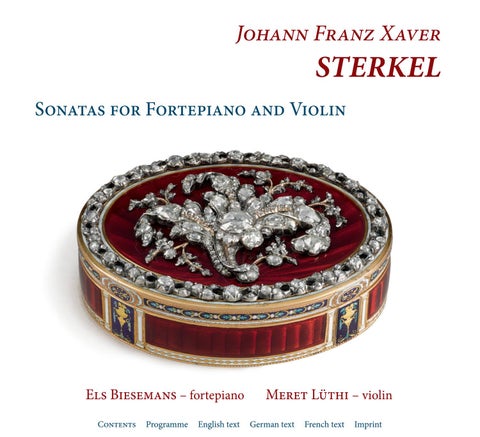
^menu Recorded in January, 2017 at Bühlkirche, Zurich-Wiedikon, Switzerland Artistic direction, recording, editing & mastering: Michaela Wiesbeck Executive production: Rainer Arndt / Outhere Graphic concept: © Laurence Drevard Design & layout: Rainer Arndt Cover: Snuffbox, Europe, late 18th century Photos: © RMN-Grand Palais (Musée du Louvre) / Stéphane Maréchalle (cover), © Tatyana Jenni (pp. 4 and 16) © gallica.bnf.fr / Bibliothèque nationale de France (p. 10) This recording was made possible with the generous support of the J. F. X. Sterkel-Gesellschaft, Aschaffenburg.
* * *
RAM 1701 www.ramee.org
2017 Outhere www.outhere-music.com www.facebook.com/outheremusic
^menu
Listen to samples from the new Outhere releases on: Écoutez les extraits des nouveautés d'Outhere sur : Hören Sie Auszüge aus den Neuerscheinungen von Outhere auf: www.outhere-music.com