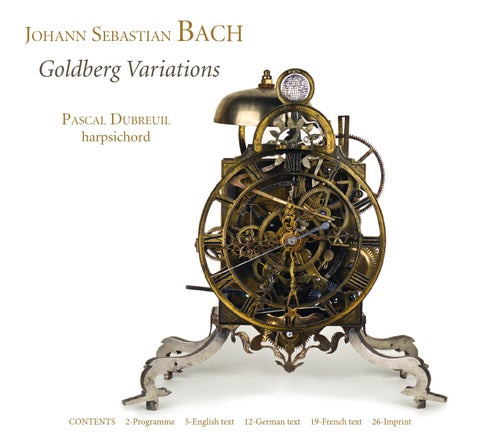
Johann Sebastian Bach
Goldberg Variations Pascal Dubreuil harpsichord
contents
2-Programme
5-English text
12-German text
19-French text
26-Imprint
Johann Sebastian Bach
Goldberg Variations BWV 988 1. 2. 3. 4. 5. 6. 7. 8. 9. 10. 11. 12. 13. 14. 15. 16.
Aria. Variatio 1. a 1 Clav. Variatio 2. a 1 Clav. Variatio 3. Canone all Unisuono. a 1 Clav. Variatio 4. a 1 Clav. Variatio 5. a 1 么 vero 2 Clav. Variatio 6. Canone alla Seconda. a 1 Clav. Variatio 7. a 1 么 vero 2 Clav. al tempo di Giga. Variatio 8. a 2 Clav. Variatio 9. Canone alla Terza. a 1 Clav. Variatio 10. Fugetta. a 1 Clav. Variatio 11. a 2 Clav. Variatio 12. Canone alla Quarta. Variatio 13. a 2 Clav. Variatio 14. a 2 Clav. Variatio 15. Canone alla Quinta. a 1 Clav. andante.
5:13 2:01 1:55 1:58 1:03 1:56 1:56 1:54 2:03 2:48 1:36 2:01 4:05 5:18 2:11 3:32
^menu
17. 18. 19. 20. 21. 22. 23. 24. 25. 26. 27. 28. 29. 30. 31. 32.
Variatio 16. Ouverture. a 1 Clav. Variatio 17. a 2 Clav. Variatio 18. Canone alla Sexta. a 1 Clav. Variatio 19. a 1 Clav. Variatio 20. a 2 Clav. Variatio 21. Canone alla Settima. Variatio 22. a 1 Clav. allabreve. Variatio 23. a 2 Clav. Variatio 24. Canone all Ottava. a 1 Clav. Variatio 25. a 2 Clav. adagio. Variatio 26. a 2 Clav. Variatio 27. Canone alla Nona. a 2 Clav. Variatio 28. a 2 Clav. Variatio 29. a 1 o vero 2 Clav. Variatio 30. a 1 Clav. Quodlibet. Aria da Capo è Fine.
2:50 1:59 1:31 1:48 2:31 3:06 1:26 2:20 3:50 8:11 2:36 2:13 2:27 2:21 1:53 2:52 Total
85:40
Pascal Dubreuil harpsichord Titus Crijnen (Sabi単an 2011) after I. I. Couchet (Antwerp 1679) 4
^menu
After several years study with Yannick le Gaillard, Pascal Dubreuil was awarded the diplomas in both harpsichord and basso continuo from the Conservatoire National Supérieur de Musique in Paris. He continued his studies with various teachers, notably Kenneth Gilbert, and especially Gustav Leonhardt. He also studied orchestral direction with Nicholas Brochot. A prizewinner at Bruges in 1997, he is now pursuing a career as performer and teacher. He has appeared throughout Europe as a harpsichordist, but also on the clavichord and fortepiano. This has been both as soloist and chamber musician, particularly with Musica Aeterna Brastislava, and as continuo-player with various ensembles such as Ensemble vocal de l'Abbaye aux Dames de Saintes and Sagittarius, as well as with soloists such as Claire Michon, Patrick Ayrton (as a harpsichord duo), François Fernandez, Marie Rouquié, Bruno Boterf and Ricardo Rapoport. He is regularly invited for festivals such as the Printemps des Arts, the Académies musicales de Saintes, the Festival de Música Antiga in Barcelona, the festival Dni starej hudby in Bratislava or the Ruhr Klavier Festival. He has recorded with the labels Le Chant du Monde, K 617 and Arion, and currently records with Ramée. His recording with the latter of Bach's six Partitas (RAM 0804) was universally acclaimed by international critics, and received several awards, among which the prestigious German Recording Critics Award (Preis der Deutschen Schallplattenkritik). Pascal Dubreuil is currently professor of harpsichord and chamber-music at the early music department of the Rennes Conservatoire. He also teaches harpsichord and musical rhetoric at the Centre d'Études Supérieures de Musique et de Danse de Poitiers. In 2009 he founded the ensemble Il Nuovo Concerto, of which is the artistic director. He is also the founder of the early music festival "Baroque... et vous?" in Rennes. His research into musical rhetoric over many years has led him to publish, jointly with Agathe Sueur, the first complete French translation of Joachim Burmeister's 1606 treatise Musica Poetica, as well as important extracts from two of Burmeister's other treatises (Mardaga, 2007). Pascal Dubreuil is also often invited as a member of juries for exams and competitions, and to lead masterclasses, both in France and abroad.
5
When one reads this title page, one question immediately springs to mind: why is the work now known as 'Goldberg Variations' when the composer designates it simply Clavier-Ăœbung (Keyboard exercise)?
The Goldberg Variations The Goldberg Variations were published, at the composer's expense, by Balthasar Schmid, engraver and printer in Nuremberg. The title page includes no date of publication, but it is certain that this was either 1740 or 1741:
In fact, the nickname 'Goldberg Variations' derives from a tradition dating back to the first biography of J. S. Bach, published by Johann Nikolaus Forkel in 1802. Since he never knew Bach, his work was based on his own research and on extensive correspondence with the composer's two oldest sons, Wilhelm Friedemann and Carl Philipp Emanuel. According to Forkel, Bach wrote this cycle of variations at the request of Count von Keyserlingk2, the former ambassador of Russia at the court of the Elector of Saxony. He frequently resided in Leipzig, and had in his service Johann Gottlieb Goldberg, a young harpsichordist and pupil of Bach's.
Keyboard Exercise consisting of an ARIA with divers transformations for the harpsichord with two manuals. Composed for music lovers, to refresh their spirits, by
Keyserlingk, who suffered from chronic insomnia, was in the habit of waking Goldberg during the night to play the harpsichord for a while, in the hope that this would help him get to sleep. He was supposedly close to Bach and commissioned a work from him to enlarge Goldberg's nocturnal repertory. Forkel goes so far as to provide the following details: "The pieces... should be of such a soft and somewhat lively character that he might be a little cheered up by them in his sleepless nights... The Count thereafter called them nothing but his variations. He was never weary of hearing them; and for a long time, when his sleepless nights came, he used to say: 'Dear Goldberg, do play me one of my variations.' Bach was, perhaps, never so well rewarded for any work
Johann Sebastian Bach Royal Polish and Electoral Saxon Composer, Kapellmeister, and Director Chori Musici in Leipzig. Nuremberg: published by Balthasar Schmid1.
6
as for this: the Count made him a present of a golden goblet filled with a hundred Louis d'or."3 Thus Bach's Keyboard Exercise entered posterity under the name of Goldberg Variations.
does indeed show a large number of corrections in ink added in his hand. Bach had previously written only one set of variations, in the Aria variata in A minor BWV 989, which is a short work (a Thema followed by ten variations) and fairly conventional. One of its principal merits is to give us a clearer idea of how the young man was then in the process of familiarising himself with composition in all the musical forms of his day. After this he turned away from the systematic writing of variations.
Despite its undeniable appeal, however, it may well be that Forkel's anecdote does not exactly reflect what really happened. For it is noteworthy that the title page of the work does not mention the name of Count von Keyserlingk. If the variations had been the product of a commission, or even of a simple request, the composer would have followed the custom of the time and included the name of the patron in question on the title page, possibly accompanied by a laudatory dedication. There is nothing to suggest that Bach did not comply with this convention. Moreover, the posthumous inventory of the composer's estate makes no mention of the golden goblet referred to by Forkel, an extremely valuable object which Bach and his wife would very probably have wished to keep. Finally, Goldberg's youth at this time (he was fourteen or fifteen) must at the very least cast some doubt on his ability to perform the work as a whole. Though he may very well have been highly gifted, certain variations, which require extreme technical skill and accomplished virtuosity on the part of the player, must still have been beyond his grasp as a teenager. Nevertheless, it would appear that Forkel was well informed on other points concerning the work. For example, he concludes his account by stating that the engraved plates of the variations included important errata, and that the composer himself corrected them in his personal copy. Bach's own copy has survived, and
The Goldberg Variations formed part of a series of publications begun by Bach shortly after his arrival Leipzig. The year 1731 saw the appearance of the six Partitas for harpsichord in a single volume, under the title Clavier-Übung I. This was followed in 1735 by Clavier-Übung II (the Italian Concerto and the Overture in the French Style), and in 1739 by Clavier-Übung III (the so-called 'Organ Mass'). Then, in 1740 or 1741, came the Goldberg Variations, under the title of ClavierÜbung. Finally, in 1747, he issued the Canonic Variations on Vom Himmel hoch. While it is obvious that the composer conceived the first three of these publications as a coherent whole, nothing indicates that he regarded the Goldberg Variations as the fourth and last part of that corpus. The term Clavier-Übung designates above all the instrumentation for which a collection is intended and the internal coherence of its musical content. The absence of numbering on the volume containing the Goldberg Variations 7
seems to suggest that it should rather be seen as a specific entity in this series of publications. Its publication was therefore all the more unexpected.
out a true bass line, while each of the two hands traverses its manual in parallel or contrary motion, sometimes without any clearly discernible melody. But this style of writing is placed at the service of strong and expressive musical ideas conducive to arousing varied emotions in the listener.
After the death of its composer, this work very quickly came to be considered as a monument of keyboard music, an unignorable yardstick for all other cycles of variations, and that reputation has remained unchanged right up to our own time. It is not only the grandeur of the art of composition and counterpoint that makes the Goldberg Variations a masterpiece, but also the variety of styles and affects. Virtuosity also plays a by no means insignificant role.
Another particularity of the work is the choice of the piece on which the entire compositional process is founded. It was not composed specifically for the occasion, for this now famous Aria was already included in the ClavierbĂźchlein (Little Keyboard Book) of Anna Magdalena Bach, a gift from the composer to his second wife. This certainly dates from the period 17251730, at least ten years before the composition of the variations.
Bach employs technical devices of which he had made little use previously, notably crossing and inversion of the hands. This virtuoso writing, always extremely demanding for the performer, is in general deployed on the two manuals of the harpsichord. In fact, after stating on the title page that the work is intended for a harpsichord with two manuals, Bach takes the trouble (something exceptionally rare in his time) of marking himself the different registrations of each variation: on one manual (a 1 Clav.), on two (a 2 Clav.), or on one or two as the player prefers (a 1 overo 2 Clav.). But this use of the two manuals does not aim only at achieving virtuosity. It is above all an indispensable parameter of the work's musical expression (Bach stipulates that certain variations, though playable on a single manual, should be performed using both). He thereby offers his music lovers unexpected sonorities and colours that had never been employed before. Whole phrases are written with-
The fact that this cycle consists of thirty variations, its unusual stylistic specificities and the choice of the term Clavier-Ăœbung are all elements suggesting that Bach may have conceived the set as a sort of 'response' to Domenico Scarlatti. Two years earlier, in 1738, the prodigious composer and harpsichordist had published a set of thirty Essercizi per Gravicembalo, the numerous reprints of which were swiftly disseminated all over Europe. In these he displays unquestionable stylistic inventiveness and originality and exploits technical possibilities of the keyboard that had previously been either ignored or little explored by composers, notably hand-crossing, very wide and fast shifts and leaps of the hands, and figuration in thirds or sixths. In the penultimate essercizio he goes so far as to call for the player to 8
Variation 16 tends to confirm this: the concept of an 'Ouverture' clearly suggests a fresh start for the cycle. 3. Bach placed a canonic variation every three variations (nos. 3, 6, 9, etc.). The canons (which are arranged in ascending order: at the unison, the second, the third, etc.) thus introduce a ternary punctuation into the progression of the work: Aria – ten groups of three variations – Aria da capo. This structural device is emphasised by the fact that all the groups of three variations are organised in the same way: a) a 'character' variation, which makes use of a specific form (Fughetta, Ouverture, Alla breve) or evokes a dance without actually being one (no. 1 courante, no. 4 passepied, no. 7 al tempo di giga, no. 13 ornamented sarabande, no. 19 minuet, no. 25 sarabande in the style of a lamento, etc.); b) a virtuoso 'commentary' variation, exploiting hand-crossings in particular; c) a canonic variation. Only the first and last groups (variations 1-3 and 28-30) are slightly different: a) the first variation, already virtuosic with its rapid hand-crossings, is the exordium of the cycle, capturing the listener's attention without, however, launching the argumentation. The second variation, with its bass in tranquilly regular quavers underpinning strict, tight counterpoint, is the start of the narration, whose principal quality is clarity; b) the last group, with its extremely virtuosic and brilliant first two variations followed by the Quodlibet, constitutes the peroration of the discourse, in which the
invert his or her hands, a technical and musical feat of which probably only he was capable. Let us not forget that at this period the execution of a musical text took on its full meaning only in front of an audience, just as the declamation of a discourse only signified something in the presence of listeners. It was only when the orator (actio) delivered his or her discourse that the visual aspects of the art of eloquence came into play: the eyes, the hands, the arms, the bearing of the head, the entire body of the orator had to be involved in the act of declamation. Hence in both Scarlatti's Essercizi and Bach's Variations the systematic use of shifts and leaps of hands should be placed in the specific context of the actio of the harpsichordist as orator. Bach was probably familiar with this collection and may well have found in it a source of inspiration and an opportunity for a musical dialogue from afar with one of the most brilliant composers and harpsichordists of his time. Analysis of the organisation of the cycle reveals multiple structures that are superimposed on each other, thus offering seemingly inexhaustible complementary levels of interpretation, following a process that is not without its echoes of the medieval and humanistic theories of the different levels of meaning of a literary text.4 1. Aria – 30 variations – Aria da capo: this is the most immediately apparent structure, which emerges from a linear reading, the equivalent of the 'literal' meaning. 2. The structure of the Aria itself (two sections with repeats, each consisting of sixteen bars) is mirrored in the structure of the cycle as a whole: Aria + fifteen variations // fifteen variations + Aria da capo. The title of 9
modification of a theme that we may at any point identify beneath the variations it undergoes.
orator must move his or her listeners' hearts and kindle their passions in order to persuade them definitively. 4. Bach marked the registration for each variation. Only two variations carry no marking: nos. 12 and 21, two figures in mirror form, each of which adds up to a total of 3. One may see here the sign of a fourth structure: Aria – three groups of three variations – four groups of three variations – three groups of three variations – Aria da capo.
Rather, the Aria is like a source that generates various musical transformations and mutations, which are founded not on its melody but on its bass and its harmony. The Goldberg Variations may therefore be listened to as a substantial piece of eloquence, abundant in ideas and words, full of varietas (variety, an essential element of the art of oratory).
The different levels of interpretation or meaning are thus superimposed successively on the literal meaning. The prominent recurrence of the figures 3 and 4 in all the details of the writing strengthens the impression that the work is heavily loaded with symbols that enrich the variety and power of the musical emotion.
Double abundance (abundance of ideas and words), a notion theorised from Antiquity onwards, had undergone numerous developments at the hands of the Renaissance humanists and their successors. In combination with the notion of oratorical amplification, it was at the centre of numerous scholastic exercises with which young adolescents were quickly familiarised in the course of their studies. To take a typical example, the exercise of Chria consisted in writing a discourse by amplifying and arguing a given subject, using structures of argumentation and amplification already described in Greek and Latin treatises of rhetoric. Erasmus, for instance, in his De duplici copia verborum et rerum (On the double abundance of words and ideas, 1512)6, insists on the usefulness of these structures and of practising them with a view to becoming capable of arguing in favour of an idea, with eloquence and conviction but without wearying the listener, by means of variety, mastery of abundance or terseness, and oratorical amplification. Thus, like a rhetorical subject, the Aria in its transformations and commentaries generates new ideas, them-
Another indication on the title page sheds a particular light on this Keyboard Exercise: curiously, even though it was in widespread use at this period, the word 'Variation' does not figure there. Bach chooses the term Veränderung, which means transformation, transfer; its Latin equivalents affectio, immutatio, conversio, refer to notions of transformation, modification, mutation, metamorphosis. The term immutatio is used notably by Cicero to define the figures that change the signification of the word (tropes). Conversio is also utilised in ancient rhetoric to evoke the idea of the circularity of the periodic phrase, the way in which it finally turns back in on itself.5 Bach's choice of Veränderungen shows that we are not dealing merely with variations in the standard musical sense, that is, a process of rhythmic or melodic 10
selves constantly modified, amplified, metamorphosed, with incessantly varied affects, before this ample musical discourse appears to turn back in on itself and return to its starting point with the return of the Aria.
of view of the music lovers for whom it is intended, its inexhaustible musical and expressive richness is indeed conducive to the refreshment of their spirits. Pascal Dubreuil Translation: Charles Johnston
This is precisely what is suggested, not without humour, by the last variation, the famous Quodlibet ('what it pleases'). This movement superimposes the bass of the Aria and two folk songs, with the whole stated in canon in four voices. The text of the first song says 'I have been away from you so long, come back, come back', while the words of the second state: 'Cabbage and beets have driven me away: if my mother had cooked meat, I would have stayed longer'. Here it is a personification of the Aria that speaks, complaining that its mother (the composer) has been incapable of cooking properly (writing good music), which is why it has been absent. The first text, for its part, humorously describes the feelings of the listener, who addresses the Aria, insistently asking it to return, which it finally does with its da capo.
Translation based (with modifications) on Hans T. David and Arthur Mendel, rev. Christoph Wolff, The New Bach Reader (New York: W. W. Norton, 1998), p. 216.
1
Forkel's spelling; recte Count Hermann Carl von Keyserlingk (1696-1764) (translator’s note).
2
3 Forkel, Johann Nikolaus, Über Johann Sebastian Bachs Leben, Kunst und Kunstwerke (Leipzig: 1802). English translation in The New Bach Reader, p. 464. 4
See for example Dante, Convivio (The Banquet), Book II, 1.
The author would like to extend his warm thanks to Mr F. Muller for his precious help on the question of the meaning and lexical field of the term Veränderungen. On the structuring of rhetoric and musical periods, readers with French may care to consult the recent study by A. Sueur, Le Frein et l'Aiguillon, Éloquence musicale et nombre oratoire (XVIe-XVIIe siècle), Paris: Classiques Garnier, 2013, part 2.
5
Whether we choose to call it Keyboard Exercise consisting of an Aria with divers transformations or Goldberg Variations, this multifaceted work has constantly fascinated its listeners for centuries. One may see in it one of the most accomplished cycles of variations for keyboard, a musical allegory of human life, a musical exegesis of the first verse of John's Gospel ('In the beginning was the Logos... through it all things were made'), but also a musical Chria of sublime eloquence or a collection of short musical discourses for the nocturnal meditations of insomniacs. Whatever the point
Modern edition: Desiderius Erasmus, Copia: Foundations of the Abundant Style ('De duplici copia verborum ac rerum commentarii duo'). Collected Works of Erasmus, vol. 24, ed. Craig R. Thompson, Toronto: University of Toronto Press, 1978.
6
11
^menu
Pascal Dubreuil studierte Cembalo bei Yannik le Gaillard und erhielt Diplome für Cembalo und Generalbass am Conservatoire National Supérieur de Musique in Paris. Er vervollständigte seine Ausbildung auf zahlreichen Meisterkursen, unter anderem bei Kenneth Gilbert, und insbesondere bei Gustav Leonhardt. Er studierte außerdem Orchesterdirigieren bei Nicolas Brochot. 1997 war er Preisträger beim Internationalen Wettbewerb in Brügge und verfolgt seitdem eine rege Konzert- und Lehrtätigkeit. Er spielt als Solist und Kammermusiker auf dem Cembalo, aber auch auf dem Clavichord und dem Pianoforte, vor allem mit dem Bratislavaer Barockorchester Musica Aeterna, als Generalbassspieler auf dem Cembalo oder der Orgel mit dem Ensemble vocal de l'Abbaye aux Dames de Saintes, Sagittarius, aber auch mit Claire Michon, Patrick Ayrton (im Cembalo-Duo), François Fernandez, Marie Rouquié, Bruno Boterf oder Ricardo Rapoport. Er gastiert auf Festivals wie Printemps des Arts, Académies Musicales de Saintes, Festival de Música Antiga in Barcelona, Festival Dni starej hudby in Bratislava oder dem Ruhr Klavier Festival. Er nahm CDs für die Label Le Chant du Monde, K 617 und Arion auf und arbeitet nun mit dem Label Ramée. Seine Einspielung der Partiten von Bach bei Ramée (RAM 0804) wurde mit zahlreichen Preisen, darunter dem renommierten Preis der deutschen Schallplattenkritik, ausgezeichnet und bescherte ihm das einhellige Lob der internationalen Fachpresse. Pascal Dubreuil ist Professor für Cembalo und Kammermusik in der Abteilung Alte Musik am Conservatoire in Rennes. Er lehrt Cembalo und musikalische Rhetorik am Centre d'Études Supérieures de Musique et de Danse in Poitiers. Außerdem leitet er das 2009 von ihm gegründeten Ensemble Il Nouvo Concerto und begründete in Rennes das Alte-Musik-Festival »Baroque... et vous?«. Seine mehrjährige Forschungsarbeit über musikalische Rhetorik führte in Zusammenarbeit mit Agathe Sueur zur Herausgabe der ersten vollständigen französischen Übersetzung von Joachim Burmeisters Traktat Musica Poetica (1606) sowie von grundlegenden Passagen der zwei anderen Abhandlungen dieses Theoretikers (Mardaga, 2007). Dubreuil wird regelmäßig zu Meisterkursen sowie als Jurymitglied für Wettbewerbe in Frankreich und im Ausland eingeladen.
12
Liest man diese Titelseite, stellt sich unwillkürlich die Frage: Warum nennt man dieses Werk die »Goldberg-Variationen«, wenn der Komponist es doch schlicht und einfach als Clavier-Übung bezeichnete?
Goldberg-Variationen Johann Sebastian Bachs Goldberg-Variationen erschienen – auf Kosten des Komponisten – beim Verleger und Notenstecher Balthasar Schmid in Nürnberg. Das Erscheinungsjahr ist auf der Titelseite nicht vermerkt, es war jedoch mit Sicherheit 1740 oder 1741.
Nun, der Beiname »Goldberg-Variationen« entspringt einer Tradition, die aus der ersten, 1802 von Johann Nikolaus Forkel veröffentlichten Biographie J. S. Bachs hervorging. Forkel kannte Bach nicht persönlich, seine Arbeit stützte sich sowohl auf die eigene Forschung als auch auf eine umfangreiche Korrespondenz mit den beiden ersten Söhnen des Komponisten, Wilhelm Friedemann und Carl Philipp Emanuel. Forkel zufolge komponierte Bach diesen Variationszyklus im Auftrag des Grafen von Keyserlingk, dem ehemaligen russischen Botschafter am Hof des Sächsischen Kurfürsten. Dieser weilte oft in Leipzig, und in seinen Diensten befand sich der junge Cembalist Johann Gottlieb Goldberg, ein Schüler von Bach.
Clavier Ubung bestehend in einer ARIA mit verschiedenen Verænderungen vors Clavicimbal mit 2 Manualen. Denen Liebhabern zur GemüthsErgetzung verfertiget von
Keyserlingk litt an chronischer Schlaflosigkeit und hatte die Gewohnheit, Goldberg des Nachts zu wecken, damit er ihm ein wenig auf dem Cembalo vorspiele, in der Hoffnung wieder Schlaf zu finden. Als Freund der Familie Bachs soll er diesen um ein Werk gebeten haben, um Goldbergs nächtliches Repertoire zu bereichern. Er wünschte Stücke, so Forkel, »die so sanften und etwas muntern Charakters wären, daß er dadurch in seinen schlaflosen Nächten ein wenig aufgeheitert werden könnte. [...] Der Graf nannte sie hernach nur seine Variationen. Er konnte sich nicht satt daran hören, und lange Zeit hindurch hieß es nun, wenn schlaflose Nächte
Johann Sebastian Bach Königl. Pohl. u. Churfl. Sæchs. HoffCompositeur, Capellmeister, u. Directore Chori Musici in Leipzig. Nürnberg in Verlegung Balthasar Schmids.
13
Ausgabe der Variationen beträchtliche Fehler aufweise, die der Komponist selbst in seinem persönlichen Exemplar korrigiert habe. Dieses Handexemplar Bachs ist uns überliefert, und man findet darin tatsächlich zahlreiche Korrekturen aus seiner Feder.
kamen: Lieber Goldberg, spiele mir doch eine von meinen Variationen. Bach ist vielleicht nie für eine seiner Arbeiten so belohnt worden, wie für diese. Der Graf machte ihm ein Geschenk mit einem goldenen Becher, welcher mit 100 Louis d'or angefüllt war.«1 So kam es, dass diese Clavier-Übung der Nachwelt als GoldbergVariationen bekannt wurde.
Bach hatte sich bis dahin nur einmal mit der Komposition von Variationen beschäftigt: in der Aria variata a-Moll, BWV 989, einem kurzen (Thema mit zehn Variationen) und eher konventionellen Werk. Sein Wert besteht vor allem darin, dass es uns verdeutlicht, wie der junge Mann sich mit sämtlichen Kompositionsformen seiner Zeit vertraut machte. Die systematische Komposition von Variationen interessierte ihn später nicht wieder.
Diese Anekdote Forkels hat unleugbar ihren Reiz, doch entspricht sie vermutlich nicht ganz der Wahrheit. Auf der Titelseite wird der Name des Grafen von Keyserlingk nicht erwähnt. Wären die Variationen tatsächlich ein Auftragswerk oder auch einfach nur auf einen Wunsch hin entstanden, hätte der Komponist den Namen des Auftraggebers, so wie es damals üblich war, auf der Titelseite vermerkt, möglicherweise unter Beigabe einer lobenden Widmung. Nichts weist darauf hin, dass Bach diesen Brauch nicht respektierte. Des weiteren ist der berühmte goldene Becher nach dem Tod des Komponisten nicht im Inventar verzeichnet, obwohl das Ehepaar Bach diesen wertvollen Gegenstand sicherlich aufbewahrt hätte. Schließlich lässt das sehr jugendliche Alter Goldbergs zu dieser Zeit (vierzehn oder fünfzehn Jahre) zumindest Zweifel an seiner Fähigkeit, die Gesamtheit des Werkes zu bewältigen, aufkommen. Selbst wenn er vermutlich sehr begabt war, mussten doch einige Variationen, die dem Interpreten eine hohe technische Meisterschaft und vollendete Virtuosität abverlangen, noch außerhalb seiner Möglichkeiten liegen. Nichtsdestotrotz scheint Forkel über andere das Werk betreffende Punkte gut informiert gewesen zu sein. Er schließt seinen Bericht mit der Anmerkung, dass die gestochene
Das Erscheinen der Goldberg-Variationen fügt sich in eine Reihe von Veröffentlichungen, mit denen Bach kurz nach seiner Ankunft in Leipzig begann: 1731 Clavier-Übung I (sechs Partiten für Cembalo in einem Band). 1735 Clavier-Übung II (Italienisches Konzert, Französische Ouvertüre). 1739 Clavier-Übung III (die Orgelmesse). Und, 1740 oder 1741, die Goldberg-Variationen unter dem Titel Clavier-Übung. Hierauf folgten 1747 die Canonischen Veränderungen über Vom Himmel hoch. Während die ersten drei der genannten Veröffentlichungen ganz eindeutig als zusammenhängende Folge konzipiert sind, deutet jedoch nichts darauf hin, dass die Goldberg-Variationen von Bach als vierter und letzter Teil dieser Reihe gedacht waren. Die Bezeichnung 14
Clavier-Übung verweist vor allem auf das Instrument, dem dieser Band zugedacht ist, und die Kohärenz seines musikalischen Inhaltes. Die fehlende Nummerierung scheint darauf hinzudeuten, dass die Goldberg-Variationen in dieser Reihe eine besondere Stellung einnehmen. Ihr Erscheinen ist darum umso überraschender.
auf nur einem Manual durchaus spielbar, auf beiden Manualen ausgeführt werden.) Auf diese Weise schenkt er dem »Liebhaber« völlig neue, unerwartete Klänge und Tonfarben. Ganze Phrasen wurden ohne eine wirkliche Basslinie komponiert; beide Hände durchwandern jeweils ihre Tastatur, in parallelen oder gegenläufigen Bewegungen, manchmal ohne dass man eine klare Melodie heraushören kann. Doch dient diese Kompositionsweise ausdrucksstarken musikalischen Ideen, die beim Hörer verschiedenste Emotionen erzeugen.
Die Goldberg-Variationen galten sehr bald nach dem Tod des Komponisten als ein Meilenstein der Klaviermusik, mit dem sich jeder andere Variationszyklus unweigerlich messen musste und bis heute muss. Es ist nicht nur die Vollkommenheit von Komposition und Kontrapunkt, die die Goldberg-Variationen zu einem Meisterwerk macht, sondern auch die Vielfalt der Stile und Affekte, wobei auch die Virtuosität eine beträchtliche Rolle spielt.
Eine weitere Besonderheit des Werkes ist die Wahl des Stückes, auf das sich der gesamte kompositorische Prozess gründet. Dieses wurde nämlich nicht eigens für diesen Anlass komponiert, vielmehr findet sich die berühmte Aria bereits im Notenbüchlein für Anna Magdalena Bach, einem Geschenk Bachs an seine zweite Frau. Das Stück entstand daher mit Sicherheit in den Jahren 1725-1730, also mindestes zehn Jahre vor den Variationen.
Bach verwendet bis dahin von ihm kaum genutzte Techniken, insbesondere das Kreuzen und Überschlagen der Hände. Diese den Interpreten unentwegt und extrem fordernde Virtuosität entfaltet sich größtenteils auf beiden Manualen des Cembalos. Bach vermerkte schon auf der Titelseite, dass das Werk für ein zweimanualiges Cembalo konzipiert ist, und notierte dann selbst – was zu seiner Zeit äußerst selten war – für jede Variation eine Registeranweisung: auf einem Manual (a 1 Clav.), auf zwei Manualen (a 2 Clav.) oder nach Belieben des Interpreten (a 1 overo 2 Clav.). Doch gebrauchte er die beiden Manuale nicht allein um der Virtuosität willen. Sie sind vor allem ein unumgänglicher Parameter für den musikalischen Ausdruck des Werkes. (So verlangt Bach in einigen Variationen, dass sie, obwohl
Die Komposition dieses Zyklus' von 30 Variationen mit ihren ungewöhnlichen kompositorischen Mitteln wie auch die Wahl des Titels Clavier-Übung legen den Gedanken nahe, dass Bach mit diesem Werk eine Art »Antwort« auf Domenico Scarlatti im Sinne hatte. Dieser hatte 1738, also zwei Jahre zuvor, einen Band mit 30 Essercizi per Gravicembalo herausgegeben, dessen zahlreiche Neuauflagen sich schnell in Europa verbreiteten. Der Komponist und unglaublich virtuose Cembalist bewies hierin außergewöhnliche Erfindungskraft und Originalität des Stils, er verwendete technische Möglich15
keiten der Tastatur, die bis dato kaum jemand ergründet hatte (insbesondere das Überkreuzen der Hände, extreme und schnelle Wechsel und Sprünge, Passagen in Terzen oder Sexten u.v.m.). Im vorletzten Essercizio verlangt er sogar, mit vertauschten Händen zu spielen, eine technische und musikalische Herausforderung, die vermutlich nur er allein zu leisten vermochte. Vergessen wir nicht, dass zu jener Zeit die Darbietung eines musikalischen Textes nur vor einem Publikum voll zur Geltung kam, ebenso wie der Vortrag einer Rede nur vor einer Zuhörerschaft sinnvoll war. Der Moment des Vortrags durch einen Redner (actio) war es, während dessen die Redekunst auch den visuellen Aspekten Rechnung trug: Augen, Hände, Arme, Kopfhaltung – der ganze Körper des Redners musste in den Vortrag involviert sein. Somit ist, sowohl in den Essercizi von Scarlatti als auch in den Variationen von Bach, der systematische Gebrauch von Wechseln und Sprüngen der Hände im spezifischen Kontext der actio des Redner-Cembalisten zu sehen. Für Bach, der diesen Band höchstwahrscheinlich kannte, war er möglicherweise Inspirationsquelle und Gelegenheit zu einem musikalischen Ferndialog mit einem der brillantesten Komponisten und Cembalisten seiner Zeit.
1. Aria – 30 Variationen – Aria da capo: dies ist die unmittelbarste Struktur, die einer linearen Lesart entspringt, dem »Wortsinn« entsprechend. 2. Die der Aria innewohnende Struktur (zwei 16-taktige Teile mit Wiederholungen) findet sich in der Struktur des Zyklus wieder: Aria + 15 Variationen // 15 Variationen + Aria da capo. Der Titel der 16. Variation, Ouverture, bestätigt dies, indem er einen Neubeginn innerhalb des Zyklus suggeriert. 3. Jede dritte Variation (Nr. 3, 6, 9 usw.) wird von Bach kanonisch angelegt. Diese Kanons (angeordnet in aufsteigender Intervallfolge: Prime, Sekunde, Terz, usw.) ergeben für den Gesamtverlauf des Werkes eine Disposition in Dreiergruppen: Aria – 10 Gruppen von jeweils drei Variationen – Aria da capo. Diese Struktur wird noch dadurch betont, dass die Dreiergruppen sich in ihrer Binnengliederung gleichen: a) eine »Charaktervariation« entweder in einer spezifischen Form (Fughetta, Ouverture, Alla breve) oder einen Tanz evozierend, ohne tatsächlich einer zu sein (Nr. 1 Courante, Nr. 4 Passepied, Nr. 7 al tempo di giga, Nr. 13 verzierte Sarabande, Nr. 19 Menuett, Nr. 25 Sarabande im Stil eines Lamento, usw.); b) eine »kommentierende«, virtuose Variation, die vor allem das Überkreuzen der Hände einsetzt; c) ein Kanon. Nur die erste und die letzte Gruppe (Variationen 1-3 und 28-30) weichen ein wenig davon ab: a) die erste Variation, mit sehr schnellem Überkreuzen schon virtuos, fungiert als Einleitung (exordium) des Zyklus, welches die Aufmerksamkeit des Zuhörers erregen soll, ohne jedoch schon die Argumentation
Die Analyse des Zyklus' bringt vielfältige, sich überlagernde Strukturen zum Vorschein, die eine fast unerschöpfliche Zahl komplementärer Lesarten ermöglicht (was uns an die mittelalterlichen und humanistischen Theorien über die verschiedenen hermeneutischen Schichten eines literarischen Textes erinnert2).
16
wird von Cicero vor allem zur Definition der Tropen herangezogen, d.h. Figuren mit veränderter Wortbedeutung. Die Bezeichnung conversio wird in der antiken Rhetorik auch gebraucht, um das Prinzip des sich schließenden Kreises einer Satzperiode zu evozieren.3 Die Entscheidung Bachs für das Wort »Veränderungen« zeigt uns, dass es sich nicht nur um Variationen im gängigen musikalischen Sinn handelt, also die Arbeit mit rhythmischen oder melodischen Modifikationen um ein Thema, welches man zu jeder Zeit in diesen Variationen wiedererkennen kann.
(argumentatio) vorwegzunehmen. Mit der zweiten Variation, deren Basslinie in ruhigen und regelmäßigen Achteln einen dichten und strengen Kontrapunkt stützt, beginnt die Erzählung (narratio), deren erstes Prinzip die Klarheit ist; b) die letzte Gruppe, zwei äußerst brillante und virtuose Variationen gefolgt vom Quodlibet, bildet den Abschluss der Rede (peroratio), in welcher der Redner das Herz des Zuhörers rühren und seine Emotionen ansprechen soll, um ihn schließlich gänzlich zu überzeugen. 4. Für jede Variation hat Bach die Registeranweisung notiert. Nur zwei Variationen bleiben ohne diesen Hinweis: die Nummern 12 und 21, zwei gespiegelte Zahlen, deren Quersumme jeweils 3 ergibt. Man kann darin ein Indiz für eine vierte Struktur sehen: Aria – 3 Gruppen von je 3 Variationen – 4 Gruppen von je 3 Variationen – 3 Gruppen von je 3 Variationen – Aria da capo.
Die Aria ist eher wie eine Quelle, der verschiedenste musikalische Transformationen und Mutationen entspringen, die nicht auf ihrer Melodie, sondern auf ihrer Basslinie und ihrer Harmonie basieren. Man kann die »Goldbergvariationen« also hören wie eine hoch eloquente Rede, reich an Ideen und Worten, und voller varietas (Vielfalt als wesentliches Element der Redekunst).
So überlagern sich ausgehend vom wörtlichen Sinn die verschiedenen Lesarten oder Bedeutungsebenen. Die fortwährende Wiederkehr der Zahlen 3 und 4 macht deutlich, wie sehr das Werk mit Symbolik beladen ist, die seine emotionale Kraft noch verstärkt.
Die »doppelte Fülle« (der Ideen und der Worte), seit der Antike ein theoretischer Begriff, hatte bei den Humanisten der Renaissance und ihren Nachfolgern vielfältige Entwicklungen durchlaufen. Im Zusammenhang mit der verbalen Steigerung (amplificatio) stand sie im Mittelpunkt zahlreicher rhetorischer Übungen, mit denen die jungen Schüler im Unterricht sehr früh vertraut gemacht wurden. Ein typisches Beispiel war die Chrie, die darin bestand, eine Rede zu schreiben, indem man ein vorgegebenes Thema behandelte und dabei Techniken der argumentatio und amplificatio benutzte, wie sie schon in den griechischen und latei-
Ein weiter Vermerk auf der Titelseite wirft noch ein besonderes Licht auf diese Clavier-Übung: seltsamerweise taucht der Terminus »Variationen« hier gar nicht auf, obwohl er zu dieser Zeit sehr geläufig war. Bach wählt vielmehr den Begriff »Veränderungen«, dessen lateinische Äquivalente affectio, immutatio und conversio auf Transformation, Modifikation, Mutation und Metamorphose verweisen. Der Begriff immutatio 17
nischen Rhetoriktraktaten beschrieben wurden. So betont beispielsweise Erasmus von Rotterdam in seinem Werk De Duplici copia verborum et rerum (Von der doppelten Fülle der Worte und Ideen, 1512) den Nutzen dieser Strukturen und ihrer Anwendung für die Fähigkeit, eine Idee eloquent und überzeugend darzulegen, ohne beim Hörer Überdruss zu erzeugen: durch Vielfalt, die Beherrschung von Fülle bzw. Knappheit und durch verbale Steigerung. So liefert die Aria, einem Redethema gleich, in ihren Umwandlungen und Kommentaren neue Ideen, welche wiederum beständig umgestaltet, verstärkt, verwandelt und mit immer neuen Affekten versehen werden, bevor dieser weitläufige musikalische Diskurs sich wie ein Kreis wieder schließt, indem er mit der Aria zu seinem Ausgangspunkt zurückkehrt.
Ob nun Clavier Ubung bestehend in einer Aria mit verschiedenen Verænderungen oder GoldbergVariationen – dieses vielschichtige Werk fasziniert sein Publikum seit Jahrhunderten. Man kann darin einen vollendeten Variationszyklus für Klavier sehen, eine musikalische Allegorie des menschlichen Lebens, eine musikalische Exegese des ersten Verses des Johannes-Evangeliums »Im Anfang war das Wort [...] und ohne dasselbe ist nichts gemacht, was gemacht ist«), aber auch eine musikalische Chrie mit bewunderungswürdiger Eloquenz, oder eben eine Sammlung kleiner musikalischer Diskurse für die nächtlichen Meditationen der Schlaflosen. Was auch immer die Ansicht seiner »Liebhaber« sein mag, sein unerschöpflicher musikalischer Reichtum ist wohl dazu angetan, ihr »Gemüth« zu »ergetzen«.
Ebendies suggeriert, nicht ohne Humor, die letzte Variation, das berühmte Quodlibet (»wie es beliebt«). In diesem erklingen zur Bassstimme der Aria zwei Volkslieder, alles zusammen im vierstimmigen Kanon. Der Text des ersten Liedes lautet: »Ich bin so lang nicht bei dir g'west, ruck her, ruck her, ruck her«, während es im zweiten Liedtext heißt: »Kraut und Rüben haben mich vertrieben, hätt mein Mutter Fleisch gekocht, so wär ich länger blieben.« Hier spricht die Aria und beklagt sich, dass ihre Mutter (der Komponist) nicht in der Lage war, ordentlich zu kochen (gute Musik zu machen), was der Grund für ihre Abwesenheit ist. Was den ersten Text betrifft, so beschreibt er augenzwinkernd das Gefühl des Hörers, der die Aria inständig bittet zurückzukehren, was sie schließlich mit ihrem da capo auch tut.
Pascal Dubreuil Übersetzung: Franziska Gorgs Forkel, Johann Nikolaus, Über Johann Sebastian Bachs Leben, Kunst und Kunstwerke. Leipzig, 1802.
1
Siehe beispielsweise Dante, Il Convivio (Das Bankett), Buch II, 1.
2
Ich danke sehr herzlich Herrn F. Muller für seine wertvollen Hinweise zu Bedeutung und Wortfeld des Terminus Veränderungen. Zum Aufbau rhetorischer und musikalischer Perioden siehe A. Sueur, Le Frein et l’Aiguillon. Éloquence musicale et nombre oratoire (XVIe-XVIIe siècle), Paris, Classiques Garnier, 2013, Teil 2.
3
18
^menu
Après avoir travaillé le clavecin durant plusieurs années avec Yannick le Gaillard, Pascal Dubreuil obtient au Conservatoire national supérieur de Musique de Paris les Premiers Prix de clavecin et de basse continue. Il complète sa formation par de nombreux stages, avec Kenneth Gilbert notamment et tout particulièrement avec Gustav Leonhardt. Il étudie également la direction d'orchestre avec Nicolas Brochot. Lauréat du Concours international de Bruges en 1997, il développe dès lors des activités de concertiste et de pédagogue. Comme claveciniste, mais aussi sur le clavicorde et le pianoforte, il joue en Europe en soliste et au sein de formations de musique de chambre, en particulier avec Musica Aeterna Bratislava, en tant que continuiste avec l'Ensemble vocal de l'Abbaye aux Dames de Saintes et Sagittarius, ou avec Claire Michon, Patrick Ayrton (en duo de clavecins), François Fernandez, Marie Rouquié, Bruno Boterf ou Ricardo Rapoport. Il est invité par des festivals tels que le Printemps des Arts, les Académies musicales de Saintes, le Festival de Musique ancienne de Barcelone, le festival Dni starej hudby de Bratislava ou le Ruhr Klavier Festival. Il a enregistré pour Le Chant du Monde, K 617 et Arion ; il enregistre actuellement pour le label Ramée. Son enregistrement de l'intégrale des six Partitas de Johann Sebastian Bach (RAM 0804) a été unanimement salué par la critique internationale et a obtenu plusieurs récompenses, dont le prestigieux Prix allemand de la Discographie (Preis der deutschen Schallplattenkritik). Pascal Dubreuil est actuellement professeur de clavecin et de musique de chambre au sein du Département de Musique ancienne du Conservatoire de Rennes. Il enseigne également le clavecin et la rhétorique musicale au Centre d'Études supérieures de Musique et de Danse de Poitiers. En 2009, il fonde l'ensemble Il Nuovo Concerto, dont il est le directeur artistique. Il est également le fondateur du festival « Baroque... et vous ? » de Rennes. Ses travaux de recherche sur la rhétorique musicale, menés depuis plusieurs années, l'ont amené à publier, en collaboration avec Agathe Sueur, la première traduction française intégrale du traité Musica Poetica (1606) de Joachim Burmeister, ainsi que d'importants extraits des deux autres traités de ce théoricien (Mardaga, 2007). Pascal Dubreuil est sollicité pour de nombreux jurys et classes de maître, en France ou à l'étranger, dans des institutions d'enseignement ou pour des examens et concours.
19
À la lecture de cette page de titre, une question vient immédiatement à l'esprit : pourquoi l'œuvre estelle surnommée « Variations Goldberg », alors que le compositeur la désigne simplement comme ClavierÜbung (Exercice de Clavier) ?
Les Variations Goldberg Les Variations Goldberg furent éditées, à compte d'auteur, chez Balthasar Schmid, graveur et éditeur à Nuremberg. La page de titre ne mentionne pas la date, mais il est certain que ce fut en 1740 ou 1741 :
De fait, le surnom de « Variations Goldberg » nous vient d'une tradition qui remonte à la première biographie de Johann Sebastian Bach, publiée en 1802 par Johann Nikolaus Forkel. N'ayant pas connu Bach, ses travaux sont fondés sur ses propres recherches et sur une correspondance soutenue avec les deux premiers fils du compositeur, Wilhelm Friedemann et Carl Philipp Emanuel. Selon Forkel, Bach aurait écrit ce cycle de variations à la demande du comte von Keyserlingk, ancien ambassadeur de Russie à la Cour de l'Électeur de Saxe. Il résidait souvent à Leipzig, ayant à son service Johann Gottlieb Goldberg, jeune claveciniste, élève de Bach.
Exercice de Clavier Se composant d'une ARIA Avec différentes transformations pour le clavecin à deux claviers. Composée à l'intention des amateurs pour la récréation de leur esprit par
Keyserlingk, qui souffrait d'insomnies chroniques, avait pour habitude de réveiller Goldberg durant la nuit pour qu'il lui joue un peu de clavecin dans l'espoir de retrouver le sommeil. Proche de Bach, il lui aurait passé commande d'une œuvre pour agrémenter le répertoire nocturne de Goldberg. Forkel précise même que « [c]es morceaux devaient être d'un caractère calme et plutôt joyeux, afin qu'ils le puissent récréer pendant ses nuits sans repos. […] Toujours le comte les appelait ses variations. Il ne se lassait jamais de les entendre et, dans la suite, pendant ses longues insomnies, il avait coutume de dire : Cher Goldberg,
Johann Sebastian Bach Compositeur du Roi de Pologne et Prince Électeur de Saxe, Maître de Chapelle et Directeur des Chœurs de Musique à Leipzig. Nuremberg, édité chez Balthasar Schmid.
20
Bach nous est parvenu et on peut effectivement y voir un grand nombre de corrections faites à la plume, de sa main.
jouez-moi donc, je vous prie, une de mes variations. Jamais peut-être Bach ne reçut pour aucun de ses ouvrages une aussi belle récompense : car le comte lui fit cadeau d'un gobelet d'or empli de cent louis d'or1. » Cet Exercice de Clavier devait ainsi passer à la postérité sous le nom Variations Goldberg.
Bach n'avait abordé qu'une seule fois l'écriture de variations, dans l'Aria variata en la mineur BWV 989, œuvre courte (Thema suivi de dix variations) et plutôt conventionnelle. L'un de ses principaux mérites est de nous faire mieux percevoir comment le jeune homme s'initiait alors à la composition de toutes les formes musicales de son temps. L'écriture systématique de variations n'avait plus retenu son attention par la suite.
Cependant, l'anecdote de Forkel, malgré son charme indéniable, n'est peut-être pas l'exact reflet de la réalité. En effet, la page de titre de l'œuvre ne mentionne pas le nom du comte von Keyserlingk. Si les Variations avaient été le fruit d'une commande, ou même d'une simple demande, le compositeur aurait, selon l'usage de l'époque, inclus le nom du commanditaire dans la page de titre, accompagné éventuellement d'une dédicace louangeuse. Rien ne peut laisser penser que Bach ne se soit pas conformé à l'usage. De plus, l'inventaire après décès du compositeur ne mentionne pas le fameux gobelet d'or, objet de grande valeur que le couple Bach aurait probablement voulu conserver. Enfin, le jeune âge de Goldberg à cette époque (14 ou 15 ans) laisse pour le moins planer le doute sur ses capacités à exécuter l'intégralité de l'œuvre. Même s'il était probablement très doué, certaines variations, exigeant de l'exécutant une très grande maîtrise technique et une virtuosité accomplie, devaient être encore hors de sa portée. Néanmoins, il semble que Forkel ait été bien renseigné sur d'autres points concernant l'œuvre. Il conclut en effet son récit en précisant que les planches gravées des variations comportent des errata importants, et que le compositeur les a lui-même corrigés sur son exemplaire personnel. Cet exemplaire personnel de
La parution des Variations Goldberg prend place dans une série de publications commencée par Bach peu après son arrivée à Leipzig. En 1731, les six Partitas pour clavecin en un seul volume, sous le titre de Clavier-Übung I. En 1735, la Clavier-Übung II (Concerto dans le Goût italien, Ouverture à la Manière française). En 1739, la Clavier-Übung III (la Messe d'orgue). Et en 1740 ou 1741, les Variations Goldberg, sous le titre de Clavier-Übung. Suivront, en 1747, les Variations canoniques sur Vom Himmel hoch. S'il est évident que le compositeur a conçu les trois premières de ces publications comme un ensemble cohérent, rien n'indique pour autant que les Variations Goldberg aient été envisagées par Bach comme la quatrième et dernière partie de cet ensemble. Le terme Clavier-Übung désigne avant tout la destination instrumentale d'un recueil et la cohérence interne de son contenu musical. L'absence de numérotation du 21
volume contenant les Variations Goldberg semble indiquer qu'il faut plutôt les envisager comme une entité spécifique dans cette série de publications. Leur parution n'en est que plus inattendue.
inattendues, jamais utilisées auparavant. Des phrases entières sont écrites sans qu'il y ait de réelle partie de basse, les deux mains parcourant chacune leur clavier, en mouvements parallèles ou contraires, parfois même sans que l'on puisse y discerner de façon claire une mélodie. Mais cette écriture est au service d'idées musicales fortes et expressives, propres à susciter des émotions variées chez l'auditeur.
Cette œuvre fut considérée très rapidement après la mort du compositeur comme un monument de la musique pour clavier, référence incontournable pour juger de tout autre cycle de variations et ce, sans discontinuer jusqu'à notre époque. C'est non seulement la grandeur de l'art de la composition et du contrepoint qui fait des Variations Goldberg un chef-d'œuvre, mais aussi la variété de l'écriture et des affects. La virtuosité y tient également une place non négligeable.
Une autre particularité de l'œuvre réside dans le choix de la pièce sur laquelle sera fondé tout le processus compositionnel. Celle-ci n'a en effet pas été composée spécifiquement pour l'occasion. De fait, cette fameuse Aria figurait déjà dans le Livre de Clavier d'Anna Magdalena Bach, cadeau du compositeur à sa seconde épouse. Elle date ainsi certainement des années 1725-1730, soit au moins dix ans avant la composition des variations.
Bach utilise des procédés techniques qu'il avait peu employés auparavant, notamment les croisements et les inversions de mains. Toujours d'une extrême exigence pour l'exécutant, cette virtuosité se déploie la plupart du temps sur les deux claviers du clavecin. De fait, après avoir précisé dans la page de titre que l'œuvre était destinée à un clavecin à deux claviers, Bach tient à indiquer lui-même (ce qui est rarissime à son époque) les différentes registrations de chaque variation : sur un clavier (a 1 Clav.), sur deux claviers (a 2 Clav.) ou au choix de l'exécutant (a 1 overo 2 Clav.). Mais l'usage des deux claviers n'a pas pour unique objectif la virtuosité. C'est avant tout un paramètre incontournable de l'expression musicale de l'œuvre (Bach demande à ce que certaines variations, bien que jouables sur un seul clavier, soient exécutées en utilisant les deux claviers). Il offre ainsi aux amateurs des sonorités et des couleurs
La composition de ce cycle de 30 variations, avec ses aspects singuliers dans l'écriture, tout comme le choix du terme Clavier-Übung, sont autant d'éléments qui amènent à penser que Bach a peut-être conçu la composition des Variations comme une sorte de « réponse » à Domenico Scarlatti. En effet, deux ans auparavant, en 1738, celui-ci avait publié un recueil de 30 Essercizi per Gravicembalo dont les nombreuses rééditions firent rapidement le tour de l'Europe. Le compositeur et claveciniste prodige y fait preuve d'une inventivité et d'une originalité incontestables dans l'écriture et y emploie des aspects techniques du clavier jusqu'alors peu ou pas abordés par les composi22
teurs (notamment les croisements, les déplacements et sauts de mains extrêmes et très rapides, les figures en tierces ou sixtes, etc.). Dans l'avant-dernier exercice, il va même jusqu'à demander de jouer en inversant les mains, prouesse technique et musicale qu'il était probablement seul à même de réaliser. N'oublions pas qu'à cette époque, l'exécution d'un texte musical ne prenait tout son sens que devant un public, au même titre que la déclamation d'un discours n'avait de sens que devant des auditeurs. C'était le moment de la prononciation du discours par l'orateur (actio), au cours duquel l'art de l'éloquence prenait pleinement en compte les aspects visuels : yeux, mains, bras, port de tête, tout le corps de l'orateur se devait d'être engagé dans la déclamation. Ainsi, tant dans les Essercizi de Scarlatti que dans les Variations de Bach, l'usage systématique des déplacements et sauts de mains est à replacer dans le contexte spécifique de l'actio du claveciniste orateur. Bach, qui a probablement eu connaissance de ce recueil, a pu y trouver une source d'inspiration et une occasion de dialogue musical à distance avec l'un des plus brillants compositeurs et clavecinistes de son temps.
1. Aria – 30 variations – Aria da capo : c'est la structure la plus immédiate, qui découle d'une lecture linéaire, équivalente du sens « littéral ». 2. La structure propre de l'Aria (deux parties avec reprises de 16 mesures chacune) se retrouve dans la structure du cycle : Aria + 15 variations // 15 variations + Aria da capo. Le titre de la variation 16 est là pour le confirmer : Ouverture, qui suggère bien un nouveau départ dans le cycle. 3. Bach a placé une variation en canon toutes les trois variations (nos 3, 6, 9, etc.). Ces canons (qui suivent un ordre croissant : à l'unisson, à la seconde, à la tierce, etc.) introduisent ainsi une ponctuation ternaire dans le déroulement de l'œuvre : Aria – 10 groupes de 3 variations – Aria da capo. Cette structure est accentuée par le fait que tous les groupes de trois variations sont organisés d'une façon semblable : a) une variation « de caractère », qui utilise une forme spécifique (Fughetta, Ouverture, Alla breve) ou évoque une danse, sans en être une réellement (no 1 courante, no 4 passepied, no 7 al tempo di giga, no 13 sarabande ornée, no 19 menuet, no 25 sarabande dans le style d'un lamento, etc.) ; b) une variation « commentaire » virtuose exploitant notamment les croisements de mains ; c) une variation en canon. Seuls les premier et dernier groupes (variations 1 à 3 et 28 à 30) sont légèrement différents : a) la première variation, déjà virtuose avec ses croisements de mains rapides, est l'exorde du cycle, qui capte l'attention de l'auditeur sans toutefois entrer dans
L'analyse de l'organisation du cycle fait surgir de multiples structures qui se superposent, offrant ainsi des niveaux de lecture complémentaires qui semblent inépuisables (suivant un processus qui n'est pas sans rappeler les théories médiévales et humanistes des différents niveaux de sens d'un texte littéraire2).
23
de transformation, modification, mutation, métamorphose. Le terme immutatio est notamment utilisé par Cicéron pour définir les figures changeant la signification des mots (les tropes). Le terme conversio est également utilisé dans la rhétorique antique pour évoquer l'idée de circularité de la phrase périodique, son enroulement final sur elle-même3. Le choix par Bach de Veränderungen indique qu'il ne s'agit pas uniquement de variations au sens musical courant : un travail de modifications rythmiques ou mélodiques à partir d'un thème que l'on pourrait à chaque moment retrouver sous ses variations.
l'argumentation. La seconde variation, avec sa basse en croches tranquillement régulières soutenant un contrepoint serré et rigoureux, est le début de la narration, dont la qualité principale est la clarté ; b) le dernier groupe, avec ses deux premières variations extrêmement virtuoses et brillantes suivies du Quodlibet, constitue la péroraison du discours, dans laquelle l'orateur doit émouvoir le cœur de son auditeur et enflammer ses passions afin de le convaincre définitivement. 4. Bach a indiqué pour chaque variation la registration. Seules deux variations ne comportent pas d'indication : les nos 12 et 21, deux chiffres en miroir, la somme de chacun faisant 3. On peut y voir l'indication d'une quatrième structure : Aria – 3 groupes de 3 variations – 4 groupes de 3 variations – 3 groupes de 3 variations – Aria da capo.
L'Aria est plutôt comme une source qui donne naissance à diverses transformations et mutations musicales, fondées non sur sa mélodie, mais sur sa basse et son harmonie. Les Variations Goldberg peuvent être alors écoutées comme une grande pièce d'éloquence, abondante en idées et en mots, pleine de varietas (la variété, élément essentiel de l'art oratoire).
Les différents niveaux de lecture ou de sens se superposent ainsi à partir du sens littéral. La forte récurrence des chiffres 3 et 4 dans tous les détails de l'écriture vient renforcer le sentiment que l'œuvre est profondément chargée de symbolismes qui enrichissent la variété et la force de l'émotion musicale.
La double abondance (celle des idées et celle des mots), notion théorisée dès l'Antiquité, avait trouvé de nombreux développements chez les humanistes de la Renaissance et leurs successeurs. Associée à la notion d'amplification oratoire, elle était au cœur de nombreux exercices scolaires auxquels les jeunes adolescents étaient très tôt habitués durant leurs études. Exemple typique, la Chria consistait à écrire un discours en amplifiant et argumentant sur un sujet donné, utilisant pour cela des structures d'argumentation et d'amplification déjà décrites dans les traités de rhéto-
Une autre indication de la page de titre vient apporter un éclairage particulier sur cet Exercice de Clavier : curieusement, et bien qu'il était couramment utilisé à cette époque, le terme « variations » n'y figure pas. Bach choisit le terme Veränderung, qui signifie « transformation, transfert », et dont les équivalents latin affectio, immutatio, conversio renvoient aux notions 24
rique grecs et latins. Érasme, par exemple, dans son ouvrage De Duplici copia verborum et rerum (De la double abondance des mots et des idées, 15124), insiste sur l'utilité de ces structures et de leur mise en pratique, afin d'être capable d'argumenter une idée avec éloquence et conviction sans provoquer la lassitude de l'auditeur, par la variété, la maîtrise de l'abondance ou du laconisme et l'amplification oratoire. Ainsi, à l'image d'un sujet, l'Aria donne lieu dans ses transformations et ses commentaires à de nouvelles idées, elles-mêmes constamment modifiées, amplifiées, métamorphosées, aux affects toujours variés, avant que cet ample discours musical ne semble s'enrouler sur lui-même pour retrouver son point de départ avec le retour de l'Aria.
Exercice de Clavier se composant d'une Aria avec différentes transformations ou Variations Goldberg, cette œuvre aux multiples facettes n'a cessé de fasciner ses auditeurs depuis des siècles. On peut y voir l'un des cycles de variations pour clavier les plus achevés, une allégorie musicale de la vie humaine, une exégèse musicale du premier verset de l'Évangile de Jean (« Dans le Principe était le Logos […] toutes choses furent par son intermédiaire »), mais également une Chria musicale à l'éloquence sublime ou encore une collection de petits discours musicaux pour les méditations nocturnes des insomniaques. Quel que soit le point de vue de ses amateurs, son inépuisable richesse musicale et expressive est bien propre à la récréation de leur esprit.
C'est bien ce que suggère, non sans humour, la dernière variation, le fameux Quodlibet (« comme il plaît »). Celui-ci superpose en effet la basse de l'Aria et deux chansons populaires, le tout à quatre voix en canon. Le texte de la première chanson nous dit : « Il y a bien longtemps que je n'ai été auprès de toi, approche, approche », tandis que le texte de la seconde constate : « Choux et navets m'ont chassé : si ma mère avait fait cuire de la viande, je serais resté plus longtemps ». C'est ici l'Aria qui parle, se plaignant que sa mère (le compositeur) n'ait pas été capable de bien cuisiner (faire de la bonne musique), raison de son absence. Quant au premier texte, il décrit avec humour le sentiment de l'auditeur, qui s'adresse à l'Aria, lui demandant instamment de revenir, ce qu'elle fait finalement avec son da capo.
Pascal Dubreuil Johann Nikolaus Forkel, Über Johann Sebastian Bachs Leben, Kunst und Kunstwerke, Leipzig, 1802, traduction française de G. Cantagrel, Sur la vie, l'art et l'œuvre de Johann Sebastian Bach, Paris, Hachette, 1982. 1
2
Voir par exemple Dante, Il Convivio (Le Banquet), Livre II, 1.
Je remercie chaleureusement M. F. Muller pour son aide précieuse concernant le sens et le champ lexical du terme Veränderungen. Sur la structuration des périodes rhétoriques et musicales, voir Agathe Sueur, Le Frein et l'Aiguillon. Éloquence musicale et nombre oratoire (XVIeXVIIe siècle), Paris, Garnier, 2013. 3
Érasme, Œuvres choisies, présentation, traduction et annotations de J. Chomarat, Paris, Le Livre de Poche, 1991. 4
25
^menu
Recorded in August, 2014 at the church of Notre-Dame de l'Assomption, Basse-Bodeux, Belgium Artistic direction, recording, editing & mastering: Rainer Arndt Production: Outhere Graphic concept: © Laurence Drevard Design & layout: Rainer Arndt (digipak), Catherine Meeùs (booklet) Cover: Time-piece, Brussels, early eighteenth century (by courtesy of Royal Museums of Art and History, Brussels) Photos: © RMAH (cover), © Pascal Dubreuil (p. 4)
RAM 1408 (This recording has been released on CompactDisc as RAM 1404) www.ramee.org
2016 Outhere www.facebook.com/outheremusic Listen to samples from the new Outhere releases on: Écoutez les extraits des nouveautés d'Outhere sur : Hören Sie Auszüge aus den Neuerscheinungen von Outhere auf: www.outhere-music.com
Previously released with Pascal Dubreuil
Johann Sebastian Bach Fait pour les Anglois
Johann Sebastian Bach Clavier-Ăœbung II
RAM 1207
RAM 1001
Johann Sebastian Bach Partitas
Antoine Dard Sonates pour le Basson
RAM 0804
RAM 0702