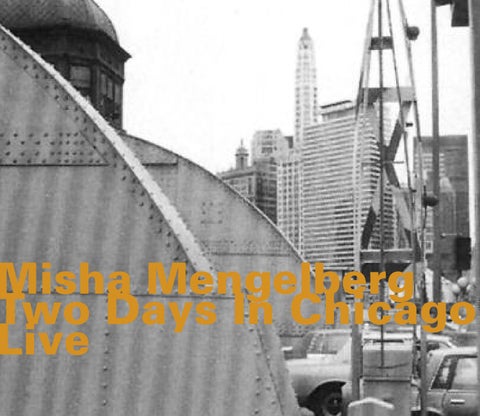
Misha Mengelberg Two Days In Chicago Live
Two Days in Chicago
Brian Morton, September 27, 2018
In 1979, Misha Mengelberg played piano on an album by saxophonist and multi-instrumentalist Keshavan Maslak. It isn’t one of the best-known items in Mengelberg’s discography, but its title fits him perfectly, even if he doesn’t play on the title track, which is Maslak solo. It’s called Humanplexity, and it’s how I’ve thought of Misha ever since. He was a deeply intelligent man, who knew his way round the 20th century avant-garde but who always played with a profound and sometimes self-mocking humanity and playfulness. The last time I saw him, he was already in the grip of Alzheimer’s disease. When words failed him, he would fill the gaps by singing or whistling.
It made me remember that he had started out his recording career not just playing with a famous American who like Messiaen had taken music lessons from the birds, but also – typical of Misha – duetting with an actual bird. The early recording of Epistrophy with Eric Dolphy, with whom Misha went on to record the so-called Last Date, was paired with his collaboration with Eeko, his wife’s African grey parrot. Misha claimed that the bird hated him. I came to realise that some musicians, if not actually hating Mengelberg, found him too mischievous, a prankster who was also much cleverer than them. He was seemingly destined for a career in music, though he did start out by studying architecture, only switching to music theory and composition at the Royal Conservatory in Amsterdam in 1958, when he was already 23. Misja (originally so spelt) was born in Kiev, in the Ukraine, on June 5, 1935. His father Karel was a film composer and conductor, his mother Rahel a harpist; that she was also German presented a problem for the family as hostility to the German people grew in the Soviet Socialist Republics. Fortunately, there was family in the Netherlands, where Misja’s uncle Willem Mengelberg was conductor of the mighty Concertgebouw Orchestra. The Mengelbergs returned to Holland in 1938, which must have felt like jumping out of the frying pan and into the fire.
The son of the family studied soberly, but began to develop a parallel career as a jazz pianist, combining an interest in bebop that was most idiosyncratically expressed in “Hypochristmutreefuzz” on Last Date, a theme that sounds so “Dolphy” now it is still rather startling to recognise that Eric didn’t write it. That date at the VARA Studio in Hilversum on June 2, 1964 is also celebrated as the first recorded encounter of Mengelberg and percussionist fellow-spirit Han Bennink, another fearsome brain contained in a childlike spirit. Both men were drawn into the Fluxus-influenced world of “happenings” and performance art best expressed in the famous Flux Festival Nieuwste Muziek en Anti-Muziek (“The latest music and anti-music”) festival which happened at the Kurzaal in Scheveningen some months after the Dolphy session. Working as a duo and in trio with saxophonist Willem Breuker, they developed a reputation for combining experimental improvisation with physical comedy. There was a Year Zero feel to Dutch music after the war, symbolised in part by the loss of all of composer Willem Pijper’s published works in the Nazi bombardment of Rotterdam. It left behind a sense that music could be reconstructed from the bottom up. This spirit lay behind the creation in 1967 of the Instant Composers Pool (ICP), which became in various form a key outlet for Mengelberg’s creativity for much of the rest of his life. To begin with, it was simply a duo, but Misha and Han gradually brought in collaborators, including the Danish saxophonist John Tchicai, the German Peter Brötzmann, and cellist Tristan Honsinger, together with other British and European players such as Derek Bailey (who ran his own cross-fertilising Company events), Evan Parker, Paul Rutherford, Dudu Pukwana and the American but French-resident Steve Lacy. Mengelberg’s piano playing was, as with so many keyboard players of that generation, a hybrid of Duke Ellington and Thelonious Monk influences, and his style of composition often resembled a more radical, arguably more Euro-
pean, version of Monk’s spiky melodic and rhythmic cells. Mengelberg sometimes expressed suspicion of free improvisation, preferring the notion of instant composition in the moment, but even when he wrote formal music for other hands, there was usually some element of improvisation involved. The 1988 solo album Impromptus, released like much of his work on the ICP imprint, took a well-attested classical form and melded it with elements of post-bop jazz. As time went by and the modern jazz tradition began to become part of a heritage industry, Mengelberg took renewed interest in the bop repertory, curating a Monk/Herbie Nichols tribute with the ICP Orchestra and collaborating with Anthony Braxton on a Charlie Parker programme. He also worked in duo with flugelhorn virtuoso and composer Franz Koglmann on four tracks for L’Heure Bleue. The last two records were released on hatART. Mengelberg had been involved with Louis Andriessen and Peter Schat in the Studio for Electro-Instrumental Music (STEIM) but never gave himself wholeheartedly to electronics, preferring the physical immediacy of the piano keyboard and pedals. His pedal work alone deserves study. Misha had a way of damping then releasing notes that created effects far more subtle than anything possible on a sampling keyboard. He was never a piano snob, preferring like Ran Blake to spend some time with a piano before performing and adapting his performance to its intrinsic voice and peccadilloes. And far from rejecting club performance as beneath his dignity as a composer, he helped in 1973 to found the Bimhuis, one of Europe’s most celebrated jazz spots.
The association with Bennink remained the key to his gig diary. Both men seemed most at home when working together, whether as a duo or in the company of others, and their many records, which outnumber Mengelberg solo performances, represent the lasting legacy of a genuinely creative partnership. Misha’s last years were shadowed by illness, but his spirit was undimmed and his role as elder statesman of Dutch and European jazz widely acknowledged. I once sat with him and listened to one of the Impromptus, preparing to ask some questions about technique. Halfway through, he began to sing a second part, in quite a different metre, full of little slides and abrupt halts but still resolutely “pianistic”. Whatever I had been about to ask him was gone, lost in wonder and the sheer delight of being in his creative presence.
Misha Mengelberg
ut o t H re t f Ha e a y o m w nit u fro ud ng pro mm . i o g ic d w r c o ! in ec ho ide rd mus ear t r w w co h irs kno rld- s re the ou f y i r o u ou to w th yo hat s y you ing njoy ing w i s s nt ow e br r i hi r r t wa r g you to ea he we ou at aim u h er t he th, r of e th nt t yo ling ! W ur X be hop nsta ha Ueh u o o o .W . em e k y r y m W r c er r X an s, o s a rs. s ou cov rne h s e T rd u a ne nt di W co yo iste ese to l R e ve pr ture re ha It e fu th of
Misha Mengelberg Two Days In Chicago Live
1 Chicago Solo ISRC CH 131.1901614
2 ’Round Midnight Misha Mengelberg piano Fred Anderson tenor saxophone Ab Baars clarinet, tenor saxophone Ken Vandermark tenor saxophone Fred Lonberg-Holm cello Wilbert de Joode contrabass Kent Kessler contrabass Hamid Drake drums Martin van Duynhoven drums All compositions are by the groups indicated unless other wise specified. Recorded live by Malachi Ritscher/Savage Sound Syndicate at the Velvet Lounge, Chicago, on October 11, 1998 during the 34th Chicago International Film Festival; Mix and new CD-master by Peter Pfister; Liner notes by Brian Morton; Cover photo by Jean-Paul Brun; Liner photo by John Corbett; Graphic concept by fuhrer vienna; Produced by John Corbett; Executive production by Bernhard „Benne“ Vischer, Christian C. Dalucas & Werner X. Uehlinger. Special thanks to Fred Anderson and the staff of the Velvet Lounge, the Chicago International Film Festival, the Beautiful Sound, the Netherland-America Foundation, Andrew Choate, and Susanna von Canon. 2018, 2nd edition remastered Printed by Gantenbein AG, CH-4144 Arlesheim www.hathut.com File under: Jazz/Free Improvisation
27:10
by Misha Mengelberg
2:59
by Thelonious Monk ISRC CH 131.1901615
3 Chicago Duo
12:18
ISRC CH 131.1901616
4 Rollo 2
4:17
by Misha Mengelberg ISRC CH 131.1901617
5 Body And Soul
6:55
by Heyman/Sour/Eyton/Green (Mengelberg/Baars) ISRC CH 131.1901618
Total Time DDD
53:43
hatOLOGY 7222
Misha Mengelberg · Two Days In Chicago · Live