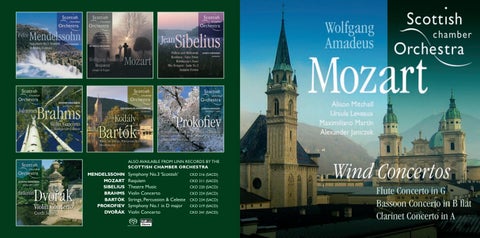
ALSO AVAILABLE FROM LINN RECORDS BY THE SCOTTISH CHAMBER ORCHESTRA
MENDELSSOHN MOZART SIBELIUS BRAHMS BARTÓK PROKOFIEV ˇ ÁK DVOR
Symphony No.3 ‘Scottish’ Requiem Theatre Music Violin Concerto Strings, Percussion & Celeste Symphony No.1 in D major Violin Concerto
CKD 216 (SACD) CKD 211 (SACD) CKD 220 (SACD) CKD 224 (SACD) CKD 234 (SACD) CKD 219 (SACD) CKD 241 (SACD)
Wolfgang Amadeus Mozart Wind Concertos
Flute Concerto in G (K.313) 1. 2. 3.
Allegro maestoso 9.11 Adagio non troppo 9.22 Rondo: Tempo di menuetto 7.34
Bassoon Concerto in B flat (K.191) 4. 5. 6.
Allegro 7.06 Andante ma adagio 6.47 Rondo: Tempo di menuetto 4.21
Clarinet Concerto in A (K.622) 7. 8. 9.
Allegro 12.03 Adagio 7.29 Rondo: Allegro 8.14 Recorded at the Usher Hall, Edinburgh, 5-7 June 2005 Produced by Tim Oldham Engineered by Philip Hobbs Post-production by Julia Thomas at Finesplice, UK Cover photo Churches of Salzburg by Martin Röse Photo of SCO by Jeremy Hardie
2
MOZART CONCERTOS
Mozart composed concertante works for all the common orchestral instruments, except trombone and double bass (concertos for trumpet K.47c and cello K.206a, have been lost). It’s fairly certain that all of them were written with a particular performer in mind, and it’s clear he had an exceptional facility for inventing music to suit the characteristics of player and instrument. Four arrangements made in 1767 for his own use, of movements from keyboard sonatas by various composers, mark his earliest essays in concerto form; these were followed by three similar arrangements, of sonatas by J.C. Bach, in 1772. His first surviving original concerto (K.207 for violin) was composed in April 1773; then came the Piano Concerto in D K.175 (December 1773), the Concertone in C for two violins and orchestra (May 1774) and the Bassoon Concerto (June 1774). By this time, Mozart, aged eighteen, was an experienced, accomplished composer with about thirty symphonies, a dozen string quartets and several Italian operas to his credit. It was the arias in his opere serie, perhaps, with their alternation of orchestral and solo sections, their accommodation of bravura passage work and their succession of motifs conveying 3
different shades of emotion, which provided the closest models at the start of Mozart’s career as a writer of concertos. The main theme in the Bassoon Concerto’s first movement, heard at the start and repeated by the solo on its first entry, centres on the bassoon’s most vocal tenor register, but with an initial motif of a bold descent through two octaves designed to demonstrate the instrument’s wide range. This theme, in the Concerto’s opening bars, also brings into striking prominence the orchestra’s high-pitched B flat horns. The opening tutti already shows Mozart’s knack of presenting an extended series of contrasting ideas in such a way that the succession has the naturalness and spontaneity of a lively conversation. The end of the tutti is signalled by an emphatic unison rising scale used as punctuation throughout the movement. In the middle section, where it appears most frequently, Mozart cleverly shortens this idea by degrees so its appearance is never predictable. Another idea, which serves as second subject, is first heard as a single violin line with accompaniment. Instead of repeating this the bassoon adds a counterpoint, only playing the original theme when it returns for a final time, when the violins play the counterpoint. The Andante ma adagio (the unusual indication means “moving, but slowly”) takes the form of an aria, its soft, sensuous mood enhanced by the colour of muted strings. Again the solo melodies concentrate on the bassoon’s plangent tenor register; occasional lower notes act as a dramatic reinforcement of the bass line, with a particularly memorable passage in which a series of these bass notes leads down to the bassoon’s very lowest pitch. In an era when many concerto slow movements were accompanied by strings alone, Mozart characteristically gives prominence to the oboes, not just in the tutti sections but accompanying and in dialogue with the soloist. In his earlier concertos, Mozart often favoured finales in Minuet tempo (the last example is in the Piano Concerto K.413 of 1782). The Bassoon Concerto’s Rondo begins with what sounds like a complete minuet played by the orchestra, and when the bassoon 4
enters it’s with the beginning of a variation soon, however, branching off into new ideas. Two further episodes, separated by shortened repeats of the orchestral minuet, are heard before the soloist gets a chance to play this main theme. It’s a crucial moment, preceded by a pause and a short cadenza, and gives the movement an extra dimension. It’s not known for whom Mozart wrote his Bassoon Concerto, but the genesis of the Flute Concerto K.313, is well documented in the family correspondence. On his arrival in Mannheim in October 1777, Mozart had quickly made friends with the flute virtuoso Johann Baptist Wendling (1723-97), who introduced him to a wealthy amateur, Ferdinand Dejean, a surgeon with the Dutch East India Company. Dejean commissioned Mozart to write “three small, easy and short concertos and several quartets for the flute”. The results of this commission are the K.313 Concerto, the D major Concerto K.314 (an arrangement of the C major Oboe Concerto he’d written some months earlier) and one, possibly two quartets for flute and strings. Mozart famously expressed his dissatisfaction with the flute as a solo instrument – “Whenever I have to write music for an instrument I dislike, I immediately lose interest” – but one would never guess this from the K.313 Concerto, the Quartet K.285 or the Andante (K.315), which he probably composed to please Dejean as a simpler alternative to K.313’s elaborate Adagio. The Concerto’s opening Allegro maestoso, with pointed, march-like rhythms, has a character that balances vivacity and stateliness. The first tutti is compact – just thirty bars – but this is the only concession to the requirement for a “small, short concerto”; these opening ideas are expanded by flute and orchestra to generous proportions. Indeed, the majestic style of the movement suggests that maybe Mozart had in mind the playing of the experienced professional, Wendling, rather than the amateur, Dejean. The enchanted atmosphere of the Adagio recalls the mood and sonorities of the slow movement of the G major Violin Concerto of 1775 (K.216); both pieces are in D major, with muted strings and flutes instead of oboes in the orchestra’s wind section. 5
And in both movements the soloist projects a calm cantilena above an accompaniment that’s full of movement, and both feature a final return by the soloist after the cadenza to the opening melody. The solemn rising unison at the start, however, comes as a preecho of the great Adagio in the Gran Partita (K.361) for wind instruments. The finale, another rondo in minuet tempo, brings the soloist in at the outset, contrasting the lightly accompanied solo statement of the theme with the sonorous orchestral version that follows. This same sequence recurs whenever the theme is repeated, but each time the flute finds a new way of ornamenting the melody, the decorations then repeated by the orchestra. In between, the episodes feature several brilliant solo passages, but Mozart is never content for long to leave the orchestra just to provide an accompaniment, delighting in bringing it forward to share in lively dialogue with the soloist. In the 1770s, as we’ve seen, Mozart wrote concertos for a number of different instruments, but in the next decade we find him focussed more narrowly on his career as pianist/composer; the horn concertos written for Joseph Leutgeb are the only nonkeyboard ones from the 1780s. In 1791, however, he turned to an instrument for which he had not previously written a concerto. For his friend, the court clarinettist Anton Stadler, he had already written two magnificent chamber works – the Trio with piano and viola K.498 and the Quintet K.581 – plus unfinished drafts for two other quintets, and, of course, remarkable clarinet parts in operatic and orchestral music (where the two clarinettists would have been Stadler and his brother Johann). The Clarinet Concerto was not composed for a standard clarinet in A but for an instrument Stadler had developed, extending the instrument’s lower range by four notes. The autograph score has not survived and, when the Concerto was first published after Mozart’s death, the solo part was adapted to suit an ordinary clarinet. For this performance, Maximiliano Martín plays a clarinet with the usual range, but has adapted the text of the first edition to make the best use of the clarinet’s lowest register. 6
In the thirteen years since the Flute Concerto, Mozart’s style had changed considerably. Instead of the slightly formal air of the earlier work’s opening, the Clarinet Concerto starts quietly and without seeking any dramatic effect. The music’s atmosphere is more romantic, with an increased range of modulations and chromatic harmonies. Interestingly it’s the solo clarinet that introduces this aspect of the music, shortly after its first entry – the opening tutti remains firmly in A major. In doing this, Mozart shows great confidence in Stadler’s ability to perform the elaborate cross fingerings needed on an eighteenth-century clarinet for notes outside the home key. These excursions add an element of shadow and of melancholy to the bright A major chords that define the Concerto’s dominant mood. Indeed, the whole work can be seen as an essay in light and shade: in the solo part, between the bright upper register and the dark lower notes, with the two often opposing one another in dramatic fashion. Then there’s the contrast between the full, mellifluous orchestral sound and the intimate effect of many delicately scored passages for clarinet with upper strings, like the opening of the rondo finale. The characteristic sound of this concerto relates to its unusual orchestration, with pairs of flutes, bassoons and horns added to the strings – Mozart clearly didn’t want to oppose the clarinet’s sound to the more incisive tone of the oboe. The most glorious orchestral moments come in the Adagio where the clarinet’s statements of the hymn-like theme are taken up by the orchestra, which plays the role of a chorus inspired by a solo singer. This Adagio’s simplicity of design, with regular phrase lengths that are only broken once or twice by the soloist, to avoid monotony and for expressive effect, contrasts with the elaborate, typically Mozartean play of different motifs in the outer movements. Mozart completed his Clarinet Concerto on about October 8th, 1791. Stadler was to give the first performance in Prague on 16th October – the score would have to be sent there and parts made, so he was only just in time. Between then and 20th November, after which his fatal illness prevented further work, Mozart composed the Little Masonic 7
Cantata (K.623) and as much of the Requiem as he was able to complete. He must have been very keen to start work on the Requiem, commissioned with a generous fee, but we can be grateful he took the time to finish this wonderful concerto for his friend. © Duncan Druce, 2006
SCOTTISH CHAMBER ORCHESTRA
Conductor Laureate Sir Charles Mackerras Conductor Emeritus Joseph Swensen Managing Director Roy McEwan
4 Royal Terrace, Edinburgh EH7 5AB tel: 0131 557 6800 fax: 0131 557 6933 e-mail: info@sco.org.uk web: www.sco.org.uk
The Scottish Chamber Orchestra is internationally recognised as one of the world’s foremost orchestras of its size and for its innovative approach to music-making and programme planning. Formed in 1974 with a commitment to serve the Scottish community, it is also one of the country’s major cultural ambassadors. The Orchestra performs throughout Scotland, including an annual tour of the Highlands and Islands, and appears regularly at the Edinburgh, St Magnus and Aldeburgh Festivals and the BBC Proms. Its busy international schedule has recently included Belgium, Germany, Austria, Switzerland, Spain, the USA, Portugal and The Netherlands. Following nine successful years as the SCO’s Principal Conductor, Joseph Swensen became the Orchestra’s first Conductor Emeritus in 2005. He and the SCO have built a reputation for exuberant and dynamic performances and, with Swensen as soloist, have performed – and recorded – a number of the great violin concertos together. 8
The SCO enjoys a close relationship with Conductor Laureate Sir Charles Mackerras, which has resulted in many successful recordings including a Grammynominated set of Brahms’ symphonies, seven Mozart operas, Beethoven’s Fidelio, symphonies by Schubert, Brahms’ serenades, four CDs of Mozart Piano Concertos with Alfred Brendel and, on Linn Records, Mozart’s Requiem and a disc of Kodály and Bartók. The Orchestra has worked closely with many leading composers, including Composer Laureate Sir Peter Maxwell Davies, Mark-Anthony Turnage, Lyell Cresswell and James MacMillan. The SCO also collaborated with the Swedish Chamber Orchestra in a four-year programme of joint commissions from Sally Beamish and Karin Rehnqvist. The SCO has led the way in the development of music education, with a unique programme of projects, providing workshops for children and adults across Scotland. This CD is the eighth in a series of recordings which the SCO is producing in partnership with Linn Records, and the first of two Mozart discs directed by Alexander Janiczek, a former Leader and regular Guest Director with the Orchestra. 1st VIOLIN
2nd VIOLIN
VIOLA
’CELLO BASS FLUTE OBOE CLARINET BASSOON HORN
Alexander Janiczek, Ruth Crouch, Lise Aferiat, Elin Edwards, Lorna McLaren, Cheryl Crockett, Joanne Green, Catherine James Claire Sterling, Liza Webb, Rosemary Ellison, Robert McFall, Niamh Lyons, Roddy Long Catherine Marwood, Simon Rawson, Brian Schiele (Flute Concerto only), Steve King, Rebecca Wexler, Kathryn Jourdan (Clarinet Concerto only) Su-a Lee, Alison Lawrance, John Davidson, Donald Gillan Anthony Alcock, Adrian Bornet Alison Mitchell, Elisabeth Dooner, Janet Larsson Robin Williams, Virginia Shaw Maximiliano Martín, Ruth Ellis Ursula Leveaux, Alison Green Robert Cook, Harry Johnstone 9
Alexander Janiczek director Alexander Janiczek, highly sought after as a director, soloist, guest leader and chamber musician, was born in Salzburg into a musical family of Polish and Czech descent. He began his violin studies at the age of four and went on to study with Helmuth Zehetmair at the Salzburg Mozarteum. He also participated in masterclasses with Max Rostal, Nathan Milstein, Ruggiero Ricci and Dorothy Delay. He first came to public attention when he won first prize in the National Competition of Austria at the age of nine and appeared soon after as soloist with conductors such as Jiri Belohlávek, Michael Gielen, Hans Graf and Manfred Honeck. He has since appeared as soloist with renowned artists such as Sir Roger Norrington, Murray Perahia, Trevor Pinnock, Yuri Bashmet, Andrew Litton, Ton Koopman and James MacMillan. From the age of twenty a close association with Sándor Végh and the Camerata Salzburg led to extensive tours as leader, director and soloist to most of the major festivals across Europe and the Americas. Recordings released at that time include the Haydn Sinfonia Concertante and Mozart’s G Major Concerto - played on Sándor Végh’s famous Paganini Stradivarius. Alexander Janiczek established a close relationship with the Scottish Chamber Orchestra as its leader from 1999-2002 and has since been invited back as director on numerous tours throughout Scotland and Europe. He has also been a regular guest leader/ director with the Chamber Orchestra of Europe with whom he has toured extensively throughout Europe and the Far East. Apart from guest leading many major symphony orchestras, Alexander Janiczek is a dedicated chamber musician and has appeared with artists such as Steven Isserlis, 10
Boris Pergamenschikow, Joshua Bell, Till Fellner, Thomas Adés and Christian Zacharias. In 2005 he was invited by Mitsuko Uchida and Richard Goode to tutor at the Marlboro Music Festival. Alexander Janiczek plays the “Baron Oppenheim” Stradivarius from 1716, which is on loan to him from the National Bank of Austria.
Alison Mitchell flute Originally from Melbourne, Alison Mitchell was appointed Principal Flute of the Scottish Chamber Orchestra in 2003. Since leaving Australia to continue her studies in Basle with the renowned Swiss flautist, Peter-Lukas Graf, she has maintained a very successful professional career between Europe and Australia playing with many major orchestras on both continents. Shortly after arriving in the UK, Alison was appointed to the position of Principal Flute with the Orchestra of Scottish Opera with whom she performed for five years before embarking on a freelance career dedicated to solo and chamber music performances. From there, an opportunity arose for her to return to Australia to take up the position of Associate Principal Flute with the Sydney Symphony. During a seven year period with the Symphony, Alison also regularly performed as guest principal flute with the highly regarded Australian Chamber Orchestra and pursued a varied mix of chamber music, recordings, broadcasts for the ABC and solo recitals. Since her return to Scotland as Principal Flute with the Scottish Chamber Orchestra, Alison has performed regularly with SCO chamber ensembles and as a concerto soloist. Her performances have included Mozart’s Concertos in G and D, the 11
Poulenc Sonata (orch. Berkeley), Concerto for Flute (1980) by Nigel Osborne and Bach’s Brandenburg Concerto No.4. As well as her work in Scotland, Alison has a continuing relationship with the Australian Chamber Orchestra and in 2005 she joined with Angela Hewitt and the ACO to produce recordings and performances throughout Australia of Bach’s Brandenburg Concerto No.5 and the Triple Concerto for flute, violin and piano. The recording was subsequently a Gramophone Editor’s Choice. Alongside her busy SCO schedule Alison performs regularly as a soloist and chamber musician. She is also a lecturer in Flute at the Royal Scottish Academy of Music and Drama.
Ursula Leveaux bassoon Ursula Leveaux, a former pupil at Chetham’s School of Music, furthered her studies with Martin Gatt in London, Brian Pollard in Amsterdam and also studied Baroque bassoon with Danny Bond in The Hague. Whilst still a student in London she was the winner the Shell-London Symphony Orchestra Scholarship and also became a member of the European Union Youth Orchestra working with conductors such as Claudio Abbado, Herbert von Karajan, Leonard Bernstein and Georg Solti. In 1987 she returned from the Netherlands to join the SCO as Principal Bassoon. As well as her work in Scotland, Ursula is frequently asked to appear as guest principal with major orchestras in Britain and throughout Europe. She is also in demand as a performer on Baroque and Classical Bassoon playing regularly for John Eliot Gardiner, including taking part in his Bach Cantata Pilgrimage in 2000. In 2005 she appeared at the Proms with Andrew Manze and The English Concert. 12
A busy chamber musician, Ursula is a member of the Nash Ensemble of London and the Hebrides Ensemble in Scotland. She is a regular participant at the prestigious Marlboro Music Festival in the USA. As well as regular appearances with the SCO, Ursula’s solo work has included concertos with the London Symphony Orchestra, Royal Liverpool Philharmonic Orchestra, BBC Scottish Symphony Orchestra and, most recently, at the 2005 Mostly Mozart Festival at the Barbican with the Academy of St Martinin-the-Fields. A regular contributor to Radio 3, Ursula’s CD recordings include the complete chamber music of Poulenc and of Saint-Saëns, Beethoven Septet and Schubert Octet, all with the Nash Ensemble. She can also be heard on the complete recording of Chabrier Songs with Dame Felicity Lott and Graham Johnson. With the SCO she has recorded the Vivaldi Bassoon Concerto in D minor, Sir Peter Maxwell Davies’ Bassoon Concerto, Strathclyde Concerto No.8 which was written especially for her.
Maximiliano Martín clarinet Young Spanish clarinettist Maximiliano Martín is rapidly establishing himself as one of the most talented and charismatic musicians of his generation. After being appointed Principal Clarinet for the Scottish Chamber Orchestra and winning the Young Artists Platform 2002, he has since made debuts at the Wigmore Hall London, Queen’s Hall Edinburgh, Glasgow Royal Concert Hall, St George’s Bristol, Turner Sims Concert Hall Southampton, Brighton and Newbury Festivals and overseas at the Tallin, Bucharest, Torreilles (France) and Tenerife Festivals. He has consistently received exceptional reviews: He has 13
poetry in his soul… a recital filled with warmth and perception, backed up with conspicuous technical accomplishment. The Herald. Born in Tenerife, Martín studied in Barcelona with Joan Enric Lluna and at the Royal College of Music in London with Robert Hill and Richard Hosford, where he held the prestigious Wilkins-Mackerras Scholarship, graduated with Distinction and received the Frederick Thurston Prize and Golden Jubilee Prize for his contribution to college life. As a soloist Martín has performed with the Scottish Chamber Orchestra, European Union Chamber Orchestra, Orquesta Sinfonica de Tenerife and Macedonian Philharmonic under eminent conductors such as Antonini, Swensen, McGegan, Canev and Halfter. As a chamber musician he has performed with the London Winds, Concord Ensemble, Hebrides Ensemble and collaborated with renowned artists including Michael Collins, Alexander Janiczek, Artur Pizarro and Christian Zacharias. As a guest principal clarinettist he has performed with the London Symphony Orchestra, Chamber Orchestra of Europe, Orquesta de Cadaques, Bergen Philharmonic, Munich Kammerorkester, Orquesta Sinfonica de Galicia under the baton of Abbado, Haitink, Colin Davis, Mackerras, Berglund, Lopez Cobos, Krivine and Litton. He has been member of the National Youth Orchestra of Spain and the Gustav Mahler Jugendorchester. His debut recital CD with Spanish pianist Javier Negrin will be released on Linn Records in 2006. Martín is also active in the education field – he currently teaches at the Royal Scottish Academy of Music and Drama and regularly gives masterclasses in Spain.
Linn is an independent precision engineering company specialising in top quality audio and video reproduction. Founded by Ivor Tiefenbrun, MBE in Glasgow, Scotland in 1972, the company grew out of Ivor’s love of music and the belief that he could vastly improve the sound quality of his own hi-fi system. Now a global brand employing over 350 people, Linn is unremittingly committed to manufacturing products for applications where sound quality matters. Linn strives to thrill customers who want the most out of life with demonstrably higher fidelity complete audio and video entertainment solutions. Our standards also ensure that even the most affordable Linn system can communicate the sheer thrill and emotion of the performance. Linn has earned a unique reputation in the world of specialist hi-fi and multichannel sound recording and reproduction. The company can now satisfy the demanding requirement of any discriminating customer who cares about sound quality, longevity and reliability. Visit www.linn.co.uk for more information and to find your nearest Linn dealer. LINN PRODUCTS LTD, FLOORS ROAD, WATERFOOT, GLASGOW G76 0EP t: +44 (0)141 307 7777 f: +44 (0)141 644 4262 e: helpline@linn.co.uk
@
www.linnrecords.com
discover the world of linn records Linn Records, Glasgow Road, Waterfoot, Glasgow G76 0EQ, UK t: +44 (0)141 303 5027/9 f: +44 (0)141 303 5007 e: info@linnrecords.co.uk 14
15