MENU
—
TRACKLIST ENGLISH FRANÇAIS DEUTSCH LYRICS
P. 4 P. 7 P. 16 P. 25 P. 36
2
This recording has been made with the support of the Fédération Wallonie-Bruxelles (Direction générale de la Culture, Service de la Musique)
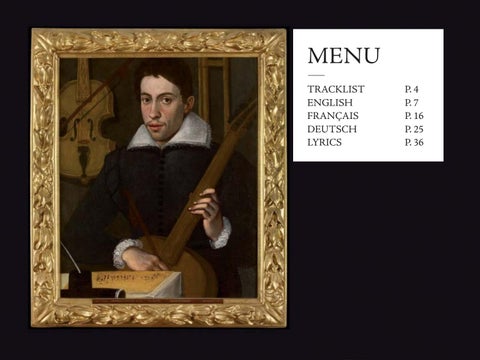
Recording: église Notre-Dame de Centeilles, October 2016 Artistic direction, recording & editing: Jérôme Lejeune Cover: Cremonese Artist, Portrait of a musician (Claudio Monteverdi?) c. 1570-1590 © Ashmolean Museum, University of Oxford
CLAUDIO MONTEVERDI SALOMONE ROSSI BALLETTI & SONATE 3
—
CLEMATIS Stéphanie de Failly, Juliette Roumailhac: violin Samantha Montgomery, Catherine Plattner, Kenny Fereira(2-6): viola Cyril Poulet: violoncello Jérôme Huille: violoncello(1) & lirone Quito Gato, Bernard Zonderman: theorbo & guitar Stephane Fuget: organ & harpsichord Ayumi Nakagawa: organ(1, 2) with the participation of Zachary Wilder: tenor
3'18
Salomone Rossi (1570-1630) 2. Sinfonia grave a 5(2) 3. Gagliarda a 5 detta la Norsina(2) 4. Passeggio d’un balletto a 5(2) 5. Gagliarda a 5 detta la Massara(2) 6. Sinfonia a 5(2)
2'16 1'31 1'02 1'38 2'07
Claudio Monteverdi (1567-1643) 7. Tempro la cetra(3)
8'21
Salomone Rossi 8. Sinfonia prima(5) 9. Sonata dudodecima sopra la Bergamasca(4)
3'02 2'15
Salomone Rossi 10. Tirsi mio, caro Tirsi(6) 11. Sinfonia undecima [in echo](2) 12. Anima del cor mio(6) 13. Corrente terza(5) 14. Brando primo(5)
2'43 1'10 2'08 1'35 1'39
Claudio Monteverdi 15. Il Ballo delle Ingrate (Ballo)(7)
6'03
4
Lodovico Viadana (1560-1627) 1. Canzon francese [in riposta](1)
3'45
Biagio Marini (1594-1663) 17. Sonata sopra Fuggi, fuggi dolente core(9)
2'40
Giuseppino del Bialo (fl. 1600) 18. Fuggi, fuggi da questo cielo
1'51
Gasparo Zanetti (c. 1600-1660) 19. La Mantovana(10)
2'26
Claudio Monteverdi(8) I balli e sinfonie d’Orfeo 20. Ritornello del Prologo 21. Sinfonia Atto secondo & Aria Ecco pur ch’à voi ritorno 22. Ritornello 23. Ritornello [Gagliarda] & Aria Vi ricorda o bosch’ombrosi 24. Sinfonia [chromatica] 25. Aria con ritornelli Qual honor di te 26. Moresca
0'43 0'58 0'33 2'10 1'23 1'12 1'05
Salomone Rossi 27. Sonata in Dialogo detta la Vienna(5)
3'56
5
Salomone Rossi 16. Sonata prima(4)
(1) Cento Concerto ecclesistici, Milano, 1605 (2) Il primo libro delle sinfonie et gagliarde a tre, quator e cinque voci, Venezia, 1607 (3) Settimo libro de madrigali, Venezia, 1619 (4) Il quarto libro de varie sonate, gagliarde, brandi e corrente, Venezia, 1642 (5) Il terzo libro de varie sonate, sinfonie, gagliarde, brandi e corrente, Venezia, 1623 (6) Il primo libro de Madrigali... con alcuni di detti Madrigali per cantar nel Chittarone, Venezia, 1600 (7) Madrigali guerrieri ed amorosi, Venezia, 1638 (8) L'Orfeo, Venezia, 1610 (9) Balletti, sarabande, correnti, sinfonie, sonate op. 22, Venezia, 1655 (10) Il Scolaro... per imparar a suanore di violini et altri stromenti, Milano, 1645 (1) Cento Concerto ecclesistici, Milano, 1605 (2) Il primo libro delle sinfonie et gagliarde a tre, quator e cinque voci, Venezia, 1607 (3) Settimo libro de madrigali, Venezia, 1619 (4) Il quarto libro de varie sonate, gagliarde, brandi e corrente, Venezia, 1642 (5) Il terzo libro de varie sonate, sinfonie, gagliarde, brandi e corrente, Venezia, 1623 (6) Il primo libro de Madrigali... con alcuni di detti Madrigali per cantar nel Chittarone, Venezia, 1600 (7) Madrigali guerrieri ed amorosi, Venezia, 1638 (8) L'Orfeo, Venezia, 1610 (9) Balletti, sarabande, correnti, sinfonie, sonate op. 22, Venezia, 1655 (10) Il Scolaro... per imparar a suanore di violini et altri stromenti, Milano, 1645
6

DE LYRICS MENU FR
At the end of the 17th century many Italian courts possessed a body of musicians whose function was to provide musical spectacles and concerts as required; many of them were also composers as well as singers or instrumentalists. They also often enjoyed excellent working conditions; this undoubtedly helped to ensure their fidelity to their employers, for these were ruling princes who felt very strongly about the quality of their musical establishments. Amongst the Northern Italian courts, the court of the Este family in Ferrara, the court of the Medici in Florence — although Florence was not considered part of the North at this time — and the court of the Gonzagas in Mantua rivalled each other in the splendour and prestige of their musical establishments. All three courts saw performances of innovatory works that anticipated the invention of opera as such; the greatest of these was of course the first performance of Monteverdi’s Orfeo in Mantua on 24 February 1607. The young Claudio Monteverdi — 23 years old — was engaged as a player of the “viuola” at the court of Mantua in 1590. He already had a solid training behind him and soon demonstrated his talent for composition in publications of various sacred and secular works: Sacrae cantiunculae (1582), Madrigali spirituali (1583), Canzonette a 3 voci (1584) and a Primo Libro de Madrigali (1587). A Secondo Libro de Madrigali was published in 1590, the year of his arrival in Mantua: its dedication to an important Milanese citizen confirms that it was published before his arrival in Mantua. His Terzo libro (1592), however, would be dedicated to Vincenzo Gonzaga. The majority of his later works were dedicated to Marc’Antonio Ingegneri (1535-1592) of Cremona; Monteverdi took great pride in having been his pupil.
7
UN CONCERTO A MANTOVA
8
Claudio Monteverdi was himself born in Cremona in 1567. The mere mention of the town brings violins and violin-making to mind; the capitals of violin-making at that time were Cremona and Brescia, where Gasparo da Salò (1542-1609) and later Giovanni Paolo Maggini (1581-1632) had been active. Fifty kilometres from Brescia, Andrea Amati (1505-1577) had founded a dynasty of luthiers in Cremona. It goes without saying that Monteverdi had witnessed the skills of these craftsmen and their unceasing work as they transformed the violin into the instrument that would come to occupy such an important position in the musical life of the time. These luthiers still continued to make violas da gamba nonetheless; it is therefore not surprising that the young Monteverdi was required to learn to play these instruments as well. It is highly possible that he was in search of employment as an instrumentalist during his time in Milan in 1589; several player/composers lived in Milan at that time who could well have served the young musician as models or even as possible teachers. The maestro di cappella Giovanni Battista Bovicelli wrote a definitive guide to the art of diminution (Regole, passaggi di musica); although the violist Francesco Rognoni was born in Milan, he was not resident in the city at that time: it is more likely that his reputation was already wellestablished there, for he was naturally not the only skilled player of the viola da gamba in the Lombard capital during that period. The above notwithstanding, Monteverdi arrived to take up a position as violist at the court of Mantua in 1590. He did not forget to mention this in the dedication of the Terzo Libro that he addressed to the duke of Mantua, describing ‘the truly noble art of playing the viol’ as well as expressing the hope that his patron would place the same trust in his compositions as he had so kindly done in his playing of the viol. One other piece of evidence depicts the young Monteverdi’s profession: the painting that we have used for the cover of this recording. Executed by an artist of Cremona towards the end of the 16th century, it represents a young musician holding a viola
9
da gamba. This individual has long been identified as Claudio Monteverdi, but this attribution is currently challenged. The duke possessed a large musical establishment that was led by the Flemish composer Giaches de Wert (1535-1596) when Monteverdi arrived at the Mantuan court. Monteverdi was therefore under his authority when he began his career in Mantua, before he later succeeded de Wert as court composer. The cappella was not composed totally of singers: there were also several instrumentalists, some of whom can be clearly identified. The most important of these was Salomone Rossi (1570?-c. 1630), who was of Jewish origin and who signed his collections of works as Salomone Rossi Hebreo; he spent his entire career at the court of Mantua. Although Rossi had composed canzonette and madrigals in Italian and a volume of sacred music in Hebrew (in the style of Catholic church music), he is principally remembered as a violinist and a composer of instrumental works. He may well have been responsible for the development of a school of violin playing, given the presence of several important violinists at the Mantuan court in the following generation. One of these was Carlo Farina, who is assumed to have been born in Mantua in 1600; he was most likely born earlier, given that he had entered the service of the Dresden court in 1625 and that his first volume of instrumental works was published in Dresden in 1626: his compositions reveal a truly individual musical character. Giovanni Battista Buonamente (1595-1642) was also born in Mantua and was also an important violin virtuoso. It is therefore highly likely that these two musicians were pupils of Salomone Rossi and, together with their teacher, they were a part of the instrumental group that accompanied the first performance of Monteverdi’s Orfeo in 1607. With regards to the viola da gamba, we know that the Mantuan court tried several times to obtain the services of the famous violist Orazio Bassani, known at the time also as Orazio della Viola. He was renowned for his improvisations of diminutions on
10
the viola bastarda, taking madrigals or motets as the basis of his improvisations. This technique was much practised by violists; the ornamentation that they employed were not based on the melodic line of the work but rather extended over every line of the polyphonic structure. Could Bassani actually have spent time at the court of Mantua? Giulio Cesare Monteverdi, the brother of Claudio, wrote of Bassani in the preface to Monteverdi’s Scherzi musicali (1607) that he had to ‘concertar le due viole bastarde’; we could well imagine that this might be a reference to a meeting or even a competition between Orazio Bassani and Claudio Monteverdi. Of the organists and harpsichordists active in Mantua at the end of the 16th century, we should mention Ludovic da Viadana, the maestro di cappella of the cathedral there between 1594 and 1597. This was not a long time to hold such a position, but it is nevertheless unthinkable that Claudio Monteverdi would not have been interested in Viadana’s work, for Viadana had been the first to publish a volume of sacred music with accompaniments for continuo in 1602: the 100 concerti ecclesiastici for one to four instrumental parts and continuo. Viadana provides useful information on how the continuo is to be realised in his preface to the work, listing the instruments best suited to the realisation of the harmony and those better suited to ornamental passage work. The opening work on this recording, a Canzona in risposta in which two ensembles dialogue with each other, is taken from this volume. Each ensemble consists of a high-pitched and a lower instrument, both ensembles being supported by the continuo: a real musical joust.
Monteverdi and his instrumental works Whilst Monteverdi indisputably dominated and influenced every genre of sacred and secular vocal music of his time, we still know very little about his output of instrumental music, of which there is only a small amount in the catalogue of his works. We should,
11
however, not consider these works negatively; Monteverdi introduced instrumental sections into his vocal works on many occasions, whenever an instrumental contribution was required as an accompaniment, for ballets and for ritornelli. It is clear that one of the most original aspects of the score of Orfeo is the quantity of instrumental music; it is not an accessory to the vocal parts, but is instead closely associated to the structure of the work as a whole: we see this in the opening Toccata that accompanies the entry of the duke and his court before the performance proper, in the balletti and especially in the ritornelli and sinfonie, all of which were composed with a precise dramatic function in mind. Such instrumental parts could have of course existed in the spectacles organised in the courts of Florence, Ferrara and Mantua from the end of the 16th century onwards, but if they did, then hardly any of them have survived. Their absence in the scores of Peri’s and Caccini’s first operas leads us to believe that, if they had indeed existed, they were added at the moment that the operas were performed. As for the instrumental works that Monteverdi introduced into his vocal works, the listener is immediately struck by their exceptional quality, which is almost insultingly superior to that of much music being written by his colleagues and his contemporaries. The suite of dances from Orfeo are a fine example of Monteverdi’s supremacy in the field, from the Ritornello that links the Prologue to Act 1, that marks the changes of scene between Act 2 and Act 3, and appears once more between Act 4 and Act 5. Although Orpheus is of course a singer — he not only wins over the Infernal Deities with his singing but also expresses his love, his pain, his worry, his joy and his despair in song — but he is also a dancer. His arias make frequent use of dance rhythms, two examples being his aria Vi ricordi in Act 2 — a galliard — and his Qual honor in Act 4, in which he gives voice to irresistible joy on learning that Eurydice will be returned to him, although on certain conditions. The viole da brazzo accompany these passages and also provide superb instrumental couplets, in five parts for the Act 2 aria and in three parts for Act 4.
12
What should we say about the intense G minor sinfonia with its painful chromaticisms that concludes the scene in which the Messaggiera announces the death of Eurydice? Her account is followed by the reaction of the shepherds, Orpheus’ farewell to the earth, the sky and the sun, and his decision to seek out Eurydice in the realm of the dead. Monteverdi knows only too well that both the characters and the audience are frozen with horror and riven with sorrow; who would be able to sing in such circumstances? The instruments alone can still speak; their music takes the lead and expresses what tearchoked voices can no longer utter. The following year, in 1608, Monteverdi supplied the duke of Mantua with a completely different type of performance: a ballet, the Ballo delle ingrate. This was published as the final work of his 8th book of madrigals in 1638, the Canti amorosi. Music for dancing plays a principal role in this score; it is also true that its moralising argument is rather misogynist, presenting the ungrateful women with are allowed to leave the Infernal Regions for a moment. Their dance expresses their eternal remorse. The score states that the ballet is to be performed with cinque viole da brazzo (from the violin family) and that the number of instruments can be doubled according to the size of the space in which the performance is being given. Some ten years after the composition of the Ballo delle ingrate, Monteverdi, now maestro di cappella at St. Mark’s in Venice, published his 7th book of madrigals in 1619. These works formed a completely new genre and allotted an important place for solo voices and duets. It opens with a real prologue, Tempro la cetra: “I tune my lyre to sing in Mars’ honour”. This madrigal a voce sola is preceded by an instrumental ritornello; a shorter version of it is later used as a refrain between the verses. A ballo in three sections concludes this opening work of the 7th Book. The five-part writing that gave Orfeo and the Ballo delle ingrate their fine fullness is used again here. Given the perfection of these scores, we can only regret that Monteverdi has not
Salomone Rossi Of all the violinists at the Mantuan court, we have chosen works by Salomone Rossi, given that the editions of his works that have survived were mostly published during Monteverdi’s time in Mantua. Rossi left four volumes of instrumental music that were published in 1607 (the year of Orfeo), 1608 (the year of the Ballo delle ingrate), 1623 and 1642. Although the first two volumes only contain Sinfonie and Gagliarde in 3 and 5 parts, Rossi’s style is finally relatively homogenous between the four volumes; the two later volumes, however, also contain various Sonatas alongside the Sinfonie and other dances. We have chosen a few of the sonatas for inclusion here. The pieces in 5 parts from the 1607 volume are strikingly similar in style to Orfeo. To give one example, the brief piece termed a Passeggio d’un balletto is actually made up from a succession of short musical cells transposed into different keys; this form is comparable in structure to Monteverdi’s Ritornello in Orfeo. We can imagine that this
13
left us a greater number of instrumental works. It is more than likely that the reason for this, both in Mantua and in Venice, was that he had fine player/composers available whom he considered perfectly capable of providing such pieces; these included Salomone Rossi in Mantua as well as Biagio Marini and Dario Castello in Venice. Nonetheless, when Monteverdi published the Vespro della beata Vergine in 1610, it seems clear that he wanted to display his perfect mastery of every ancient and modern genre; he now provided a “Sonata” for the first and only time in his career. Based on the Gregorian chant for Sancta Maria ora pro nobis, this Sonata unfolds in sumptuous fashion with a group of instruments used in a highly original fashion: 2 violins, 2 cornetts, 3 trombones and continuo. The piece is modern, brilliant, uses spatial techniques, is full of invention and is far beyond comparison with similar works by his contemporaries. It is as if Monteverdi wanted to say “Now you can see that I can do this too — and far better than the others!”
14
piece could be used in many different ways, generally as a form of transition between contrasting dances; it would also have been repeated as many times as necessary whilst the dancers got themselves ready for the following ballo. Monteverdi himself suggested such an organisation of the music in the short introduction of his Ballo delle ingrate. The greater part of Rossi’s compositions was intended for two upper parts and continuo. We have here given several examples of his dances, sinfonie and sonatas. We have also provided a corollary to the suite of extracts from Orfeo with a small group of Rossi’s vocal and instrumental works. The two madrigals a voce sola are taken from his Primo Libro de Madrigali a cinque voci (1600). This volume is unusual not only in that it makes use of a continuo line but also in that is provides a number of these madrigals in versions for solo voice accompanied by the chitarrone. The Sinfonia prima and the three ballets are taken from the Terzo libro (1623). We have chosen three highly individual examples of the sonatas. Published in 1642, the Sonata prima seems to be rather old-fashioned, given that it was composed at a time when the genre had already undergone considerable development in Venice and elsewhere. This also confirms the idea that either Rossi’s style did not evolve with time or that these later publications were made up of works composed at a much earlier time. This sonata begins with a long slow section in duple time and ends with two shorter sections, the first in triple time and the second in duple time and in a faster tempo. As will also be the case for many volumes of instrumental music composed during the first half of the 17th century, Rossi’s sonatas are often presented in the form of variations on ostinato basses such as Ruggiero, Romanesca and Bergamasca or on melodies such as the famous Monica. We have here chosen to include the irresistible Bergamasca, preceding it with the Sinfonia undecima of the Libro primo (1607); the echo effects that it employs remind us that this technique was common at the time and that Monteverdi also made use of it.
It is of course impossible to contemplate a concert in Mantua without being reminded of the ancient song that is so closely linked to the city. This originated as a song of the people and was hugely popular during Rossi’s lifetime and long afterwards – to the point that we might well wonder why none of Rossi’s surviving works make use of the melody. The version of the song we include here is taken from a manuscript bearing the signature of one Giuseppino del Biabo. Several instrumental works include its name in their titles, such as the Sonata a 3 per due violine e basso sopra Fuggi, fuggi dolente core that Biagio Marini published in his Libro Terzo (Opera XXII) in 1655. Gaspare Zanetti had already offered another version of the song, then entitled La Mantovana, in a volume of dances for four parts, composed some ten years earlier in a style that had much in common with Renaissance dance music. It is with this melody that our journey around Mantua comes to its end: this journey began in the cathedral, then followed the musicians of the ducal court before now reaching its end with the lighter moods of a popular song of the time. JÉRÔME LEJEUNE TRANSLATION: PETER LOCKWOOD
DE LYRICS MENU FR
Il ballo di Mantova
15
One of Rossi’s most well-known sonatas is taken from the Terzo libro (1623). The Sonata in dialogo detta La Vienna is unique in Rossi’s output. Each violin twice presents a thematic element in turn; given the remarkable character of the two melodies, it is easy to imagine a type of dramatic dialogue. The two instruments unite in duet to bring the sonata to a close; the two parts cross, are mixed and answer each other as if in a love duet.
MENU EN DE LYRICS 16
UN CONCERT À MANTOUE En cette fin de XVIe siècle, de nombreuses cours italiennes disposent de musiciens affectés aux divertissements musicaux ; s’ils sont chanteurs ou instrumentistes, bon nombre d’entre eux sont également compositeurs. Ils bénéficient souvent d’excellentes conditions de travail, ce qui contribue certainement à assurer leur fidélité à ces princes très jaloux de leur renommée. Parmi les cours d’Italie du Nord – encore que Florence ne soit pas au nord –, les chapelles musicales de la cour d’Este à Ferrare, de celle des Médicis à Florence et enfin de celle des Gonzague à Mantoue rivalisent de prestige. Toutes trois ont vu naître bon nombre de nouveautés qui préludent à l’invention de l’opéra dont l’apothéose est, sans aucun doute, la représentation à Mantoue, le 24 février 1607, de l’Orfeo de Monteverdi. C’est en 1590 que Claudio Monteverdi – il a alors 23 ans – est engagé comme joueur de « viuola » à la cour de Mantoue. Ce jeune musicien a déjà derrière lui une solide formation et a fait la preuve de son talent de compositeur par diverses publications d’œuvres sacrées et profanes : Sacrae cantiunculae (1582), Madrigali spirituali (1583), Canzonette a 3 voci (1584) et un Primo Libro de Madrigali (1587). Un Secondo Libro de Madrigali est édité en 1590, l’année de son arrivée à Mantoue : la dédicace à un notable milanais confirme bien que cette édition est antérieure à son arrivée à Mantoue. Par contre, le Terzo Libro (1592) sera bien dédié à Vincent Gonzague. En ce qui concerne les publications antérieures, elles sont majoritairement dédiées à son professeur crémonais, Marc’Antonio Ingegneri (1535-1592), dont il se réclame fièrement le disciple. C’est effectivement à Crémone que Claudio Monteverdi naît en 1567. Lorsque l’on évoque cette ville, on pense immédiatement à la lutherie ; à cette époque, Crémone doit
17
partager le rôle de « capitale de la lutherie » avec Brescia, où Gasparo da Salò (15421609) puis Giovanni Paolo Maggini (1581-1632) sont actifs. À une cinquantaine de kilomètres de là, à Crémone, c’est Andrea Amati (1505-1577) qui fonde une véritable dynastie de luthiers. Il est certain que Monteverdi est le témoin de l’activité de ces artisans, de leur travail incessant pour faire du violon cet instrument qui s’imposera d’une façon si importante dans la vie musicale. Mais ces luthiers construisent aussi des violes de gambe et il n’est donc pas étonnant que le jeune Claudio s’initie également au jeu de ces instruments. Lors de son séjour à Milan en 1589, il est bien possible qu’il sollicite un emploi comme instrumentiste. À cette époque vivent à Milan plusieurs compositeursinstrumentistes qui pourraient bien être des modèles, voire des maîtres potentiels pour le jeune musicien. Le maître de chapelle Giovanni Battista Bovicelli est l’auteur d’un ouvrage capital sur l’art des diminutions (Regole, passaggi di musica, Milan, 1593). Bien que le violiste d’origine milanaise Franceso Rognoni ne se trouve pas dans sa ville natale à cette époque, il est probable que sa réputation y soit bien installée et qu’il y ait d’autres virtuoses de la viole de gambe dans la capitale lombarde. Quoi qu’il en soit, c’est bien comme violiste que Monteverdi arrive à la cour de Mantoue en 1590. Il ne manque pas de le rappeler dans la dédicace du Terzo Libro qu’il adresse au duc, évoquant « la fort noble pratique de la viole » mais aussi le fait qu’il espère que son patron lui accordera sa confiance pour son œuvre de compositeur ainsi qu’il l’a fait « avec bienveillance pour son talent dans le jeu de la viole ». Un autre témoignage met en lumière le métier d’instrumentiste de Claudio Monteverdi ; il s’agit du tableau qui illustre la couverture de cet enregistrement. Œuvre d’un artiste crémonais de la fin du XVIe siècle, cette peinture représente un jeune musicien tenant une viole de gambe. On l’a longtemps identifié comme étant Claudio Monteverdi, mais cette affirmation est aujourd’hui contestée. Lorsque Monteverdi arrive à la cour de Mantoue, le duc entretien une chapelle
18
musicale importante, dirigée alors par le Flamand Giaches de Wert (1535-1596). C’est donc à son service que Monteverdi entame sa carrière mantouane, avant de lui succéder au poste de compositeur de la cour. Outre des chanteurs, la musique de la cour possède aussi plusieurs instrumentistes, dont certains sont bien identifiés. C’est principalement le cas de Salomone Rossi (1570 ?-c. 1630), musicien d’origine juive – il signe ses recueils de « Salomone Rossi Hebreo » – actif durant toute sa carrière à la cour de Mantoue. Si Rossi est l’auteur de canzonette et de madrigaux en italien et d’un recueil de musique sacrée en hébreu (dans le style de la musique religieuse catholique !), c’est son activité de violoniste et de compositeur de musique instrumentale que l’histoire a principalement retenu. Est-il le fondateur d’une « école » ? C’est bien possible, ainsi que le laisse soupçonner la présence, à la génération suivante, de plusieurs violonistes importants à la cour de Mantoue. C’est le cas de Carlo Farina, dont on situe la date de naissance, à Mantoue, vers 1600 ; il est plus que probable que sa naissance soit antérieure à cette date, car c’est nanti d’une réelle personnalité qu’il édite à Dresde, en 1626, son premier recueil de pièces instrumentales. Depuis l’année précédente, il occupe un poste de violoniste à la cour saxonne. Giovanni Battista Buonamente (1595-1642), également natif de Mantoue, est aussi connu comme important virtuose du violon. Il est donc probable que ces deux musiciens sont les disciples de Salomone Rossi et participent, avec leur maître, à la création de l’Orfeo en 1607. En ce qui concerne la viole de gambe, on sait que, dans les années 1580-1590, la cour de Mantoue essaye à plusieurs reprises de s’attacher le service d’Orazio Bassani, célèbre violiste (connu d’ailleurs sous le nom d’« Orazio della Viola »). Il est réputé pour son talent d’improvisateur de diminutions sur la viole « alla bastarda », ce qu’il fait au départ de madrigaux ou de motets. Cette pratique typique du jeu des violistes consiste à réaliser ces ornementations non pas sur une ligne mélodique, mais bien en parcourant toutes les voix de la polyphonie. Bassani séjourne-t-il à la cour de Mantoue ? En tout cas,
Monteverdi compositeur de musique instrumentale ? Alors que ce compositeur a sans conteste dominé et influencé toute la production de musique vocale sacrée et profane de son temps, on reste sur sa faim en ce qui concerne la musique instrumentale, qui occupe une place bien maigre dans le catalogue de ses œuvres. Mais le constat est-il vraiment négatif ? À de très nombreuses occasions, il a abordé la musique instrumentale dans la composition de ses œuvres vocales, dès lors qu’une partie instrumentale était nécessaire pour un accompagnement, pour des ballets ou pour des ritournelles. Il est incontestable que l’une des grandes originalités de la partition de l’Orfeo est la
19
dans la préface des Scherzi Musicali de Monteverdi (1607), Giulio Cesare Monteverdi (le frère de Claudio) évoque l’activité de ce dernier, écrivant qu’il doit « concertar le due viole bastarde » ; peut-on imaginer que ce témoignage évoque une rencontre entre Orazio Bassani et Claudio Monteverdi ? Ou une compétition ? Parmi les organistes (ou clavecinistes) actifs à Mantoue en cette fin de XVIe siècle, il convient de mentionner Lodovico da Viadana, maestro di cappella de la cathédrale entre 1594 et 1597. Ce n’est certes pas un long séjour, mais il est inimaginable que Claudio Monteverdi ne soit pas intéressé par les idées de ce compositeur, le premier à éditer, en 1602, un recueil de musique sacrée avec le soutien de la basse continue : 100 Concerti ecclesiastici pour une à quatre voix et basse continue. Dans la préface de cet ouvrage, le compositeur donne de très importantes informations sur la réalisation de la basse continue, spécifiant les instruments aptes à réaliser l’harmonie et ceux destinés aux figurations ornementales. C’est de ce recueil que provient la pièce qui sert d’ouverture à cet enregistrement. Il s’agit d’une Canzona in riposta, où deux ensembles se répondent en dialogue : de chaque côté se trouvent un instrument soprano et un instrument grave, le tout soutenu évidemment par la basse continue ; une véritable joute musicale.
20
quantité de musique instrumentale dont le rôle n’est pas accessoire, mais bien intiment associé à la construction de l’ouvrage, qu’il s’agisse de la Toccata d’ouverture pour accompagner l’entrée du duc et de la cour au spectacle, des balletti et surtout des ritornelli et sinfonie qui sont toutes conçues avec une véritable fonction dramatique. Certes, ces parties instrumentales peuvent avoir existé dans les spectacles organisés dans les cours de Florence, Ferrare ou Mantoue dès la fin du XVIe siècle, mais nous ne les avons quasiment pas conservées. Leur absence dans des partitions comme les premiers opéras de Peri ou de Caccini peut faire penser que des pièces provenant d’autres sources sont ajoutées au moment des représentations. En ce qui concerne les pièces instrumentales que Monteverdi insère dans ses compositions vocales, on est immédiatement frappé par leur exceptionnelle qualité qui peut même être considérée comme « insultante » vis-à-vis de la musique de ses contemporains et collègues… La suite de Balli d’Orfeo illustre bien cette suprématie de Monteverdi, depuis le Ritornello qui sert de lien entre le prologue et l’acte I, puis à nouveau, comme pour marquer les changements de lieu, entre les actes II et III, puis à nouveau entre les actes IV et V. Si Orphée est chanteur (c’est bien par son chant qu’il va convaincre les divinités infernales, mais aussi chanter son amour, sa douleur, son inquiétude, sa joie, son désespoir…), Orphée est aussi danseur. À plusieurs reprises, ses airs sont composés sur une dynamique de danse, qu’il s’agisse de son air de l’acte II (Vi ricorda), qui n’est autre qu’une gaillarde, ou celui où, à l’acte IV (Qual honor), il proclame son irrésistible joie lorsqu’il apprend qu’Eurydice lui sera rendue (sous conditions !). Ce sont les « viole da brazzo » à cinq parties pour l’air de l’acte II, à trois parties pour celui de l’acte IV qui l’accompagnent dans de superbes couplets instrumentaux. Et que dire de l’intense Sinfonia en sol mineur avec ses douloureux chromatismes qui vient conclure la scène durant laquelle la Messageria annonce la mort d’Eurydice ? Après ce récit, la réaction
21
des bergers, les adieux d’Orphée à la terre, au ciel et au soleil et sa décision de retrouver Eurydice dans le séjour des morts, Monteverdi sait bien que tant les acteurs que les spectateurs sont glacés d’effroi et effondrés de douleur ; qui peut encore chanter ? Ce sont donc les seuls instruments qui peuvent prendre la parole et, par leur chant, dire ce que les voix, nouées de larmes, ne peuvent plus exprimer. L’année suivante, en 1608, c’est à un tout autre spectacle que Monteverdi convie le duc de Mantoue : c’est un ballet, Il Ballo delle Ingrate. Il l’édite en fin de son huitième livre de madrigaux en 1638, comme conclusion aux Canti amorosi. La musique de danse joue un rôle capital dans cette partition, dont l’argument moralisateur est à vrai dire assez misogyne, mettant en spectacle ces « ingrates » qui sortent un instant des enfers et dont la danse évoque en quelque sorte leurs remords éternels. La partition indique que ce ballet est joué avec « cinque viole de brazzo » (donc la famille du violon) et que l’on peut redoubler les parties selon la taille du lieu où se fait la représentation. Une dizaine d’années plus tard, en 1619, alors qu’il est maître de chapelle à San Marco de Venise, Monteverdi publie son septième livre de madrigaux. Ceux-ci sont d’un genre nouveau, réservant une place importante aux voix solistes et aux duos. Il s’ouvre par un véritable « prologue » avec Tempro la cetra : « J’accorde ma lyre pour chanter en l’honneur de Mars. » Ce madrigal « a voce sola » est introduit par une ritournelle instrumentale dont une version raccourcie sert, par la suite, de refrain entre les couplets. C’est à nouveau avec un ballo en trois sections que se termine cette pièce d’ouverture du livre. L’écriture est à cinq parties, ce qui confère à cette partition cette belle plénitude rencontrée dans l’Orfeo et dans Il Ballo delle Ingrate. Devant la perfection de ces partitions, nous ne pouvons que regretter que Monteverdi ne nous ait pas laissé plus de compositions instrumentales. Il est plus que probable que la raison doit être trouvée tout simplement dans le fait que, tant à Mantoue qu’à Venise, il avait à son service de très bons instrumentistes-compositeurs qu’il devait
considérer comme hautement capables d’assumer l’écriture de ces pièces : Salomone Rossi à Mantoue, Biagio Marini ou Dario Castello à Venise. Ceci dit, lorsqu’il édite le recueil des Vespro della Beata Vergine en 1610, il semble évident qu’il veut montrer sa parfaite maîtrise de tous les genres anciens et nouveaux et propose donc, pour la seule fois de sa carrière, une sonata. Basée sur un cantus firmus grégorien, « Santa Maria ora pro nobis », cette sonate se déploie d’une façon somptueuse avec un effectif utilisé d’une façon très originale (2 violons, 2 cornets à bouquin, 3 trombones et basse continue). Elle est moderne, virtuose, spatialisée, inventive et sans aucune comparaison avec les compositions de ses contemporains. Comme s’il voulait dire : « Eh bien, vous voyez que je peux faire cela aussi… et mieux que bien d’autres ! »
22
Salomone Rossi Des violonistes de la cour de Mantoue, nous n’avons retenu que Salomone Rossi, dont les éditions sont en bonne partie contemporaines du séjour de Monteverdi. Rossi nous a laissé quatre recueils de musique instrumentale édités respectivement en 1607 (année de l’Orfeo) et en 1608 (année du Ballo delle Ingrate), puis en 1623 et en 1642. Si les deux premiers recueils ne comportent que des sinfonie et gagliarde à trois et cinq parties, le style de Rossi reste finalement assez homogène entre les quatre livres, bien que les deux derniers comportent, à côté des sinfonie et autres danses, diverses sonate dont nous proposons quelques exemples. C’est du recueil de 1607 que proviennent les pièces à cinq parties dont l’analogie stylistique avec l’Orfeo est frappante. Il convient par exemple de signaler que la très courte pièce intitulée Passeggio d’un balletto est en fait constituée de la succession de brèves cellules musicales transposées dans des tons différents, une structure assez comparable au Ritornello de l’Orfeo. On peut imaginer que cette pièce peut être utilisée de diverses façons, principalement pour servir de transition entre diverses danses et sans doute
23
répétée autant de fois qu’il le faut pour que les danseurs se préparent au ballo suivant. Monteverdi lui-même suggère cette façon de faire pour la brève introduction du Ballo delle Ingrate ! La grande majorité des compositions de Rossi est destinée à deux dessus et basse continue. Nous en proposons quelques exemples : danses, sinfonie, sonates. En réponse à la suite d’extraits de l’Orfeo, voici une petite « suite » de pièces instrumentales et vocales de Rossi. Les deux madrigaux « a voce sola » proviennent du Primo Libro de Madrigali a cinque voci édité en 1600. Ce recueil a la particularité de posséder une basse continue, mais surtout de proposer quelques-uns de ces madrigaux dans une version pour voix seule avec accompagnement de chitarrone. La Sinfonia prima et les trois ballets proviennent du Terzo Libro (1623). Parmi les sonates, nous en proposons trois exemples bien particuliers. Éditée en 1642, la Sonata prima semble bien archaïque à cette époque où le genre s’est déjà considérablement développé, notamment à Venise. Ceci nous conforte d’ailleurs dans l’idée que soit le style de Rossi n’a pas suivi l’évolution de son temps, soit ces ultimes éditions sont constituées de compositions parfois assez anciennes. Cette sonate comporte une longue partie lente en mesure binaire et se termine avec la succession de deux brèves sections, une ternaire puis une binaire, plus rapide. Comme c’est le cas dans de nombreux livres de musique instrumentale italienne de la première moitié du XVIIe siècle, les sonates de Rossi ne manquent pas de se présenter sous forme de variations sur des motifs de basse obstinée, comme Ruggiero, Romanesca, Bergamasca ou sur des mélodies, telle la célèbre Monica. De ce genre, nous avons retenu l’irrésistible Bergamasca qui l’on a fait précéder de la Sinfonia undecima du Primo Libro (1607), dont l’écriture avec les effets d’écho nous rappelle cette pratique courante à l’époque et à laquelle Monteverdi a recours également. C’est du Terzo Libro (1623) que provient l’une des sonates les plus connues de Rossi.
MENU EN DE LYRICS 24
La Sonata in dialogo detta La Vienna est unique dans l’œuvre du compositeur. À deux reprises et en alternance, chaque violon propose un élément thématique ; doit-on y voir un dialogue théâtral, tant la personnalité des mélodies est remarquable ? Ensuite, les deux instruments se réunissent en duo pour conclure la sonate ; les voix se croisent, se mélangent, se répondent en une sorte de duo amoureux.
Il Ballo di Mantova Comment imaginer un « concert à Mantoue » sans y associer cette chanson populaire si intimement liée à cette ville ? Cette mélodie d’origine populaire connaîtra un succès très important, bien au-delà de la génération de Rossi. Comment d’ailleurs se fait-il qu’aucune composition conservée de cet auteur ne fasse appel à cette mélodie ? La chanson proposée ici provient d’un manuscrit où elle porte la signature de Giuseppino del Biabo. L’on retrouve cette chanson dans diverses compositions instrumentales, dont la Sonata a 3 per due violine e basso sopra Fuggi, fuggi dolente core que Biagio Marini publie dans son Libro Terzo (Opera XXII) en 1655. Dix ans plus tôt, dans un recueil de danses à quatre parties, d’une écriture encore très proche des danses de la Renaissance, Gaspare Zanetti propose une version de cette pièce sous le titre de La Mantovana. C’est avec cette mélodie (dont on arrive difficilement à se débarrasser !) que s’achève ce voyage mantouan… Il a commencé à la cathédrale, a suivi les musiciens de la cour et se termine dans l’atmosphère plus légère de la musique populaire. JÉRÔME LEJEUNE
LYRICS MENU EN FR
Gegen Ende des 16. Jh. verfügen viele italienische Höfe über Musiker, die dazu bestimmt sind, für musikalische Vergnügungen zu sorgen. Viele sind Sänger oder Instrumentalisten, unter ihnen finden sich aber auch zahlreiche Komponisten. Oft kommen ihnen ausgezeichnete Arbeitsbedingungen zugute, was sicher dazu beiträgt, ihre Treue gegenüber den Fürsten zu sichern, die eifersüchtig auf ihr Renommee achten. Unter den Höfen Norditaliens – wobei Florenz nicht im Norden liegt –, rivalisieren der Hof der Este in Ferrara, der der Medicis in Florenz und schließlich der der Gonzagas in Mantua hinsichtlich des Prestiges ihrer Musikkapellen. An allen dreien sind zahlreiche Neuerungen entstanden, die die Erfindung der Oper ankündigen, bis es als Apotheose am 24. Februar 1697 in Mantua zur Aufführung von Monteverdis L’Orfeo kommt. Im Jahre 5090 wird Claudio Monteverdi – mit 23 Jahren – als „Viuola“-Spieler an den Hof von Mantua engagiert. Der junge Musiker hat bereits eine solide Ausbildung hinter sich und durch verschiedene Publikationen geistlicher und profaner Werke sein Talent als Komponist unter Beweis gestellt: Sacrae cantiunculae (1582), Madrigali spirituali (1583), Canzonette a 3 voci (1584) und ein Primo Libro de Madrigali (1587). Ein Secondo Libro de Madrigali erscheint 1590, dem Jahr seiner Ankunft in Mantua: Die Widmung gilt einem adeligen Mailänder und bestätigt, dass die Sammlung vor seiner Ankunft in Mantua veröffentlicht wurde. Dagegen ist das Terzo Libro (1592) Vincenzo Gonzaga gewidmet. Was die früheren Veröffentlichungen betrifft, so sind die meisten seinem Lehrer aus Cremona Marc’Antonio Ingegneri (1535-1592) gewidmet, als dessen Schüler er sich stolz bezeichnet. Claudio Monteverdi wurde 1567 in Cremona geboren. Nennt man den Namen dieser Stadt, denkt man sofort an Geigenbau; in dieser Zeit musste Cremona allerdings
25
EIN KONZERT IN MANTUA
26
die Rolle der „Hauptstadt des Geigenbaus“ mit Brescia teilen, wo Gasparo da Salò (15421609), und danach Giovanni Paolo Maggini (1581-1632) tätig waren. Etwa fünfzig Kilometer davon entfernt, gründete Andrea Amati (1505-1577) in Cremona eine wahre Dynastie von Instrumentenbauern. Zweifellos war Monteverdi Zeuge der Aktivität dieser Kunsthandwerker und ihrer unermüdlichen Bemühungen, aus der Violine jenes Instrument zu machen, das sich so stark im Musikleben durchsetzen sollte. Doch diese Instrumentenbauer stellten auch noch Gamben her, und daher ist es nicht erstaunlich, dass der junge Claudio sich mit diesen Instrumenten vertraut machen musste. Bei seinem Aufenthalt in Mailand im Jahre 1589 ist es gut möglich, dass er um eine Stellung als Musiker ansuchte. In dieser Zeit lebten in Mailand mehrere komponierende Instrumentalisten, die für den jungen Musiker Modelle oder auch mögliche Lehrmeister hätten sein können. Der Kapellmeister Giovanni Battista Bovicelli schrieb ein wesentliches Werk über die Kunst der Diminutionen (Regole, passaggi di musica, Mailand, 1593). Obwohl Francesco Rognoni ein Gambist mailändischer Herkunft war, hielt er sich in dieser Zeit nicht in seiner Geburtsstadt auf. Doch war sein Ruf sicher auch dort sehr groß, und er war bestimmt nicht der einzige Gambenvirtuose in der lombardischen Hauptstadt. Wie dem auch sei, Monteverdi kommt 1590 als Gambist an den Hof von Mantua, was er übrigens im Terzo Libro in seiner Widmung an den Herzog erwähnt und auf das „sehr edle Spiel der Gambe“ anspielt, doch seiner Hoffnung Ausdruck verleiht, sein Arbeitgeber möge auch seinem kompositorischen Schaffen Vertrauen schenken, so wie er „seinem Gambenspiel mit Wohlwollen“ entgegengekommen ist. Ein anderes Zeugnis spricht für den Beruf Claudio Monteverdis als Instrumentalist; es handelt sich um ein Gemälde, das uns als Titelbild dieser Aufnahme dient. Die Malerei ist das Werk eines Künstlers aus Cremona vom Ende des 16. Jh. und stellt einen jungen Musiker dar, der eine Gambe hält. Lange hielt man ihn für Claudio Monteverdi, was nun allerdings bezweifelt wird.
27
Wie dem auch sei, als Monteverdi an den Hof von Mantua kam, hatte der Herzog eine bedeutende Musikkapelle, die vom Flamen Giaches de Wert (1535-1596) geleitet wurde. In seinem Dienst begann Monteverdi also seine Karriere in Mantua, bevor er dessen Nachfolger als Hofkomponist wurde. Doch neben den Sängern besaß die Hofmusik auch mehrere Instrumentalisten, von denen einige gut identifiziert werden konnten. Das ist besonders für Salomone Rossi (1570 ? – um 1630) der Fall, ein Musiker jüdischer Herkunft – er unterzeichnete seine Sammlungen mit „Salomone Rossi Hebreo“ –, der seine ganze Karriere am Hof von Mantua verbrachte. Rossi komponierte Canzonette und italienische Madrigale sowie eine Sammlung geistlicher Musik auf Hebräisch (im Stil der katholischen geistlichen Musik!), doch ist er vor allem als Gambist und Komponist von Instrumentalmusik in die Geschichte eingegangen. War er Gründer einer „Schule“? Wahrscheinlich ja, wofür die Anwesenheit mehrerer bedeutender Gambisten der folgenden Generation am Hof von Mantua spricht. So etwa Carlo Farina, dessen Geburtsdatum man um 1600 in Mantua ansetzt. Es ist mehr als wahrscheinlich, dass er vor diesem Datum geboren wurde, denn er gab 1626 in Dresden eine erste Sammlung von Instrumentalstücken heraus, die von großer Persönlichkeit zeugen. Seit dem vorangegangenen Jahr hatte er einen Gambenposten am sächsischen Hof inne. Giovanni Battista Buonamente (1595-1642), der ebenfalls aus Mantua stammte, war als bedeutender Geigenvirtuose bekannt. Es ist daher wahrscheinlich, dass beide Musiker Schüler Salomone Rossis waren und mit ihrem Meister zu den Musikern der Uraufführung von L’Orfeo im Jahre 1607 zählten. Was die Gambe betrifft, so ist bekannt, dass der Hof von Mantua in den Jahren 1580-1590 mehrmals versuchte, den (übrigens unter dem Namen „Orazio della Viola“ bekannten) berühmten Gambisten Orazio Bassani an sich zu binden. Er war für sein Talent bekannt, ausgehend von Madrigalen oder Motetten Diminutionen auf der Gambe „alla bastarda“ zu improvisieren. Diese Praktik, die typisch für das Spiel der
28
Gambisten war, bestand darin, Verzierungen nicht auf einer Melodielinie zu spielen, sondern dabei alle Stimmen der Polyphonie zu durchlaufen. Hielt sich Bassani am Hof von Mantua auf? Jedenfalls erwähnte Giulio Cesare Monteverdi (Claudios Bruder) im Vorwort zu Monteverdis Scherzi Musicali (1607) die Aktivität Bassanis, indem er angab, dass dieser auf zwei „Viole bastarde“ spielen musste. Ist es vorstellbar, dass diese Aussage auf eine Begegnung zwischen Orazio Bassani und Claudio Monteverdi zurückgeht. Eine Begegnung? Ein Wettbewerb? Unter den Organisten (oder Cembalisten), die Ende des 16. Jh. in Mantua tätig waren, muss Lodovico da Viadana genannt werden, der zwischen 1594 und 1597 Maestro di capella der Kathedrale war. Das war zwar kein langer Aufenthalt, doch ist es unvorstellbar, dass Claudio Monteverdi sich nicht für die Ideen dieses Komponisten interessierte, der als erster 1602 eine Sammlung geistlicher Musik mit Basso continuo veröffentlichte: 100 Concerti ecclesiastici für eine bis zu vier Stimmen und Basso continuo. Im Vorwort zu diesem Werk nennt er drei sehr wichtige Informationen über die Ausführung des Basso continuo und gibt die Instrumente an, die für die Harmonie und jene, die für die ornamentalen Figurationen zuständig sind. Aus dieser Sammlung stammt das Stück, das der vorliegenden Aufnahme als Ouvertüre dient. Es handelt sich um eine Canzona in riposta, bei der zwei Ensembles ein Zwiegespräch führen: Auf jeder Seite befindet sich ein Sopran- und ein tiefes Instrument, wobei alle von einem Basso continuo unterstützt werden; ein echter musikalischer Wettstreit.
Monteverdi, Komponist von Instrumentalmusik? Während dieser Komponist unbestreitbar die gesamte Produktion an geistlicher und weltlicher Vokalmusik seiner Zeit beherrschte und beeinflusste, bleibt man hinsichtlich der Instrumentalmusik in den Erwartungen enttäuscht, denn sie nimmt in seinem Werkkatalog einen recht dürftigen Platz ein. Doch ist diese Feststellung so
29
negativ? Zu vielen Gelegenheiten schrieb er Instrumentalmusik im Rahmen seiner Vokalwerke, sobald eine Instrumentalstimme für eine Begleitung, für Ballette oder Ritornelle notwendig war. Eine der großen Originalitäten der Partitur von L’Orfeo ist unbestreitbar die Menge an Instrumentalmusik, deren Rolle nicht nebensächlich ist, sondern eng mit dem Aufbau des Werkes verbunden, ob es sich um die Toccata der Ouvertüre zur Begleitung des Eintritts des Herzogs und des Hofes in den Veranstaltungssaal handelt, um die Balletti oder vor allem um die Ritornelli und Sinfonie, die alle eine echte dramatische Funktion haben. Sicher konnten Instrumentalstellen in Aufführungen existieren, die an den Höfen von Florenz, Ferrara oder Mantua ab dem Ende des 16. Jh. veranstaltet wurden, doch sind sie uns kaum erhalten. Dass sie in Partituren wie den ersten Opern von Peri oder Caccini fehlen, kann darauf schließen lassen, dass diese Stücke, wenn sie existierten, aus anderen Quellen stammten und bei den Aufführungen hinzugefügt wurden. Was die Instrumentalstücke betrifft, die Monteverdi in seine Vokalwerke einfügt, so fällt einem sofort ihre außergewöhnliche Qualität auf, die gegenüber der Musik seiner Zeitgenossen und Kollegen geradezu als „beleidigend“ betrachtet werden kann ... Die Abfolge der Balli d’Orfeo veranschaulicht deutlich die Überlegenheit Monteverdis ab dem Ritornello, das als Verbindung zwischen dem Prolog und dem 1. Akt dient, dann von neuem, um den Ortswechsel zwischen dem 2. und 3. Akt anzugeben, und schließlich zwischen dem 4. und 5. Akt. Orpheus ist nicht nur Sänger (mit seinem Gesang überzeugt er die Gottheiten der Unterwelt, doch besingt er auch seine Liebe, seinen Schmerz, seine Sorge, seine Freude, seine Verzweiflung usw.), er ist auch Tänzer. Mehrmals weisen seine Arien Tanzdynamik auf, ob es sich um die im 2. Akt handelt (Vi ricordi), die nichts anderes als eine Gaillarde ist, oder um die, in der Orfeo im 4. Akt (Qual honor) seine unwiderstehliche Freude ausdrückt, als er erfährt, dass ihm Eurydike (unter bestimmten Bedingungen!) wiedergegeben wird. Bei der Arie aus dem
30
2. Akt begleiten ihn die „viole da brazzo“ fünfstimmig, bei der des 4. Akts dreistimmig mit wunderschönen Instrumentalstrophen. Und was soll man zur intensiven Sinfonia in g-Moll mit ihrer schmerzlichen Chromatik sagen, die die Szene abschließt, in der die Messageria den Tod der Eurydike verkündet? Nach diesem Bericht, der Reaktion der Hirten, dem an Erde, Himmel und Sonne gerichteten Abschied des Orpheus und seinem Beschluss, Eurydike in der Unterwelt wiederzufinden, weiß Monteverdi genau, dass sowohl die Interpreten als auch die Zuschauer vor Entsetzten erstarrt und erschüttert sind; wer kann da noch singen? Also können nur die Instrumente das Wort ergreifen und durch ihren Gesang ausdrücken, was die tränenerstickten Stimmen nicht mehr formulieren können. Im darauffolgenden Jahr 1608 bietet Monteverdi dem Herzog von Mantua eine ganz andere Aufführung. Dieses Mal ist es ein Ballett: Il Ballo delle Ingrate. Er gab es am Ende seines 8. Madrigalbuches 1638 als Abschluss der Canti amorosi heraus. Die Tanzmusik spielt eine wesentliche Rolle in dieser Komposition, deren erbauliche Handlung ehrlich gesagt ziemlich frauenfeindlich ist und die „Undankbaren“ in Szene setzt, die für einen Augenblick aus der Unterwelt auf die Erde kommen, und deren Tanz gewissermaßen ihre ewige Reue ausdrückt. Die Partitur gibt an, dass dieses Ballett mit „cinque viole da brazzo“ (also der Geigenfamilie) zu spielen ist, und man die Stimmen je nach Größe des Aufführungsortes verdoppeln kann. Etwa zehn Jahre später, d.h. 1619, veröffentlichte Monteverdi, als er Kapellmeister der Markuskirche in Venedig war, sein 7. Madrigalbuch. Diese Werke sind neuartig und räumen den Stimmen von Solisten sowie Duetten einen bedeutenden Platz ein. Das Buch beginnt mit einem richtigen „Prolog“, Tempro la Cetra: „Ich stimme meine Lyra, um Mars zu Ehren zu singen“. Dieses Madrigal a voce sola wird durch ein instrumentales Ritornell eingeleitet, dessen Kurzfassung danach zwischen den Strophen als Refrain dient. Dieses Einleitungsstück des 7. Buches endet wieder mit einem dreiteiligen
Salomone Rossi Unter den Geigern am Hof von Mantua wählten wir nur Salomone Rossi aus, dessen Veröffentlichungen zum Großteil in die Zeit von Monteverdis Aufenthalt in dieser Stadt fallen. Rossi hinterließ uns vier Sammlungen von Instrumentalmusik, die 1607 (im Jahr von L’Orfeo), 1608 (im Jahr des Ballo delle Ingrate), 1623 und 1642 erschienen. Die ersten beiden Sammlungen enthalten nur Sinfonie und Gagliarde für 3 und 5 Stimmen, dennoch bleibt Rossis Stil in allen vier Büchern ziemlich einheitlich, obwohl die beiden letzten neben den Sinfonie und anderen Tänzen auch verschiedene Sonate enthalten, von denen hier einige Beispiele zu hören sind.
31
„Ballo“. Und der Satz ist abermals fünfstimmig, was der Komposition jene schöne Fülle verschafft, die man bereits in L’Orfeo und Il Ballo delle Ingrate antraf. Angesichts der Vollkommenheit dieser Werke können wir nur bedauern, dass uns Monteverdi nicht mehr Instrumentalkompositionen hinterlassen hat. Höchstwahrscheinlich ist der Grund dafür ganz einfach, nämlich dass sowohl in Mantua als auch in Venedig sehr gute Musiker bzw. Komponisten in seinem Dienst standen, die er wohl absolut fähig fand, solche Stücke zu komponieren: Salomone Rossi in Mantua, Biagio Marini oder Dario Castello in Venedig. Abgesehen davon scheint es offensichtlich, dass er, als er 1610 die Sammlung Vespro della Beata Vergine veröffentlicht, seine vollkommene Beherrschung aller alten und neuen Gattungen zeigen möchte und daher zum einzigen Mal in seiner Karriere eine „Sonata“ mit einbezieht. Diese auf dem gregorianischen Cantus firmus „Santa Maria ora pro nobis“ aufgebaute Sonate entfaltet sich prächtig mit einer sehr originell eingesetzten Besetzung (2 Violinen, 2 Zinken, 3 Posaunen und Basso continuo). Sie ist modern, virtuos, räumlich aufgeteilt, erfindungsreich und gänzlich unvergleichlich mit den Kompositionen seiner Zeitgenossen, als wollte er sagen: „Wie ihr seht, kann ich das auch ... und besser als viele andere!“.
32
Aus dem Sammlung von 1607 stammen die fünfstimmigen Werke, deren stilistische Analogie zu L’Orfeo eklatant ist. Zum Beispiel ist zu bemerken, dass das sehr kurze, Passeggio d’un balletto genannte Stück eigentlich aus einer Aufeinanderfolge kurzer musikalischer Zellen besteht, die in verschiedene Tonarten transponiert wurden, also eine Struktur besitzt, die mit dem Ritornello des Orfeo vergleichbar ist. Es ist vorstellbar, dass dieses Stück auf verschiedene Arten verwendet werden kann, vor allem als Übergang zwischen verschiedenen Tänzen, wobei es zweifellos so oft wie nötig wiederholt wird, damit sich die Tänzer für den folgenden Ballo vorbereiten können. Monteverdi selbst schlug diese Vorgehensweise für die kurze Einleitung des Ballo dell Ingrate vor! Die überwiegende Mehrheit der Kompositionen Rossis ist für zwei Oberstimmen und Basso continuo geschrieben. Hier sind als Beispiele einige Tänze, Sinfonie und Sonaten zu hören. Quasi als Antwort auf die Folge von Auszügen aus L’Orfeo enthält die vorliegende CD auch eine kleine „Suite“ von Instrumental- und Vokalwerken Rossis. Die beiden Madrigale „a voce sola“ stammen aus dem 1600 erschienenen Primo Libro de Madrigali a cinque voci. Diese Sammlung weist die Besonderheit auf, einen Basso continuo zu besitzen, aber vor allem einige dieser Madrigale in einer Fassung für Solostimme mit Chitarrone anzubieten. Die Sinfonia prima und die drei Ballette stammen aus dem Terzo Libro (1623). Unter den Sonaten schlagen wir drei ganz besondere Beispiele vor. Die 1642 erschienene Sonata prima scheint recht archaisch in dieser Zeit, in der sich die Gattung – u.a. in Venedig – schon erheblich entwickelt hatte. Das bestärkt uns übrigens in der Annahme, Rossis Stil habe sich entweder nicht mit seiner Zeit mitentwickelt oder diese letzten Veröffentlichungen bestanden teilweise aus ziemlich alten Kompositionen. Die vorliegende Sonate enthält einen langen, langsamen Teil in binärem Rhythmus und endet mit einer Abfolge von zwei kurzen Abschnitten, wobei der eine ternär, der andere binäre, aber rascher ist.
Il ballo di Mantova Wie sollte man sich ein „Konzert in Mantua“ vorstellen, ohne dieses Volkslied mit einzubeziehen, das so innig mit der Stadt verbunden ist? Diese Melodie volkstümlichen Ursprungs war äußerst erfolgreich, und das weit nach Rossis Generation. Wie kommt es eigentlich, dass keine erhaltene Komposition dieses Musikers besagte Melodie verwendet? Das hier vorgeschlagene Lied stammt aus einer Handschrift, in dem es mit Giuseppino del Biabo unterzeichnet ist. Unter dem Titel des Liedes findet man verschiedene Instrumentalkompositionen, darunter die Sonata a 3 per due violine e basso sopra Fuggi, fuggi dolente core, die Biagio Marini in seinem Libro Terzo (Opera XXII) 1655 veröffentlichte. Zehn Jahre davor hatte Gaspare Zanetti in einer vierstimmigen
33
Wie das bei vielen italienischen Instrumentalmusik-Sammlungen der ersten Hälfte des 17. Jh. der Fall werden sollte, nehmen auch Rossis Sonaten die Form von Variationen über Motive von Bassi ostinati wie Ruggiero, Romanesca, Bergamasca oder Melodien wie die berühmte Monica an. Von dieser Art, wählten wird die unwiderstehliche Bergamasca, der wir die Sinfonia undecima aus dem Libro primo (1607) voranstellen. Die Kompositionsweise der letzteren mit ihren Echoeffekten erinnert uns an diese Praktik, die in dieser Zeit gängig war und auf die auch Monteverdi zurückgriff. Aus dem Terzo Libro (1623) stammt eine der bekanntesten Sonaten von Rossi. Die Sonata in dialogo detta La Vienna ist in Rossis Werk einzigartig. Abwechselnd spielt jede Violine zweimal ein thematisches Element; die Persönlichkeit der Melodien ist so bemerkenswert, dass man sich fragen kann, ob darin ein theatralischer Dialog zu erkennen ist. Danach vereinigen sich die beiden Instrumente, um die Sonate zu beenden. Die Stimmen kreuzen sich, vermischen sich, antworten einander in einer Art Liebesduett.
LYRICS MENU EN FR 34
Tanzsammlung eine Fassung dieses Stückes unter dem Titel La Mantovana in einer Kompositionsweise vorgeschlagen, die noch sehr an Tänze der Renaissance erinnert. Mit dieser Melodie (die man nur schwer wieder loswird!) endet diese Reise nach Mantua ... Sie begann in der Kathedrale, folgte den Musikern des Hofes und endete in der leichteren Stimmung einer Volksmusik. JÉRÔME LEJEUNE ÜBERSETZUNG: SILVIA BERUTTIRONELT
35
DE MENU EN FR
7. Tempro la cetra Tempro la cetra e, per cantar gli onori di Marte, alzo tal hor lo stil e i carmi ma in van la tento, e impossibil parmi ch'ella giammai risuoni altro ch'amore.
7. Tempro la cetra I tune my lyre, and to sing the praises of Mars, elevate the tone of my style and songs; but I strum her in vain, and cannot conceive that she will ever quiver for ought but love.
Cosi, pur tra 1'arene e pur tra fiori, nott' amorose Amor torna a dettarmi ne vol ch'io prend' ancora a cantar d'armi, se non di quelle ond' egli impiaga i cori.
Hence in the arena or in the bower, nought but amorous airs does Love dictate, nor does she wish that I should sing of weapons save those that wound the heart.
36
Hor 1'humil plettro e i rozzi accenti indegni, Musa, The lowly plectrum and the coarse undignified qual dianzi accorda, infin ch'al canto de la Tromba inflections, oh Muse, tune them, as erstwhile you did, that by the song of the sublime Trumpet, sublime il Ciel ti degni. Heaven deems you worthy at last. Riede ai teneri scherzi e dolce intanto lo Dio guerrier, temprando i feri sdegni, in grembo a Citherea dorma al tuo canto.
Return to tender trifles: that, meanwhile, the warrior god, tempering his fierce wrath, may sleep in Venus' lap, lulled by your song.
10. Tirsi mio, caro Tirsi Tirsi mio, caro Tirsi E tu ancor m’abbandoni ? Così morir mi lasci e non m’aiti ? Almen non mi negar gl’ultimi baci. Ferirà pur duo petti un ferro solo ; Verserà pur la piaga Di tua Filli il tuo sangue. Tirsi, un tempo sí dolce e caro nome Ch’invocar non soleva indarno mai, Soccorri a me tua Filli,
10. Tirsi mio, caro Tirsi My Thyrsis, dear Thyrsis, How can you still be leaving me? To leave me to die like this and not help me? At least do not deny me some last kisses. One dagger will strike two hearts; Your Phyllis’ wound Will pour forth your blood. Thyrsis, once I would never have invoked Your sweet and dear name; Come to your Phyllis’ aid,
7. Tempro la cetra J'accorde ma lyre et, pour chanter en l'honneur de Mars, je hausse le ton de mon style et de mes chants ; mais en vain je la touche, et il me semble impossible qu'elle puisse vibrer pour d'autres musiques que d'amour.
7. Tempro la cetra Ich stimme die Lyra, um Lob zu singen dem Mars, hebe ich den Ton meines Stils und meiner Lieder; doch umsonst riihr' ich sie, unmoglich scheint's mir, daß sie je wieder erklinge, es sei denn fur Liebeslieder.
Ainsi, dans l'arène ou parmi les fleurs, Amour à nouveau me dicte des notes amoureuses : il ne veut pas que je recommence à chanter les armes, sinon celles avec lesquelles il blesse les cœurs.
Denn, auf dem Platz oder auf den Wiesen, Liebesnoten befiehlt Amor mir: will nicht, daB ich andere Waffen besinge, als die, mit denen er die Herzen verletzt.
37
Der sanfte Anschlag und die unwiirdig rohen L'humble plectre et les rudes accents indignes, Muse, accorde comme jadis, pour que du chant de la Akzente, Muse, die du friiher stimmtest, bis des erhabenen Trompetengesangs der Himmel dich Trompette sublime le Ciel te rende digne. wiirdig hielt. Retourne a tes tendres jeux : et qu'entre-temps, radouci, le Dieu guerrier, tempérant ses traits fiers, s'endorme à ton chant sur le sein de Cythère.
Kehr' zuriick zu deinen zarten Spielen: auf daB derweil der kriegerische Gott, sein wildes Aussehen zahmend, in den Armen von Venus schlafe zu deinem Gesang.
10. Tirsi mio, caro Tirsi Mon Thyrse, cher Thyrse et tu m’abandonnes donc ? Tu me laisses ainsi mourir sans recours ? Au moins, ne me refuse pas le dernier baiser. Un seul fer frappera deux cœurs et la plaie de ta Phyllis versera ton sang. Thyrse, autrefois nom si doux et si cher que je n’invoquais jamais en vain, viens en aide à ta Phyllis,
10. Tirsi mio, caro Tirsi Mein Thyrsis, teurer Thyrsis, du verlässt mich also? Du lässt mich so sterben, ohne mir zu helfen? Verweigere mir wenigstens nicht den letzten Kuss. Ein einziges Eisen wird zwei Herzen verwunden; Und die Wunde deiner Phyllis Wird dein Blut vergießen. Thyrsis, früher ein so lieber und so teurer Name, den ich nie umsonst aussprach, komm mir, deiner Phyllis, zu Hilfe,
DE MENU EN FR 38
Chè, come vedi da spietata sorte Condotta son a cruda et empia morte.
For, driven by pitiless fate, I am led to a cruel and evil death.
12. Anima del cor mio Anima del cor mio, Poi che da me, misera me, ti parti, S’ami confort’alcun a’miei martiri, Non isdegnar ch’almen ti segu’anch’io, Solo co’miei sospiri E sol per rimembrarti, Ch’in tante pen’e ’n così fiero scempio Vivrò d’amor di vera fede esempio.
12. Anima del cor mio Soul of my heart, Since, woe is me, you are leaving me, If you take any comfort in my suffering, Do not disdain that I too follow you, Alone with my sighs And only to remember you. I, amidst such torment and cruel slaughter, lived And will still live for love, an example of true faith.
18. Fuggi, fuggi da questo cielo Fuggi Fuggi Fuggi da questo cielo Aspro e duro spietato gelo Tu che tutto imprigioni e leghi Né per pianto ti frangi o pieghi fier tiranno, gel de l'anno fuggi fuggi fuggi là dove il Verno su le brine ha seggio eterno.
18. Fuggi, fuggi da questo cielo Begone, begone from these skies, Bitter, hard and pitiless ice, You who imprison and bind everything Proud tyrant, this year’s ice, Who will not be broken or bent by weeping. Begone, begone to where Winter Rules eternal over the frosts.
Vieni vieni candida vien vermiglia Tu del mondo sei maraviglia Tu nemica d'amare noie Dà all'anima delle gioie Messagger per Primavera Tu sei dell'anno la giovinezza Tu del mondo sei la vaghezza.
Come, come, white and scarlet one, You are the marvel of the world. You, the foe of bitter hurts, Grant joy to the soul, Spring’s messenger. You are the young season of the year, You are the beauty of the world.
denn wie du siehst, führt mich ein unerbittliches Schicksal in einen grausamen Tod.
12. Anima del cor mio Âme de mon cœur, après que tu t’es séparée de moi, pauvre de moi, si tu veux être le réconfort à mes martyres, ne dédaigne pas qu’au moins je puisse te suivre avec mes seuls soupirs, et seulement pour te rappeler que, parmi tant de peines et de cruelles horreurs, je vivrai d’amour, exemple de vraie loyauté.
12. Anima del cor mio Seele meines Herzens, Da du dich von mir Armen getrennt hast, so dulde wenigstens, wenn du der Trost meiner Leiden sein willst, dass ich dir folgen darf mit nichts als meinen Seufzern und nur um dich daran zu erinnern, dass ich unter all dem Kummer und der grausamen Qual von der Liebe leben werde, als Beispiel wahrer Treue.
18. Fuggi, fuggi da questo cielo Fuis, fuis, fuis ce ciel, âpre et impitoyablement froid, toi qui emprisonnes et tout enchaînes et ne te laisses toucher par aucune larme. Fier tyran, gel de l’année, fuis, fuis donc là où l’Hiver sur les givres règne éternellement.
18. Fuggi, fuggi da questo cielo Flieh, flieh, flieh diesen Himmel, der du, rau und unerbittlich kalt, alles einkerkerst und in Ketten legst und dich von keiner Träne rühren lässt. Stolzer Tyrann, Frost des Jahres, fliehe, fliehe dorthin, wo de Winter ewig über den Raureif herrscht.
Viens, viens donc candide et vermeille, tu es merveille du monde. Toi, l’ennemie des amères tristesses réjouis notre âme ! Messagère du Printemps, tu es l’enfance de l’année, tu es le charme du monde.
Komm, komm in Weiß, komm in Rot, du bist das Wunder der Welt. Du, Feind der bitteren Traurigkeit, Erfreue unsere Seele! Botin des Frühlings, du bist die Kindheit des Jahres, du bist der Charme der Welt.
39
car comme tu le vois je suis conduite par un implacable sort à une mort cruelle.
DE MENU EN FR
Come, come, lighthearted and charming Spring, Love’s prophet; Listen to Zephyr, who invites you And to the earth that embraces the sky. May comes, summoned by its rays, Come with your lap filled with flowers, Come on the wings of the breezes.
21. Ecco pur ch'à voi ritorno (Orfeo) Ecco pur ch'a voi ritorno, Care selve e piaggie amate, Da quel sol fatte beate Per cui sol mie notti han giorno.
21. Ecco pur ch'à voi ritorno (Orfeo) See now, I return to you, dear woods and beloved hills, made blessed by that sun through whom alone my darkness is lightened.
23. Vi ricorda, o bosch'ombrosi (Orfeo) Vi ricorda, o bosch'ombrosi, De' miei lungh'aspri tormenti, Quando i sassi ai miei lamenti Rispondean fatti pietosi?
23. Vi ricorda, o bosch'ombrosi (Orfeo) Do you recall, O shady woods, my long, bitter torments, when the rocks, their hearts softened, replied to my laments?
Dite, allor non vi sembrai Piu d'ogni altro sconsolato? Hor fortuna ha stil cangiato Et ha volto in festa i guai.
Say, did I not then seem to you more wretched than any other? Now Fortune has changed her tune and turned my woes into rejoicing.
Vissi già mesto e dolente, Hor gioisco, e quegli affanni Che sofferti ho per tant'anni Fan piu caro il ben presente.
Once I lived in sadness and sorrow; now I rejoice, and those anxieties that I have suffered for so many years make my present happy state more dear.
40
Vieni vieni vieni leggiadra e vaga Primavera d'amor presaga Odi Zefiro che t'invita e la terra che il ciel marita al suo raggio venga Maggio vieni con il grembo di bei fioretti, Vien su l'ale dei zefiretti.
Komm, sanfter, schöner Frühling, Vorbote der Liebe, Höre den Zephyr, der dich einlädt, und die Erde, die sich mit dem Himmel vereint! Möge der Monat Mai erstrahlen! Komm, die Arme voller Blumen, komm auf den Flügeln der kleinen Zephyre!
21. Ecco pur ch'à voi ritorno (Orfeo) Voici done qu'à vous je reviens, chères forêts et prairies bien-aimées, qu'égaye ce même soleil qui seul éclaire mes nuits.
21. Ecco pur ch'à voi ritorno (Orfeo) Seht, ich kehre zu euch zurück, geliebte Wälder und Hügel, die von der Sonne bestrahlt werden, welche allein meine Nächte in Tage verwandelt.
23. Vi ricorda, o bosch'ombrosi (Orfeo) Vous souvient-il, ô bois ombreux, de mon long et cruel tourment, quand les pierres, prises de pitié, faisaient écho à mes gémissements ?
23. Vi ricorda, o bosch'ombrosi (Orfeo) Schattenreiche Wälder, erinnert ihr euch noch an meine langen, harten Qualen, und wie die Steine von Mitleid erfüllt auf meine Klagen Antwort gaben?
Dites-moi, ne vous semblai-je pas alors le plus désespéré des hommes? Aujourd'hui la fortune suit un autre cours et a changé les peines en joie.
Sagt, schien ich nicht damals betrübter zu sein als jeder andere? Nun hat mein Schicksal sich gewendet und meine Klagen in Jubel verwandelt.
J'ai vécu jadis triste et éploré, j'exulte maintenant, et ces tourments qu'au long de tant d'années j'ai endurés donnent plus de prix au bonheur présent.
Einst lebte ich traurig und voll Schmerzen, doch jetzt bin ich fröhlich, und der Kummer, den ich so viele Jahre ertragen mußte, macht mir mein jetziges Glück noch wertvoller.
41
Viens, doux et beau printemps annonciateur d’amour, écoute Zéphyr qui t’invite et la terre qui s’unit au ciel ! Que Mai resplendisse ! viens les bras chargés de fleurs, viens sur les ailes des petits zéphyrs !
DE MENU EN FR 42
Sol per te, bella Euridice, Benedico il mio tormento; Dopo il duol viè piu contento, Dopo il mal vie più felice.
Through you alone, lovely Eurydice, I bless my torments; after sorrow, one is all the more content, after woe, one is all the happier.
25. Qual honor di te sia degno (Orfeo) Qual honor di te sia degno, Mia cetra onnipotente, S'hai nel tartareo regno Piegar potuto ogni indurata mente?
25. Qual honor di te sia degno (Orfeo) What honour will be worthy of you, my all-powerful lyre, . since you have succeeded in softening every stubborn heart in the realm of Tartarus ?
Luogo avrai fra le più belle imagini celesti, Ond'al tuo suon le stelle Danzeranno in giri or tardi or presti.
You shall have a place amid the loveliest images of the heavens, where the stars shall dance in circles, now slowly, now quickly, to your sound.
Nur deinetwegen, schöne Eurydike, preise ich meine Qualen: Denn nach dem Leid wird man glücklicher und nach den Schmerzen fröhlicher.
25. Qual honor di te sia degno (Orfeo) Quel honneur sera digne de toi, ma lyre toute-puissante, si dans le royaume du Tartare tu as su faire céder les esprits les plus inflexibles ?
25. Qual honor di te sia degno (Orfeo) Welche Ehre ist deincr würdig, meine allmächtige Leier? Denn du hast im Reich des Tartarus die steinernen Herzen bezwungen.
Tu auras ta place parmi les plus belles figures du ciel, et au son de ta musique les étoiles, tantôt rapidement et tantôt lentement tourneront en dansant.
Du wirst deinen Platz unter den schönsten Sternenbildern finden, und zu deinem Klang werden die Sterne ihren langsamen und schnellen Reigen tanzen.
43
Pour toi seule, belle Eurydice, je bénis ma souffrance ; après la peine, ma joie est plus profonde, après le malheur, mon bonheur est plus grand.