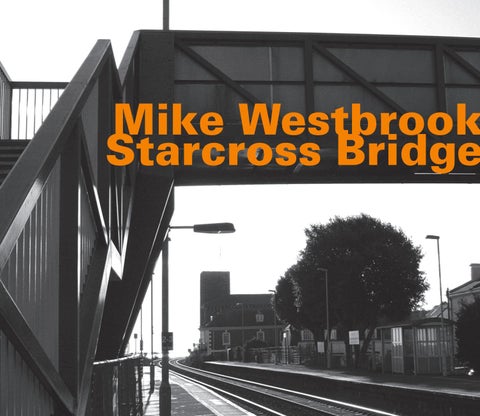
Mike Westbrook Starcross Bridge
Starcross Bridge
Philip Clark, April15th, 2018
When Louis Armstrong recorded the first of his Hot Five sides in 1925, and a year later Jelly Roll Morton’s Red Hot Peppers stepped into a Chicago recording studio for the first time, a divide opened up in the history of jazz. Louis was the first great jazz improviser while Jelly Roll, as he would have been the first to tell anyone who asked, established a tradition of composition in the music. In segregated New Orleans, this division was etched along racial lines. As a Creole, Morton considered lowerclass ‘Negro’ improvisation to be beneath him. He aspired to be taken seriously as a composer – and serious composers produced scores. As the history of jazz gathered pace through the 1930s and into bebop and beyond, piano players who were first and foremost ‘pianists’ against those who, to quote Dave Brubeck, were “composers who happened to play piano” fell either side of the divide, although with greater mutual respect than Morton ever showed Armstrong. Earl Hines, Art Tatum, Teddy Wilson, Oscar Peterson and Phineas Newborn Jr were instinctual pianists, while Thelonious Monk, Brubeck and Lennie Tristano allowed their pianism to be shaped by their compositional interests – and also fitting convincingly into that latter category is the British pianist and composer Mike Westbrook.
Speaking in 2004*, Westbrook made the careful distinction that, on the British jazz scene of the 1950s around which he grew up, the slightly older generation of musicians who emerged around Ronnie Scott – which would include Tubby Hayes, Phil Seamen and Stan Tracey – had developed their carefully primed instrumental knowhow by working in dance bands. “Sometimes they mightn’t have played much jazz,” he said, “but they had regular gigs through which they could develop.” Westbrook, though, developed inside a completely different milieu: “My generation came out of art schools and the like, and we were far less ‘professional musicians’ as we worked out our ideas – we worked through experimentation and trial-and-error.” * (published in Jazz Review, December 2004, “Mike Westbrook – Suite Enough”) A decade later, it became commonplace for British rock musicians like Ray Davies (of The Kinks) and Brian Eno (of Roxy Music) to learn something about the creative process at art colleges – such places were cheap to attend, free even, and less imposing than an institution like the Royal College of Music – and then apply what they had learnt to sound. Reproduced in Brian Olewnick’s newly published The Room Extended (PowerHouse Books), a biography of the guitarist Keith Rowe – who played in the first Westbrook big band before involving himself in free improvisation – a photograph of an art catalogue from 1963 immortalises Westbrook and Rowe not as musicians, but as painters. Both young men had recently graduated from Plymouth College of Art. Rowe gave his canvases titles like “Church With Angels And Stars” with a nod towards “Ella And Oscar”, while Westbrook opted for “The Red Sail”, “The Rider” and “Serpentine”, a backstory that feels directly pertinent to Starcross Bridge, this new album of solo piano music.
Westbrook has an obviously intense relationship with the chiaroscuro of harmony and the play of timbre, and the right word (the only word?) to describe this music is ‘painterly’. Morton Feldman’s work was also painterly and Westbrook’s instinct for creating washes of colour that, at times, he leaves hanging in the air is reminiscent of a painter stepping back from the canvas to take a look – gaining perspective on his perspective. Feldman would have understood. Westbrook’s first solo album, an immaculately turned set of sixteen miniatures to which he (coincidently) gave the decidedly Feldmanesque title Piano, was recorded in 1975. There was then a gap in his solo piano output of four decades as he grasped at the opportunity to assemble those extended compositions that made his reputation – The Cortège, London Bridge Is Broken Down, The Westbrook Blake, Big Band Rossini – and elevated the tradition of jazz composition in Britain to new conceptual and musical heights.
And then there was Paris (ASC Records ASCCD 166), the solo piano record released in 2016 to celebrate Westbrook’s 80th birthday. It would be a mistake to consider Starcross Bridge as a follow-up. It is an equal rather than a sequel; a record that can co-exist alongside Paris as Westbrook journeys further inside his idea of solo piano music. The earlier album was structured into ‘parts’ completed by a tiny coda. Westbrook divides this new record into three chapters that he rounds off with a short Postscript. Versions of Lennon and McCartney’s “Because”, “You Make Me Feel Brand New” (a 1974 hit for The Stylistics) and Westbrook’s own
Photo by Xavier Lambours
“View From The Drawbridge” and “Blues for Terenzi” appear on both records, but because the surrounding context – to employ that painting analogy again, their ‘framing’ – is so distinct, this is a whole new exhibition. Explicit within the meaning of that word compose is that compositional structures are composed ‘of’ different strains of material. Jelly Roll Morton’s often misunderstood claim that he “invented jazz” meant precisely that: his compositions were knitted together from many sources including ragtime, blues and stomps; ‘jazz’ for Morton was an attitude one took towards material, it was not a musical style or genre. Westbrook, too, roams far and wide for his material, those memoires of 1970s pop rubbing against two Thelonious Monk compositions and some classic slices of Ellingtonia. Within chapters, the tunes merge into each other. You might struggle, without looking at your CD player, to discern where Billy Strayhorn’s “Johnny Come Lately” ends and “Monk’s Mood” begins. The colour spectrum of one tune is allowed to bleed into the next – Westbrook is thinking through the composed continuum as deeply as any individual moment. Compositional antennae allow his piano access-all-areas to the forms of “Johnny Come Lately” and Monk’s “Round Midnight”, performances that sound like
Westbrook is taking us on a slow walk around their structures, stepping inside points of outstanding natural beauty, re-treading paths of particular interest. “Johnny Come Lately” arrives at an uneasy resolution around the most Ellingtonian polytonal crunch imaginable; the harmonic carapace Westbrook erects around “You Make Me Feel Brand New” occasionally parts to reveal authentic pop harmonies – the thing itself – underneath. This album is also rooted in the personal. Westbrook’s enduring creative partnership with his wife, the singer, lyricist and painter Kate Westbrook is represented by two songs they wrote together, “Brazilian Love Songs” and “Rooster Rabelais”; Mike’s “View From The Drawbridge” is a dedication “for Kate”. Starcross is a rail station nearby the Westbrook home in Devon, near Plymouth where his creative life began all those years ago. His title track is dedicated to the tenor saxophonist Lou Gare, whose death in 2017 was a particular wrench. Like Keith Rowe, Gare was an early Westbrook associate who became a founder member of the free improvisation collective AMM in 1965 – and then rejoined Westbrook in his Devon-based big band during the last decade of his life. Starcross Bridge is an intricately woven network of musical and personal references by a composer who happens to play piano rather well.
Mike Westbrook
ut o t H re t f Ha e a y o m w nit u fro ud ng pro mm . i o g ic d w r c o ! in ec ho ide rd mus ear t r w w co h irs kno rld- s re the ou f y i r o u ou to w th yo hat s y you ing njoy ing w i s s nt ow e br r i hi r r t wa r g you to ea he we ou at aim u h er t he th, r of e th nt t yo ling ! W r X be op sta ha eh ou you em e h con r. W X. U y e r k r a m . W ur o cov rne an , o s Th rds u as ner nts dis We co yo iste ese to l Re ve pr ture re ha It e fu th of
This album is rooted in the personal, including Westbrook’s enduring creative partnership with his wife, the singer, lyricist and painter Kate Westbrook. Starcross Bridge is an intricately woven network of musical and personal references. Philip Clark
OLOGY
Cet album est ancré dans l’intime, à commencer par la relation fructueuse au long cours qu’entretient Westbrook avec sa femme, la chanteuse, parolière et peintre Kate Westbrook. Starcross Bridge est une toile finement tissée de références musicales et personnelles. Philip Clark (Translated by Benjamin Mouliets)
11 If Thou Must Love Me
Mike Westbrook Starcross Bridge Mike Westbrook
Samuel Crossman/John Ireland arranged by Mike Westbrook
Starcross Bridge
‘Round Midnight
6:04
Thelonious Monk
4
Because Brazilian Love Songs
6
Johnny Come Lately
7
Monk’s Mood
3:11
Thelonious Monk
CHAPTER TWO 8 I Got It Bad – And That Ain’t Good
3:19
View From The Drawbridge
9:55
Mike Westbrook for Kate
10 You Make Me Feel Brand New 6:03 Thom Bell/Linda Creed
2018, 1st edition Printed by Gantenbein AG, CH 4127 Birsfelden www.hathut.com File under: Jazz/Free Improvisation
Samuel Blaser Trio Taktlos Zürich 2017 hatOLOGY 747
62:14
Recorded at 19 rue Paul Fort, 75014 Paris on December 1st & 2nd 2017 by Miles Ashton; Edited and mixed by Jon Hiseman at Temple Music Studios, London; CDmaster by Peter Pfister; Cover photograph of Starcross Bridge by Kate Westbrook; Liner notes by Philip Clark; Graphic concept by fuhrer vienna. Produced by Bernhard “Benne” Vischer, Christian C. Dalucas & Werner X. Uehlinger With special thanks to Hélène Aziza and Charles Adriaenssen.
Duke Ellington
9
Matthew Shipp Invisible Touch At Taktlos Zürich hatOLOGY 743
Gioacchino Rossini ‘The Barber of Seville’ arranged by Mike Westbrook
Total Time DDD
6:47
6:04
. POSTSCRIPT 14 L’Amoroso E Sincero Lindoro 3:52 .
ISRC CH 131.1901578 to ISRC CH 131.1901591
Billy Strayhorn
Anthony Braxton Quartet (Willisau) 1991 Studio : hatOLOGY 2-735
Kate Westbrook & Mike Westbrook
3:50
Kate Westbrook & Mike Westbrook for Bettina Bollmann
2:45
Mike Westbrook in memory of Danilo Terenzi (1956 – 1995)
4:19
Lennon/McCartney
5
CHAPTER THREE 12 Blues for Terenzi 13 Rooster Rabelais
3:37
Mike Westbrook inspired by Samuel Crossman/ John Ireland dedicated to Lou Gare (1939 – 2017)
3
Ran Blake Something To Live For hatOLOGY 711
piano
CHAPTER ONE 1 My Song Is Love Unknown 1:13 2
1:08
Mike Westbrook/Elizabeth Barrett Browning (‘Sonnets from the Portuguese’)
Myra Melford Trio Alive In The House Of Saints Part 1 : hatOLOGY 707 Part 2 : hatOLOGY 708
+ 훿 2018 for Outhere SA 1000 Brussels, Belgium by Hat Hut Records Ltd. Box 821, 4020 Basel, Switzerland. All rights reserved. Made in Switzerland.
hatOLOGY 754
Mike Westbrook · Starcross Bridge