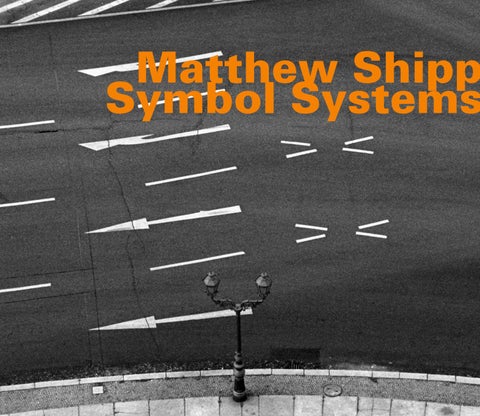
Matthew Shipp Symbol Systems
Symbol Systems
Art Lange, Chicago, 2017
“The law of chaos is the law of ideas / of improvisations and seasons of belief.” Thus the 20th century American poet Wallace Stevens characterizes the conflict – and the mutual dependence – between the individual imagination and the appearance, that is, our recognition, of so-called reality. The premise that there is a “law” at the heart of anything as fluid and unpredictable as chaos, and that it becomes concrete through the creative impulses that we accept on faith as “truth,” was one of the complex theories he held concerning how we find meaning in our lives. Writing in an age of alienation and skepticism, Stevens put his faith in the imagination to transform our insecurities and doubts into an awareness of reality as flawed, but vital and inspiring. “The imperfect is our paradise,” he wrote.
Stevens preferred poetry to music as an example of creative force and “the supreme fiction” (that is, the function of the imagination as a guide to define our personal beliefs) which he saw as a viable response to a spiritual void, somewhat surprising given his devotion to the idea of the abstract as a necessary factor in the quest for a meaningful relationship with reality. Music is the most abstract of the arts and, beyond its own syntax and systems, invites a personal symbolism on the part of the listener. Nevertheless, in his 1945 poem “Esthétique de Mal” (The Aesthetics of Evil) he includes a penetrating description that can serve as a link to the specific qualities one can associate with the artistry of Matthew Shipp. “When B. sat down at the piano and made A transparence in which we heard music, made music In which we heard transparent sounds, did he play All sorts of notes? Or did he play only one In an ecstasy of its associates, Variations in the tones of a single sound, The last, or sounds so single they seemed one?”
As of 2018, and the welcome reissue of this album, Symbol Systems, Matthew Shipp’s recording career has entered its fourth decade, confirming him as one of the most prolific and imaginative musicians of our time. Prolific, in part, because of an extensive catalogue of collaborations – duos with several bassists, “conventional” trios, unconventional instrumentations largely featuring guitarist Joe Morris and/or violist Mat Maneri, and especially more than a dozen ventures with notable saxophonists, from David S. Ware and Ivo Perelman to Roscoe Mitchell and Evan Parker – and imaginative of necessity because of the vast range of stylistic responses such distinctive musicians required. [For the sake of full disclosure, I should admit that I served as in-studio producer for six of Matthew’s hat Art and hatOLOGY releases, from 1996-99.]
Symbol Systems, however, occupies a special place in his discography. Originally issued in 1995 on the No More Records label, it was at the time his sixth release as a leader or co-leader, but significantly his first solo album, and as such provided us with the purest view to date of his multifaceted, indivisible improvisational/compositional concepts. The first characteristic one is likely to notice is the diversity of styles he employs – a romantic/ lyrical perspective, repetitious riffs as energy force, inquisitive introspection, propulsive rhythmic momentum, circuitous melodic contours.
But if we listen closely to Symbol Systems in the context of Wallace Stevens’ archetypal pianist, several interesting parallels emerge. The key words are transparence, variations, and ecstasy. The transparency of Shipp’s improvisations reveal he is an architect of motifs, who designs and elaborates on shapes and patterns while altering their dynamic and dramatic emphasis, often in an elusive manner that progresses from one area of motivic examination to another seamlessly and unexpectedly. The variations he employs are not solely thematic extensions or ornamentation, but at times notes circling a harmonic nucleus like molecules of melody, or elsewhere shifting gestures through isolated references, such as a hint of stride or two-part counterpoint, shaped and shaded with a continuous strategy of attacks, accents, and tonal colors. And the nature of improvisation, specifically in Shipp’s music, the process and progress of sounds, finds the choice of one note an existential act, and ultimately that note evolves “in an ecstasy of its associates.”
In Stevens’ terms, the reality of Shipp’s music lies in his imaginative choices and, equally, in our perception of it. So if I perceive throughout Symbol Systems moments of Ellingtonian percussiveness, Ivesian intensity, the harmonic sensitivity of Debussy and Ravel, mutated Stravinsky, and a linear projection that extends back via Andrew Hill and Bud Powell through Bach to the Elizabethan keyboard fantasies of Byrd and Bull, it’s not due to any conscious borrowing on the pianist’s part, but the manner in which he has abstracted various keyboard and compositional concepts down to their essence, made them a part of his personal musical symbolism, allowing us to share in the world he has created.
Matthew Shipp
ut o t H re t f Ha e a y o m w nit u fro ud ng pro mm . i o g ic d w r c o ! in ec ho ide rd mus ear t r w w co h irs kno rld- s re the ou f y i r o u ou to w th yo hat s y you ing njoy ing w i s s nt ow e br r i hi r r t wa r g you to ea he we ou at aim u h er t he th, r of e th nt t yo ling ! W r X be op sta ha eh ou you em e h con r. W X. U y e r k r a m . W ur o cov rne an , o s Th rds u as ner nts dis We co yo iste ese to l Re ve pr ture re ha It e fu th of
Symbol Systems occupies a special place in Matthew Shipp’s discography. Originally issued in 1995 on the No More Records label, it was at the time his sixth release as a leader or co-leader, but significantly his first solo album, and as such provided us with the purest view to date of his multifaceted, indivisible improvisational/compositional concepts. Art Lange Symbol Systems occupe une place particulière dans la discographie de Matthew Shipp. Sorti à l’origine en 1995 sur le label No More Records, ce qui fut à l’époque son sixième disque en tant que leader ou co-leader est, avant tout, son premier album solo, nous offrant ainsi l’aperçu jusqu’alors le plus pur de ses concepts multiformes, mêlant intimement l’improvisation à la composition. Art Lange (Translated by Benjamin Mouliets)
OLOGY
Albert Ayler Quartet Copenhagen Live 1964 hatOLOGY 665 Anthony Braxton Quintet (Basel) 1977 hatOLOGY 676
Matthew Shipp Symbol Systems Matthew Shipp
11 Nerve Signals 12 Algebraic Boogie
piano
Clocks
7:05
Harmonic Oscillator
3:50
ISRC CH 131.1901565
3
Temperate Zone
1:56
ISRC CH 131.1901566
4
Symbol Systems
4:49
4:16
ISRC CH 131.1901576
14 The Inventor, part 2
ISRC CH 131.1901564
2
2:16
ISRC CH 131.1901575
13 The Inventor, part 1 1
3:33
ISRC CH 131.1901574
3:07
Albert Ayler Quartet European Radio Studio Recordings 1964 hatOLOGY 678 Ran Blake Something To Live For hatOLOGY 711 Matthew Shipp Invisible Touch At Taktlos Zürich hatOLOGY 743
ISRC CH 131.1901577
Total Time DDD
60:55
All titles composed by Matthew Shipp, Tuhtah Publishing SUISA.
ISRC CH 131.1901567
5
The Highway
6:09
ISRC CH 131.1901568
6
Self-Regulated Motion
3:19
ISRC CH 131.1901569
7
Frame
5:11
ISRC CH 131.1901570
8
Flow Of Meaning
7:13
ISRC CH 131.1901571
9
Dance Of The Blue Atoms
3:25
ISRC CH 131.1901572
10 Bop Abyss ISRC CH 131.1901573
4:36
Recorded by Chris Flam at Baby Monster Studios on November 22, 1995, Produced by Alan Schneider, Originally released on No More Records. 2017 acquired by Hat Hut Records Ltd. CD-master November 29, 2017 by Peter Pfister. Cover photo by Hans Hagen Stockhausen. Liner notes by Art Lange. Graphic concept by fuhrer vienna. Executive production by Bernhard “Benne” Vischer, Christian C. Dalucas & Werner X. Uehlinger. 2018, 1st edition Printed by Gantenbein AG, CH 4127 Birsfelden www.hathut.com File under: Jazz/Free Improvisation
+ 훿 2018 HAT HUT Records Ltd. Box 81, 4020 Basel, Switzerland. All rights reserved. Unauthorized duplication is a violation of applicable laws. Made in Switzerland.
hatOLOGY 749
Matthew Shipp · Symbol Systems