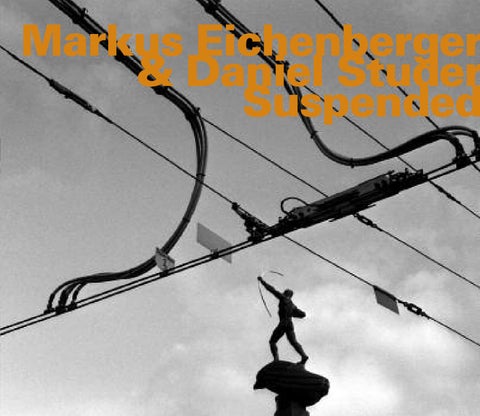
Markus Eichenberger & Daniel Studer Suspended
Suspended
Art Lange, Chicago, October 2017
The stereopticon is a machine that allows us to view a blending of two separate images, left and right, into a single image. In his essay “The Critic as Artist” (from the book Every Force Evolves A Form, North Point Press), Guy Davenport relates how, when looking at two distinct squares filled with seemingly random dots, he saw “a sharp-edged isosceles triangle beautifully defined, suspended just above the spatter of dots. This floating, Platonic triangle is nowhere but in our head. Without the stereopticon to serve us, there is no way of discerning what latent pattern lurks in either square, realizable only in the fusion of the two.”
There is an obvious parallel in this visual phenomenon and the experience of hearing musicians in a duo setting. While we may listen to each one on their own, separate from the other, their interaction results in a third perspective of sound and experience which exists only in the moment, a phantom perception which may not be a function of physics but is nonetheless as real as human nature. We often attempt to solve this quandary with logic. If the duo is performing, say, Johannes Brahms’ third sonata for violin and piano, op. 108, we tend to project what we hear onto a context that includes possible familiarity with the music itself; knowledge, perhaps, of Brahms’ chronological and stylistic position in the evolution of European classical music; and emotional responses related to an individual aesthetic sensibility – all of which affect the listening experience. How different is the effect, however, when the music is totally improvised?
Improvisation assumes a fresh experience, an unfamiliarity with what is to come, a disruption of expectations. How much more intense and disorienting the experience becomes in the music of Markus Eichenberger and Daniel Studer. Each one has an impressive résumé of musical adventures, but as a duo their music expresses special qualities and asks challenging questions. Suspended offers no customary structures, no consistent prototypes; the titles are not instructions, illustrations, or explanations. Manipulating an abstract dialect of sounds, many of them in the grey area between recognizable pitch and expressive noise, they initiate a system of relationships that allows – requires – the listener to participate in the spontaneous search for meaning.
From the musician’s point of view, music may be thought of as practiced physical gestures on an instrument; a harmonic or textural complex with conventions or self-imposed rules; a philosophical or psychological interpretation of sound as event; even an existential affirmation of activity as order. But in the search for meaning the listener’s powers of perception may be used to discern other, primarily conceptual, avenues of significance. In the case of Suspended, the seven pieces could be read as chapters in a continuing story, following an abstract narrative of details; metaphorically, as two people on a precarious journey of cautious steps and surreptitious actions; or a conversation in whispers and groans between eccentric inhabitants of a Beckett-like environment. Because of its newness, any attempt to describe the music ultimately reflects a personal sense of cognition – “the act or process of knowing including both awareness and judgment” (Webster’s Dictionary) – moreso than its own inherent qualities.
Conversely, familiarity between these musicians neither limits their various modes of operation (improvisational, compositional, or any degree in between) nor impedes their ability to create sounds spontaneous and unpredictable – rather, it provides them with an implicit context in which their “awareness and judgment” functions within a distinctive musical dynamic. The duo of Eichenberger and Studer has been in existence for over eight years, although their collaborations in other settings date back to 1997; nevertheless, the music herein reveals no studied formulas or predetermined maneuvers beyond a focused tenacity of intent and concord of sonorities. The sounds themselves, and not the rationale behind them, define the experience.
Thus, from my point of view, as with the stereopticon, the two distinct instruments – the clarinet emphasizing and coloring the breath, shaping the air, transparent and fluid; the other stimulating the strings and body of the bass, adjusting dynamics, percussive and resonant – cohere as a single, indivisible, unimaginable, dramatic expression of being. The resulting spectrum of sound encourages friction and whispers, implies intervals and assumes contours smooth or jagged, admits silence as an equal texture, and establishes a spatial reference – a place where such musical activity, whether restrained and delicate or aggressive and biting, exists as the only experience of its kind, if you choose to listen.
Markus Eichenberger & Daniel Studer
ut o t H re t f Ha e a y o m w nit u fro ud ng pro mm . i o g ic d w r c o ! in ec ho ide rd mus ear t r w w co h irs kno rld- s re the ou f y i r o u ou to w th yo hat s y you ing njoy ing w i s s nt ow e br r i hi r r t wa r g you to ea he we ou at aim u h er t he th, r of e th nt t yo ling ! W ur X be hop nsta ha Ueh u o o o .W . em e k y r y m W r c er r X an s, o s a rs. s ou cov rne h s e T rd u a ne nt di W co yo iste ese to l Re ve pr ture re ha It e fu th of
Improvisation assumes a fresh experience, an unfamiliarity with what is to come, a disruption of expectations. How much more intense and disorienting the experience becomes in the music of Markus Eichenberger and Daniel Studer. Each one has an impressive résumé of musical adventures, but as a duo their music expresses special qualities and asks challenging questions. Suspended offers no customary structures, no consistent prototypes; the titles are not instructions, illustrations, or explanations. Manipulating an abstract dialect of sounds, many of them in the grey area between recognizable pitch and expressive noise, they initiate a system of relationships that allows – requires – the listener to participate in the spontaneous search for meaning. Art Lange
OLOGY
Albert Ayler Quartet Copenhagen Live 1964 hatOLOGY 665 Anthony Braxton Quintet (Basel) 1977 hatOLOGY 676 Albert Ayler Quartet European Radio Studio Recordings 1964 hatOLOGY 678 Ran Blake Something To Live For hatOLOGY 711
Markus Eichenberger & Daniel Studer Suspended
Matthew Shipp Invisible Touch At Taktlos Zürich hatOLOGY 743
Markus Eichenberger clarinet & bassclarinet Daniel Studer double bass 1
Walking Harshly
4:17
ISRC CH 131.1801541
2
Pausing Reluctantly
5:40
ISRC CH 131.1801542
3
Staying Numbly
6:24
ISRC CH 131.1801543
4
Glancing Loudly
5:14
ISRC CH 131.1801544
5
Listening Sideways
10:56
ISRC CH 131.1801545
6
Gliding Upwards
7:50
ISRC CH 131.1801546
7
Aiming Anew
5:25
ISRC CH 131.1801547
Total Time DDD
45:52
All titles composed by Markus Eichenberger & Daniel Studer, Tuhtah Publishing SUISA. Recorded 9 & 10 December 2016 at Studio 1, Radio Studio Zurich, Radio SRF 2 by Martin Pearson; Produced by Peter Bürli for Radio SRF 2 and Eichenberger–Studer; CD-master by Peter Pfister; Liner Notes by Art Lange; Cover photo by Hans Hagen Stockhausen ; Grafic concept by fuhrer vienna; Executive production by Bernhard “Benne” Vischer, Christian C. Dalucas & Werner X. Uehlinger. 2018, 1st Edition Printed by Gantenbein AG, CH 4127 Birsfelden www.hathut.com File under: Jazz/Free Improvisation
+ 훿 2018 HAT HUT Records Ltd. Box 81, 4020 Basel, Switzerland. All rights reserved. Unauthorized duplication is a violation of applicable laws. Made in Switzerland.
hatOLOGY 748
Markus Eichenberger & Daniel Studer ¡ Suspended