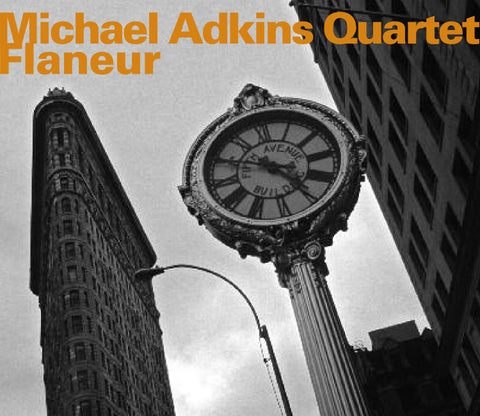
Michael Adkins Quartet Flaneur
Flaneur
Brian Morton, October 2008
It has a very personal resonance, this title. In the mid 1950s, my late father wrote a magazine column under the pseudonym “Flaneur”, random jottings from the industrial streets of Glasgow, glimpses of places, snatches of voices, chance encounters of the kind that Charles Baudelaire, who developed the ideology of flânerie and applied it to the streets of Haussmann’s Paris, considered definitive of urban life. The old man also made a film, punningly called Under the Arches, which simply followed walking feet (hence the pun) out from the arcades of the old Glasgow High School and into the city. I spoke to him about it again not long before he died and said it sounded pretty avantgarde. He gave me a funny look.
There is, however, a long and established discourse – much of it French or at least European – that arises out of Baudelaire’s notion of the walker in the city, a watcher whose gaze was itself the act of participation. Much comes from this: Susan Sontag’s street photographer who treats the urban landscape as a field of ‘voluptuous extremes’; the Situationists’ new science of psychogeography and Guy Debord’s concept of the dérive, by which a group of individuals ‘drop their usual motives for movement and action, their relations, their work and leisure activities, and let themselves be drawn by the attractions of the terrain and the encounters they find there’. Of course, with its military connotations, the dérive was also a manual for street fighting and urban riot, or at best for a kind of creative contention between the individual and the group. You wondered what the relevance of all this might be to jazz? Right there. That sense of individual expression ‘within and against’ the group, to use a phrase deployed by both James Baldwin and Ralph Ellison in just this context, a science of freedom-with-rules. Listen to what Michael Adkins seems to be doing here. ‘The City’ was a draft title for one of the tunes, but perhaps that was too obvious. ‘Archives’ is a subtler and more elusive substitute. It smacks somewhat of Walter Benjamin’s ‘utopian’ Arcades project, but either way it’s an essentially urban concept. Who ever heard of an archive – other than a secret government bunker – being in the country? Who ever hurried through one?
There is a tendency to see jazz performance divided between uptempo numbers and ballads, but Adkins is perhaps concerned with something different, a thoughtful, alert, observant gait – Henry David Thoreau preferred to talk about ‘sauntering’ – that offers the player a new relationship with his surroundings. Adkins’ immediate surroundings are familiar enough, the group he unveiled on a previous hatOLOGY (660) recording Rotator; only the bassist is a newcomer. Saxophone, piano, bass fiddle and drums – nothing new there, one might think. Except that Adkins does propose a new relationship between the constituent elements. Much has been made of his saxophone sound, which does as Stuart Broomer perceptively noted in his liner note to the previous CD sound like a confident appropriation of many decades of saxophone language and jazz styles. Here, though, one is perhaps less immediately struck by the timbre and phrasing of the ‘lead’ instrument than how it moves through the space defined by the group. ‘Walking’ is a term most often associated with bass players, though it isn’t by any means the only or even the major style adopted by the bass player here. He saunters, and pauses to engage with what’s passing by. He’s sometimes confronted by some or another challenge and there’s a hint of old-fashioned contention in that. But mostly these men are moving through a virtual space, a u-topic space, and governed by the rhythms – you might need to read Elias Canetti and Crowds and Power for a gloss on this – of heartbeat, feet and breathing. These change with mood, effort, level of anxiety or delight and, as ever, context. When you hear running feet behind you, do you run too, or stop and turn? Do you fall into step with the one who walks beside you? Or change the cadence of your stride to avoid drawing alongside a stranger? These are disciplines of the city and part of its physical language. Sarnia in Canada, Detroit, New York – Adkins grew up with one dialect or another.
That’s Sarnia - now named after one of the Channel Islands, Guernsey, but once known as Rapids! – where composer R. Murray Schafer, creator of soundscapes and inventor of the term schizophonia, was born. Something in the water perhaps. A schizophonic experience was considered to be one in which sound was separated from its source - others might describe this as ‘acousmatic’ – but isn’t that precisely the experience we have of moving through the city: the violinist practising upstairs, against but unaware of the boom-box in the street, the bitten-off radio jingle as a shop door closes, the sudden bark of laughter, the cry that might be sex or fear. Adkins might have the same reaction as my father to ‘avant-garde’. It’s another military term, of course, and an overworked one. He works instead in a refined form of the urban vernacular. There is nothing ‘picturesque’ – Sontag adapts the term in her On Photography – in his music, in the sense that he does not seek to capture, or seem to, snapshots of specific places. ‘Tenth Avenue’ might seem an exception. There is probably a Tenth Avenue in Detroit and possibly one in Sarnia, but you can’t quite see those words in a musical context without thinking of Richard Rodgers and, yes, On Your Toes, because the other way of moving through a modern city is dancing. Listen to that penultimate track, and don’t you imagine a kind of choreography, not Ray Bolger (uh huh, the Scarecrow played the hoofer in peril in the original production) or Gene Kelly or Moira Shearer,
but someone who’s gone past the simple two-beat of straightline walking and into the more dynamic metres that allow you a passage through the crowd. No human motion makes the environment more visible and available than walking. No human motion reveals more of what is human and how it interacts with the not-human than improvisation on musical instruments. Listen to ‘We’ll See’, and you get that strong sense that at every turn there is something new, not definitive or final, but simply new and to be absorbed. It’s an expression that can be fatalistic – ‘we’ll see’ – or it can defer a final decision, as when a child gazes through a store window and wants something shiny or sweet. We’ll see. This isn’t music that deliberately withholds its perceptions, teasing the listener with enigmatic glimpses – ‘What do you want to be enigmatic for, Michael?’, as purblind James Thurber might have said to him – or drawing him pictures. Quite the reverse. These themes invite the listener to join the company, take a stroll, ‘let him be drawn by the attractions of the terrain’ and the encounters he might find there. We walk. We listen. We’ll hear.
Also available hatOLOGY 660
MichaelAdkinsQuartet Rotator
Michael Adkins Quartet
ut o t H re t f Ha e a y o m w nit u fro ud ng pro mm . i o g ic d w r c o ! in ec ho ide rd mus ear t r w w co h irs kno rld- s re the ou f y i r o u ou to w th yo hat s y you ing njoy ing w i s s nt ow e br r i hi r r t wa r g you to ea he we ou at aim u h er t he th, r of e th nt t yo ling ! W ur X be hop nsta ha Ueh u o o o .W . em e k y r y m W r c er r X an s, o s a rs. s ou cov rne h s e T rd u a ne nt di W co yo iste ese to l Re ve pr ture re ha It e fu th of
There is a tendency to see jazz performance divided between uptempo numbers and ballads, but Adkins is perhaps concerned with something different, a thoughtful, alert, observant gait – Henry David Thoreau preferred to talk about ‘sauntering’ – that offers the player a new relationship with his surroundings. Adkins’ immediate surroundings are familiar enough, the group he unveiled on a previous hatOLOGY 660 recording Rotator; only the bassist is a newcomer. Saxophone, piano, bass fiddle and drums – nothing new there, one might think. Except that Adkins does propose a new relationship between the constituent elements ... These themes invite the listener to join the company, take a stroll, ‘let him be drawn by the attractions of the terrain’ and the encounters he might find there. We walk. We listen. We’ll hear. Brian Morton
Albert Ayler Quartet European Radio Studio Recordings 1964 hatOLOGY 678
Michael Adkins tenor saxophone Russ Lossing piano Larry Grenadier double bass Paul Motian drums
Ran Blake Something To Live For hatOLOGY 711 Matthew Shipp Invisible Touch At Taktlos Zürich hatOLOGY 743
6:55
ISRC CH 131.1801523
2
Hard request
7:22
ISRC CH 131.1801524
3
We’ll See
5:28
ISRC CH 131.1801525
4
Numeral
4:40
ISRC CH 131.1801526
Second Walk: 5 Before You Know It
5:40
ISRC CH 131.1801527
6
Grafica
6:48
ISRC CH 131.1801528
7
Offerings
6:42
by Walter Gross and Jack Laurence
All titles composed by Michael Adkins; Tuhtah Publishing, Suisa. Recorded by James Farber at Avetar Studios New York N.Y. on March 22, 2008; Mix by James Farber on May 9, 2008; Liner notes by Brian Morton; Cover photo by Luca Buti; Graphic concept by fuhrer vienna; Produced by Michael Adkins; Executive production by Bernhard “Benne” Vischer, Christian C. Dalucas & Werner X. Uehlinger Special thanks to: Paul, Larry, Russ, Tino Passante, JoAnne Fordham, Emilio Lyons, Perry Ritter, John Hebert, Ian Froman, Todd Neufeld, Billy Mintz, Jeff Williams, Tony Moreno, Aidan O'donell, Nasheet and Sharif Waits and Alvin Fielder.
ISRC CH 131.1801529
8
Silhouette
9:42
ISRC CH 131.1801530
Total Time DDD
Albert Ayler Quartet Copenhagen Live 1964 hatOLOGY 665 Anthony Braxton Quintet (Basel) 1977 hatOLOGY 676
Michael Adkins Quartet Flaneur
First Walk: 1 Archives
OLOGY
53:31
2018, 1st Edition Printed by Gantenbein AG, CH 4127 Birsfelden www.hathut.com File under: Jazz/Free Improvisation
+ 훿 2018 HAT HUT Records Ltd. Box 81, 4020 Basel, Switzerland. All rights reserved. Unauthorized duplication is a violation of applicable laws. Made in Switzerland.
hatOLOGY 745
Michael Adkins Quartet · Flaneur