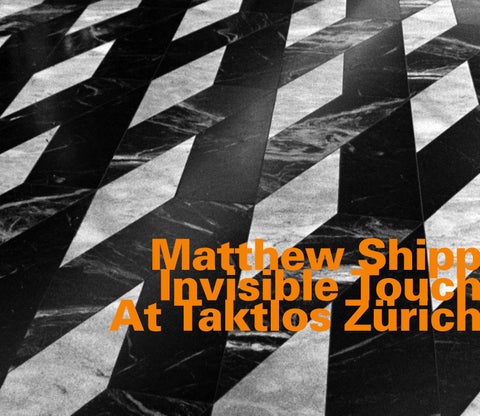
Matthew Shipp Invisible Touch At Taktlos Zürich
Invisible Touch At Taktlos Zürich
Derek Taylor, February 2017
“The music should speak for itself whatever it is and says.” Matthew Shipp’s pithy response to an overly broad query into the whys and wherefores of his art from this writer carries conviction in its conclusion that is absolute. As individualist improvisers go, Shipp remains one of the most rugged and resolute in relation to his instrument. His reservoirs of confidence and purposefulness are grounded in a conception of artistic self that has little patience for those unwilling to consider the work on its own terms. Suffering fools lightly is not in Shipp’s general social vocabulary, but a generosity of spirit and an incisive sense of humor are attributes in regular evidence. To cite a single manifestation, the storied Shipp smile is a celebrated feature of his countenance, Cheshire cat in counterpart and brimming with effusive jocularity.
Shipp’s strain of individualism doesn’t operate in a vacuum. It’s rooted in and draws on a myriad of time and space-spanning relationships, both professional and personal. Decades-deep bonds with his immediate peers and an unflagging commitment to family align with an abiding industry toward throwing his talents in with new colleagues wherever he finds them. It’s exemplary of the old competitive sports adage that the best team players are those comfortable in their own skins. One cannot find what works well with others unless one first locates and accepts what works well with oneself. Milestones are copious in the Shipp’s career. Studies with Joe Maneri at the New England Conservatory of Music and private lessons with unsung composer/improviser Dennis Sandole. Early experiments outside conventional classical and jazz forms with altoist and erstwhile roommate Rob Brown. A life-altering decade-and-a-half spent touring the world as one quarter of the David S. Ware Quartet and the multitude of opportunities and connections that sprang from the tenure. Fraternal kinships with bassist William Parker and saxophonist Ivo Perelman, both of which have yielded countless encounters over the years. Forays into electronic music and Hip Hop influenced improvisation along with collaborations with European improvisers including duets with Evan Parker have also been part of the journey. Shipp’s been a near constant in creative improvised music for nearly four decades, the changes in his approach and sound elastic and cumulative rather than rigid and repetitive.
As voluminous and representative as Shipp’s myriad ensemble recordings are there’s a special section of his discography reserved for solo performance. In these settings absent collaborators, he necessarily folds in on himself, the influences and erudition gleaned from others coupled to personal concepts and filtered through the thought-to-action choices borne by mind to fingers and feet. These are inherently challenging contexts, the figurative safety net and sounding board of fellow musicians removed in favor of the risks (and rewards) of solitary expression. They are also scenarios where Shipp almost uniformly excels, giving over to his instrument’s mechanics and switching internal gears from the physical to the meta-physical in an effort to leave all extraneous distractions behind. The other obvious element to any solo gig equation is an audience. On this final date of a whirlwind European tour organized around seven countries in eight days, Shipp finds a Swiss assemblage of concertgoers primed for his performance. The recital unfolds organically and without artifice, each piece stitched to the next with the connective seams between barely visible and taking on the larger appearance of an extended medley. Shipp begins with rich, reverberating block chords that gain momentum only to ease up in fluid transition to stacked revolving structures. The piano at his disposal is both beautifully tuned and comprehensively captured.
Bright patterns forwarded by a questing right hand open up “Instinctive Touch” as deft pedal play rounds off sharp edges into well-honed lyricism. Shipp’s clusters expand in weight and presence his hands racing in arched alignment through a rapid series of concentric circuits. “Pocket” places some distance between them with right rifling through notes as left parses a darkly resonant cloud of thunder in response. With “Gamma Ray” comes another shift in mood although the respite from tension is brief as a sleeper motif awakens and swiftly usurps the larger structure. “Piece Within Piece” achieves a similar hat-trick as stabbing runs and swerving detours give way to fleeting slivers of melody obscured to the point of near opacity by craggy ornamentations and crenelated asides until a flourish-laden coda.
Among the most referenced ballads in the Great American Songbook, “Tenderly” serves as the sole composition of the set outside Shipp’s immediate design. Any romanticism in his rendering takes on a brow-furrowing, conflicted cast and the piece becomes a rolling at times roiling tone poem wrought with flickering light and shadow undercut by ominous swirls of pedal-swollen sustain. “Monk’s Nightmare” embodies its namesake through staccato call and response and skittering, scattering notes with Shipp’s accelerated breathing audible around the edges. “Blue In Orion” and “It” offer further feasts, the first an off-center waltz steeped in naked melodicism and bright note decay and the next a forest of collisions and abutments audible within a staggered cascade of variable velocity clusters. A brief encore “Fairplay” fields a final display of Shipp’s enormous digital dexterity with the faintest echoes of the earlier “Tenderly” threaded through a daunting obstacle course of rapid fire progressions and deviations. The laconic expression of gratitude uttered by the pianist in the applause-laden aftermath almost feels anti-climactic in its earnest modesty when squared against the breadth of what’s transpired.
Shipp’s stated aim is that rarefied realm where verbal and written descriptors fail, subsumed by the primacy of organized sound, spontaneous and of the moment. Whether he reaches that space is always arguable both on the part of artist and audience, but this compact and intensely contemplative set suggests an exemplar of success in that regard. In Shipp’s typically succinct and germane summation: “I did feel very good about the flow that I felt I got.”
Matthew Shipp
ut o t H re t f Ha e a y o m w nit u fro ud ng pro mm . i o g ic d w r c o ! in ec ho ide rd mus ear t r w w co h irs kno rld- s re the ou f y i r o u ou to w th yo hat s y you ing njoy ing w i s s nt ow e br r i hi r r t wa r g you to ea he we ou at aim u h er t he th, r of e th nt t yo ling ! W ur X be hop nsta ha Ueh u o o o .W . em e k y r y m W r c er r X an s, o s a rs. s ou cov rne h s e T rd u a ne nt di W co yo iste ese to l Re ve pr ture re ha It e fu th of
Shipp’s stated aim is that rarefied realm where verbal and written descriptors fail, subsumed by the primacy of organized sound, spontaneous and of the moment. Whether he reaches that space is always arguable both on the part of artist and audience, but this compact and intensely contemplative set suggests an exemplar of success in that regard. In Shipp’s typically succinct and germane summation: “I did feel very good about the flow that I felt I got.” Derek Taylor
OLOGY Albert Ayler Quartet European Radio Studio Recordings 1964 hatOLOGY 678 Anthony Braxton Quartet (Santa Cruz) 1993 2nd set hatOLOGY 714
Matthew Shipp Invisible Touch At Taktlos Zürich Matthew Shipp 1
Cecil Taylor Garden · 2nd set hatOLOGY 720
piano
Light Beam
0:43
Uwe Oberg Work hatOLOGY 740
4:56
Ellery Eskelin Trio Willisau · Live hatOLOGY 741
5:46
Anthony Braxton, Quartet (Basel) 1977 hatOLOGY 676
ISRC CH 131.1701465
2
Intro Z ISRC CH 131.1701466
3
Instinctive Touch ISRC CH 131.1701467
4
1:32
ISRC CH 131.1701468
5
Gamma Ray
5:50
ISRC CH 131.1701469
6
Piece Within Piece
5:43
All compositions by Matthew Shipp (except otherwise indicated) published by Tuhtah Publishing/SUISA.
ISRC CH 131.1701470
7
Tenderly
4:07
by Walter Gross and Jack Laurence ISRC CH 131.1701471
8
Monk’s Nightmare
7:00
ISRC CH 131.1701472
9
Blue in Orion
4:39
ISRC CH 131.1701473
10 It
5:14
Recorded live May 19th, 2016 at Taktlos Festival, Rote Fabrik by Jeroen Visser, Fishing Bakery Labs; Festival organised by Fredi Bosshard; Mix by Peter Pfister & Jeroen Visser; CD-master by Peter Pfister; Liner notes by Derek Taylor; Cover photo by Hans Hagen Stockhausen; Graphic conept by fuhrer vienna; Produced by Fredi Bosshard/Fabrikjazz, Christian C. Dalucas, Mario DaRugna, Bernhard “Benne” Vischer & Werner X. Uehlinger.
ISRC CH 131.1701474
11 Fairplay
3:58
ISRC CH 131.1701475
Total Time DDD
49:33
1st Edition 2017 Printed by Gantenbein AG, CH 4127 Birsfelden www.hathut.com File under: Jazz/Free Improvisation
+ 훿 2017 HAT HUT Records Ltd. Box 81, 4020 Basel, Switzerland. All rights reserved. Unauthorized duplication is a violation of applicable laws. Made in Switzerland.
hatOLOGY 743
Matthew Shipp · Invisible Touch At Taktlos Zürich