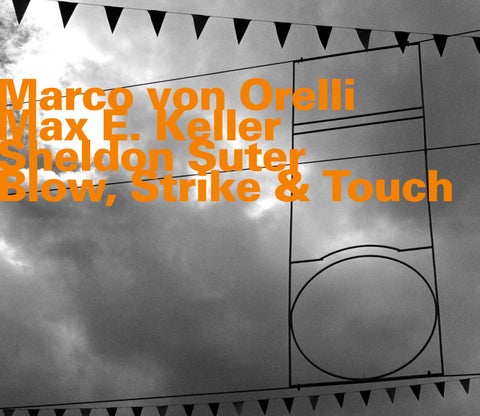
Marco von Orelli Max E. Keller Sheldon Suter Blow, Strike & Touch
Blow, Strike & Touch
Stuart Broomer, December 2015
Listening to the trio of Marco von Orelli, Max E. Keller and Sheldon Suter, one comes very close to the essence of the improvised music project, an idea in which the largest and smallest units—of time and space, of personality and the world—are simultaneously engaged. The Swiss trio is made up of three very distinct musicians, distinct in the way in which their values and responses intersect to create this special music, which is a form constructed at once of their differences as well as their empathy. Call it real-time collective composition, but each of the three musicians is willing to pursue specific components and paths that through their collective method become larger than any individual design. Marco von Orelli has been active as a composer and trumpeter for over twenty years, working in various ensembles and improvising partnerships as well as developing more formal approaches with the Marco von Orelli 5 and 6. He remarks, “I’m interested in an improvisational approach to developing and playing within a peripheral design that shouldn’t be restrictive. This can be compositional, conceptual or take place freely and without specifications.” That sense of open design is as apparent in the pieces created here as it is in his compositions for his sextet and quintet. It’s a commitment to an openness of methodology that unites this collaborative trio.
Max E. Keller was among the first Swiss musicians to play free jazz, beginning in 1966, and making a significant impact at the Zurich Jazz Festival in 1967. He began working in electronic music a few years later and has distinguished himself both in free improvisation—he has worked with a host of musicians including Urs Leimgruber, Charlotte Hug and Barry Guy—while composing a significant body of work that includes chamber music, electronic music and an opera. Von Orelli comments, “I find it exciting to play freely improvised music with Max, because he has been working as an active composer of contemporary music. In addition, he appeared as a free jazz pianist in his early years. That combination of free jazz energy and composition makes him an interesting partner.” Keller remarks of the trio that, “Our music is full of surprise, for us and for the listener. It’s a contrast to the normalized, conformist and digital standardized world. We are quite different persons in age, background et cetera, and this is perhaps the reason for the extremely diverse musical processes in our trio.” He’s happy to elaborate on just how those different processes can work. “We are different, but we agree to not play the most obvious reaction to some proposed material. For example, in the piece, “Albero Genealogico” (family tree), the trumpet starts with a soft melody with long pauses. Sheldon and I do not play here at first, but after a while Sheldon starts with a very, very soft layer as from another planet, a layer he develops very slowly and steadily during the whole piece, whereas I start later backing the trumpet first and then I go my own way through different moods—in contrast to the drums. I like this reflective playing very much and I would designate it as ‘instant composing.’ Another quality is to expand the tone color of our instruments: I like to play inside the piano and sometimes I play percussion: None of us stay in the traditional functions of our instruments. Instead we try to create a wide variety of constellations.
Sheldon Suter’s approach to drumming is highly intuitive, a kind of organic approach to sound, and he and von Orelli are partners in several improvising ensembles that stretch towards electronics. This includes, for example the quartet Big Bold Back Bone with the Lisbon guitarist Luis Lopes and electronic musician Tavassos, and they have also collaborated with Frantz Loriot and DJ Sniff as Lost Socks. As von Orelli explains,”Sheldon has been a very close friend since sandpit times. Our fathers were already very close friends. We got together very early and have often launched musical projects together. He’s an extremely sensitive drummer and he sounds confident. He can still surprise me musically!” Sheldon describes his own beginnings: “My father was a jazz drummer and I started to sit at the drum set as a kid, playing along with West Coast jazz records. I didn’t study formally, I’m self-taught. So basically I was a jazz drummer and I listened exclusively to jazz. “Later, between 20 and 25, I also got more interested in modern and contemporary classical music, ethnic music from everywhere and European free improvised music and still everything in the jazz universe from bebop until today. This was the time I began to experiment with adding new instruments to the drum set and developing new techniques to create different sounds. “For me, the focus is on the sound. The sound is the thing that touches me deeply. Improvisation starts from a sound, a noise, a colour, and from this material comes the time or the no-time, the dynamic, the form, everything. Another thing I try to consider during improvisation is the breath of the music. The breath is the silence between the tension and the relaxation. “What I enjoy in playing with Marco is his richness of sounds and the clear formal decisions he always makes. It’s the same with Max: he has a big overview of the formal structure”. Our voyage into this music might begin with the language the three share with us—a world defined by short words and sudden actions. “Lidschlag” (blink) might be central to this world, may be a voluntary or involuntary action, of the briefest duration, whether isolated or repeated in rapid succession. It is a singular action that both shuts off and opens the world to us, and in its singularity it may give us in an instant of time a new world. What was it that made us blink? What has
happened to reshape our relationship to the world in that microsecond? How, in its interval, has the world, or how have we, changed? That is both the promise and the risk of collective creation. That notion of the instant is similarly embedded in the title Blow, Strike & Touch: it insists on the immediacy of the act, of sound as it’s brought into being, on its actual physicality, a sense in which that instant of being, that gesture, takes precedence over any prior reflection or any later act of self-interpretation. The most complex creation is only the sum of its actions. How do we gauge improvised time, how many layers and directions does it have, how infinitely nuanced is the idea of causality in an ensemble with this much individuated history, this sophisticated, with reflexes this quick? What is thought before it is heard, what is heard before it is thought? How long is an event or rhythm there before it’s articulated? The quality of this music may be heard in the way it simultaneously invites and rewards different kinds of listening. It can be heard as both responsive dialogue and as an assembly of layers. Marco von Orelli exploits the particular clarity of his sound—whether open or muted—to provide a kind of linear focus, while Keller can generate an orchestral sweep at the piano and Suter sometimes brings a drama that resembles the energy of taiko drums; however, all three are adept at making music at the granular level, creating continuous sound at the level
of the particle, suggesting the atomic make-up of sound itself, the grain of consciousness. It’s evident from the beginning, the subtle undergrowth of sound, that flurry of strings and percussion that develops while von Orelli plays specifically with amplitude, his volume making the significance of the quiet sounds even greater, and it’s evident as well in the transmutation of every instrument’s characteristic voice in “Miniatur #2”.
There’s also the way the three musicians establish their individual presences in their epic “Jagdhund,” from von Orelli’s spray of particulate air to the virtuoso flight of Keller to the playful and expansive spirit of Suter’s solo episode. Listening closely, we’re drawn simultaneously to the larger formal curves these musicians generate and the immediate interest in the examination of sonic texture, each element of time and design penetrating the other.
Marco von Orelli Max E. Keller Sheldon Suter
ut o t H re t f Ha e a y o m w nit u fro ud ng pro mm . i o g ic d w r c o ! in ec ho ide rd mus ear t r w w co h irs kno rld- s re the ou f y i r o u ou to w th yo hat s y you ing njoy ing w i s s nt ow e br r i hi r r t wa r g you to ea he we ou at aim u h er t he th, r of e th nt t yo ling ! W ur X be hop nsta ha Ueh u o o o .W . em e k y r y m W r c er r X an s, o s a rs. s ou cov rne h s e T rd u a ne nt di W co yo iste ese to l Re ve pr ture re ha It e fu th of
The quality of this music may be heard in the way it simultaneously invites and rewards different kinds of listening. It can be heard as both responsive dialogue and as an assembly of layers. Marco von Orelli exploits the particular clarity of his sound--whether open or muted--to provide a kind of linear focus, while Keller can generate an orchestral sweep at the piano and Suter sometimes brings a drama that resembles the energy of taiko drums; however, all three are adept at making music at the granular level, creating continuous sound at the level of the particle, suggesting the atomic make-up of sound itself, the grain of consciousness. Stuart Broomer
Marco von Orelli Max E. Keller Sheldon Suter Blow, Strike & Touch
Anthony Braxton Quartet (Santa Cruz) 1993 2nd set hatOLOGY 714 Cecil Taylor Garden · 2nd set hatOLOGY 720
Marco von Orelli trumpet Max E. Keller piano Sheldon Suter drums 1
Miniatur #1
Uwe Oberg Work hatOLOGY 740
1:42
ISRC CH 131.1701488
2
Wideangle
6:09
ISRC CH 131.1701489
3
Miniatur #2
1:30
ISRC CH 131.1701490
4
Miniatur #3
1:06
ISRC CH 131.1701491
5
Jagdhund
12:48
ISRC CH 131.1701492
6
Miniatur #4
1:13
ISRC CH 131.1701493
7
Nacht Schichten
OLOGY Albert Ayler Quartet European Radio Studio Recordings 1964 hatOLOGY 678
7:39
All comspositions by Marco von Orelli, Max E. Keller & Sheldon Suter, Tuhtah Publishing SUISA. Recorded live at JazzAmMittwoch April 2, 2014, Theater am Gleis, Winterthur, Switzerland; Mix & premaster by Hannes Kumke; CD-master by Peter Pfister; Cover photo by Hans Hagen Stockhausen; Liner photo by Gabi Tramonti; Liner notes by Stuart Broomer; graphic concept by fuhrer vienna; Produced by Max E. Keller; Executive production by Christian C. Dalucas, Bernhard "Benne" Vischer & Werner X. Uehlinger. www.marcovonorelli.ch www.max-e-keller.ch
Ellery Eskelin Trio Willisau · Live hatOLOGY 741 Anthony Braxton, Quartet (Basel) 1977 hatOLOGY 676
ISRC CH 131.1701494
8
Miniatur #5
1:00
ISRC CH 131.1701495
9
Albero Genealogico
6:42
ISRC CH 131.1701496
10 Miniatur #6
2:10
ISRC CH 131.1701497
11 Lidschlag
5:32
ISRC CH 131.1701498
Total Time DDD
47:37
Special thanks to: Irene, Giuditta & Blue Anaïs, Melanie, Joshua, Louis, Helene & Daniel, Hannes, Werner X. Uehlinger 2017, 1st CD Edition Printed by Gantenbein AG, CH 4127 Birsfelden www.hathut.com File under: Jazz/Free Improvisation
+ 훿 2017 HAT HUT Records Ltd. Box 81, 4020 Basel, Switzerland. All rights reserved. Unauthorized duplication is a violation of applicable laws. Made in Switzerland.
hatOLOGY 732
Marco von Orelli, Max E. Keller, Sheldon Suter · Blow, Strike & Touch