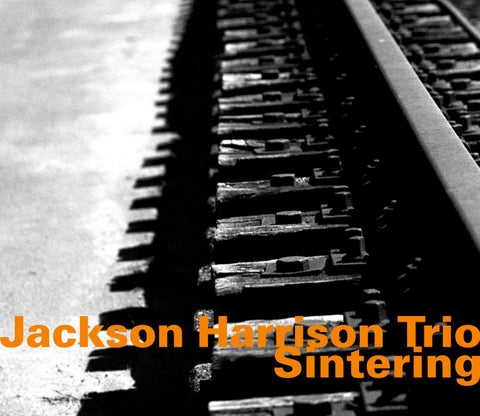
Jackson Harrison Trio Sintering
Sintering
Stuart Broomer, August 2014
Jackson Harrison isn’t in a hurry. While many musicians his age, 33, record with seemingly monthly frequency, Harrison has quietly let seven years pass since his debut was released, the lustrously ephemeral Land Tides, and nine since it was recorded. In the early decades of the 21st century, that’s the kind of time in which a new technology or a pop star can appear, find instant favour and mass adulation, be cast aside on the ashheap of history and revived as the answer to a trivia question about some antediluvian past.
It’s not as if Land Tides didn’t meet with recognition. Writing in Signal to Noise, Lawrence Cosentino remarked that, “each note twinkles like a hot point in an unbounded sky,” while Brian Morton wrote in The Wire that “What’s striking is how concentrated Harrison’s playing is, not in the sense of sounding clotted or tonally congested but rather in seeming to come from an almost mystical understanding that transcends technique.” That’s the kind of press that might send another musician rushing back to the studio, but it didn’t have that effect on Harrison at all. Instead he’s been travelling further into his music, with that “almost mystical understanding” that Morton heard in Land Tides. Harrison seems to work from a sense of abundant time and space. On that debut recording he drew inspiration from the moon’s gravitational pull on the earth and the ancient rock monasteries of India. In some sense, that abundance might reflect Australia’s own space and time, from the scale of its wilderness to an ancestral Dreamtime. That sense of duration is apparent in other developments in Australian music, such as the overlapping figures employed by The Necks to generate long collective improvisations and Ross Bolleter’s highly creative use of pianos abandoned in the landscape. Jackson may work from closer ties to the jazz tradition and record in a studio on a Steinway D, but something of the same time and space conspires in his music to admit mysteries.
While one can trace the building blocks of this music through Herbie Hancock and Paul Bley to Bill Evans, its paths of modality, chromaticism and repetition leading eventually to the once highly individualistic (and now central) piano musics of Erik Satie and Alexander Scriabin, Harrison provides the immediate example of his mentor, Mike Nock, and his ability to fuse structure and spontaneity: “Mike has been a huge influence on me. He unremittingly pursues his musical vision through the piano and his compositions. He plays in the moment with fire and passion, but also with lines that have an internal strength and sophisticated structure. Mike’s musical life is artistically uncompromising but always actuated by a desire to connect himself with his audience.” That sense of the immediate extends to the make-up of Harrison’s trio, a group that began with his first days at music college. It’s hard to imagine this collective intimacy with time arising in a group whose members haven’t known each other since youth. The pianist recalls, “I met Ben Waples almost fourteen years ago on our first day at the Sydney Conservatorium of Music, I remember this as we kicked off the friendship with a discussion of Herbie Hancock’s ‘Thrust’ album. I spent the next year hearing about Ben’s talented younger brother James ‘Pug’ Waples, who was then still in high school and planning to move up to Sydney after graduation. When this happened we began playing gigs around Sydney as a trio and have played together ever since. “Ben possesses a strikingly natural fluency with his instrument and with music in general, and his harmonic intuition is essential to the trio as he can move within and support any texture I play. James plays the drums like an artist painting a canvas and can explode (as he puts it) any idea whilst not engulfing the piano. On top of it he has a solid groove and cymbal beat.
“This trio’s music reflects the broad range of music I am drawn to, whether it’s a simple melody or tune, or freely improvised music, and Ben and James’ musicianship allows us to travel to any of these spaces.” That leads naturally to Harrison’s conception of his own music: “I mainly pursue melody and textural richness, or my versions of those things. If the music hits a vein which I feel has some kind of internal strength or meaning, be that a melodic phrase, a rhythm or a texture, I like to try and stay with it and see what emerges. Artists I admire have the ability to both follow and create a line seemingly simultaneously.” If there’s an overarching meaning to be drawn from Jackson Harrison’s music it might revolve around the way his individual pieces are often reveries of repetition and relationship. He can repeat a phrase seemingly endlessly, and whether we tune in immediately to the microscopic variations of touch or the shifting continuum of his partners’ roles, something is changing and growing, as much time itself as the piece, as the oneness of Jackson’s figures with time becomes absolute. There is a miracle of fixity here, a persistent and indivisible doubleness in which both sameness and change are absolute, as if an intense sense of the quotidian has opened onto the Dreamtime, a sense of the past that is at once remote, immediate and continuous.
That sense of time allows a musical phrase to become fixed, to assume a kind of immutability, in part because so much of what Jackson plays—his clusters, lines and phrases—resists any kind of conventional resolution, whether it’s the sustained melodic repetition of “Charcoal Chorale,” with its mirroring phrases, or the relationship between phrases in “Day for Night.” The movement of the music from piece to piece suggests larger structures, suggested by the titles “Preludial” and “Fin,” but the process seamlessly links composed pieces and collective improvisations. Harrison describes the moods captured at the beginning and end of the session: “Both ‘Preludial’ and ‘Fin’ are free improvisations. Both pieces start with the piano and there was no design contemplated in their respective moments other than to attempt to follow the music from the first note onwards. ‘Preludial’ was recorded at the start of the day, and ‘Fin’ at the end. To my ears ‘Preludial’ simmers with energy and a desire to get into it, as it were. In ‘Fin,’ we are allowing calm, pastoral colours and textures to wash over the trio, and perhaps this was only possible at the end of the day.” More formal pieces appear in the course of the session. Harrison continues, “‘Roundel’ has a long melodic form interspersed with a vamp. This piece was untitled until I heard about the poetic form known as ‘Roundel’ or ‘Rondeau,’ and that seemed to match (in a general sense) the form of the tune.
“I first heard of the metallurgical process of sintering when looking at an art book featuring Australian designer Marc Newson’s work which was made with metal. It struck me that Newson was using a turbulent process at the end of which a beautiful object emerged. There may be some similarities with music and jazz in that the process is fiery but there also may follow a beautiful ‘product’ embodied in a recording or a score.” It’s worth further noting that sintering—materials forming a solid mass without melting—is a process that occurs in many forms in both geology and industry, linking nature and art. Harrison is a melodist who has found his own patterns for melody, apparent in the anxious repetition of an unresolved motif in the opening “Preludial,” in the transformative, alchemical heat suggested by “Sintering,” or the contrast of the transparent resolution of “River Dolphin.” Throughout, Harrison creates his own structural language with a music that is both deceptively simple and, ultimately, wholly beautiful, the recording somehow complete with the sunlight dance on water that “Fin” seems to capture, Harrison’s lapping figures and James Waples’ spare, resonant drums echoing toward infinity.
Jackson Harrison Trio
ut o t H re t f Ha e a y o m w nit u fro ud ng pro mm . i o g ic d w r c o ! in ec ho ide rd mus ear t r w w co h irs kno rld- s re the ou f y i r o u ou to w th yo hat s y you ing njoy ing w i s s nt ow e br r i hi r r t wa r g you to ea he we ou at aim u h er t he th, r of e th nt t yo ling ! W r X be op sta ha eh ou you em e h con r. W X. U y e r k r a m . W ur o cov rne an , o s Th rds u as ner nts dis We co yo iste ese to l Re ve pr ture re ha It e fu th of
Harrison is a melodist who has found his own patterns for melody, apparent in the anxious repetition of an unresolved motif in the opening “Preludial,” in the transformative, alchemical heat suggested by “Sintering,” or the contrast of the transparent resolution of “River Dolphin.” Throughout, Harrison creates his own structural language with a music that is both deceptively simple and, ultimately, wholly beautiful … Stuart Broomer, August 2014
OLOGY Albert Ayler Quartet European Radio Studio Recordings 1964 hatOLOGY 678 Anthony Braxton Quartet (Santa Cruz) 1993 2nd set hatOLOGY 714
Jackson Harrison Trio Sintering
Cecil Taylor Garden · 2nd set hatOLOGY 720
Jackson Harrison piano Ben Waples double bass James Waples drums 1
Preludial
Uwe Oberg Work hatOLOGY 740
6:53
Ellery Eskelin Trio Willisau · Live hatOLOGY 741
by Jackson Harrison, Ben Waples and James Waples ISRC CH 131.1601458
2
Roundel
11:13
ISRC CH 131.1601459
3
Sintering
4:51
by Jackson Harrison, Ben Waples and James Waples ISRC CH 131.1601425
4
Charcoal Chorale
11:21
ISRC CH 131.1601461
5
Day For Night
5:50
ISRC CH 131.1601462
6
River Dolphin
7:28
ISRC CH 131.1601463
7
Fin
5:15
by Jackson Harrison, Ben Waples and James Waples
Special thanks to Kim Hungerford, Anthony and Sharon Lee, Mike Nock and Yuri Takahashi, Ivan Vizintin.
ISRC CH 1311601464
Total Time DDD All compositions by Jackson Harrison except otherwise indicated, Tuhtah Publishing SUISA
Recorded September 6th, 2013 by Ivan Vizintin at Lee Studio, Sydney; Mixed and mastered December 2013 by Jan Erik Kongshaug at Rainbow Studio, Oslo; CDMaster by Peter Pfister; Liner notes by Stuart Broomer; Photo by Hans Hagen Stockhausen; Graphic concept by fuhrer vienna; Produced by Jackson Harrison and Anthony Lee; Executive production by Bernhard "Benne" Vischer, Christian C. Dalucas and Werner X. Uehlinger.
52:56
1st Edition, 2016 Printed by Gantenbein AG, CH 4127 Birsfelden www.hathut.com File under: Jazz/Free Improvisation
+ 훿 2016 HAT HUT Records Ltd. Box 81, 4020 Basel, Switzerland. All rights reserved. Unauthorized duplication is a violation of applicable laws. Made in Switzerland. Released as part of the 40th anniversary of Hat Hut Records.
hatOLOGY 723
Jackson Harrison Trio · Sintering