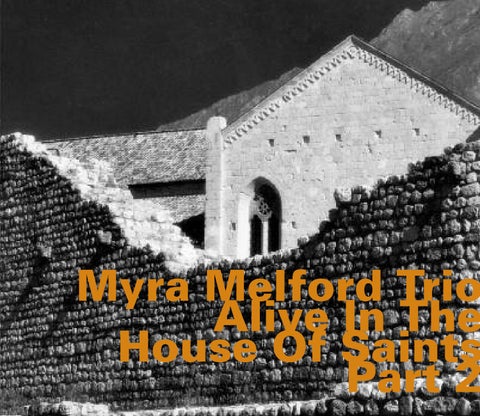
Myra Melford Trio Alive In The House Of Saints Part 2
Alive In The House Of Saints
Andy Hamilton, October 14, 2017
Myra Melford is a polystylist, who draws on and creates multiple playing styles. She combines free playing with strong melodic content and driving rhythms, from a wide range of influences. In Alive In The House Of Saints these include stomping classic jazz piano, the funky attack of Horace Silver, gospel plangency, Keith Jarrett’s country and blues lyricism, and Don Pullen-style free jazz. Though from quite early in her career, Alive is one of her finest recordings – high on the musical power spectrum, one of the most exciting albums of piano jazz. Her polystylism contrasts with artists who have a strong signature style – an approach that allows listeners to identify them after a few bars, internalised and immediately apparent in everything the artist produces. A signature style doesn’t directly imply anything about artistic quality – that depends on how the style is created and used. True improvising artists such as Lee Konitz or Miles Davis are recognisable from the first few notes. But what is a virtue in Konitz’s case, can become, in the hands of lesser artists, a mere branding device.
For some writers, even in the most illustrious cases, a signature style is a branding device. Art historian Christopher Atkins’s recent book The Signature Style of Frans Hals illuminates the relation of subjectivity and style, interpreting the Dutch master’s style as a personal and workshop brand. Initially, Hals worked in two distinct modes – smooth for portraiture, rough and unblended for genre scenes. In the 1630s he abandoned genre painting, and began to develop a sketchy aesthetic for portraits. Scientific examination shows that Hals worked up his paintings over several sessions, while seemingly persuading viewers that his sketches were spontaneous. It’s not necessary to be a connoisseur, in order to tell a Hals from a Rembrandt or a Vermeer. Hals, it seems, developed a sketchy manner – increasing the roughness and looseness of individual strokes, and the degree to which they were unblended – in order to emphasise an individual style. Philosopher of art Richard Wollheim contrasted individual style and signature: individual style is personal and intentional, while signature elements reveal authorship but are not necessarily intentional. But these are elusive distinctions, and Wollheim allowed that artists can intentionally employ a distinctive individual style, in order to make their authorship known. However, to call this “branding” is to diminish the pursuit of individuality, I’d say.
A signature style belongs with the Romantic conception of artistic genius. Maybe it doesn’t have to be a unitary style – in his earlier career, for instance, Ligeti perhaps had two contrasting signatures. But some artists reject a signature style entirely. British composer James Weeks comments that “I don’t want to write what I already know…It’s a question of unlearning, of being ready always to let go of what you think you know. Technique has to be re-made, or at least re-purposed, at every moment, unless you want to re-write the same piece over and over again”. Another example is Kazuo Ishiguro. For Duncan White, writing on his recent award of the Nobel Prize for Literature, Ishiguro doesn’t have a signature style: “It doesn’t do justice to his extraordinary ability to reinvent himself from book to book. It’s not just that he has a different idea each time; it’s that each of his novels reads as if written by a completely different person. He is a shape shifter…a chameleon”. To say that each novel reads as if written by a different author is too strong – there are deep connections between the works, and without common features, there is no style at all. Reticence and plainness, for instance, are part of Ishiguro’s style. Just as one should distinguish a signature style that expresses genuine individual artistry, from one that’s pure branding, so there’s a contrast between artistic rejection of signature style, and banal failure to achieve a personal style. Some deeply individual artists have a signature, and others do not; the same contrast applies to hacks. Thus as with Ishiguro, at a deep level there’s a rich artistic personality in Myra Melford’s work, that takes many distinct forms. Thinking again of Frans Hals, for instance: while the painter worked to create the impression of real spontaneity, Melford works to create real spontaneity, producing music of power and sophistication.
Perhaps the jazz world, with its historic connections with the entertainment industry, tends to favour artists who have a signature style. Bill Evans, McCoy Tyner, Miles Davis, John Coltrane, Ornette Coleman – these musicians have a strong signature style, part and parcel of their iconic influence. But there are great jazz players who don’t have a signature style: as well as Melford, one could mention John Zorn, William Parker, Wadada Leo Smith, Ethan Iverson and Dave Douglas. (In the other 20th century American artform often bracketed with jazz, Stanley Kubrick, or Powell and Pressburger, would be other examples.) Some of these players have a signature style tonally, but not formally. In Melford’s case, this rejection of signature is partly a product of her open-eared fascination with many genres of music. As she commented in an interview, “I’ve certainly listened to lots of Latin American music and African music, never with the idea of trying to study those traditions deeply and play it authentically, so to speak, but rather to allow it to inspire me and see how it filters through my own sensibility”. During a Fulbright scholarship to Calcutta in 2000-1, she studied North Indian classical music with a harmonium master. Though the work on this recording precedes those studies, the methodology is the same, in relation to the more obviously jazz-related influences apparent here.
Born in 1957 in the Chicago area, and brought up there, Melford studied with Art Lande, Julian Priester, and Gary Peacock at the Cornish Institute in Seattle. In 1984 she moved to New York to work with the masters she’d heard on recordings and in concerts, including Henry Threadgill, Jaki Byard and Don Pullen and later performed with mentors Leroy Jenkins and Joseph Jarman. In 1990 she formed a trio with Lindsey Horner on bass and Reggie Nicholson on drums – this is the totally simpatico trio heard on the present album, a date from 1993. A two-CD reissue with previously unreleased tracks appeared in 2001; now the label has again reissued the two CDs, separately this time, with Part 2 following last year’s reissue of Part 1 hatOLOGY 707. A vital ingredient to the performance is Melford’s compositions, which are thematically strong and subtle springboards for improvisation. Her studies with Henry Threadgill were formative, as she explained in an interview: “I wanted badly to get away from the head-solo-head thing, which is so overused in jazz. Henry was the perfect person to study with. He calls his process organic composition…[He would] take a simple cell, or musical idea, turn it upside-down, make all sorts of permutations on it and then have the form of the piece grow out of these ideas in a natural way”.
On these superb sides, the members of the trio respond organically to one another – their creative empathy is clear throughout. Reggie Nicholson is a great, rather neglected drummer who, on this session, is on dazzling form. The result is a consummate live performance, full of feeling, in which no one is wrong-footed. Melford is alive to everything she hears, responding in the moment to her musical partners.
Myra Melford Trio Alive In The House Of Saints Part 1 Also available hatOLOGY 707
Myra Melford Trio
ut o t H re t f Ha e a y o m w nit u fro ud ng pro mm . i o g ic d w r c o ! in ec ho ide rd mus ear t r w w co h irs kno rld- s re the ou f y i r o u ou to w th yo hat s y you ing njoy ing w i s s nt ow e br r i hi r r t wa r g you to ea he we ou at aim u h er t he th, r of e th nt t yo ling ! W ur X be hop nsta ha Ueh u o o o .W . em e k y r y m W r c er r X an s, o s a rs. s ou cov rne h s e T rd u a ne nt di W co yo iste ese to l Re ve pr ture re ha It e fu th of
Myra Melford is a polystylist, who draws on and creates multiple playing styles. In Alive In The House Of Saints these include stomping classic jazz piano with a funky attack, gospel plangency, country and blues lyricism, and free jazz episodes. Though from quite early in her career, Alive In The House Of Saints, Parts 1 and 2 is one of her finest recordings – high on the musical power spectrum, and one of the most exciting albums of piano jazz. The members of the trio respond organically to one another – their creative empathy is clear throughout. Melford is alive to everything she hears, responding in the moment to her musical partners. Andy Hamilton
OLOGY
Albert Ayler Quartet Copenhagen Live 1964 hatOLOGY 665 Anthony Braxton Quintet (Basel) 1977 hatOLOGY 676
Myra Melford Trio Alive In The House Of Saints Part 2 Myra Melford
Ran Blake Something To Live For hatOLOGY 711
piano
Lindsey Horner
bass
Reggie Nicholson 1
Albert Ayler Quartet European Radio Studio Recordings 1964 hatOLOGY 678
Matthew Shipp Invisible Touch At Taktlos Zürich hatOLOGY 743
drums
Breaking Light
8:57
ISRC CH 131.1801535
2
Some Kind Of Blues*
9:39
ISRC CH 131.1801536
3
That The Peace
10:44
ISRC CH 131.1801537
4
And Silence
12:11
ISRC CH 131.1801538
5
Now & Now 2*
6:53
ISRC CH 131.1801539
6
Live Jump
12:19
ISRC CH 131.1801540
Total Time DDD
60:46
All titles composed by Myra Melford. All (except titles with *) Tuhtah Publishing SUISA.
Co-Production Westdeutscher Rundfunk Köln/Hat Hut Records Ltd.; 1–4 recorded live on February 5, 1993 at The Club, Heiligenhaus, Germany. 5–6 recorded live on February 3, 1993 at Alte Oper, Frankfurt, Germany.; Recording supervisor: Ansgar Ballhorn; Sound engineer: Georg Litzinger; Remix & new CD master December 2000 by Peter Pfister; Cover photo by Elio Ciol; Liner notes by Andy Hamilton; Graphic concept by fuhrer vienna; Produced by Arnd Richter/Werner X. Uehlinger. 2018, 3rd Edition remastered Printed by Gantenbein AG, CH 4127 Birsfelden www.hathut.com File under: Jazz/Free Improvisation
+ 훿 2018 HAT HUT Records Ltd. Box 81, 4020 Basel, Switzerland. All rights reserved. Unauthorized duplication is a violation of applicable laws. Made in Switzerland.
hatOLOGY 708
Myra Melford Trio · Alive In The House Of Saints, Part 2