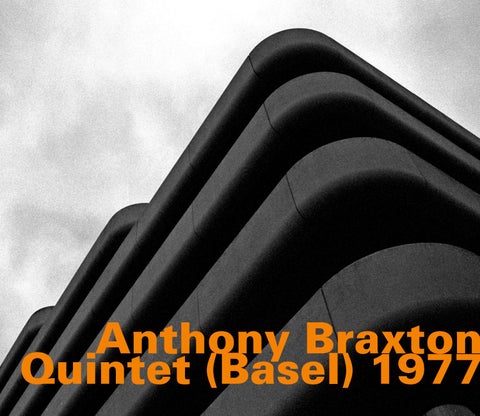
Anthony Braxton Quintet (Basel) 1977
Quintet (Basel) 1977
Art Lange, March 2000
In his liner notes to the live recording Dortmund (Quartet) 1976 (hat Art 6075, released in 1991), Graham Lock lamented that there was little, if any, documentation of Anthony Braxton’s various quartets (and, on rare occasions, quintets) from 1975 to ‘78, preventing us from experiencing the full scope of Braxton’s music during this period. Bits and pieces of the picture have fortunately been appearing since Lock’s comments were written, and as we shall see this important release marks the biggest and most valuable piece yet offered. It is, of course, misleading to base an overview of a musician’s work solely upon recorded examples; there’s much crucial detail that falls between the cracks, remaining unheard, flawed through memory, possibly unknown altogether. Nevertheless, recordings serve as valuable signposts along the unpredictable path such a multifarious career takes. This was a period of fluctuation and expansion for Braxton, marking the beginning of some collaborations and the ending of others. The wonderful quartet with trumpeter Kenny Wheeler, bassist Dave Holland, and drummer Barry Altschul, which brought Braxton’s music to a larger and more appreciative audience than it had previously enjoyed, began in 1974; within two years trombonist George Lewis had replaced Wheeler (this was the quartet that played at Dortmund in ‘76
on hatOLOGY 557), then the group dissolved. Except for a frustratingly brief excerpt from a 1976 loft concert featuring an unusual septet including Lewis and Altschul, prior to now there has been no other material available of Braxton leading one of his working ensembles from that point until the emergence of the quartet with trombonist Ray Anderson, bassist John Lindberg, and drummer Thurman Barker heard on Performance (Quartet) 1979 (hatOLOGY 574). The most striking aspect of the personnel employed by Braxton for this March 1977 performance in Basel is the participation of Muhal Richard Abrams. Muhal was then, and of course remains today, one of the key figures in contemporary American music, both for his own exceptional music, and his role in co-founding the Association for the Advancement of Creative Musicians and guiding it through its crucial (and crucially influential) early years in Chicago when the organization was directly responsible for providing a forum for experimental musicians, in what Braxton would characterize as the post-Coltrane and postWebern musical continuum, that helped erase distinctions between composition and improvisation and greatly expand the palette of sonorities available to the creative musician. Muhal’s appearance as a featured guest in this group illustrates the powerful link between himself and Braxton, from the earliest days of Braxton’s career (the alto saxophonist received the ultimate compliment in 1967 by being invited to make his recording debut on Abrams’ first album under the AACM banner, Levels and Degrees of Light [Delmark]) through today. But Braxton and Abrams seemed especially close during this period; they appeared together on Woody Shaw’s The Iron Men (Muse), Abrams performed in Braxton’s Creative Music Orchestra (Arista), Braxton returned the favor on Muhal’s 1+OQA+19 (Black Saint), and they collaborated on Duets 1976 (Arista).
Of course, their history goes deeper than this. Abrams was a frequent guest with Braxton’s first
lasting ensemble, the cooperative trio sometimes known as the Creative Construction Company, with violinist Leroy Jenkins and trumpeter Leo Smith. The pianist appeared on their 1968 debut recording, released under Braxton’s name (as were most of the group’s subsequent sessions), Three Compositions of New Jazz (Delmark), and again when, on Braxton’s return from Europe, the group reunited for a single concert in 1970 (two volumes originally released on Muse). In many ways, Muhal’s playing became a blueprint for the multifaceted functions which the piano would need to fulfill in Braxton’s future music, and set a high standard for others to reach; although several (Michael Smith, David Rosenboom, Anthony Davis among them) worked with Braxton at isolated times, the fact that no pianist remained a permanent part of any of his groups until the emergence of Marilyn Crispell illustrates not only how difficult a position it was to fill but also how successful Crispell was at negotiating its demands. (None of which is meant to suggest that Braxton feels any ambivalence about the instrument’s role in his music; actually, he has often been happy to work in occasional or one-shot duos with pianists as temperamentally and stylistically diverse as Ran Blake, Giorgio Gaslini, and György Szabados; he has composed extensively for the piano, both solo [witness the substantial Piano Music (Notated)
1968-88 (hat Now Series 61941-44)] and in various chamber ensembles; and he even put his horns aside for a seat at the keyboard himself circa 1994-95.) As a composer, too, some of Abrams’ ideas were to influence Braxton during his formative stages. John Litweiler, in his important book The Freedom Principle, quotes Abrams as expressing the necessity of “expansion and contraction of rhythm” in his music (which he discovered in Art Tatum’s playing), something which would find both a concrete and metaphorical place in Braxton’s compositional outlook (via his pulse track structures and other methods of inspiring shifting degrees of engagement among the members of any given group), as well as highlighting the importance of working with musicians able not merely to fit in but to “create a part” in his compositions. Also, in his Tri-Axium Writings, Braxton cites Abrams’ exploration of the “spiritual implications of the black aesthetic.” These attitudes could be interpreted as forerunners of Braxton’s “affinity postulation”—how individuals identify a self-awareness and constructive realization in relation to an ensemble-oriented music (itself a metaphor for a democratic community), simultaneously establishing a connection to a spiritual or higher, transcendental, force. Further, one wonders if Braxton’s early, open, and variable concepts for large ensembles were not influenced by his experiences with Abrams’ (sadly unrecorded) Experimental Band of the early and mid 1960s equally alongside his knowledge of contemporary European “classical” composers like Ligeti, Stockhausen, Xenakis, and the American maverick Earle Brown. As the repertory from this Basel concert indicates, Braxton’s “book” from which he took material for live performances at this time was heavily weighted in favor of recent compositions (17 of which were written between 1976 and ‘79 and listed in his catalogue of works as Composition No. 69 A-Q), with a few favorites drawn from the earlier collections
of No. 6 A-P and No. 40 A-Q. All of these pieces focus on particular improvisational strategies and are flexible enough in format and design to accommodate any type of small group. Though Braxton had not yet fully codified the “collage structure” which was to be in practice for the 1979 Willisau performance, much less the later “pulse track” and “mutable construction” formats, he nevertheless did have the individual pieces connected into suites by way of brief improvisational interludes. Thus Composition No. 69J, “a single-line structure that re-seats itself into open pockets of light improvisation,” segues from Mark Helias’ bass solo directly into the “thematic-generating” spatial tactics and shaped contour lines of No. 69N. Braxton notes that during this piece “the floor should drop out of the music,” giving the musicians no solid harmonic or rhythmic footing whatsoever; as the music reaches fruition, the horns and piano pick up and enlarge the incipient rhythms developed in the open ensemble improvisation and charge into the uptempo, aggressive No. 69G—”an atonal line continuum of beboplike phrase constructions.” This piece is the conclusion of the concert’s first set. Unfortunately the second set needed to be excerpted (omitting No. 69F and No. 40I) to fit on this disc; what we have are the opening piece, Composition No. 69M—”a bebop-like head for the Nuclear Age...a principle-
generating structure (pattern or vamp) that points the fabric of its invention”—and what was either the concert’s finale or encore, a Braxton favorite (from the number of times it has appeared on disc or in performances), No. 40B, dedicated to Lou Donaldson, which with Mingus-like élan alternates between a jazzy ostinato pulse and a fast swing section. Each of these compositions contains, in Braxton’s term, “multi-structural logics”—multi-sectional internal guides (either specific notation or directions, or conversely, unspecified regions intended to engage the imagination of the participants) that ensure focused details, spontaneous dialogues, interactive gestures, fresh dynamics, cohesive shapes, and continuous momentum. I leave the discovery of favorite episodes or events to you. But it’s important to remember that despite Braxton’s compositional craft—the motivating factors behind the music and the formal glue that holds it together—this is, as Braxton intended all along, music that emerges from the particular combination of musicians. George Lewis is one of Braxton’s favorite collaborators, for reasons that should be immediately audible. Muhal Richard Abrams is a rare and fascinating addition to this group. Bassist Mark Helias and drummer Charles “Bobo” Shaw have not often been documented in Braxton’s music, yet they were occasional contributors during this period, and their familiarity with and commitment to the music is obvious. Despite the temporary, even fleeting nature of this ensemble, for me, what emanates from these performances is a spirit which exemplifies the life-affirming status of Anthony Braxton’s music, reveals new information about the past, and gives us hope for the future.
Anthony Braxton
ut o t H re t f Ha e a y o m w nit u fro ud ng pro mm . i o g ic d w r c o ! in ec ho ide rd mus ear t r w w co h irs kno rld- s re the ou f y i r o u ou to w th yo hat s y you ing njoy ing w i s s nt ow e br r i hi r r t wa r g you to ea he we ou at aim u h er t he th, r of e th nt t yo ling ! W r X be op sta ha eh ou you em e h con r. W X. U y e r k r a m . W ur o cov rne an , o s Th rds u as ner nts dis We co yo iste ese to l Re ve pr ture re ha It e fu th of
I leave the discovery of favorite episodes or events to you. But it’s important to remember that despite Braxton’s compositional craft—the motivating factors behind the music and the formal glue that holds it together—this is, as Braxton intended all along, music that emerges from the particular combination of musicians. George Lewis is one of Braxton’s favorite collaborators, for reasons that should be immediately audible. Muhal Richard Abrams is a rare and fascinating addition to this group. Bassist Mark Helias and drummer Charles “Bobo” Shaw have not often been documented in Braxton’s music, yet they were occasional contributors during this period, and their familiarity with and commitment to the music is obvious. Despite the temporary, even fleeting nature of this ensemble, for me, what emanates from these performances is a spirit which exemplifies the life-affirming status of Anthony Braxton’s music, reveals new information about the past, and gives us hope for the future. Art Lange
1
Anthony Braxton Quintet (Basel) 1977
George Lewis
alto saxophone, sopranino saxophone & clarinet
Muhal Richard Abrams Mark Helias
Cecil Taylor Garden · 2nd set hatOLOGY 720
/
26:02
Uwe Oberg Work hatOLOGY 740
12:52
Ellery Eskelin Trio Willisau · Live hatOLOGY 741
ISRC CH 131.19900163
3
Composition 69 M ISRC CH 131.19900164
4
trombone
Composition 69 N/G
Composition 40 B
Anthony Braxton Quartet (Santa Cruz) 1993 2nd set hatOLOGY 714
16:25
ISRC CH 131.19900162
2 Anthony Braxton
Composition 69 J
OLOGY Albert Ayler Quartet European Radio Studio Recordings 1964 hatOLOGY 678
18:15
ISRC CH 131.19900165
piano
Total Time AAD
73:37
double bass
Charles “Bobo” Shaw
drums
Compositions by Anthony Braxton, Tuhtah Publishing/Suisa. Recorded live June 2, 1977 at Safranzunft, Basel Switzerland by Radio DRS, Studio Basel; New CD-master August 2016 by Peter Pfister; Liner notes by Art Lange; Cover photo by Hans Hagen Stockhausen; Graphic concept by furher vienna; Executive production by Bernhard “Benne” Vischer, Christian C. Dalucas and Werner X. Uehlinger. Special thanks to Peter Bürli & Jazz in Basel. 2nd Edition, 2016 Printed by Gantenbein AG, CH 4127 Birsfelden www.hathut.com File under: Jazz/Free Improvisation
+ 훿 2016 HAT HUT Records Ltd. Box 81, 4020 Basel, Switzerland. All rights reserved. Unauthorized duplication is a violation of applicable laws. Made in Switzerland. Released as part of the 40th anniversary of Hat Hut Records.
hatOLOGY 676
Anthony Braxton · Quintet (Basel) 1977