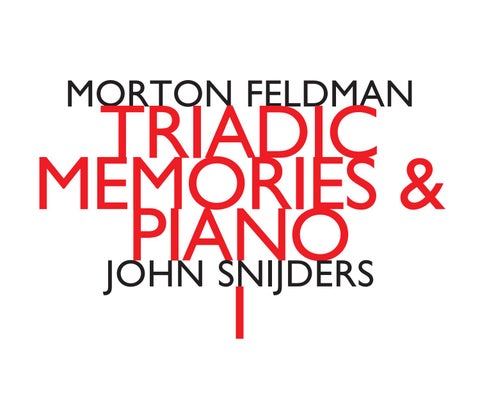
TRIADIC MEMORIES & PIANO JOHN SNIJDERS I MORTON FELDMAN
To listen to the piano music of Morton Feldman is to come close to the heart of his compositional personality. Feldman’s writing for instruments is never less than beautiful but the piano was his instrument, indeed more than an instrument: an atelier, a laboratory, even a desk. Gavin Bryars recalls visiting Feldman in 1968 in his New York apartment and observing him at work, sitting at his grand piano, at which he worked ‘slowly and painstakingly, trying a cluster of notes, peering at the score with his eyes inches from the paper, writing a few notes, playing them again and again’. To another visitor, Walter Zimmermann in 1975, Feldman explained that he worked at the piano because ‘it slows me down and you can hear the time element much more, the acoustical reality… just sitting at a table, it becomes too fancy. You develop a kind of system… you get into something that has really nothing to do with acoustical reality.’ Feldman’s preoccupation with ‘acoustical reality’ was the primary subject of all his work but the intimate acoustic reality of the instrument at which he worked became a particular focus during the last decade of his life. He produced four extended solo works: the two recorded here, Piano (1977) and Triadic Memories (1981), and then For Bunita Marcus (1984) and Palais de Mari (1986). All sound like Feldman of course – all share that extraordinary sense of time
suspended, of instrumental colour refracted through pitch and back again, voicing and revoicing that ‘cluster of notes’ which Bryars had heard him trying – but each also offers a radically different conception of the piano. Most radical of all perhaps is Triadic Memories. Under the first measure of music on each of the twenty-five pages of Feldman’s manuscript score is a fraction, an abbreviation and an arrow, indicating that the piano’s sustaining pedal is to be held halfway down throughout the piece. Introducing the music to its first American audience in Buffalo on 18th March 1982 (Roger Woodward had given the world premiere in London the previous October) Feldman explained this feature of the piece and joked that he didn’t want the audience to think that the pianist, Aki Takahashi, was ‘one of those pianists that never take the pedal off’. Joking aside, this technical adjustment to the resonance of the piano has profound implications. As Feldman said to his Buffalo listeners, the challenge was to ‘find a new palette that worked’ in the new acoustic reality of a piano that never quite stops ringing. ‘A new palette’: as so often with Feldman the allusion to painting is more than a metaphor and in Triadic Memories he had in mind a particular technique which he had noticed in a series of recent paintings by Cy Twombly. Lecturing in Toronto a month after the American premiere
of Triadic Memories, Feldman described how Twombly ‘used a kind of gesso, very thin gesso, where the tint changed ever so slightly you could hardly catch it from one painting to another. And it gave it this kind of – rainbow. And I got that idea from him, I got that idea of putting a little gesso, that I’m on this very precarious gesso smudge, so to speak.’ By 1981 and the composition of Triadic Memories Feldman had made the quite deliberate decision to adapt his musical language, to imagine a music whose conception did not depend on the presence of an audience with all their expectations of how music should be. In the 1982 Toronto lecture Feldman suggested that the trigger for this shift in artistic purpose was a conversation with a music publisher: ‘he looks at me and he says, “Feldman, you’re not gonna make it unless.” I said, “Unless what?” He said, “You need a little drama. Not much. You need a little drama. Just a little bit”.’ Feldman’s response was typically oblique. Drama, by its very nature, requires an audience, and Feldman chose instead to strip his music of any vestige of drama because, as he also said in the Toronto lecture, ‘if music is to be a art form it has to exist at least six weeks. Give us six weeks without an audience, and maybe something else could happen’. Triadic Memories is a version of that ‘something else’, its ‘precarious gesso
smudge’ precluding any possibility of dramatic oppositions of texture. Instead its subtly varied reiterations of a limited repertoire of figures challenges us to choose between a moment-tomoment listening – how beautiful this sound is now – and a listening in time – how beautiful that this should follow that. Above all, the new dimension of late-period Feldman, extended duration, challenges our reliance on memory as a musical navigation aid; perhaps this elongated musical territory needs a new sort of listening altogether. In many Feldman scores there’s also an element of ambiguity and in Triadic Memories it’s to do with duration, an ambiguity which has led to wide deviations in the timing of previous CD recordings of the work. Feldman said that the piece lasted ninety minutes but he didn’t include a metronome marking in his manuscript score. Normally that wouldn’t be a problem since the tempo in almost all late-Feldman is 63-66 beats per minutes, but if one plays the quarter-notes in Triadic Memories at that speed the piece is much shorter than ninety minutes; that was Aki Takahashi’s tempo and Feldman told her it was far too fast. Instead John Snijders plays the opening 3/8 measure as if it were two beats at Feldman’s normal tempo, an inspired solution to the puzzle which produces an overall duration of exactly the length Feldman anticipated. Because Snijders
uses Feldman’s manuscript score he also plays the right number of repeats; Feldman marked many measures to be repeated several times but unhelpfully the first printed edition of the score failed to indicate this. If Triadic Memories is characteristic of late-period Feldman, Piano is harder to categorise. Completed in May 1977 it is the only solo instrumental piece in a period dominated by the opera Neither (1977) and a series of works for orchestra. These are large-scale works in that they involve many musicians but their time-scale is conventional – the longest, Flute and Orchestra (1977/8) takes thirty-five minutes, the shortest, Voices and Orchestra (1972), fifteen – and their ‘glamorous’ (a favourite Feldman adjective) orchestration suggests that Feldman was consciously composing with, not against, the grain of audience expectations. Piano is less easily gratifying. In his essay, ‘Morton Feldman – the iconoclast’, Walter Zimmermann claims Feldman as a musical disciple of the third Mosaic commandment, ‘Thou shalt not make unto thee any graven image’, and concludes his essay with an analysis of the image-less music of Piano. Where Triadic Memories has figures smudged together by the half-pedalling into threads which in turn form longer, larger patterns, the individual sounds of Piano resolutely refuse to coalesce into readily memorable constellations,
even though they are often grouped together in continuous sequences. Piano is also a work of considerable complexity, the score sometimes multiplying in density from two to four to six staves, the music often in different metres on the different pairs of staves. Again, the contrast with Triadic Memories is telling. The score of Piano superimposes staves because Feldman is superimposing previously heard passages of the piece, copying them exactly but placing them on top of one another. The paradox here is that the process of superimposition obliterates any evidence of repetition; Feldman transcribes earlier music yet we hear only more new music. In Triadic Memories, on the other hand, Feldman never quite writes the same thing twice, but because he is turning the same handful of notes over and over again it seems at every moment as if we are about to hear repetition. Perhaps this is why time passing in Piano is so different from time passing in Triadic Memories. What do we listen to in Feldman? Music as an art form, versions of ‘something else’, how time passes, or a man sitting at a piano? Such clear music, so many questions. Christopher Fox 8th September 2010
or s, rd a o c s Re u a p e ut yo ho you H e e v t g a Ha o h rs. W brin ear! t h m ro are tene m to ou f g e lis ai at y din d w of ant h r o y w ec prou unit onst r is tr irs ow mm ur c hea f o h co u ur yo now ide ents at yo r is k w res h nge s i o th u t orld rep r. W hli e e o er t th t y g w . I ov . U he an win ding disc r X w r e W o e gr co to rn u! yo h, w ur s re ure We nk Xt of o thi fut a r y Th you ber njo the e of em m you usic t a m th he t
What do we listen to in Feldman? Music as an art form, versions of ‘something else’, how time passes, or a man sitting at a piano? Such clear music, so many questions. Christopher Fox
MORTON FELDMAN (1926–1987) T RI AD I C M EM O R I ES (1 9 81) & P I AN O ( 1 9 7 7 ) J O H N S N I J D E R S piano I hat(now)ART 2051 Triadic Memories Total Time DDD (beginning) 62:42
For the listener's convenience disc one is provided with an additional track point; this does not indicate a division of any kind of the work. ISRC CH 130.1700793 to ISRC CH 130.1700794
Co-Production: Hessischer Rundfunk & Hat Hut Records Ltd.: Recorded October 2000 at Hessischer Rundfunk, Frankfurt; Recording producer: Christoph Claßen; Recording engineer: Reiner Schwarz; CD-master by Peter Pfister; Liner notes by Christopher Fox; Graphic concept by fuhrer vienna; Executive production by Dr. Bernd Leukert, Bernhard “Benne” Vischer, Christian C. Dalucas & Werner X. Uehlinger. 2017, 1st edition Printed by Gantenbein AG, CH-4127 Birsfelden www.hathut.com File under: New Music/Contemporary Music
hat[now]ART 2051
M O RTO N F E L D M A N · T R I A D I C M E M O R I E S & P I A N O
TRIADIC MEMORIES & PIANO JOHN SNIJDERS II MORTON FELDMAN
To listen to the piano music of Morton Feldman is to come close to the heart of his compositional personality. Feldman’s writing for instruments is never less than beautiful but the piano was his instrument, indeed more than an instrument: an atelier, a laboratory, even a desk. Gavin Bryars recalls visiting Feldman in 1968 in his New York apartment and observing him at work, sitting at his grand piano, at which he worked ‘slowly and painstakingly, trying a cluster of notes, peering at the score with his eyes inches from the paper, writing a few notes, playing them again and again’. To another visitor, Walter Zimmermann in 1975, Feldman explained that he worked at the piano because ‘it slows me down and you can hear the time element much more, the acoustical reality… just sitting at a table, it becomes too fancy. You develop a kind of system… you get into something that has really nothing to do with acoustical reality.’ Feldman’s preoccupation with ‘acoustical reality’ was the primary subject of all his work but the intimate acoustic reality of the instrument at which he worked became a particular focus during the last decade of his life. He produced four extended solo works: the two recorded here, Piano (1977) and Triadic Memories (1981), and then For Bunita Marcus (1984) and Palais de Mari (1986). All sound like Feldman of course – all share that extraordinary sense of time
suspended, of instrumental colour refracted through pitch and back again, voicing and revoicing that ‘cluster of notes’ which Bryars had heard him trying – but each also offers a radically different conception of the piano. Most radical of all perhaps is Triadic Memories. Under the first measure of music on each of the twenty-five pages of Feldman’s manuscript score is a fraction, an abbreviation and an arrow, indicating that the piano’s sustaining pedal is to be held halfway down throughout the piece. Introducing the music to its first American audience in Buffalo on 18th March 1982 (Roger Woodward had given the world premiere in London the previous October) Feldman explained this feature of the piece and joked that he didn’t want the audience to think that the pianist, Aki Takahashi, was ‘one of those pianists that never take the pedal off’. Joking aside, this technical adjustment to the resonance of the piano has profound implications. As Feldman said to his Buffalo listeners, the challenge was to ‘find a new palette that worked’ in the new acoustic reality of a piano that never quite stops ringing. ‘A new palette’: as so often with Feldman the allusion to painting is more than a metaphor and in Triadic Memories he had in mind a particular technique which he had noticed in a series of recent paintings by Cy Twombly. Lecturing in Toronto a month after the American premiere
of Triadic Memories, Feldman described how Twombly ‘used a kind of gesso, very thin gesso, where the tint changed ever so slightly you could hardly catch it from one painting to another. And it gave it this kind of – rainbow. And I got that idea from him, I got that idea of putting a little gesso, that I’m on this very precarious gesso smudge, so to speak.’ By 1981 and the composition of Triadic Memories Feldman had made the quite deliberate decision to adapt his musical language, to imagine a music whose conception did not depend on the presence of an audience with all their expectations of how music should be. In the 1982 Toronto lecture Feldman suggested that the trigger for this shift in artistic purpose was a conversation with a music publisher: ‘he looks at me and he says, “Feldman, you’re not gonna make it unless.” I said, “Unless what?” He said, “You need a little drama. Not much. You need a little drama. Just a little bit”.’ Feldman’s response was typically oblique. Drama, by its very nature, requires an audience, and Feldman chose instead to strip his music of any vestige of drama because, as he also said in the Toronto lecture, ‘if music is to be a art form it has to exist at least six weeks. Give us six weeks without an audience, and maybe something else could happen’. Triadic Memories is a version of that ‘something else’, its ‘precarious gesso
smudge’ precluding any possibility of dramatic oppositions of texture. Instead its subtly varied reiterations of a limited repertoire of figures challenges us to choose between a moment-tomoment listening – how beautiful this sound is now – and a listening in time – how beautiful that this should follow that. Above all, the new dimension of late-period Feldman, extended duration, challenges our reliance on memory as a musical navigation aid; perhaps this elongated musical territory needs a new sort of listening altogether. In many Feldman scores there’s also an element of ambiguity and in Triadic Memories it’s to do with duration, an ambiguity which has led to wide deviations in the timing of previous CD recordings of the work. Feldman said that the piece lasted ninety minutes but he didn’t include a metronome marking in his manuscript score. Normally that wouldn’t be a problem since the tempo in almost all late-Feldman is 63-66 beats per minutes, but if one plays the quarter-notes in Triadic Memories at that speed the piece is much shorter than ninety minutes; that was Aki Takahashi’s tempo and Feldman told her it was far too fast. Instead John Snijders plays the opening 3/8 measure as if it were two beats at Feldman’s normal tempo, an inspired solution to the puzzle which produces an overall duration of exactly the length Feldman anticipated. Because Snijders
uses Feldman’s manuscript score he also plays the right number of repeats; Feldman marked many measures to be repeated several times but unhelpfully the first printed edition of the score failed to indicate this. If Triadic Memories is characteristic of late-period Feldman, Piano is harder to categorise. Completed in May 1977 it is the only solo instrumental piece in a period dominated by the opera Neither (1977) and a series of works for orchestra. These are large-scale works in that they involve many musicians but their time-scale is conventional – the longest, Flute and Orchestra (1977/8) takes thirty-five minutes, the shortest, Voices and Orchestra (1972), fifteen – and their ‘glamorous’ (a favourite Feldman adjective) orchestration suggests that Feldman was consciously composing with, not against, the grain of audience expectations. Piano is less easily gratifying. In his essay, ‘Morton Feldman – the iconoclast’, Walter Zimmermann claims Feldman as a musical disciple of the third Mosaic commandment, ‘Thou shalt not make unto thee any graven image’, and concludes his essay with an analysis of the image-less music of Piano. Where Triadic Memories has figures smudged together by the half-pedalling into threads which in turn form longer, larger patterns, the individual sounds of Piano resolutely refuse to coalesce into readily memorable constellations,
even though they are often grouped together in continuous sequences. Piano is also a work of considerable complexity, the score sometimes multiplying in density from two to four to six staves, the music often in different metres on the different pairs of staves. Again, the contrast with Triadic Memories is telling. The score of Piano superimposes staves because Feldman is superimposing previously heard passages of the piece, copying them exactly but placing them on top of one another. The paradox here is that the process of superimposition obliterates any evidence of repetition; Feldman transcribes earlier music yet we hear only more new music. In Triadic Memories, on the other hand, Feldman never quite writes the same thing twice, but because he is turning the same handful of notes over and over again it seems at every moment as if we are about to hear repetition. Perhaps this is why time passing in Piano is so different from time passing in Triadic Memories. What do we listen to in Feldman? Music as an art form, versions of ‘something else’, how time passes, or a man sitting at a piano? Such clear music, so many questions. Christopher Fox 8th September 2010
or s, rd a o c s Re u a p e ut yo ho you H e e v t g a Ha o h rs. W brin ear! t h m ro are tene m to ou f g e lis ai at y din d w of ant h r o y w ec prou unit onst r is tr irs ow mm ur c hea f o h co u ur yo now ide ents at yo r is k w res h nge s i o th u t orld rep r. W hli e e o er t th t y g w . I ov . U he an win ding disc r X w r e W o e gr co to rn u! yo h, w ur s re ure We nk Xt of o thi fut a r y Th you ber njo the e of em m you usic t a m th he t
What do we listen to in Feldman? Music as an art form, versions of ‘something else’, how time passes, or a man sitting at a piano? Such clear music, so many questions. Christopher Fox
MORTON FELDMAN (1926–1987) T RI AD I C M EM O R I ES (1 9 81) & P I AN O ( 1 9 7 7 ) J O H N S N I J D E R S piano II hat(now)ART 2052 Triadic Memories (conclusion) 27:05 ISRC CH 130.1700795
Piano 25:22
ISRC CH 130.1700796
Total Time DDD
52:33
Co-Production: Hessischer Rundfunk & Hat Hut Records Ltd.: Recorded October 2000 at Hessischer Rundfunk, Frankfurt; Recording producer: Christoph Claßen; Recording engineer: Reiner Schwarz; CD-master by Peter Pfister; Liner notes by Christopher Fox; Graphic concept by fuhrer vienna; Executive production by Dr. Bernd Leukert, Bernhard “Benne” Vischer, Christian C. Dalucas & Werner X. Uehlinger. 2017, 1st edition Printed by Gantenbein AG, CH-4127 Birsfelden www.hathut.com File under: New Music/Contemporary Music
hat[now]ART 2052
M O RTO N F E L D M A N · T R I A D I C M E M O R I E S & P I A N O