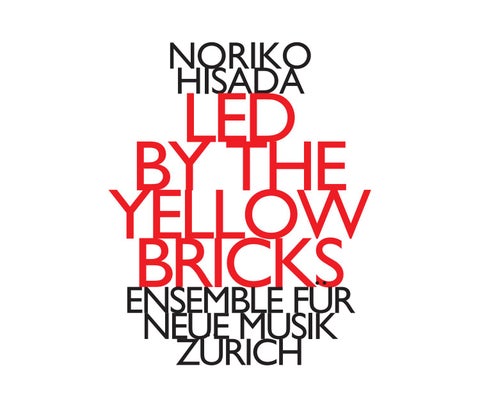
NORIKO HISADA
LED BY THE YELLOW BRICKS ENSEMBLE FÜR NEUE MUSIK ZÜRICH
N O R I KO H I S A DA : T H E W I Z A R D O F O Z “She came close to Dorothy and kissed her gently on the forehead. Where her lips touched the girl they left a round, shining mark, as Dorothy found out soon after.” And with that the little girl sets out on a journey down the road paved with yellow bricks, toward the Emerald City to find the great and powerful Wizard of Oz, who is supposed to help Dorothy get back to Kansas, which does in fact work out in the end, though differently than expected because the Wizard isn’t so powerful after all … &c. &c. Let’s leave Dorothy to the path Lyman Frank Baum set out for her in his classic children’s novel The Wonderful Wizard of Oz, originally published in 1900. To follow the eponymous seven-part cycle by Noriko Hisada there is no need to know more. The composer’s main intent wasn’t to retell the story down to the smallest detail. Therefore we neither encounter the Tin Woodman nor the Cowardly Lion, neither the Wicked Witch of the West, who – as everybody knows – melts when exposed to water, nor the Good Witch of the South, nor of course the deadly poppy field and the dainty China Country … As Hisada writes, this work does not tell “seven consecutive stories”, but those who
want to can certainly imagine such things and go on fantasising. After all, the book was an inspiration for the composer too, but it became interwoven with her own childhood adventures. “The several scenes imagined from childhood memories consist of both my real experience and my imagination. The Wizard of Oz triggered these memories. For example, the fourth piece, ‘A Voice I Don’t Know’, and the fifth, ‘A Place I Know’, were based on the images of my small childhood adventures (for me, they were quite big adventures). They came back to me while I was reading The Wonderful Wizard of Oz. The other five pieces were also inspired by both phrases and scenes from the book and my own feelings. Together they created my imagined scenery, and then these sceneries became the basis of each of the pieces when I composed.” Led by the Yellow Bricks follows its own course along the yellow road. Noriko Hisada is a composer of the imaginary. Born in Tokyo in 1963, the Japanese artist already attracted attention at the ISCM World Music Days in Zurich in 1991. At the time the ensemble für neue musik zürich played her quintet Prognostication – and this marked the beginning of a long
friendship with the musicians from Zurich. A friendship that inspired several compositions, for instance in 1994/98 the chamber opera Das Höllenbild based on the short story Jigokuhen by the Japanese writer Ryunosuke Akutagawa. In collaboration with the artist Peter Regli she worked on the series Reality Hacking no. 237 at the Helmhaus Zurich. And it was also Peter Regli, who together with the architect Peter Märkli commissioned her to write this most recent cycle, which premiered in April 2016. You feel the affinity. “The ensemble für neue musik zürich is one of the musical groups I deeply confide in. I have composed some works for them in the past, and I’ve always felt very content with their performance. I have always been very grateful to them. When I write music for the ensemble für neue musik zürich, I often recall and feel the sounds they create. The energy I get from their sounds provokes me to convert my thoughts into a new musical work. Led by the Yellow Bricks would never have been created if I had not encountered them.” Thus, each musician has their own nice little solo part in this cycle. What is so good about Hisada’s music is above all that she has nothing to prove to anybody. Already in 1991 she wrote with disarming honesty that it was not important
whether the two “characteristics” she was working with back then “musically meant progress or regress”. Not only does she trust the musicians, she also has trust in her music – and in this way she is like Dorothy in Baum’s story, who keeps a certain degree of optimism even in tricky situations. There is a solution to any problem. And so the music proceeds: clear and clever, perfectly balanced, sometimes almost austere. Though it is full of creative ideas, it is tightly structured – and it has the courage to pause, interrupt, change course. These not only are musical virtues, but also dramatic qualities. Just like every good storyteller Hisada knows how to lead the ear. Perhaps as a subtle reference to this the composer inserts a few spoken sentences between the third and fourth movement: “How do you like those ears? – They aren’t straight. – Never mind. – They are ears just the same.” So let’s trust our ears. The music unfolds from small gestures. In the opening movement the piano takes the main part and successively combines with various partners. The ear gladly follows through different stages – and then, a small element, a little portamento on the clarinet (the kiss of the little old woman?), is enough to let us know that it is almost over. The music proceeds,
delicate, determined; it draws a line that it follows, in the second movement it even moves along a kind of walking bass line. Its dramatic climax continues in the third movement, which is about “The Monster And The Big Yellow Poppies”. Deep, powerful chords on the piano – and high notes fluttering above: there’s something threatening about it. The movement ends with an almost menacing fortissimo. Are we scared? Or was that just another intimidating artifice of the Wizard of Oz? And where to from here? Never mind. They are ears just the same. Delicate figures emerge, scarcely audible, mysterious. The celesta, a voice I don’t know from my childhood, scatters finest pixie dust with its magic wand, and in “A Place I Know” the flute plays a dreamy solo. Perhaps we are now in the Emerald City of the Wizard of Oz. Perhaps this is the composer remembering her own past. And getting lost in it? Beautiful melancholy. In any case, in the sixth and second to last movement all this blends with tiny reminiscences of the first three movements. Earlier occurring elements re-emerge briefly, combine, and disappear again … The music, which proceeded so clearly and determined before, which often just followed a line, eventually becomes intertwined in
polyphony. After this sixth piece everything seems to spin around in circles. Did the music get lost? A second time the narrator pipes up and says, “If this road goes in, it must come out.” The simple and concise sentence is the key to the whole work, because it demonstrates the optimism that pervades not only the children’s book but this music, too, the almost fearless straightforwardness, the friendliness and gregariousness, the taking for granted of life. And therefore the music can go “deep into the forest”, because it knows that it will find its way out again. In fact, the music once more traces convoluted paths there, but it takes its time, falls into a sure-footed little waltz, spins and twirls and – finally flies away. Leaving behind only pixie dust. Thomas Meyer translated by Friederike Kulcsar
or s, rd a o c s Re u a p e ut yo ho you H e e v t g a Ha o h rs. W brin ear! t h m ro are tene m to ou f g e lis ai at y din d w of ant h r o y w ec prou unit onst r is tr irs ow mm ur c hea f o h co u ur yo now ide ents at yo r is k w res h nge s i o th u t orld rep r. W hli e e o er t th t y g w . I ov . U he an win ding disc r X w r e W o e gr co to rn u! yo h, w ur s re ure We nk Xt of o thi fut a r y Th you ber njo the e of em m you usic t a m th he t
So let’s trust our ears. The music unfolds from small gestures. In the opening movement the piano takes the main part and successively combines with various partners. The ear gladly follows through different stages – and then, a small element, a little portamento on the clarinet (the kiss of the little old woman?), is enough to let us know that it is almost over. The music proceeds, delicate, determined; it draws a line that it follows, in the second movement it even moves along a kind of walking bass line. Its dramatic climax continues in the third movement, which is about “The Monster And The Big Yellow Poppies”. Deep, powerful chords on the piano – and high notes fluttering above: there’s something threatening about it. The movement ends with an almost menacing fortissimo. Are we scared? Or was that just another intimidating artifice of the Wizard of Oz? Thomas Meyer
NORIKO HISADA LED BY T H E Y ELLOW BR I C K S ENSEMBLE FÜR NEUE MUSIK ZÜRICH
Hans-Peter Frehner, flute; Manfred Spitaler, clarinet; Jürg Henneberger, piano, celesta; Lorenz Haas, percussion; Urs Bumbacher, violin; Nicola Romanò, cello; Immanuel Gottschick-Daskalakis, voice; Sebastian Gottschick, conductor. I 2 3 4 5 6 7
LED BY THE YELLOW BRICKS (2015) A round shining mark 9:00 ISRC CH130.1700786 The yellow bricks 1 10:52 ISRC CH130.1700787 The monster and the big yellow poppies 9:02 ISRC CH130.1700788 A voice I don't know 6:00 ISRC CH130.1700789 A place I know 3:42 ISRC CH130.1700790 The yellow bricks 2 3:07 ISRC CH130.1700791 Deep into the forest 12:01 ISRC CH130.1700792
[now]ART Morton Feldman For John Cage hat(now)ART 160 John Cage · Domenico Scarlatti Changes hat(now)ART 188 Karlheinz Stockhausen Mantra hat(now)ART 190 Karlheinz Stockhausen · Ludwig van Beethoven hat(now) ART 193 James Tenney Bass Works hat(now)ART 197 Morton Feldman Three Voices hat(now)ART 198 Morton Feldman Patterns In A Chromatic Field hat(now)ART 2-204
Total Time 53:48 DDD
Commissioned by Peter Märkli & Peter Regli for ensemble für neue musik zürich Co-Production Swiss Radio SRF2Kultur/ensemble für neue musik zürich/Hat Hut Records Ltd. Recorded by Moritz Wetter at Radio Studio Zürich on 19th and 20th February 2017 Graphic concept by fuhrer vienna; Executive production by Bernhard “Benne” Vischer, Christian C. Dalucas & Werner X. Uehlinger. With kind support of Toshifumi Shimanaka.
2017, 1st edition Printed by Gantenbein AG, CH-4127 Birsfelden www.hathut.com File under: New Music/C o ntempo rary Music
+ 훿 2017 HAT HUT Records Ltd. Box 81, 4020 Basel, Switzerland. All rights reserved. Unauthorized duplication is a violation of applicable laws. Made in Switzerland.
hat[now]ART 203
N O R I KO H I S A DA · L E D B Y T H E Y E L L OW B R I C K S