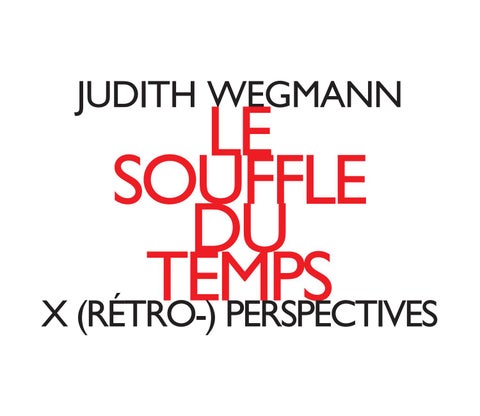
LE SOUFFLE DU TEMPS X (RÉTRO-) PERSPECTIVES JUDITH WEGMANN
Photo by Judith Wegmann
I once attended a small recital of Olivier Messiaen’s music, made by the composer’s wife Yvonne Loriod, and in his presence. Mme Loriod came onstage, acknowledged the audience and sat down at the keyboard. And then nothing happened for what seemed like a very long time. She seemed composed (in the other sense); there was absolutely no suggestion that she might have forgotten the notes to the first piece she was to play; she was not nervous, or struck with stagefright. She was, simply, waiting. It’s a device that improvisers sometimes use to build drama or to suggest the importance of the very first attack, and as such it can be horribly overdone. Cecil Taylor often approached the keyboard only indirectly and after various dance movements and vocalisations. Keith Jarrett sometimes bows, eyes closed, as if some message will whisper up from the soundbox, giving permission to start. Stan Tracey would glare at the piano, as if it was an unruly platoon of recruits, before selecting one poor soul and stabbing out a percussive note. And so on. What was different about Mme Loriod’s gesture was its air of infinite calm and of inevitability. And when she did, at last, play the first few notes of the new piece, with their characteristic allusion to birdsong, it was as if time past and time future had been bundled up and condensed into that particular moment. That is the impression I get from Judith Wegmann’s music. It is not “timeless” in the sense that it postmodernly suspends styles or that it sets out to evoke a long history of
pianism. It is more in the air of unhurriedness, of quiet preparation, that the parallel seems to hold. There may also be some accidental connection in the underpinning of bells – actually modified strings – that supports this astonishing performance. Bells have many, and in some respects contradictory, associations in our culture. They imply both celebration and mourning. They are inherently musical, but often played in the midst of a vast urban confusion that blurs and eclipses their most musical elements: the famous church bells of London sometimes seem to fight it out on a Sunday morning. Bells can be warnings, and sometimes they can simply mark the passage of time. It’s the last aspect that seems the most potent in Judith Wegmann’s case. And yet her bell-strings are not about simple chronology, or “time” in the jazz musician’s sense. Nor are they ritualised in the usual way. Instead, they seem to assert that this, here, now, is the moment and the only moment for this spontaneous but intuitively prepared music to emerge. There is a potential paradox and a required explanation lurking there. The notion of improvisation as creation ab nihilo is a dangerously naïve one. The creative improviser does not declare Year Zero on all previous performance or any older style. Instead, (s)he brings the accumulated knowledge of a lifetime, every musical understanding and external cultural impetus, and (s)he makes them meaningful in that moment. Judith says, in an e-mail, “I waited a long time to record a CD . . . I was waiting for the right moment . . . I just know it is the right moment
now”. As listeners, whether to Wegmann or Loriod or someone else, we are not privileged to know why this now rather than another now is the right now, but as listeners we can tell that it is. The rightness and logic of Wegmann’s playing here is testimony to the decisive moment. The clear, unhurried attack and logically but still mysteriously evolving lines are the product not of urgent, headlong haste, but of long thought and of emotion (as the poet said) recollected in tranquillity. When Yvonne Loriod finished her Paris recital, there was no immediate onrush of applause. Instead, she sat very still on her piano stool, only after a moment or two glancing across at her composer husband. He neither nodded nor
Photo by Sabine Burger
applauded, nor gave any indication of approval or disapproval, but the connection made released something in the room, and one of the quietest and most heartfelt ovations I ever heard greeted the finished music. And what did she do then? She played the pieces over again. I tell this story advisedly and advisorily. Make time to listen to this music, as the musician made time to prepare for it. Don’t wedge it into a pile of other CDs clamouring to be heard. Don’t immediately applaud it and move on to the next thing. Play it again. You’ll be playing it for years. Brian Morton, December 2016
or s, rd a o c s Re u a p e ut yo ho you H e e v t g a Ha o h rs. W brin ear! t h m ro are tene m to ou f g e lis ai at y din d w of ant h r o y w ec prou unit onst r is tr irs ow mm ur c hea f o h co u ur yo now ide ents at yo r is k w res h nge s i o th u t orld rep r. W hli e e o er t th t y g w . I ov . U he an win ding disc r X w r e W o e gr co to rn u! yo h, w ur s re ure We nk Xt of o thi fut a r y Th you ber njo the e of em m you usic t a m th he t
Make time to listen to this music, as the musician made time to prepare for it. Don’twedge it into a pile of other CDs clamouring to be heard. Don’t immediately applaud itand move on to the next thing. Play it again. You’ll be playing it for years Brian Morton
JUDITH WEGMANN LE S O U FFLE D U T EM P S X (RÉTRO-) PERSPECTIVES I II III IV V
9:07 5:22 5:18 4:38 7:28
Judith Wegmann, piano
ISRC ISRC ISRC ISRC ISRC
CH CH CH CH CH
130.1700771 130.1700772 130.1700773 130.1700774 130.1700775
VI VI VIII IX X
Total Time 59:53 DDD
4:35 5:20 9:45 5:02 3:11
ISRC ISRC ISRC ISRC ISRC
CH CH CH CH CH
130.1700776 130.1700777 130.1700778 130.1700779 130.1700780
Composed by Judith Wegmann, Tuhtah publishing SUISA.
Recorded February and March 2016 in the atelier of Judith Wegmann in Biel/Switzerland on a grand piano; Mixed by Simon Fankhauser; CD-master by Peter Pfister; Liner notes by Brian Morton; Graphic concept by fuhrer vienna; Produced by Judith Wegmann; Executive production by Bernhard “Benne” Vischer, Christian C. Dalucas and Werner X. Uehlinger.
[now]ART Morton Feldman For John Cage hat(now)ART 160 John Cage · Domenico Scarlatti Changes hat(now)ART 188 Karlheinz Stockhausen Mantra hat(now)ART 190 Karlheinz Stockhausen · Ludwig van Beethoven hat(now) ART 193 James Tenney Bass Works hat(now)ART 197 Morton Feldman Three Voices hat(now)ART 198 Morton Feldman Patterns In A Chromatic Field hat(now)ART 2-204
With kind support of Migros Aare Kulturprozent, Erziehungsdirektion Amt für Kultur Kanton Bern, Dienststelle Kultur der Stadt Biel, Präsidialdirektion Kultur der Stadt Bern, Amt für Kultur Kanton Zug, Präsidialdepartement Kultur der Stadt Zug. Special thanks to my friends and family.
Judith Wegmann has been playing the piano since the age of 6. She has studied jazz, classical and improvised music and successfully completed her Master’s Degree. Today, she is active as a freelance pianist in a variety of projects. For more information, visit www.judithwegmann.ch. 2017, 1st edition Printed by Gantenbein AG, CH-4127 Birsfelden www.hathut.com File under: New Music/C o ntempo rary Music
+ 훿 2017 HAT HUT Records Ltd. Box 81, 4020 Basel, Switzerland. All rights reserved. Unauthorized duplication is a violation of applicable laws. Made in Switzerland.
hat[now]ART 202
JUDITH WEGMANN· LE SOUFFLE DU TEMPS