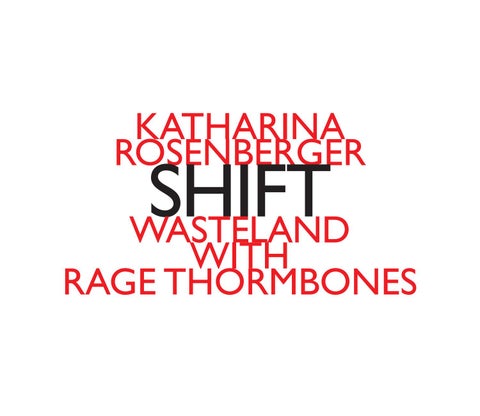
KATHARINA ROSENBERGER
SHIFT WASTELAND
WITH RAGE THORMBONES
An old composer once sat through an hour of new pieces by his pupils. At the end, he rose to his feet, spread his hands philosophically and said “Much to admire there . . . “, before quietly leaving the room. Admiration is a curious action and commodity. It implies surprise, or even wonder. The “note of admiration” is the ! that we drop into our writing to register those same feelings. Admiration is not the same as emotional involvement. There is much to admire in Katharina Rosenberger’s music. She brings, always, a fresh or newly refreshed palette of instrumental sound. She creates structures that attract admiration for their improbable tensile strength – how does a piece like modules here – hold together? But this is not what makes the music special. Rosenberger does not invite us to sit and admire, and then, like the old composer (who is a real person, even though he remains anonymous) leave the room unmoved. Instead, she
invites us in. She involves the listener. This spreads chills to some hearts, fears that some kind of audience participation is to be called for. The miracle of Rosenberger’s approach is that the involvement comes entirely through the openness of the music itself, but also in the way her ensemble is conceived. Exquisitely interpreted by the superb musicians of Los Angeles based wasteLAnd and maddeningly innovative and virtuosic RAGE THORMBONES, every one of these pieces involves spatialization to some degree. The featured musicians on SHIFT are required to move through the sonic space. Rosenberger draws very strongly on the 16th century practice of chori spazzati in order to create musical environments in which the score is not simply a linear development but a kinetic form, surrounding the listener (literally in the case of modules and with a strong implication of coming
to us through long, almost geological time, on Gesang an das noch namenlose Land). On SHIFT, she makes the movements of the two trombonists reflect not just the three-dimensional activity of Rafael Soto’s sculpturesque painting Vibración casi immaterial but also the presence of the painter himself, whose speaking voice is represented and carried by the two extraordinary soloists, trombonists Matt Barbier and Weston Olencki, who are the protagonists of the piece. Their audible physical moments, reflected as well in the improvistory interludes, are the embodiment of Soto in the work, affirming his real presence. Many musical works have been thirled to painting or sculpture, either in the form of installation, commentary or meta-text. Rosenberger’s Gesang . . . is a collaboration that involves cartography and early travel writing, that of Amerigo Vespucci, still the least understood and celebrated of the great explorers. It was made in collaboration with artist Abdolreza
Aminlari, in the form of delicate embroidered panels based on the maps of Martin Waldseemüller, which were in turn inspired by the writings of Vespucci. The deep influence, though, is the poetry of Pablo Neruda, whose voice seems to take on a continental depth and breadth in Canto general, his tenth and perhaps greatest volume of poems, a decade in the making and published in 1950. In modules Rosenberger brings an openness of regard to the process of composition, distributing her players in such a way that every audience member has his/her own perspective on the ensemble (true of a conventional orchestral concert, too, but seldom remarked) and a very immediate and physical sense of the music as a process of change and variation. This is a jazz value, though not a fixed or inevitable one. The repetitions and variations one hears, or rather senses, in SHIFT are very like the geological upswellings of a semi-familiar theme in a long improvisation. They
remind us what is under the surface. Rosenberger describes walking back and forth in front of Soto’s great paintingconstruction, moving at different speeds, pausing or retracing at different points. We are rarely given an opportunity to experience music in this way. The recording is immaculate and very detailed, but one doesn’t have to find ways to split the signal and recreate the exact positioning of the players. The sense of movement is in the music itself. The music enacts and realises mobility. Even without being consciously aware of its pre-texts and contexts, whether these are a specific kinetic painting, as an obscure pre-Columbian flute melody in Gesang… suggesting deep historical time, or a physical installation as in modules, these pieces draw in the listener. Each is a sonic environment, a utopic or virtual space in which the physical dimensions, temperatures, textures and vectors of travel are all dictated by sound. Much music written for an installation loses
half its rationale when separated from the context. Rosenberger’s music, by contrast, creates its own environments. They are all the intellectually richer for revealing their inspirations in art and cartography, but they do not depend on those narratives for their success, which is why what you are holding in your hand is such an exciting recording. This really is, as the label has it, music with its ear to the future. Brian Morton, November 2016
r s, o rd co as a e e R u ut yo hop ou t H ave We ng y ! a i H o h rs. br ear t e m h o fro are isten im t you g l e n di d w of nt a hat r y a o ec prou unit onst is w r tr irs ow omm ur c hea f r h o c u ou ow ide nts yo y is kn d-w rese hat ger l his to p W lin r t ou wor It re ver. eh e . o th t y g .U he an win ding disc r X ! W e w gro cor to rne u e o , w ur re re W k y Xth f o this futu o an Th your ber njoy f the e o em m you usic t m a th the
There is much to admire in Katharina Rosenberger’s music. She brings, always, a fresh or newly refreshed palette of instrumental sound. She creates structures that attract admiration for their improbable tensile strength – how does a piece like modules here – hold together? But this is not what makes the music special. Rosenberger does not invite us to sit and admire, and then, like the old composer (who is a real person, even though he remains anonymous) leave the room unmoved. Instead, she invites us in. She involves the listener. Brian Morton
K AT H A R I N A RO S E N B E R G E R ( 1 9 7 1 ) SHIFT First recordings by wasteLAnd with RAGE THORMBONES Michael Matsuno, flutes; Claire Chenette, oboe; Brian Walsh, clarinets/tenor saxophone; Justin DeHart, percussion; Richard Valitutto, piano; Mark Menzies, violin/viola; Andrew Tholl, violin; Linnea Powell, viola; Ashley Walters, violoncello; Scott Worthington, contrabass; Nicholas Deyoe, e-guitar, conductor RAGE THORMBONES: Matt Barbier, trombone, Weston Olencki, trombone 1. speed sputter (improvisation) for two trombones (2016) 1:35 2. SHIFT for two trombones and ensemble (2014) 18:43 3. flutter gust (improvisation) for two trombones (2016) 0:42 4. Gesang an das noch namenlose Land for string trio (2013) 19:48 5. RESHIFT 011516-3 for two trombones (2016) 2:10 6. wafts & drifts (improvisation) for two trombones (2016) 1:10 7. modules for amplified quartet and effect pedals (2015) 13:11 8. postlude (improvisation) for e-guitar (2016) 1:50
[now]ART Morton Feldman For John Cage hat(now)ART 160 John Cage · Domenico Scarlatti Changes hat(now)ART 188 Karlheinz Stockhausen Mantra hat(now)ART 190 Karlheinz Stockhausen · Ludwig van Beethoven hat(now) ART 193 James Tenney Bass Works hat(now)ART 197 Morton Feldman Three Voices hat(now)ART 198 Morton Feldman Patterns In A Chromatic Field hat(now)AR 2-204
ISRC CH 130.1600750 to ISRC CH 130.1600757 Total Time DDD
59:15
Recorded: January 14 &15 and March 6, 2016, Conrad Prebys Concert Hall, University of California San Diego, USA; Tom Erbe – recording supervision, Andrew Munsey – sound engineer and editor; Andreas Werner – mixdown and mastering; CD-master by Peter Pfister: Liner notes by Brian Morton; Produced by Katharina Rosenberger; Executive production by Christian C. Dalucas, Bernhard "Benne" Vischer & Werner X. Uehlinger. Special thanks to: Nick Deyoe and the wastLAand directors, Abdolreza Aminlari, Desirée Meiser, the Sovak-Antretter family, the UCSD Department of Music, Björn Glaus, Ernesto Klar, Isabelle Hren, Anja Kaltbrunner, Manuela Giorgi, the Rosenberger and the Calumet family. Funded in part through a grant from the UCSD Academic Senate and the UCSD Subvention Grant. With kind support of the Willy A. and Hedwig Bachofen-Henn Foundation. 2016, 1st edition Printed by Gantenbein AG, CH-4127 Birsfelden www.hathut.com File under: New Music/Contemporary Music
+ 훿 2016 HAT HUT Records Ltd. Box 81, 4020 Basel, Switzerland. All rights reserved. Unauthorized duplication is a violation of applicable laws. Made in Switzerland.
hat[now]ART 199
K AT H A R I N A R O S E N B E R G E R · S H I F T