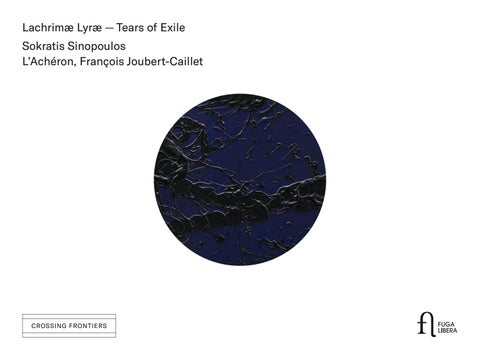
Lachrimæ Lyræ — Tears of Exile Sokratis Sinopoulos L’Achéron, François Joubert-Caillet
CROSSING FRONTIERS
Lachrimæ Lyræ — Tears of Exile
MENU
Sokratis Sinopoulos L’Achéron, François Joubert-Caillet
2
Credits Tracklist Programme note
EN
FR
DE
FUG 753
Recording
English translations
Abbaye de Noirlac – Centre culturel de rencontre (Cher,
Peter Lockwood
MENU
France), 15-17 July 2018 Artistic Direction, recording & mastering
Deutsche Übersetzungen
Aude-Marie Piloz
Silvia Berutti-Ronelt
Special thanks to Château de Lunéville (Conseil départemental de Meurthe-et-Moselle), Abbaye de Noirlac, Arsenal de Metz, DRAC Grand Est, Région Grand Est, Ville de Nancy.
3
L’Achéron expresses its grateful thanks to Adami for its support of this recording.
Fuga Libera
Editorial Coordinator
Cover:
Artistic Director
Julien Lepièce
Fabienne Verdier,
Jérôme Lejeune
Ainsi la nuit - Lyra, 2018 (detail) Acrylic and mixed media on canvas Photography:
183 x 270 cm
Design
© Jean-Baptiste Millot,
Courtesy Fabienne Verdier
Stoëmp Studio
except p. 28: © Henri Gaud
and Galerie Lelong & Co.
Lachrimæ Lyræ — Tears of Exile
MENU
Sokratis Sinopoulos L’Achéron, François Joubert-Caillet
4
Sokratis Sinopoulos: Greek lyra
L’Achéron François Joubert-Caillet: treble viol & direction Andreas Linos: tenor viol Lucile Boulanger: tenor viol Sarah van Oudenhove: bass viol
Based on an original idea of Andreas Linos Sokratis Sinopoulos appears courtesy of ECM Records
Fuga Libera
Lachrimæ Lyræ — Tears of Exile • Sokratis Sinopoulos — L’Achéron, François Joubert-Caillet
FUG 753
. Vega
2’48
02
. Lachrimæ Antiquæ
4’05
03
. Lachrimæ Antiquæ Novæ
4’18
04
. Sheliak
2’19
05
. Lachrimæ Gementes
4’02
06
. Lachrimæ Tristes
4’34
. Lachrimæ Coactæ
2’17
08
. Lachrimæ Amantis
4’26
09
. Lachrimæ Veræ
4’59
. Sulafat
4’33
. Sir John Souch his Galliard
2’14
12
. Aladfar
2’23
13
. The King of Denmark Galliard
1’53
14
. M. Giles Hobies his Galliard
3’02
15
. Captaine Digorie Piper his Galliard
3’44
16
. M. Bucton his Galliard
2’27
. Alathfar
1’21
18
. M. Nichols Almand
3’44
19
. The Earl of Essex Galliard
2’51
. Semper Dowland semper Dolens
3’26
01
07
10 11
17
20
MENU
5
after the Lachrimæ or Seaven Teares (1604) by John Dowland (1563-1626), except tracks 1, 4, 10, 12 & 17: improvisations named after the 5 main stars of the Lyra constellation
Fuga Libera
Lachrimæ Lyræ — Tears of Exile • Sokratis Sinopoulos — L’Achéron, François Joubert-Caillet
FUG 753
This collaboration between a consort of viols and the Greek lyra takes John Dowland’s Lachrimæ or Seaven Teares as its point of departure; together they paint a transverse and stateless picture of melancholy, although this is set against the joyful hope of a shining future that appears in these improvisations and timeless Anglo-Byzantine dances.
EN
MENU
6
Fuga Libera
Lachrimæ Lyræ — Tears of Exile • Sokratis Sinopoulos — L’Achéron, François Joubert-Caillet
FUG 753
Lachrimæ Lyræ, Tears of Exile The Greek lyra and the viola da gamba are the instruments most suited to the expression of melancholy. Both of them, at the height of their respective popularity, were used to express this highly individual emotion, this state of mind that chargess music to a point beyond what words can express. Both of these instruments, in their separate periods and different circumstances, were not only employed in the same manner but also suffered the same fate: while it is so far still impossible to make a historical connection between the lyra and the viol, it is nonetheless astonishing to note how much the two instruments had in common, as if they were sisters unknown to each other, each evolving as an echo of the other several centuries apart and in very different parts of the world, expressing and experiencing the same things without ever meeting.
MENU
Technically speaking, both instruments use the same bow position, palm upwards; they are both pear-shaped, and are tuned in similar fashion. Artistically speaking, each of them voiced, in their own world, the perfect expression of what the Greeks termed harmolipi, a joyous sadness, or the pleasure taken in experiencing sadness.
7
In England, the most renowned exponent of this melancholy was John Dowland (1563-1626), with his volume entitled Lachrimæ or Seaven Teares (1604): its seven pavanes express this theme in interrelated episodes, passing from a lover’s melancholy to the pious tears of a mystical revelation. The Lachrimæ are followed by joyous dances in a fast tempo, these symbolising the hope of salvation regained. The lyra was played by Greek musicians in Constantinople from the beginning of the Byzantine empire until the beginning of the 17th century. It developed Fuga Libera
Lachrimæ Lyræ — Tears of Exile • Sokratis Sinopoulos — L’Achéron, François Joubert-Caillet
FUG 753
a repertoire that was defined by its exile in the Ottoman empire, with a nostalgia and a longing for home that is also to be found in Dowland’s works: Dowland himself was living in Denmark during the years that he was composing the Lachrimæ. Another link was that the British and Greek taverns were at that time places where music was heard attentively and in silence; the viola da gamba and the lyra were the leading players in these musical evenings during which audiences first wept and then danced, creating a mystical rite of purification.
MENU
This music is intended not only to present the mirrored meeting of these two instruments and of the Elizabethan and Byzantine – Ottoman worlds, but also to tell a tale of catharsis, of a happy metamorphosis, of light-filled shadows and unrestrained lamentation. It is also mirrors the tears shed by the millions of people forced into exile today.
8
François Joubert-Caillet
Fuga Libera
Lachrimæ Lyræ — Tears of Exile • Sokratis Sinopoulos — L’Achéron, François Joubert-Caillet
FUG 753
Sokratis Sinopoulos, lyra
MENU
Sokratis Sinopoulos is a modern master of the lyra, a bowed instrument that dates back to the Byzantine era. His delicate and expressive style of playing is acclaimed wherever he performs; he collaborates with musicians throughout the world, with jazz and classical musicians as well with musicians working in the Greek and Mediterranean popular traditions. Born in Athens in 1974, Sokratis Sinopoulos first studied Byzantine music and classic guitar before taking up the lyra with Ross Daly in 1988. His outstanding talent ensured that he soon became a member of Daly’s ensemble Labyrinthos. Since that time he has given a great number of concerts and has made recordings with such musicians as Elena Karaindrou, Charles Lloyd and Loreena McKennitt. He was awarded the Melina Mercouri Prize for young artists in 1999.
9
He formed the Sokratis Sinopoulos Quartet together with pianist Yann Keerim, bass player Dimitris Tsekouras percussionist Dimitris Emmanouil in 2010, with the intention that they should find a common musical territory through improvisation rather than become attached to a specific genre. Their first album, Eight Winds, was produced by Manfred Eicher and was released on the ECM label to great acclaim in 2015. Sokratis is assistant professor in the department of musical sciences and art at the University of Macedonia in Thessaloniki in Greece.
www.sokratissinopoulos.com Fuga Libera
Lachrimæ Lyræ — Tears of Exile • Sokratis Sinopoulos — L’Achéron, François Joubert-Caillet
FUG 753
L’Achéron
MENU
In Greek mythology, the Acheron was the river that Orpheus had to cross to rescue Eurydice from the Underworld. The Achéron ensemble in its turn aims to open a path between seemingly opposite worlds: those of the living and the dead, of the past and the present, of idealism and of reality. Founded by François Joubert-Caillet in 2009, L’Achéron is made up of young musicians of various origins, all of whom were trained in the leading conservatories that specialise in early music, these including the Schola Cantorum Basiliensis, the Conservatoires nationaux supérieurs of Lyon and Paris, and the Royal Conservatories of Brussels and of The Hague. Its musicians have also specialised individually in other associated artistic fields: theatre, stage direction, ancient and modern dance, writing, improvisation, puppetry, instrument making, and sound recording are all included amongst their interests.
10
L’Achéron hopes to strengthen the links between its musicians and their audiences by making early music more accessible without changing its essential character, by delvingg deeply into the richly coloured array of instruments and various musical practices of the Renaissance and of the Baroque. In their endeavour to present this music that is so full of life with the most colourful instrumental palette possible, L’Achéron opens a path that is both temporal and sensitive; the flavours and the colours of earlier times are conjured up with particular intensity.
Fuga Libera
Lachrimæ Lyræ — Tears of Exile • Sokratis Sinopoulos — L’Achéron, François Joubert-Caillet
FUG 753
The original disposition of the ensemble was a consort of viols: the luthier Arnaud Giral has collaborated with the ensemble from 2013 and is in the process of creating a characteristically English consort of viols for them. Five instruments have already been delivered to the ensemble; these have given the consort a homogeneity, a depth and a richness of sound and harmony. A virginal and an organ made according to English models will also soon join the ensemble.
MENU
L’Achéron collaborates regularly with artists from different cultures: their project L’Orgue du Sultan was a collaboration with the Sultan Veled ensemble and combined music from the Elizabethan and Ottoman periods; their Lachrimæ Lyræ was made with Sokratis Sinopoulos, a master performer on the Greek lyra. The ensemble has also taken part in a recording of electronic music with the DJ Marc Romboy and with Tamar Halperin based on works of Henry Purcell. 11
L’Achéron is based in Nancy in France and appears in festivals and concert series throughout Europe, these including the festivals of Saintes, Sablé, Royaumont, Ambronay and the Auditorium du Louvre, the Tage Alter Musik in Regensburg, the Bach Festival of Lausanne, the Festival of Early Music of Utrecht, and in the Concertgebouw in Bruges and the Philharmonia in Warsaw, amongst others.
Fuga Libera
Lachrimæ Lyræ — Tears of Exile • Sokratis Sinopoulos — L’Achéron, François Joubert-Caillet
FUG 753
L’Achéron records for the Ricercar (Outhere) label. Their recordings include Orlando Gibbons’ Fancies for the viols, which was used as incidental music for a production of Shakespeare’s The Tempest by Robert Carsen at the ComédieFrançaise; The Fruit of Love, a collection of works by Anthony Holborne; the Ludi Musici by Samuel Scheidt, that was also awarded a Diapason d’or; Johann Caspar Kerll’s Requiem with Vox Luminis; the Ouvertures of Johann Bernhard Bach (awarded an Echo Klassik 2017); Marin Marais’ Pièces favorites; Marais’ complete Pièces de viole have also been recorded by François Joubert-Caillet: the Premier Livre of these was awarded a Diapason d’or as well as a Choc by Classica. Their latest release appeared in January 2019 and is of the trio sonatas of Philipp Heinrich Erlebach.
MENU
www.lacheron.com 12
Fuga Libera
Lachrimæ Lyræ — Tears of Exile • Sokratis Sinopoulos — L’Achéron, François Joubert-Caillet
FUG 753
D’après les Lachrimæ or Seaven Teares de John Dowland, une rencontre entre le consort de violes et la lyra grecque peignant ici ensemble un tableau transversal et apatride de la mélancolie avec, en contrepoint, l’espoir et la joie d’un avenir radieux dans des improvisations et des danses anglo-byzantines intemporelles.
FR
MENU
13
Fuga Libera
Lachrimæ Lyræ — Tears of Exile • Sokratis Sinopoulos — L’Achéron, François Joubert-Caillet
FUG 753
Lachrimæ Lyræ, les larmes de l’exil La lyra grecque, comme la viole de gambe, est l’instrument de la mélancolie. L’une et l’autre, aux âges d’or de leurs histoires, étaient utilisées pour exprimer ce sentiment si particulier, cet état d’âme qui nourrit tant de musiques, au-delà des mots. Ces deux instruments, à des périodes différentes et dans des circonstances diverses, ont connu des utilisations et des destins identiques : s’il est – encore – impossible de tisser un lien historique entre la lyra et la viole, il est pourtant stupéfiant de remarquer à quel point elles se ressemblent, comme des sœurs qui s’ignoreraient, évoluant chacune en écho l’une de l’autre, à quelques siècles de distance, dans des régions éloignées, exprimant et vivant les mêmes choses sans jamais se rencontrer. Sur le plan technique, toutes les deux utilisent la même position d’archet « paume vers le ciel », sont en forme de poire, leur accord est similaire également ; sur le plan artistique, elles sont, chacune dans leur monde, l’instrument idiomatique de ce que les Grecs nomment l’harmolipi, la tristesse joyeuse, le plaisir d’être malheureux.
MENU
14
En Angleterre, le chantre de cette mélancolie est certainement John Dowland (1563-1626), avec son recueil de Lachrimæ or Seaven Teares (1604) : en sept pavanes, il décline ce thème avec des tableaux complémentaires, de la mélancolie amoureuse aux larmes pieuses d’une illumination mystique. Ces Lachrimæ sont suivies de danses allègres, symbolisant l’espoir d’un salut retrouvé. Jouée par des musiciens grecs à Constantinople dès l’époque de l’Empire byzantin et jusqu’au début du XVIIe siècle, la lyra a développé un répertoire marqué par cet exil en Empire ottoman, une nostalgie et un mal du pays que l’on retrouve dans l’œuvre de John Dowland, expatrié lui aussi au Danemark
Fuga Libera
Lachrimæ Lyræ — Tears of Exile • Sokratis Sinopoulos — L’Achéron, François Joubert-Caillet
FUG 753
dans les années de composition de ses Lachrimæ. Autre point commun : les tavernes britanniques et grecques étaient alors des lieux où la musique était écoutée attentivement, dans le silence, la viole de gambe et la lyra étant les actrices incontournables de ces concerts populaires où l’on pleurait puis dansait, créant ainsi une sorte de rite purificateur et mystique.
MENU
Cette musique désire faire entendre la rencontre en miroir de ces deux instruments et des mondes élisabéthain et byzantin-ottoman, mais également décrire un récit cathartique, une métamorphose heureuse, des ténèbres à la lumière et de la déploration à la fête. Elle se fera aussi l’écho des larmes versées par des millions de personnes forcées à l’exil aujourd’hui.
François Joubert-Caillet 15
Fuga Libera
Lachrimæ Lyræ — Tears of Exile • Sokratis Sinopoulos — L’Achéron, François Joubert-Caillet
FUG 753
Sokratis Sinopoulos, lyra
MENU
Sokratis Sinopoulos est un maître contemporain de la lyra, un instrument à archet de l’ère byzantine. Son jeu délicat et très expressif est acclamé de façon unanime. Il collabore avec de nombreux musiciens dans le monde entier, aussi bien dans les domaines du jazz et du classique que dans les traditions populaires grecques ou méditerranéennes. Né à Athènes en 1974, Sokratis Sinopoulos étudie d’abord la musique byzantine et la guitare classique, puis commence à étudier la lyra en 1988 avec Ross Daly. Son talent remarquable le fait rapidement rejoindre le groupe de Daly, Labyrinthos. Depuis, il a donné de très nombreux concerts et réalisé des enregistrements avec des musiciens tels qu’Elena Karaindrou, Charles Lloyd et Loreena McKennitt. En 1999, il est honoré du Prix national pour jeunes artistes Melina Mercouri.
16
En 2010, il crée le Sokratis Sinopoulos Quartet avec le pianiste Yann Keerim, le bassiste Dimitris Tsekouras et le percussionniste Dimitris Emmanouil, les encourageant à improviser librement en trouvant un terrain musical commun plutôt que d’adhérer à un genre spécifique. Leur premier album Eight Winds est produit par Manfred Eicher pour le label ECM en 2015 et reçoit un accueil enthousiaste. Sokratis est professeur assistant au département des sciences musicales et d’art à l’Université de Macédoine à Thessalonique, en Grèce.
www.sokratissinopoulos.com Fuga Libera
Lachrimæ Lyræ — Tears of Exile • Sokratis Sinopoulos — L’Achéron, François Joubert-Caillet
FUG 753
L’Achéron
MENU
Dans la mythologie grecque, l’Achéron est le fleuve que traverse Orphée pour secourir Eurydice des enfers. Comme son nom l’inspire, L’Achéron veut ouvrir une voie entre deux mondes apparemment opposés : celui des vivants et celui des défunts, le passé et le présent, l’idéal et la réalité. Fondé en 2009 par François Joubert-Caillet, L’Achéron est constitué de jeunes musiciens aux origines variées ayant été formés dans les plus grandes écoles de musique ancienne (la Schola Cantorum Basiliensis, les Conservatoires nationaux supérieurs de Lyon et de Paris, les Conservatoires royaux de Bruxelles et de La Haye, etc.). Ses musiciens ont pour certains d’autres facettes artistiques : le théâtre, la mise en scène, les danses anciennes ou contemporaines, l’écriture, l’improvisation, les marionnettes, la facture d’instrument et la prise de son composent l’éventail des passions qui se croisent dans l’ensemble.
17
L’Achéron désire renforcer les liens entre les musiciens et le public en rendant les musiques anciennes accessibles sans les dénaturer, en se plongeant profondément dans l’instrumentarium coloré et les pratiques musicales multiples de la Renaissance et du baroque. Tentant de peindre avec la palette la plus riche ces musiques si vivantes, la traversée que L’Achéron propose est à la fois temporelle et sensible, les saveurs d’autres temps y sont intensément cultivées.
Fuga Libera
Lachrimæ Lyræ — Tears of Exile • Sokratis Sinopoulos — L’Achéron, François Joubert-Caillet
FUG 753
La formation première de L’Achéron est le consort de violes de gambe : depuis 2013, le luthier Arnaud Giral accompagne l’ensemble en construisant un consort typiquement anglais. Cinq instruments ont d’ores et déjà vu le jour, donnant à ce consort une homogénéité, une profondeur et une richesse harmonique uniques. Un virginal et un orgue britanniques vont prochainement les rejoindre...
MENU
L’Achéron s’associe régulièrement avec des artistes d’horizons différents : son projet L’Orgue du Sultan l’a vu collaborer avec l’ensemble Sultan Veled dans une rencontre des musiques élisabéthaine et ottomane, ces Lachrimæ Lyræ avec le maître de la lyra grecque Sokratis Sinopoulos ; il participe également à un album de musique électronique avec le DJ Marc Romboy et Tamar Halperin autour d’Henry Purcell… L’Achéron est basé à Nancy (France). Il est invité à se produire dans divers festivals et saisons musicales en Europe, tels que les festivals de Saintes, Sablé, Royaumont, Ambronay, l’Auditorium du Louvre, les Tage Alter Musik de Regensburg, le Festival Bach de Lausanne, le Concertgebouw de Bruges, le Festival Oude Muziek d’Utrecht, la Philharmonie de Varsovie, etc.
Fuga Libera
Lachrimæ Lyræ — Tears of Exile • Sokratis Sinopoulos — L’Achéron, François Joubert-Caillet
18
FUG 753
Au disque, L’Achéron enregistre pour le label Ricercar (Outhere). Il a ainsi fait paraître Fancies for the viols d’Orlando Gibbons, utilisé comme bande originale de La Tempête de William Shakespeare à la Comédie-Française dans une mise en scène de Robert Carsen ; The Fruit of Love consacré à Anthony Holborne ; les Ludi Musici de Samuel Scheidt (Diapason d’or) ; le Requiem de Johann Caspar Kerll avec l’ensemble Vox Luminis ; les Ouvertures de Johann Bernhard Bach (Echo Klassik 2017) ; les Pièces favorites de Marin Marais, dont l’intégralité des Pièces de Viole a été enregistrée par François Joubert-Caillet (le Premier Livre a reçu un Diapason d’Or et un Choc de Classica). Dernière parution en janvier 2019 : les sonates en trio de Philipp Heinrich Erlebach.
MENU
www.lacheron.com
19
Fuga Libera
Lachrimæ Lyræ — Tears of Exile • Sokratis Sinopoulos — L’Achéron, François Joubert-Caillet
FUG 753
Nach den Lachrimæ or Seaven Teares von John Dowland kommt es hier zu einer Begegnung zwischen dem Gamben-Consort und der griechischen Lyra, die gemeinsam ein transversales, nicht an Staaten gebundenes Bild der Melancholie entwerfen und dazu als Kontrapunkt mit Improvisationen und zeitlosen anglo-byzantinischen Tänzen die Hoffnung auf und die Freude über eine strahlende Zukunft ausdrücken.
DE
MENU
20
Fuga Libera
Lachrimæ Lyræ — Tears of Exile • Sokratis Sinopoulos — L’Achéron, François Joubert-Caillet
FUG 753
Lachrimæ Lyræ, die Tränen des Exils Die griechische Lyra ist wie die Gambe ein Instrument der Melancholie. Sowohl die eine wie auch die andere wurde im goldenen Zeitalter ihrer Geschichten verwendet, um dieses charakteristische Gefühl auszudrücken, diesen Gemütszustand, der die Musik jenseits der Worte so oft inspiriert. Die beiden Instrumente hatten in verschiedenen Zeiten und unter unterschiedlichen Bedingungen identische Verwendungen und Schicksale: Zwar ist es – noch – unmöglich, eine historische Verbindung zwischen der Lyra und der Gambe herzustellen, doch ist es erstaunlich festzustellen, wie sehr sie sich ähneln, als wären sie Schwestern, die einander nicht kennen, wobei sich aber jede wie ein Echo der anderen entwickelt und im Abstand mehrerer Jahrhunderte in entfernten Regionen das Gleiche ausdrückt und lebt, ohne dass sie sich je begegnen. In technischer Hinsicht benutzen beide die gleiche „den Handteller himmelwärts“ gerichtete Bogenhaltung, sie haben die Form einer Birne und auch ihre Stimmung ist ähnlich; auf künstlerischer Ebene ist jede in ihrer Welt das idiomatische Instrument dessen, was die Griechen harmolipi nennen, fröhliche Traurigkeit, das Lustgefühl, unglücklich zu sein.
MENU
21
In England ist der Verfechter dieser Melancholie zweifellos John Dowland (1563-1626) mit seiner Sammlung der Lachrimæ or Seaven Teares (1604): In sieben Pavanen variiert er dieses Thema mit ergänzenden Bildern, die von der Melancholie aus Liebe bis zu den frommen Tränen einer mystischen Erleuchtung reichen. Auf diese Lachrimæ folgen beschwingte Tänze, die die Hoffnung auf ein wiedergefundenes Wohlbefinden symbolisieren. Die Lyra, auf der die griechischen Musiker in Konstantinopel ab der Zeit des byzantinischen Reiches bis zum Beginn des 17. Jh. spielten, entwickelte ein Fuga Libera
Lachrimæ Lyræ — Tears of Exile • Sokratis Sinopoulos — L’Achéron, François Joubert-Caillet
FUG 753
Repertoire, das von jenem Exil im ottomanischen Reich gekennzeichnet ist. Diese Nostalgie und das Heimweh sind im Werk John Dowlands wiederzufinden, der in den Jahren der Komposition seiner Lachrimæ nach Dänemark emigriert war. Eine andere Gemeinsamkeit: Die britischen und griechischen Wirtshäuser waren damals Orte, an denen man der Musik aufmerksam und still zuhörte. Die Gambe und die Lyra galten bei diesen volkstümlichen Konzerten als unumgänglich, bei denen man weinte und daraufhin tanzte und so eine Art reinigenden, mystischen Ritus schuf.
MENU
Diese Musik möchte eine spiegelbildliche Begegnung zwischen den beiden Instrumenten und der elisabethanischen und byzantinisch-ottomanischen Welt zu Gehör bringen, aber auch eine kathartische Erzählung beschreiben, eine glückliche Metamorphose vom Dunkel zum Licht und von der Klage zum Fest. Sie will auch ein Widerhall der Tränen sein, die heute von Millionen zum Exil gezwungenen Menschen vergossen werden.
22
François Joubert-Caillet
Fuga Libera
Lachrimæ Lyræ — Tears of Exile • Sokratis Sinopoulos — L’Achéron, François Joubert-Caillet
FUG 753
Sokratis Sinopoulos, Lyra
MENU
Sokratis Sinopoulos ist ein zeitgenössischer Meister der Lyra, eines Streichinstruments aus der byzantinischen Zeit. Sein feinfühliges, sehr expressives Spiel wird einstimmig gerühmt. Er arbeitet mit vielen Musikern auf der ganzen Welt zusammen, und das sowohl im Bereich des Jazz als auch der klassischen Musik und der griechischen und südländischen Volksmusiktraditionen. 1974 in Athen geboren, studierte Sokratis Sinopoulos zunächst die byzantinische Musik und klassische Gitarre, bevor er 1988 begann, bei Ross Daly Lyra zu studieren. Dank seines bemerkenswerten Talents wurde er bald in Dalys Gruppe Labyrinthos aufgenommen. Seither gibt er viele Konzerte und macht Aufnahmen mit Musikern wie Elena Karaindrou, Charles Lloyd und Loreena McKennitt. Im Jahr 1999 erhielt er den griechischen Melina-Mercouri-Staatspreis für junge Künstler.
23
2010 gründete er das Sokratis Sinopoulos Quartet mit dem Pianisten Yann Keerim, dem Bassisten Dimitris Tsekouras und dem Perkussionisten Dimitris Emmanouil. Er ermutigte sie zur freien Improvisation mit dem Ziel, ein gemeinsames musikalisches Territorium zu finden, anstatt sich einer bestimmten Art der Musik anzuschließen. Ihr erstes Album Eight Winds wurde 2015 von Manfred Eicher für das Label ECM produziert und mit Begeisterung aufgenommen. Sokratis ist Assistenzprofessor der Fachabteilung für Musikwissenschaft und Kunst an der mazedonischen Universität in Thessaloniki / Griechenland. www.sokratissinopoulos.com Fuga Libera
Lachrimæ Lyræ — Tears of Exile • Sokratis Sinopoulos — L’Achéron, François Joubert-Caillet
FUG 753
L’Achéron
MENU
In der griechischen Mythologie ist Acheron der Fluss, den Orpheus überquert, um Eurydike aus der Unterwelt zu befreien. Sein Name weist darauf hin, dass L’Achéron einen Weg zwischen zwei anscheinend gegensätzlichen Welten öffnen will: den der Lebenden und den der Toten, der Vergangenheit und der Gegenwart, des Ideals und der Realität. L’Achéron wurde 2009 von François Joubert-Caillet gegründet und besteht aus jungen Musikern verschiedener Herkunft, die in den bedeutendsten Schulen für alte Musik (in der Schola Cantorum Basiliensis, den Conservatoires nationaux supérieurs von Lyon und Paris, den Conservatoires Royaux von Brüssel und Den Haag usw.) ausgebildet wurden. Einige dieser Musiker haben auch andere künstlerische Facetten: Theater, Inszenierungen, alte oder zeitgenössische Tänze, Schriftstellerei, Improvisation, Marionetten, Instrumentenbau und Tontechnik bilden die Palette der Leidenschaften, die einander im Ensemble begegnen.
24
L’Achéron möchte die Beziehungen zwischen Musikern und Publikum festigen, indem es die alten Musiken zugänglich macht, ohne sie zu entstellen, und sich in das bunte Instrumentarium und die vielfachen musikalischen Praktiken der Renaissance und des Barocks vertieft. Es versucht, diese so lebendigen Arten der Musik mit der reichsten Farbpalette wiederzugeben und schlägt dabei eine zeitliche, sensible Reise vor, bei der die Reize anderer Zeiten intensiv kultiviert werden.
Fuga Libera
Lachrimæ Lyræ — Tears of Exile • Sokratis Sinopoulos — L’Achéron, François Joubert-Caillet
FUG 753
Die erste Besetzung von L’Achéron ist das Gambenconsort: Seit 2013 begleitet der Instrumentenbauer Arnaud Giral das Ensemble, indem er ein typisch englisches Consort baut. Fünf Instrumente sind bereits entstanden und verleihen dem Consort einzigartige Homogenität, Tiefe und harmonischen Reichtum. Ein Virginal und eine britische Orgel kommen demnächst hinzu ...
MENU
L’Achéron arbeitet regelmäßig mit Künstlern verschiedener Horizonte zusammen: An seinem Projekt L’Orgue du Sultan war das Ensemble Sultan Veled an der Begegnung zwischen der elisabethanischen und der ottomanischen Musik beteiligt, an Lachrimæ Lyræ der Meister der griechischen Lyra Sokratis Sinopoulos; es nimmt außerdem an einem Album von elektronischer Musik mit dem DJ Marc Romboy und Tamar Halperin rund um Henry Purcell teil. L’Achéron hat seinen Sitz in Nancy (Frankreich). Das Ensemble wird eingeladen, bei verschiedenen Festivals und Musiksaisons in Europa aufzutreten, wie etwa bei den Festivals von Saintes, Sablé, Royaumont, Ambronay, im Auditorium du Louvre, bei den Tagen Alter Musik in Regensburg, beim Festival Bach von Lausanne, im Concertgebouw von Brügge, beim Festival Oude Muziek von Utrecht, in der Philharmonie von Warschau usw.
Fuga Libera
Lachrimæ Lyræ — Tears of Exile • Sokratis Sinopoulos — L’Achéron, François Joubert-Caillet
25
FUG 753
L’Achéron nimmt seine CDs für das Label Ricercar (Outhere) auf. So erschienen bereits Fancies fort he viols von Orlando Gibbons, eine Aufnahme, die als Bühnenmusik für Shakespeares Der Sturm an der Comédie-Française in der Inszenierung von Robert Carsen verwendet wurde; The Fruit of Love ist Anthony Holborne gewidmet; Ludi Musici Samuel Scheidt (Diapason d’or); das Requiem von Johann Caspar Kerll mit dem Ensemble Vox Luminis; die Ouvertures von Johann Bernhard Bach (Echo Klassik 2017); die Pièces favorites von Marin Marais, darunter eine Gesamtaufnahme der Pièces de Viole, wurden von François Joubert-Caillet aufgenommen (der Premier Livre erhielt ein Diapason d’or und einen Choc de Classica). Die jüngste Veröffentlichung im Januar 2019: die Triosonaten von Philipp Heinrich Erlebach.
MENU
www.lacheron.com 26
Fuga Libera
Lachrimæ Lyræ — Tears of Exile • Sokratis Sinopoulos — L’Achéron, François Joubert-Caillet
FUG 753
MENU
27
Fuga Libera
Lachrimæ Lyræ — Tears of Exile • Sokratis Sinopoulos — L’Achéron, François Joubert-Caillet
FUG 753
Noirlac Abbey — Cultural Exchange Center The ambition of the Noirlac Abbey Cultural Exchange Center is to link the monument’s rich heritage to dense, eclectic artistic activity. At the heart of this project are the meeting of the past with modernity, artists with the monument, and audiences with artistic creation. The Abbey’s year is punctuated by hosting artists in residence, research sessions, recordings, creations and public performances.
MENU
Abbaye de Noirlac — Centre culturel de rencontre L’abbaye de Noirlac — Centre culturel de rencontre — ambitionne de lier la richesse patrimoniale du monument à une actualité artistique dense et éclectique. La rencontre du passé avec la modernité, des artistes avec le monument, des publics avec la création artistique sont au cœur de ce projet. Accueil d’artistes en résidence, sessions de recherche, enregistrements, créations et représentations publiques jalonnent l’année de l’abbaye.
28
www.abbayedenoirlac.fr
For even more great music visit www.outhere-music.com/en/labels/fugalibera
Fuga Libera
Lachrimæ Lyræ — Tears of Exile • Sokratis Sinopoulos — L’Achéron, François Joubert-Caillet
FUG 753
MENU
29
Fuga Libera
Lachrimæ Lyræ — Tears of Exile • Sokratis Sinopoulos — L’Achéron, François Joubert-Caillet
FUG 753