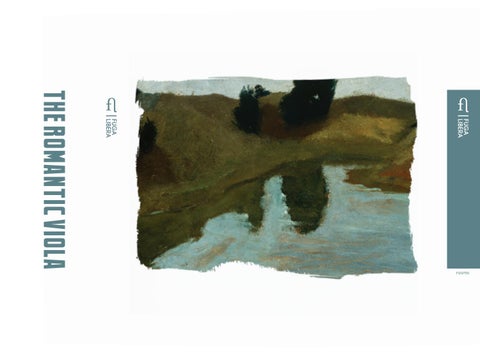
THE ROMANTIC VIOLA
FUG750
MENU Tracklist English Franรงais Deutsch Biographies
D A N I E L WEISSMANN JEAN-LOUIS DELAHAUT
THE ROMANTIC VIOLA Robert Fuchs (1847-1927)
Franz Liszt (1811-1886) 10 – Romance oubliée (Andante Malinconico)
Sonata in D minor Op. 86 1 – Allegro moderato ma passionato 2 – Andantino grazioso 3 – Allegro Vivace
– – –
8:31 5:31 6:00
Henri Vieuxtemps (1820-1881) Sonata in B-flat major Op. 36 4 – Maestoso-Allegro 5 – Barcarolla (Andante con moto) 6 – Finale scherzando allegretto
– – –
12:14 6:27 4:03
Carl Reinecke (1824-1910) Drei Phantasiestücke Op. 43 7 – Romanze (Andante) 8 – Allegro molto agitato 9 – Jahrmarkt-Szene eine humoreske
– 2:50 – 5:36 – 5:07
(Molto vivace „ausgelassen und mit ungebundener Laune“)
Menu
Hern professor Hermann Ritter, Erfinder der viola alta zugeeignet
Total Time
–
3:54
–
01:00:13
Daniel Weissmann – viola Jean-Louis Delahaut – piano
EN
The Romantic viola
Hugo Rodriguez
Although we now agree that the four principal bowed string instruments of the Western world first appeared more or less within the same period, notably during the first half of the 16th century, their later histories were to be very different. Whereas the violin gradually took its place as the king of instruments, and the cello and the double bass both developed their clearly separate techniques and aesthetics, the viola continued to be confined to a lesser role: this ignorance of its qualities gave rise to assumptions about the instrument that were simplistic, to say the least. Given this negative attitude, this lesser rank meant that the viola became the instrument onto which bad violinists were sidelined; it became the perfect accompanying instrument, restricted to a necessary but ungrateful padding, completing the harmonies implied by the melody line and the bass. One example should suffice: the eminent columnist Jules Janin wrote satirically in the Revue et Gazette musicale of 4 January 1835 that if the violin family really wished to be considered as being of high rank, then the viola could hardly have any other role than that of the family cook: as invisible as she was indispensable.
From a positive point of view, the lesser rank of the viola made it particularly suited to the expression of melancholic and discreet introspection; its real depths were sometimes hidden by the noisy brilliance of the other instruments, but it nonetheless expressed the shifting moods of the soul with modesty and delicacy. The instrument’s median range caused certain composers of the 18th century to choose to play it during evenings of chamber or of orchestral music; the viola offered them the perfect place from which they could immerse themselves in the harmonies, consider the detailed construction of combinations of timbres in real time, and, if necessary, come up with new ideas. Carl Philipp Emanuel Bach wrote to the author of the first biography of J.S. Bach, Johann Nikolaus Forkel, in 1774, stating that when his father decided to play an orchestral line, he preferred to play the viola, with all the force and the sweetness that was required. Bach gave the viola a central position in the third and sixth Brandenburg Concertos, as well as in the cantatas Wo soll ich fliehen hin (BWV 5) and Gleichwie der Regen und Schnee vom Himmel fällt (BWV 18). Other composers of the period showed their interest in the viola by giving it music written in a richer and more expressive style, up to the point of giving it a solo role as we hear in the viola concertos by the brothers Carl and Anton Stamitz, Franz Anton Hoffmeister and Karl Ditters von Dittersdorf, not forgetting Mozart’s own Sinfonia concertante K. 364 / 320d.
Menu
Mozart took the viola line in evenings of chamber music with his friends Haydn, Dittersdorf and Vanhal for the same reasons as Bach. Works such as the Trio for piano, clarinet and viola K. 498 (the “Kegelstatt” trio) and the Divertimento for string trio K. 563 demonstrate this progressive highlighting of the viola line; this approach was taken up and continued by Beethoven from the three string quartets op. 59 onwards. All of these developments during the Classic period, however, as real as they were, took advantage of the viola’s lesser rank instead of helping to raise it. From the 20th century onwards, however, composers came to consider the viola as a solo instrument of the first order, with works composed for it by Bartók, Hindemith, Walton, Milhaud, Martinů, Zimmermann, Berio, Ligeti and Kurtág. It was also spotlighted in international competitions and played by such prestigious musicians as Lionel Tertis, Maurice Vieux, William Primrose and, most recently, Tabea Zimmermann. The origins of this radical change are to be found in the 19th century, and in the emancipation of aesthetics created by the Romantic movement in particular. Hector Berlioz (1803-1869) played a decisive role on this. In his Traité d’instrumentation et d’orchestration he denounced the unjust servitude of this noble instrument and took pains to display its individual character. As was often the case, his idea was as simple as it was brilliant, anticipating what today seems to us to be self-evident. According to Berlioz, the most important aspect of an instrument, what makes it unique and what moves us, is not what it plays, its melodies, its high or low notes or its extremes of dynamics, or the virtuosity of which it is capable. It is its timbre, its colour, the way in which its sound is created and then resonates, both alone and in relation to other instruments. It is a little like when a singer is admired just as much, if not even more, for the simple beauty of his or her voice, rather than for the texts and melodies that are interpreted. Given that the viola has almost all of the same characteristics as the violin, except for its timbre, it is only by concentrating on its timbre that we can enter the instrument’s individual sound world. Putting his ideas into practice, Berlioz composed one of his masterpieces, the program symphony for orchestra and solo viola Harold en Italie, in 1834. Berlioz recounted its somewhat troubled genesis in his Mémoires. The great violinist Niccolò Paganini initially wanted a work that would show off the Stradivarius viola that he had bought. Deeply impressed
EN
by the Symphonie fantastique, he commissioned Berlioz to write a largescale concert work with a choral finale in the manner of Beethoven’s Ninth Symphony. When he first came to play through a draft of the first movement, he promptly withdrew from the project complaining “That isn’t it at all! There are too many long passages where I don’t play! I have to be playing all the time!” Berlioz then abandoned the idea of a solo concerto for once and for all and redrafted the work completely. Drawing on memories of his travels in Italy, the orchestra portrays a succession of varying Transalpine scenes and landscapes. The viola takes the role of a melancholy dreamer, a version of Byron’s Childe Harold: a traveller who passes through these places and observes them, comments on them and even drowns them out, like a nostalgic off-stage narrator who wishes to find his place in the world of men and of nature but who always finds himself inexplicably exiled from it. Harold en Italie was performed for the first time that same year by Chrétien Urhan, one of the first professional violists; the work was such a success that Paganini, although gravely ill, decided to go and hear it in 1838. Won over by the piece, he went to see Berlioz after the concert, throwing himself at his feet and thanking him for having given him one of the last great moments of his life. Knowing that Berlioz was in grave financial difficulties at that time, Paganini then made him a gift of twenty thousand francs. As this recording demonstrates, the viola became a source of continuing inspiration to the composers of the 19th century from Harold en Italie onwards; here we present several key chamber works for viola from the Romantic period. When the Belgian violin virtuoso Henri Vieuxtemps (1820-1881) gave the first performance in London in January 1861 of the Sonata for viola and piano in B flat major op. 36, a work that he himself had composed a year earlier, he clearly intended to thrust the viola into the limelight with a work comparable to the great violin sonatas of the time. The sonata has three movements, the first of which is notable for its subtle architecture. In the Classical tradition, the first movement of a sonata contains two contrasted and clearly identifiable themes, the first being in the key of the sonata as a whole and the second in a related key; the movement as a whole could also be preceded by a slow introduction in recitative style. Vieuxtemps here dispenses with the unity expected of a first theme by dividing it in two: the first part is unstable, striking and appears almost by chance; the second part is stable, sweet, and almost Mozartian in
character. The apparent instability and independence of this first part of the theme create a striking ambiguity in the music, giving the impression that it is related to the second part of the theme just as much as it is related to the slow introduction that preceded it, thanks to the rapid passage in G minor in dotted triplets that immediately follows the introduction. In the introduction itself, Vieuxtemps replaces the traditional semi-improvised passage in recitative style with a melody of the greatest purity, filling it with tender melancholy. The viola’s timbre depicts this marvellously, to the point that it is difficult to not see this introduction as the true foundation of the movement. The second theme is not really a true second theme as such: despite the fact that it is stated in E minor, a key far removed from B flat major, it is melodically extremely close to the theme used in the slow introduction. In another indication of the importance of the slow introduction to the movement as a whole, Vieuxtemps restates it just before the coda and links it to the first theme, as striking as it was earlier but now freed of its instability. Robert Fuchs (1847-1927) was an Austrian organist, a professor of harmony and counterpoint at the Vienna Conservatory, now the Universität für Musik und darstellende Kunst. His pupils included Wolf, Mahler and Sibelius. He composed several works for viola and piano, one of which is this ambitious Sonata in D minor op. 86. Although it was composed after Vieuxtemps’ sonata, it is much more classical; in structure. The first movement respects the traditional sonata form and thus forms an interesting contrast to Vieuxtemps’ first movement. As had also been the case with Brahms — Fuchs had been Brahms’ friend, admirer and protégé — the assumption of a classical form and its constraints acted as a stimulant on his musical imagination. The second movement, marked Andantino grazioso, is presented as a Romantic representation of the minuet; this noble and delicate dance in triple time had been much appreciated during the Ancien Régime before being incorporated more and more frequently into sonatas and symphonies of the Classical period. Carl Reinecke (1824-1910) had been a central figure of musical life in Germany, with connections to Mendelssohn, Schumann et Brahms. The resident conductor of the Gewandhaus Orchestra in Leipzig, he was also professor and director of the Leipzig Conservatory, where his pupils included Grieg, Janáček and Busoni. His Phantasiestücke for viola and piano were composed during the 1850s; these three youthful works demonstrate that he had already acquired a profound knowledge of
EN
the instrument. The first is entitled Romance and is clearly modelled on Mendelssohn’s Lieder ohne Worte. The astonishing freedom of structure of the second — untitled — work recalls Schumann’s imaginative outpourings for piano. The third, entitled Jahrmarkt-Szene, is a depiction of the good-humoured rustic dances of an imaginary mediaeval age. These pieces follow no established formal template; they belong to the characteristically Romantic idea of a fragmentary, sketch-like work, one that had been improvised on the spur of the moment or a feeling, hence their title: Phantasiestücke. Who could ever have imagined that Franz Liszt (1811-1886), the master composer for the piano — the other king of instruments — would compose a piece for viola, given that he had very little affinity with chamber music? He did exactly this, however, in 1880, dedicating a Romance oubliée to Hermann Ritter, a violist who had manufactured a particularly large and powerful version of the instrument, the viola alta, measuring 48 cm. The piece can be traced back to a song entitled Les pleurs des femmes, with a text by Caroline Pavlova (née Jaenisch). Liszt had composed the song in the 1840s, when his career as a virtuoso was at its height; he then transcribed it as a Romance for solo piano. The publisher Arnold Simon sent him a long-lost copy of the work some forty years later so that Liszt might authorise him to republish it. Liszt gave his authorisation by rewriting the Romance entirely, recasting it as a work for viola. The work breathes the eerie simplicity that is characteristic of Liszt’s late works. The harmonies are more profound, its sadness seeming now appeased or resigned. The melody of the original Romance disappears as the end of the piece nears. The music is stripped to essentials: all that remains are chords, played simply on the piano and as broken chords by the viola. These broken chords that spring from a dying melody are deeply reminiscent of those that accompany the march of the pilgrims in Harold en Italie; it is as if Liszt sent a momentary thought to his friend Berlioz, who had died in 1869, to say that he had not forgotten him.
Menu
FR
L’alto Romantique
Hugo Rodriguez
Si l’on s’accorde aujourd’hui sur le fait que les quatre principaux instruments à cordes frottées de la tradition occidentale sont plus ou moins apparus à la même époque, en l’occurrence durant la première moitié du XVIe siècle, il est clair qu’ils n’ont pas eu la même histoire. Tandis que le violon est peu à peu devenu le « roi des instruments » et que le violoncelle comme la contrebasse ont acquis une autonomie technique et esthétique incontestable, l’alto est longtemps resté cantonné à un rang subalterne, objet d’une méconnaissance propice à des interprétations pour le moins réductrices. Négativement perçue, une telle subalternité faisait de l’alto la voie de garage des mauvais violonistes et l’instrument d’accompagnement par excellence, cantonné au nécessaire mais ingrat remplissage des parties extrêmes. Pour n’en glaner qu’un exemple, on citera l’éminent chroniqueur Jules Janin qui, dans la Revue et Gazette musicale du 4 janvier 1835, poussa le bon mot jusqu’à soutenir que, si la famille des violons se voulait véritablement une famille de haute tenue, l’alto ne pourrait guère y avoir d’autre place que celle de cuisinière de la maison, aussi invisible qu’indispensable. Positivement perçue, la subalternité de l’alto le rendait particulièrement apte à exprimer l’introspection mélancolique et discrète, la profondeur réelle mais cachée par l’éclat parfois tapageur des autres instruments, l’expression tempérée et délicate des nuances de l’âme. Sa position médiane en fit aussi l’instrument que certains compositeurs du XVIIIe siècle aimaient jouer lors de séances de musique de chambre ou d’orchestre. Il offrait en effet le point de vue idéal d’où l’on pouvait au mieux s’immerger dans l’harmonie musicale, observer le détail des combinaisons sonores en temps réel et, le cas échéant, trouver de nouvelles idées. Dans une lettre de 1774 à Johann Nikolaus Forkel, le premier biographe de Bach, son fils Carl Philipp Emanuel rapporte que, lorsque son père tenait une partie d’orchestre, « il jouait de préférence de l’alto avec la force et la douceur voulues ». Bach confie d’ailleurs à l’alto une place centrale dans les troisième et sixième Concertos brandebourgeois ainsi que dans certaines cantates, telle Wo soll ich fliehen hin (BWV 5) ou Gleichwie der Regen und Schnee vom Himmel fällt (BWV 18). D’autres compositeurs de l’époque marquent leur intérêt pour l’alto en cherchant à le mettre en valeur par une écriture plus riche et plus expressive, voire à lui confier un rôle de soliste comme dans les concertos pour alto des frères Carl et Anton Stamitz, Franz Anton Hoffmeister, Karl Ditters von Dittersdorf et
Menu
dans la Symphonie concertante K. 364 / 320d de Mozart. Pour les mêmes raisons que Bach, Mozart aimait tenir la partie d’alto lors de séances de musique de chambre en compagnie de ses amis Haydn, Dittersdorf et Vanhal. Des œuvres comme le Trio pour piano, clarinette et alto K. 498 (dit « Les Quilles ») ou le Divertimento pour trio à cordes K. 563 témoignent de cette progressive mise en lumière de l’alto, une démarche poursuivie par Beethoven à partir des trois quatuors à cordes de l’opus 59. Toutefois, ces évolutions de la période classique, aussi réelles soient-elles, tirent parti de la subalternité de l’alto plus qu’elles ne l’en sortent. Une simple comparaison contemporaine suffit pour percevoir le contraste avec le classicisme. À dater du XXe siècle, l’alto accède au rang d’instrument soliste de premier ordre dans l’horizon des compositeurs (pensons aux œuvres de Bartók, Hindemith, Walton, Milhaud, Martinů, Zimmermann, Berio, Ligeti ou Kurtág). Il est en outre mis en valeur dans des concours internationaux et servi par de prestigieux interprètes, au premier rang desquels figurent Lionel Tertis, Maurice Vieux, William Primrose et, plus récemment, Tabea Zimmermann. C’est au XIXe siècle qu’il faut chercher l’origine de ce changement radical, en particulier dans le mouvement d’émancipation esthétique porté par le romantisme. L’impact d’Hector Berlioz (1803-1869) est à cet égard décisif. Dans son Traité d’instrumentation et d’orchestration, il dénonce « l’injuste servage de ce noble instrument » et s’attache à en dégager la singularité. Comme souvent en cette matière, son idée est aussi simple que génialement anticipatrice de ce qui, aujourd’hui, fait figure d’évidence. Selon Berlioz, ce qui compte dans un instrument, ce qui le rend unique et qui nous touche, ce ne sont pas en premier lieu les mélodies qu’il permet de jouer, les aigus, les graves ou l’intensité sonore qu’il est capable d’atteindre, la virtuosité qu’il permet de déployer. C’est son timbre, sa couleur, la manière dont il sonne et dont il résonne, seul ou en relation avec d’autres instruments. Un peu comme lorsque l’on aime un chanteur ou une chanteuse autant, voire davantage pour sa voix en elle-même que pour ses textes et ses mélodies. Et puisque l’alto possède presque les mêmes caractéristiques que le violon, excepté son timbre, c’est en se concentrant sur lui que l’on pourra pénétrer l’univers de cet instrument. Joignant le geste à la parole, Berlioz compose en 1834 l’un de ses chefsd’œuvre, la symphonie à programme pour orchestre et alto principal Harold en Italie. Sa genèse quelque peu mouvementée nous est contée
FR
dans les Mémoires de son auteur. À l’origine, le grand violoniste Niccolò Paganini souhaitait mettre en valeur l’alto Stradivarius qu’il avait acheté. Séduit par la Symphonie fantastique, il commande à Berlioz une grande œuvre concertante avec chœur final sur le modèle de la Neuvième symphonie de Beethoven. Mais à la lecture des esquisses du premier mouvement, Paganini se retire du projet : « Ce n’est pas cela ! Je me tais trop longtemps là-dedans. Il faut que je joue toujours. » Rompant pour de bon avec l’idée du concerto virtuose, Berlioz réoriente complètement son projet. Puisant dans les souvenirs de son voyage en Italie, l’œuvre se déploie comme une suite poétique où l’orchestre dépeint diverses scènes et paysages transalpins. L’alto y incarne « une sorte de rêveur mélancolique dans le genre du Childe Harold de Byron », personnage voyageur qui traverse ces lieux et les observe, les commente et les couvre, comme une voix off qui aurait le mal du siècle, qui parfois voudrait prendre part au monde des hommes et de la nature mais qui toujours finit par s’en tenir inexplicablement exilée. L’œuvre est créée l’année même de sa composition par Chrétien Urhan, l’un des premiers altistes professionnels. Elle remporte un succès considérable, si bien que Paganini, déjà très malade, se décidera à venir l’écouter en 1838. Subjugué, il ira voir Berlioz après le concert pour se jeter à ses pieds en le remerciant de lui avoir offert l’un des derniers et des plus bouleversants moments de sa vie. Le sachant par ailleurs en grande difficulté financière, il lui fera don de vingt mille francs. À partir d’Harold en Italie, l’alto ne cessera d’inspirer les compositeurs du XIXe siècle, comme en témoigne ce disque où se trouvent réunies certaines pièces marquantes du répertoire romantique pour alto dans le domaine de la musique de chambre. Lorsqu’en janvier 1861, le virtuose belge du violon Henri Vieuxtemps (1820-1881) crée lui-même à Londres la Sonate pour alto et piano en si bémol majeur op. 36 qu’il a composée un an plus tôt, il manifeste clairement son intention de faire briller l’alto dans une œuvre à l’envergure similaire à celle du grand répertoire pour violon. Parmi les trois mouvements qui la composent, on épinglera la subtile architecture du premier. Dans la tradition classique, un premier mouvement de sonate contient deux thèmes contrastés et clairement identifiables, le premier dans la tonalité principale, le second dans une tonalité voisine, le tout parfois précédé d’une introduction lente dans un style récitatif. Dans le cas présent, Vieuxtemps casse l’homogénéité attendue pour un thème principal en
le scindant en deux parties, la première instable, éclatante et surgissant presque par inadvertance, la seconde stable, douce, quasi mozartienne. L’instabilité et l’indépendance perceptives de cette première moitié du thème produisent alors une ambiguïté saisissante pour les auditeurs. Elle nous apparaît en effet autant faire partie du thème principal que se rattacher à ce qui précède, en l’occurrence une section rapide en sol mineur sur des triolets pointés, section qui succédait à l’introduction lente. Or, dans cette dernière, au lieu du traditionnel style récitatif, voire semi-improvisé, Vieuxtemps nous offre une mélodie d’une grande pureté, traversée par une sorte de tendre mélancolie. Le timbre de l’alto y fait merveille, à tel point qu’il est difficile de ne pas considérer cette introduction comme le véritable pilier du mouvement. Quant au second thème, il n’en est pas vraiment un puisque, outre le fait qu’il soit énoncé en mi mineur, une tonalité éloignée de si bémol majeur, il est mélodiquement très proche du thème de l’introduction lente. Enfin, nouvel indice de la primauté de l’introduction lente, Vieuxtemps la reprend juste avant la coda et l’unit au thème principal, toujours éclatant mais désormais libre de son instabilité. Robert Fuchs (1847-1927) était un organiste autrichien, professeur d’harmonie et de contrepoint au Conservatoire de Vienne où il eut notamment pour élèves Wolf, Mahler et Sibelius. On lui doit plusieurs œuvres pour alto et piano, parmi lesquelles cette ambitieuse Sonate en ré mineur op. 86. Bien qu’écrite après celle de Vieuxtemps, elle est de facture beaucoup plus classique. Le premier mouvement respecte par exemple la trame de la forme sonate décrite ci-dessus et permet au passage un comparatif intéressant avec celle de Vieuxtemps. Toutefois, à l’instar de ce que l’on observe chez Brahms, de qui Fuchs était à la fois l’ami, l’admirateur et le protégé, la contrainte volontaire d’un moule classique fonctionne chez lui comme un stimulant pour l’imagination. Le deuxième mouvement, Andantino grazioso, se présente ainsi comme une relecture romantique du menuet, une danse ternaire noble et délicate, très prisée sous l’Ancien Régime avant d’être progressivement intégrée aux sonates et aux symphonies classiques. Lié à Mendelssohn, Schumann et Brahms, Carl Reinecke (1824-1910) était une personnalité centrale de la vie musicale allemande. Chef permanent de l’orchestre du Gewandhaus de Leipzig, il fut aussi professeur et directeur du Conservatoire de la ville où il eut notamment pour élèves Grieg, Janáček et Busoni. Composées au tournant des années 1850, les
FR
Phantasiestücke pour alto et piano op. 43 sont trois pièces de jeunesse qui témoignent déjà d’une profonde connaissance de l’instrument. La première, intitulée « Romance », est un véritable pastiche des Romances sans paroles de Mendelssohn. La seconde n’a pas de titre et rappelle, par sa surprenante liberté formelle, l’imagination débordante du piano de Schumann. Quant à la troisième, intitulée « Scène de fête foraine », elle évoque la bonne humeur des danses populaires d’un Moyen Âge imaginaire. Ces « morceaux » (Stücke) ne suivent aucun canevas formel préétabli. Ils appartiennent à cette esthétique typiquement romantique du fragment, de l’esquisse, de l’œuvre improvisée au détour d’un sentiment, d’un moment de vie et qui démentent leur appellation de « fantaisie ». Qui, enfin, aurait pu croire que Franz Liszt (1811-1886), le maître de cet autre roi des instruments qu’est le piano, composerait une pièce pour alto alors qu’il n’avait par ailleurs que très peu d’affinités avec la musique de chambre ? C’est pourtant ce qu’il fit en 1880, au soir de sa vie, en dédiant cette Romance oubliée à Hermann Ritter, un altiste qui avait, quelques années plus tôt, conçu un instrument particulièrement grand et puissant (48 cm) nommé viola alta. L’œuvre provient d’une mélodie intitulée Les pleurs des femmes, sur un poème de Caroline Pavlova (née Jaenisch). Composée dans les années 1840, lorsque Liszt était au sommet de sa gloire de virtuose, cette mélodie avait ensuite été transformée en une Romance pour piano seul dont l’éditeur Arnold Simon avait, près de quarante ans plus tard, envoyé à Liszt un exemplaire oublié afin que ce dernier l’autorise à la republier. En fait d’autorisation, Liszt lui renvoya une réécriture complète de la romance sous la forme de cette pièce pour alto. D’elle émane cette étrange simplicité du dernier Liszt. Les harmonies y sont plus profondes, la tristesse apaisée ou résignée, selon ce qu’on y écoute. À mesure que la fin approche s’évanouit le thème de la romance originelle. La musique se dépouille et ne garde que ses accords, plaqués au piano, en arpèges à l’alto. Ces arpèges nés d’une mélodie qui s’éteint, ce sont ceux de la Marche des pèlerins d’Harold en Italie. Comme une pensée de Liszt à son ami disparu pour lui dire que, l’espace d’un instant, il n’a plus oublié.
Menu
DE
Hugo Rodriguez
Menu
Die Bratsche in der Romantik Zwar ist man sich heute darüber einig, dass die vier wichtigsten Streichinstrumente der abendländischen Tradition mehr oder weniger in derselben Zeit entstanden sind, u.zw. in der ersten Hälfte des 16. Jh., doch es ist klar, dass sie nicht die gleiche Geschichte hatten. Während die Violine nach und nach zur „Königin der Instrumente“ wurde, und das Violoncello wie der Kontrabass unbestreitbar eine technische wie ästhetische Autonomie erwarben, blieb die Bratsche lange auf eine untergeordnete Rolle beschränkt und war so schlecht bekannt, dass man über sie bestenfalls vereinfachende Meinungen hatte.
weise zur Geltung zu bringen, ja ihr sogar eine Solistenrolle zuzuschreiben, wie in den Violakonzerten der Brüder Carl und Anton Stamitz, Franz-Anton Hoffmeisters, Karl Ditters von Dittersdorfs und in der Sinfonia concertante KV 364 / 320d von Mozart. Aus den gleichen Gründen wie Bach spielte Mozart gern die Altstimme, wenn er mit seinen Freunden Haydn, Dittersdorf und Vanhal Kammermusik machte. Werke wie das „Kegelstatt“-Trio für Klavier, Klarinette und Viola KV 498 oder das Divertimento KV 563 für Streichtrio zeugen davon, dass die Bratsche allmählich ans Licht gebracht wurde, was Beethoven ab den drei Streichquartetten op. 59 fortsetzte.
In einer solch untergeordneten Stellung wurde die Bratsche negativ wahrgenommen und als Abstellgleis für schlechte Geiger bzw. als das Begleitinstrument schlechthin betrachtet, das sich auf die unattraktiven Füllsel für die Außenstimmen beschränkte. Um nur ein Beispiel zu nennen, soll hier der prominente Kolumnist Jules Janin zitiert werden, der in der Revue et Gazette musicale vom 4. Januar 1835 den Witz so weit trieb zu behaupteten, dass die Bratsche in der Familie der Violinen, wenn diese wirklich eine anspruchsvolle Familie sein wollte, kaum einen anderen Platz als den der Köchin des Hauses einnehmen könnte, die so unsichtbar wie unabkömmlich ist.
Obwohl diese Entwicklungen der Klassik eine Tatsache sind, nutzen sie die untergeordnete Stellung der Bratsche eher aus, als dass sie ihr aus ihr heraushelfen. Ein einfacher Vergleich mit der heutigen Situation genügt, um den Kontrast festzustellen: Ab dem 20. Jh. erringt die Bratsche den Rang eines Soloinstruments erster Klasse bei Komponisten wie etwa Bartók, Hindemith, Walton, Milhaud, Martinů, Zimmermann, Berio, Ligeti oder Kurtág. Sie wird unter anderem in internationalen Wettbewerben zur Geltung gebracht und von prominenten Interpreten gespielt, unter denen vor allem Lionel Tertis, Maurice Vieux, William Primrose und in jüngerer Zeit Tabea Zimmermann zu nennen sind.
Betrachtet man die Bratsche positiv, so befähigte sie diese untergeordnete Stellung besonders dazu, eine melancholische, diskrete Selbstbeobachtung sowie den gemäßigten, feinfühligen Ausdruck der seelischen Nuancen zu Gehör zu bringen, also die wahre Tiefe, die aber durch die manchmal lautstarke Brillanz der anderen Instrumente verdeckt wird. Ihre mittlere Stellung veranlasste auch einige Komponisten des 18. Jh. dazu, in der Kammer- oder Orchestermusik gern Bratsche zu spielen. Sie bot nämlich einen idealen Blickpunkt, von dem aus man am besten in die musikalische Harmonie tauchen, die Einzelheiten der klanglichen Kombinationen in Echtzeit beobachten und gegebenenfalls neue Ideen finden konnte. In einem Brief aus dem Jahre 1774 an Johann Nikolaus Forkel, den ersten Biographen Bachs, berichtete sein Sohn Carl Philipp Emanuel, dass sein Vater, wenn er eine Stimme im Orchester innehatte, „am liebsten Bratsche mit der beabsichtigten Kraft und Sanftmut spielte“. Bach vertraut übrigens der Bratsche einen zentralen Platz im dritten und sechsten seiner Brandenburgischen Konzerte an, aber auch in einigen Kantaten wie Wo soll ich fliehen hin (BWV 5) oder Gleichwie der Regen und Schnee vom Himmel fällt (BWV 18). Andere Komponisten dieser Zeit drücken ihr Interesse für die Bratsche aus, indem sie versuchen, sie durch eine reichere, expressivere Kompositions-
Die Ursache dieser radikalen Veränderung ist im 19. Jh. zu suchen, u.zw. besonders in der von der Romantik vertretenen Strömung ästhetischer Emanzipation. Der Einfluss von Hectore Berlioz (1803-1869) ist in dieser Hinsicht entscheidend. In seinem Traité d’instrumentation et d’orchestration (Lehrbuch der Instrumentation und Orchestration) prangert er „die ungerechte Knechtschaft dieses edlen Instruments“ an und bemüht sich, seine Einzigartigkeit aufzuzeigen. Wie oft in diesem Bereich ist seine Idee ebenso einfach wie sie genial vorwegnimmt, was heute evident ist. Was laut Berlioz bei einem Instrument zählt, was es einzigartig macht und womit es uns berührt, sind in erster Linie nicht die Melodien, die es spielt, die hohen, die tiefen Töne, die Lautstärke, die es erreichen, oder die Virtuosität, die man darauf entfalten kann. Was ergreift, ist sein Timbre, seine Klangfarbe, die Art, in der es allein oder mit anderen Instrumenten klingt. Das entspricht in etwa einem Sänger oder einer Sängerin, die man ebenso wegen seiner bzw. ihrer Stimme liebt wie – wenn nicht noch mehr – wegen seiner / ihrer Texte und Lieder. Und da die Bratsche abgesehen von ihrem Timbre fast die gleichen Merkmale hat wie die Geige, muss man sich auf ihr Timbre konzentrieren, um in die Welt dieses Instruments vorzudringen.
DE
Berlioz setzte seine Worte in die Tat um, indem er 1834 eines seiner Meisterwerke komponierte, die Programmsymphonie für Orchester und Solobratsche Harold en Italie. Von ihrer etwas bewegten Entstehung erzählt uns der Komponist in seinen Mémoires. Ursprünglich wollte der große Geiger Niccolò Paganini die Stradivari-Bratsche zur Geltung bringen, die er gekauft hatte. Von der Symphonie fantastique begeistert, gab er bei Berlioz ein großes konzertantes Werk mit Schlusschor nach dem Modell von Beethovens Neunter Symphonie in Auftrag. Doch als er die Skizzen zum ersten Satz sah, zog Paganini sein Projekt zurück: „Das ist es nicht! Ich schweige darin zu lange. Ich muss die ganze Zeit spielen.“ Berlioz gab danach die Idee eines virtuosen Konzerts vollkommen auf und lenkte sein Projekt in eine neue Richtung. Er schöpfte aus seinen Erinnerungen an eine Italienreise und machte aus dem Werk eine poetische Suite, in der das Orchester verschiedene italienische Szenen und Landschaften schildert. Die Bratsche verkörpert darin „so etwas wie einen melancholischen Träumer in der Art von Byrons Childe Harold“, der Figur eines Reisenden, der durch diese Orte kommt, sie beobachtet, sie kommentiert und darüber berichtet wie eine Off-Stimme voll Weltschmerz, die manchmal an der Welt der Menschen und der Natur teilnehmen möchte, sich aber schließlich unerklärlicherweise immer daraus zurückzieht. Das Werk wurde im Jahr seiner Komposition von Chrétien Urhan, einem der bedeutendsten professionellen Bratschisten uraufgeführt. Es hatte großen Erfolg, so dass der bereits sehr kranke Paganini beschloss, 1838 zu einer Aufführung zu kommen. Er war davon so fasziniert, dass er nach dem Konzert zu Berlioz ging, um sich ihm zu Füßen zu werfen und ihm zu danken, dass er ihm einen der letzten und ergreifendsten Augenblicke seines Lebens geschenkt hatte. Da er Berlioz im Übrigen in großen finanziellen Schwierigkeiten wusste, schenkte er ihm zwanzigtausend Francs. Ab Harold en Italie inspirierte die Bratsche die Komponisten des 19. Jh. ständig, wovon diese CD zeugt, auf der bestimmte markante Stücke des romantischen Bratschen- Repertoires der Kammermusik zusammengestellt sind. Als der belgische Geigenvirtuose Henri Vieuxtemps (1820-1881) im Januar 1861 die von ihm ein Jahr zuvor komponierte Sonate pour alto et piano in B-Dur op. 36 in London selbst uraufführte, brachte er deutlich seine Absicht zum Ausdruck, die Bratsche in einem Werk zum Glänzen zu bringen, dessen Format dem großen Geigenrepertoire entspricht.
Unter den drei Sätzen, aus denen es besteht, ist der subtile Aufbau des ersten hervorzuheben. In der klassischen Tradition enthält der erste Satz in Sonatenhauptsatzform zwei kontrastierende, deutlich erkennbare Themen, von denen das erste in der Haupttonart und das zweite in einer benachbarten Tonart steht, wobei all dem manchmal eine langsame Einleitung im Rezitativstil vorangeht. Im vorliegenden Fall stört Vieuxtemps die bei einem Hauptthema erwartete Homogenität, indem er es in zwei Teile teilt, von denen der erste instabil und durchdringend ist und beinahe versehentlich auftaucht, während der zweite stabil, sanft, ja fast mozartisch ist. Die Instabilität und Unabhängigkeit, die in dieser ersten Hälfte des Themas wahrnehmbar sind, rufen einen für die Zuhörer erstaunlichen Zwiespalt hervor. Sie scheint tatsächlich ebenso zum Hauptthema zu gehören, wie sie mit dem Vorangehenden verbunden ist, d.h. mit einem raschen, auf eine langsame Einleitung folgenden Abschnitt in g-Moll auf punktierten Triolen. Und in ebendieser Einleitung schenkt uns Vieuxtemps anstatt eines rezitativischen, ja sogar halb improvisierten Stils eine Melodie von großer Reinheit, die von einer Art zärtlichen Melancholie durchzogen ist. Das Timbre der Bratsche hat hier eine so wunderbare Wirkung, dass es schwer ist, diese Einleitung nicht als den wahren Pfeiler des Satzes zu betrachten. Was das Seitenthema betrifft, so ist es nicht wirklich eines, denn abgesehen davon, dass es in e-Moll steht, einer von B-Dur entfernten Tonart, ist es melodisch mit dem Einleitungsthema nahe verwandt. Schließlich gibt es noch ein Anzeichen für die Vorrangstellung der langsamen Einleitung: Vieuxtemps nimmt sie knapp vor der Coda wieder auf und verbindet sie mit dem Hauptthema, das immer noch durchdringend, doch nun von seiner Instabilität befreit ist. Robert Fuchs (1847-1927) war ein österreichischer Organist und unterrichtete am Wiener Konservatorium Harmonie und Kontrapunkt, wo er u. a. Wolf, Mahler und Sibelius zu seinen Schülern zählte. Wir verdanken ihm mehrere Werke für Bratsche und Klavier, darunter diese ehrgeizige Sonate in d-Moll op. 86, die zwar später als die von Vieuxtemps geschrieben wurde, aber dennoch weit klassischer angelegt ist. Der erste Satz beachtet zum Beispiel die oben beschriebene Sonatenhauptsatzform und erlaubt nebenbei einen interessanten Vergleich mit dem Werk von Vieuxtemps. Allerdings wirkt diese sich selbst freiwillig auferlegte Verpflichtung einer klassischen Form bei ihm wie bei Brahms, dessen Freund, Bewunderer und Schützling er war, als fantasieanregend. So ist der zweite Satz Andantino grazioso eine romantische Interpretation des Menuetts, eines edlen, zarten ternären
DE
Tanzes, der unter dem Ancien Régime sehr beliebt war, bevor er nach und nach in die klassischen Sonaten und Symphonien eingefügt wurde. Der Mendelssohn, Schumann und Brahms nahestehende Carl Reinecke (1824-1910) war eine zentrale Persönlichkeit im deutschen Musikleben. Er war ständiger Leiter des Gewandhausorchesters von Leipzig, aber auch Professor und Direktor des Konservatoriums der Stadt, wo er u. a. Grieg, Janáček und Busoni unterrichtete. Die Phantasiestücke für Viola und Klavier op. 43 sind drei Jugendwerke, die bereits von seiner tiefen Kenntnis des Instruments zeugen. Das erste mit dem Titel „Romanze“ ist eine richtige Nachempfindung der Lieder ohne Worte von Mendelssohn. Das zweite hat keinen Titel und erinnert durch seine erstaunliche formale Freiheit an die überschäumende Fantasie von Schumann für das Klavier. Was das dritte mit dem Titel „Jahrmarkt-Szene“ betrifft, so schildert es die gute Laune von Volkstänzen eines Fantasie-Mittelalters. Diese Stücke richten sich nach keinem vorgegebenen formalen Modell. Sie gehören zu jener typisch romantischen Ästhetik des Fragments bzw. der Skizze oder des durch ein Gefühl ausgelösten improvisierten Werkes, eines Augenblicks im Leben, wovon die Bezeichnung „Fantasie“ zeugt. Wer hätte geglaubt, dass Franz Liszt (1811-1886), der Meister des anderen Königs der Instrumente, d.h. des Klaviers, ein Stück für Bratsche geschrieben hat, während er sonst nur wenig Geschmack an der Kammermusik fand? Dennoch tat er das 1880 gegen Ende seines Lebens und widmete diese Vergessene Romanze Hermann Ritter, einem Bratschisten, der einige Jahre zuvor ein besonders großes, kraftvolles Instrument (48 cm) namens Viola alta konzipiert hatte. Das Werk geht von einem Lied mit dem Titel Die Tränen der Frauen auf ein Gedicht von Caroline Pavlova (geborene Jaenisch) aus. Das in den 1840er Jahren komponierte Lied, in einer Zeit, als Liszt am Gipfel seines Ruhms als Virtuose stand, wurde danach in eine Romanze für Soloklavier umgeschrieben, von der der Verleger Arnold Simon Liszt fast vierzig Jahre später ein vergessenes Exemplar schickte, um ihn um seine Genehmigung für die Veröffentlichung zu bitten. Als Genehmigung schickte ihm Liszt eine völlige Umarbeitung der Romanze in Form eines Stückes für Bratsche, das von der merkwürdigen Einfachheit der letzten Schaffensperiode von Liszt geprägt ist. Die Harmonien sind darin tiefer, die Traurigkeit gelindert oder resigniert, je nachdem, was man hört. Je mehr sich die Romanze ihrem Ende nähert, umso mehr schwindet das
Menu
Originalthema. Die Musik entäußert sich und behält nur ihre Akkorde, die auf dem Klavier gleichzeitig angeschlagen, während sie auf der Bratsche arpeggiert werden. Diese Arpeggios, die aus einer erlöschenden Melodie entstehen, sind jene des Pilgermarsches aus Harold en Italie, als würde Liszt an seinen verstorbenen Freund denken, um ihm zu sagen, dass er diesen Augenblick nie vergisst.
EN
Biographies
Menu
FR
DANIEL WEISSMANN, viola A child prodigy, Daniel Weissmann discovered music at the age of two and began his studies on the violin at the age of four. He trained first at the École Normale de Musique de Paris and then at the Conservatoire Royal de Bruxelles, gaining diplomas in violin and in chamber music. His sense of initiative and taste for setting up new projects, however, also led him to study economics and management at the Université de Paris-Nanterre; these were to be extremely important in his twinned activities as performing musician and as director of various musical institutions and projects. He acted as artistic advisor and director not only for individual artists but also for regional and national organisations in France from 1989 to 2014, combining this work with his activities as an orchestral and a chamber musician. After becoming enraptured with the beauty of the viola’s sound, he then played the instrument in string quartets and other chamber ensembles before deciding to devote himself to the discovery of the Baroque and Romantic works composed for the instrument. He began his first recording of a series devoted to the viola repertoire in 2008. Thanks to his interest in the development of musical organisations and public musical issues, he was soon appointed to manage various important artistic projects: musical advisor for several theatres of national renown, director of productions for the society La Mandole with violinist Patrice Fontanarosa, managing director of the Orchestre Chalon Bourgogne (1988-2003), managing director of the Mosaïques project for the Centre de création et de diffusion musicales, 1999-2009, artistic advisor and programmer for the Opéra-Dijon (Grand Théâtre et Auditorium, 20062010 and managing director of the Orchestre Dijon Bourgogne (2009-2014). He was appointed General Secretary of the Musique et vin au Clos Vougeot Festival in 2008; in this position created a sponsorship programme to set up a fund to provide a source of instruments for young string players. Since 2015 he has been managing director of the Orchestre Philharmonique Royal de Liège; he continues his own musical activities with a series of concerts and recordings, as these allow him to remain in close contact with the twin facets of his musical life.
Musicien précoce, Daniel Weissmann découvre la musique à l’âge de 2 ans et prend le violon comme moyen d’expression artistique à l’âge de 4 ans. Après des études à l’École normale de musique de Paris puis au Conservatoire royal de Bruxelles, il dispose d’un bagage complet de musicien, récompensé par de nombreux diplômes en violon et en musique de chambre. Mais c’est aussi son goût de l’initiative et de la création de projets qui le conduit à mener parallèlement des études d’économie et de gestion (Université de ParisNanterre) qui seront déterminantes dans sa double activité de musicien et de directeur d’institutions et de projets musicaux. De 1989 à 2014, il exerce de nombreuses fonctions de direction artistique aussi bien auprès d’artistes que de collectivités locales et nationales françaises tout en continuant son activité de musicien au sein des orchestres et avec ses propres ensembles de musique de chambre. Découvrant la beauté de la sonorité de l’alto, il joue au sein de quatuors et divers ensembles musicaux et décide de consacrer un nouveau travail à cet instrument autour des répertoires baroque et romantique. Dès 2008, il enregistre une série de disques consacrés au répertoire de l’alto. Passionné par l’évolution des structures et des enjeux publics de la musique, il se voit confier de nombreuses missions de gestion d’importants projets artistiques : tour à tour conseiller musical sur les scènes nationales françaises, directeur de production de la société La Mandole (auprès du violoniste Patrice Fontanarosa), directeur général de l’Orchestre Chalon-Bourgogne (1988-2003), directeur général du projet Mosaïques (Centre de création et de diffusion musicales, 1999-2009), conseiller artistique et délégué à la programmation de l’Opéra de Dijon (Grand Théâtre et Auditorium, 2006-2010) et directeur général de l’Orchestre Dijon Bourgogne (2009-2014). En 2008, il devient secrétaire général du Festival « Musique et vin au Clos Vougeot », position qui lui permet de développer une opération de mécénat autour de la création d’un fonds instrumental pour les jeunes musiciens à cordes. Depuis 2015, il est directeur général de l’Orchestre philharmonique royal de Liège et poursuit ses activités de musicien par une série de concerts et d’enregistrements qui lui permettent de garder toujours le contact avec les deux facettes du métier de la musique.
EN
Biographies
Menu
FR
JEAN-LOUIS DELAHAUT, piano Jean-Louis Delahaut studied with Yvonne Loriod-Messiaen and with Maurice Crut before gaining his diplomas in piano and chamber music from the CNSM (Paris), where he was also taught by Pierre Réach and Christian Ivaldi. His career is primarily focused on accompaniment and on chamber music, leading him to collaborate with renowned artists in various festivals, these including Présence for Radio France, Aspekt for Salzburg, Flâneries musicales for Reims and La Péniche opera. He and Daniel Weissmann formed a duo in 2008; since that time they have recorded not only the violin but also the viola sonatas by Brahms.
Après des études dans les classes d’Yvonne Loriod-Messiaen et de Maurice Crut, Jean-Louis Delahaut obtient un premier prix de piano et un premier prix de musique de chambre au CNSM de Paris. Il y bénéficie aussi de l’enseignement de Pierre Réach et de Christian Ivaldi. Son parcours de concertiste est centré sur le répertoire de l’accompagnement et de la musique de chambre. Il a eu l’occasion de se produire avec des artistes de renom dans différents festivals (Présence à Radio France, Aspekt à Salzbourg, Flâneries musicales de Reims, La Péniche Opéra). Depuis 2008, il forme un duo avec Daniel Weissmann avec lequel il enregistre aussi bien au violon qu’à l’alto les sonates de Brahms.
RECORDING
Liège, Salle philharmonique, October 2017 Recording & editing: Franck Guinfoleau Artistic direction: Clara Adam PICTURES
Landschaft mit Tümpel (1900), Paula Modersohn-Becker (1876-1907) Bremen, Paula Modersohn-Becker-Museum ©akg / P. Modersohn-Becker-Museum Daniel Weissman ©Anthony Dehez FUGA LIBERA
Production: Jérôme Lejeune Artwork concept & design: Racasse-Studio.com English translations: Peter Lockwood Deutsche Übersetzungen: Silvia Berutti-Ronelt THANKS
We would also like to express our grateful thanks to the musicologist and authority on viola music Frédéric Laine for his advice as we chose the works for this recording.