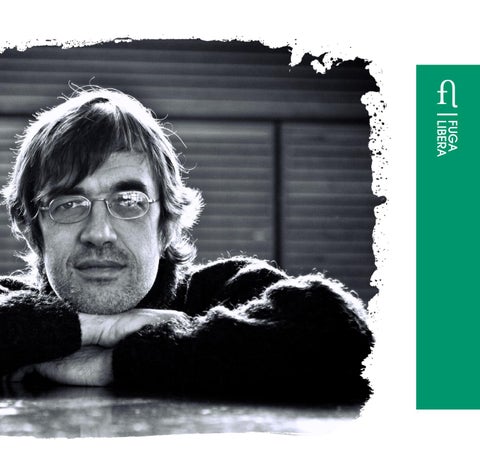
Slavic Soul
J A N MICHIELS
Antonín Dvořák 1 – In the Old Castle / Na starém hradě1 – 4’09 Leoš Janáček 2 – Vivo2
– 1’38
Antonín Dvořák 3 – Furiant1
– 2’41
Leoš Janáček 4 – The Barn Owl Has Not Flown Away! – 3’27 / Sýček neodletěl!2 Antonín Dvořák 5 – Reverie / Vzpomínáni1
– 3’52
Leoš Janáček 1.X.1905, JW 8/19 6 – I. The Presentiment / Předtucha 7 – II. The Death / Smrt
– 5’03 – 6’15
Antonín Dvořák Dumka-Furiant, op. 12 8 – I. Dumka (Allegretto moderato) – 4’31 9 – II. Furiant (Vivace) – 4’03 Leoš Janáček 10 – Allegro2 11 – Good Night! / Dobrou noc!2 2
– 5’03 – 2’25
Antonín Dvořák 12 – Serenade / Serenáda1
– 4’41
Leoš Janáček 13 – Words Fail! / Nelze domluvit!2
– 1’51
Antonín Dvořák Humoresques, op. 101 / Humoresky 14 – No. 1 – Vivace 15 – No. 7 – Poco lento e grazioso
– 2’12 – 2’43
Leoš Janáček 16 – Allegretto2 17 – The Madonna of Frýdek / Frydecká Panna Maria2
– 2’34 – 3’22
Antonín Dvořák 18 – On the Holy Mountain / Na Svaté Hoře1 – 3’12 Leoš Janáček In The Mist, JW VIII/22 / V Mlhách 19 – I. Andante 20 – II. Molto Adagio 21 – III. Andante 22 – IV. Presto
– 3’04 – 4’09 – 2’09 – 4’52
– 77’57
1 2
Total Time
from Poetic Tone Pictures, op.85 / Poetické Nálady from On an Overgrown Path, JW VIII/17 / Po zarostlém chodníčku
3
EN
Jan Michiels 4
Slavic Soul Leoš Janáček considered Antonín Dvořák as a father figure (“From him I must come to understand which movements by Beethoven and the other classics merit the most study”) and may be seen as his most important heir : “I can interchange his personality with his work, he created melodies from my heart. Nothing in the world can break such a bond.” This last quote was responsible for the creation of this cd-program : a composed dialogue between both Czech masters. When the 43-year-old Antonín Dvořák composed his Dumka-Furiant, op. 12, he was already a celebrity, partly through the considerable support of Johannes Brahms, who had warmly recommended the Czech to his publishers Simrock. The Dumka was a new musical form which Dvořák had developed under the encouragement of the thirteen-year-younger Leoš Janáček – the artful interweaving of elegiac melodies and thoroughgoing motivic development was inspired by two literary forms from the Ukraine : the lyrical dumka and the epic duma. And in this opus 12 we can also hear a clear connection with the ‘Eja Mater’ from Dvořák’s own Stabat Mater. The moving nostalgia emanating from Dvořák’s many dumky is characteristic of his pan-Slavic disposition - a contrast to the Habsburg domination of his time. The Furiant - a thoroughly Czech dance – reveals another side of his national consciousness. In 1889, Dvořák wrote the following about his Poetic Tone Pictures: “Every piece will have a title and should express something, as in programme music, but in Schumann’s sense […]” and further : “For I am not simply a musician in the purest sense, but a poet!” “In the Old Castle”, for example, sketches a shadowy scene of ruins with a tangible sense of nostalgia for the Prague Citadel of the golden fourteenth century. In his manucript, the “Furiant” received the subtitle of “Tanz der Bürschen” (“Dance of the Students”) and “On the Holy Mountain” refers to a place
of pilgrimage in the Bohemian Příbram, not far from Dvořák’s summer residence of Vysoká, about which the deeply religious composer wrote: “[…] For several days now I have been back in this most beautiful forest, where I have spent wonderful days in splendid weather, marvelling time and again at the enchanting birdsongs in my garden, which I tend so carefully and love like divine art […]”. The “speaking” motifs and picturesque harmonies look forward to the opera Rusalka and the symphonic poems that the composer would write in the 1890’s. Janáček was one of the first who would recognise the importance of these works: “I am among those who have always recognised and understood in Dvořák’s compositions all the characteristics of the powerful expression of dramatic music”. Another fascinating aspect of Dvořák’s personality was his passionate interest for locomotives and for the general industrial progress of his time. From 1884 to 1896, for example, the automobile, the motorcycle, the gramophone, the diesel motor and the x-ray were all invented – and it was an other of Dvořák’s obsessions, the steamship, which brought the popular composer to New York, where he was appointed director of the National Conservatory of Music. One year later, the premiere of his Ninth Symphony enjoyed particular succes. During this stay in America, Dvořák filled a number of sketch books with “Motivy” – jottings of which many a composer would be jealous. Brahms once let slip that “one can only but envy the man’s fresh, cheerful and rich inventiveness.” A few of these melodies, not reworked in larger compositions, found their way into the Humoresques that the composer wrote in Vysoká during a Bohemian vacation from his American adventure. These eight miniatures are almost suggestive of photography: refined and simple narrative lines, without any superfluous or decorative complexity. The first Humoresque is based on a sketch for an unfinished opera (Hiawatha) –
5
EN
Jan Michiels 6
and the seventh piece became one of the most famous classical melodies of the 19th century. Dvořák aimed to write accessible music – in his article on Schubert that appeared in 1894, he wrote that “modern taste demands of music that it be concise, condensed and powerful”. The path that had led to this point from his first string quartets and symphonies was exceptional. Starting from Classical examples (Haydn to Schumann), through a great fascination for Wagner (his third string quartet of 1870 is more than an hour long, with many Wagnerian features) and an equally great admiration for Brahms – a most unusual combination for the time – he eventually found his own Slavic voice that on the cusp of the modern age was able to move people of many nationalities, as it continues to do today. The piano works recorded here form something of a musical diary (in the sense of Schumann’s Albumblätter and looking forward to the miniatures of Janáček, Bartók and Kurtág) that reveal a little of the interior world of the simple Bohemian ‘Musikant’, as Dvořák humbly called himself. A musical diary in the margin of his symphonies, his symphonic poems, the Stabat Mater, the Requiem and his many operas (with Rusalka from 1901 as summit). Antonín Dvořák died in Prague during the preparation of his opera Armida in 1904. During the same year, Leoš Janáček knew his first success with the premiere of his opera Jenůfa in Brno. According to a famous student of Janáček’s, the pianist Rudolf Firkušný, Janáček’s entire life and musical development are contained in his chamber and piano music. Doubtless, the milestones remain the operas as Jenůfa, Katia Kabanova, The Cunning Little Vixen, The Makropoulos Affair, From the House of the Dead... The decade that followed the premiere of Jenůfa was a continual battle to get his works staged. The majority of Janáček’s compositions for solo piano were products of this context. The cycle On an overgrown path, for example, consists of fifteen
miniatures composed between 1901 and 1911 – a sort of diary, almost a confession, about the emotional peaks and valleys in his life over those years. “The Barn Owl Has Not Flown Away” refers to a typical superstition story from the countryside ; “Words Fail” depicts the composer mourning his daughter Olga and “The Madonna of Frýdek” shows us pure piety. Now and then you can clearly hear that some of these pieces were conceived for harmonium, the premier instrument in the musical tradition in the village where Janáček grew up, Hukvaldy. These pages are sonic impressions of numerous indelible memories, in an attempt by the composer to find the roots of his existence under the ‘overgrown path’ of his life. In 1905, he wrote the sonata 1.X.1905, after the murder of a worker during the demonstration in Brno. A third movement was destroyed by Janáček immediately after he composed it – and the first two movements were thrown in the Moldau... Happily for us, the Czech pianist Ludmila Tucková had taken copies that were edited later – now with the composer’s approval. This music shows the dramatic power of Janáček in all his strenght. This dramatic vein continued also in his piano pieces, written in between the operas. Janáček himself wrote about this latter genre: “The history of opera is the mother of wisdom. Gluck, Mozart, Wagner and the modern composers have always tried to present to present the truth of life on stage […]. Since in daily life people do not sing, but speak, all arias and songs in opera should be avoided where they do not also occur in daily life. So we should base it on the melody of language itself”. Since 1885, Janáček had been writing down these spoken melodies in various notebooks, listening to people at work, on the train, or on the streets of his home town of Brno : conversations between children, girls at play, the patter of a baker or an old beggar, words of his dear friend Dvořák,
7
EN
Jan Michiels 8
a speech by Rabindranath Tagore (whose philosophy of freedom was a profound influence on Janáček), the last words of his dying daughter Olga, birdsong, the mosquitoes of Venice – all sort of sounds found their way into his hastily sketched musical staves. As he put it, “as soon as someone spoke to me, I may not have understood the words, but I immediately caught the rising and falling of the tones! And I knew right away what that person was like: I knew how they were feeling, if they were lying, if they were upset […]. Sounds, the intonation of human speech, from every living creature, have always contained the deepest truth for me […] these spoken melodies are windows offering a look into the human soul”. In his compositions for piano, the cycle In the Mist approaches very closely the style of Janáček’s operas. It is an extremely emotional music with capricious tempo changes, brisk harmonizations, fragmented melodies: a real instrumental drama in four acts... “You know, don’t you, that all my motifs grow out of the earth, from the animals, from the people – that they are connected to everything that exists”, Janáček wrote to a friend. He saw the world and his compositions as a many-layered, kaleidoscopic montage of actions, themes and motifs. So is this cd-program in a similar way a kaleidoscopic montage... of “his melodies from my heart”. An instrumental drama as an homage to Antonín Dvořák and Leoš Janáček – two slavic masters in translating the human soul into music.
Jan Michiels Jan Michiels (°1966) studied with Abel Matthys at the Royal Conservatory of Brussels. From 1988 to 1993 he studied at the Hochschule der Künste in Berlin under the direction of Hans Leygraf where he was awarded an exceptional distinction. He was Tenuto-laureate in 1988 ; in 1989 he won the international E. Durlet competition. In 1991 he was laureate of the international Queen Elizabeth Competition. In 1992 he was awarded the JeM/ Cera prize for musicians and in 1996 he was signed up as festival star of the Flanders Festival. He is also laureate of the ‘Gouden Vleugels/ KBC Muziekprijs’ 2006. Jan Michiels is currently active as piano professor in the Koninklijk Conservatorium Brussel, where he also led the class of contemporary music for eight years. He conducted masterclasses in London, Murcia, Hamburg, Oslo, Montepulciano, Szombathely (Bartokfestival). He was jury member in several competitions (Brussels, Bolzano,...). He obtained in 2011 a doctorate in the arts (with greatest distinction) by performing a ‘teatro dell’ascolto’, inspired by the ‘New Prometheus’ of Luigi Nono.. He regularly performs as a soloist or with chamber music ensembles (a.o. a piano duo, Ying Yang, with Inge Spinette) in several musical centres in Europe and Asia, with conductors such as Angus, Asbury, Baudo, Blunier, Boreycko, Edwards, Eötvös, Guerrero, Holliger, LathamKönig, Kamu, Märkl, Meylemans, Nézet-Séguin, Ono, Pfaff, Rahbari, Rundel, Soustrot, Stern, Tabachnik, Tamayo, Zagrosek, Zender - but also with dance-productions of Anna Teresa De Keersmaeker, Vincent Dunoyer and Sen Hea Ha. His repertoire reaches from Bach to today. Apart from his many radio recordings, he also recorded cd’s with works from a.o. Bach, Bartók, Beethoven, Brahms, Busoni, Debussy, Dvorák, Janácek, Liszt, Rachmaninov, Ligeti, Kurtág and Goeyvaerts (these three last composers appreciated very much his interpretations). www.michielsjan.be
9
FR
Jan Michiels 10
Slavic Soul Leoš Janáček tenait Antonín Dvořák pour une figure paternelle – « De lui j’ai appris quels sont les mouvements de Beethoven et des autres classiques qui méritent le plus d’être étudiés » – et peut être considéré comme son plus important héritier : « Sa personnalité et son oeuvre sont interchangeables ; il a créé des mélodies selon mon coeur. Rien au monde ne peut briser un tel lien ». Cette dernière phrase a suscité la composition du programme de cet album, composé comme un dialogue entre ces deux maîtres tchèques. Lorsque Dvořák, à l’âge de quarante-trois ans, composa son Dumka-Furiant, op. 12, il était déjà célèbre, grâce notamment à l’important soutien de Johannes Brahms, qui avait chaudement recommandé le compositeur tchèque à son propre éditeur, Simrock. La Dumka était une forme musicale nouvelle que Dvořák avait développée avec les encouragements de son cadet de treize ans, Leos Janáček. L’habile entrelacs de mélodies élégiaques et d’un développement motivique approfondi s’inspire de deux formes littéraires d’Ulkraine : la lyrique dumka et l’épique duma. Et dans cet opus 12, on entend aussi clairement un lien avec le mouvement « Eja Mater » extrait du Stabat Mater de Dvořák lui-même. L’émouvante nostalgie qui émane des nombreuses dumky de Dvořák est caractéristique de ses penchants panslaves – qui allaient à l’encontre de la domination habsbourgeoise de l’époque. Le Furiant – danse typiquement tchèque – révèle un autre aspect de sa conscience nationale. En 1889, Dvořák écrivit à propos de ses Impressions Poétiques : « Toute pièce aura un titre et devra exprimer quelque chose, comme dans la musique à programme, mais au sens de Schumann » ; et plus loin : « Car je ne suis pas simplement un musicien au sens le plus pur, mais un poète ! ». « Au vieux château », par exemple, esquisse une scène de ruines mystérieuse avec un sentiment tangible de nostalgie pour la citadelle de Prague du XIVe siècle. Dans le manuscrit, le Furiant est sous-titré « Tanz der Bür-
schen » (« Danse des étudiants ») et « Sur la montagne sacrée » renvoie à un lieu de pèlerinage à Příbram en Bohème, non loin de la résidence d’été de Dvořák à Vysoka, à propos de quoi le compositeur, profondément religieux, écrit : « Depuis quelques jours, je suis de retour dans cette très belle forêt, où j’ai passé des journées magnifiques, par un temps splendide, à m’émerveiller sans fin des chants d’oiseaux dans mon jardin, dont je m’occupe si attentivement et aime comme l’art divin ». Les motifs parlants et les harmonies pittoresques préfigurent le monde féerique de l’opéra Rusalka et les poèmes symphoniques que le compositeur allait écrire dans les années 1890. Leoš Janáček fut l’un des premiers à saluer l’importance de ces oeuvres : « Je suis de ceux qui ont toujours reconnu et compris dans les compositions de Dvořák tout ce qui caractérise la puissance expressive de la musique dramatique ». Un autre aspect fascinant de la personnalité de Dvořák était sa passion pour les locomotives et les progrès industriels de son temps. Les années de 1884 à 1896 virent ainsi l’invention de l’automobile, de la motocyclette, du gramophone, du moteur diesel et des rayons-X – et c’est une autre des obsessions de Dvořák (le bâteau à vapeur) qui, en 1892, amena le célèbre compositeur à New York, où il fut nommé directeur du Conservatoire national de musique. Un an plus tard, la création de sa Neuvième Symphonie remporta un succès spectaculaire. Lors son séjour en Amérique, Dvořák emplit un certain nombre de carnets d’esquisses de « Motivy » – notes dont maints compositeurs seraient jaloux. Brahms laissa un jour échapper qu’on « ne peut qu’envier l’invention fraîche, gaie et riche de cet homme ». Certaines de ces mélodies, qui n’avaient pas été retravaillées dans des compositions plus vastes, trouvèrent leur place dans les Humoresques que le compositeur écrivit en vancances à Vysoka, au moment de son aventure américaine. Ces huit miniatures évoquent presque la photographie : des lignes narratives simples et raffinées, sans aucune complexité superflue
11
FR
Jan Michiels 12
ou décorative. Le premier morceau est basé sur des esquisses d’un opéra inachevé (Hiawatha), tandis que le septième est devenu l’une des mélodies les plus célèbres du XIXe siècle. Dvořák visait à écrire une musique accessible – dans son article sur Schubert publié en 1894, il note que « le goût moderne exige une musique qui soit concise, condensée et puissante ». Le parcours qui avait conduit à cet aboutissement, depuis ses premiers quatuors à cordes et symphonies, était exceptionnel : partant d’exemples classiques (de Haydn à Schumann), en passant par une grande fascination pour Wagner (son Troisième quatuor à cordes de 1870 dure plus d’une heure, avec de nombreuses caractéristiques wagnériennes) et une non moins grande admiration pour Brahms – combinaison des plus inhabituelles pour l’époque –, il finit par trouver sa propre voix slave, qui, à l’aube de la modernité, fut capable d’émouvoir des auditeurs de nombreuses origines, comme elle continue de le faire aujourd’hui. Les oeuvres pour piano enregistrées ici forment un espèce de journal musical (un peu comme les Albumblätter de Schumann, et préfigurant les miniatures de Janáček, Bartók et Kurtág) qui révèle un peu le monde intérieur du simple ‘Musikant’ de Bohême, ainsi que Dvořák se baptisait humblement. Un journal musical dans les coulisses de ces opéras, ses symphonies, ses poèmes symphoniques, son Stabat Mater et son Requiem... Dvořák mourût à Prague pendant les préparations de son opéra ‘Armida’ – en 1904. Durant cette même année, Leoš Janáček vivait son premier grand succès avec la première de son opéra Jenůfa à Brno. Selon un élève célèbre de Janáček – le pianiste Rudolf Firkušný –, la musique de chambre et de piano de celui-ci comprennent toute la vie et le développement musical de Janáček. Des jalons de ces derniers restent indubitablement des opéras tels que Jenůfa, Katia Kabanova, La petite renarde rusée, L’affaire Makropoulos, De la maison des morts,... La décennie qui suivit la première de Jenůfa fut une lutte continue pour mettre ses oeuvres
en scène. C’est dans ce contexte que sont nées la plupart des compositions de Janáček pour piano seul. Ainsi, le cycle Sur un sentier recouvert se compose de quinze miniatures créées entre 1901 et 1911 – une sorte de journal, presque une confession, sur les hauts et les bas émotionnels dans sa vie pendant ces années-là. « La chevêche ne s’est pas envolée » est basé sur une histoire typique de superstition à la campagne, « La parole manque » nous confronte avec le compositeur en deuil pour sa fille Olga et « La vierge de Frýdek » nous montre une piété pure. De temps en temps, nous percevons clairement que quelques pièces étaient conçues à l’origine pour l’harmonium, l’instrument par excellence de la tradition musicale du village de la jeunesse de Janáček, Hukvaldy. Ces pages mettent en musique d’innombrables souvenirs indélébiles, une tentative du compositeur de retrouver les racines de son existence sous le « sentier recouvert » de sa vie. En 1905, il écrivit la sonate 1.X.1905, après le meurtre d’un ouvrier pendant une démonstration à Brno. Un troisième mouvement fut détruit par Janáček immédiatement après sa composition – et les deux premiers furent jetés dans le Moldau... Heureusement pour nous, la pianiste tchèque Ludmila Tucková avait fait des copies qui seraient éditées plus tard avec l’accord de Janáček. Cette musique nous montre la force dramatique de la musique du compositeur dans toute sa vigueur. La veine dramatique de Janáček a donc également trouvé une voie dans sa musique pour piano – entre ses opéras. Dans ce dernier genre, Janáček écrivit lui-même : « L’histoire de l’opéra est la mère de la sagesse. Gluck, Mozart, Wagner et les compositeurs modernes ont toujours essayé de mettre en scène la vérité de lavie […]. Étant donné que dans la vie quotidienne, les gens ne chantent pas, mais parlent, il faut éviter dans l’opéra tous les airs et les chansons là où ils n’existent pas non plus dans la vie réelle. Voilà pourquoi nous devons nous baser sur la mélodie de la langue même ».
13
FR
Jan Michiels 14
Dès 1885, Janáček notait des mélodies parlées dans divers carnets de notes : il écoutait les gens à leur travail, dans le train, dans les rues de son port d’attache Brno. Conversations entre enfants, fillettes qui jouent, le bagou d’un boulanger ou d’un vieux mendiant, les paroles de son ami Dvořák, un discours de Rabindranath Tagore (dont la philosophie de la liberté a fortement influencé Janacek), les dernières paroles de sa fille Olga à l’agonie, les bruits d’oiseau, les moustiques à Venise,... : d’innombrables sons ont trouvé leur voie sur des portées esquissées à la hâte – « Dès que quelqu’un m’adressait la parole, je ne comprenais peut-être pas les mots, mais je saissisais immédiatement la montée et la descente des tons ! Et je savais d’emblée comment était cette personne : je savais comment elle se sentait, si elle était en train de mentir, si elle était bouleversée […]. Les sons, l’intonation de la parole humaine, de tout être vivant, ont toujours contenu pour moi la vérité la plus profonde […], ces mélodies parlées sont des fenêtres qui laissent apercevoir l’âme humaine » – voilà le credo de Janáček. De toutes ses compositions pour piano, le cycle Dans les brumes s’approche le plus du style des opéras. C’est une musique extrêmement émotionelle avec des capricieux changements de tempo, des harmonisations inattendues et des mélodies fragmentées : un vrai drame instrumental en quatre actes... « Vous savez tout de même que tous mes motifs naissent de la terre, des animaux, des hommes – qu’il sont liés à tout ce qui existe », écrit Janáček à un ami. Il considérait le monde et ses compositions comme un montage kaléidoscopique stratifié d’actions, des thèmes et des motifs. C’est aussi le cas du programme sur ce cd : un montage kaléidoscopique de « ses mélodies selon mon coeur ». Un drame instrumental comme hommage à Antonín Dvořák et Leoš Janáček : deux maîtres slaves qui traduisaient l’âme humaine en musique.
Jan Michiels Durant sa formation, Jan Michiels (°1966) étudie d’abord auprès d’Abel Matthys au Koninklijk Conservatorium Brussel, puis il travaille sous la direction de Hans Leygraf à la Hochschule der Künste Berlin – où il obtient la plus grande distinction. En 1988, il est lauréat du concours Tenuto, en 1989 il remporte la compétition internationale E. Durlet et en 1991, il est lauréat du Concours international Reine Elisabeth. En 1992, il reçoit le prix JeM/Cera de l’interprète. En 1996, il est la tête d’affiche du Festival van Vlaanderen. Il est également lauréat du ‘Gouden Vleugels/KBC Muziekprijs’ 2006. Jan Michiels est aujourd’hui professeur de piano au Koninklijk Conservatorium Brussel, où il a également dirigé la classe de musique contemporaine durant huit ans. Il donne des masterclasses à Londres, Murcia, Hambourg, Oslo, Montepulciano, Szombathely (Bartokfestival), et a été membre de jury dans différentes compétitions (Bruxelles, Bolzano,...). Il termine en 2011 un doctorat dans les arts (avec la plus grande distinction) après avoir présenté un Teatro dell’ascolto, inspiré du Promethée de Luigi Nono. Il joue régulièrement comme soliste ou avec des ensembles de musique de chambre (le quatuor à clavier « Tetra Lyre » ou le duo de piano avec Inge Spinette) sur différentes scènes d’Europe et d’Asie, sous la direction de chefs tels que Angus, Asbury, Baudo, Blunier, Boreycko, Edwards, Eötvös, Guerrero, Holliger, Latham-König, Kamu, Märkl, Meylemans, Nézet-Séguin, Ono, Pfaff, Rahbari, Rundel, Soustrot, Stern, Tabachnik, Tamayo, Zagrosek, Zender – mais aussi aux côtés de choréographes comme Anna Teresa De Keersmaeker, Vincent Dunoyer et Sen Hea Ha. Son répertoire s’étend de Bach à nos jours. En dehors de plusieurs enregistrements pour la radio, il a entre autres enregistré sur cd des oeuvres de Bach, Bartók, Beethoven, Brahms, Busoni, Debussy, Dvorák, Janácek, Liszt, Rachmaninov, Ligeti, Kurtág et Goeyvaerts (ces trois derniers compositeurs étaient ravis de ses interprétations). www.michielsjan.be
15
NL
Jan Michiels 16
Slavic Soul Leoš Janáček beschouwde Antonín Dvořák als een vaderfiguur (“Ich muss erfahren von ihm welche Sätze er von Beethoven und den anderen Klassikern am meisten zu studieren empfehlt”) en is wellicht zijn voornaamste erfgenaam gebleken : “Ich kann seine Persönlichkeit mit seinem Werk vertauschen, er schöpfte seine Melodien aus meinem Herzen. Einen solchen Bund kann nichts in der Welt trennen”. Dit laatste citaat was de directe aanleiding tot het samenstellen van dit programma : een gecomponeerde dialoog tussen beide Tsjechische meesters. Als de drieënveertigjarige Dvořák zijn Dumka en Furiant, op. 12, neerschreef was hij al een beroemdheid, niet in het minst dankzij de steun van Johannes Brahms die de Tsjech warm had aanbevolen aan zijn uitgever Simrock. De Dumka was een nieuwe muzikale vorm die Dvorák op aansporing van de dertien jaar jongere Janáček heeft uitgewerkt – de kunstvolle verweving van elegische melodieën en doorgedreven motivische verwerking is geïnspireerd door twee literaire vormen uit de Oekraïne : de lyrische dumka en de epische duma. En in dit opus 12 is er ook een duidelijke verwantschap waar te nemen met het “Eja Mater” deel uit Dvořáks eigen Stabat Mater. De aangrijpende nostalgie die spreekt uit Dvořáks talrijke dumky tekent zijn panslavische ingesteldheid – tegenover de Habsburgse dominantie in zijn tijd. De Furiant – Tsjechische dans bij uitstek – toont een ander facet van zijn nationaal zelfbewustzijn. In 1889 schreef Dvořák over zijn Poetické nálady : “Jedes Stück wird einen Titel haben und soll etwas ausdrücken, also gewissermassen Programmusik, aber im Sinne Schumanns […]” of nog : “Denn da bin ich nicht nur reiner Musikant, sondern Poet !”. “Na starém hradě” bijvoorbeeld schildert een duistere ruïnenscène met een voelbaar heimwee naar de Praagse Burcht van de gouden veertiende eeuw. De Furiant heeft hier in het manuscript de ondertitel “Tanz der Bürschen” meegekregen en “Na Svaté Hoře” verwijst naar een pelgrimsplaats in het Boheemse Příbram, niet ver
gelegen van Dvořák zomerverblijf in Vysoká waarover de diepreligieuze componist schreef : “[…] ich bin seit einigen Tagen wieder hier im schönsten Wald, wo ich die herrlichste Tage beim schönsten Wetter verbringe und den bezaubernden Gesang der Vögel immer und immer bewundere […] den ganzen Tag verbringe ich meistens in meinem Garten, den ich so schön pflege und liebe wie die göttliche Kunst […]„. De sprekende motieven en schilderachtige harmonieën verwijzen reeds naar de sprookjeswereld van de opera Rusalka en de symfonische gedichten die Dvořák op het einde van de negentiende eeuw zou schrijven. Janáček was één van de eersten die het belang van deze werken zou inzien : “Ich gehöre zu jenen, welche in Dvořáks Kompositionen stets alle Merkmale eines mächtigen Ausdrucks der dramatischen Musik erkannt und erfasst haben”. Een ander fascinerend aspect van Dvořáks persoonlijkheid is zijn hartstochtelijke interesse voor locomotieven... en voor de algemene industriële vooruitgang van zijn tijd. Van 1884 tot 1896 bijvoorbeeld werden het automobiel, de motorfiets, de grammofoonplaat, de dieselmotor en de röntgenstralen uitgevonden – en het was een andere obsessie van Dvořák – het stoomschip – die de veelgevraagde componist in 1892 naar New York bracht, waar hij aangesteld werd als directeur van de National Conservatory of Music. Eén jaar later werd de creatie van zijn Negende Symfonie een weergaloos succes. Tijdens dit verblijf in Amerika schreef Dvořák een aantal schetsboeken vol met “Motivy” waarop wel menig componist jaloers moest worden. Brahms liet zich ooit ontvallen : “[…] und man kann den Mann um seine frische, heitere und reiche Erfindungsgabe nur beneiden”. Enkele melodieën hieruit die niet verwerkt werden in grotere composities vonden hun weg naar de Humoresken die Dvořák schreef in Vysoká tijdens een Boheemse rustpauze in het Amerikaanse avontuur. Deze acht miniaturen doen haast denken aan fotografie : verfijnde en eenvoudige narratieve lijnen, zonder enige overbodige decoratieve complexiteit.
17
NL
Jan Michiels 18
De eerste Humoreske is gebaseerd op schetsen voor een onvoltooide opera (Hiawatha) en de zevende Humoreske is één van de bekendste romantische melodieën geworden. Dvořák wou toegankelijke muziek schrijven – in zijn artikel over Schubert dat in 1894 verscheen schreef hij : “Moderner Geschmack fordert für die Musik dass sie knapp,verdichtet und kraftvoll sei”. De weg hiernaartoe vanuit zijn eerste strijkkwartetten en symfonieën is uitzonderlijk. Vanuit klassieke voorbeelden (van Haydn tot Schumann), via een grote fascinatie voor Wagner (zijn Derde strijkkwartet uit 1870 overschrijdt met vele Wagneriaanse wendingen het uur...), en via een even grote bewondering voor Brahms (een combinatie die voor die tijd hoogst atypisch was) vond hij zijn eigen slavische stem die op de brug naar de moderne tijd grote bevolkingsgroepen aansprak en nog altijd blijft ontroeren. De hier opgenomen pianowerken vormen een soort muzikaal dagboek (in de zin van Schumanns Albumblätter en vooruitwijzend naar de miniaturen van Janáček, Bartók en Kurtág) dat een stukje van de innerlijke wereld blootlegt van de eenvoudige Boheemse ‚Musikant‘ , zoals Dvořák zichzelf al te bescheiden noemde. Een muzikaal dagboek in de marge van zijn symfonieën, symfonische gedichten, oratoria en opera‘s (een dertiental – met Rusalka uit 1901 als hoogtepunt)... Antonín Dvořák stierf in Praag tijdens de voorbeidingen van zijn opera Armida in 1904. In datzelfde jaar kende Leoš Janáček zijn eerste succes met de première van zijn opera Jenůfa in Brno. Volgens een beroemde leerling van Janáček – de pianist Rudolf Firkušný – omvatten diens kamermuziek en pianomuziek Janáčeks ganse leven en muzikale ontwikkeling. Mijlpalen daarin blijven ongetwijfeld opera’s met naast Jenůfa : Katia Kabanova, Das Schlaue Füchslein, Die Sache Makropoulos, Aus einem Totenhaus...Tijdens het decennium dat volgde op de première van Jenůfa voerde hij een voortdurende strijd om zijn werk
op het toneel te brengen. In die context ontstonden het merendeel van Janáčeks composities voor piano solo. De cyclus Po zarostlém chodníčku bijvoorbeeld bestaat uit vijftien miniaturen die ontstonden tussen 1901 en 1911 – een soort dagboek, haast een biecht, over de emotionele hoogtes en laagtes in zijn leven. “Sýček neodletěl” verwijst naar een typisch luguber bijgeloof op het platteland, “Nelze domluvit” verplaatst ons naar de rouw van de componist om zijn dochter Olga, en in “Frydecká Panna Maria” horen we pure vroomheid. Hier en daar is nog hoorbaar dat sommige stukken eerst voor harmonium gedacht waren, hét instrument van de muzikale traditie in het dorp van Janáceks jeugd, Hukvaldy. Deze pagina’s verklanken talloze onuitwisbare herinneringen, in een poging van de componist om de wortels van zijn bestaan onder het “overgroeide pad” van zijn leven terug te vinden. In 1905 schreef hij de sonate 1.X.1905 naar aanleiding van de moord op een arbeider tijdens een demonstratie in Brno. Een derde deel verscheurde hij onmiddellijk na de compositie en de eerste twee delen wierp hij in de Moldau... Gelukkig voor ons had de pianiste Ludmila Tucková al een kopie gemaakt die later met Janáčeks goedkeuring werd uitgegeven. Deze muziek toont de dramatische kracht van Janáčeks muziek ten volle. Het dramatische talent van Janáček vond dus ook een weg in zijn pianostukken – tussen de opera’s door. Over dit laatste genre schreef Janáček zelf : “ De geschiedenis van de opera is de moeder van de wijsheid. Gluck, Mozart, Wagner en de moderne componisten hebben altijd getracht om de levenswaarheid op het toneel te brengen […]. Aangezien de mensen in het dagelijkse leven niet zingen, maar spreken, moet men alle aria’s en liederen in de opera daar vermijden, waar ze ook niet in het werkelijke leven voorkomen. Daarom moeten we ons baseren op de melodie van de taal zelf”. Sinds 1885 al noteerde Janáček spraakmelodieën in diverse notitieboekjes : hij beluisterde mensen op het werk, in de trein, in de straten van
19
NL
Jan Michiels 20
zijn thuishaven Brno. Gesprekken tussen kinderen, spelende meisjes, het gepraat van een bakker of een oude bedelaar, woorden van zijn geliefde vriend Dvořák, een toespraak van Rabindranath Tagore (wiens vrijheidsfilosofie Janáček sterk beïnvloedde), de laatste woorden van zijn stervende dochter Olga, vogelgeluiden, de muggen in Venetië,... : ontelbare klanken vonden hun weg op haastig geschetste notenbalken – “van zodra iemand tot me sprak, begreep ik de woorden misschien niet, maar ik vatte onmiddellijk het stijgen en dalen van de tonen ! En ik wist op slag hoe die persoon was : ik wist hoe hij of zij zich voelde, of hij of zij aan het liegen was, of hij of zij overstuur was […]. Klanken, de intonatie van de menselijke spraak, van elk levend wezen, hebben voor mij altijd de diepste waarheid bevat […], deze spraakmelodieën zijn vensters die toegang verschaffen tot de menselijke ziel” – zo luidt Janáčeks credo… De cyclus V Mlhách komt wellicht het dichtst bij de stijl van Janáčeks opera‘s : het is een uiterst emotionele muziek met grillige tempowisselingen, bruuske harmonisaties en gefragmenteerde motieven – een instrumentaal drama in vier actes... “U weet toch dat al mijn motieven uit de aarde groeien, uit de dieren, uit de mensen – dat ze met alles wat bestaat verbonden zijn”, schrijft Janáček aan een vriend. Hij zag de wereld en zijn composities als een veelgelaagde, kaleidoscopische montage van handelingen, thema’s en motieven. Ook dit cd-programma is een kaleidoscopische montage van “seine Melodien aus meinem Herzen”. Een instrumentaal drama als hommage aan Antonín Dvořák en Leoš Janáček – twee Slavische grootmeesters in het verklanken van de menselijke ziel.
Jan Michiels Jan Michiels (°1966) studeerde bij Abel Matthys aan het Koninklijk Conservatorium Brussel. Daarna werkte hij aan de Hochschule der Künste Berlin onder leiding van Hans Leygraf – tijdens zijn Reifeprüfung kreeg hij een bijzondere onderscheiding. In 1988 werd hij Tenuto-laureaat ; in 1989 won hij de internationale wedstrijd E. Durlet. In 1991 werd hij laureaat van de Koningin Elisabethwedstrijd. In 1992 werd hem de JeM/ Cera-prijs voor vertolkers toegekend en voor 1996 werd hij als ‘festivalster’ binnen het Festival van Vlaanderen gecontracteerd. Hij is tevens laureaat van de Gouden Vleugels/KBC Muziekprijs 2006. Momenteel is hij docent piano aan het Koninklijk Conservatorium Brussel, waar hij tevens gedurende acht jaar de klas Hedendaagse Muziek leidde. Hij gaf masterclasses in London, Murcia, Hamburg, Oslo, Montepulciano, Szombathely (Bartokfestival). Hij was jurylid in verschillende wedstrijden (Brussel, Bolzano, ...) en behaalde in 2011 een doctoraat in de kunsten (met grootste onderscheiding) na de presentatie van een ‘teatro dell’ascolto’, geïnspireerd door de ‘nieuwe Prometheus’ van Luigi Nono. Jan Michiels treedt regelmatig als solist of in kamermuziekverband (met onder andere het pianokwartet ‘Tetra Lyre’ en in pianoduo met Inge Spinette) op in diverse muziekcentra in Europa en Azië met onder andere dirigenten als Angus, Asbury, Baudo, Blunier, Boreycko, Edwards, Eötvös, Guerrero, Holliger, Latham-König, Kamu, Märkl, Meylemans, Nézet-Séguin, Ono, Pfaff, Rahbari, Rundel, Soustrot, Stern, Tabachnik, Tamayo, Zagrosek, Zender – maar ook met dansproducties van Anna Teresa De Keersmaeker, Vincent Dunoyer en Sen Hea Ha. Zijn repertoire reikt van Bach tot vandaag. Naast vele radio-opnames realiseerde hij cd’s met werk van onder andere Bach, Bartók, Beethoven, Brahms, Busoni, Debussy, Dvorák, Janácek, Liszt, Rachmaninov, Ligeti, Kurtág en Goeyvaerts (deze drie laatste componisten hadden veel lof voor zijn interpretaties). www.michielsjan.be
21
JAN MICHIELS
RECORDING
Recording: 17, 18, 24 February 2016, Concert Hall, Royal Conservatory of Brussels (Belgium) Instrument: Steinway D Piano Tuning: Gaëtan Leclef Editing, Mixing & Mastering Engineer: Yannick Willox (www.acousticrecordingservice.be) PICTURES
Photographs Jan Michiels ©Michael Seum FUGA LIBERA
Label Manager / Production / Edition : Aliénor Mahy Artwork concept, Cover illustration & Design: Racasse-Studio.com Booklet : Aliénor Mahy
23
Soul
JAN MICHIELS Slavic
FUG743