MENU
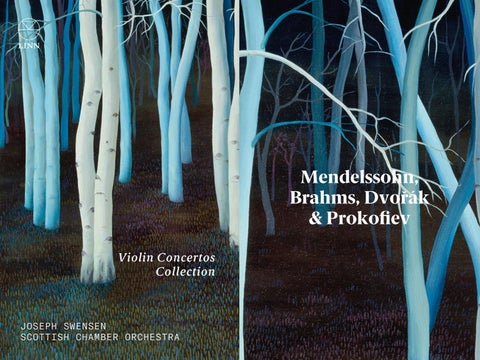
Mendelssohn, Brahms, Dvoล รกk & Prokofiev Violin Concertos Collection
JOSEPH SWENSEN SCOTTISH CHAMBER ORCHESTRA 1
MENU
Credits CD 1 : Tracklist Programme note CD 2 : Tracklist Programme note CD 3 : Tracklist Programme note
Mendelssohn, Brahms, Dvořák & Prokofiev
CD 4 : Tracklist Programme note
Violin Concertos Collection
Biographies
JOSEPH SWENSEN SCOTTISH CHAMBER ORCHESTRA 2
3
Recording Engineers Philip Hobbs (CD 1, 2 & 4), Calum Malcolm
Post-production Julia Thomas
Recorded in Usher Hall, Edinburgh, UK, on 1–3 July 2002 (CD 1), 7–9 July 2003 (CD 2), 22–23 February 2004 (CD 3) and 15–16 March 2003 (CD 4) Recording Producer Andrew Keener
Cover Image Mystic (2004), by Magdolna Ban, © Private Collection / Bridgeman Images
Design stoempstudio.com
MENU
71:44
Felix Mendelssohn (1809–1847)
JOSEPH SWENSEN conductor SCOTTISH CHAMBER ORCHESTRA
CD 1 1 — The Hebrides (Fingal’s Cave), Op. 26 9:51
Violin Concerto in E minor, Op. 64 JOSEPH SWENSEN violin
Symphony No. 3 in A minor ‘Scottish’, Op. 56
5 6 7 8
Andante con moto – Allegro un poco agitato 12:07 Vivace non troppo 4:12 Adagio 8:22 Allegro vivacissimo – Allegro maestoso assai 8:49
— — — —
4
Originally CKD 216
2 — Allegro molto appassionato 13:30 3 — Andante – Allegretto non troppo 8:59 4 — Allegro molto vivace 5:54
MENU
Felix Mendelssohn
MENU
Violin Concerto & Symphony No. 3
Rather than being solely a composer, Felix Mendelssohn should be considered a polymath. He was educated and skilled in music, painting and drawing, languages, the classics, as well as being an accomplished sportsman, dancer and chess player. His musical achievements – of which composition was always the most important in his own eyes – also include performances as a virtuoso on the piano and organ, a gifted violinist, a conductor, and an administrator and editor who has left a legacy still respected and followed in the twenty-first century. Born in Hamburg, 3 February 1809, Mendelssohn was the second child of Abraham and Lea Mendelssohn. Abraham was a successful banker in a firm he founded with his brother in Berlin, a city he and his family (including the children Fanny, born in 1805, Felix and another daughter, Rebecka, born in 1811) returned to in July 1811. A fourth child, Paul, was born in 1812. The family were well off, and the children well educated. Felix and his sister Fanny received their initial musical education from their mother Lea and later, others were called in to help polish the two prodigies. During a visit to Paris in 1816–7 the children received piano lessons from Marie Bigot, a player who was admired by both Haydn and Beethoven. Later musical lessons came from Ludwig Berger and then, at the Berlin Sing-Akademie, with Carl Friedrich Zelter. Zelter was 5
himself schooled and taught using instruction from Kirnberger’s Die Kunst des reinen Satzes in der Musik, written to disseminate the pedagogical method of J. S. Bach. Zelter probably commenced teaching the young Mendelssohn composition in mid-1819; his first datable composition was performed on 11 December 1819. Family connections allowed much opportunity for the young Mendelssohn to meet and perform in front of leading European musicians including, at various times, Hummel, Spohr, Schelbe, Moscheles, Cherubini, Kreutzer and Rossini. When still in his mid-teens, Mendelssohn was given a copy of J. S. Bach’s St Matthew Passion, a work which he revived in a celebrated performance at the Berlin Sing-Akademie in March 1829, following years of preparation. By this time Mendelssohn was known as a gifted composer whose works were regularly being performed – his A Midsummer Night’s Dream was premiered in early 1827 at a concert which also included the composer playing one of the solo parts in his Concerto for two pianos in A flat major. The earliest of his Lieder ohne Worte (‘Songs without words’) was written, as a birthday present for his sister Fanny, in 1828. 1829 also saw Mendelssohn embark on what can best be described as a grand tour. Shortly after the performances of the St Matthew Passion, Mendelssohn left for Hamburg and, following a difficult crossing of the English Channel, arrived in London on 21 April. Initially remaining in London, often performing at private gatherings,
6
MENU
Mendelssohn left London in late July to visit Scotland for a walking tour. It was at an assembly of bagpipe musicians at Holyrood Palace, Edinburgh, that the inspiration for the opening of the Symphony No. 3 ‘Scottish’ came to him, and within two weeks he had the genesis of his Overture ‘The Hebrides’, which came to him while looking out at the Hebrides. A letter written to his family, dated 7 August 1829, includes the opening bars of the first theme in score. Although intimately connected with the work, it was not until the following day that Mendelssohn visited Fingal’s Cave on the island of Staffa. Despite being capable of writing quickly when it was required of him, Mendelssohn was at heart a constant reviser of his own works. The first draft of the Overture ‘The Hebrides’ was completed in Rome during a visit in the winter of 1830–1, but the work was not completed and performed until mid-1832. In the case of the ‘Scottish’ Symphony, work was even slower with the piece not being completed and performed until 1842. Part of the delay with the latter piece can be directly attributed to his other activities. From 1833, still in his early twenties, Mendelssohn held a series of musical posts, including those of Music Director in Düsseldorf and, from 1835, Musical Director in Leipzig, where his duties included conducting the Gewandhaus Orchestra. In 1838 he directed a series of four ‘historical concerts’, featuring performances of music composed up to a hundred years earlier.
7
MENU
A similar series in 1841 featured five concerts, the first of which featured the music of J. S. Bach and Handel, and the last featuring music by contemporary composers. Although not the first to do so, Mendelssohn conducted with a baton, and it is here that the orchestral concert programme of today has its earliest foundations. Mendelssohn’s later life saw an increased workload with his time divided between a newly created, although undefined, post in Berlin, and his position in Leipzig. He was also involved in the creation of the Music Conservatory in Leipzig, heading a staff which included Robert Schumann, Ignaz Moscheles, Ferdinand David, Moritz Hauptmann and later Niels Gade. As his workload increased, so did his frustration at the lack of time available to pursue his favourite activity, composition. The ‘Scottish’ Symphony was finished in January 1842 and received its premiere on 3 March of that year. However, the true compositional masterpiece of Mendelssohn’s later years is his Violin Concerto in E minor, Op. 64, written for Ferdinand David, and premiered in Leipzig (conducted by Niels Gade) on 13 March 1845. Mendelssohn never managed to free himself of other commitments; a commission from the London Handel Society to edit Israel in Egypt resulted in the first ‘modern published edition’ with Mendelssohn clearly differentiating between Handel’s written marks and his own suggestions. The following year his edition of Bach’s organ works used similar practices.
8
MENU
The depression, for that is what a modern physician may well call it, in his later years never escaped Mendelssohn. Whereas Mozart suffered poverty, Beethoven deafness and Schumann madness, Mendelssohn suffered as a result of his great success, something familiar to the people of the twenty-first century. He died, mere months after his beloved sister Fanny, following a stroke on 4 November 1847, aged only thirty-eight.
© Jack Dine
© D. Martin, 2002
9
MENU
71:35
Johannes Brahms (1833–1897)
JOSEPH SWENSEN conductor SCOTTISH CHAMBER ORCHESTRA
CD 2 Violin Concerto in D major, Op. 77 JOSEPH SWENSEN violin Allegro non troppo 23:11 Adagio 8:49 Allegro giocoso, ma non troppo vivace 8:26
Originally CKD 224
1 — 2 — 3 —
10
Hungarian Dances, WoO1
4 — 5 — 6 — 7 — 8 — 9 — 10 — 11 — 12 — 13 — 14 — 15 — 16 — 17 —
No. 1 in G minor (orch. Brahms) 2:56 No. 8 in A minor (orch. Gál) 2:41 No. 19 in B minor (orch. Dvořák) 1:57 No. 2 in D minor (orch. Hallén) 2:38 No. 18 in D major (orch. Dvořák) 1:19 No. 9 in E minor (orch. Gál) 1:58 No. 21 in E minor (orch. Dvořák) 1:13 No. 20 in E minor (orch. Dvořák) 2:31 No. 3 in F major (orch. Brahms) 2:30 No. 6 in D major (orch. Schmeling) 3:14 No. 7 in A major (orch. Schmeling) 1:29 No. 10 in F major (orch. Brahms) 1:30 No. 17 in F sharp minor (orch. Dvořák) 2:53 No. 5 in G minor (orch. Schmeling) 2:20
MENU
Johannes Brahms
MENU
Violin Concerto & Hungarian Dances
In the 1850s Johannes Brahms encountered two Hungarian violinists, Eduard Reményi and Joseph Joachim, both of whom were to have a profound impact on the direction of his musical career. Reményi was one of the many Hungarian exiles who had ended up in Hamburg while en route to America in the aftermath of the 1848 revolution. A gifted violinist who had studied at the conservatory in Vienna, he was particularly renowned for his virtuosic performances of the wild and exciting music that was played by Hungary’s Romani gypsies in coffee shops and bars across central Europe. This music was widely believed to be the indigenous folk music of Hungary. However, it was actually an amalgam of various Hungarian styles, interpreted by the gypsies to create a distinct genre that sounded decidedly exotic to Western ears. The style enjoyed enormous popularity in the nineteenth century, and was seized upon by composers such as Weber, Schubert, Liszt and Brahms, whose spirited evocations of the music can be seen in their numerous style hongrois compositions. Reményi and Brahms often played together in Hamburg, Brahms improvising piano accompaniments to Reményi’s Hungarian dances and, in 1853, the two embarked on a concert tour of North Germany. They made an odd couple, Reményi’s theatrical nature
11
providing a stark contrast to the shy and earnest young German and, unsurprisingly, they went their separate ways midway through the tour. Before they parted company however, Reményi introduced Brahms to his fellow compatriot, Joseph Joachim. Like Reményi, Joachim was an enthusiastic champion of Hungarian gypsy music. However, he approached composing and performing with a gravitas that was much more suited to Brahms’ outlook. The more experienced Joachim took Brahms under his wing immediately, introducing him to the Schumann circle and offering him endless compositional advice. The pair studied counterpoint together, played Bach together and quickly laid the foundations for what was to become a lifelong friendship and musical partnership. Brahms wrote the Violin Concerto in D major, Op. 77, in the summer of 1878 while holidaying in the idyllic setting of Pörtschach in the Styrian Alps, the place where, a year earlier, he had written his Second Symphony. Immediate parallels can be drawn between the two works: both are in D Major, have a first movement in triple time with a triadic first subject and are pervaded by the new-found self-confidence and inner calm that manifested itself in Brahms’ writing following the completion of his long-awaited First Symphony. The Concerto was written specifically with Joachim in mind and, as soon as the violin part was finished in August 1878, Brahms sent it to his friend, writing: ‘Now I’ll be satisfied if you say a word, and maybe write in a few: difficult, uncomfortable, impossible, etc.’ Joachim happily stepped in as advisor, and over the next few months made numerous suggestions regarding violin figurations, bowing and orchestral textures. 12
MENU
The pair corresponded repeatedly over the work until its premiere in Leipzig on New Year’s Day 1879, and Brahms continued to tinker with it until its eventual publication in October 1879. Characteristically, although eager for advice, Brahms was not always willing to take Joachim’s proposals on board, and often did not make the alterations suggested by the latter. Nevertheless, the resulting product represents a masterful display of violin writing inspired by the integrity of Joachim’s style. The violinistic qualities of the Concerto were not, however, universally recognized when it first appeared. Josef Hellmesberger, after conducting the premiere of the work, famously remarked that it was a concerto ‘not for, but against the violin’, an attitude that was undoubtedly a reaction to the unprecedented symphonic scope of the work. Reflecting Brahms’ and Joachim’s respect for their Germanic musical heritage, the Concerto builds on the legacy of the violin concertos of Beethoven and Mendelssohn, reconciling the nineteenth-century demand for virtuosity with the intellectual rigour required of the symphony. The first movement is conceived in an utterly symphonic manner, involving a grand scale orchestral exposition and an elaborate wor king out of the thematic material in the solo part. Yet the movement is pervaded by a sense of warmth that belies its compositional intricacies, and moments such as the waltz-like elaboration of the second subject, when it is first taken by the solo violin, exude a cheerful contentment reminiscent of the Second Symphony. Brahms declined to write a cadenza for the movement, leaving this task to Joachim instead. Alternative cadenzas have since been composed by the likes of Busoni and Tovey.
13
MENU
However, Joachim’s cadenza, which can be heard on this recording, appropriately remains the most popular. Each of the three movements of the Concerto reveals a different dimension of Brahms’ multi-faceted compositional persona and, if the first movement epitomizes Brahms the symphonist, it is Brahms the song composer who emerges in the lyrical second movement. Written to replace the two middle movements he had originally sketched out for the Concerto, this ‘feeble Adagio’, as Brahms described it to Joachim, contains some of the composer’s most intimate writing. The movement is built on a gentle melody, the beauty of which lies in its simplicity. The melody is stated first by solo oboe, accompanied by a rich blend of woodwind, and is then treated to a stream of seamless variations by the solo violin. The final movement of the Concerto, an exuberant ‘Rondo alla Zingarese’ (rondo in the Hungarian style), draws on Brahms’ love of Hungarian gypsy music. Clearly an homage to Joachim who had written a finale in the style hongrois for his own Hungarian Concerto of 1861, Brahms managed to immerse himself far deeper in the style than his Hungarian friend. The bravura virtuosity of the solo violin part is very much in the gypsy spirit and the movement exudes an enormous energy, impelled by restless dotted rhythmic figures and syncopations. It contains an extended coda in which the rondo theme is transformed into a high spirited Hungarian style march, providing a fitting climax to the Concerto.
14
MENU
Although Brahms’ earliest arrangements of the Hungarian Dances date back to the 1850s, no doubt resulting from his partnership with Reményi, it was not until 1869 that the first ten Dances were published by Simrock in an arrangement for piano duet. The piano duet was the ideal medium for domestic consumption and, unsurprisingly, given the popula rity of the style hongrois, the Dances met with immediate success. Eager to build on their popularity, Simrock persuaded Brahms to arrange a number of them for orchestra, and subsequently his orchestrations of Nos. 1, 3 and 10 were published in 1874. A further set of Dances was issued in 1881, again in an arrangement for piano duet, but Brahms did not orchestrate any more of the Dances. This task was undertaken instead by some of his most dedicated supporters, most notably by Antonín Dvořák, who orchestrated Nos. 17–21, and claimed that the Dances exerted a direct influence on his own Slavonic Dances. Brahms described himself as the arranger rather than composer of the Dances and tellingly published both sets without an opus number. Yet there has been considerable debate about the origins of the various melodies and Reményi went so far as to level accusations of plagiarism at Brahms. Brahms undoubtedly learned some from the latter and probably picked up others in coffee shops in Hamburg and Vienna. He did, however, also compose a number of the tunes himself; according to Joachim, he wrote Nos. 11, 14 and 16. The Dances contain a kaleidoscope of Hungarian colours, ranging from the plaintive parallel thirds and sixths that open the sixth Dance to the florid ornamentations in the seventh. The verbunkos features prominently in dances Nos. 1–10. A recrui ting dance played by gypsies for the Hungarian army, the verbunkos and its 15
MENU
more formalized derivative, the csárdás, alternate slow sections called lassan with faster friska sections. The lassan sections tend to be majestic and dignified, and often characterized by a strong dotted rhythmic figure, such as that found in the opening section of Dances Nos. 1, 5 and 8. The contrasting friska sections contain lively virtuosic music, rife with cross rhythms and syncopations. Ubiquitous in these sections is the characteristic alla zoppa (‘limping’) rhythm, a short-long-short rhythmic figure that Brahms uses extensively in the faster sections of his Dances. The issue of authenticity is one that raises its head repeatedly with regard to the style hongrois. Was Brahms aware that the style was not indigenous to Hungary? Probably not. However, even if he had known, it is unlikely that he would have been too concerned. When doubt was shed on the authenticity of his favourite collection of folk songs, he wrote to Philipp Spitta: ‘Not a folk tune? Fine, so then we have one more cherished composer’, an attitude he would almost certainly have taken with his beloved Hungarian Dances.
© Elaine Kelly, 2004
16
MENU
63:46
Antonín Dvořák (1841–1904)
JOSEPH SWENSEN conductor SCOTTISH CHAMBER ORCHESTRA
CD 3
1 — 2 — 3 —
Allegro ma non troppo 10:42 Adagio ma non troppo 10:18 Finale: Allegro giocoso, ma non troppo 10:17
Czech Suite, Op. 39 (B. 93)
4 — 5 — 6 — 7 — 8 —
Preludium (Pastorale): Allegro moderato 3:00 Polka: Allegretto grazioso 4:08 Sousedská (Minuetto): Allegro giusto 3:51 Romanza: Andante con moto 4:49 Finale (Furiant): Presto 4:59
9 — Nocturne for string orchestra in B major, Op. 40 (B. 47) 7:06
Two Waltzes, Op. 54 (B. 105)
10 — No. 1 in A major (arr. for string orchestra) 4:09
Originally CKD 241
Violin Concerto in A minor, Op. 53 (B. 108) JOSEPH SWENSEN violin
17
MENU
Antonín Dvořák
MENU
Violin Concerto & Czech Suite
Taking the Directorship of the National Conservatory of Music in New York in 1892 was unarguably the most momentous decision of Dvořák’s career, but the most significant period in his creative life began some seventeen years earlier. The 1870s saw Dvořák emerging from near obscurity as a performer into the national and, eventually, international limelight. From being one of Prague’s most dependable orchestral viola players and an organist of some note locally, he secured his position, in little more than three years, as one of Bohemia’s rising stars in composition. This dramatic advance was due to significant changes in his musical style: after cultiva ting a highly experimental, and hardly ‘audience friendly’, manner in which Liszt and Wagner were primary influences, he adopted a more classical approach touched by the models of Beethoven, Brahms and Smetana. This new compositional style can be said to have crystallized in 1875. During this extraordinary year he composed the Moravian Duets, the well-known E major Serenade for strings, three major chamber works, his Fifth Symphony and the marvellously lyrical five-act grand opera Vanda. This remarkable productivity was largely prompted by him winning an Austrian state prize offered to struggling artists; the relative financial independence he achieved unleashed great compositional
18
energy and allowed him to forge the musical style that would prove the foundation for a hugely successful career. The publication of the Moravian Duets and first set of Slavonic Dances by the German publisher Simrock toward the end of the 1870s transformed Dvořák’s reputation. The national accent cultivated in these works commended him to audiences across Europe and beyond. With considerable entrepreneurial skill Dvořák continued to exploit this national vein in many of his works composed in the late 1870s and through the 1880s. Like Smetana, Dvořák did not build this pungent style on the quotation of folksong, but the rhythms of national dance certainly flow strongly through it. A work that benefits notably from this manner is the five-movement Czech Suite. This attractive and imaginatively scored work was composed in April 1879. In many ways it is a companion work to the more famous Serenades for strings (Op. 22) and wind (Op. 44) composed in 1875 and 1878 respectively. It shares with the two Serenades a similar, slightly retrospective thread although, as its name implies, it includes as many as three nationally-inspired dances. The opening ‘Preludium’ (subtitled ‘Pastorale’) also has a national feel with its pedalnote imitation of the Czech bagpipe. Dvořák does not, however, allow the device to pin the harmony down: gentle modulation and a subtle use of counterpoint keep this introductory movement delightfully fresh. The rustic qualities of the ‘Polka’ second movement emerge mainly in its second strain; the opening melody itself and the slightly brisker Trio are as delicate as anything Dvořák wrote at the time. The middle movement is a dignified ‘Sousedská’. This minuet-like piece begins 19
MENU
with wind instruments – surely a conscious tribute to Dvořák’s eighteenthcentury Czech predecessors – and supplies a brief development of the first theme in place of a Trio. An exquisitely understated ‘Romanza’ and an exhilarating, symphonically developed ‘Furiant’, full of exciting cross rhythms, conclude this delightful collection of movements. There is a story, related by one of the composer’s pupils after his death, that Dvořák preferred his Violin Concerto to his great B minor Cello Concerto. While the Violin Concerto certainly justifies its role as a much-loved constituent of the repertoire, the judgement of history has favoured the Cello Concerto, which is now one of Dvořák’s two most popular orchestral works. His preference for the Violin Concerto may have had much to do with his notorious mistrust of the timbre of the cello (‘thin on top and grumbling in the bass’); it may also reflect Dvořák’s own instrumental expertise since he was a good viola player and, when occasion demanded, an able violinist. Dvořák wrote the Violin Concerto during the summer of 1879 as his reputation was fast acquiring its international dimension. Along with a large admiring public, Dvořák now found himself in the company of such luminaries as Brahms and his violinist friend Joseph Joachim. An inscription on a sketch for the Violin Concerto, made in July 1879, indicates that Dvořák intended it for Joachim. At the end of the same month, Dvořák visited him in Berlin and presumably discussed his new Concerto. A version of the Concerto was completed later that summer, but this was far from being the end of the story. Joachim recommended numerous revisions which Dvořák, an almost compulsive reviser of his own works, 20
MENU
undertook meticulously. While it is not possible to assess the full extent of these revisions since Dvořák destroyed the original material, it is clear from a letter that the changes were very far reaching, touching every aspect of the Concerto’s musical fabric and organization. Even these alterations were not enough for Robert Keller, a much valued adviser of Dvořák’s publisher Simrock, who wanted the composer to write a new ending for the first movement rather than letting it lead straight into the slow movement. For Dvořák, who was usually receptive to Keller’s suggestions, the time for accommodation was past, and he refused to make this change not least, perhaps, because the passage linking first and second movements is one of the loveliest in the Concerto. Simrock accepted his judgement and in 1883, four years after its completion, the Concerto was published. It is interesting to reflect that Joachim may have been in agreement with Keller since he never performed the work at a public concert, though he had run through it in a fairly full orchestral rehearsal in Berlin; the premiere was given in 1883 by Dvořák’s friend the violinist František Ondříček. Even by Dvořák’s standards, the Concerto is a richly lyrical work. The first movement begins boldly with a forceful unison statement from the orchestra answered by a bitter-sweet melody from the solo violin. Another exchange between solo and orchestra and a cadential flou rish lead into the main part of the movement in which the violin is rarely silent. A miniature cadenza initiates the exquisitely crafted link into the slow movement whose rapt melodic lines are interrupted by a stormy minor-key central episode – a direct anticipation of the slow movement 21
MENU
of the Cello Concerto composed sixteen years later. The finale is close to the world of the Slavonic Dances and the Czech Suite. The main theme is imbued with the cross-rhythms of the Czech Furiant and provides the frame for a number of memorable episodes, including a reflective D minor interlude, before the exhilarating conclusion. The Nocturne in B major is something of a ‘time-traveller’ in Dvořák’s output. Over a period of some fourteen years, it appeared in as many as five guises. It began life as the slow section of one of Dvořák’s most experimental works, the String Quartet in E minor (B. 19) from the late 1860s. This astonishing work is cast in a single movement lasting some forty minutes; the music that became the Nocturne provides a gentle interlude in a bold, often tumultuous, exploration of contemporary tonality. While Dvořák made no attempt to rescue the main part of the Quartet through revision, he salvaged the slow section and used it as the first slow movement of the Double Bass String Quintet of 1875. Proving to be rather too much of a good thing, this extra slow movement was dropped and the Nocturne achieved independence in versions for piano for four hands, violin and piano, and for string orchestra possibly as late as 1883. In this version for strings, either solo or orchestral, the Nocturne is an attractive occasional piece, richly textured with affecting harmonies set over a sustained pedal bass note.
22
MENU
Dvořák’s best known piano music, in the shape of the Slavonic Dances and Legends, are duets, but he also wrote numerous collections of pieces for two hands. One of these was a group of Eight Waltzes composed late in 1879 and the first two weeks of 1880. Later that year, for a concert of his own promotion, Dvořák arranged two of the dances, the first and fourth, for string orchestra. The first, in A major, is amiable and relaxed, although a more plaintive mood is struck in the slightly brisker Trio.
© Lukasz Rajchert
© Jan Smaczny, 2005
23
MENU
54:51
Sergei Prokofiev (1891–1953)
JOSEPH SWENSEN conductor SCOTTISH CHAMBER ORCHESTRA
CD 4 Symphony No. 1 in D major ‘Classical’, Op. 25 1 2 3 4
— — — —
Allegro 4:27 Larghetto 4:09 Gavotta: Non troppo allegro 1:36 Finale: Molto vivace 3:54
Five Melodies for solo violin and orchestra (orch. Joseph Swensen) JOSEPH SWENSEN violin 8 — 9 — 10 — 11 — 12 —
Violin Concerto No. 2 in G minor, Op. 63 JOSEPH SWENSEN violin
Andante 2:14 Lento, ma non troppo 2:19 Animato, ma non allegro 3:19 Allegretto leggero e scherzando 1:12 Andante non troppo 3:03
Originally CKD 219
5 — Allegro moderato 11:18 6 — Andante assai 10:33 7 — Allegro ben marcato 6:26
24
MENU
Sergei Prokofiev
MENU
Symphony No. 1 & Violin Concerto No. 2
In the summer of 1902 the twenty-seven-year-old composer Rheinhold Glière travelled to Sontsovka, the rural Ukrainian estate where the Prokofievs lived, to teach piano and composition to eleven-year-old Sergei Sergeyevich. He came armed with a violin. As Sontsovka was thousands of miles away from the nearest city, the young Prokofiev scarcely knew any instrument other than the piano. One can imagine the tremendous impression made on the budding composer by Glière practising his violin between lessons. On several evenings Prokofiev accompanied his teacher at the piano, playing Mozart sonatas. Although he himself became a pianist, it is surely no accident that the violin became, after his own instrument, the medium for which Prokofiev composed some of his most personal and expressive music, the violin’s warm, almost vocal qualities clearly inspiring some of his most poetic and tender thoughts, not to mention some of his most glorious melodic writing. Prokofiev’s two Violin Concertos, the Sonata in F minor and even his arrangements of works not originally intended for violin, such as the Five Melodies and Sonata No. 2, are all masterpieces that testify to the extraordinary affinity Prokofiev had with the instrument.
25
The Violin Concerto No. 2 is perhaps the best-known and loved of Prokofiev’s violin works. Composed in 1935, just before Prokofiev ended his seventeen years of self-imposed exile from post-Revolutionary Russia, it is one of his finest essays in the style of ‘new simplicity’ he had been cultivating from the early 1930s. Fearing that his inspiration was drying up after his flirtation with the modish styles of such composers as Honegger, Hindemith and above all Stravinsky, Prokofiev had consciously clarified his harmonic language and given primacy to his melodic invention. The cheeky tunefulness of Lieutenant Kijé was one striking result, and it was a year after arranging a suite from this film score that Prokofiev composed his Second Concerto for the French-Belgian violinist Robert Soetens. Soetens had taken part in the premiere of Prokofiev’s Sonata for two violins in 1932, partnering Samuel Dushkin who had just received a Violin Concerto from Stravinsky. It therefore seemed appropriate that Soetens should receive a concerto from Stravinsky’s composing rival, who gave him a year’s exclusive right to perform the work. In contrast to the lush orchestral forces of Concerto No. 1, the Second is scored with Classical restraint: just a pair each of flutes, oboes, clarinets, bassoons, horns and trumpets, as well as strings (a line-up, save for the percussion, identical to that of Prokofiev’s ‘Classical’ Symphony). Even the ‘exotic’ instruments which reside in the percussion department are ones Mozart might have recognized, if not within a symphonic score: side drum, triangle, castanets (possibly in salutation to its projected Madrid premiere), and – a key player in this score – bass drum. The soloist launches the Concerto with an unaccompanied, brooding melody, out of which much of the movement’s material is to be woven. 26
MENU
This eventually elicits a stark reply from muted violas and basses playing in unison and a gradual build up of entries from the rest of the orchestra, though textures remain lean and almost severely contrapuntal until the arrival of the soloist’s rich-toned, lyrical second theme, echoed by horns. This offers only temporary respite, though, as the development section becomes increasingly hectic, the soloist’s rapidly weaving passages suggesting fearful flight, and the movement finally ends with several decisive cadences underscored by the thud of the bass drum like so many closing doors. With the slow movement comes one of Prokofiev’s most celebrated long-arching melodies, cast by the soloist initially over a simple arpeggio accompaniment played, with almost imbecilic-sounding precision, by pizzicato strings and staccato clarinet. The finale starts as a vigorous waltz, but the bass drum, whose sinister presence has been felt in the first movement, increasingly takes charge, its impatient pounding dislocating the waltz rhythm and harrying the soloist to the Concerto’s final sardonic cadence. It should be said that, although Prokofiev was about to return to Russia and so enter the horrors of Stalin’s Terror, it seems likely that the Concerto’s ambivalent emotional character rather reflected Prokofiev’s feelings about the fraught condition of Western Europe, ravaged by economic depression and with its democracies apparently bankrupt against a rising tide of fascism. With a wife and two young sons to support, he believed that by returning to Russia he was stabilizing his income; as he reported, in all innocence, to his friend Vernon Duke, ‘any government that lets me write my music in peace, publishes everything I
27
MENU
compose before the ink is dry, and performs every note that comes from my pen is all right with me.’ Prokofiev, of course, had had a number of successes in the West, among them the Five Melodies. These were composed in their original form early in 1921 when Prokofiev was touring California. In these hauntingly beautiful pieces, originally intended as vocalises for the Russian mezzo-soprano and one time lover of Rachmaninov, Nina Koshetz, one senses his relish of the ‘marvellous weather and smiling people’ he had encountered, touched with a certain wistfulness as he perhaps recalled his then lost homeland. Yet it was only when the Melodies were arranged in 1925 for the violin’s hyper-expressive powers that their full poignant lyricism was revealed. These arrangements were made with the assistance of the Polish violinist Paul Kochanski, a friend and regular performing partner of Szymanowski, whose playing in pre-Revolutionary Russia had so inspired Prokofiev when he composed his enchantingly lyrical First Violin Concerto. Reunited in America, Prokofiev and Kochanski became firm friends, and Prokofiev dedicated three of the Five Melodies – the first, third and fourth – to Kochanski. The second piece is dedicated to another violinist, Cecilia Hansen, wife of one of Prokofiev’s pianist friends from his days at the St Petersburg Conservatory; and the last is dedicated to Szigeti, who did so much to champion Prokofiev’s First Violin Concerto, securing its first recording (with Beecham conducting) even against the resistance of the directors of Columbia Records to whom he was contracted.
28
MENU
Joseph Swensen writes: ‘The Five Melodies had been among my favourite works by Prokofiev for many years before I chose to orchestrate them. The original accompaniment is among the most colourful of the composer’s works for the piano and it was precisely the element of colour which intrigued me most in my orchestration. Limiting myself to strings, and to only the notes of Prokofiev’s original piano part, my intention was that this version be but a subtle evolution of Prokofiev’s original. Use of harmonics, pizzicato, and blurring effects are inspired by what a truly great pianist may attempt on his instrument, but only allude to. The obvious influence of Debussy in Prokofiev’s original has resulted in an orchestral sound which seems equally indebted to the great French composer.’ Composed almost concurrently with the First Violin Concerto in 1917 was Prokofiev’s First Symphony – effectively, as one Moscow professor has impishly suggested, his belated graduation-style exercise to write an orthodox ‘Classical’ symphony. Prokofiev had graduated from the St Petersburg Conservatory in 1914, where he had studied conduc ting under Nikolai Tcherepnin. Tcherepnin had a particular enthusiasm for such late eighteenth-century Classical composers as Mozart and Haydn – this at a time when Haydn in particular was scarcely performed. During his conducting classes, Tcherepnin would sit by Prokofiev to point out felicities in their scoring – ‘Now listen to that delightful little bassoon there!’ Prokofiev, at that time an enthusiast for Scriabin’s febrile harmonies, found the Classical composers’ clean-cut, orderly style and economical yet piquant orchestration a revelation. Although it seems an early version of the third movement ‘Gavotta’ was composed before his
29
MENU
graduation, it was only after the February Revolution of 1917 that he finally completed his Symphony No. 1. This was partly as an exercise in writing music away from the piano to try to discover ‘more transparent orchestral colours’. Prokofiev not only succeeded in this, but discovered a balletic grace quite unlike his galumphing first attempt at ballet, Ala i Lolli, abandoned in 1915. He himself named his Symphony ‘Classical’ in order to ‘tease the geese’. Indeed, it lives up to its name with a conventional four-movement symphonic scheme and its textbook-style sonata form for the first movement, with clearly punctuated exposition and development sections, then recapitulation. Prokofiev spices these conventions with individual touches of his own, playing harmonic sleights of hand with sudden shifts into alien keys – like the unnatural perspectives of an Escher drawing – and replacing the usual minuet and trio third movement with his favoured gavotte (its trio section given a pastoral flavour by its musette-style bass drone). However it is the music’s freshness, succinctness and unforced joie de vivre which has made Prokofiev’s affectionate pastiche of Haydn’s manner an enduring favourite.
© Daniel Jaffé, 2005
30
MENU
Joseph Swensen
MENU
conductor & violin
Joseph Swensen is Artistic Director of the NFM Orkiestra Leopoldinum (Wrocław), Conductor Emeritus of the Scottish Chamber Orchestra and Principal Guest Conductor of the Orquesta Ciudad de Granada. He has previously served as Principal Guest Conductor and Artistic Adviser of the Orchestre de Chambre de Paris (2009–2012), Principal Conductor of the Scottish Chamber Orchestra (1996–2005) and Principal Conductor of the Malmö Opera (2005–2011). A sought-after pedagogue, Joseph Swensen teaches conducting, violin and chamber music at the Royal Conservatoire of Scotland in Glasgow. During his nine-year tenure with the Scottish Chamber Orchestra, Swensen and the orchestra toured extensively in the US, UK, Europe and the Far East. They performed together at the Mostly Mozart Festival in New York, Tanglewood and Ravinia Festivals, the BBC Proms, the Barbican and the Amsterdam Concertgebouw. With the Orchestre de Chambre de Paris, Swensen appeared at the Festival Radio France in Montpellier and La Folle Journée de Nantes et Tokyo. As Principal Conductor of the Malmö Opera in Sweden, Swensen conducted highly acclaimed productions, notably rarely staged ones such as Macbeth, Vanessa, Dialogues des Carmélites and La fanciulla del West, alongside Salome, La bohème, La traviata, Madama Butterfly among others. 31
Before launching his conducting career in the mid1990s, Swensen enjoyed a highly successful career as a violin soloist appearing with the world’s major orchestras and conductors. As an exclusive recording artist with BMG Classics he recorded the Beethoven Violin Concerto with André Previn and the Royal Philharmonic Orchestra and the Sibelius Violin Concerto with Jukka-Pekka Saraste and the Finnish Radio Symphony Orchestra. The violinist and conductor naturally meet in the art of play-direct. With a special interest in exploring and developing this art, Swensen has extended the repertoire far beyond the classical period, directing from the violin concertos by composers such as Brahms, Barber and Prokofiev. With the Orchestre de Chambre de Paris, Swensen created the first Paris Play-Direct Academy in May 2011. A multifaceted musician, Swensen has composed works such as Mantram for string orchestra, Latif for solo cello with chamber ensemble, Shizue for solo shakuhachi and orchestra, and the Symphony for horn and orchestra (‘The Fire and the Rose’). Swensen’s Sinfonia in B, an orchestration of the rarely performed 1854 version of Brahms’ Trio Op. 8, has been recorded for Signum Records. An American of Norwegian and Japanese descent, Joseph Swensen was born in Hoboken, New Jersey and grew up in Harlem, New York City.
32
MENU
Scottish Chamber Orchestra
The internationally celebrated Scottish Chamber Orchestra is made up of a unique collection of talented musicians who inspire and connect with people of all ages. The SCO aims to provide as many opportunities as possible for people to hear their music by touring the length and breadth of Scotland and around the world as proud ambassadors for Scottish cultural excellence. In recent years, the orchestra has travelled throughout Europe, the Far East, India and the United States. The SCO makes a significant contribution to Scottish life, both on the concert platform and beyond, working in schools, universities, hospitals, care homes, places of work and community centres through the SCO Connect creative learning programme. The SCO’s discography exceeds 150 albums. The orchestra’s long-standing relationship with its former Conductor Laureate, Sir Charles Mackerras, resulted in many exceptional performances and recordings, including two multi-award-winning albums for Linn of Mozart’s late symphonies. 33
MENU
The SCO has strong relationships with many eminent guest conductors, including its Principal Conductor Maxim Emelyanychev, Principal Guest Conductor Emmanuel Krivineand Conductor Emeritus Joseph Swensen, Robin Ticciati, Andrew Manze, JohnStorgårds and Richard Egarr. The orchestra enjoys close relationships with many leading composers and has commissioned more than 150 new works, including pieces by Martin Suckling, Sir Peter Maxwell Davies, Sir James MacMillan, Judith Weir, Sally Beamish, Karin Rehnqvist, Hafliði Hallgrímsson, Lyell Cresswell, Mark-Anthony Turnage, Einojuhani Rautavaara, John McLeod, Rolf Martinsson and Toshio Hosokawa. The SCO receives core funding from the Scottish Government as one of Scotland’s five National Performing Arts Companies.
34
MENU
Also available on Linn
MENU
CKD 220 Joseph Swensen, Scottish Chamber Orchestra Sibelius: Theatre Music
CKD 601 Robin Ticciati, Scottish Chamber Orchestra Brahms: The Symphonies
CKD 540 Sir Charles Mackerras, Joseph Swensen, Robin Ticciati, Scottish Chamber Orchestra Scottish Chamber Orchestra: 40th Anniversary Edition
CKD 572 Scottish Chamber Orchestra Wind Soloists Beethoven: Music for Winds
35
MENU
CKD 220
CKD 540
CKD 601
CKD 572
36
MENU
FOR EVEN MORE GREAT MUSIC VISIT LINNRECORDS.COM