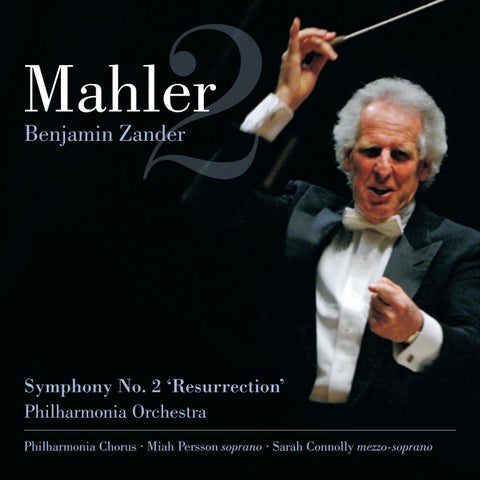
Mahler Benjamin Zander
Symphony No. 2 ‘Resurrection’ Philharmonia Orchestra Philharmonia Chorus · Miah Persson soprano · Sarah Connolly mezzo-soprano
Mahler Symphony No. 2
‘Resurrection’
Benjamin Zander Philharmonia Orchestra Recorded at Watford Colosseum, London, UK from 6 – 8 Jan 2012
Recording editing by Thomas C. Moore, Five/Four Productions, Ltd.
Produced by Elaine Martone and David St. George
Post-production by Gus Skinas, Super Audio Center
Engineered by Robert Friedrich, Five/Four Productions, Ltd. Assistant engineering by Jonathan Stokes and Neil Hutchison, Classic Sound, Ltd.
Design by toucari.live Cover image by Tony Rinaldo All other photos of Benjamin Zander by Jesse Weiner
David St. George has been involved in every aspect of this recording, as co-producer and most importantly as my musical collaborator, in a relationship of deep trust and mutual understanding, in which he has guided and inspired the music at every moment. Ben Zander
Symphony No. 2 in C minor ‘Resurrection’ Disc 1
1. I. Allegro maestoso 22:40
Disc 2 1. II. Andante moderato 10:01 2. III. In ruhig fliessender Bewegung 12:44 3. IV. Urlicht 5:47 4. V. Im Tempo des Scherzo 38:57 Total Time: 90:09 Off-stage brass conductor: Courtney Lewis
Gustav Mahler, photographed in 1892.
GUSTAV MAHLER
Symphony No. 2 in C minor (‘Resurrection’) Mahler began work on his Second Symphony when he was twenty-seven, still a young man. Yet the questions it raises and the solution it offers are not those of youth, but of maturity. The basic Faustian questions – To what purpose do we live? Can artistic creation have meaning if life itself has none? – come to trouble almost every introspective artist around the midpoint of his life. For Mahler, the time for questioning the whole nature of being came earlier than for most, and the questions were abiding ones, to be grappled with anew in each successive symphony. In a sense the Second Symphony marks the beginning of this search. The First Symphony is an end, not a beginning. It gloriously caps the youthful period of Mahler’s creative life, but its indomitable heroism was not really an answer to the questions that Mahler was asking. Indeed, it was the implications of the First Symphony’s program that led directly to the Second’s anguished search for ultimate meanings. The precise nature of these questions, however, and the extraordinary musical form that they were to take, did not come to him at once. In fact, the gestation period for the Second Symphony was longer than that for any of his other works. The symphony began as an isolated symphonic movement in C minor, composed at furious speed and finished in 1888, just a few months after the First Symphony. It is certain that from the very beginning Mahler regarded this movement as the first movement of a symphony, but seven years were to pass before the nature and scope of that symphony would be clear to him.
5
Entitled Todtenfeier (Funeral Rites), the movement stood alone for several years, a lament of such anger, yearning and despair that it virtually defied any attempt at a continuation. And, indeed, with the artist-hero already dead and buried in the first movement, what sort of a continuation would be possible? Mahler appears briefly to have considered the idea of presenting Todtenfeier to the world as a one movement symphonic poem but held back, convinced that it was to be part of something larger that he could not yet discern. He did, over the years, try the movement out at the piano for his friends, sometimes with disastrous results (the conductor Hans von Bülow covered his ears with his hands). In the meantime he became increasingly intrigued by the musical possibilities inherent in the folk-like naïveté, mysticism and irony of L. Archim von Arnim and Clemens Brentano’s collection of poems Des Knaben Wunderhorn (The Youth’s Magic Horn), published in the early years of the century. Mahler’s Wunderhorn settings proliferated rapidly, in both piano and orchestra versions, until, in the summer of 1893, he tried the experiment of transforming one of the songs for voice and piano, Des Antonius von Padua Fischpredigt (The Sermon of Anthony of Padua to the Fishes), into a purely instrumental movement, and thus the ‘Scherzo’ was the second movement of the symphony to come into being (another version of the song, for voice and orchestra, followed a few weeks later). At the same time he returned to some sketches for a nostalgic, slightly sentimental ‘Andante’ which he had begun years before, and so another movement of the symphony was completed – while he was still unsure about the overall plan of the symphony, or, indeed, in what order to place these very disparate movements (at first he thought the ‘Scherzo’ should immediately follow the first movement, and even much later, when he had finally decided on a five movement plan, he thought of introducing the ‘Andante’ just before the finale). Now Mahler had three movements for his symphony, but was really no nearer the goal than he had been five years before,
6
since he still lacked a finale, or even the idea for a finale, that would gather up the threads of the preceding movements and make a unified work out of them. More months elapsed, until fate placed the solution in Mahler’s lap through an incident which one would feel forced to reject as a bit of romantic apocrypha, were it not so thoroughly documented. February 1894 brought news of von Bülow’s death in Cairo. This great conductor, whom Mahler admired above all others, had been the one musician whose approval would have meant most to Mahler, and that approval had been steadfastly withheld. For Mahler the conductor, von Bülow had had praise enough, but in Mahler the composer he sensed the imminent collapse of the values which he cherished most. The music actually sickened him.* A month after the funeral a memorial service was held in Hamburg, and there, squirming in an overcrowded pew of the packed Michaelskirche, Mahler heard the choir intone a chorale setting of Friedrich Klopstock’s hymn Auferstehung. As the opening words wafted down from the loft in the disembodied tones of a boys choir, Mahler knew that he had found his answer, ‘You shall arise, yes, you shall arise, my dust, after a short rest.’ At mid-afternoon on the same day, a friend called on him at home to find him bent over his manuscript paper, already at work on the finale. The progress of the symphony from darkness to light, from death to renewal, was now clear, although while working on the last movement Mahler continued to juggle the ordering of the others, and even added a fifth movement, the Wunderhorn song ‘Urlicht’ (‘First Light’). He had written the song two years before, without, it would seem, any thought of including it in the symphony. The work was finished at last on the 18th December 1894, and received its first complete performance, under the composer’s direction, on the 13th December 1895. The audience, puzzled and a bit shocked at first, found itself drawn into the
7
tormented and ecstatic world of the piece as it progressed, and during the last few minutes of the finale there were reportedly scenes of men sobbing uncontrollably, of total strangers embracing each other; one woman even leapt from her seat, knelt down in the aisle and clasped her hands in prayer. The critics, however, were implacable. The Berliner Fremdenblatt snarled to the words of ‘Urlicht’: ‘Man lies in greatest pain… How I wish I were in heaven.’ ‘Noise,’ ‘bombast,’ ‘cacophony,’ ‘a morbid taste for the ugly and the deformed’ – so wrote every critic in Berlin. But a few of them, while decrying this assault on the holy Temple of Art, felt bound to admit that the Second Symphony, more than any other new music of the time (Strauss was in the ascendant), seemed to point the way for music’s future. The beleaguered compositional history of the Second Symphony makes its unity of vision seem all the more miraculous. It is one of those works that force us to speculate on the mysterious nature of the creative urge, the way in which unconscious forces seem to control events and guide the artist along a path which he himself does not see until, having reached the goal, he turns and looks back. Mahler originally designated the opening movement as a funeral rite, although he decided to omit the term in the published score. Morbidly personal and metaphysically supra-personal at the same time, it looks back in bitterness and grief on the struggle of the hero (specifically, of the Titan of the First Symphony), on a life devoted to the search for meaning, but in which all meanings seemed to be negated by death. Now, as the mourners stand around the bier, they must ask themselves whether, after a life of struggle, there is anything else. Do we live on after death, or is death the end, reducing our achievements to vanity, our striving to a pitiful thrashing? The medieval sequence ‘Dies irae’ haunts the movement as a spectre. Peace and repose are promised, as in the beautiful second theme in the strings, but consoling hints like this are cut short by grim reminders of mortality. The progress of the movement is inexorable – it ends in annihilation.
8
By the movement’s end, all hope, all joy, all life forces have been obliterated. We see nothing but the void. Mahler invites us to stare into the face of emptiness, calling for a pause after the first movement of at least five minutes. And then follows the ‘Andante’, a minuet of Schubertian grace, slightly sentimental, tender, charming and, one thinks, incongruous. A graceful melody unfolds in the first section, ingeniously divided among the strings so that this becomes spatial music (directionality of sound was a consideration for Mahler all the time, not just in writing for off-stage horns and the like). A contrasting section brings an expressive, equally nostalgic theme in the winds and whispering staccatos in the strings like a summer breeze. The minuet returns with greater contrapuntal elaboration and an even more finely spun texture. A few storm clouds appear but bring a threat no greater than a brief shower. At the minuet’s final appearance Mahler disrupts the theme’s regular phrasing with echoes in the winds, the ne plus ultra of naïveté. So why is this movement here? The answer can only be found in retrospect as the ironic third movement unfolds, a sarcastic and ultimately despairing examination of the futility of human endeavour. From this vantage point we can see the second movement for what it is; an illusion, a dream of cosy Biedermeier tranquillity as insubstantial as a verdant mirage in the Sahara. As mentioned above, the ‘Scherzo’ is a purely orchestral revision and expansion of the Wunderhorn song Des Antonius von Padua Fischpredigt. In the song St. Anthony, tired of sermonizing to an absent congregation, goes down to the river to preach to the fish. Pike and eel and salmon and cod all listen attentively, mouths agape, nod their heads piously, acclaim the sermon as the best they’ve ever heard, and hasten home to resume their old vices; the carp to their gluttony, the pikes to their thieving, the eels to their whoring.
9
The poem has a gentle irony and folk humour, but Mahler’s ‘Scherzo’ reinterprets the poem, with biting sarcasm, as a bitter parable. Running through the movement almost like a perpetuum mobile is an undulating theme in the strings, describing over and over the same melodic arc, moving upwards from its starting note in aimless fashion, darting around for a bit, and then returning to its starting pitch. In the course of the ‘Scherzo’ this endlessly repeated melodic motion acquires the force of a symbol, tracing the course of days in the life of man, doomed endlessly to repeat the same acts, entertain the same aspirations, with an ever growing sense of futility and meaninglessness. The circular rondo form of the movement serves to underscore this. A contrasting, trio-like middle section seems briefly to offer some consolation, but each return of the main theme brings a greater sense of disgust and triviality, until near the end the tempo quickens, the motives run together in a frantic mêlée, and the orchestra comes together in a harrowing fortissimo, which Mahler once described as a scream of despair. In the light of all this it would seem that there is no answer to the questions of the first movement. The ‘Andante’, with its vision of worldly serenity, proved to be an illusion; the ‘Scherzo’ manifested growing pessimism leading to despair. Yet with the very opening notes of the following movement, ‘Urlicht,’ Mahler begins to point to a way out of the dilemma. Without pause he moves from the hollowly resonating C at the end of the ‘Scherzo’ to the tonic D-flat that opens the song. The effect is that of being suddenly lifted to an entirely new plane, from which, unencumbered by the rush of daily events, one’s eyes can see clearly and penetrate to essential matters. Beginning as a chorale, the setting becomes urgent and impassioned only for a brief moment before the end. The tone throughout is one of naïve, simple faith, in accord with the childlike diction of the poem. Mahler specifically stipulated that the singer of this song use ‘the tone and vocal expression of a child who thinks he is in heaven.’
10
The ray of hope which shines through in ‘Urlicht’ illumines the path of the gigantic finale. Mahler saw this path as leading from the despair and chaos of the ‘Scherzo’ (he opens the movement, again linked without pause to the preceding one, with an intensified version of the ‘Scherzo’s’ ‘scream of despair’), through a vision of the Last Judgment, to the promise and sure knowledge of renewal after death and of the continuity of man’s spiritual ascent through the ages. The large-scale form of this movement is determined by its programmatic content to a degree quite uncommon in Mahler. Following the poetic idea the music falls into three large sections, and individual programmatic details stand out in bold relief. After the anguish of the opening a curious stillness descends – eerie and speaking of infinity, unlike anything heard so far in the work. Off-stage horns echo a call, ‘the voice crying in the wilderness.’ The ‘Dies irae’ is heard in the winds above pizzicatos in the strings, with a melodic continuation that points towards the resurrection theme of the closing chorus. The whole orchestra begins to come alive with the premonition of the voice in the wilderness. Another theme, later associated with the soloists’ exhortation to faith, enters timidly and hesitatingly in the winds. One more time the ‘Dies irae’ appears, now in the brass, and what a moment before was still filled with foreboding is now calm and assured, with even a trace of exaltation. The orchestra glories in its most ecstatic sonorities, preparing for the great mystery which is about to be revealed. The awesome conclusion of the symphony is filled with apocalyptic Christian symbols, but divested of their customary meanings – looking back to Nietzsche’s concept of the ‘eternal return’ and forward to the pantheism which suffuses the Third Symphony (Mahler extensively rewrote and expanded Klopstock’s hymn to bring it into accord with his own views). Lest a program annotator be accused of unacceptable exegetical license, perhaps the description of what follows should
11
be left to the composer himself. In a letter written in 1901 to his future wife, Alma Schindler, Mahler explained the theologically unorthodox ‘Christian’ conclusion of the work: The earth quakes, the graves burst open, the dead arise and stream on in endless procession. The great and the little ones of the earth – kings and beggars, righteous and godless – all press on – the cry for mercy and forgiveness strikes fearfully on our ears. The wailing rises higher – our senses desert us, consciousness dies at the approach of the eternal spirit. The ‘Last Trump’ is heard – the trumpets of the Apocalypse ring out; in the eerie silence that follows we can just catch the distant, barely audible song of a nightingale, a last remulous echo of earthly life! A chorus of saints and heavenly beings softly breaks forth: ‘You shall arise, surely you shall arise.’ Then appears the glory of God! A wondrous, soft light penetrates us to the heart – all is holy calm! And behold – it is no judgment – there are no sinners, no just. None is great, none is small. There is no punishment and no reward. An overwhelming love lightens our being. We know and are.
© David St. George, 2013
* Those interested should be alerted to the existence of a remarkable book by Theodor Reik, The Haunting Melody, in which the noted psychologist explores the evidence linking Mahler’s long delay in completing the Second Symphony with a neurotic father fixation towards von Bülow. In this view, the conductor was a repressive, Urizen-like negator, whose death was necessary to release the creative freedom of Mahler’s imagination. The book was written in 1953, antedating by several decades the craze for spiffy, armchair psychobiography.
12
Symphony No. 2 in C minor Translations by Michael Steinberg
IV. Urlicht O Röschen rot! Der Mensch liegt in grösster Noth! Der Mensch liegt in grösster Pein! Je lieber möcht’ ich im Himmel sein!
IV. Primal Light O little red rose! Humankind lies in greatest need! Humankind lies in greatest pain! Much rather would I be in Heaven!
Da kam ich auf einen breiten Weg; Da kam ein Engelein und wollt’ mich abweisen. Ach nein! Ich ließ mich nicht abweisen!
Then I came onto a broad path; An angel came and wanted to turn me away. But no, I would not be turned away!
Ich bin von Gott and will wieder zu Gott! Der liebe Gott wird mir ein Lichtchen Geben, Wird leuchten mir bis in das ewig selig Leben!
I am from God and would return to God! Dear God will give me a little light, Will light me to eternal, blissful life.
from Des Knaben Wunderhorn
from Des Knaben Wunderhorn
13
V. Auferstehung Aufersteh’n, ja aufersteh’n wirst du, Mein Staub, nach kurzer Ruh! Unsterblich Leben! Unsterblich Leben Wird der dich rief geben!
V. Resurrection Rise again, yes, you will rise again, My dust, after brief rest! Immortal life! Immortal life Will He who called you grant you!
Wieder aufzublüh’n wirst du gesät! Der Herr der Ernte geht Und sammelt Garben Uns ein, die starben!
To bloom again you were sown! The Lord of the Harvest goes And gathers sheaves, Us, who died!
Friedrich Gottlieb Klopstock
Friedrich Gottlieb Klopstock
O glaube, mein Herz, o glaube: Es geht dir nichts verloren! Dein ist, Dein, ja Dein, was du gesehnt, Dein, was du geliebt, Was du gestritten!
O believe, my heart, but believe: Nothing will be lost to you! Yours is what you longed for, Yours what you loved, What you fought for!
O glaube: Du warst nicht umsonst geboren! Hast nicht umsonst gelitten!
O believe: You were not born in vain! You have not lived in vain, nor suffered!
Was entstanden ist, das muß vergehen! Was vergangen, auferstehen! Hör’ auf zu beben! Bereite dich zu leben!
All that has come into being must perish! All that has perished must rise again! Cease from trembling! Prepare to live!
14
O Schmerz! Du Alldurchdringer! Dir bin ich entrungen! O Tod! Du Allbezwinger! Nun bist du bezwungen! Mit Flügeln, die ich mir errungen, In heißem Liebesstreben Werd’ ich entschweben Zum Licht, zu dem kein Aug’ gedrungen! Sterben werd’ ich, um zu leben!
O Pain, piercer of all things, From you I have been wrested! O Death, conqueror of all things, Now you are conquered! With wings I won for myself In love’s ardent struggle, I shall fly upwards To that light which no eye has penetrated! I shall die so as to live.
Aufersteh’n, ja aufersteh’n wirst du, Mein Herz, in einem Nu! Was du geschlagen, Zu Gott wird es dich tragen!
Rise again, yes, you will rise again, My heart, in the twinkling of an eye! What you have conquered Will bear you to God!
Gustav Mahler
Gustav Mahler
15
BENJAMIN ZANDER Music was Benjamin Zander’s life at a very early age. When Zander was nine he was already composing and by twelve he was studying under Benjamin Britten and Imogen Holst. He left home at the age of fifteen to study for five years with the great Spanish cellist Gaspar Cassado in Florence and at the State Academy in Cologne. After completing his degree at London University, he went to the United States on a Harkness Fellowship and has made his home in Boston ever since. There, as conductor of the Boston Philharmonic since its formation in 1978, and a guest conductor of numerous other orchestras, he has become the centre of an intense, at times almost cult-like following. In his case, however, the followers are not starry-eyed acolytes, but rather some of the most well-informed musical intellectuals in America. For nearly thirty years, beginning with Michael Steinberg’s passionate advocacy on his behalf in the pages of the Boston Globe, critics and public have been united in their praise of Zander’s interpretations of the central repertory. For 45 years he was on the faculty of the New England Conservatory of Music, where his class on interpretation attracted students from all over the world, and he travels extensively giving masterclasses, conducting guest performances, and touring with his own recently formed Boston Philharmonic Youth Orchestra. He has established an international reputation as a guest conductor and has conducted the Israel Philharmonic for three consecutive years, and conducted orchestras as diverse as the Bournemouth Symphony, the Scottish and Irish National Orchestras, the St Petersburg Philharmonic, the Malaysian Symphony, the St Louis Symphony Orchestra, the Indianapolis Symphony, the Youth Orchestra of the Americas, the Tulsa Symphony Orchestra, the Toronto Symphony Orchestra, and has appeared with the National Youth Orchestras of New Zealand, Australia and Venezuela.
17
One of the unique characteristics of Zander’s approach to giving a concert is to precede each performance with an illustrated talk, which is for many members of the audience, an integral part of the whole experience. This is based on his belief that, given some guidance, everybody can understand and come to love great music. Zander began working regularly with the Philharmonia Orchestra in 1995, conducting a series of Mahler symphonies to extraordinary critical acclaim. Zander’s recordings with the Philharmonia on Telarc include Mahler’s Symphonies No. 1, 3, 4, 5, 6 and 9, Beethoven’s Symphonies No. 5 and 7 and, most recently, the Grammy-nominated Bruckner Symphony No. 5. Zander has developed an additional career as a speaker to organisations, using the conductor/orchestra relationship as a model for leadership. He has been profiled on CNN, the BBC, 60 Minutes and in the Washington Post. The Art of Possibility, a best-selling book, co-authored with leading psychotherapist Rosamund Zander has been translated into fifteen languages. This is his first recording for Linn.
18
PHILHARMONIA ORCHESTRA The Philharmonia Orchestra is one of the world’s great orchestras. Acknowledged as the UK’s foremost musical pioneer, with an extraordinary recording legacy, the Philharmonia leads the field with its quality of playing and its innovative approach to audience development, residencies, music education and the use of new technologies in reaching a global audience. Together with its relationships with the world’s most sought-after artists, most importantly its Principal Conductor and Artistic Advisor Esa-Pekka Salonen, the Philharmonia Orchestra is at the heart of British musical life. Today, the Philharmonia has the greatest claim of any orchestra to be the UK’s National Orchestra. It is committed to presenting the same quality, live musicmaking in venues throughout the country as it brings to London and the great concert halls of the world. The Orchestra has performed in excess of 160 concerts in one season and has presented live digital events and recorded scores for films, CDs and computer games. Under Esa-Pekka Salonen a series of flagship, visionary projects – City of Dreams: Vienna 1900 -1935 (2009), Bill Viola’s Tristan und Isolde (2010) and Infernal Dance: Inside the World of Béla Bartók (2011) – have been critically acclaimed. Since 1995, the Orchestra’s work has been underpinned by its much admired UK and International Residency Programme, which began with the launch of its residencies at the Bedford Corn Exchange and London’s Southbank Centre. Recently, the Orchestra celebrated its 16th year as Resident Orchestra of De Montfort Hall in Leicester and its 12th year as Orchestra in Partnership at The Anvil in Basingstoke; the orchestra also enjoys residencies at the Marlowe Theatre in Canterbury and the Three Choirs Festival. www.philharmonia.co.uk
19
1st Violin Zsolt-TihamĂŠr Visontay Anna-Liisa Bezrodny Nathaniel Anderson-Frank Imogen East Lulu Fuller AdriĂĄn Varela Karin Tilch Shlomy Dobrinsky Victoria Irish Mark Derudder Eleanor Wilkinson Sarah Sew Dimiter Tchernookov Stuart James Benjamin Roskams Laura Dixon Grace Lee Justin Jones Alan Brind Emma Wragg 2nd Violin Nicole Wilson Fiona Cornall Samantha Reagan Gillian Costello Susan Hedger Helena Roques
Julian Milone Gideon Robinson Jan Regulski Timothy Colman Paula Clifton-Everest Teresa Pople Helen Cochrane Franziska Mattishent Emma Martin Viola Alexander Zemtsov Nicholas Bootiman Michael Turner Cheremie Hamilton-Miller Gijs Kramers Samuel Burstin Ellen Blythe Carol Hultmark Pamela Ferriman Emmanuella Reiter-Bootiman Gwendolyn Fisher Rebecca Wade Graham Griffiths Richard Cookson Elizabeth Butler
20
Cello Timothy Walden Deirdre Cooper Eric Villeminey Victoria Simonsen Anne Baker Richard Birchall Maria Zachariadou Hetty Snell Matthew Forbes Katharine Thulborn Judith Fleet Vanessa Park Louise McMonagle Bass Neil Tarlton Gareth Sheppard Michael Fuller Simon Oliver Sebastian Pennar Adam Wynter William Cole Jan Zahourek
Flute Samuel Coles (dbl) June Scott (dbl) Piccolo Keith Bragg (dbl) Jenny Doyne Sophie Johnson (dbl) Oboe Christopher Cowie (dbl) Ian Hardwick James Turnbull Cor Anglais Jill Crowther (dbl) Ruth Contractor Clarinet Tim Lines Douglas Mitchell Katy Ayling E-flat Clarinet Jennifer McLaren Katie Lockhart Bass Clarinet Katy Ayling (dbl)
Bassoon Amy Harman Michael Cole Andrew Watson Contra Bassoon Luke Whitehead (dbl) Horn Katy Woolley (dbl) Tim Ball Adrian Uren Carsten Williams James Handy (dbl) Kira Doherty (dbl) Nicolas Fleury (dbl) Trumpet Alistair Mackie Mark Calder Christopher Evans Robert Farley Christian Barraclough Anthony Cross Neil Brough Robin Totterdell Trombone Byron Fulcher Rebecca Smith
21
Bass Trombone Christian Jones Patrick Jackman Tuba Peter Smith Timpani Andrew Smith Matthew Rich Percussion Christopher Thomas Peter Fry Kevin Hathway (dbl) David Corkhill Christopher Terian Harp Rachel Masters Fiona Clifton-Welker Organ Richard Pearce
PHILHARMONIA CHORUS The Philharmonia Chorus is an independent symphony chorus based in London. Founded in 1957 by Walter Legge who had formed the Philharmonia Orchestra 12 years earlier, the Philharmonia Chorus quickly established itself under Chorus Master Wilhelm Pitz as Europe’s leading symphony chorus. Since then, the Chorus has performed with nearly every distinguished conductor of our time and has made over 80 recordings. The tradition of choral excellence continues today with Chorus Master Stefan Bevier. www.philharmoniachorus.co.uk
22
Sopranos Genevieve Arkle Sarah Barnes Gill Beach Fleur Bray Carol Capper Elizabeth Casselton Caitlin Downie Esther Drabkin-Reiter Susanna Fairbairn Sheila Fitzgerald Viki Hart Elisabeth Hinze Felicity Hope Louise Judge Vivien Karam Bridget Kerrison Carolyn Killen Juliet King-Smith Sarah Lambie Jackie Leach Donna Lennard Francesca Letch Gwendolen Martin Silva McQueen Ellie Moore Dilys Morgan Rosslyn Panatti Rachel Pitt Alice Pollock Charlotte Richardson Ayano Sasaki-Crawley Kate Smith Denise Squires
Emma Watson Julia Weatherley Nardus Williams Katrina Wilson Helen Winter Altos Kate Aitchison Elizabeth Album Cathy Bell Verity Birch Rosanna Brandi Anne-Maria Brennan Sophia Cheung Anneliese Collett Sheena Cormack Ursula Davies Lara de Belder Claire Eadington Joanne Evans Helen Ford Elizabeth Harniess Judy Jones Celia Kent Sophie Kent Aino Konkka Aurore Lacabe Pamela Pearce Nerys Pipe Lorna Reader Lindsay Rosser Helen Sadler Muriel Scott Sue Smith
Silvia Strebel Danny Thomas Sheena Thompson Hana Tiller Tenors Richard Ashdown Simon Bainbridge Richard Bignall Alastair Carey Rhys Cook Harvey Eagles Christian Forssander Robert Geary Edmund Henderson Christopher Hollis Douglas Johnson Peter Kirk Simon Lowe Simon Marsh Andrew Martin Peter Mather Jon Meredith William Morgan Graham Neal David Phillips Michael Ridley Benedict Rowe Michael Savino Paul Thirer Alexander Wall
23
Basses Stephen Benson Tony Brewer David Bryant Phillip Dangerfield Michael Day Julien Debreuil Richard Gaskell Nigel Gee David Hansford Richard Harding Oliver Hogg James Hutchings Matthew Jelf Alan Jones Steffan Jones Peter Kirby Richard Lane Hector Macandrew Geoffrey Maddock Barnaby Mason Thomas McKenna Wojtek Mrozowski John Murton Aziz Panni Sheevam Pattni Peter Quintrell Stephen Rosser James Shirras Jonathan Wood Jonathan Wood David Wright
Chorus Master STEFAN BEVIER Stefan Bevier originally studied singing and double bass at the Hochschule der KĂźnste, Berlin, and obtained a scholarship from the Herbert von Karajan Foundation. He was a member of the Orchestra Academy of the Berlin Philharmonic Orchestra as well as a regular deputy for them under Herbert von Karajan. He studied singing with Dietrich Fischer-Dieskau, Schuch-Tovini and Aribert Reimann, and conducting with the former Chief Conductor of the Berlin Philharmonic, Sergiu Celibidache. He is Chief Conductor of the Festival Orchestra Berlin, the Baroque Orchestra Berlin, and is the founder and conductor of the European Vocal Soloists. He started working with the Philharmonia Chorus in 1999, and was appointed Chorus Master in 2010.
Photo by Barbara Dotsch
24
Mezzo-soprano SARAH CONNOLLY Sarah Connolly is one of the foremost British mezzo-sopranos. She is a Fellow of the Royal College of Music where she studied piano and singing. She has been nominated for a Laurence Olivier Award, a TMA Award, two Grammy Awards and has won Edison, Gramophone and South Bank Awards. On the operatic stage, highlights include The Composer at The Metropolitan Opera, New York, Dido at La Scala and Giulio Cesare at Glyndebourne. Her concert and recital programmes have also taken her around the world including Carnegie Hall, Dresden Staatskapelle and Concertgebouw, Amsterdam. Sarah Connolly was made a Commander of the British Empire in the 2010 New Year Honours.
Photo by Peter Warren
25
Soprano MIAH PERSSON Miah Persson is a Swedish soprano who is in great demand with the major opera houses and orchestras of the world. She has appeared at the Salzburg Festival, Royal Opera House Covent Garden, Metropolitan Opera New York, Aix-en-Provence Festival, Liceu Barcelona, Netherlands Opera, San Francisco Opera, Paris Opera and many others. She has performed roles including Sophie (Der Rosenkavalier), Gretel (Hansel und Gretel), Fiordiligi (Così fan tutte), Zerlina (Don Giovanni), Susanna (Le Nozze di Figaro), Sifare (Mitridate), Anne Trulove (The Rake’s Progress), the title role in Poppea and Pamina (Die Zauberflöte). Miah was appointed a court singer by the king of Sweden in Jan 2011. In concert Persson has appeared with the Deutsche Symphonie Orchester Berlin, Chicago Symphony Orchestra, Musiciens du Louvre, Budapest Festival Orchestra, Los Angeles Philharmonic Orchestra and at the BBC Proms. She has given recitals at Wigmore Hall and Frankfurt Opera. Conductors with whom she has performed include Sir Charles Mackerras, Vladimir Ashkenazy, Daniel Barenboim, Ivor Bolton, Pierre Boulez, Ivan Fischer, Sir John Eliot Gardiner, Nikolaus Harnoncourt, Semyon Bychkov, Philippe Herreweghe, Rene Jacobs, Bernard Haitink and Marc Minkowski.
Photo by Monika Rittershaus
26
CKR 452
ALSO AVAILABLE ON LINN
Royal Academy of Music Soloists Ensemble Mahler: Symphonie No. 4
Royal Academy of Music Soloists Ensemble Mahler: Lieder eines fahrenden Gesellen
Boston Philharmonic Youth Orchestra Benjamin Zander Shostakovich: Symphony No. 5
Scottish Chamber Orchestra Robin Ticciati Berlioz: Les nuits d’été
Swedish Radio Symphony Orchestra Robin Ticciati Berlioz: L’enfance du Christ
Dunedin Consort J.S. Bach: John Passion, Reconstruction of Bach’s Passion Liturgy
For even more great music visit linnrecords.com