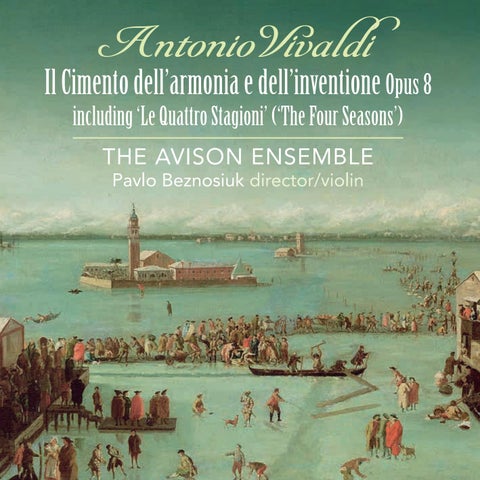
AntonioVivaldi
Il Cimento dell’armonia e dell’inventione Opus 8 including ‘Le Quattro Stagioni’ (‘The Four Seasons’) The AVISON eNSeMBLe Pavlo Beznosiuk director/violin
DISC 1
THE FOUR SEASONS
Violin Concerto in E Major, Op.8, No.1, RV.269, ‘La Primavera’ (Spring) q Allegro (3.29) w Largo (2.39) e Allegro (4.04)
Violin Concerto in G minor, Op.8, No.2, RV.315, ‘L’Estate’ (Summer) r Allegro non molto (5.14) t Adagio (2.11) y Presto (2.49)
Violin Concerto in F Major, Op.8, No.3, RV.293, ‘L’Autunno’ (Autumn) u Allegro (4.53) i Adagio molto (2.05) o Allegro (3.10)
Violin Concerto in F minor, Op.8, No.4, RV.297, ‘L’Inverno’ (Winter) a Allegro non molto (3.27) s Largo (1.42) d Allegro (3.05)
Violin Concerto in E flat Major, Op.8, No.5, RV.253, ‘La Tempesta di Mare’ f Presto (3.00) g Largo (2.08) h Presto (3.56)
Violin Concerto in C Major, Op.8, No.6, RV.180, ‘Il Piacere’
j Allegro (3.24) k Largo e cantabile (2.34) l Allegro (3.11)
page 18 2
ToTal TIme : 57.54
Cover image: The Frozen Lagoon (oil on canvas) by Battaglioli, Francesco (1725-96) (school of) Ca’ Rezzonico, museo del Settecento, Venice / alinari / The Bridgeman art library Nationality
DISC 2
Violin Concerto in D minor, Op.8, No.7, RV.242
q Allegro (3.11) w Largo (1.47) e Allegro (3.04)
Violin Concerto in G minor, Op.8, No.8, RV.332
r Allegro (3.30) t Largo (2.06) y Allegro (4.01)
Violin Concerto in D minor, Op.8, No.9, RV.236
u Allegro (3.09) i Largo (1.59) o Allegro (2.49)
Violin Concerto in B flat Major, Op.8, No.10, RV.362, ‘La Caccia’ a Allegro (3.37) s Adagio (2.11) d Allegro (2.36)
Violin Concerto in D Major, Op.8, No.11, RV.210
f Allegro (4.51) g Largo (2.24) h Allegro (5.03)
Violin Concerto in C Major, Op.8, No.12, RV.178
j Allegro (3.13) k Largo (2.08) l Allegro (3.44) ToTal TIme : 56.16
page 3
Recorded at St George’s Chesterton, Cambridge, UK from 29th November to 5th December 2009 Produced and engineered by Philip Hobbs executive producer Gordon Dixon Post-production by Julia Thomas, Finesplice, UK Design by John Haxby Photographs of The avison ensemble and Pavlo Beznosiuk by Joanne Green Sonnet translations by Simon D. I. Fleming
AntonioVivaldi
The AVISON eNSeMBLe
Gordon Dixon, executive Director Frances Benton, Development Director 3 Bentinck Place, Newcastle upon Tyne, Ne4 6XN, UK
Il Cimento dell’armonia e dell’inventione
tel: +44 (0)191 226 0799
Twelve Concertos for Violin, Strings and Continuo Opus 8
Pavlo Beznosiuk ................................. violin Matthys Hofmans, Antwerp, 1676
T
Caroline Balding ................................ violin Stainer School, c.1690 oday the name Antonio Vivaldi is synonymous with Italian Baroque Music. Joanne Green ........................................ violin Michiel de Hoog, 1988 His most famous work, Le Quattro Stagioni (The Four Seasons), contains Sara DeCorso ........................................ violin Soquet, Paris, 1784 some of the most instantly recognisable music ever composed and is Katarina Bengtson ........................... violin Richard Duke, Holborn, London, 1750 today viewed as a pinnacle of musical art. Nevertheless, for almost two centuries Simon Kodurand ............................... violin Christopher Rowe, Isle of Wight, 1993 this work and others by Vivaldi were entirely forgotten, and it was not until the ewa Chmielewska-Zorzano ..... violin Jan Pawlikowski, Kraków, 2007 twentieth century that his dramatic rehabilitation secured him a place, alongside – copy of Groblicz I, Poland 1600 Handel and J. S. Bach, as one of the most influential andcainventive composers Rachel Byrt .............................................. violin Nicholas from the first half of the eighteenth century.Woodward, Bristol, 1993
page 16 4
– copy of Andrea Guarneri, 1664,
Vivaldi had an inauspicious He was Rachel Rowntree ...............................background. violin Paul Collins, 2000born on 4 March 1678, the first of at least nine children produced by Giovanni Battista and Thomas Kirby .......................................... viola Bernd Hiller, Markneukirchen, 2006Camilla. He was baptisedTunnicliffe at home on the day of his attrib. birth Leonhard in fear that he might die c.1720 abruptly. The Richard ............................. cello Mausiell, Nuremberg, sickliness that resulted in his swift may have been the first sign of the ill Deborah Thorne ................................... cello baptism English, circa 1770 health, probably asthma, which plagued Vivaldi theMaker rest of his life. His father, Tim amherst ............................................. bass Made in Venice, for c.1700. is unknown who begun his.............................. career as a barber was, by the time of Vivaldi’s birth, working Paulahad Chateauneuf lute Archlute by Martin Haycock in 1990 after as a professional musician. In 1685Magno Giovanni was admitted to the Tieffenbrucker, Venice, c.1620 andorchestra of St Mark’s Basilica. Although it was5-course not Venice’s theinclose guitar bycathedral, Martin Haycock 2001 proximity of the Basilica to the Doge’s Palace,after coupled with its location on the principal Sellas, c.1640 square, facilitated its development into a central venue for the production of Roger Hamilton ................. harpsichord Harpsichord by Morton Gould, 1991, after ceremonial sacred music. The young Antonio, who was trained in music by his & organ Carlo Grimaldi and Box Organ after Loosemore (1655) father, may have acted as his deputy at St Mark’s; his earliest recorded public by William Drake of Buckfastleigh, 2001 appearance, as a ‘supernumerary’ violinist, was at the Basilica at Christmas 1696.
Despite his youthful musical promise, Vivaldi was directed towards the priesthood. Such a move was not without precedent, particularly for those of humble birth, as this career path would have offered a hope of social mobility and provided some financial security. However, Vivaldi was less than dedicated to his priestly duties and, soon after his ordination in 1703, he turned his back on the priesthood in favour of a career in music. In the same year that Vivaldi became a priest, he entered the employ of the Ospedale della Pietà (Devout Hospital of Mercy), a refuge for orphaned, illegitimate, destitute, or abandoned girls. Many of them would receive some musical training and Vivaldi, as their Maestro di Violino, would have provided this education. A select group of these girls were used to supply music for services at the Pietà, important social occasions in the calendar of the Venetian nobility and an attraction for foreign visitors. The English traveller, Edward Wright, attended one of these performances; he recorded that the girls performed behind iron grills which obscured them from view. Part of Vivaldi’s duties at the Pietà involved the composition of new music for the girls to perform, and many of Vivaldi’s concertos were written for their use. Even in later years when his travels prevented him teaching at the Pietà, he continued to compose concertos for them. From 1713 he was given the opportunity, by the governors of the Pietà, to compose sacred vocal music and his success led to his promotion to the post of Maestro di Concerti in 1716. The best known of his church music from this period is the magnificent Gloria (RV. 589) from c1715. Vivaldi was also a respected composer of operas and several were performed during his extended trips to Mantua and Rome. Furthermore, he made trips to Prague, Amsterdam, and Vienna; in the latter place he died in abject poverty in 1741 and was buried in a pauper’s grave.
page 5
In his lifetime Vivaldi was more highly esteemed as a violinist than as a composer of music. Nevertheless, he was prolific and wrote around five-hundred concertos for a variety of forces. Most were written for a solo violin with orchestra, but a substantial number were composed for soloists on instruments as diverse as the
Concerto No. 2 – ‘L’Estate’ (Summer)
cello, mandolin, recorder, and bassoon; a significant number of other concertos were written for two or more soloists. Vivaldi boasted, rather fancifully, that he Allegrocompose non molto could a concerto faster than a copyist could write one out. His first Beneath the harsh published works, thesun’s Opusheat 1 trio sonatas from c1705, are in deference to those by men and flocks and the pine Arcangelo Corelli.languish They were followed by tree a setburns; of twelve violin sonatas four years the cuckoo’s unleashes voice and,composing as soon asconcertos it is heard, later. By this time Vivaldi its was actively which circulated in the turtle dove the chorus. manuscript; his and first goldfinch published join concertos, the Opus 3 L’estro armonico (Harmonic inspiration), appeared in 1711. This set was one of the most influential musical Sweet Zephyrus blows, but Boreas quarrels with his neighbour; publications of the first half of the eighteenth century and they were particularly and the shepherd weeps, fearful of the violent storm, and what may lie ahead; popular in Germany where J. S. Bach transcribed several for keyboard. Other sonatas Adagio and concertos appeared in print over the subsequent years, but the best known are the twelve 8 concertos, first published at Amsterdam in the fearofofthese the lightning and Opus the thunder’s roar, 1725. Vivaldi gave them title of Ilfuriously, cimento dell’armonica e dell’inventione (The trial and the gnats and fliesthe that buzz between and invention) depriveharmony his fatigued limbs ofand rest.dedicated them to Count Wenzel von Morzin, a cousin of Haydn’s patron at Dolni Lukavice. The first edition discloses that Presto was Morzin’s Maestro di Musica in Italia and in this capacity it appears Vivaldi Alas,hehis worst fears were warranted. that was commissioned, on an occasional basis, to send fresh compositions The thunder roars,Vivaldi the sky flares, and hailstones to Morzin by post. had clearly been in his service for many years before sever the 8’s heads of the proudly standing corn. the Opus publication, and manuscript copies of the Four Seasons had been in Morzin’s possession for some time, probably since their composition in the 1710s. Perhaps in order to make these four concertos seem fresher, and avoid any offence to his patron, Vivaldi included descriptive sonnets of the Seasons, Allegro written by himself, and partly influenced by the poetry of John Milton. probably The text peasant with dance song The of thecelebrates sonnets was linked toand events within the concertos by a series of the letters, sweet pleasure of aillustrative rich harvest cue with further quotes or paraphrases of the sonnets added and, to theablaze music.with Bacchus’ liquor,
Concerto No. 3 – ‘L’Autunno’ (Autumn)
page 14 6
many conclude their pleasure with slumber.
From an early date the Four Seasons were popular with audiences. In France they Adagio molto admired and ‘Spring’ was a favourite at the Concert Spiritual. A were particularly The fresh air performance provides satisfaction, distinguished of this concerto took place in 1730 when it was played and season, which invites soformed, many in part, of members of the aristocracy. at thethe court of Louis XV by a band
Such was the popularity of Vivaldi in France that, in 1739, a Paris edition of the Opus 8 appeared. Even in Italy, a country where Vivaldi’s fame rested more on his ability as a performer, the Four Seasons were performed long after his death and in 1761 they were, according to Carlo Goldoni, Vivaldi’s chief claim to fame. In Britain these works appear to have been less popular and were never published in London, even though John Walsh reissued other opi by Vivaldi. Nevertheless, the fifth concerto from the Opus 8 is known to have received a London performance in 1724, presumably from a manuscript copy brought from Italy. John Hawkins, the British musicologist, knew these concertos; in 1776 he wrote that the ‘Opera VIII is the most applauded of Vivaldi’s works.’ A copy of the Opus 8 also appears to have found its way to Newcastle upon Tyne where Charles Avison, in his Essay on Musical Expression (1752), criticised the way the Four Seasons imitated the sound of nature, chiefly the barking of a dog. He also said that Vivaldi’s music was ‘only a fit Amusement for Children; nor indeed for these, if ever they are intended to be led to a just Taste in Music’. Yet, in his youth, Avison must have held Vivaldi in far higher esteem as several of his early concertos, particularly those for keyboard, have a marked deference to those by Vivaldi.
page 7
Outside the collection that comprises of Four Seasons, which are obviously linked together, the other concertos were not assembled as a single integrated collection. Of the remaining eight, three were given names. These are No. 5 ‘La Tempesta di Mare’ (‘The Storm at Sea’), No. 6 ‘Il Piacere’ (‘Pleasure’), and No. 10 ‘La Caccia’ (‘The Hunt’). Unlike the Seasons, these concertos were not accompanied by descriptive texts. Instead, the titles imply a certain event or emotion and some, if not all, appear to have been given their labels as an afterthought to describe existing music. For example, Concerto 6, ‘Pleasure’, demonstrates little difference between it and other un-named concertos; likewise ‘The Hunt’, in spite of its horn-like motivic ideas, has little else to identify it with an actual hunt. Of the unnamed concertos, No. 7 was originally dedicated to Johann Georg Pisendel, a pupil of Vivaldi in 1716-17, while No. 9 began life as an oboe concerto. Concerto twelve also exists in an arrangement for solo oboe with orchestra.
page 12 8
Within concertos Vivaldi utilised a three-movement of fast-slow-fast, lagoon; his all these are well-known, well-loved and great funplan to play but we must a layout that reproduced byevocations composersofthroughout Europe. In his also marvel at was Vivaldi’s effortless human states: joy and faithfast in movements he favoured anlethargy arrangement that hassobbing, become fear known ‘ritornello the future (‘Spring’), dull and inertia, andastrepidation form’, a structural plan staggering, that consists of several recapitulations of the main (‘Summer’), of drunken slurred speech, inebriated hiccoughs and thematic material, often and in closely related keys,(‘Autumn’). played by the even the bewildered fear varied of a desperate tormented animal In full the orchestra. ’ritornels’ ‘Winter’, are sandwiched episodes incracking which the last line of Between the sonnetthese accompanying despite biting wind, ice soloists are theteeth, chiefVivaldi protagonists. Although is unknown and chattering shows that he has itclearly focused if onVivaldi the joyscreated rather this form he certainly and it was widely imitated. central slow than the hardships ofpopularised that season.itAbove all, one feels that all The his descriptions movements areare frequently closely related keys;ofthey the and evocations suffusedshort with and love,in depicting the essence life also in hisplace beloved emphasis onthe thesame soloists, whoregard are expected to convey the intense Veneto with heartfelt and attention to detail that we emotional see in the content ofofthe music. the two Tiepolos or the less polished Pietro Longhi. canvases Canaletto, All twelve concertos in this set are fine works, even if the Four Seasons have come The instantly recognizable opening theme of ‘Spring’ is re-used by Vivaldi in to overshadow the others. First movements, such as those of concertos six and operatic contexts: once to accompany the appearance of a personification of seven, are strong, vibrant, and reveal Vivaldi’s exceptional skill at composition. fortune and elsewhere to evoke the sense of a calm and prosperous voyage, uses Likewise the vivacious start of ‘La Tempesta di Mare’, with its driving descending which intrigue me and suggest that we should think of this familiar music not so scales, is dazzling in its virtuosity and a fine specimen of Vivaldi’s art. Some much as a robust shout of welcome to the long-awaited season but representing movements, such as opening of No.11, feature a fugal ritornello idea; others, for a gentler, more profound sense of gratitude and relief at its arrival. Finer shades of instance the central sarabande movement of concerto twelve, are in the form of meaning like this can be teased out of the whole Opus 8 set and make for a richer a dance. The Four Seasons themselves, with their programmatic elements, were aural experience which is often lost in the kinetic frenzy (there are an awful lot of works of genius and highly progressive for their time. Even if they were not fully notes in Vivaldi!) of much of the music, inducing a sort of ‘note-blindness’ which appreciated by Vivaldi’s peers, they have developed into a worldwide phenomenon. can obscure the subtle variety of energies bustling around these scores. Let us It is perhaps the Italian musician, Francesco Geminiani, who best captured the not forget how richly characterful the other 8 concerti are also, ‘La Tempesta di essence of Vivaldi’s Opus 8 when he wrote that the ‘Intention of Musick is not Mare’ and ‘La Caccia’ are self-explanatory but there are many other delights: the only to please the Ear, but to express Sentiments, strike the Imagination, affect prosecco fizz of ‘Il Piacere’, the unsettled tension and anxiety of No. 7, sombre the Mind, and command the Passions.’ It is in these concertos that Vivaldi rose whimsy of No. 8 with its cadenza-like pedal points in the last movement, the closest to this ideal aesthetic and, in doing so, produced an exceptional work angular, chromatic No. 9 and the charming No. 12, full of bonhomie (or should that has withstood the ravages of time and continues to maintain a prominent that be bonarietá?). For me the stand-out piece is No. 11, written in D Major, the place in twenty-first century culture. key of many of Vivaldi’s larger-scale violin concerti; the violin and orchestra are truly integrated and its Christmas-morning clamour is infectious. © Simon D. I. Fleming, 2011
V
ivaldi was fond of giving engaging titles to both his individual pieces and collections of concerti, some explicitly programmatic (‘La Tempesta di Mare’, ‘L’Inquietudine’, ‘Il Gardellino’), others more general (L’Estro Armonico, La Cetra, La Stravaganza). With his title for Opus 8 there is a slight semantic problem in how we interpret the word Cimento – is Vivaldi suggesting a contest between, an experiment in or a trial/assay of both Harmony and Invention? Paul Everett in his engrossing volume on Opus 8 suggests the latter but also prompts us to focus on the two objects of the title and acknowledge them as aspects of the intuitive, unpredictable and imaginative (Inventione), and the disciplined, structured and mathematical (Harmonia) sides of human nature. Thus we can see Opus 8 as a happy union of right brain/left brain functions, a co-existence which is here so organic, natural and imperceptible that it is easy to forget just how original and daring these pieces are. We live in a world where the ubiquity of recorded music can blind us to its content and with the use of Le Quattro Stagioni in film and TV advertising, lift and restaurant muzak, and as the default setting in so many companies’ callqueuing systems the situation is acute. When we finally sit down in silence to a performance it’s very easy to listen but much harder to really HEAR.
page 9
We have help in getting beneath the aural surface of the music and finding its deeper meaning in the shape of the four sonnets which accompany the first four concerti of this set. Vivaldi makes mention of these and their handy guideletters in the dedication (to Count Wenzel von Morzin of Bohemia) of the first edition, explaining their inclusion to provide a detailed ‘road-map’ to music that was already in the Count’s possession, having been sent to him some years before in manuscript form. Whether or not these sonnets were actually penned by Vivaldi, they are doubly useful, setting not only the visual scene for each movement but also a strong physical sense and an emotional, inner subtext. We have, of course, the celebrated musical depictions of storms, a variety of flora and fauna, a plethora of different winds, thunder and lighting and a frozen
page 10
page 11
page 8 12
Within concertos Vivaldi utilised a three-movement of fast-slow-fast, lagoon; his all these are well-known, well-loved and great funplan to play but we must a layout that reproduced byevocations composersofthroughout Europe. In his also marvel at was Vivaldi’s effortless human states: joy and faithfast in movements he favoured anlethargy arrangement that hassobbing, become fear known ‘ritornello the future (‘Spring’), dull and inertia, andastrepidation form’, a structural plan staggering, that consists of several recapitulations of the main (‘Summer’), of drunken slurred speech, inebriated hiccoughs and thematic material, often and in closely related keys,(‘Autumn’). played by the even the bewildered fear varied of a desperate tormented animal In full the orchestra. ’ritornels’ ‘Winter’, are sandwiched episodes incracking which the last line of Between the sonnetthese accompanying despite biting wind, ice soloists are theteeth, chiefVivaldi protagonists. Although is unknown and chattering shows that he has itclearly focused if onVivaldi the joyscreated rather this form he certainly and it was widely imitated. central slow than the hardships ofpopularised that season.itAbove all, one feels that all The his descriptions movements areare frequently closely related keys;ofthey the and evocations suffusedshort with and love,in depicting the essence life also in hisplace beloved emphasis onthe thesame soloists, whoregard are expected to convey the intense Veneto with heartfelt and attention to detail that we emotional see in the content ofofthe music. the two Tiepolos or the less polished Pietro Longhi. canvases Canaletto, All twelve concertos in this set are fine works, even if the Four Seasons have come The instantly recognizable opening theme of ‘Spring’ is re-used by Vivaldi in to overshadow the others. First movements, such as those of concertos six and operatic contexts: once to accompany the appearance of a personification of seven, are strong, vibrant, and reveal Vivaldi’s exceptional skill at composition. fortune and elsewhere to evoke the sense of a calm and prosperous voyage, uses Likewise the vivacious start of ‘La Tempesta di Mare’, with its driving descending which intrigue me and suggest that we should think of this familiar music not so scales, is dazzling in its virtuosity and a fine specimen of Vivaldi’s art. Some much as a robust shout of welcome to the long-awaited season but representing movements, such as opening of No.11, feature a fugal ritornello idea; others, for a gentler, more profound sense of gratitude and relief at its arrival. Finer shades of instance the central sarabande movement of concerto twelve, are in the form of meaning like this can be teased out of the whole Opus 8 set and make for a richer a dance. The Four Seasons themselves, with their programmatic elements, were aural experience which is often lost in the kinetic frenzy (there are an awful lot of works of genius and highly progressive for their time. Even if they were not fully notes in Vivaldi!) of much of the music, inducing a sort of ‘note-blindness’ which appreciated by Vivaldi’s peers, they have developed into a worldwide phenomenon. can obscure the subtle variety of energies bustling around these scores. Let us It is perhaps the Italian musician, Francesco Geminiani, who best captured the not forget how richly characterful the other 8 concerti are also, ‘La Tempesta di essence of Vivaldi’s Opus 8 when he wrote that the ‘Intention of Musick is not Mare’ and ‘La Caccia’ are self-explanatory but there are many other delights: the only to please the Ear, but to express Sentiments, strike the Imagination, affect prosecco fizz of ‘Il Piacere’, the unsettled tension and anxiety of No. 7, sombre the Mind, and command the Passions.’ It is in these concertos that Vivaldi rose whimsy of No. 8 with its cadenza-like pedal points in the last movement, the closest to this ideal aesthetic and, in doing so, produced an exceptional work angular, chromatic No. 9 and the charming No. 12, full of bonhomie (or should that has withstood the ravages of time and continues to maintain a prominent that be bonarietá?). For me the stand-out piece is No. 11, written in D Major, the place in twenty-first century culture. key of many of Vivaldi’s larger-scale violin concerti; the violin and orchestra are truly integrated and its Christmas-morning clamour is infectious. © Simon D. I. Fleming, 2011
Throughout the set, in the same way that the Venetians’ artistic heritage of dynamic light, through Titian, Tintoretto and Veronese, pulses and vibrates, so Vivaldi’s musical energy vibrates within us, connecting us to him in an irresistible, celebratory collection. © Pavlo Beznosiuk, 2011 I am indebted to Paul Everett whose book, Vivaldi: the Four Seasons and Other Concertos, Op.8 (Cambridge University Press 1996) was used in the preparation of this note.
Le Quattro Staggioni (The Four Seasons): The Sonnets Concerto No. 1 – ‘La Primavera’ (Spring) Allegro Spring has arrived and the birds proclaim her return with joyful song and, at the breath of the Zephyrs, murmuring streams flow: thunder and lightning, those harbingers of Spring, cover the sky with a dark mantle, and then, when the storms fall silent, the birds resume their melodious song: Largo and, on the flower-strewn meadow, to the welcome murmuring of branches and trees, the goatherd sleeps, his dependable dog beside him.
page 13
Allegro Led by the festive sound of a shepherd’s bagpipe, nymphs and shepherds dance at the joyful appearance of spring.
Concerto No. 2 – ‘L’Estate’ (Summer)
cello, mandolin, recorder, and bassoon; a significant number of other concertos were written for two or more soloists. Vivaldi boasted, rather fancifully, that he Allegrocompose non molto could a concerto faster than a copyist could write one out. His first Beneath the harsh published works, thesun’s Opusheat 1 trio sonatas from c1705, are in deference to those by men and flocks and the pine Arcangelo Corelli.languish They were followed by tree a setburns; of twelve violin sonatas four years the cuckoo’s unleashes voice and,composing as soon asconcertos it is heard, later. By this time Vivaldi its was actively which circulated in the turtle dove the chorus. manuscript; his and first goldfinch published join concertos, the Opus 3 L’estro armonico (Harmonic inspiration), appeared in 1711. This set was one of the most influential musical Sweet Zephyrus blows, but Boreas quarrels with his neighbour; publications of the first half of the eighteenth century and they were particularly and the shepherd weeps, fearful of the violent storm, and what may lie ahead; popular in Germany where J. S. Bach transcribed several for keyboard. Other sonatas Adagio and concertos appeared in print over the subsequent years, but the best known are the twelve 8 concertos, first published at Amsterdam in the fearofofthese the lightning and Opus the thunder’s roar, 1725. Vivaldi gave them title of Ilfuriously, cimento dell’armonica e dell’inventione (The trial and the gnats and fliesthe that buzz between and invention) depriveharmony his fatigued limbs ofand rest.dedicated them to Count Wenzel von Morzin, a cousin of Haydn’s patron at Dolni Lukavice. The first edition discloses that Presto was Morzin’s Maestro di Musica in Italia and in this capacity it appears Vivaldi Alas,hehis worst fears were warranted. that was commissioned, on an occasional basis, to send fresh compositions The thunder roars,Vivaldi the sky flares, and hailstones to Morzin by post. had clearly been in his service for many years before sever the 8’s heads of the proudly standing corn. the Opus publication, and manuscript copies of the Four Seasons had been in Morzin’s possession for some time, probably since their composition in the 1710s. Perhaps in order to make these four concertos seem fresher, and avoid any offence to his patron, Vivaldi included descriptive sonnets of the Seasons, Allegro written by himself, and partly influenced by the poetry of John Milton. probably The text peasant with dance song The of thecelebrates sonnets was linked toand events within the concertos by a series of the letters, sweet pleasure of aillustrative rich harvest cue with further quotes or paraphrases of the sonnets added and, to theablaze music.with Bacchus’ liquor,
Concerto No. 3 – ‘L’Autunno’ (Autumn)
page 6 14
many conclude their pleasure with slumber.
From an early date the Four Seasons were popular with audiences. In France they Adagio molto admired and ‘Spring’ was a favourite at the Concert Spiritual. A were particularly The fresh air performance provides satisfaction, distinguished of this concerto took place in 1730 when it was played and season, which invites soformed, many in part, of members of the aristocracy. at thethe court of Louis XV by a band
to the pleasure of sweetest slumber, causes many to abandon dance and song. Allegro At dawn the hunters emerge with horns, guns and dogs. The wild animal takes flight while they give chase; terrified and tired by the noise of the guns and dogs, wounded, the prey struggles on but, overwhelmed, dies.
Concerto No. 4 – ‘L’Inverno’ (Winter) Allegro non molto Shivering, frozen, amid icy snow, at the harsh wind’s chilling breath; to run, stamping one’s icy feet, teeth chattering in the bitter chill; Largo to rest contentedly by the fireside while the rain outside drenches a hundred others; Allegro to tread on ice, with slow steps, moving cautiously in fear of falling; to go fast, slip, and fall to the ground, to hasten onwards across the ice and run fast until the ice cracks and breaks open;
page 15
to hear, as they go through the iron-clad gates, Sirocco, Boreas, and all the winds at war. This is winter, but of a kind that brings delight.
AntonioVivaldi
The AVISON eNSeMBLe
Gordon Dixon, executive Director Frances Benton, Development Director 3 Bentinck Place, Newcastle upon Tyne, Ne4 6XN, UK
Il Cimento dell’armonia e dell’inventione
tel: +44 (0)191 226 0799
Twelve Concertos for Violin, Strings and Continuo Opus 8
Pavlo Beznosiuk ................................. violin Matthys Hofmans, Antwerp, 1676
T
Caroline Balding ................................ violin Stainer School, c.1690 oday the name Antonio Vivaldi is synonymous with Italian Baroque Music. Joanne Green ........................................ violin Michiel de Hoog, 1988 His most famous work, Le Quattro Stagioni (The Four Seasons), contains Sara DeCorso ........................................ violin Soquet, Paris, 1784 some of the most instantly recognisable music ever composed and is Katarina Bengtson ........................... violin Richard Duke, Holborn, London, 1750 today viewed as a pinnacle of musical art. Nevertheless, for almost two centuries Simon Kodurand ............................... violin Christopher Rowe, Isle of Wight, 1993 this work and others by Vivaldi were entirely forgotten, and it was not until the ewa Chmielewska-Zorzano ..... violin Jan Pawlikowski, Kraków, 2007 twentieth century that his dramatic rehabilitation secured him a place, alongside – copy of Groblicz I, Poland 1600 Handel and J. S. Bach, as one of the most influential andcainventive composers Rachel Byrt .............................................. violin Nicholas from the first half of the eighteenth century.Woodward, Bristol, 1993
page 16 4
– copy of Andrea Guarneri, 1664,
Vivaldi had an inauspicious He was Rachel Rowntree ...............................background. violin Paul Collins, 2000born on 4 March 1678, the first of at least nine children produced by Giovanni Battista and Thomas Kirby .......................................... viola Bernd Hiller, Markneukirchen, 2006Camilla. He was baptisedTunnicliffe at home on the day of his attrib. birth Leonhard in fear that he might die c.1720 abruptly. The Richard ............................. cello Mausiell, Nuremberg, sickliness that resulted in his swift may have been the first sign of the ill Deborah Thorne ................................... cello baptism English, circa 1770 health, probably asthma, which plagued Vivaldi theMaker rest of his life. His father, Tim amherst ............................................. bass Made in Venice, for c.1700. is unknown who begun his.............................. career as a barber was, by the time of Vivaldi’s birth, working Paulahad Chateauneuf lute Archlute by Martin Haycock in 1990 after as a professional musician. In 1685Magno Giovanni was admitted to the Tieffenbrucker, Venice, c.1620 andorchestra of St Mark’s Basilica. Although it was5-course not Venice’s theinclose guitar bycathedral, Martin Haycock 2001 proximity of the Basilica to the Doge’s Palace,after coupled with its location on the principal Sellas, c.1640 square, facilitated its development into a central venue for the production of Roger Hamilton ................. harpsichord Harpsichord by Morton Gould, 1991, after ceremonial sacred music. The young Antonio, who was trained in music by his & organ Carlo Grimaldi and Box Organ after Loosemore (1655) father, may have acted as his deputy at St Mark’s; his earliest recorded public by William Drake of Buckfastleigh, 2001 appearance, as a ‘supernumerary’ violinist, was at the Basilica at Christmas 1696.
T
he Avison Ensemble is one of England’s foremost exponents of 18th century music on period instruments. It is named after Charles Avison (1709-1770), the Newcastle-born composer, conductor and organist, ‘the most important English concerto composer of the 18th Century’ (New Grove).
In addition to playing other works from the Baroque and early Classical periods, The Avison Ensemble is also a training ground for young up and coming musicians to gain experience at period performance practice and styles, affording them the opportunity to work with outstanding directors and soloists. The Ensemble has an active outreach programme involving thousands of children each year in music education projects throughout the North East. The Avison Ensemble’s recording of the complete works of Charles Avison on both the Naxos and Divine Art labels has been exceptionally well received. Their recording of Six Cello Concertos by John Garth has been a sensational success, having been reprinted several times during the first year of its release and is regularly played on Classic FM. In 2009, The Avison Ensemble released their acclaimed first recording on Linn Records: Handel’s Concerti Grossi Opus 6 (Linn CKR 362). This work is widely regarded as the composer’s greatest contribution to the Baroque period and the recording received critical acclaim:
Orchestral Choice: ‘I shall certainly return frequently to this splendid set.’ BBC Music Magazine
‘The Avison’s accounts under Pavlo Beznosiuk have a natural, easy virtuosity that will endear them to purists…’ The Sunday Times
‘Where The Avison Ensemble really triumphs… is in conveying a sense of occasion and musical opulence… Magnificent!’ page 17
International Record Review
DISC 1
THE FOUR SEASONS
Violin Concerto in E Major, Op.8, No.1, RV.269, ‘La Primavera’ (Spring) q Allegro (3.29) w Largo (2.39) e Allegro (4.04)
Violin Concerto in G minor, Op.8, No.2, RV.315, ‘L’Estate’ (Summer) r Allegro non molto (5.14) t Adagio (2.11) y Presto (2.49)
Violin Concerto in F Major, Op.8, No.3, RV.293, ‘L’Autunno’ (Autumn) u Allegro (4.53) i Adagio molto (2.05) o Allegro (3.10)
Violin Concerto in F minor, Op.8, No.4, RV.297, ‘L’Inverno’ (Winter) a Allegro non molto (3.27) s Largo (1.42) d Allegro (3.05)
Violin Concerto in E flat Major, Op.8, No.5, RV.253, ‘La Tempesta di Mare’ f Presto (3.00) g Largo (2.08) h Presto (3.56)
Violin Concerto in C Major, Op.8, No.6, RV.180, ‘Il Piacere’
j Allegro (3.24) k Largo e cantabile (2.34) l Allegro (3.11)
page 18 2
ToTal TIme : 57.54
Cover image: The Frozen Lagoon (oil on canvas) by Battaglioli, Francesco (1725-96) (school of) Ca’ Rezzonico, museo del Settecento, Venice / alinari / The Bridgeman art library Nationality
In addition to numerous appearances in the English regions, The Avison Ensemble has also appeared to critical acclaim at St. John’s, Smith Square in London and at the Hallé Handel Festival in Germany. Recently, the Ensemble has performed at St. James’ Palace in London with the choir of Her Majesty the Queen’s Chapel Royal and were the largest orchestra in the opening concert series at the new London concert hall, Kings Place, performing Beethoven’s Triple Concerto as part of an all Beethoven programme on period instruments. www.avisonensemble.com
Pavlo Beznosiuk director/violin
P
page 19
avlo Beznosiuk has secured his reputation as one of Europe’s most respected Baroque violinists over the last 25 years with a busy international career as soloist, chamber musician, concertmaster and increasingly as a director. In the mid 80s he was involved in pioneering work in the use of Renaissance violins with The Parley of Instruments and was a key member of the groundbreaking Medieval ensemble The New London Consort playing Vielles, Rebec and Lira da Braccio. He is a frequent soloist/director with the Academy of Ancient Music and recent recital work has included performances of Biber’s Rosary Sonatas and concerts combining solo violin music of Bach with that of Berio and Bartók. As musical director of The Avison Ensemble he has completed an exhaustive recorded survey of the music of Charles Avison and in 2010 released a recording of Handel’s Concerti Grossi Opus 6 (Linn CKR 362) which has been received enthusiastically in the music press. Other recordings include Biber’s Rosary Sonatas, Vivaldi’s Opus 12 Violin Concerti with The Academy of Ancient Music and Christopher Hogwood, J.S. Bach’s Sonatas & Partitas for Solo Violin (Linn BKD 366) and two recordings of Mozart’s Sinfonia Concertante with Monica Huggett and Rachel Podger and works by Walther and Westhoff . Pavlo Beznosiuk teaches Baroque Violin at the Guildhall School of Music and Drama and The Royal Academy of Music in London.
The Avison Ensemble
Handel : Concerti Grossi Opus 6
The Avison Ensemble
Corelli: Opus 1 & 3: Church Sonatas
CKR 365
ALSO AVAILABLE ON LINN
Pavlo Beznosiuk
J S Bach : Sonatas & Partitas For Solo Violin
The Avison Ensemble
Corelli: Opus 2 & 4: Chamber Sonatas
For even more great music visit linnrecords.com
The Avison Ensemble
Corelli: Opus 6: Concerti Grossi
The Avison Ensemble
Corelli: Opus 5: Violin Sonatas