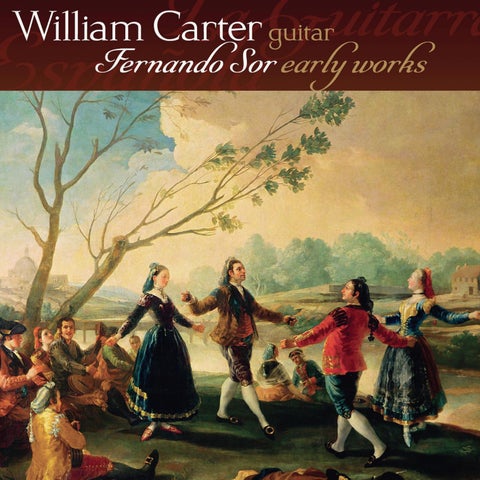
William Carter guitar
Fernando Sor early works
Three Minuets, Op.11
1 No.6 in A major: Andante Maestoso 2 No.7 in a minor: Andante 3 No.8 in A major: Andante con moto
10
4 Air: ‘Oh Cara armonia’ from Mozart’s
11
Opera Il Flauto Magico. Arranged with an Introduction and Variations for the Guitar. As performed by the Author at the Nobilities Concerts. Op.9
12 13
From Studios for the Spanish Guitar, Op.6 No.2 in A major: Andante Allegro No.8 in C major: Andantino No.9 in d minor: Andante Allegro No.11 in e minor: Allegro Moderato No.12 in A major: Andante
5 Menuet in c minor, Op.24 No.1 6 Menuet in C major, Op.5 No.3
14
7 Andante Largo, Op.5 No.3
15 Grand Solo, Op.14:
Two Minuets, Op.11 8 No.5 in D major: Andante Maestoso 9 No.4 in D major: Andante con moto
16 Menuet in G major, Op.3
Andante, Allegro
William Carter, guitar by Tony Johnson, 2006 after 19th century models Recorded at St Martin’s Church, East Woodhay, UK on the 12th – 13th January 2009 Produced and engineered by Philip Hobbs Post production by Julia at Finesplice Photograph of William Carter by Amit Lennon Front cover from Bridgeman Art: Dance on the Banks of the River Manzanares (1777) by Francisco Jose de Goya y Lucientes, (1746-1828)
William Carter : 2
Fernando Sor (1778~1839) Early Works Our scene is the Guitarist’s Heaven. This area of Mount Parnassus is a gentle flowering meadow, the Castalian brook flowing smoothly through its middle. In the distance, giant stacks of Marshall amps tower into the clouds. On our left we see Jimi Hendrix and Andrés Segovia, strolling arm-in-arm and chatting companionably about fingernails and guitar picks. Beyond them, in a shady bower, Lonnie Johnson plays to a quietly appreciative Ramón Montoya and Lester Flatt. One gentleman, dressed in the height of Regency fashion, sits a little apart from the others at a writing desk. He’s holding a pen and concentrating on a densely written, half-completed orchestral score and he looks a little out of sorts. Perhaps he’s craving some peace and quiet so he can think clearly, or maybe he’s just longing for access to a piano. His name is Fernando Sor. Sor is thought of today (when remembered at all) as a guitar composer, but in his lifetime, although a celebrated virtuoso on that instrument, he was even more renowned as a creator of ballet and vocal music. His most successful work, the ballet Cendrillon, was performed to acclaim throughout Europe (over 100 times at the Paris Opera alone) and chosen for the inauguration of the Bolshoi Theatre. Such was the appeal of his vocal music that an English reviewer wrote: ‘a new set of arietts, from his pen, causes almost as much sensation, as the publication of a new novel by the author of Waverley.’ Today, such is the sad mutability of fame, Sor’s wonderful output languishes, neglected equally with that of Sir Walter Scott. Sor’s guitar music is some of the finest ever written for the instrument, yet it’s sadly under-represented in the programmes of today’s virtuosi, seemingly intent on ever more prodigious feats of transcription and performance, or digging out even more obscure works by marginal guitarists of the past. Meanwhile Sor’s music, modest but perfect, lies unregarded, in plain view, like Poe’s purloined letter. William Carter : 3
This is a little ironic, because Sor’s relationship with the guitar world was always a slightly prickly one. While today’s players may avoid him for his failure to write 32 sonatas and nine symphonies for solo guitar, early players of his work were frustrated by his taste for strange keys, and his insistence on strict part writing. Sor even tried to notate guitar music at its proper pitch, publishing one work on two staves in alto and bass clef (guitar music, then and now, is usually crowded onto a single stave with the note heads extending the wrong way, written in the treble clef, but sounding an octave lower). Of course guitarists refused to buy it and the whole piece had to be re-engraved. The next composer with enough crazy idealism to notate guitar music at its real pitch was Anton von Webern. But the trouble over Sor’s Opus 7 did not end there – guitarists then, as now, were addicted to transcription, but imagine the irritation Sor must have felt upon seeing this piece published as "transcribed for the guitar" by one Felix Horetzky who helped it along by putting it into a key with more open strings available and easing the strictness of the part writing. The idea behind the present recording is to collect together some of Sor’s finest early works, those composed when he was still living in Spain or written just after, as a war refugee in Paris. These pieces, like the early paintings of Goya, document the final flowering of Spain’s 18th century culture – a fragile world that was to vanish forever in the horrors of The Peninsular War. I’ll give a short précis of Sor’s early life which is indebted to Brian Jeffery, whose biography of Sor is the authoritative work on him. I’ve also consulted Alfonse Ledhuy’s article on Sor (which might well have been written in the 3rd person by Sor himself) from a Musical Encyclopaedia published in Paris in the 1830s. Sor was born to an upper-middle class family in 1778 and was baptized in Barcelona Cathedral on the 14th of February. He showed his musical bent early and at the age of 5 was already singing (and acting) arias from Italian opera. While his father (a civic official) was an amateur musician who sang and played guitar, he intended his son for an administrative or military career, and didn’t William Carter : 4
want him to learn music in case it might interfere with his mastery of Latin. Sor’s response was to set examples from his Latin grammar to music in his own invented notation. His father soon relented and Sor was allowed to play the guitar and learn singing and the violin. Sor’s life changed drastically upon his father’s death in about 1789-90. The family no longer had the money to educate him privately but word of his musical talent had spread to the monastery of Montserrat, one of the most famous choir schools in Spain. Here, the 12-year-old boy was educated not just in the intricacies of vocal polyphony but also in up-to-date orchestral playing (it was customary for the monks to perform Haydn symphonies at mass alongside villancicos and older choral music). Sor stayed in Montserrat until his late teens when family connections found him a commission in the Spanish Army. The life of a young officer at this time was far from unpleasant, and seemingly more of a Ruritanian idyll than a true military career (something which probably served to underscore the brutality of the coming Peninsular War). Music was considered a worthy pursuit, and Sor’s abilities as singer, guitarist and pianist actually helped him win a promotion to full lieutenant! His regiment was stationed near Barcelona and Sor found time to compose, at the age of 17, his first opera, Telemaco. Telemaco had 15 performances at the Barcelona Opera in the 1797-8 season and the way was prepared for the next stage of his career - a move to Madrid. Here, Sor found a valuable patron in the Duchess of Alba (known to us today for her sponsorship of Goya, and the magnificent portrait he made of her). ‘At this time the Duchess of Alba took him under her protection and showed him all the affection of a mother... To help his studies she had prepared a studio in her mansion where he could study Italian scores and practice the piano’ (Ledhuy). Sadly for Sor, his patroness became ill and died suddenly in 1802. Again from Ledhuy, ‘The Duke of Medina-Coeli wanted to assist him, he offered him a position in the general administration of his Catalan estates. The prospect of returning to Barcelona made him accept. The post was a sinecure... at this time he composed 2 symphonies, William Carter : 5
3 string quartets, a salve, 5 or 6 rosarios and many Spanish airs.’ Sor made another trip back to Madrid where he wrote more vocal music (a melodrama, La Elvira Portuguesa and many boleros) and then accepted a royal administrative place in Andalusia. ‘The duties of his employment did not prevent him from spending a great deal of his time in Malaga, where he occupied himself successfully with music. He directed there the concerts of the American Consul, Mr. Kirkpatrik... thus passed the 4 years which preceded the arrival of Napoleon in Spain.’ From this time we have an anecdote about Sor’s multifaceted talents. ‘About the years 1802 or 1803, when Sor was an officer in the army, garrisoned in, or very near Malaga, the Austrian [sic] consul, Mr Quipatri [sic] gave a grand concert, to which came all the most elegant people in Malaga and its environs. In this concert Sor played a solo on the double bass, with variations, which left everyone who heard him admiring and astounded, including the professional musicians there present. This was told me by Don Vicente Ribera, a fine trumpet player of much experience, who on that occasion was playing the serpent in the orchestra.’ (Baltasar Saldoni, Diccionnario de Efemerides de Musicas Espanols, Madrid 1868.) This period of Sor’s life vanished with Napoleon’s invasion. The whole edifice of Spanish political and cultural life collapsed under the brutality of this conflict, waged with a truly modern violence and disregard for civilian casualties. Indeed, probably the easiest way to get a feel for the effect of Napoleon’s invasion on Sor would be to imagine him as a talented young Iraqi composer at the turn of the present century. The records are not entirely clear, but it seems that as chaos descended on Spain he made some rather bad, but idealistic decisions, fighting first on one side and then the other. In the end, he got the worst of both sides and wound up as an exiled war refugee. He would never return to Spain.
William Carter : 6
The MUSIC
I’ve chosen three large-scale works, interspersed with shorter pieces – menuets and etudes. While Sor was well able to sustain larger musical structures he had a natural affinity for creating perfect miniatures on the guitar. Maybe precisely because he was comfortable writing for a full orchestra, he was able to appreciate the guitar’s aptness for intimate expression. Tracks 1 to 3 – 3 Menuets in A, Op.11 : Sor groups these dances in units of two and three by key and in this, as well as their lyricism and wit, they recall the music of another Catalan, Antonio Soler. Track 4 – Variations on a Theme of Mozart, Op.9 : Probably the most famous work by Sor. Here he shows himself a true classicist in his subordination of virtuosity to humour and wit. The theme is ‘Das Klinget so Herrlich’ from the Magic Flute (in which the evil spirits are so charmed by Papageno’s magic bells that they can only dance helplessly) but we never actually hear it. Instead a portentous chromatic introduction (drawn from music in Act 2) is followed by a theme which is itself a variation of Mozart’s tune. Then a series of increasingly elaborate variations use virtuosity, barriolage and harmonics to make the guitar playfully evoke chimes and glockenspiels. The piece was immediately successful and reprinted many times. The early edition on which I base my version has a title page bearing the words, “as performed by the author at the Nobilities Concerts”. Tracks 5 & 6 – Menuet in c minor, Op.24 No.1 / Menuet in C major, Op.5 No.3 : I’ve made this pairing myself. The c minor menuet bears a later opus number, but the collection shows signs of having been assembled from older works. Certainly this menuet, with its Sturm und Drang and use of the diminished chord, seems to come straight from the world of C.P.E. Bach or early Haydn. The C major menuet which follows, recalls a Mozart wind trio in its ease and perfection of part-writing. William Carter : 7
Track 7 – Andante Largo, Op.5 : A large scale early movement dedicated to ‘his wife’ about whom little is known. Tracks 8 & 9 – 2 Menuets in D, Op.11 : Again Sor’s humour is to the fore in these two sly works. Who could fail to be amused by the strut and swagger of the first of these – “As proud (as the Catalan saying goes) as a bald man in a fur hat'? Tracks 10 to 14. – 5 Studios, Op.6 [no. 2, 8, 9, 11 and 12] : Sor was one of the first composers to write etudes and here achieves a real synthesis of musical content and technical challenge. These studies each target a different problem of guitar playing. No. 2 is a Schumannesque study in position shifting (30 years before Album für die Jugend), No. 8 explores stretto and strict 3-part writing and 9, moving sixths. Studio 11 could well be one of Mendelssohn’s Songs Without Words, with its melody floating over rippling arpeggios and number 12 is a finger-wrenching setting of a serene cantabile accompanied by three moving parts beneath. Track 15 – Grand Solo, Op.14 : This work exists in widely differing versions of which I have consulted many to make my own. A dark introduction in d minor gives way to a sunny sonata allegro movement in the major. Sor seems here to be composing nothing less than an Italianate opera buffa overture for the guitar. Track 16 – Menuet in G major, Op.3 : I close with my favourite of the early menuets. This nostalgic chromatic movement seems almost to look forward to Scott Joplin! It was included at the end of a set of rather formulaic variations seemingly to fill up empty space. Published in a magazine for amateurs (The Journal of Lyre or Guitar) shortly after Sor’s escape to Paris, it’s as though he was saying, “I can give you what you want, but this is the real me.” William Carter : 8
PerfOrMANCe CONCerNS: fINGerNAILS AND INSTrUMeNTS
Although I’ve lamented Sor’s absence from today’s concert halls, it would be wrong to give the impression that this has always been the case. Indeed, the two greatest guitarists of our time – Andrés Segovia and Julian Bream, both had an unsurpassed way with Sor’s music. It featured frequently in their programmes and they’ve left us many wonderful recordings. Bream has committed many of the later large-scale works to disc (I still remember the electrifying impact his recording of the c minor sonata had on me when I was a child) and Segovia played many of the early works with great panache (his recording of the Grand Solo is a classic of the gramophone). With fine performances like these readily available, why make more? The answer comes down to a simple question of “fingernails”. As the guitar is played today, the strings are plucked by the fingernails of the right hand. Nails have the advantage of helping the instrument speak quickly and also create higher overtones which help the instrument’s audibility in large halls or with other instruments playing. There have always been guitarists who played with nails but never uniformly, until about the last century. In Sor’s time there were probably just as many (or more) players who favoured the tips of the fingers (the ‘nibble end of the flesh’ as Thomas Mace puts it) to pluck with, just as players of the lute and harp do. The sound is softer but perhaps more vocal in quality. While each of these methods of playing can give wonderful results (this is my opinion, anyway) they are very different in their basic sound and Sor was a fingertip player. He wrote a method later in his life which is one of the more fascinating musical documents from his time. It begins with telling how to hold and tune the instrument and finishes ninety pages later with an analysis and reduction for guitar and four voices of the opening of Haydn’s Creation! On the subject of tone production and fingernails he is unequivocal: ‘Never in my life have I heard a guitarist whose playing was supportable if he played with the nails. The nails can produce but very few gradations in the quality of the sound... their performance is to William Carter : 9
mine, what the harpsichord was in comparison to the pianoforte...’ Strong words but clear ones! It has to be admitted that further on in the method he is slightly more generous and observes of his friend Aguado (a nail player): ‘if the nails did not allow him to give the same expression as I did, he gave one peculiar to himself, which injured nothing’. But still, his preferences are so clear that it seemed worthwhile to me to try to explore them and I found it mysterious that with so much interest in recreating the performance styles of the past that so few attempts have been made to play the guitar this way. I, of course, don’t claim awareness of every recording in the world, but to the best of my knowledge this is the first one ever made devoted to Sor’s solo guitar music played without fingernails. There are reasons for this other than simple inertia; one of the most compelling is that surviving 19th century guitars are often extremely difficult to play with fingertips. The choice is often between audibility and dexterity and even with ones best effort's, many surviving instruments (and modern copies) are so heavily built that playing them without nails feels, I imagine, like trying to eat steak with no teeth! I was fortunate enough eventually to get to play a few more lightly constructed instruments that were less frustrating and a chance conversation with someone working as a curator of antique furniture gave me some useful ideas about my situation. I learned the informal “Law of Furniture Survival” – surviving antique furniture is almost always uncomfortable. A comfortable chair will be sat on until it wears out. By analogy we could guess that guitars (which as domestic instruments have rarely been cherished like old violins or cellos) which are fun to play would be played into oblivion and that ones with heavier construction (which suit nail players better anyway) would be more likely to survive. The more lightly built old instruments that I had access to were either unavailable for the amount of time needed for a recording or were extremely fragile and tired-sounding. I reflected on the fact that Sor would have never played an old guitar himself (the 6-string guitar that we know today was introduced when Sor was a young man) and decided to have a new instrument made. The result, built by Tony Johnson to William Carter : 10
his own design, but using 19th century instruments as models, is something I really love and I’ve no doubt that Sor would have enjoyed playing it as well. It has the range of colour and depth of bass which I associate with the guitar (as opposed to a lute) but speaks easily when plucked with bare fingers. Sor also left very precise thoughts about fingering that are at odds with today’s practice and more in line with the technique of earlier instruments. One of the maxims he gives at the end of his method presents it in a nutshell: ‘Never give work to the weakest fingers, whilst the strongest are doing nothing’. This is directly contrary to the sort of training we receive today, which is all about making the weak and strong fingers interchangeable. Interestingly, it seems to echo Chopin’s reported teaching in which students were asked to take advantage of the different sounds made naturally by different fingers and it’s interesting to speculate about contact between Sor and his younger colleague. They both lived in Paris at the same time, both taught privately as a source of income, and apparently appeared on at least one concert programme together. Playing Sor using his fingerings proved at first difficult for me as both early training and my own anatomy have made me favour the ring finger of my right hand (traditionally a weak finger) in preference to my middle finger. But the sound of the two truly is different and it has been a pleasure to get to know this music not just as something abstract but as a consequence of ones hands working in a certain way. And I believe Sor, even though a rationalist of the Enlightenment, would have profoundly agreed with Rachmaninov’s idea that music is ‘sound and colour’.
William Carter : 11
ACkNOWLeDGeMeNTS ACkNOWLeDGeMeNTS
Recordingsare arecollaborative collaborative efforts. efforts. This This one one certainly certainly couldn’t couldn’t have have been been Recordings made without Philip Hobbs, a great and generous producer, sound engineer made without Philip Hobbs, a great and generous producer, sound engineer and insightful musician, all in one. Tony Johnson worked so patiently on the and insightful musician, all in one. Tony Johnson worked so patiently on the guitar and found so many ways to honour my musical requests that I am very guitar and found so many ways to honour my musical requests that I am very much in mind of Sor’s words about the guitar maker Lacote: “the only person much in mind of Sor’s words about the guitar maker Lacote: “the only person who, besides his talents, has proved to me that he possesses the quality of not being who, besides his talents, has proved to me that he possesses the quality of not being inflexible to reasoning”. Anyone who works with instrument makers today will inflexible to reasoning”. Anyone who works with instrument makers today will enjoy these words, as apt now as they have ever been. Nigel North was the first enjoy these words, as apt now as they have ever been. Nigel North was the first person I heard play the guitar successfully without nails so he pointed the way person I heard play the guitar successfully without nails so he pointed the way by example, but Nigel never taught me the guitar, he was too busy trying to get by example, but Nigel never taught me the guitar, he was too busy trying to get me to understand figured bass. So it’s to the two gentlemen who did sweat over me to understand figured bass. So it’s to the two gentlemen who did sweat over me on that instrument that I’d like to dedicate this recording: Bruce Holzman, me on that instrument that I’d like to dedicate this recording: Bruce Holzman, and Pat O’Brien. and Pat O’Brien. Although they both work in different areas, Bruce in the world of the Although they both work in different areas, Bruce in the world of the modern classical guitar, and Pat in the field of historical performance practice, modern classical guitar, and Pat in the field of historical performance practice, they have much in common. Both of them that rare breed; gracious and they have much common. of them rare breed; and considerate New in Yorkers, bothBoth of them men ofthat absolute personalgracious and musical considerate New Yorkers, both of them men as ofteachers, absolute but personal and afforded musical integrity and both of them, known primarily who have integrity and of them, known primarily teachers, but who have me some of both my finest musical experiences onasthose rare occasions when,afforded for one me some of my finest musical experiences on those rare occasions when, for one reason or another, they took my instrument to illustrate a point. reason or another, they took my instrument to illustrate a point. © William Carter, London 2009 © William Carter, London 2009 Bibliography Bibliography Brian Jeffery, Fernando Sor, Composer and Guitarist. [Tecla,1994] Brian Jeffery, Fernando Sor, Composer and de Guitarist. [Tecla,1994] Alfonse Ledhuy, Encyclopedie Pittoresque la Musique [Paris, 1835] Alfonse Ledhuy, Encyclopedie de la Musique [Paris,A.Merrick, 1835] Fernando Sor, Methode pour Pittoresque la Guitare, [Paris, 1830], trans. [London, 1832] Fernando Sor, Methode pour la Guitare, [Paris, 1830], trans. A.Merrick, [London, 1832] William Carter : 12 William Carter : 12
ACkNOWLeDGeMeNTS
Recordings are collaborative efforts. This one certainly couldn’t have been made without Philip Hobbs, a great and generous producer, sound engineer and insightful musician, all in one. Tony Johnson worked so patiently on the guitar and found so many ways to honour my musical requests that I am very much in mind of Sor’s words about the guitar maker Lacote: “the only person who, besides his talents, has proved to me that he possesses the quality of not being inflexible to reasoning”. Anyone who works with instrument makers today will enjoy these words, as apt now as they have ever been. Nigel North was the first person I heard play the guitar successfully without nails so he pointed the way by example, but Nigel never taught me the guitar, he was too busy trying to get me to understand figured bass. So it’s to the two gentlemen who did sweat over me on that instrument that I’d like to dedicate this recording: Bruce Holzman, and Pat O’Brien. Although they both work in different areas, Bruce in the world of the modern classical guitar, and Pat in the field of historical performance practice, they have much in common. Both of them that rare breed; gracious and considerate New Yorkers, both of them men of absolute personal and musical WILLIaM CarTer integrity and both of them, known primarily as teachers, but who have afforded WILLIaM CarTer me some of my finest musical experiences on those rare occasions when, for one “What most you about William aCarter reason or another, they took mystrikes instrument to illustrate point.is the sheer force “What imagination” most strikes you about William CarterinisGramophone. the sheer force of his musical writes William Yeoman of his musical2009 imagination” writes William Yeoman in Gramophone. , London © William Carter Born in Florida, Carter received a thorough training as a modern guitarist with Born in Florida,atCarter receivedState a thorough training a modern guitarist with Bibliography Bruce Holzman The Florida University beforeasfalling in love with the Brian Jeffery, Fernando Sor, Composer and Guitarist. [Tecla,1994] Bruce Holzman at The Florida State University before falling in love with the earlier plucked instruments and the world of historical performance. Following Alfonseguidance Ledhuy, Encyclopedie Pittoresque de laYork Musique [Paris, 1835] earlier plucked instruments and the world of historical performance. Following initial from Pat O’Brien in New City, he travelled to London as Fernando Sor, Methode pour la Guitare,in[Paris, 1830],City, trans.he A.Merrick, [London, 1832] guidance fromwhere Pat O’Brien travelled ainitial Fulbright Scholar he studiedNew the York lute with Nigel North to andLondon quicklyas a Fulbright Scholar where he studied the lute with Nigel North and quickly established himself as one of the leading players on old instruments. established himself as one of the leading players on old instruments. William Carter : 12
William Carter : 13
William Carter : 13
Concert tours and festival appearances followed throughout Europe, Asia and North and South America both as an orchestral player and as a chamber musician and soloist with his own group, Palladians. Carter has an extensive discography (including 10 CDs with Palladians) and has featured on numerous recordings of the Academy of Ancient Music and The English Concert, for both of which he acts as principal lutenist. He is also an enthusiastic teacher and is Professor of Baroque Studies and Lute at The Guildhall School of Music and Drama in London. 2005 saw a new development in Carter’s career as his exploration of the world of baroque guitar led to the release of his first solo album La Guitarre Royalle: The music of Francesco Corbetta (Linn CKD 185) which has been widely praised and named in Gramophone’s ‘Critic’s Choice’ list for 2005. In 2007 Carter released his second solo album on Linn La Guitarra Española: The music of Santiago de Murcia (Linn CKD 288) which was awarded Gramophone Editor’s Choice. William Carter’s previous albums have won great critical acclaim: This is a wonderful disc… a real flamenco inspired tour-de-force. – GrAMOPhONe This is that rare and perfect thing, a pioneering recording where the historical interest is fully matched by the quality of the music and performance... one of 2005’s real gems. – INTerNATIONAL reCOrD reVIeW The compelling artistry of William Carter makes this often complex music sound disarmingly simple and natural, making each and every movement a unique and treasurable listening experience. – CLASSIC fM MAGAzINe Mr. Carter performs with agility and eloquence on a first solo disc with as much appeal for fans of Eric Clapton as those of John Williams. – The OBSerVer Carter’s sound is gorgeous… the playing is faultless… helps introduce a guitarist of the highest stature. – fANfAre For further information - www.williamcarter.eu William Carter : 14
second solo album on Linn La Guitarra Española: The music of Santiago de Murcia (Linn CKD 288) which was awarded Gramophone Editor’s Choice. William Carter’s previous albums have won great critical acclaim: This is a wonderful disc… a real flamenco inspired tour-de-force. – GrAMOPhONe This is that rare and perfect thing, a pioneering recording where the historical interest is fully matched by the quality of the music and performance... one of 2005’s realDiscover gems. – INTerNATIONAL the world ofreCOrD LinnreVIeW Records
The compelling artistry of William Carter makes this often complex music sound
Linn Records is home to some of the world’s finest classical talent. As extensive as it is diverse, simple making each andranging every movement a unique and thedisarmingly catalogue boasts an and arraynatural, of exceptional performers from the Scottish Chamber fMto MAGAzINe treasurable listening experience. – CLASSIC Orchestra, Dunedin Consort and Fitzwilliam Quartet James Gilchrist and Pamela Thorby. Linn Records classical recordings have received great critical acclaim and numerous awards Mr. Carter performs with agility and eloquence on a first solo disc with as much and plaudits. In 2009 ‘Mozart Symphonies 38- 41’ by the SCO and Sir Charles Mackerras won appeal for fans of Eric Clapton as those of John Williams. – The OBSerVer the prestigious BBC Music Magazine ‘Disc of the Year’ and the ‘Critics’ Award’ at the Classical BRITs. Further successes include the the playing Dunedin isConsort’s recording of Handel’sa ‘Messiah Carter’s sound is gorgeous… faultless… helps introduce guitarist (Dublin Version, stature. 1742)’ which was named ‘Baroque Vocal Album of the Year’ at the Classic FM the highest – fANfAre Gramophone Awards in 2007 and won the ‘Baroque Award’ at the 2008 Midem Awards.
of
For further information - www.williamcarter.eu
Linn recordings are all available to download at high resolution from the award-winning website www.linnrecords.com William Carter : 14 Downloads can be enjoyed on the Linn DS range of products which are the first digital stream players to deliver specialist performance and convenience completely in harmony with how people live. Linn DS products offer maximum freedom of choice for customers. All Linn systems are modular, upgradeable and expandable, so choosing Linn is an investment in an authentic specialist system. Linn retailers are trained to the highest standard to help you select the best system to meet your current and future needs through expert demonstration and consultation, installation and after-sales service. Linn standards ensure that whichever system you choose, you will experience the thrill and emotion of the original performance like never before. Linn, GLASGOW ROAd, WAteRfOOt, GLASGOW G76 0eQ UK t: +44 (0)141 307 7777 f: +44 (0)141 303 5007 e: info@linnrecords.co.uk w: www.linnrecords.com / www.linn.co.uk
William Carter : 15
Bach Reimagines Bach
Francesco Corbetta La Guitarre Royalle
Santiago de Murcia La Guitarra EspaĂąola
Le Calme: Fernando Sor Late Works
J. S. Bach Sonatas and Chorales
For even more great music visit linnrecords.com
CKR 343
ALSO AVAILABLE BY WILLIAM CARTER ON LINN
Les Elemens: Marais and Rebel