Igor Stravinsky
(1882~1971)
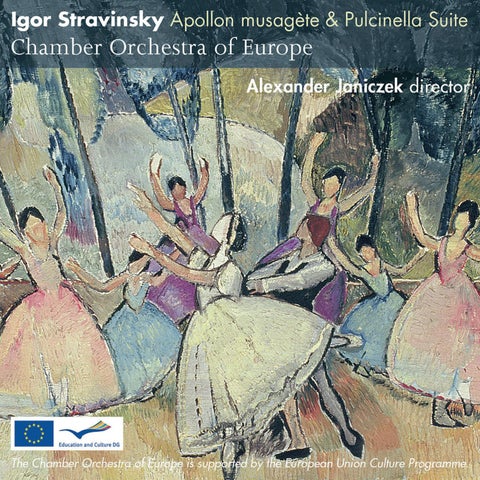
Chamber Orchestra of Europe Alexander Janiczek director Recorded at Église Maronite Notre-Dame Du Liban, Paris, France from 19th~21st November 2008 Produced and engineered by Philip Hobbs Post-production by Julia Thomas, Finesplice, UK Cover painting: The Ballet (oil on plywood) by Grace Cossington Smith, (1892~1984) Private Collection/Lauraine Diggins Fine Art, Australia/The Bridgeman Art Library Photographs of the Chamber Orchestra of Europe by Mario Proenca Photographs of Alexander Janiczek by Colin Dickson Design by the Art Surgery
2
Apollon musagète q Naissance d’Apollon ...................... 5.07 w Variation d’Apollon ........................ 2.51 e Pas d’action ....................................... 4.45 r Variation de Calliope ..................... 1.23 t Variation de Polymnie .................... 1.25 y Variation de Terpsichore ............... 1.33 u Variation d’Apollon ........................ 2.25 i Pas de deux ....................................... 4.05 o Coda (Apollon et les Muses) ........ 3.34 a Apothéose .......................................... 3.49
Pulcinella Suite s I d II f III g III h III j IV k V l VI ; VII 2) VIII
Sinfonia .................................. 1.59 Serenata ................................. 3.06 a: Scherzino ............................... 1.52 b: Allegro .................................... 1.02 c: Andantino .............................. 1.28 Tarantella ............................... 1.56 Toccata .................................... 0.58 Gavotta ................................... 4.01 Vivo.......................................... 1.38 a: Menuetto ................................ 2.40
2! VIII b: Finale....................................... 2.09 ToTAl Running Time ................................ 54.00
3
Stravinsky Stravinsky andand thethe Past: Past:
Pulcinella Pulcinella andand Apollon Apollon musagète musagète Though Though bornborn in Russia, in Russia, IgorIgor Stravinsky Stravinsky spent spent mostmost of his of long his long life life in exile. in exile. From From 1914 1914 he lived he lived first first in Switzerland, in Switzerland, thenthen in France, in France, thenthen in America. in America. He was He was not not to to return return to his to homeland his homeland for almost for almost halfhalf a century, a century, andand thenthen onlyonly for aforbrief a brief visitvisit in in 1962. 1962. The The novelist novelist andand essayist essayist Milan Milan Kundera, Kundera, himself himself a long-time a long-time émigré émigré fromfrom the the communist communist régime régime in his in native his native Czechoslovakia, Czechoslovakia, understood understood all too all too wellwell the the consequences consequences of this of this separation separation fromfrom the land the land of birth: of birth: Without Without a doubt, a doubt, Stravinsky Stravinsky … bore … bore withwith himhim the wound the wound of his of his emigration emigration … [H]is … [H]is onlyonly home home waswas music, music, all of allmusic of music by all by all musicians, musicians, the very the very history history of music of music … He … did He did all he all could he could to feel to feel at at home home there: there: he lingered he lingered in each in each room room of that of that mansion, mansion, touched touched every every corner, corner, stroked stroked every every piece piece of the of furniture; the furniture; he went he went fromfrom the music the music of of ancient ancient folklore folklore to Pergolesi, to Pergolesi, whowho gavegave himhim Pulcinella Pulcinella …, …, to the to other the other Baroque Baroque masters, masters, without without whom whom his Apollon his Apollon musagète musagète … would … would be be unimaginable. unimaginable. (Testaments (Testaments Betrayed, Betrayed, trans. trans. L. Asher) L. Asher)
While While Stravinsky Stravinsky swiftly swiftly became became a cosmopolitan a cosmopolitan composer, composer, speaking speaking the the international international language language of modern of modern ‘Western’ ‘Western’ music, music, the sting the sting of his of estrangement his estrangement never never left him. left him. His His roots roots remained remained planted planted in Russian in Russian soil.soil. The The initial initial ideaidea for Pulcinella for Pulcinella waswas suggested suggested to Stravinsky to Stravinsky by Sergey by Sergey Diaghilev, Diaghilev, impresario impresario of the of the famous famous Ballets Ballets Russes Russes company, company, andand the the manman responsible responsible for for bringing bringing Stravinsky Stravinsky his first his first international international success success via his via commission his commission of the of music the music for for The The Firebird. Firebird. All All Diaghilev Diaghilev wanted wanted on this on this occasion occasion waswas arrangements arrangements of of th -century -century Italian Italian composer composer some some music music by –byas– he as thought he thought at the at the timetime – the – the 18th18 Giovanni Giovanni Battista Battista Pergolesi. Pergolesi. The The choreographer choreographer Léonide Léonide Massine Massine hadhad devised devised the the 4
story and Pablo Picasso had been engaged to design the production; Manuel de Falla had already declined the invitation to compose the music. At first, it seems, Stravinsky was decidedly nonplussed at the suggestion. But Diaghilev persuaded him at least to consult transcriptions of the music made both in Naples and at the British Museum. Stravinsky was instantly smitten: ‘I looked, and I fell in love’, he recalled. Pulcinella was premiered on 15th May 1920 by the Ballets Russes at the Opéra in Paris, where it was billed simply as ‘music by Pergolesi, arranged and orchestrated by Igor Stravinsky’. Yet the work subsequently came to be identified more directly with Stravinsky as composer rather than arranger, in part a consequence of the concert suites he made of the score, including the version from 1922 (revised 1949) heard on this recording. While Stravinsky later asserted that the ‘remarkable thing about Pulcinella is not how much but how little has been added or changed’, the alterations are significant enough to turn the music instantly into something unmistakably of the 20th century. Stravinsky began by working directly onto the transcriptions Diaghilev had given him, subtly annotating the melodies and bass lines of arias by Pergolesi, trio sonata movements by Gallo, and even a tarantella by Wassenaer. Sometimes the result was just a representation of the original in Stravinsky’s own accent. No-one could mistake the trombone and double-bass melody of the ‘Vivo’ for anything other than Stravinsky, even though every note of Pergolesi’s music is still present. There are cunning harmonic touches, anachronistic pedal points and off-beat accents that reveal the thumbprint of the arranger, but it remains a loving, albeit humorous, homage to Pergolesi. The same is true of the opening ‘Sinfonia’ (original music by Gallo). Elsewhere, however, Stravinsky declares his hand more decisively. In the ‘Serenata’, for instance, he adds an unchanging drone (an open fifth), which denies the music its forward movement and whose resulting dissonances bestow a languid, melancholic air. The ‘Finale’ is radically recomposed, repeating 5
barsbars andand moving moving themthem around, around, adding adding newnew harmonies harmonies andand shifting shifting downbeats, downbeats, resulting resulting in ainrhythmically a rhythmically energised energised music music thatthat is categorically is categorically Stravinskian Stravinskian and,and, oneone might might say,say, almost almost as Russian as Russian as itasis itItalian. is Italian. Pulcinella Pulcinella waswas Stravinsky’s Stravinsky’s discovery discovery of the of past, the past, ‘the‘the epiphany epiphany through through which which the the whole whole of my of late my late work work became became possible. possible. It was It was a backward a backward look, look, of course of course – the– the first first of many of many lovelove affairs affairs in that in that direction direction – but – but it was it was a look a look in the in the mirror, mirror, too’.too’. Despite Despite its obvious its obvious dependence dependence on the on the music music of the of the past,past, Pulcinella Pulcinella represented represented an important an important turning turning point point in Stravinsky’s in Stravinsky’s artistic artistic development. development. Just Just as, after as, after the the FirstFirst World World War, War, Picasso Picasso hadhad felt felt the the need need to seek to seek a rapprochement a rapprochement withwith the the traditional traditional forms forms of art of art he had he had onceonce rejected rejected so that so that he could he could move move forward, forward, equally equally Pulcinella Pulcinella revealed revealed to Stravinsky to Stravinsky the the possibilities possibilities of engagement of engagement withwith all all kinds kinds of earlier of earlier music music in order in order to renew to renew his own his own musical musical language. language. Crucial, Crucial, though, though, waswas not the not material the material he took he took (it could (it could come come fromfrom anywhere anywhere – he–described he described himself himself as suffering as suffering fromfrom a rare a rare formform of kleptomania!) of kleptomania!) but but his attitude his attitude to it.toEverything it. Everything he he touched touched he made he made his own. his own. If Pulcinella If Pulcinella waswas the epiphany, the epiphany, thenthen Apollon Apollon musagète musagète mustmust surely surely be the be apogee the apogee of what of what became became known known as Stravinsky’s as Stravinsky’s ‘neoclassicism’. ‘neoclassicism’. Commissioned Commissioned by the by the American American patron patron Elizabeth Elizabeth Sprague Sprague Coolidge, Coolidge, Stravinsky Stravinsky chose, chose, as he as explains he explains in his in his autobiography, autobiography, ‘to compose ‘to compose a ballet a ballet founded founded on moments on moments or episodes or episodes in Greek in Greek mythology mythology plastically plastically interpreted interpreted by dancing by dancing of the of the so-called so-called classical classical school’. school’. He wanted He wanted to create to create whatwhat he termed he termed a ‘ballet a ‘ballet blanc’, blanc’, a score a score of great of great purity purity andand unity, unity, in which in which violent violent contrasts contrasts werewere avoided avoided andand all elements all elements werewere pared pared down down to their to their simplest. simplest. Hence Hence it isitscored is scored for for strings strings alone alone andand makes makes almost almost exclusive exclusive use use of diatonic of diatonic harmony harmony (the(the equivalent equivalent of the of the ‘white ‘white notes’ notes’ on the on the piano piano keyboard). keyboard). For For Georges Georges Balanchine, Balanchine, choreographer choreographer of the of the 1928 1928 European European premiere, premiere, the work the work waswas a revelation: a revelation: ‘In its ‘Indiscipline its discipline andand restraint, restraint, in in its sustained its sustained oneness oneness of tone of tone andand feeling feeling … [Apollon] … [Apollon] seemed seemed to tell to tell me me thatthat I I 6
could dare not to use everything, that I, too, could eliminate’. The result was the perfect union of music and dance in the expression of pure, classical beauty. And how did Stravinsky achieve this sense of order as symbolised by the Greek god Apollo? One means was to look to poetry. Each dance explores a basic iambic (short–long) pattern; the ‘Variation of Calliope’ (the muse of poetry) is headed by two lines from Boileau and takes the twelve-syllable lines of the alexandrine as its rhythmic model. Another means was to allude to the stateliness of French Baroque dances, such as the ouverture style of the opening ‘Birth of Apollo’ or the pavane-like second ‘Variation of Apollo’. The closing ‘Apotheosis’, in which Apollo leads the three Muses towards Parnassus, brings together the various rhythmic elements of the work in music that is not just serenely beautiful but also seems to speak of something deeper and darker, something beyond reason and order. Stravinsky looks back to ancient Greece, but is ultimately only able to see the reflection of his own tragic age. Even when at his most classical, we hear, once again, the voice of Stravinsky the exile. © Jonathan Cross, 2009
7
Chamber Orchestra of Europe 8
Chamber Orchestra of Europe The Chamber Orchestra of Europe is supported by the European Union Culture Programme.
Acknowledged as one of the finest orchestras in the world, the Chamber Orchestra of Europe (COE) was founded in 1981 by a group of young musicians graduating from the European Union Youth Orchestra. It was their ambition to continue working together at the highest possible professional level, and of that original group, 18 remain in the current core membership of 50. It is the players’ wealth of cultural backgrounds and shared love of music-making which remain at the heart of their inspired performances. Representing fifteen nationalities living in twelve European countries, the COE mainly performs in continental Europe, regularly visits the USA and occasionally tours in the Far East. From the beginning, the Orchestra has appeared with the world’s leading conductors and soloists. As well as being Leaders and Principals of other major orchestras, the players themselves also pursue parallel careers as international soloists, members of celebrated chamber groups, and as tutors and professors of music. The COE’s philosophy also influences the players’ own work during the rest of the year, notably in a wide range of educational projects in which they are involved. Important partnerships with some of the most prominent concert halls in Europe such as the Royal Festival Hall in London, the Cité de la Musique in Paris, the Alte Oper in Frankfurt, and the Concertgebouw in Amsterdam have all contributed to a full diary for the foreseeable future. The COE is honoured to have a close association with the Gulbenkian Foundation in Lisbon, to appear regularly at the festivals in Lucerne and at Styriarte in Graz, and to have strong links with the concert halls in Baden-Baden, Bonn, Budapest, Brussels, Cologne, Luxembourg, Toulouse, Vienna and many more. 9
Renowned not only for its remarkable live performances but also for the quality of its recordings, the COE has won many international prizes for its wide repertoire. It is proud of its three Gramophone “Record of the Year” awards, a 2004 Grammy Award, and the MIDEM 2008 “Classical Download” Award. In 2007, the COE was appointed one of the European Union’s “Cultural Ambassadors”, and as a result now benefits from invaluable EU support. Over recent years the Orchestra has also received significant financial support from The Gatsby Charitable Foundation. violins
violas
flutes
Alexander Janiczek Fiona Brett Christian Eisenberger Ingrid Friedrich Lucy Gould Matilda Kaul Sywia Konopka Fiona McNaught Stefano Mollo Fredrik Paulsson Joe Rappaport Bettina Sartorius Aki Sauliere Lisa Schatzman Henriette Scheytt Martin Walch
Pascal Siffert Aurélie Entringer Göran Fröst James Hogg Dorle Sommer
Jaime Martin Josine Buter
cellos
William Conway Kate Gould Howard Penny Luis Zorita double basses
Enno Senft Denton Roberts Lutz Schumacher
oboes
François Leleux Ruth Contractor bassoons
Matthew Wilkie Christopher Gunia horns
Martin Owen Elizabeth Randell trumpets
Nicholas Thompson trombone
Håkan Björkman 10
11
Alexander Janiczek
director Alexander Janiczek, highly sought after as a director, soloist, guest leader and chamber musician, was born in Salzburg to a musical family of Polish and Czech descent. He studied with Helmuth Zehetmair at the Mozarteum and also in masterclasses with Max Rostal, Nathan Milstein, Ruggiero Ricci and Dorothy Delay. Alexander established his name as a concert violinist at the age of nine when he won first prize in the National Competition of Austria. From the age of twenty he developed a close association with Sándor Végh and the Camerata Salzburg. This led to tours across Europe and the Americas as leader, director and soloist and in recordings including Haydn’s Sinfonia Concertante and Mozart’s G Major Concerto – played on Sándor Végh’s famous Paganini Stradivarius. He is a regular guest director with the Chamber Orchestra of Europe, with whom he has toured extensively for many years throughout Europe and the Far East. In 2008 he directed the Orchestra in a European tour with Mitsuko Uchida in a programme of Mozart and Stravinsky. A previous programme of Mozart, Strauss and Wagner with Uchida was toured across Europe in 2007. Of his direction of Strauss’ Metamorphosen it was said, ‘we witnessed the phenomenon of twentythree musicians linked as telepathically as a quartet’ (Intermezzo) ‘which seemed to emerge through internal combustion’ (The Times). Alexander Janiczek also has a close relationship with the Scottish Chamber Orchestra, whom he led from 1999-2002 and continues to be invited back to as director and soloist on tours throughout Scotland and Europe. He has directed the Orchestra in the highly acclaimed series of Mozart recordings for Linn Records (Linn BKD 273, 287 and 320). 12
Alexander also directs orchestras such as the Orchestra I Pomeriggi Musicali of Milan, the Orchestra di Padova e del Veneto and the Swedish Chamber Orchestra and has recently committed himself to exploring 19th-century performance practice with La Chambre Philharmonique under Emmanuel Krivine and the Orchestre des Champs-Elysées under Philippe Herreweghe. He has appeared as guest leader for special projects with orchestras such as: Budapest Festival, City of Birmingham Symphony, London Philharmonic, London Symphony and Royal Concertgebouw Orchestras and the Bavarian Radio Orchestra, SWR Radio Sinfonieorchester Stuttgart and Bavarian State Opera, Munich. Alexander has an extensive repertoire ranging from Bartók and Berg to Mendelssohn and Mozart and has appeared with artists such as Yuri Bashmet, Jiří Bělohlávek, Olari Elts, Thierry Fischer, Hans Graf, Philippe Herreweghe, Manfred Honeck, Neeme Järvi, Ton Koopman, Oliver Knussen, Emmanuel Krivine, Antonello Manacorda, Sir Roger Norrington, Murray Perahia, Matthias Pintscher and Joseph Swensen. As a dedicated chamber musician, he was invited by Mitsuko Uchida and Richard Goode to the Marlboro Music Festival and has appeared with artists such as Thomas Adès, Stefan Arnold, Joshua Bell, Till Fellner, Steven Isserlis, Boris Pergamenschikow, Denes Varjon, Llŷr Williams and Christian Zacharias. His chamber music with Llŷr Williams currently includes the complete Beethoven Sonatas. He also features on the Hebrides Ensemble’s acclaimed CD for Linn Records, ‘Olivier Messiaen: Chamber Works’ (Linn BKD 314), launched at London’s Wigmore Hall. Alexander Janiczek plays the ‘Baron Oppenheim’ Stradivarius from 1716, which is on loan to him from the National Bank of Austria. www.loganartsmanagement.com 13
Linn is an independent precision engineering company specialising in top quality audio and video reproduction. Founded by Ivor Tiefenbrun, MBE in Glasgow, Scotland in 1972, the company grew out of Ivor’s love of music and the belief that he could vastly improve the sound quality of his own hi-fi system. Now sold in over 45 countries, Linn remains unremittingly committed to manufacturing products for applications where sound quality matters. Linn strives to thrill customers who want the most out of life with demonstrably higher fidelity complete audio and video entertainment solutions. Our standards also ensure that even the most affordable Linn system can communicate the sheer thrill and emotion of the performance. Linn has earned a unique reputation in the world of specialist hi-fi and multi-channel sound recording and reproduction. The company can now satisfy the demanding requirement of any discriminating customer who cares about sound quality, longevity and reliability. Visit www.linn.co.uk for more information and to find your nearest Linn dealer.
www.linnrecords.com
14
Oliver Knussen, Royal Academy of Music Manson Ensemble Stravinsky: The Soldier’s Tale
Scottish Chamber Orchestra
Mozart: Divertimento K.334 & Oboe Quartet K.370
CKR 330
ALSO AVAILABLE ON LINN
Scottish Chamber Orchestra
Weber: Wind Concertos
Alexander Janiczek, Hebrides Ensemble Alexander Janiczek, Scottish Chamber Messiaen: Chamber Scottish Chamber Orchestra Works Orchestra Mozart: Serenade K. 203 & Divertimento K. 251
For even more great music visit linnrecords.com
Mozart: Serenades