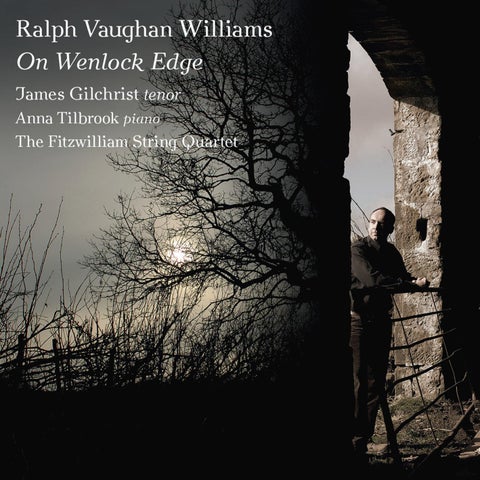
Ralph Vaughan Williams (1872-1958) On Wenlock Edge 1 2 3 4 5 6
On Wenlock Edge From far, from eve and morning Is my team ploughing Oh, when I was in love with you Bredon Hill Clun
Peter Warlock (1894-1930) 7
On Wenlock Edge
2 ~ On We n lo c k Ed g e ~
Recorded at Christ’s Hospital School, Horsham, West Sussex — November 21st-23rd, 2006 Produced and engineered by Philip Hobbs Post-production by Julia Thomas at Finesplice, UK Piano tuned by David Widdicombe Design and photographs of James Gilchrist and Wenlock Edge by John Haxby With thanks to Bruce Grindlay, Head of Music at Christ’s Hospital School Generously supported by grants from The Bliss Trust, The Ivor Gurney Society and Finzi Friends.
The Curlew He reproves the curlew The lover mourns for the loss of love The withering of the boughs He hears the cry of the sedge
Arthur Bliss (1891-1975) 8
Elegiac Sonnet
Ivor Gurney (1890-1937) Ludlow & Teme 9 10 11 12 13 14 15
When smoke stood up from Ludlow Far in a western brookland ’Tis time I think Ludlow Fair On the idle hill of summer When I was one and twenty The Lent Lily Total Time : 69.34
James Gilchrist tenor
Anna Tilbrook piano Michael Cox flute Gareth Hulse cor anglais The Fitzwilliam String Quartet Lucy Russell violin Jonathan Sparey violin Alan George viola Andrew Skidmore cello
On Wenlock Edge
~ O n We nlo c k E d ge ~ 3
In an article about Ralph Vaughan Williams’ song cycle On Wenlock Edge, Edwin Evans — a critic noted for his promotion in England of contemporary French music — reported that in around 1907 Vaughan Williams, ‘Like many another English composer who has gone through the academic mill, had made the discovery that his training had left him inarticulate at the very time when he was ripe for self-expression. He had something to say and was tongue-tied.’ Vaughan Williams consulted Evans who later recalled that, ‘As the French composers, whatever they had to say, seemed to have little difficulty in expressing themselves, he thought he might learn from them’. Although Evans provided him with a letter of introduction to Vincent D’Indy, when he arrived in Paris in January 1908, at the age of thirty-five, it was to a composer three years his junior that he went: Maurice Ravel. Vaughan Williams later recalled that when he returned from Paris three months later, ‘I came back with a bad attack of French fever and wrote a string quartet which caused a friend to say that I must have been having
tea with Debussy’. The quartet — Vaughan Williams’ first, in G minor — shows very obvious French influence, including some melodic echoes of Ravel’s own quartet in the first movement. Despite the overt French influence in the work, Vaughan Williams succeeded in asserting both his individuality and an assuredly English voice, perhaps grounded by his work on English folk melodies — begun in earnest in 1904 — distinct echoes of which are heard particularly in the last movement of the quartet. The quartet was followed in 1909 by his song cycle to poems of A.E. Housman for tenor, string quartet and piano, On Wenlock Edge. Following a performance of the cycle in May 1920, given by the work’s first interpreter, Gervase Elwes, Ivor Gurney wrote of the work on his programme:
4 ~ O n Wen l o c k E d ge ~
‘Purely English words retranslated and reinforced by almost purely English music — the product of a great mind not always working at the full of its power, but there continually and clearly apparent. The French mannerisms must be forgotten in the strong Englishness of the prevailing mood — in the unmistakable spirit of the time of creation. England is the spring of emotion, the centre of power, and the pictures of her, the breath of her earth and growing things are continually felt through the lovely sound.’ The French influence is particularly noticeable in ‘Bredon Hill’, the accompaniment of which is redolent of ‘La Vallée des Cloches’ from Ravel’s Miroirs for piano (1905). However, the work as a whole seems to bear a more overriding influence. The use of the piano quintet as the accompanying ensemble was an innovation in English music. Before the time of On Wenlock Edge the string quartet alone had been used as an accompaniment to song by Henry Walford Davies in 1894 (Prospice), and it would go on to be used by a number of other composers, including Vaughan Williams. However, its use never caught on as much as one might have supposed, especially given that musicians were beginning to rediscover and take on influences from England’s Golden Age, the Elizabethan period, in the revival of which the quartet could be seen as the natural successor to the viol consort. The introduction of the piano
~ O n Wen lo c k E d ge ~ 5
into the ensemble, as an independent soloist rather than keyboard continuo, has few precursors and probably takes its lead from Ravel’s teacher, Gabriel Fauré. His Paul Verlaine cycle, La Bonne Chanson, had been composed in 1892-4 with piano accompaniment; in 1898 — a year after Ravel had come under his tutelage — Fauré arranged it for piano and string quintet. 1898 also saw a song with piano quintet by Ernest Chausson: his last completed work, Chanson Perpétuelle. Although performed in 1899 this remained unpublished until 1911. Vaughan Williams sets six poems from A.E. Housman’s first and most enduring collection, A Shropshire Lad (1896). The landscape inhabited by Housman is that of a mythical, idealised Shropshire, similar to the Wessex evoked in the novels of Thomas Hardy. His dominant themes are love, and a post-industrial pastoral nostalgia, infused with expressions of disillusionment at the sacrifice of the young soldiers going to war, never to return. The poems, with their directness of speech and simple forms, influenced by Scottish Border Ballads and the work of Heinrich Heine, were easy fodder for composers. In fact Gurney, writing from the trenches during the First World War, warned of the difficulty of setting them well because of their immediacy: ‘Such precise and measured verses are too easy to set … One can only set them, say, a little better than Hermann Lohr or Maud Valerie White can; for their abilities are quite up to setting such poems’. Vaughan Williams’ On Wenlock Edge came on the cusp of a burgeoning of musical settings, reinforced by the fresh relevance of the sentiments of Housman’s poems with the coming of the First World War. Whilst Housman never refused permission for his poems to be set, his reticence to allow the original poems to be printed in programmes and to accept royalties from songs seems to demonstrate a dis-ownership of his work once it had been reworked into a musical setting — what is an act of violence upon a poem, the form of which has already been deemed perfect by its originator. This is perhaps witnessed by the occasion when a friend of Housman’s, Dr Percy Withers, thought to play him a gramophone recording of Vaughan Williams’ On Wenlock Edge — the only known occurrence of Housman hearing settings of his verses. Dr Withers wrote that it was only after two of the songs had been played that he turned in his chair to behold ‘a face wrought and flushed with torment,
a figure tense and bolt upright as though in an extremity of controlling pain or anger, or both.’ If, as it seems, Housman only heard the first two songs, he didn’t get to hear the third, which was the cause of some antagonism between the poet and composer. In December 1920 Housman wrote to his publisher, ‘I am told that composers in some cases have mutilated my poems—that Vaughan Williams cut two verses out of ‘Is my team ploughing?’ I wonder how he would like me to cut two bars out of his music’. When asked about this after Housman’s death Vaughan Williams was unremorseful, stating that ‘the composer has a perfect right artistically to set any portion of a poem he chooses provided he does not actually alter the sense … I also feel that a poet should be grateful to anyone who fails to perpetuate such lines as “The goal stands up, the keeper/Stands up to keep the goal”.’ Housman’s reaction aside, Ravel paid Vaughan Williams the compliment of playing the piano in the first French performance of the work, in February 1912, following which he wrote, ‘Everyone is agreed that your lyric poems were a revelation’.
6 ~ O n Wen lo c k E d ge ~
Ludlow and Teme On Wenlock Edge also came as a revelation to Ivor Gurney. His first hearing of the cycle in November 1919 became one of the most influential moments in his career. He was so fired up by the experience that he immediately set to work on his own cycle of seven Shropshire Lad settings for the same ensemble, Ludlow and Teme, which he completed in December 1919. Ludlow and Teme received its first performance in March 1920 at the home of Gurney’s close friend, Marion Scott, performed by Steuart Wilson, the Philharmonic Quartet, and apparently with Gurney at the piano. Scott recalled that Ludlow and Teme ‘had a spontaneous success. No composer being forthcoming in spite of repeated calls for him, Gurney was sought, and at length found, bashfully hiding behind the big bookcase at the far end of the back drawing-room.’ The ensemble became an important one for Gurney. In May 1920, with the prospect of a second performance of Ludlow and Teme at the end of the
~ O n Wen lo c k E d ge ~ 7
month, and following his second hearing of On Wenlock Edge, his review of which has been quoted previously, he composed a second Housman cycle with piano quintet, this time with a baritone soloist: The Western Playland. Gurney made further settings for baritone and piano quintet in 1925, this time of Robert Louis Stevenson and Walt Whitman, perhaps encouraged by the publication of Ludlow and Teme in October 1923 and the forthcoming publication of The Western Playland in February 1926, both under the auspices of the Carnegie United Kingdom Trust’s scheme for the publication of works by British composers. It could also be argued that the success of these works encouraged Gurney’s exploration of, and belief in chamber music in the latter part of his career, writing numerous string quartets and other chamber works between 1921 and 1927, when he stopped composing. At the time of his hearing of On Wenlock Edge and the genesis of Ludlow and Teme Gurney had recently returned to the Royal College of Music following the First World War, resuming his studies not with Sir Charles Stanford, as before the war, but with Vaughan Williams himself. The time was one of Gurney’s most intense periods of creativity, producing numerous instrumental works, some two hundred songs, and hundreds of poems. As well as this creativity it also saw a growth of concern amongst Gurney’s friends about his increasingly erratic behaviour leading to, his incarceration in a mental hospital from September 1922 until his death in December 1937. Towards the beginning of August 1925 Gurney was informed by Marion Scott that Ludlow and Teme was to be broadcast on the BBC National Service, sung by a Mr Osmond Davies. Ten days before the broadcast, on 15 August, Gurney wrote to Osmond Davies, ‘Ivor Gurney writes saying he is so glad that Mr Davies is singing (to wide audience) Ludlow and Teme, and from the praise given his voice by Miss Scott, it should do well. Wishes that it were the revised version … The alterations are simple (and striking). I wish Mr Davies would make them.’ This CD recording is the first performance of Gurney’s revised and corrected version, in a new edition based on three sources left by Gurney dating from 1925: Gurney’s annotated copies of the published full and vocal scores and three manuscript pages of amendments and insertions.
8 ~ On We n lo c k Ed g e ~
The manuscript notes are headed ‘Ludlow and Teme: Some instantly practicable — and also harder — suggested alternatives. Enormous improvement. Taking away of squareness.’ This ‘taking away of squareness’ is epitomised in the first song, ‘When smoke stood up from Ludlow’, where Gurney occasionally breaks up the regular 4/4 metre. This is particularly effective in the fourth verse where a small cut of just two beats increases the feeling of impulsiveness in the singer’s killing of the singing blackbird. As well as being a musical revision, it could be that, in wanting to ‘take away the squareness’, Gurney is also trying to break free from the formal routine of daily life imposed upon him in the mental hospital — a life very different from the wayward existence of walking, reading and writing he led in his freedom. One might also suggest that, in his exile from the musical world, he was finding the courage to break away from some of the squareness and formality that Stanford had endeavoured to impose upon his pupil. None of the songs have escaped revision, albeit many of them in small ways. Two revisions are particularly significant: the end of ‘Ludlow Fair’ has an entirely new passage inserted, adding a repeat of ‘the lads that will die in their glory’, heightening the desperate tragedy of the loss of the sons of Shropshire; and in the final song, ‘The Lent Lily’, Gurney repeats the words ‘the spring’s array’ at the climax of the song — a climax originally only partially attained by the use of the string quartet alone. In the extraordinarily heartfelt slow movement of the cycle, ‘Far in a western brookland’, Gurney has made a couple of amendments to Housman’s text, exchanging the second and fourth verses and altering a line of the third. Unlike Vaughan Williams, these are not pre-meditated changes but the result of Gurney’s habit of setting texts from memory and his occasional mis-remembrances. These are sometimes inadvertently filled in by Gurney without altering the meaning of the line, such as ‘long since forgotten’ instead of Housman’s ‘no more remembered’ in the third verse of ‘Far in a western brookland’. Despite these alterations, this and the final song, ‘The Lent Lily’, epitomise a sensitivity to poetry unique to Gurney and in which Housman could perhaps be pleased to have found a fine interpreter: in his song settings
he allows the poems to breathe and be sung and expressed in their own time without feeling restricted by the music — a poet’s sense, born of his dual ability as a composer-poet.
The Curlew
~ On We nl o c k Ed g e ~ 9
The short life of Philip Heseltine, better known by his pen name of Peter Warlock, was one of notoriety: he was a scholar, editor, critic and biographer, as well as a composer; he lived a ‘riotously bohemian existence’, as portrayed in D.H.Lawrence’s Women in Love in which the unflattering character of Halliday is modelled on Heseltine; and he had a reputation for his blunt, cutting criticisms, which were often channelled into limericks. His mysterious death in 1930 added a final patina to the life of one of British music’s more colourful characters. Commentators have defined two personae in his music: the boisterousness of Peter Warlock and the introspection of Philip Heseltine. Some believe that it was the introspective guise, with its underlying melancholy and despair that produced the finest music; it is this persona that produced what is regarded as Warlock’s masterpiece, The Curlew. The Curlew, a work uniquely scored for flute, cor anglais and string quartet, sets four poems by William Butler Yeats — one of the most prominent figures in the Irish literary revival at the end of the nineteenth century. Yeats’ earlier poetry became popular with composers and, in order to keep a check on this, he employed a censor to approve the publication of settings — a necessity apparently brought about after he had heard ‘a setting of his Lake Isle of Innisfree — a poem which voices a solitary man’s desire for still greater solitude — sung by a choir of a thousand Boy Scouts’. Warlock was a great admirer of Yeats, whom he was to meet in Dublin in 1917. However, when he submitted The Curlew to Yeats’ censor prior to seeking publication, the request for permission to publish the songs was turned down. There ensued some heated correspondence which, according to Yeats, resulted in Warlock being forbidden to use his words again. Despite this, Yeats’ hand was forced when The Curlew was awarded publication under the auspices of Carnegie United Kingdom Trust in 1923. The adjudicators’ report to the
10 ~ On We nl o c k E dg e ~
Trustees noted that the work was ‘A most imaginative setting of Mr Yeats’ poems, of which, indeed, it may be regarded as the musical counterpart.’ Warlock first embarked upon The Curlew in 1915, with the composition of ‘He reproves the curlew’ and the sketching of ‘The lover mourns for the loss of love’, completed in 1917. A setting of ‘The cloths of heaven’ was added in 1916, and by 1920 these had been joined by ‘Wine comes in at the mouth’ and ‘He hears the cry of the sedge’. It was performed in this form before being revised in 1922 with a new song, ‘The withering of the boughs’, replacing ‘The cloths of heaven’ and ‘Wine comes in at the mouth’. Warlock wrote that the work should be considered not merely as a set of songs but as a piece of chamber music, later referring to it as ‘a kind of symphonic poem’. In fact, with its pseudo-continuous form, The Curlew is the largest scale single movement he was to produce. Warlock drew attention to four significant motifs that recur during the work, three of which first appear in the extended introduction, which sets the desolate scene: the opening line heard on the cor anglais, which is taken up by the singer at his first entry; a motif played by the string quartet alone in which parallel tenths between the first violin and viola are supported by sustained notes in the cello and second violin (this has been called the ‘gloom’ motif by one commentator); the motif heard for the first time at the second entry of the cor anglais. The fourth motif — a falling sequence of minor thirds — is first heard at the end of the flute line in the instrumental section after the second song, although the minor third has already been prominent in the previous motifs. It is also thought that the pointed two note figure heard near the opening in the violins and flute is the cry of the curlew and the repeated notes of the next flute entry that of the peewit. The sincerity of Warlock’s feeling is perhaps best portrayed in his response to some obviously cynical public remarks: ‘It sounds the depths of desolation and despair, so of course people don’t take it seriously but speak of pose and the “luxuriousness” of Celtic melancholy’. The despair is destined not to find any resolution within the work, except for a brief glimmer of a tragic contentment in the singer’s dream of ’a sleepy country where swans fly round coupled with golden chains’; or is this an image of surrender? The largely
unaccompanied nature of the last song echoes the singer’s loneliness as he wanders by the desolate lake, affirmed in the final, hopeless statement: ‘Your breast will not lie by the breast of your beloved in sleep’.
Elegiac Sonnet
~ O n Wen lo c k E dg e ~ 11
Unlike the cautious approach to composers shown by Housman and Yeats, the poet Cecil Day Lewis positively encouraged the union of poetry and music. In 1943 Day Lewis was instrumental in the founding of the Apollo Society, the aim of which was to ‘revive the neglected art of reading poetry and to show that poetry and music can be regarded as complementary’. In the society’s meetings poetry readings would be preceded, interspersed or followed by musical pieces, with the intention that ‘the poems and the music should comment upon one another somehow — by a similarity of mood it may be, or association of style or subject, or by a violent provocative contrast’. Foreshadowing his later appointment as Poet Laureate in 1968, Day Lewis had provided the words for the recently appointed Master of the Queen’s Musick, Arthur Bliss, for A Song of Welcome — a work for soprano, baritone, chorus and orchestra written and performed to commemorate the ‘joyous occasion’ of the Queen and the Duke of Edinburgh’s return from a Commonwealth tour in July 1954. Sean Day Lewis, in a biography of his father, wrote that following this, Bliss ‘recognised in Cecil a poet who loved music and had the technical resources and understanding needed to provide singable words’; for this reason Bliss hoped that they might one day collaborate on an opera. Just two months after A Song of Welcome Bliss wrote to Day Lewis, ‘Would you be willing to write for me (say) a sonnet that I could set for Tenor (Peter Pears) and string quartet and possibly piano?’ Bliss wanted to write a work for a concert to be given in memory of a gifted Australian pianist who had taken his own life in December 1953, at the age of 31: Noel Mewton-Wood. Mewton-Wood had settled in London, where he made his professional debut at the Queen’s Hall in 1940 under Thomas Beecham, who declared him to be ‘the best talent that I’ve discovered in the British Empire for years; he’s exceptional and his technique is superb’. Although it was as a pianist that he
1 2 ~ O n We nlo c k E d ge ~
was winning admiration, with performances of works from Purcell to Hindemith, Mewton-Wood was also studying composition with Frank Bridge, producing chamber music, a piano concerto and an opera, as well as the score for a film: the 1944 ornithological comedy, Tawny Pipit. In 1948 Mewton-Wood was invited by the British Council to go to Ankara with Arthur Bliss and conductor George Weldon to give the opening concert at the recently built opera house. The programme included Bliss’ Piano Concerto – a work that Mewton-Wood went on to perform in a Promenade concert in 1949 and which he recorded in 1952. In gratitude for his championing of the concerto, Bliss composed a piano sonata for Mewton-Wood in 1952. When Bliss approached Day Lewis for a sonnet he didn’t have to wait long, for a matter of days later he was able to write to John Amis, who was organising the memorial concert, ‘Day Lewis has just written me a most lovely Elegiac Sonnet in memory of Mewton-Wood, which I shall set for tenor voice, string quartet and piano, and which I hope Peter Pears, Britten and the Zorian Quartet will do me the honour to perform.’ Day Lewis’ words are deeply personal. In August 1952, Day Lewis and his wife, actress Jill Balcon, had given an Apollo Society recital in which Mewton-Wood — a near neighbour of theirs in London – had provided the music. His personal knowledge of his life and his work as a pianist is reflected in the sonnet, including a hint at the reason for his suicide: the sudden death of his lover, Bill Fredricks, from a ruptured appendix; a death that he felt responsible for by not paying enough attention to Fredricks’ apparently frequent claims of ‘a supposed illness of some sort’. When, a month before the concert, on 4 November 1954, Bliss wrote to his publisher reporting that he had completed the sonnet, he also commented that ‘we cannot expect many performances’, perhaps feeling that its scoring would hinder its prospects. Certainly this beautiful, personal memorial to Mewton-Wood, both in Bliss’ music and Day Lewis’ words, is not as well known or as much performed as it deserves. © Philip Lancaster, 2007
James Gilchrist tenor
~ On We nl o c k E d ge ~ 1 3
James Gilchrist began his working life as a doctor, turning to a full-time career in music in 1996. He has a particular interest in English music. He has recently performed Tippett’s The Knot Garden (Sir Andrew Davis/BBC SO), Britten’s War Requiem (Bonn and The Three Choirs, Gloucester), Frederic in The Pirates of Penzance and Ralph in HMS Pinafore (Scottish Chamber Orchestra), Britten’s Serenade at The Sage, Gateshead and Purcell’s King Arthur for Mark Morris at English National Opera and in Berkeley, California. He appeared in a televised performance of Berlioz L’enfance du Christ at the BBC Proms (Monteverdi Choir & Orchestra). A keen exponent of the music of Bach and Handel, he has performed Bach cantatas (Monteverdi Choir/Sir John Eliot Gardiner/ Europe and America; Bach Collegium Japan/Tokyo), B Minor Mass (Semyon Bychkov/Turin and Santa Cecilia in Rome), Septimius in Theodora (Scottish Chamber Orchestra), Israel in Egypt (St Louis SO, Norddeutscher Rundfunk) Judas Maccabeus (Danish Radio Orchestra), Bach’s Christmas Oratorio (Ton Koopman/Tonhalle Orchestra, Zürich), St Matthew Passion (North Carolina SO and at Symphony Hall, Boston), and St John Passion and St Matthew Passion (Royal Concertgebouw Orchestra/Amsterdam). As a recitalist, he has appeared with Malcolm Martineau, John Constable and Julius Drake. In his partnership with the pianist Anna Tilbrook, he has performed Schumann, Finzi, Poulenc, Tippett and Britten for BBC Radio 3. In partnership with the harpist Alison Nicholls he has premiered works by Howard Skempton, Nichola LeFanu, and Alec Roth (settings of Vikram Seth), and with the Nash Ensemble at Princeton University and the Wigmore Hall. Operatic performances include Quint in Britten’s Turn of the Screw, Ferrando in Cosi Fan Tutte, Scaramuccio in Strauss’ Ariadne Auf Naxos (Richard Hickox), Gomatz in Mozart’s Zaide (Istanbul), Vaughan Williams’ Sir John in Love (Barbican/Radio 3), Hyllus in Handel’s Hercules (Berlin), Acis & Galatea (Berlin Staatsoper) and Evandre in Gluck’s Alceste (La Monnaie in Brussels).
His many recordings include the title role in Britten’s Albert Herring and Vaughan Williams’ A Poisoned Kiss for Chandos, Bach St Matthew His many recordings include the title role in Britten’s Albert Herring Passion (Gabrieli Consort/Paul McCreesh), Bach St John Passion (New and Vaughan Williams’ A Poisoned Kiss for Chandos, Bach St Matthew College Choir/Edward Higginbottom), Rachmaninov Vespers (Kings College, Passion (Gabrieli Consort/Paul McCreesh), Bach St John Passion (New Cambridge), Rameau Cantatas (ASV), Grainger Songs (Chandos), Handel’s College Choir/Edward Higginbottom), Rachmaninov Vespers (Kings College, Ode to St Cecilia (The King’s Consort/Hyperion), Bach Missa Brevis Cambridge), Rameau Cantatas (ASV), Grainger Songs (Chandos), Handel’s (Collegium Instrumentale Brugense), and various Bach Cantatas with Sir John Ode to St Cecilia (The King’s Consort/Hyperion), Bach Missa Brevis Eliot Gardiner, Ton Koopman and Masaaki Suzuki. Most recently James has (Collegium Instrumentale Brugense), and various Bach Cantatas with Sir John recorded a disc of Finzi song cycles, ‘Oh Fair to See’, (Linn CKD 253) which was Eliot Gardiner, Ton Koopman and Masaaki Suzuki. Most recently James has released to great critical acclaim in 2005. recorded a disc of Finzi song cycles, ‘Oh Fair to See’, (Linn CKD 253) which was released to great critical acclaim in 2005.
1 4 ~ O14 n ~We On nloWen ck E lodcge k E~ dg e ~
Anna Tilbrook Anna Tilbrook is one of Britain’s most acclaimed young pianists who has built Anna Tilbrook
a considerable reputation in song recitals and chamber music. She made her Anna Tilbrook is one of Britain’s most acclaimed young pianists who has built debut at the Wigmore Hall in 1999 and has since become a regular visitor to a considerable reputation in song recitals and chamber music. She made her the major concert halls and festivals throughout the UK. She can frequently be debut at the Wigmore Hall in 1999 and has since become a regular visitor to heard on Radio 3. the major concert halls and festivals throughout the UK. She can frequently be Anna has collaborated with many leading Lieder singers including heard on Radio 3. James Gilchrist, Ian Bostridge, Stephen Loges, Stephen Varcoe, Lucy Crowe Anna has collaborated with many leading Lieder singers including and Gillian Keith whilst also enjoying duo partnerships with a number of James Gilchrist, Ian Bostridge, Stephen Loges, Stephen Varcoe, Lucy Crowe instrumentalists. and Gillian Keith whilst also enjoying duo partnerships with a number of Born in Hertfordshire, Anna studied music at York University and the instrumentalists. Royal Academy of Music and she now lives in London. ‘Anna Tilbrook is an Born in Hertfordshire, Anna studied music at York University and the outstanding accompanist: discreet when necessary, but also able to make the Royal Academy of Music and she now lives in London. ‘Anna Tilbrook is an simplest phrase or chordal progression tell without a touch of exaggeration’ outstanding accompanist: discreet when necessary, but also able to make the (BBC Music Magazine, July 2005). simplest phrase or chordal progression tell without a touch of exaggeration’ (BBC Music Magazine, July 2005).
Fitzwilliam String Quartet Founded in 1968 by four Cambridge undergraduates, the Fitzwilliam String Fitzwilliam String Quartet Quartet first became well known through their close personal association with Founded in 1968 by four Cambridge undergraduates, the Fitzwilliam String Dmitri Shostakovich, who befriended them following a visit to York to hear them Quartet first became well known through their close personal association with Dmitri Shostakovich, who befriended them following a visit to York to hear them
~ O n ~We Onl n oWe c knlo E dg c ke E~ d1ge 5 ~ 15
play. He entrusted them with the Western premiéres of his last three quartets, and before long they had become the first ever group to perform and record all play. He entrusted them with the Western premiéres of his last three quartets, fifteen. These recordings gained many international awards, and secured for and before long they had become the first ever group to perform and record all the quartet a worldwide concert schedule and a long term contract with Decca/ fifteen. These recordings gained many international awards, and secured for London. the quartet a worldwide concert schedule and a long term contract with Decca/ They are one of the few string quartets in the world to use Classical London. instruments for the appropriate repertoire, and perhaps unique in that they They are one of the few string quartets in the world to use Classical perform on both historical and modern set-ups — sometimes within the same instruments for the appropriate repertoire, and perhaps unique in that they concert! Extremely generous private patronage has made possible their current perform on both historical and modern set-ups — sometimes within the same collaboration with Linn Records, which includes Haydn’s The Seven Last Words concert! Extremely generous private patronage has made possible their current (Linn CKD 153) and Brahms’ quintet with clarinettist Lesley Schatzberger collaboration with Linn Records, which includes Haydn’s The Seven Last Words (Linn BKD 278). (Linn CKD 153) and Brahms’ quintet with clarinettist Lesley Schatzberger Recent travels have taken them all over the world to places such as USA, (Linn BKD 278). South Africa, Slovenia, Russia, Switzerland, Germany, Spain, China and India. Recent travels have taken them all over the world to places such as USA, South Africa, Slovenia, Russia, Switzerland, Germany, Spain, China and India.
On Wenlock Edge
From far, from eve and morning
Alfred Edward Housman
From far, from eve and morning And yon twelve-winded sky, The stuff of life to knit me Blew hither: here am I.
On Wenlock Edge On Wenlock Edge the wood’s in trouble; His forest fleece the Wrekin heaves; The gale, it plies the saplings double, And thick on Severn snow the leaves. ‘Twould blow like this through holt and hanger When Uricon the city stood: ‘Tis the old wind in the old anger, But then it threshed another wood. Then, ‘twas before my time, the Roman At yonder heaving hill would stare: The blood that warms an English yeoman, The thoughts that hurt him, they were there.
1 6 ~ On Wen lo c k E dg e ~
There, like the wind through the woods in riot, Through him the gale of life blew high; The tree of man was never quiet: Then ‘twas the Roman, now ‘tis I. The gale, it plies the saplings double, It blows so hard, ‘twill soon be gone: To-day the Roman and his trouble Are ashes under Uricon. A Shropshire Lad, XXXI
Now – for a breath I tarry Nor yet disperse apart – Take my hand quick and tell me, What have you in your heart. Speak now, and I will answer; How shall I help you, say; Ere to the wind’s twelve quarters I take my endless way. A Shropshire Lad, XXXII
Is my team ploughing ‘Is my team ploughing, That I was used to drive And hear the harness jingle When I was man alive?’ Ay, the horses trample, The harness jingles now; No change though you lie under The land you used to plough. ‘Is football playing Along the river shore, With lads to chase the leather, Now I stand up no more?’
Ay, the ball is flying, The lads play heart and soul; The goal stands up, the keeper Stands up to keep the goal.*
And now the fancy passes by, And nothing will remain, And miles around they’ll say that I Am quite myself again.
‘Is my girl happy. That I thought hard to leave, And has she tired of weeping As she lies down at eve?’
Ay, she lies down lightly, She lies not down to weep: Your girl is well contented. Be still, my lad, and sleep.
In summertime on Bredon The bells they sound so clear; Round both the shires they ring them In steeples far and near, A happy noise to hear.
‘Is my friend hearty, Now I am thin and pine, And has he found to sleep in A better bed than mine?’ Yes lad, I lie easy, I lie as lads would choose; I cheer a dead man’s sweetheart, Never ask me whose. A Shropshire Lad, XXXVII * Vaughan Williams omits vv.3 & 4
Oh, when I was in love with you Oh, when I was in love with you, Then I was clean and brave, And miles around the wonder grew How well did I behave.
Bredon Hill
Here of a Sunday morning My love and I would lie, And see the coloured counties, And hear the larks so high About us in the sky. The bells would ring to call her In valleys miles away: ‘Come all to church, good people; Good people, come and pray.’ But here my love would stay. And I would turn and answer Among the springing thyme, ‘Oh, peal upon our wedding, And we will hear the chime, And come to church in time.’
~ O n Wen lo c k E dg e ~ 1 7
A Shropshire Lad, XXXVIII
But when the snows at Christmas On Bredon top were strown, My love rose up so early And stole out unbeknown And went to church alone. They tolled the one bell only, Groom there was none to see, The mourners followed after, And so to church went she, And would not wait for me. The bells they sound on Bredon, And still the steeples hum. ‘Come all to church, good people,’ – Oh, noisy bells, be dumb; I hear you, I will come. A Shropshire Lad, XXI
Clun
18 ~ On We n lo c k Ed g e ~
In valleys of springs and rivers, By Ony and Teme and Clun, The country for easy livers, The quietest under the sun, We still had sorrows to lighten, One could not be always glad, And lads knew trouble at Knighton When I was a Knighton lad. By bridges that Thames runs under, In London, the town built ill, ’Tis sure small matter for wonder If sorrow is with one still.
And if as a lad grows older The troubles he bears are more, He carries his griefs on a shoulder That handselled them long before. Where shall one halt to deliver This luggage I’d lief set down? Not Thames, not Teme is the river, Nor London nor Knighton the town: ’Tis a long way further than Knighton, A quieter place than Clun, Where doomsday may thunder and lighten And little ’twill matter to one. A Shropshire Lad, L
The Curlew William Butler Yeats He reproves the curlew O, curlew, cry no more in the air, Or only to the waters in the West; Because your crying brings to my mind Passion-dimmed eyes and long heavy hair That was shaken out over my breast: There is enough evil in the crying of wind.
The lover mourns for the loss of love Pale brows, still hands and dim hair, I had a beautiful friend And dreamed that the old despair
Would end in love in the end: She looked in my heart one day And saw your image was there; She has gone weeping away.
The withering of the boughs I cried when the moon was murmuring to the birds, ‘Let peewit call and curlew cry where they will, I long for your merry and tender and pitiful words, For the roads are unending, and there is no place to my mind.’ The honey-pale moon lay low on the sleepy hill, And I fell asleep upon the lonely Echtge of streams. No boughs have withered because of the wintry wind; The boughs have withered because I have told them my dreams I know of the leafy paths the witches take, Who come with their crowns of pearl and their spindles of wool, And their secret smile, out of the depths of the lake; I know where a dim moon drifts, where the Danaan kind Wind and unwind their dances when the light grows cool On the island lawns, their feet where the pale foam gleams, No boughs have withered because of the wintry wind; The boughs have withered because I have told them my dreams. ~ O n We nl o c k E dg e ~ 1 9
I know of a sleepy country, where swans fly round Coupled with golden chains, and sing as they fly. A king and a queen are wandering there, and the sound Has made them so happy and hopeless, so deaf and so blind With wisdom, they wander ‘till all the years have gone by; I know, and the curlew and peewit on Echtge of streams. No boughs have withered because of the wintry wind; The boughs have withered because I have told them my dreams.
He hears the cry of the sedge
Ludlow & Teme
I wander by the edge Of this desolate lake Where wind cries in the sedge ‘Until the axle break That keeps the stars in their round, And hands hurl in the deep The banners of East and West, And the girdle of light is unbound, Your breast will not lie by the breast of your beloved in sleep’.
Alfred Edward Housman
Elegiac Sonnet Cecil Day Lewis A fountain plays no more: those pure cascades And diamond plumes now sleep within their source. A breath, a mist of joy, the woodsong fades – The trill, the transport of his April force.
2 0 ~ On We nl o c k E dg e ~
How well those hands, rippling from mood to mood Figured a brooding or a brilliant phrase! Music’s dear child, how well he understood His mother’s heart – the fury and the grace! Patient to bear the stern ordeal of art, Keyed to her ideal strain, he found too hard The simple exercise of human loss. He took his grief away, and we are less. Laurels enough he had. Lay on his heart A flower he never knew – the rose called peace.
When smoke stood up from Ludlow When smoke stood up from Ludlow, And mist blew off from Teme, And blithe afield to ploughing Against the morning beam I strode beside my team, The blackbird in the coppice Looked out to see me stride, And hearkened as I whistled The trampling team beside, And fluted and replied: ‘Lie down, lie down, young yeoman; What use to rise and rise? Rise man a thousand mornings Yet down at last he lies, And then the man is wise.’ I heard the tune he sang me, And spied his yellow bill; I picked a stone and aimed it And threw it with a will: Then the bird was still. Then my soul within me Took up the blackbird’s strain, And still beside the horses Along the dewy lane It sang the song again:
‘Lie down, lie down, young yeoman; The sun moves always west; The road one treads to labour Will lead one home to rest, And that will be the best.’ A Shropshire Lad, VII
’Tis time I think
Far in a Western Brookland That bred me, long ago The poplars stand and tremble By pools I used to know.
’Tis time I think by Wenlock town The golden broom should blow; The hawthorn sprinkled up and down Should charge the land with snow.
There, by the starlit fences, The wanderer halts and hears My soul that lingers sighing About the glimmering weirs.
Spring will not wait the loiterer’s time Who keeps so long away; So others wear the broom and climb The hedgerows heaped with may.
He hears: long since forgotten In fields where I was known, Here I lie down in London And turn to rest alone.
Oh tarnish late on Wenlock Edge, Gold that I never see; Lie long, high snowdrifts in the hedge That will not shower on me.
There in the windless night-time, The wanderer, marvelling why, Halts on the bridge to hearken How soft the poplars sigh.
A Shropshire Lad, XXXIX
A Shropshire Lad, LIII Note: Gurney has exchanged verses two and four from Housman’s original. The first line of the third verse has been misremembered by Gurney. Housman’s original reads ‘no more remembered’.
~ On We nl o c k E d ge ~ 2 1
Far in a Western Brookland
Ludlow Fair The lads in their hundreds to Ludlow come in for the fair There’s men from the barn and the forge and the mill and the fold, The lads for the girls and the lads for the liquor are there, And there with the rest are the lads that will never be old. There’s chaps from the town and the field and the till and the cart, And many to count are the stalwart, and many the brave, And many the handsome of face and the handsome of heart, And few that will carry their looks or their truth to the grave. I wish one could know them, I wish there were tokens to tell The fortunate fellows that now you can never discern; And then one could talk with them friendly and wish them farewell And watch them depart on the way that they will not return. But now you may stare as you like and there’s nothing to scan; And brushing your elbow unguessed-at and not to be told They carry back bright to the coiner the mintage of man, The lads that will die in their glory and never be old. A Shropshire Lad, XXIII
2 2 ~ On We n lo c k Ed g e ~
On the idle hill of summer On the idle hill of summer, Sleepy with the flow of streams, Far I hear the steady drummer Drumming like a noise in dreams. Far and near and low and louder On the roads of earth go by, Dear to friends and food for powder, Soldiers marching, all to die.
East and west on fields forgotten Bleach the bones of comrades slain, Lovely lads and dead and rotten; None that go return again. Far the calling bugles hollo, High the screaming fife replies, Gay the files of scarlet follow: Woman bore me, I will rise. A Shropshire Lad, XXXV
When I was one-and-twenty When I was one-and-twenty I heard a wise man say, ‘Give crowns and pounds and guineas But not your heart away; Give pearls away and rubies But keep your fancy free.’ But I was one-and-twenty, No use to talk to me.
A Shropshire Lad, XIII *Housman’s original: ‘The heart out of the bosom’.
’Tis spring; come out to ramble The hilly brakes around, For under thorn and bramble About the hollow ground The primroses are found. And there’s the windflower chilly With all the winds at play, And there’s the Lenten lily That has not long to stay And dies on Easter Day. And since till girls go maying You find the primrose still, And find the windflower playing With every wind at will, But not the daffodil. Bring baskets now, and sally Upon the spring’s array, And bear from hill and valley The daffodil away That dies on Easter Day. A Shropshire Lad, XXIX ~ O n Wen lo c k E dg e ~ 2 3
When I was one-and-twenty I heard him say again, ‘The heart from out the bosom* Was never given in vain; ’Tis paid with sighs a plenty And sold for endless rue.’ And I am two-and-twenty, And oh, ’tis true, ’tis true.
The Lent Lily
Oh Fair to See
Robert Schumann
My Beloved is Mine
Kenneth Leighton
Song cycles for tenor and piano by Gerald Finzi
Song cycles by Benjamin Britten
Song Cycles
Earth, Sweet Earth
Benjamin Britten Winter Words
For even more great music visit linnrecords.com
CKR 296
ALSO AVAILABLE BY JAMES GILCHRIST ON LINN