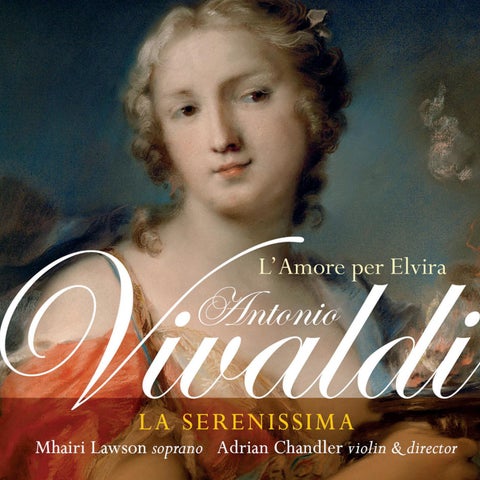
Antonio VIVALDI (1678-1741) Sonata ‘Graz’ (No.3) for violin & continuo in D, RV 11
(reconstruction: Adrian Chandler) 1. Largo 3.29 2. Allegro 3.23 3. Largo 2.32 4. Allegro 2.58
Cantata Tremori al braccio for soprano & continuo, RV 799 5. 6. 7. 8.
Recitativo: Tremori al braccio 1.36 Aria – Andante: Quando chiami dolce, e cara 6.25 Recitativo: Ah nò, mia cara Elvira 0.47 Aria – Largo: Quello che senti, ò bella 5.40
Sonata for violin, cello & continuo in C minor, RV 83 9. 10. 11.
Allegro 2.30 Largo 3.52 Allegro 2.37
Cantata Elvira, anima mia for soprano & continuo, RV 654 12. 13. 14. 15.
Recitativo: Elvira, anima mia 1.25 Aria – Larghetto: Partirò, ma vedrai quanto 5.15 Recitativo: Passo al rogo fatal 1.06 Aria – Allegro non molto: Pupille vaghe 3.12
Sonata ‘Graz’ (No.2) for violin & continuo in B minor, RV 37
(reconstruction: Adrian Chandler) 16. Largo 3.31 17. Allegro 3.08 18. Largo 2.10 19. Allegro 3.16
Cantata Lungi dal vago volto for soprano, violin & continuo, RV 680 20. 21. 22. 23. 2
Recitativo: Lungi dal vago volto 2.02 Aria – Largo: Augelletti, voi col canto 8.39 Recitativo: Allegrezza, mio core 1.02 Aria – Allegro: Mi stringerai sì, sì 4.58 2
L A S ER EN IS S IMA
3
3
L’Amore per Elvira With the Vivaldi revival entering its second century, we are finally becoming better acquainted with the man and his music. Naturally his concertos remain his most potent selling point, both on record and in concert, but thanks to the modern recording industry, his sacred music and operas are forcing a fresh appraisal of this extraordinary Venetian. Still awaiting thorough exploration, however, are his forty-odd cantatas for solo soprano and alto, an aspect of his output that has largely been neglected by scholars and performers alike, yet one which contains some of his finest and most inspired music. It would appear that Vivaldi first started writing cantatas for the Mantuan court whilst holding the secular post of Maestro di Cappella di Camera. The fame achieved through the publication of his concertos titled L’estro armonico (1711) soon enabled him to make his operatic debut in the provincial town of Vicenza with Ottone inVilla (RV 729), the success of which led to various commissions for Venetian houses between the years 1714 and 1718. Unsurprisingly the Mantuan court were keen to acquire the services of such a promising young composer and soon he was producing works such as Teuzzone (RV 736) and Tito Manlio (RV 738) at theTeatro Arciducale (also known as the Teatro Comico) in the carnival season of 1718-19. Vivaldi’s patron in Mantua was Landgrave Philip of Hesse-Darmstadt (1671-1736), a military man who had won his spurs fighting for the English against the French in the Netherlands in 1691-92. He was evidently a man of exquisite and expensive taste and was eventually recalled in 1735 by Holy Roman Emperor Charles VI in favour of a candidate with smaller expense claims! Twelve of Vivaldi’s Mantuan cantatas survive, some of which appear to have been part of a cycle of possibly twelve works. They were probably written for the court’s elite inner circle, some members of which appear in the cantatas sporting Arcadian 4
4
pseudonyms, a popular practice amongst contemporary Arcadian communities. Precedence had already been set by Vivaldi’s Serenata a quattro voci (RV 692) where Daliso (who appears in cantatas RV 652 and RV 665) represents Philip himself, Tirsi (who appears in RV 649 and 659) represents Margherita Pavesi Furlani and Eurilla (who appears in RV 649) represents Philip’s daughter Theodora. The most prolific name however is that of Elvira, the object of three cantatas. Possibly conceived as a set, these works form a little story. In Tremori al braccio (RV 799) the lover, (whose name we later learn to be Fileno) trembles at his inability to confess his love to Elvira, only overcoming his reticence in the finale (though not without reservations). In the second work Elvira, anima mia (RV 654), Fileno bears the sad tidings to Elvira that he must leave for a while and asks for one last kiss before he leaves. In the final work, Lungi dal vago volto (RV 680), the returning Fileno spies Elvira in the distance and he finally reaches her in the happy concluding aria. Not long ago the performance of these three cantatas would have been impossible: Tremori al braccio was discovered as recently as 1999 by Oliver Fourés in the Gesellschaft der Musikfreunde in Vienna. It provides a marvellous opening to the trilogy: the three trilled quavers depicting Fileno’s trembling arms at the opening are a masterstroke and the harmonic structure of the opening recitative is inspired, as are those of its compatriot works. Housed in the Diözesanarchiv, Graz, are five sonatas by Vivaldi for violin and violonzello (sic). These works have hitherto been neglected mainly on account of their missing bass parts. Three survive elsewhere in slightly altered forms; the fast movements of the first sonata (RV 4) survive in the sonata dedicated to Johann Georg Pisendel (RV 2), the fourth sonata (RV 7) shares three movements with a sonata extant in both Udine and Cividale del Friuli (RV 7a) and the fifth sonata (RV 17) shares three movements with the ninth Manchester sonata (RV 17a). The second and third sonatas are as yet unknown in other sources hence the reconstruction of Vivaldian bass parts for the purposes of this performance. 5
5
Although the Manchester sonatas were probably presented to Cardinal Ottoboni in 1726, at least five of these twelve works were written earlier including that which survives in Graz. One sonata was probably penned as early as 1716/7, conceived for Pisendel at the same time as RV 2 (see above). This evidence tends to point to a compositional date for the Graz set as 1716-1720, similar to that of the Elvira cantatas which also bear some startling thematic similarities. The received wisdom of recent academic research tends to suggest that the most popular accompaniment for the baroque violin sonata would have been either harpsichord or cello. Although the title of these sonatas only specifies the cello, we have opted for the more decadent combination of cello, harpsichord and guitar or theorbo – a more lavish yet still historically plausible alternative. The final work due for discussion is the sole surviving sonata by Vivaldi for violin and obbligato cello, a combination he also used in three concertos. Unlike the violin sonatas, this work adopts Vivaldi’s standard three-movement concerto layout and even uses a simplified version of ritornello form in the first movement before reverting to the more standard binary form for the second and third movements. Whilst it is unsurprising for Vivaldi to introduce its concerto elements into a sonata, the three movement sonata had already been pre-empted by the Venetian trio sonata of the 1660s-1690s, examples of which Vivaldi must surely have known. © Adrian Chandler, March 23, 2006
6
6
Tremori al braccio, RV 799 Recitativo: Tremori al braccio e lagrime sul ciglio, sospiri al labbro, al volto mio pallore in sua muta favella parlan teco, o mia bella, ed à quel core che quest’anima adora l’avviso del mio amor non giunse ancora? Perché le mie catene so strascinar con arte, acciò il rumore non si senta de’ ceppi che mi stringono il core, il ciglio del mio ben non le rimira; e perché tace il labbro, Amor sen’ride e non m’intende Elvira.
Recitative: My shaking arms, the tears in my eyes, My sighing lips, my pale face In their mute address Speak to you my love, And has the message of my love not yet reached That heart which this soul loves? Since I know how to drag My chains artfully, So that no one hears the noise of the stocks That fetter my heart, The eyes of my beloved do not notice them; And because my lips are silent, Cupid laughs and Elvira hears me not.
Aria: Quando chiami dolce e cara quell’ auretta che respiri, tu favelli a’ miei sospiri ma quel core non lo sa.
Aria: When you call the air sweet and precious Which you breathe You are talking to my sighs But your heart is unawares.
Perché sono le rugiade che tu baci su l’erbette sconosciute lagrimette non m’impetrano pietà.
Since the dews You kiss on tender grasses Are unrecognised as tears They cannot plead for me.
Recitativo: Ah no, mia cara Elvira, ch’una fiamma sì grande sepolta non può star nell’alma mia. Io t’amo, ed è sì forte questo puro amor mio
Recitative: Ah no, my dear Elvira, So great a passion Cannot not stay buried in my soul. I love you, and so strong Is this pure love of mine 7
7
che se di te non penso, o che vivo non sono, o non son io.
That if I think not of you, I live no more, or it is not myself that lives.
Aria: Quello che senti, o bella schezare intorno al sen è figlio del mio amor è un mio sospiro.
Aria: What you feel, o my fair one Dallying beside your bosom Is the child of my love It is my sighing.
Ti priega, e pur non sa s’amore o crudeltà speri dal tuo bel cor il mio martiro.
It cries you mercy, and yet Knows not if it hopes for Love or cruelty from your lovely heart. You are my torment.
Elvira, anima mia, RV 654
8
Recitativo: Elvira, anima mia, mirami, se lo puoi, nunzio di meste note a gl’occhi tuoi. Non più vedrai Fileno, de’ più teneri affetti tra li soavi lacci, tra il mormorio de’ baci ebro di gioia, a riposarsi in seno. Forz’è di rio destino Ch’io parta, ch’io ti lasci e vada altrove, Senza poterti dir quando né dove.
Recitative: Elvira, dearer to me than life, Look on me, if you can, For I bring bad tidings before your eyes. No more shall you see Fileno Caught by the tenderest of loves Amongst the sweetest snares, Amongst murmuring of kisses drunk with joy, Rest in your bosom. An evil fate is forcing Me to leave, to leave you and go elsewhere, Without having leave to tell you when or where.
Aria: Partirò, ma vedrai quanto, bell’Elvira, dal mio pianto sia il dolor del mio partir.
Aria: I shall go, but you’ll see how great, Lovely Elvira, from my tears, Is the pain of that parting. 8
Senza te, gioia amorosa, la mia vita è più penosa d’ogni barbaro martir.
Without you, my beloved jewel, My life is full of pain And of every kind of barbarous suffering.
Recitativo: Passo al rogo fatal e son già cinto di tormenti e d’affanni. O cara Elvira mira, pietosa mira ancor per un momento nel specchio de’ miei lumi il mio tormento. Prendi l’ultimo bacio con quello stesso ciglio che da bocca languente del padre moribondo il sugge un figlio.
Recitative: I am going to the deadly pyre and am beset already by torments and woes. Oh dear Elvira Look on, look on with pity For a moment longer Into the mirror of my eyes at my pain. Take this last kiss With the same look in your eyes That a son would have when kissing His dying father’s withered lips.
Aria: Pupille vaghe, bellezza amata, alma adorata, Elvira, addio.
Aria: Oh lovely eyes, Beloved beauty, Being I adore, Elvira, farewell.
Parto, ma resta doglia funesta nell’afflitto mio sen e nel cor mio.
I am leaving, but terrible Pain remains In my shattered mind and in my heart.
Lungi dal vago volto, RV 680 Recitativo: Lungi dal vago volto della mia bella Elvira viver non posso. Oh Dio! E pur crudo destin per mio tormento or mi condanna a pascolar l’armento.
Recitative: Far from the lovely face Of my beautiful Elvira I cannot live. Oh God! To torment me a cruel fate Has condemned me to herd cattle. 9
9
10
Ma qual da lungi ammira non distinta beltade il guardo mio pastorella che viene? Temo d’errar, mi perdo, corro, mi fermo, rido, sospiro ad un, ardo, gelo, contento e tormentato. Mi sembra alla divisa, non mi par al sembiante; deh per pietade Amor, amico cielo, sciogli dal mio bel sol la nube, il velo.
But who is the shepherdess coming This way, the faint traces of whose beauty My gaze has lit upon from this distance? I’m afraid I’ll make a mistake, I’ll lose my way, I run, I stop, I laugh, I sigh, all of me Burns, I freeze, I am both happy and tortured. Her uniform’s that of a shepherdess Her beauty’s not; Love, for pity’s sake, Friendly Heaven, From before my lovely Sun, burn off the clouds, the veil.
Aria: Augelletti, voi col canto queste selve impreziosite, ed io posso sol col pianto consolare il mio dolor.
Aria: Little birds, with your songs You make these woods precious, But I with my tears alone Can console my pain.
Fate voi che dolce incanto con amor o con pietade, chiami al bosco il mio tesor.
See to it sweet incantations All for Love or Pity’s sake, Call to the woods my best beloved.
Recitativo: Allegrezza, mio core, ch’al fin giunse alla meta l’avida mia pupilla: ti riconosco, o bella, ti riveggio, mio bene, t’abbraccio, pastorella. Perdona, o cara, a’miei sospiri affetti, perché errante pastor veder non suole tra queste ombrose frondi aperto il sole.
Recitative: Take delight, oh my heart, For my pining eye Has found its treasure in the end: I know you, my beauty, I set my eyes on you again, my love, I hold you in my arms, my shepherdess. Forgive, my dearest, my gasps of wonder For wandering shepherds are unused, in These shady valleys, to seeing the sun clearly. 10
Aria: Mi stringerai sì, sì, non partirai più no. Bella, ti rapirò se il cor non cede.
Aria: You will hold me in your arms, yes, You’ll never leave again, no. My beauty, I’ll transport you if my heart doesn’t burst.
Avvinto al tuo bel sen Wrapped in your lovely bosom, ti giuro, amato ben, I swear to you, my beloved, che mai ti mancherò d’amor e fede. That I will never fail you in love or faithfulness.
La Serenissima La Serenissima was formed in 1994 for a performance of Antonio Vivaldi’s La Senna festeggiante (RV 693) and ten years later, has firmly established itself as one of the leading exponents of the music of Antonio Vivaldi and his Italian contemporaries. Since the first CD release in 2003, La Serenissima has been universally applauded by publications such as Gramophone Magazine, The Sunday Times, BBC Music Magazine, Diapason, Fanfare Magazine, American Record Guide,The Independent,The Strad, La Stampa, Gaudisc and the Evening Standard for its performances and recordings. Whilst works like the Four Seasons form an important part of La Serenissima’s repertoire, (one performance being described by The Independent as ‘bouncily eager to entertain, astonish and delight,’) La Serenissima pride themselves on bringing works seldom heard to the concert platform, including Vivaldi’s Ottone in Villa (RV 729), Giustino (RV 724), Tito Manlio (RV 717), Tremori al braccio (RV 799), the violin sonata (RV 798), the Concerto fatto per la Solennità della S. Lingua di S. Antonio in Padova, 1712 (RV 212) and the two double violin concerti from his manuscript set La Cetra (RV 520 and 526). Rarities by other composers include Albinoni’s Il Nascimento dell’Aurora, and Caldara’s Cantata per la Notte del Santissimo Natale. La Serenissima has appeared at many of the UK’s leading festivals and venues including South Bank Early Music Festival, Spitalfields, Warwick, Lichfield and the 11
11
Beverley Early Music Festivals,York Early Music Festival, Cambridge Summer Music, St George’s Bristol and Snape Maltings. They have also appeared in Italy, Germany, Denmark, Belgium, Mexico and most recently Spain, all to great acclaim. They have performed for BBC Radio 3 on numerous occasions. 2006 sees the release of their fourth disc with Avie Records, and the first of a series of three charting the development of the North Italian violin concerto. This will coincide with promotional concerts in the UK and Spain. The 2006/7 season sees tours of the Elvira programme to Spain, Ireland and the UK. Adrian Chandler, director & violin Born on Merseyside in 1974, Adrian Chandler studied both modern and Baroque violin at the Royal College of Music with Rodney Friend and Catherine Mackintosh. Whilst still a student at the RCM he founded the period ensemble La Serenissima which he has since directed in many performances in Europe and the UK. With La Serenissima, Adrian Chandler has performed solo recitals and Vivaldi concerti in major festivals such as Spitafields, Southwark, Bruges, South Bank Early Music Festival and York Early Music Festival, as well as in concert series in Germany, Italy, Denmark, Spain, Mexico, Ireland and the UK. In addition to his work with La Serenissima, Adrian Chandler has led British early music ensembles such as the Musicians of the Globe, the Gabrieli Players, the Avison Ensemble, Concerto Caledonia and the New London Consort. As leader of Philip Pickett’s New London Consort and Musicians of the Globe, Adrian has performed on many tours in Italy, Japan, Benelux, Mexico and 12
12
Austria, as well as taking part in many of the ensembles’ recordings for Decca and Philips. Adrian’s performances have been broadcast by BBC Radio 3, Radio Scotland, Dutch Radio, Radio 3 Belgium, Radio France, Danish Radio, Classic FM and Japanese TV. His discography includes solo sonatas by Marini, Vivaldi and Veracini for ASV, Opus 111 and Linn. His most recent releases recorded with La Serenissima for Avie Records feature virtuoso sonatas by Albinoni, Pisendel and Vivaldi (AV0018), Vivaldi Concerti and Arias (AV0031), religious concerti by Vivaldi (AV2063), and The Rise of the North ItalianViolin ConcertoVolume 1(AV2106), the first in a series of three records. In 2006 Adrian was awarded a three year AHRC (Arts and Humanities Research Council) fellowship at Southampton University in order to research the development of the North Italian violin concerto between 1690 and 1740 (running in conjunction with concerts and recordings for La Serenissima). Mhairi Lawson, soprano While still a student at the Guildhall School of Music and Drama, Mhairi won the International Early Music Network Young Artists Prize with the fortepianist Olga Tverskaya, which led to her first CD recording of Haydn’s English and Scottish Songs (premiere recording on original instruments). As a soloist Mhairi has appeared at venues such as New York’s Lincoln Centre, Paris’ Cité de la Musique, Théatre du Châtelet and Opera Comique, Edinburgh’s Festival Theatre, Utrecht’s Vredenburg, London’s Barbican Centre, South Bank Centre, Royal Opera House and Coliseum Theatre with companies including English National Opera, Les Arts Florissants, The Gabrieli Consort and the Scottish Chamber Orchestra. 13
13
Mhairi has a special interest in the music of 18th Century Scotland and Italy of which she has given many performances and recorded for CD with Concerto Caledonia (Linn CKD 140, Mungrel Stuff – music by Scottish / Italian composers). With the virtuoso baroque band La Serenissima, Mhairi has performed Vivaldi’s La Senna Festeggiante and Laudate Pueri in Venice, and recorded works by Vivaldi, Hasse and Giacomelli for their recent discs Vivaldi in Arcadia and Music for the Pieta. These have received much critical acclaim in publications including Gramophone, Diapason, BBC Music Magazine and Classic FM Magazine. At London’s Wigmore Hall, Mhairi has given many performances of dramatic works including Handel’s Alcina and Aci, Galatea e Polifemo, Purcell’s King Arthur and Fairy Queen and most recently Hasse’s rarely performed serenata Antonio e Cleopatra, all with the Early Opera Company. Recent and current projects include concert and operatic arias by Mozart with the Orchestre National des pays de la Loire (France), recitals of Lieder, English Songs and Haydn Canzonettas with pianists Julius Drake and David Owen Norris, and, with the Gabrieli Consort and Players, Handel’s Athalia in Madrid, Bach’s St John Passion and B minor Mass in Germany and Purcell’s Fairy Queen at the BBC Proms in London’s Royal Albert Hall. Operatic engagements include Purcell’s King Arthur in the UK and the USA with English National Opera, the Mark Morris Dance Company and the Philharmonia Baroque Orchestra and Pergolesi’s La serva padrona in Naples. Recorded at St Andrew’s Church, Toddington, UK: 27-29 March 2006 Produced and Engineered by Philip Hobbs Post-Production by Julia Thomas at Finesplice Ltd Photography by Richard Alcaide Design by John Haxby Project Management: Caroline Dooley Cover image: The Fire (1744) by Rosalba Carriera (1675-1757) courtesy of AKG Images, London 14
14
French: L’Amore per Elvira Grâce à l’intérêt suscité par la redécouverte de Vivaldi depuis plus d’un siècle, nous commençons enfin à mieux connaître l’homme et son œuvre. Sans surprise, ses concerti demeurent ses pièces les plus prisées, tant au disque qu’en concert. Toutefois, grâce aux efforts récents de l’industrie du disque, les enregistrements de sa musique sacrée et de ses opéras permettent désormais d’apprécier à sa juste valeur l’extraordinaire compositeur vénitien. Au sein de l’œuvre de Vivaldi, ses quelques quarante cantates pour soprano solo et alto ont jusqu’à présent pour la plupart été négligées, tant par les musicologues que par les interprètes. Contenant certaines des pages les plus raffinées et inspirées de l’œuvre de Vivaldi, elles démontrent de manière éclatante l’incroyable variété de l’art du compositeur. Il semblerait que Vivaldi ait entrepris de composer des cantates pour la cour de Mantoue alors qu’il y occupait le poste de Maestro di Cappella di Camera. Le succès rencontré par la publication du recueil de concerti L’estro armonico en 1711 lui permit peu de temps après de présenter son premier opéra Ottone in Villa (RV 729) dans la ville provinciale de Vicenza, avant de composer plusieurs opéras pour diverses maisons vénitiennes de 1714 à 1718. Sans surprise, la cour de Mantoue chercha à s’attacher les services de ce jeune compositeur prometteur et, peu de temps après, Vivaldi présentait des œuvres lyriques telles que Teuzzone (RV 736) et Tito Manlio (RV 738) au Teatro Arciducale (également connu sous le nom de Teatro Comico) lors de la saison de Carnaval 1718-19. Mécène de Vivaldi à la cour de Mantoue, le landgrave Philippe de HesseDarmstadt (1671-1736), un militaire ayant gagné ses galons en combattant la France auprès des Anglais durant la campagne des Pays-Bas de 1691-92, était à l’évidence un homme de goût ne lésinant jamais sur les dépenses, à tel point que l’Empereur Romain Germanique Charles VI le fit rappeler en 1735 au profit d’un candidat moins prodigue! 15
15
Douze des cantates de Mantoue de Vivaldi ont survécu, certaines faisant vraisemblablement partie d’un cycle de douze collections. Probablement composées pour le cercle d’initiés de la cour, elles font apparaître certains de ses membres sous des pseudonymes arcadiens - une pratique en vogue parmi les communautés arcadiennes de l’époque. Vivaldi en avait déjà fait usage pour la Serenata a quattro voci (RV 692) dans laquelle Daliso (personnage également présent dans les cantates RV 652 et RV 665) représente Philippe lui-même, Tirsi (cantates RV 649 et 659) représente Margherita Pavesi Furlani et Eurilla (cantates RV 649) représente Theodora, la fille de Philippe. Le nom qui revient le plus fréquemment, pourtant, est celui d’Elvira qui inspire trois des cantates. Celles-ci – peut-être conçues à l’origine pour former un cycle – constituent un ensemble dramatique à part entière. Dans Tremori al braccio (RV 799), l’amant (dont le nom Fileno apparaitra plus tard) tremble devant son incapacité à déclarer son amour à Elvira avant de triompher de ses réticences (non sans réserve) dans le final. Dans la seconde cantate Elvira, anima mia (RV 654), Fileno annonce à Elvira qu’il doit partir pour quelque temps (ce qui le rendra triste) et lui demande un dernier baiser. Dans la dernière cantate Lungi dal vago volto (RV 680) Fileno épie Elvira alors qu’il est sur le retour, puis il la rejoint pour un joyeux aria final. La redécouverte de Tremori al braccio par Oliver Fourés à la Gesellschaft der Musikfreunde de Vienne en 1999 permet enfin de présenter les trois cantates dans leur ensemble et offre une magnifique ouverture à cette trilogie. Les trois trilles décrivant les bras tremblants de Fileno sont un véritable coup de génie, tandis que la structure harmonique du récitatif d’ouverture est proprement inspirée. Les cinq sonates de Vivaldi pour violon et violonzello (sic) conservées aux Diözesanarchiv de Graz ont pendant longtemps été négligées en raison, notamment, de l’absence de partie de basse. Trois de ces sonates ont survécu dans d’autres sources sous des formes variées : les mouvements rapides de la première sonate (RV 4) se retrouvent dans la sonate dédiée à Johann Georg Pisendel (RV 2); la quatrième 16
16
sonate (RV 7) partage trois mouvements avec une sonate conservée à la fois à Udine et Cividale del Friuli (RV 7a); quant à la cinquième sonate (RV 17), elle partage trois mouvements avec la neuvième sonate de Manchester (RV 17a). Les seconde et troisième sonates ne figurent malheureusement dans aucune autre source. Des parties de basse vivaldiennes ont donc été reconstituées pour les besoins de cet enregistrement. Si les douze sonates de Manchester furent probablement présentées au Cardinal Ottoboni en 1726, au moins cinq d’entre elles – dont celle conservée à Graz – furent composées auparavant. De plus, l’une de ces sonates fut probablement composée pour Pisendel à la même période que la sonate RV 2 autour de 1716-17 (voir ci-dessus). Au vu de ces éléments, il semblerait que la composition de la collection de Graz date de 1716-1720, tout comme les cantates Elvira, ce qui expliquerait les nombreuses similarités stylistiques entre les deux cycles. Les dernières recherches musicologiques montrent qu’à l’époque Baroque l’accompagnement de la sonate pour violon était généralement confié au clavecin ou au violoncelle. Malgré le titre de ces sonates, qui ne mentionne que le violoncelle, nous avons fait le choix d’associer violoncelle, clavecin et guitare ou théorbe – un accompagnement certes plus luxueux, mais néanmoins historiquement plausible. La dernière œuvre présentée ici est l’unique sonate de Vivaldi pour violon et violoncelle obbligato qui nous soit parvenue, une combinaison également utilisée par le compositeur dans trois de ses concerti. A la différence des sonates pour violon, cettte pièce adopte la forme standard du concerto en trois mouvements de Vivaldi et offre même une version simplifiée d’un ritornello dans le premier mouvement, avant de revenir à une forme binaire plus classique pour les second et troisième mouvements. S’il est peu surprenant qu’un tel adepte du concerto ait voulu introduire certains de ses éléments dans la sonate, il est fort probable que Vivaldi connaissait également certains exemples de la sonate en trio vénitienne des années 1660-1690 qui utilisait déjà la forme en trois mouvements. 17
17
La Serenissima Fondé en 1994 à l’occasion d’une représentation de La Senna Festeggiante d’Antonio Vivaldi (RV 693), l’ensemble La Serenissima s’est depuis établi comme l’un des plus fervents défenseurs de la musique d’Antonio Vivaldi et de ses contemporains italiens. Depuis la sortie de son premier CD en 2003, La Serenissima a connu un grand succès critique auprès de publications telles que Gramophone, The Sunday Times, BBC Music Magazine, Diapason, Fanfare Magazine, American Record Guide, The Independent, The Strad, La Stampa, Gaudisc et The Evening Standard tant pour ses concerts que pour ses enregistrements. Si des œuvres telles que les Quatre Saisons occupent une place de choix dans le répertoire de l’ensemble (“une interprétation vigoureusement désireuse de divertir, d’étonner et de ravir”, dixit The Independent) La Serenissima s’enorgueillit d’interpréter des œuvres de Vivaldi et de ses contemporains rarement, voire jamais, présentées en public. Ainsi de Ottone in Villa (RV 729), Giustino (RV 724), Tito Manlio (RV 717), Tremori al braccio (RV 799), de la sonate pour violon (RV 798), du Concerto fatto per la Solennità della S. Lingua di S. Antonio in Padova, 1712 (RV 212) et des deux concerti pour deux violons tirés du recueil manuscrit La Cetra (RV 520 & 526). De même pour Il Nascimento dell’Aurora d’Albinoni et pour la Cantata per la Notte del Santissimo Natale de Caldara. La Serenissima se produit régulièrement dans de nombreux festivals britanniques, dont ceux du South Bank Centre de Londres, de Spitalfields, Warwick, Lichfield,York, Cambridge et Beverley, au St George’s Bristol et à Snape Maltings, ainsi que pour BBC Radio 3. A l’étranger, l’Ensemble s’est produit avec grand succès en Italie, en Allemagne et en Belgique, au Danemark et au Mexique, ainsi que récemment en Espagne. En 2006 La Serenissima publiera son quatrième CD et entamera une nouvelle série de trois enregistrements consacrés au développement du concerto pour violon dans l’Italie du Nord. Durant la saison 2006-7 La Serenissima se produira en tournée en Espagne, Irlande et Grande-Bretagne avec les Cantates Elvira. 18
18
Adrian Chandler, directeur & violon Né à Merseyside en 1974, Adrian Chandler étudie le violon moderne et baroque au Royal College of Music de Londres auprès de Rodney Friend et de Catherine Mackintosh. Encore étudiant, il fonde l’ensemble de musique ancienne La Serenissima, qu’il a depuis dirigé dans de nombreux concerts en Grande-Bretagne et en Europe. Avec La Serenissima, Adrian Chandler s’est produit en solo, tant en récital qu’en concerto, dans le cadre d’importants festivals tels que Spitalfields, Southwark, Bruges, le South Bank Early Music Festival et le York Early Music Festival, ainsi que dans le cadre de séries de concerts en Grande-Bretagne, Allemagne, Italie, Espagne, Irlande, au Danemark et au Mexique. En outre, Adrian s’est produit en tant que premier violon avec de nombreux ensembles de musique ancienne, dont les Musicians of the Globe, les Gabrieli Players, l’Avison Ensemble, Concerto Caledonia et le New London Consort. Violon solo du New London Consort et des Musicians of the Globe (direction Philip Pickett) Adrian s’est produit dans le cadre de nombreuses tournées en Italie, au Japon, au Benelux, en Autriche et au Mexique, et a participé à de nombreux enregistrements pour Decca et Philips Classics. Les concerts d’Adrian ont été diffusés par BBC Radio 3, Radio Scotland, la radio néerlandaise, Radio 3 Belgique, Radio-France, la radio danoise, Classic FM et la télévision japonaise. Sa discographie comprend les sonates en solo de Marini, Vivaldi et Veracini pour ASV, Opus 111 et Linn. Ses plus récents enregistrements avec La Serenissima (Avie Records), comprennent des sonates virtuoses d’Albinoni, Pisendel et Vivaldi (AV0018), des concerti et arias de Vivaldi (AV0031), des concerti religieux de Vivaldi (AV2063) et des concerti pour violon de l’Italie du Nord Vol 1(AV2106) – le premier volet d’une série de trois CDs. Adrian est lauréat d’une bourse d’étude délivrée par l’Arts and Humanities Research Council pour étudier, à l’Université de Southampton, le développement du concerto pour violon dans l’Italie du Nord de 1690 à 1740. Ce travail de recherche 19
19
sera mené en parallèle à des projets de concerts et d’enregistrements avec La Serenissima. Mhairi Lawson, soprano Etudiante à la Guildhall School of Music and Drama de Londres, Mhairi remporte avec la pianofortiste Olga Tverskaya le Prix du Jeune Artiste décerné par l’International Early Music Network, ce qui la conduit à enregistrer un premier CD de mélodies anglaises et écossaises de Haydn (une première sur instruments d’époque). En tant que soliste, Mhairi s’est produite au Lincoln Center de New York, à la Cité de la Musique, au Théâtre du Châtelet et à l’Opéra Comique de Paris, au Théâtre du Festival d’Edimbourg, au Vredenburg d’Utrecht ainsi qu’aux Barbican Hall, South Bank Centre, Royal Opera House et Coliseum Theatre de Londres, avec des ensembles tells que l’English National Opera, Les Arts Florissants, The Gabrieli Consort et le Scottish Chamber Orchestra. Mhairi se spécialise dans le répertoire du XVIIIème siècle en Ecosse et en Italie, qu’elle a interprété de nombreuses fois en concerts ou lors d’enregistrements avec Concerto Caledonia (Linn CKD 140 – Mungrel Stuff). Avec l’ensemble virtuose La Serenissima, Mhairi s’est produite dans La Senna Festeggiante et le Laudate Pueri de Vivaldi à Venise. Elle a également enregistré des oeuvres de Vivaldi, Hasse et Giacomelli pour les CDs Vivaldi in Arcadia et Music for the Pieta qui ont reçu un accueil enthousiaste dans la presse musicale spécialisée (Gramophone, Diapason, BBC Music Magazine et Classic FM Magazine). Au Wigmore Hall de Londres, Mhairi s’est produite avec l’Early Opera Company dans de nombreux ouvrages, dont Alcina et Aci, Galatea e Polifemo de Handel, King Arthur et Fairy Queen de Purcell, et plus récemment, dans la sérénade Antonio e Cleopatra de Hasse. Parmi ses prestations récentes, Mhairi s’est produite dans des airs de Mozart avec l’Orchestre National des Pays de la Loire, en récital de Lieder, de chansons 20
20
anglaises et de Canzonettas de Haydn avec les pianistes Julius Drake et David Owen Norris, ainsi qu’avec les Gabrieli Consort and Players dans Athalia de Haendel à Madrid, la Passion selon St Jean et la Messe en si mineur de Bach en Allemagne et Fairy Queen de Purcell aux BBC Proms de Londres. Parmi ses prochains engagements lyriques figurent King Arthur de Purcell en Grande-Bretagne et aux USA avec l’English National Opera, Mark Morris Dance Company et le Philharmonia Baroque Orchestra, ainsi que La Serva Padrona de Pergolèse à Naples. Traduction: Anais Smart
German: L’Amore per Elvira Das vor mehr als hundert Jahren wiedererwachte Interesse an Vivaldi hat sich bis heute erhalten und sorgt weiterhin für die Verbreitung seiner Musik und seiner Lebensgeschichte. Während seine Konzerte verständlicherweise große Kassenerfolge sind – im Konzertsaal und in Aufzeichnungen –, fordern inzwischen auch seine sakrale Musik und seine Opern eine neue Wertschätzung dieses außerordentlichen Venezianers. Darüberhinaus verdienen seine etwa vierzig Kantaten für Sopran- und Altstimme, von Musikwissenschaftlern und Musikern lange Zeit unbeachtet, gründliche Zuwendung. Sie beinhalten einige seiner feinsten und inspiriertesten Kompositionen und widerlegen damit jegliche Unterstellung, dass Vivaldi ein Komponist durchschnittlicher Güte war. Man nimmt an, dass Vivaldi seine ersten Kantaten für den Hof von Mantua schrieb, wo er das weltliche Amt des Maestro di Cappella di Camera innehielt. Der Ruhm, der ihm die Veröffentlichung seiner Konzerte L’estro armonico (1711) brachte, 21
21
ermöglichte ihm sein Operndebut in der Provinzstadt Vicenza mit Ottone in Villa (RV 729), dessen Erfolg zwischen 1714 und 1718 wiederum zu verschiedenen
Aufträgen für venezianische Häuser führte. Daraufhin entschloss sich der Hof von Mantua, die Talente dieses vielversprechenden jungen Komponisten einzusetzen. Bereits in der Karnevalsaison 1718-19 führte er am Teatro Arciducale (auch Teatro Comico genannt) Werke wie Teuzzone (RV 736) und Tito Manlio (RV 738) auf. Vivaldis Mäzen in Mantua war Landgraf Philip von Hessen-Darmstadt (16711736), ein Soldat hohen Ranges, der sich 1691-92 seine Sporen in den Niederlanden verdient hatte, wo er auf der Seite der Engländer gegen die Franzosen gekämpft hatte. Er war offensichtlich ein Mann mit exquisitem und teurem Geschmack und wurde deshalb 1735 vom Heiligen Römischen Kaiser Karl VI abberufen, zugunsten eines Kandidaten mit geringeren Spesenansprüchen! Von Vivaldis Mantua-Kantaten sind zwölf erhalten geblieben, von denen einige wahrscheinlich zu einem Zyklus von etwa 12 Werken gehören. Es ist anzunehmen, dass sie für den elitären inneren Kreis des Hofes geschrieben wurden, dessen Mitglieder hier und da unter arkadischem Pseudonym in Kantaten erscheinen, ein beliebter Brauch in den damaligen arkadischen Gemeinschaften. Vivaldi hatte mit seiner Serenata a quattro voci (RV 692) schon ein Beispiel dafür geschaffen, wo Daliso (die in den Kantaten RV 652 und RV 665 erscheint) Philip selbst darstellt, Tirsi (die in RV 649 und 659 auftritt) stellt Margherita Pavesi Furlani dar, und Eurilla in RV 649 stellt Philips Tochter Theodora dar. Der produktivste Name ist jedoch Elvira, die in drei Kantaten vorkommt. Diese Werke sind möglicherweise als eine Ausgabe gedacht und erzählen eine kleine Geschichte. In Tremori al braccio (RV 799) zittert der Geliebte (dessen Name Fileno wir erst später erfahren) auf Grund seines Unvermögens, Elvira seine Liebe zu bekennen. Erst im Finale überwindet er seine Zurückhaltung (jedoch nicht ohne Vorbehalte). Im zweiten Werk “Elvira, anima mia” (RV 654) bringt Fileno Elvira die traurige Nachricht, dass er sie für eine Weile verlassen muss, was ihn traurig macht, und bittet sie um 22
22
einen letzten Kuss, bevor er geht. Im letzten Werk, “Lungi dal vago volto” (RV 680), sieht der zurückkehrende Fileno Elvira in der Ferne und er ist in der fröhlichen Schlußarie endlich mit ihr vereint. Die Aufführung dieser drei Kantaten wäre vor einigen Jahren noch undenkbar gewesen, da Tremori al braccio erst 1999 von Oliver Fourés in der Gesellschaft der Musikfreunde in Wien entdeckt wurde. Es bildet einen herrlichen Einstieg in die Trilogie; die drei getrillerten Achtelnoten am Anfang, die Filenos zitternde Arme symbolisieren, sind ein Meisterstück, und die harmonische Struktur im Eröffnungsrezitativ ist voller Inspiration. Im Diözesanarchiv von Graz werden fünf Sonaten von Vivaldi für Violine und Violonzello (sic) aufbewahrt. Auf Grund der fehlenden Baßstimme blieben diese Werke lange Zeit unbeachtet. Drei sind in leicht abgeänderter Form in anderen Sammlungen erhalten; die schnellen Sätze der ersten Sonate (RV 4) sind in der Johann Georg Pisendel gewidmeten Sonate zu finden (RV 2), die vierte Sonate (RV 7) hat drei Sätze mit einer Sonate gemeinsam, die sowohl in Udine als auch in Cividale del Friuli (RV 7a) vorkommt, und in der fünften Sonate (RV 17) finden wir drei Sätze aus der neunten Manchestersonate (RV 17a). Die zweite und dritte Sonate sind bisher aus anderen Quellen nicht bekannt, was eine Rekonstruktion der Vivaldischen Baßstimmen zum Zweck dieser Aufführung erforderlich machte. Obwohl die Manchestersonaten wahrscheinlich Kardinal Ottoboni im Jahre 1726 überreicht worden waren, sind mindestens fünf dieser zwölfWerke früher komponiert worden, einschließlich jenes, das in Graz aufbewahrt wird. Eine Sonate wurde möglicherweise schon 1716/7 niedergeschrieben und Pisendel gewidmet, zeitgleich mit RV 2 (siehe oben). Diese Anhaltspunkte lassen auf ein Kompostionsdatum für den Grazer Satz um die Jahre 1716-1720 schließen, ähnlich dem für die Elvirakantaten, welche auch thematische Ähnlichkeiten aufweisen. Auf Grund neuerer akademischer Forschung ist man zu der Überzeugung gekommen, dass das beliebteste Begleitinstrument für die Barockviolinsonate 23
23
entweder Cembalo oder Cello gewesen sein muss. Obwohl der Titel dieser Sonaten nur Cello angibt, haben wir uns für die etwas dekadentere Kombination von Cello, Cembalo und Gitarre oder Theorbe entschieden – eine aufwendigere jedoch historisch plausible Alternative. Das letzte zur Diskussion gestellte Werk ist die einzige erhaltene Sonate von Vivaldi für Violine und obligates Cello, eine Kombination, die er auch in drei Konzerten einsetzte. Im Unterschied zu den Violinsonaten weist dieses Werk Vivaldis übliche Dreisatzform seiner Konzerte auf und sogar eine vereinfachte Version der Ritornellform im ersten Satz, bevor es im zweiten und dritten Satz zu der gebräuchlicheren Binarform zurückkommt. Als Befürworter des Konzerts ist es Vivaldi nicht zu verdenken, dass er dessen Elemente auch in die Sonate einführte. Die Dreisatzsonate war ohnehin schon in der venezianischen Triosonate von 1660-1690 verwendet worden, eine Gepflogenheit, die Vivaldi gewiss nicht unbekannt war. La Serenissima La Serenissima wurde 1994 für eine Aufführung von Antonio Vivaldis La Senna festeggiante (RV 693) gegründet, und zehn Jahre später gilt das Ensemble als einer der führenden Exponenten der Musik Antonio Vivaldis und seiner italienischen Zeitgenossen. Seit der Erscheinung ihrer ersten CD im Jahre 2003 hat La Serenissima für ihre Aufführungen und Aufnahmen allgemein großen Beifall gefunden durch Publikationen wie Gramophone Magazine, The Sunday Times, BBC Music Magazine, Diapason, Fanfare Magazine, American Record Guide, The Independent, The Strad, La Stampa, Gaudisc und Evening Standard. Obwohl Werke wie Die vier Jahreszeiten einen wichtigen Teil in La Serenissimas Repertoire darstellen, – eine Aufführung wurde von The Independent als “munter darauf bedacht, Unterhaltung, Erstaunen und Entzücken auszulösen” beschrieben spezialisiert sich La Serenissima vor allem darauf, selten oder nie gehörte Werke zur 24
24
Aufführung zu bringen, unter anderenVivaldis Ottone inVilla (RV 729), Giustino (RV 724), Tito Manlio (RV 717), Tremori al braccio (RV 799), die Violinsonate RV 798, das Concerto fatto per la Solennità della S. Lingua di S. Antonio in Padova 1712 (RV 212) und die zwei Doppelkonzerte für Violine von seinem Manuskriptsatz La Cetra (RV 520 & 526). Raritäten anderer Komponisten wie Albinonis Il Nascimento dell’Aurora und Caldaras Cantata per la Notte del Santissimo Natale gehören ebenfalls zu ihrem Repertoire. La Serenissima ist auf vielen der führenden britischen Festivals aufgetreten, wie zum Beispiel South Bank Early Music Festival, Spitalfields, Warwick, Lichfield und Beverley Early Music Festivals, York Early Music Festival, Cambridge Summer Music, St. George’s Bristol und Snape Maltings. Ihre Konzerte in Italien, Deutschland, Dänemark, Mexiko und vor kurzem Spanien erhielten allgemein große Anerkennung. Auch für BBC Radio 3 haben sie wiederholt gespielt. 2006 bringen sie ihre vierte CD heraus, die erste in einer Serie von drei Aufnahmen, die die Entwicklung des norditalinischen Violinkonzerts aufzeichnen. Dies erfolgt zeitgleich mit Einführungskonzerten in Großbritannien und Spanien. Während der 2006/7 Saison werden das “Elvira” – Programm auf Tourneen in Spanien, Irland und im Vereinigten Königreich vorgestellt. Adrian Chandler (Leiter, Violine) Adrian Chandler, 1974 in Merseyside geboren, studierte moderne und Barockvioline am Royal College of Music unter Rodney Friend und Catherine Mackintosh. Schon als Student des RCM gründete er das Barockensemble La Serenissima, das er seitdem in vielen Konzerten in Großbritannien und anderen europäischen Ländern geleitet hat. Mit La Serenissima ist Adrian Chandler als Solist und in Vivaldikonzerten in großen Festivals wie Spitalfields, Southwark, Bruges, South Bank Early Music Festival undYork Early Music Festival aufgetreten, sowie in Tourneekonzerten in Deutschland, Italien, Dänemark, Spanien, Mexiko, Irland und Großbritannien. 25
25
Darüberhinaus hat Adrian Chandler britische Ensembles für alte Musik geleitet, wie die Musicians of the Globe, die Gabriele Players, das Avison Ensemble, Concerto Caledonia und New London Consort. Als Leiter von Philip Picketts New London Consort und Musicians of the Globe ist Adrian auf vielen Tourneen in Italien, Japan, Benelux, Mexiko und Österreich aufgetreten und hat an den Aufnahmen dieser Ensembles für Decca und Philips mitgewirkt. Adrians Aufführungen wurden im BBC Radio 3 und Radio Schottland gesendet, sowie Radio Holland, Belgien, Frankreich, Dänemark, Classic FM und im japanischen Fernsehen. Seine Diskographie beinhaltet Solosonaten von Marini, Vivaldi und Veracini fur ASV, Opus 111 und Linn. Unter seinen neuesten Aufnahmen mit La Serenissima (Avie Records) sind virtuose Sonaten von Albinoni, Pisendel und Vivaldi (AV0018), Konzerte und Arien (AV0031) sowie religiöse Konzerte von Vivaldi (AV206) und “The Rise of the North Italian Violin Concerto” ( Der Aufstieg des norditalienischen Violinkonzertes) Teil 1 (AV2106) in einer Serie von drei Aufnahmen, der zweite wird 2007 herauskommen. Adrian wurde 2006 ein Forschungsstipendium des geisteswissenschaftlichen Forschungsrates an der Universität Southampton verliehen für seine Forschungsarbeit über das norditalienische Violinkonzert zwischen 1690 und 1740. Dies wird zeitgleich und in Verbindung mit Konzerten und Aufnahmen für La Serenissima laufen. Mhairi Lawson (Sopran) Schon als Studentin der Guildhall School of Music and Drama gewann Mahiri den International Early Music Network Young Artists Prize mit der Pianistin Olga Tverskaya, was zu ihrer ersten CD-Aufnahme von Haydns englischen und schottischen Liedern führte (Erstaufnahme mit Originalinstrumenten). Als Solistin trat Mhairi im Lincoln Centre in NewYork auf, in der Pariser Cité de la Musique, im Théâtre de Châtelet und Opera Comique, Edinburghs Festival Theatre, 26
26
Utrechts Vredenburg, im Londoner Barbican Centre, South Bank Centre, Royal Opera House und Coliseum Theatre mit Truppen und Ensembles wie English National Opera, Les Arts Florissants, The Gabrieli Consort und The Scottish Chamber Orchestra. Mhairi hat eine besondere Vorliebe für schottische und italienische Musik des 18. Jahrhunderts, ist damit vielfach aufgetreten und hat CD-Aufnahmen mit dem Concerto Caledonia (Linn CKD 140 – Mungrel Stuff) gemacht. Mit dem virtuosen Barockensemble La Serenissima hat Mhairi Vivaldis La Senna festeggiante und Laudate Pueri in Venedig aufgeführt und Werke von Vivaldi, Hasse und Giacomelli für La Serenissimas kürzlich erschienene CD Vivaldi in Arcadia und Music for the Pieta aufgenommen, die in Zeitschriften wie Gramophone, Diapason, BBC Music Magazine und Classic FM Magazine anerkennende Kritiken erhielten. In der Londoner Wigmore Hall hat Mhairi viele Darbietungen dramatischer Werke gegeben, wie z.B. Händels Alcina und Aci, Galatea e Polifemo, Purcells King Arthur und Fairy Queen und vor kurzem Hasses selten aufgeführtes Werk Antonio e Cleopatra, jeweils mit der Early Opera Company. Zu ihren neueren und zur Zeit laufenden Projekten gehören Konzert- und Opernarien von Mozart mit dem Orchestre National des pays de la Loire (Frankreich), Solokonzerte mit deutschen und englischen Liedern sowie Kanzonetten von Haydn mit den Pianisten Julius Drake und David Owen Norris und, gemeinsam mit den Gabrieli Consort and Players, Händels Athalia in Madrid, Bachs Johannespassion und die Messe in h-moll in Deutschland sowie Purcells Fairy Queen in den Promenadenkonzerten der BBC in der Londoner Royal Albert Hall. Zu ihren Opernengagements gehören Purcells King Arthur in GB und USA mit English National Opera, Mark Morris Dance Company und dem Philharmonia Baroque Orchestra sowie Pergolesis La serva padrona in Neapel. Übersetztung: Sylvia Colley
27
27
CKR 281
ALSO AVAILABLE ON LINN
The Avison Ensemble
Palladian Ensemble Les Saisons Amusantes
Handel: Operatic Arias
The Avison Ensemble
Dunedin Consort
Ensemble Marsyas
Vivaldi: Concerti Opus 8
Corelli: Opus 6: Concerti Grossi
Handel: Ode for St Cecilia’s Day
For even more great music visit linnrecords.com
Emma Bell
Edinburgh 1742: Barsanti & Handel