MENU
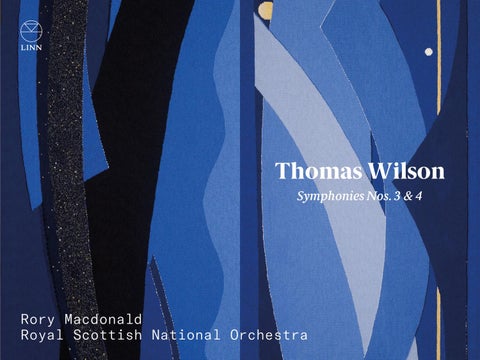
Thomas Wilson Symphonies Nos. 3 & 4
Rory Macdonald Royal Scottish National Orchestra 1
Credits Tracklist Programme note Biographies
Thomas Wilson Symphonies Nos. 3 & 4
Rory Macdonald Royal Scottish National Orchestra
3
Recording Producer Matthew Bennett
Recorded in Glasgow Royal Concert Hall, UK, on 8–9 January 2018
Design stoempstudio.com
Executive Producer & Mix Engineer Philip Hobbs
Recording Engineer Hedd Peter Morfett-Jones
Cover Image Dance to the Music of Time (2012) by Jeni Ross Courtesy of the Warden and Scholars of New College, Oxford, © Bridgeman Images MENU
Thomas Wilson (1927–2001)
73:20 RORY MACDONALD conductor ROYAL SCOTTISH NATIONAL ORCHESTRA
1 — Symphony No. 4 ‘Passeleth Tapestry’ (1988) 28:59 2 — Symphony No. 3 (1979) 26:58 3 — Carillon (1990) 17:23
MENU
Thomas Wilson
MENU
Symphonies Nos. 3 & 4
Thomas Brendan Wilson was born on 10 October 1927 to British parents in the mining town of Trinidad in Colorado, USA. When he was very young his family returned to the UK and settled in the Glasgow area of Scotland, where, apart from a period of three years spent in France, he lived and worked for the rest of his life. He was educated at St Mary’s College, Aberdeen and, after serving in the Royal Air Force from 1945 to 1948, he continued his academic studies, reading Music at the University of Glasgow under Ernest Bullock and Frederick Rimmer. In 1952 he married Margaret Rayner; they had three sons. After gradua ting, he went on to teach, first in local schools and then, in 1957 as music lecturer at the University of Glasgow. He was appointed a Reader at the University in 1971, given a personal Chair in 1977 and made Emeritus Professor in 1982, which was also the year of his retirement. He received many awards, including the CBE in 1990. Four years later he became the first musician to be elected to the fellow1 ship of the Royal Society of Edinburgh. Dubbed ‘the father of Scottish music’, Wilson was a founder member of the Scottish Society of Composers and became a source of inspiration and encouragement to many younger colleagues based in his country of domicile. His influence extended beyond national boundaries, however, and he played a key role in British musical life, holding executive and advisory positions in the Composers’ Guild of Great Britain, The Arts Council and The Society for the Promotion of New Music. He died on 12 June 2001 at the age of 73. His friend and fellow composer John Maxwell Geddes commented at 2
the time: ‘There is a distillation of Tom in his music. He was a national treasure. 2 The nation has his music. Now get on and play it’. Wilson once offered this typically balanced and considered description of his own output: ‘Though there is a Scottish dimension to my music … it is not of an obvious or ethnic kind. Early influences such as Bartók and Berg have led through serialism, aleatoricism, and various other expressionist and mystical 3 aspects to a mature style which is almost “classical” in its lucidity.’ His perfectionism and ruthless self-criticism resulted in the suppression of nearly all of his early pieces; his mature canon dates from the Third String Quartet of 1958. In the following decades his music was championed by leading Scottish conductors Alexander Gibson, James Loughran and Bryden Thomson and he soon established himself as a creative artist of international standing. Time-honoured forms such as symphonies, concertos, string quartets and sonatas feature prominently in his catalogue of works. He was especially interested in symphonic music and once stated that everything he wrote was symphonic because all his pieces have ‘a sense of broad, unhurried sweep, of 4 unfolding grandness’. Symphonies span his professional creative life: the premiere in August 1957 of the subsequently withdrawn First under Colin Davis brought him to prominence and the Fifth of 1998, scored for chamber orchestra, was his last completed work. Thomas Wilson’s Third Symphony (1979) is in five unbroken sections arranged in alternately slow and fast tempos which map the life-journey from the momentous upheaval of birth, through confusion and complication, to eventual clarity and simplicity and, at the end, a suggestion of rebirth. 3
MENU
The slow opening begins by discovering its material, rather than presenting it fully formed: as Wilson put it, ‘for me, music does not simply describe, 5 it must EXPLORE!’ From these hesitant, preliminary gestures, the textures fill out and more refined ideas emerge and crystallize. In the second part (fast) there is a greater sense of forward motion and direction. Some remnants of the previous section’s disarray remain, however, and the music itself is erratic, though showing signs of a nascent sense of self-belief and sophistication. In the central part (slow) the musical style is simple and yet richer than before. The primordial-sounding material from the Symphony’s opening pages is revisited in a brief central episode. The fourth part of the work (fast) bursts in with high spirits. On closer inspection the music appears more precarious and complex, however, and the Symphony moves inexorably towards a crisis point. After this turmoil, the material eventually retreats into a hollow tranquillity. From this uneasy serenity the final part of the Symphony (slow) arises. The musical language is more direct and poised than previously, though this does not preclude moments of restlessness. In the enigmatic closing bars, a muted single solo violin note represents the birth of a new cycle and the audience is left to imagine its development. The Third Symphony was commissioned by the Royal Scottish National Orchestra, who premiered it under Sir Alexander Gibson at Glasgow University on 22 September 1979. In his review in The Guardian published two days later, Gerald Larner described it as ‘one of most impressive works written by a Scottish composer in recent years’, going on to state that ‘Wilson makes his long term point by stylistic allusion and is remarkably successful in sustaining the argument over a large span and with a genuinely symphonic effect’.
4
MENU
Commissioned by Renfrew District Council and Strathclyde Regional Council, the Fourth Symphony ‘Passeleth Tapestry’ was written in 1988 to mark Paisley’s 500th anniversary as a Burgh of Barony. Passeleth is the twelfthcentury form of the town’s name – the period in which the Abbey was founded, the Stewarts rose to power, and the first mention of the town occurs in documents. The Symphony charts Paisley’s history from its earliest days. Rather than illustrating individual events, it considers various epochs and their defining characteristics. A carillon of celebration opens the work based upon four notes (A E flat - E - B flat), which are derived from the name Paisley, the Abbey, and the Stewarts (the Royal dynasty closely associated with Paisley and the Abbey). These notes also furnish the material for the rest of the piece, which plays continuously. After the opening carillon recedes, various linked musical statements outline major influences on Paisley’s early history, including a contemplative segment depicting the tranquillity of the Abbey and fanfare-like ideas suggesting the Stewarts. This section ends with an orchestral carillon which slowly fades to echoes of the Stewart fanfares. The second section of the work is concerned with the religious uphea vals of the Reformation. Music based freely on the protestant psalm tune ‘Martyrs’ vies for supremacy with the Abbey’s music, though the original psalm tune itself is never stated in its entirety. Eventually a certain degree of composure is recovered and the section ends with reminders of the carillon and echoes of ‘Martyrs’.
5
MENU
Motor rhythms in the third section reflect the dynamism of the nineteenth century’s ‘machine age’. The inexorable forward momentum is stalled briefly by a more lyrical central passage in which Paisley’s artistic achievements are recalled. A carillon for full orchestra forms an imposing climax to this section. In its aftermath, the music’s intensity is gradually replaced by a calm stillness. In the closing stages of the work, the survey reaches the late twentieth century. A resolution of the principal material’s conflicts is represented by harmonious partnership between elements of the Reformers’ tune ‘Martyrs’ (shared between violas and second violins) and the Abbey’s ancient melody ‘Victimae paschali laudes’ (flute). After a short restatement of the opening carillon of celebration, the work ends decisively on a positive note that also looks speculatively to the future. Wilson’s orchestration is masterly throughout and his treatment of the strings is especially fresh and inventive, from daringly prolonged tremolando passages to velvety, swooning chordal sequences. Impressive tutti statements are counterpoised by intimate solo writing and the various contrasting sections are unified by recurring bell-like themes and patterns. The premiere of ‘Passeleth Tapestry’ took place at a commemorative concert in Paisley Abbey on 6 August 1988 by the Royal Scottish National Orchestra conducted by their then Principal Conductor Bryden Thomson. In his review for The Glasgow Herald, Michael Tumelty admitted that he could not recall another recent work that had ‘communicated such a structurally assured sense 6 of self-confidence on first exposure’.
6
MENU
In 1990 Glasgow was the European City of Culture. This gave rise to several important musical projects, including a commission from Thomas Wilson for a major orchestral work for the Royal Scottish National Orchestra and their Principal Conductor Bryden Thomson to inaugurate the opening of the city’s new Royal Concert Hall on 5 October 1990. The resulting score, Carillon, is a celebration of Glasgow and the enduring spirit and resilience of its people. A reference to the time-honoured use of bells to announce important events, the title also underlines the fact that bell-like figures dominate the piece from the outset. The slow introduction starts with an imposing public fanfare based on four notes contained in the word ‘Glasgow’: G - A - S (E flat) - G; these four notes form a musical motif that pervades the whole piece. The music becomes quieter and more reflective before the main Allegro section begins with material reflecting the outgoing, energetic nature of the place and its people. An evocation of the clamour of the city’s Victorian-Edwardian industrial heritage is followed by a scherzando episode that represents Glaswegian wit, with upper woodwind, percussion and piano to the fore. A brief solo for first violin heralds the work’s elegiac central Nocturne that recalls the despondency and economic depression of the 1930s. Lightening the mood of this slow section, a magical interlude recalls a view of the city from the hills of Cathkin Braes one summer night with the valley below filled with twinkling lights, conjured up by harp, piano, celesta and glockenspiel. The final section is fast and relates to the post-war years and the city’s regeneration. As the closing bars approach, the music becomes increasingly lively and self-assured.
7
MENU
By incorporating in the score his own deeply personal feelings about the city he regarded as home, Thomas Wilson ensures that the multi-layered Carillon is much more than merely an occasional piece. It is also one of the composer’s most direct and joyful utterances; as he commented: ‘My main intention 7 is simple enough – to say that Glasgow is a great city and I love it’.
© Paul Conway, 2018
1 —
John Maxwell Geddes, ‘Thomas Wilson’, The Guardian (19 June 2001), p.18.
2 — Quoted by Michael Tumelty in ‘Leading composer dies after long illness’, The Glasgow Herald (13 June 2001). 3 —
Ed. Brian Morton and Pamela Collins, Contemporary Composers (Chicago: St James Press, 1992), p.972.
4 —
Mary Miller, ‘A Life in Symphony’, The Scotsman (November 1996), quoted in Margaret Wilson and
David Griffith, Thomas Wilson: Introit: Towards the Light (Glasgow: Queensgate Music), p.308.
5 —
Handwritten note in his sketches for Symphony No. 3, in the Private Collection of Margaret Wilson, quoted in ed. Graham Hair, The Music of Thomas Wilson (Glasgow: Musica Scotia Trust, 2004), p.171.
6 —
Quoted in Margaret Wilson and David Griffith, Thomas Wilson: Introit: Towards the Light (Glasgow: Queensgate Music), p.247.
7 —
Ibid, p.273.
8
MENU
Rory Macdonald
MENU
Conductor
Rory Macdonald stands out as one of the most interesting British conductors of his generation. As an opera conductor, he is particularly admired for his interpretations of Mozart and Britten. He has conducted Britten’s Peter Grimes at the Brisbane Festival, Owen Wingrave and A Midsummer Night’s Dream for the Royal Opera House, Covent Garden, Albert Herring for Glyndebourne on Tour, and The Turn of the Screw at the Wiener Konzerthaus. In addition, he marked his US debut with A Midsummer Night’s Dream at the Lyric Opera of Chicago, which was followed by The Rape of Lucretia at the Houston Grand Opera. Macdonald made his debut with Oper Frankfurt in Mozart’s Così fan tutte. Prior to that, he has conducted new productions of Mozart’s Die Zauberflöte at the Lyric Opera of Chicago, the San Francisco Opera and the Royal Danish Opera. His other operatic engagements include Janáček’s The Cunning Little Vixen for the Bergen National Opera as well as new productions of Bizet’s Carmen at the Canadian Opera Company, the Houston Grand Opera and the Santa Fe Opera. On the concer t podium, Macdonald has worked with the London Philharmonic Orchestra, the Royal Philharmonic Orchestra, the BBC Philharmonic, the BBC Scottish Symphony Orchestra, the Orchestra Filarmonica
9
di Bologna, the Prague Philharmonia, the Royal Concertgebouw Orchestra, the Netherlands Philharmonic Orchestra, the Oslo Philharmonic, the Bergen Philharmonic Orchestra, the Orchestre National du Capitole de Toulouse and the Hallé Orchestra among others. He has conducted the premieres of works by notable composers such as Sir James MacMillan, Sally Beamish and Geoffrey Gordon. Macdonald studied music at the University of Cambridge. While at university he studied under David Zinman and Jorma Panula at the American Academy of Conducting in Aspen. After graduating from Cambridge he was appointed assistant conductor to Iván Fischer at the Budapest Festival Orchestra and to Sir Mark Elder and the Hallé Orchestra. He was also a member of the Jette Parker Young Artists Programme at the Royal Opera House, where he worked closely with Sir Antonio Pappano.
10
MENU
© Benjamin Ealovega
MENU
11
Royal Scottish National Orchestra
Formed in 1891 as the Scottish Orchestra, the company became the Scottish National Orchestra in 1950, and was awarded Royal Patronage in 1977. Throughout its history, the orchestra has played an integral part in Scotland’s musical life, including performing at the opening ceremony of the Scottish Parliament building in 2004. Many renowned conductors have contri buted to its success, including George Szell, Sir John Barbirolli, Walter Susskind, Sir Alexander Gibson, Neeme Järvi, Walter Weller, Alexander Lazarev and Stéphane Denève. The orchestra’s artistic team is led by Danish conductor Thomas Søndergård, who was appointed RSNO Music Director in 2018, having previously held the position of Principal Guest Conductor. Hong Kong-born conductor Elim Chan succeeds Søndergård as the new Principal Guest Conductor. The RSNO performs across Scotland, including concerts in Glasgow, Edinburgh, Dundee, Aberdeen, Perth and Inverness. The orchestra appears regularly at the Edinburgh International Festival, the BBC Proms at London’s Royal Albert Hall and the St Magnus International Festival, Orkney, and has made tours to the US, Spain, France, China and Germany. The RSNO was an active participant in the cultural programme of the 2014 Commonwealth Games, held 12
MENU
in Glasgow, and in the same year hosted the Ryder Cup Gala Concert at the SSE Hydro. The RSNO has a worldwide reputation for the quality of its recordings, receiving two Diapason d’or de l’année awards (Denève/Roussel 2007; Denève/ Debussy 2012) and eight Grammy Award nominations. Over 200 releases are available, including the complete symphonies of Sibelius (Gibson), Prokofiev (Järvi), Glazunov (Serebrier), Nielsen and Martinů (Thomson), Roussel (Denève) and the major orchestral works of Debussy (Denève). The RSNO’s pioneering learning and engagement programme, Music for Life, aims to engage the people of Scotland with music across key stages of life: Early Years, Nurseries and Schools, Teenagers and Students, Families, Accessing Lives, Working Lives and Retired and Later Life. The team is committed to placing the orchestra at the centre of Scottish communities via community workshops and annual residencies across the length and breadth of the country.
13
MENU
MENU
14
Royal Scottish National Orchestra
First Violin Maya Iwabuchi Leader TamĂĄs Fejes Assistant Leader Lena Zeliszewska Patrick Curlett Barbara Paterson Jane Reid Caroline Parry Ursula Heidecker Allen Elizabeth Lloyd Susannah Lowdon Alan John Fiona Stephen Liam Lynch Laura Ghiro
Second Violin Xander van Vliet Principal Marion Wilson Elita Poulter Harriet Wilson Christopher Ffoulkes Nigel Mason Michael Rigg Wanda Wojtasinska Paul Medd Anne BĂźnemann Sophie Lang Kirstin Drew
15
MENU
MENU
Viola Tom Dunn Principal Ian Budd Lisa Rourke David Martin Fiona West Claire Dunn Katherine Wren Maria Trittinger Francesca Hunt David McCreadie Cello Aleksei Kiseliov Principal Betsy Taylor Kennedy Leitch Arthur Boutillier William Paterson Ruth Rowlands Rachael Lee Sarah Digger
Double Bass Ana Cordova Principal Margarida Castro Michael Rae Paul Sutherland John Clark Sally Davis Flute Katherine Bryan Principal Helen Brew Janet Richardson Principal Piccolo Oboe Adrian Wilson Principal Peter Dykes Peter Facer Cor Anglais
16
MENU
Clarinet Natalie Harris Guest Principal Josef Pacewicz Duncan Swindells Principal Bass Clarinet
Trumpet Christopher Hart Principal Marcus Pope Robert Baxter Brian McGinley
Bassoon David Hubbard Principal Luis Eisen Peter Wesley Contrabassoon
Trombone Dรกvur Juul Magnussen Principal Lance Green Alastair Sinclair Principal Bass Trombone
Horn Christopher Gough Principal Alison Murray Andrew McLean David McClenaghan Lauren Reeve-Rawlings
Tuba John Whitener Principal Timpani Scott Bywater Guest Principal
17
MENU
Percussion Simon Lowdon Principal John Poulter Martin Willis Joanne McDowell Harp Pippa Tunnell Piano & Celesta Lynda Cochrane Organ Mark Hindley
18
Also available on Linn
MENU
CKD 590 Brandenburgisches Staatsorchester Frankfurt Adler: One Lives but Once A 90th Birthday Celebration
CKD 420 Royal Scottish National Orchestra Katherine Bryan plays Flute Concertos by Christopher Rouse & Jacques Ibert
CKD 528 Eliot Fisk José Serebrier Royal Scottish National Orchestra Beaser: Guitar Concerto
CKR 367 Katherine Bryan Royal Scottish National Orchestra Liebermann Flute Concerto and works by Hüe, Poulenc & Nielsen
CKD 545 José Serebrier Royal Scottish National Orchestra José Serebrier Conducts Samuel Adler
CKD 247 Alexander Lazarev Royal Scottish National Orchestra Shostakovich: Symphony No. 11
19
MENU
CKD 590
CKD 528
CKD 545
CKD 420
CKR 367
CKD 247
20
MENU
FOR EVEN MORE GREAT MUSIC VISIT LINNRECORDS.COM