MENU
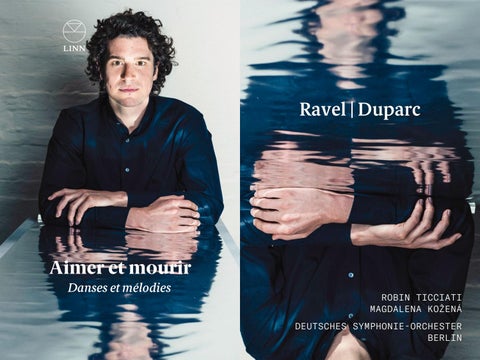
Ravel | Duparc
Aimer et mourir Danses et mélodies
ROBIN TICCIATI MAGDALENA KOŽENÁ DEUTSCHES SYMPHONIE-ORCHESTER BERLIN 1
Credits Tracklist Programme note Sung texts Biographies Français Deutsch
Ravel | Duparc Aimer et mourir Danses et mélodies
ROBIN TICCIATI MAGDALENA KOŽENÁ DEUTSCHES SYMPHONIE-ORCHESTER BERLIN
Š Camille Blake 3
Assistant Engineer Robert Cammidge
Post-production Julia Thomas
Recorded in Jesus-Christus-Kirche, Berlin Dahlem, Germany, on 18–22 December 2017 Recording Producer & Engineer Philip Hobbs
Cover Image Photograph of Robin Ticciati by Camille Blake
Design stoempstudio.com
MENU
60:27
Ravel | Duparc Aimer et mourir Danses et mélodies
ROBIN TICCIATI MAGDALENA KOŽENÁ DEUTSCHES SYMPHONIE-ORCHESTER BERLIN
Maurice Ravel (1875–1937)
Maurice Ravel
1 — Daphnis et Chloé Suite No. 2 Lever du jour – Pantomime – Danse générale 16:45
Valses nobles et sentimentales orch. Ravel
Henri Duparc (1848–1933) 2 — L’invitation au voyage Baudelaire, orch. Duparc 5:12 3 — Au pays où se fait la guerre Gautier, orch. Duparc 5:33 4 — Chanson triste Cazalis, orch. Duparc 4:15 5 — Phidylé Leconte de Lisle, orch. Duparc 6:16
6 — 7 — 8 — 9 — 10 — 11 — 12 — 13 —
Modéré 1:16 Assez lent 2:43 Modéré 1:46 Assez animé 1:17 Presque lent 1:23 Assez vif 0:53 Moins vif 2:59 Épilogue: Lent 4:15
Henri Duparc 14 — Aux étoiles 5:29
MENU
Aimer et mourir
MENU
Danses et mélodies
Following the exhibition of Russian paintings that Diaghilev mounted in Paris in 1906 came the five concerts of Russian music in 1907 and the opera season of 1908 in which Chaliapin as Boris Godunov was a phenomenal success. Finally, in 1909, Diaghilev brought Russian ballet to Paris. But from early days he dreamt of commissioning French composers, probably foreseeing that Parisian funding for his enterprises was likely to be more stable if the music was homegrown. Daphnis et Chloé, given its premiere at the Théâtre du Châtelet on 8 June 1912, was the first major work to fulfil this dream. 2
MENU
For the choreographer Michel Fokine, Daphnis embodied a new kind of ballet in which ‘the music should not consist of waltzes, polkas and final gallops – indispensable in the old ballet – but must express the story of the ballet and, primarily, its emotional content’. It remained to find a composer. Debussy, eternally hard up, was tempted by a project provisionally entitled Masques et bergamasques, before finally composing Jeux, produced by Diaghilev in 1913. Ravel however had good reasons in 1909 to give Diaghilev’s commission of Daphnis his best shot. His opera L’heure espagnole could still find no place at the Opéra-Comique because the story was thought to be too risqué‚ even for Paris. A ballet for Diaghilev, with the promise of as many performers as he needed, was just the opportunity he was looking for. Things began reasonably well, but essentially Ravel and Fokine, even if they agreed that the ballet should present a unified whole (Ravel called his score a ‘choreographic symphony’), saw the story from quite different points of view. Fokine claimed that he ‘planned to make an elaborate dramatic sequence out of the attack of the pirates. Ravel, however, wanted to produce a lightning attack…I was unable to inspire him to create musically that violent, gruesome picture which was so vivid in my imagination.’ One cannot help being amused at the thought of Ravel, that most gentle and civilized of men, being encouraged to set the stage of the Châtelet swimming in gore. 3
MENU
By May 1910 Ravel had finished a first version of the whole ballet, but then realized that his finale was too short to carry nearly an hour’s uninterrupted music. For some eighteen months he was blocked and the production was postponed. In desperation he eventually put the score of Rimsky-Korsakov’s Scheherazade on the piano rest and used that to lever himself back into the swing. Then, after the first Daphnis rehearsals, Diaghilev briefly threatened to cancel the whole project… The ballet, with realistically Greek décor by Léon Bakst, was given a mere two performances right at the end of the 1912 season, much to Ravel’s fury. Press reaction was muted, where not actually hostile. Diaghilev did see his way to putting on Daphnis three times in 1913, again at the very end of the season, but never again in Paris. Ravel made two orchestral suites from the score, one before and one after its 1912 premiere. The second suite effectively embraces the last third of the ballet. The beautiful Chloé, wooed by the shepherd Daphnis, has been carried off by pirates. Pan has intervened, the pirates have run off, and the suite begins with the Dawn Music (Ravel, asked how it was that this most famous musical evocation of sunrise had been penned by someone who never got up before 10.30 am, replied, reasonably enough, ‘I used my imagination’). Then Daphnis and Chloé mime the story of Pan and Syrinx to a brilliant passage on flutes. The suite ends with a general dance of rejoicing in which, as noted above, we can detect Ravel’s affection for Rimsky-Korsakov’s Scheherazade. The first performance of the suite in 1914 moved even the conservative Vincent d’Indy to cautious praise: Ravel, he commented, seemed to be abandoning the bibelot and miniature (no doubt a hit at Ma mère l’oye) and moving in the direction of real music. 4
MENU
The period of the Third Republic in France was marked by the regular appearance of institutions that were to liberate artists from the dogmas propounded by other institutions. Thus the Schola Cantorum was formed in 1894 by Vincent d’Indy and others to counteract the operatic and starpromoting tendencies of the Paris Conservatoire. Similarly, the Société musicale indépendante (SMI), founded in 1910 by Ravel, Fauré, Dukas and others, was designed to promote music that had been, or would most likely be, refused by the Société nationale de musique, now under the control of…Vincent d’Indy. Something of this pioneering spirit comes across in the circumstances of the first performance of Ravel’s Valses nobles et sentimentales in their original piano version at the thirteenth concert of the Société musicale indépendante on 9 May 1911. They, like all the pieces that evening, were given under the cloak of anonymity, and the audience was then invited to guess the composer’s name. In the event the idea succeeded only in making fools out of a majority of the audience (Kodály and Satie were among those thought to have written the Valses) and in annoying the composer. The exercise was not repeated during the next twenty-four years of the society’s existence. Possibly as a thankyou for taking part in this slightly embarrassing occasion, Ravel dedicated the Valses to their interpreter, Louis Aubert, to add to his laurels as the first singer of the ‘Pie Jesu’ in Fauré’s Requiem, in his days as a choirboy at La Madeleine.
5
MENU
It is not that surprising that so few of the audience guessed their real author. Miroirs, Gaspard de la nuit and Ma mère l’oye, his most recent piano pieces, had all been descriptive, whereas these waltzes, despite the nod in their title towards Schubert, have from the start shed any atmospheric or colouristic air. Perhaps as a result of their difficult entry into the world, Ravel was particularly fond of these pieces and, when it was suggested he might orchestrate them for a ballet, he jumped at the chance, completing the task in just a few weeks in the spring of 1912. The ballet, called Adélaïde, ou le langage des fleurs, had its premiere in Paris in April of that year. Many critics have found Ravel’s orchestration of the work among his most miraculous. In particular, he retains the spare athleticism of the original. The first waltz, for example, has a harshness about it that looks forward to Ravel’s post-war style: in its orchestral garb we hear even more clearly adumbrations of La valse. Textures do soften thereafter, but the economy of Ravel’s orchestra brings out the sparer, more linear writing, with the outlines of the themes even more precisely etched. The harmonies also frequently push at the limits of what the waltz form had traditionally suggested, with simultaneous but conflicting progressions being followed to their mathematically correct endpoints (Bach did the same), and Ravel uses orchestral colour to point up the tensions. 6
MENU
In one or two areas, the orchestral version simplifies difficulties in the original. The pianist Vlado Perlemuter, who studied all Ravel’s piano music with the composer in the summer of 1927, remembered being drilled without mercy in the two-against-three syncopations in the first waltz. On the orchestra, flutes, oboes, horns, harp and percussion play one rhythm, everyone else the other (it was here that Ravel, not a great conductor, admitted his right hand just went round and round…). And in the second half of the fourth waltz, the orchestral forces prompted Ravel to add a wonderful countermelody on horns and octave cellos, which he then took back into the piano original. In both versions, the Valses are one of the hardest of his works to bring off, not so much technically as aesthetically; for one thing, they are unusual in having so many passages of marked ‘rubato’, something Ravel normally hated. The ‘Épilogue’, which follows the seven waltzes, is a particular instance: themes from the waltzes themselves are heard only as faint memories, and all must be fused into a single mood – nostalgia without incoherence, sentiment without sentimentality. Both piano and orchestral scores bear an epigraph from a novel by the composer’s friend Henri de Régnier: ‘…le plaisir délicieux et toujours nouveau d’une occupation inutile’ (‘…the delightful pleasure, ever fresh, of a pointless occupation’). Ravel knew as well as anyone that this work is far from being pointless. He warns us merely not to look in this instance for any meaning beyond the notes. 7
MENU
Although Henri Duparc is best known for his songs, he also left a few piano and orchestral works that are worth reviving. Aux étoiles was originally the first of three movements making up a Poème nocturne which Duparc himself conducted on 11 April 1874. The two other movements, like much of his output, were destroyed and Aux étoiles seems to have survived by mistake! Duparc revised the score in 1910 and it was published the following year. It evokes a starry night and the epigraph asks ‘Who can discern the secret essence of this light, so humble, yet coming from such immensity?’ The form is Duparc’s favourite ABA, starting and ending in a calm C major over long pedal notes; the central, more chromatic section testifies to his visits to Bayreuth in 1869 and 1870. The seventeen solo songs he wrote between 1869 and 1885 have long been recognized as being among the glories of French music. At the same time, they do not fit that neatly into the familiar notions of it as light, bright, delicate and charming. Reynaldo Hahn, a composer of mélodies that are more conventional in effect, thought Duparc’s songs treated their French texts with appalling disregard, while Ravel called them ‘imperfect…but works of genius’. Certainly listing imperfections now seems pointless in the face of many of the songs’ visceral impact. Baudelaire’s poem ‘L’invitation au voyage’ deals in what today would be termed ‘positive emotions’. But at the same time it can hardly be described as ‘cheerful’ (or ‘gai’): the feelings it evokes are too deep for that. Given Duparc’s propensity for conjuring up dream atmosphere, it is not surprising that he omitted the second of the three verses with its all-too-material mentions of rich ceilings, deep mirrors and oriental splendour. He prefers to remain out of doors. 8
As one Duparc authority has written, the poem ‘is an open book for those who know the Low Countries: the fogs, the canals, the hyacinths, the sunsets’, and this song of 1870 takes its place avant la lettre among the finest of Impressionist paintings in sound. ‘Chanson triste’ is probably the earliest of all his songs, from about the first half of 1869, and it may have been a present to his fiancée – though the song is in fact dedicated to her brother! The arpeggiated accompaniment plainly derives from Gounod, but in the course of the various revisions Duparc made between 1869 and 1911 these were increasingly ornamented by internal dissonances that add greatly to the song’s emotional weight, and which are more clearly articulated in this orchestral version. The overall result is remarkably similar to Liszt’s famous Liebesträume. ‘Au pays où se fait la guerre’ was written in 1869 or 1870. If in the latter, it may reflect Duparc’s experiences as a soldier in the Franco-Prussian War; certainly it was intended initially as an aria for the opera Roussalka, on which Duparc laboured for years, but finally destroyed as being sub-standard. The song has an undeniably Wagnerian sweep, with larger intervals than those favoured by Gounod or Fauré. This orchestral version also brings further subtleties hard to achieve in the original piano score, most notably the way the two low clarinets in the opening phrase return to play it at the end, initial anxiety echoed in final heartbreak.
9
MENU
MENU
‘Phidylé’, Duparc’s only setting of the Parnassian poet Leconte de Lisle, dates from about 1882. Here torment is replaced by ecstasy, but on the composer’s own terms. Of the original ten strophes of Leconte’s original he took only the first three and the last and, as another Duparc scholar has pointed out, Duparc ‘removed the most classical strophes (involving Diana and her nymphs), thereby giving the poem a character less close to the serenity of the Parnassians, one that is more subjective, less cerebral, more emotional’. He also took no account of the original division of stanzas and freely repeated words and phrases – for example, the threefold repetition of ‘Repose, ô Phidylé’ at the start of the second section of the song, and the twofold one of ‘Me récompensent’ in the final line, both of which allow the harmony to sweep all before it. The long coda is enriched by inner voices of truly Wagnerian magnificence.
© Roger Nichols, 2018
10
L’invitation au voyage
MENU
Invitation to the voyage 1870
Mon enfant, ma sœur, Songe à la douceur D’aller là-bas vivre ensemble ! Aimer à loisir, Aimer et mourir Au pays qui te ressemble ! Les soleils mouillés De ces ciels brouillés Pour mon esprit ont les charmes Si mystérieux De tes traîtres yeux, Brillant à travers leurs larmes.
My child, my sister, think of the sweetness of going there to live together! To love at leisure, to love and to die in a country that is the image of you! The misty suns of those changeable skies have for me the same mysterious charm as your fickle eyes shining through their tears.
Là, tout n’est qu’ordre et beauté, Luxe, calme et volupté.
There, all is harmony and beauty, luxury, calm and delight.
11
MENU
Vois sur ces canaux Dormir ces vaisseaux Dont l’humeur est vagabonde ; C’est pour assouvir Ton moindre désir Qu’ils viennent du bout du monde. – Les soleils couchants Revêtent les champs, Les canaux, la ville entière, D’hyacinthe et d’or ; Le monde s’endort Dans une chaude lumière.
See how those ships, nomads by nature, are slumbering in the canals; to gratify your every desire they have come from the ends of the earth. – The westering suns clothe the fields, the canals, and the town with reddish-orange and gold; the world falls asleep bathed in warmth and light.
Là, tout n’est qu’ordre et beauté, Luxe, calme et volupté.
There, all is harmony and beauty, luxury, calm and delight.
Charles Baudelaire (1821–1867)
© Peter Low, 2000 Reprinted with permission by the LiederNet Archive
12
Au pays où se fait la guerre
MENU
To the country where war is waged 1869/70
Au pays où se fait la guerre Mon bel ami s’en est allé ; Il semble à mon cœur désolé Qu’il ne reste que moi sur terre ! En partant, au baiser d’adieu, Il m’a pris mon âme à ma bouche. Qui le tient si longtemps, mon Dieu ? Voilà le soleil qui se couche, Et moi, toute seule en ma tour, J’attends encore son retour.
To the country where war is waged my beautiful love departed; it seems to my desolate heart that I alone remain on earth! When leaving, at our kiss goodbye, he took my soul from my mouth. Who is holding him back so long, O God? There is the sun setting, and I, all alone in my tower, I still await his return.
Les pigeons sur le toit roucoulent, Roucoulent amoureusement ; Avec un son triste et charmant Les eaux sous les grands saules coulent. Je me sens tout près de pleurer ; Mon cœur comme un lis plein s’épanche, Et je n’ose plus espérer. Voici briller la lune blanche, Et moi, toute seule en ma tour, J’attends encore son retour.
The pigeons on the roof are cooing, cooing lovingly; with a sad and charming sound the waters under the large willows flow. I feel ready to cry; my heart, like a full lily, overflows, and I no longer dare to hope. Here gleams the white moon, and I, all alone in my tower, I still await his return.
13
MENU
Quelqu’un monte à grands pas la rampe : Serait-ce lui, mon doux amant ? Ce n’est pas lui, mais seulement Mon petit page avec ma lampe. Vents du soir, volez, dites-lui Qu’il est ma pensée et mon rêve, Toute ma joie et mon ennui. Voici que l’aurore se lève, Et moi, toute seule en ma tour, J’attends encore son retour.
Someone is climbing the ramp rapidly: could it be him, my sweet love? It is not him, but only my little page with my lamp. Evening winds, veiled, tell him that he is my thoughts and my dream, all my joy and my longing. Here is the dawn rising, and I, all alone in my tower, I still await his return.
Théophile Gautier (1811–1872)
© Victoria de Menil Reprinted with permission by the LiederNet Archive
14
Chanson triste
MENU
Sorrowful song 1869
Dans ton cœur dort un clair de lune, Un doux clair de lune d’été, Et pour fuir la vie importune, Je me noierai dans ta clarté.
In your heart moonlight lies dormant, a gentle moonlight of summer; and to flee from the troubles of life, I will drown myself in your brightness.
J’oublierai les douleurs passées, Mon amour, quand tu berceras Mon triste cœur et mes pensées Dans le calme aimant de tes bras.
I will forget past griefs, my love, when you rock my unhappy heart and my thoughts in the loving tranquility of your arms.
Tu prendras ma tête malade, Oh ! quelquefois, sur tes genoux, Et lui diras une ballade Qui semblera parler de nous ;
You will lay my anxious head, oh! – sometimes – upon your lap, and you will utter to it a ballad that will seem to speak of us;
Et dans tes yeux pleins de tristesse, Dans tes yeux alors je boirai Tant de baisers et de tendresses Que peut-être je guérirai.
and from your eyes so full of sadness, from your eyes I will then drink so many kisses and so much tenderness that perhaps at last I will be healed.
Henri Cazalis (1840–1909)
© Emily Ezust Reprinted with permission by the LiederNet Archive 15
Phidylé
MENU
Phidylé 1882
L’herbe est molle au sommeil sous les frais peupliers, Aux pentes des sources moussues, Qui dans les prés en fleur germant par mille issues, Se perdent sous les noirs halliers.
The grass is soft for slumber beneath the fresh poplars, on the slopes by the mossy springs, which, in the meadows flowering with a thousand plants, lose themselves under dark thickets.
Repose, ô Phidylé ! Midi sur les feuillages Rayonne et t’invite au sommeil. Par le trèfle et le thym, seules, en plein soleil, Chantent les abeilles volages.
Rest, O Phidylé! The midday sun shines on the foliage and invites you to sleep. Among clover and thyme, alone,in full sunlight, hum the fickle honeybees.
Un chaud parfum circule au détour des sentiers, La rouge fleur des blés s’incline, Et les oiseaux, rasant de l’aile la colline, Cherchent l’ombre des églantiers.
A warm fragrance circulates about the turning paths, the red cornflower tilts, and the birds, skimming the hill with their wings, search for shade among the wild roses.
Repose, ô Phidylé !
Rest, O Phidylé! 16
MENU
Mais, quand l’Astre, incliné sur sa courbe éclatante, Verra ses ardeurs s’apaiser, Que ton plus beau sourire et ton meilleur baiser Me récompensent de l’attente !
But when the sun, turning in its resplendent orbit, finds its heat abating, let your loveliest smile and your most ardent kiss recompense me for waiting!
Charles Leconte de Lisle (1818–1894)
© Emily Ezust, 2005 Reprinted with permission by the LiederNet Archive
17
Robin Ticciati
MENU
conductor
Robin Ticciati has been Music Director of the Deutsches SymphonieOrchester Berlin since 2017 and Music Director of Glyndebourne Festival Opera since 2014. He was Principal Conductor of the Scottish Chamber Orchestra from 2009 to 2018. Guest-conducting highlights include concerts with the Wiener Philharmoniker, the Symphonieorchester des Bayerischen Rundfunks, the Budapest Festival Orchestra, the London Philharmonic Orchestra, the London Symphony Orchestra, the Chamber Orchestra of Europe and the Staatskapelle Dresden. Opera projects include productions of La damnation de Faust, Pelléas et Mélisande and La clemenza di Tito at Glyndebourne and the BBC Proms; Peter Grimes at La Scala, Le nozze di Figaro at the Salzburg Festival, and Eugene Onegin at both the Royal Opera House and the Metropolitan Opera. His highly acclaimed discography includes Berlioz with the Swedish Radio Symphony Orchestra; Haydn, Schumann, Berlioz and Brahms with the Scottish Chamber Orchestra; and Dvořák, Bruckner and Brahms with the Bamberger Symphoniker. His debut recording with the Deutsches SymphonieOrchester Berlin features works by Debussy and Fauré. 18
MENU
© Camille Blake
Born in London, Robin Ticciati is a violinist, pianist and percussionist by training. He was a member of the National Youth Orchestra of Great Britain when he turned to conducting, aged fifteen, under the guidance of Sir Colin Davis and Sir Simon Rattle. He has been appointed ‘Sir Colin Davis Fellow of Conducting’ by the Royal Academy of Music.
19
Magdalena Kožená
MENU
mezzo-soprano
Magdalena Kožená was born in the Czech city of Brno and studied voice and piano at the Brno Conservatory and later at Bratislava’s Academy of Performing Arts. She has been awarded several major prizes both in the Czech Republic and internationally, culminating in the Sixth International Mozart Competition in Salzburg in 1995. Named Artist of the Year by Gramophone in 2004, Kožená has worked with many of the world’s leading conductors such as Claudio Abbado, Pierre Boulez, Gustavo Dudamel, Sir John Eliot Gardiner, Bernard Haitink, Nikolaus Harnoncourt, Mariss Jansons, James Levine, Sir Charles Mackerras and Sir Roger Norrington. Her list of distinguished recital partners includes the p ianists Daniel Barenboim, Yefim Bronfman, Malcolm Martineau, András Schiff and Mitsuko Uchida. Kožená’s understanding of historical performance practices has been cultivated in collaboration with outstanding period-instrument ensembles, including the English Baroque Soloists, the Gabrieli Consort & Players, Il Giardino Armonico, Les Musiciens du Louvre, La Cetra Barockorchester Basel, the Orchestra of the Age of Enlightenment, the Venice Baroque Orchestra and Le Concert d’Astrée. She is also in demand as soloist with the Berlin, Vienna and Czech Philharmonics and the Cleveland, Philadelphia and Royal Concertgebouw Orchestras.
20
MENU
Kožená first performed at the Salzburg Festival in 2002 as Zerlina in Mozart’s Don Giovanni and returned in 2013 as Idamante, a role she has also sung for the Glyndebourne Festival and in Berlin and Lucerne. Kožená made her first appearance at New York’s Metropolitan Opera in 2003 as Cherubino in Mozart’s Le nozze di Figaro and has since been a regular guest. She sang Zerlina for the company’s tour to Japan in 2006 and returned to New York to take the title role in Jonathan Miller’s production of Debussy’s Pelléas et Mélisande in 2010/11. Her opera credits also include Angelina in Rossini’s La Cenerentola (Royal Opera House), Octavian in Richard Strauss’s Der Rosenkavalier (Staatsoper Berlin and Baden Baden Easter Festival), the title role in Bizet’s Carmen (Salzburg Easter and Summer Festivals), Charpentier’s Médée (Theater Basel) and Martinů’s Juliette (Staatsoper Berlin).
© Oleg Rostovtsev
Kožená was appointed a Chevalier de l’Ordre des Arts et des Lettres by the French government in 2003 for her services to French music.
21
Deutsches Symphonie-Orchester Berlin
For more than seventy years the Deutsches Symphonie-Orchester Berlin (DSO Berlin) has distinguished itself as one of Germany’s leading orchestras. The number of renowned music directors, the scope and variety of its work, and its particular emphasis on modern and contemporary music makes the ensemble unique. Founded as the RIAS Symphony Orchestra in 1946, it was renamed the Radio Symphony Orchestra Berlin in 1956 and has borne its current name since 1993. As the first Music Director, Ferenc Fricsay defined the standards in terms of repertoire, acoustic ideal and media presence. In 1964, the young Lorin Maazel assumed artistic responsibility. In 1982, he was followed by Riccardo Chailly and in 1989 by Vladimir Ashkenazy. Kent Nagano was appointed Music Director in 2000. Since his departure in 2006, he has been associated with the orchestra as an honorary conductor. 22
MENU
MENU
From 2007 to 2010, as the successor to Nagano, Ingo Metzmacher set decisive accents in the concert life of the capital with progressive programmes and consistent commitment to the music of the twentieth and twenty-first centuries. From 2012 to 2016, the North Ossetian Tugan Sokhiev was Music Director of the DSO Berlin; his successor Robin Ticciati took on this position at the start of the 2017/18 season. Apart from its concerts in Berlin, the DSO Berlin also tours internationally in the major concert halls of Europe, North and South America, and the Near, Middle and Far East. The DSO Berlin is also acclaimed worldwide for its many award-winning recordings. In 2011, it was awarded a Grammy Award for the best opera recording for the production of Kaija Saariaho’s L’Amour de loin conducted by Kent Nagano. The DSO Berlin is an ensemble of the Radio Orchestra and Choirs GmbH (roc berlin). The shareholders are Deutschlandradio, the Federal Republic of Germany, the State of Berlin and Radio Berlin-Brandenburg.
23
Deutsches Symphonie-Orchester Berlin first violin Wei Lu Byol Kang Hande Küden Ioana-Silvia Musat Mika Bamba Ilja Sekler Nari Hong Nikolaus Kneser Elsa Brown Ksenija Zečević Lauriane Vernhes Yuri Katsumata Thomas Descamps Ingrid Schliephake Alexey Naumenko Michael Engel
second violin Andreas Schumann Eva-Christina Schönweiß Johannes Watzel Clemens Linder Matthias Roither Eero Lagerstam Tarla Grau Jan van Schaik Uta Fiedler-Reetz Bertram Hartling Kamila Glass Marija Mücke Elena Rindler Alina Lepper
24
MENU
MENU
viola Igor Budinstein Annemarie Moorcroft Verena Wehling Leo Klepper Andreas Reincke Lorna Hartling Birgit Mulch-Gahl Anna Bortolin Thaïs Coelho Viktor Bátki Ilji Park Katharina Hage cello Mischa Meyer Dávid Adorján Adele Bitter Mathias Donderer Thomas Rößeler Catherine Blaise
Claudia Benker-Schreiber Leslie Riva-Ruppert Sara Minemoto Joan Bachs Hoon Sun Chae double bass Peter Pühn Christine Felsch Gregor Schaetz Gerhardt Müller-Goldboom Matthias Hendel Ulrich Schneider Rolf Jansen Florian Heidenreich
25
MENU
flute Kornelia Brandkamp Gergely Bodoky Frauke Leopold Frauke Ross Manfred Ludwig ■
bassoon Karoline Zurl Douglas Bull Hendrik Schütt Markus Kneisel
oboe Thomas Hecker Martin Kögel Max Werner
horn Zora Slokar Lionel Speciale Ozan Çakar Barnabas Kubina
clarinet Thomas Holzmann Bernhard Nusser Richard Obermayer Dieter Velte
trumpet Falk Maertens Raphael Mentzen Matthias Kühnle Heinz Radzischewski
26
MENU
trombone Andreas Klein Susann Ziegler Rainer Vogt tuba Johannes Lipp
harp Elsie Bedleem Anne Williams celesta Holger Groschopp Daphnis et Chloé
■
timpani Erich Trog percussion Roman Lepper Henrik Magnus Schmidt Thomas Lutz Alexander Ludwig Ralf Gröling Daniel Tummes Matthias Dölling Lukas Böhm Thomas Hoffmann
27
MENU
© Peter Adamik
28
Aimer et mourir
MENU
Danses et mélodies
À l’exposition de peintures russes que Diaghilev monta à Paris en 1906 succédèrent les cinq concerts de musique russe en 1907 et la saison d’opéra en 1908, dans laquelle Chaliapine en Boris Godounov rencontra un succès phénoménal. Enfin, Diaghilev amena le ballet russe à Paris en 1909. Mais dès le début, il rêva de passer commande à des compositeurs français, supputant probablement que le financement parisien de ses entreprises serait plus solide si la musique était d’origine locale. Daphnis et Chloé, créé au Théâtre du Châtelet le 8 juin 1912, fut la première œuvre majeure à rencontrer ce rêve. 29
MENU
Pour le chorégraphe Michel Fokine, Daphnis représentait une sorte nouvelle de ballet, dans laquelle « la musique ne consisterait pas en valses, polkas et galops finaux – indissociables des anciens ballets –, mais raconterait l’histoire du ballet et, avant tout, traduirait son contenu émotionnel ». Il restait à trouver un compositeur. Debussy, éternellement à court d’argent, fut tenté par un projet provisoirement intitulé Masques et bergamasques, avant de finalement composer Jeux, produit par Diaghilev en 1913. Ravel, de son côté, avait de bonnes raisons d’apporter un soin tout particulier à la commande que Diaghilev lui fit de Daphnis. Il n’arrivait pas à faire entrer son opéra L’heure espagnole à l’Opéra-Comique parce que l’histoire était jugée trop risquée, même pour Paris. Un ballet pour Diaghilev, avec l’autorisation d’y placer autant d’interprètes que nécessaire, était précisément l’opportunité qu’il recherchait. Les choses s’engagèrent plutôt bien, mais Ravel et Fokine, même s’ils s’accordaient sur le fait que le ballet devait constituer un ensemble unifié (Ravel qualifiait sa partition de « symphonie chorégraphique »), envisageaient l’histoire de points de vue différents. Fokine affirmait qu’il « prévoyait de faire de l’attaque des pirates une séquence dramatique complexe. Ravel, cependant, voulait une attaque fulgurante… Je n’ai pas réussi à lui inspirer ce tableau violent et horrible, si vif dans mon imagination. » On ne peut s’empêcher d’être amusé à la pensée de Ravel, le plus doux et civilisé des hommes, encouragé à faire baigner la scène du Châtelet dans le sang. En mai 1910, Ravel avait achevé une première version complète du ballet, mais il réalisa alors que le finale était trop court pour conclure près d’une heure de musique ininterrompue. Il fut bloqué pendant près de dix-huit mois et la production fut postposée. En désespoir de cause, il finit par mettre 30
MENU
la partition de Schéhérazade de Rimski-Korsakov sur le pupitre du piano et s’en servit pour se remettre dans le bain. Ensuite, après les premières répétitions de Daphnis, Diaghilev menaça brièvement d’annuler tout le projet… À la grande fureur de Ravel, le ballet ne fut donné que deux fois à la toute fin de la saison 1912, avec un décor grec réaliste de Léon Bakst. La réaction de la presse fut muette, si pas carrément hostile. Diaghilev parvint à placer Daphnis encore trois fois en 1913, à nouveau à la toute fin de la saison, mais plus jamais à Paris. Ravel tira deux suites orchestrales de la partition, l’une avant et l’autre après la création du ballet en 1912. La seconde suite couvre le dernier tiers de l’œuvre. La belle Chloé, courtisée par le berger Daphnis, a été enlevée par des pirates. Pan est intervenu, les pirates se sont enfuis, et la suite commence avec la musique de l’aube (Ravel, à qui l’on demandait comment cette magnifique évocation d’un lever du jour avait pu être écrite par quelqu’un qui ne s’était jamais levé avant 10 heures 30, répondit, de façon assez pragmatique : « J’ai fait appel à mon imagination »). Daphnis et Chloé miment la légende de Pan et Syrinx sur un passage brillant joué par les flûtes. La suite s’achève avec une danse générale de réjouissance dans laquelle on peut deviner la tendresse de Ravel pour Schéhérazade de Rimski-Korsakov, œuvre dont il a été question plus haut. La première représentation de la suite en 1914 poussa même le conservateur Vincent d’Indy à un éloge prudent : selon lui, Ravel semblait abandonner le bibelot et la miniature (sans doute une référence à Ma mère l’oye) et se diriger vers la vraie musique.
31
La période de la Troisième République en France fut marquée par l’apparition régulière d’institutions devant libérer les artistes des dogmes prononcés par d’autres institutions. Ainsi, la Schola Cantorum fut fondée en 1894, notamment par Vincent d’Indy, dans le but de contrer les tendances opératiques et à la promotion des stars du Conservatoire de Paris. De même, la Société musicale indépendante (SMI), fondée en 1910 par Ravel, Fauré et Dukas notamment, était destinée à promouvoir la musique qui avait été ou qui serait probablement refusée par la Société nationale de musique, à présent sous le contrôle de… Vincent d’Indy. On retrouve quelque chose de cet esprit d’avant-garde dans les circonstances de la première représentation des Valses nobles et sentimentales de Ravel, dans leur version originale pour piano, lors du treizième concert de la Société musicale indépendante le 9 mai 1911. Comme toutes les œuvres au programme ce soir-là, les Valses furent données sous le couvert de l’anonymat et le public fut invité à deviner le nom du compositeur. L’idée ne réussit qu’à faire passer pour des idiots une majorité du public (Kodály et Satie étaient parmi les compositeurs supposés) et à agacer le compositeur. L’exercice ne serait plus répété au cours des vingt-quatre autres années de l’existence de la société. Ravel dédia ses Valses à leur interprète, Louis Aubert, peut-être pour le remercier d’avoir participé à cet événement un peu embarrassant, ajoutant ainsi quelques lauriers à la couronne du premier interprète du « Pie Jesu » du Requiem de Fauré, alors qu’il était choriste à l’église de La Madeleine. Il n’est pas surprenant que si peu de personnes devinèrent le réel auteur de l’œuvre. Miroirs, Gaspard de la nuit et Ma mère l’oye, ses pièces pour piano les plus récentes, étaient toutes descriptives, tandis que les Valses, 32
MENU
MENU
malgré le clin d’œil de leur titre à Schubert, s’étaient dès le départ débarrassées de toute quête d’atmosphère ou de couleur. Ravel était particulièrement attaché à ces pièces, peut-être en raison de leur difficile « entrée dans le monde », et il sauta sur l’occasion de les orchestrer pour en faire un ballet quand cela lui fut suggéré, ce qu’il fit en quelques semaines seulement, au printemps 1912. Le ballet, Adélaïde, ou le langage des fleurs, fut créé à Paris en avril de cette année. De nombreux critiques ont considéré cette orchestration comme l’une des plus extraordinaires du compositeur, qui conserve notamment le tempérament athlétique dépouillé de l’original. La première valse, par exemple, présente une sévérité qui préfigure le style d’après-guerre de Ravel : dans leur habit orchestral, les préfigurations de La valse sont plus perceptibles encore. Ce caractère s’atténue ensuite, mais la structure de l’orchestre de Ravel fait ressortir l’écriture plus sèche, plus linéaire, avec des thèmes aux contours plus précisément définis. Les harmonies également poussent fréquemment jusqu’aux limites de ce que la forme de la valse suggère traditionnellement, avec des progressions simultanées mais conflictuelles menées jusqu’à leur point de terminaison mathématiquement correct (Bach avait fait de même), et Ravel utilise la couleur orchestrale pour accuser les tensions. En l’un ou l’autre endroit, la version orchestrale aplanit les difficultés de l’original. Le pianiste Vlado Perlemuter, qui étudia toute la musique de Ravel pour piano avec le compositeur à l’été 1927, se rappelle avoir été entraîné sans pitié à jouer les syncopes « deux contre trois » de la première valse. Dans l’orchestre, les flûtes, les hautbois, les cors, la harpe et les percussions jouent un rythme, et tous les autres l’autre rythme (c’est ici que Ravel, qui n’était pas un
33
MENU
très grand chef d’orchestre, admettait que sa main droite tournait en rond…). Dans la seconde moitié de la quatrième valse, les forces orchestrales incitèrent Ravel à ajouter une merveilleuse contre-mélodie aux cors et aux violoncelles à l’octave, qu’il reprit ensuite dans l’original pour piano. Dans leurs deux versions, les Valses sont l’une des œuvres de Ravel les plus difficiles à jouer, pas tant techniquement qu’esthétiquement ; avant tout, elles sont inhabituelles en ce qu’elles contiennent de nombreux passages « rubato », ce qu’habituellement Ravel détestait. L’« Épilogue », qui suit les sept valses, est un exemple particulier : les thèmes des valses eux-mêmes apparaissent comme de pâles souvenirs et doivent s’unir en un seul état d’esprit – nostalgie sans incohérence, sentiment sans sentimentalité. Les partitions pour piano et pour orchestre portent toutes deux l’épigraphe d’un ami du compositeur, Henri de Régnier : « … le plaisir délicieux et toujours nouveau d’une occupation inutile ». Mieux que quiconque, Ravel savait que son œuvre était loin d’être inutile. Il nous avertit simplement de ne pas chercher de signification au-delà des notes. Bien qu’Henri Duparc soit mieux connu pour ses mélodies, il nous a aussi laissé quelques œuvres pour piano et pour orchestre qui valent la peine d’être redécouvertes. Aux étoiles constituait à l’origine le premier des trois mouvements d’un Poème nocturne que Duparc dirigea lui-même le 11 avril 1874. Les deux autres mouvements, à l’instar d’une grande partie de sa production, furent détruits et Aux étoiles semble avoir survécu par erreur. Duparc révisa la partition en 1910 et elle fut publiée l’année suivante. L’œuvre évoque une nuit étoilée et l’épigraphe interroge : « Qui peut savoir les vertus secrètes de cette 34
MENU
lumière si humble, mais venant de l’immensité ? » La forme, ABA, est celle que Duparc préférait, commençant et s’achevant dans un calme do majeur sur de longues notes de pédale : la section centrale, plus chromatique, témoigne de ses visites à Bayreuth en 1869 et en 1870. Les dix-sept mélodies solos qu’il écrivit entre 1869 et 1885 furent longtemps reconnues comme appartenant aux gloires de la musique française. En même temps, elles ne cadrent pas bien avec ses canons de légèreté, de luminosité, de délicatesse et de charme. Reynaldo Hahn, qui composait des mélodies plus conventionnelles, affirmait que les mélodies de Duparc traitaient leurs textes français avec un mépris épouvantable, tandis que Ravel les voyait comme « imparfaites… mais les œuvres d’un génie ». Lister les imperfections semble à présent bien vain devant l’impression viscérale que laissent nombre des mélodies... « L’invitation au voyage » de Baudelaire traite de ce que l’on appellerait aujourd’hui les « émotions positives ». Et cependant, le poème peut difficilement être qualifié de « joyeux » (ou de « gai ») : les sentiments qu’il évoque sont trop profonds pour cela. Il semble logique que Duparc ait laissé de côté la seconde des trois strophes, vu sa propension à évoquer les atmosphères de rêve : celle-ci mentionne de riches plafonds, des miroirs profonds et une splendeur orientale. Le compositeur préférait rester de l’autre côté de la porte… Ainsi que l’a écrit l’un des spécialistes de Duparc, le poème « est un livre ouvert pour ceux qui connaissent les Pays-Bas : le brouillard, les canaux, les hyacinthes, les couchers de soleil », et cette mélodie de 1870 prend place avant l’heure parmi les plus belles peintures sonores impressionnistes.
35
MENU
« Chanson triste » est probablement la plus ancienne de toutes ses mélodies. Datant de la première moitié de 1869, elle pourrait avoir été un cadeau à sa fiancée – bien que la mélodie soit en réalité dédiée à son frère à elle ! L’accompagnement en arpèges est manifestement inspiré de Gounod, mais au cours des différentes révisions que fit Duparc entre 1869 et 1911, il les agrémenta de plus en plus de dissonances internes, qui chargent émotionnellement la mélodie et sont articulées plus clairement dans la version orchestrale. Le résultat global est remarquablement similaire au fameux Liebesträume de Liszt. « Au pays où se fait la guerre » fut écrite en 1869 ou en 1870. Dans ce dernier cas, elle pourrait refléter l’expérience de la vie de soldat que fit Duparc lors de la Guerre franco-prussienne ; la mélodie était certainement initialement destinée à être une aria pour l’opéra Roussalka, sur lequel Duparc travailla des années durant, mais qu’il détruisit finalement parce qu’il le jugeait de qualité insuffisante. La mélodie possède une indéniable touche wagnérienne, avec de plus grands intervalles que ceux que privilégient Gounod et Fauré, par exemple. Cette version orchestrale apporte également d’autres subtilités difficiles à rendre dans la version originale pour piano, en particulier la façon dont les deux clarinettes graves reviennent jouer la phrase d’introduction à la fin, l’anxiété du début recevant un écho dans un déchirement final. « Phidylé », la seule mise en musique par Duparc d’un texte du poète parnassien Leconte de Lisle, date de 1882 environ. Le tourment est remplacé par l’extase, selon les propres termes du compositeur. Des dix strophes originales de Leconte, il a choisi les trois premières et la dernière, et, ainsi que l’a souligné un autre spécialiste de Duparc, il a « supprimé les strophes les plus classiques
36
MENU
(dont Diane et ses nymphes), donnant ainsi au poème un caractère moins proche de la sérénité des Parnassiens, plus subjectif, moins cérébral, plus émotionnel ». Il n’a également pas tenu compte de la division originale en stances et répète librement certains mots et certaines phrases – par exemple, la triple répétition de « Repose, ô Phidylé » au début de la deuxième section de la mélodie, et la double répétition de « Me récompensent » à la fin, qui permettent toutes deux à l’harmonie de tout balayer. La longue coda est enrichie par les voix intérieures, dans une magnificence toute wagnérienne.
© Roger Nichols, 2018 Traduction : Catherine Meeùs
37
Aimer et mourir
MENU
Danses et mélodies
Nach der Ausstellung russischer Gemälde in Paris, die Djagilew im Jahr 1906 auf die Beine gestellt hatte, folgten 1907 die fünf Konzerte russischer Musik und die Opernsaison 1908, in der Schaljapin als Boris Godunow ein gewaltiger Erfolg beschieden war. Schließlich brachte Djagilew 1909 die Ballets Russes nach Paris. Von Anfang an träumte er davon, Aufträge an französische Komponisten zu vergeben, da er wohl ahnte, dass die Pariser Finanzierung seiner Unternehmungen sicherer sein würde, wenn die Musik „einheimisch“ wäre. Daphnis et Chloé, uraufgeführt am 8. Juni 1912 im Théâtre du Châtelet, war das erste große Werk, mit dem er sich diesen Traum erfüllte. Für den Choreografen Michel Fokine verkörperte Daphnis eine neue Art von Ballett, in der „die Musik nicht aus Walzern, Polkas und finalen Galopps – unentbehrliche Zutaten im alten Ballett – bestehen sollte, sondern die Handlung des Balletts und vor allem seinen emotionalen Gehalt zum Ausdruck bringt“. Es galt nur noch einen Komponisten zu finden. Debussy, ewig in Geldnot, wurde erst einmal von einem Projekt namens Masques et bergamasques angezogen, bevor er schließlich Jeux komponierte, das 1913 von Djagilew inszeniert wurde. Ravel hatte dagegen im Jahr 1909 gute Gründe, für Djagilews Daphnis-Auftrag sein Bestes zu geben. Seine Oper L’heure espagnole konnte in der Opéra-Comique immer noch keinen Platz finden, weil die Story selbst für Paris zu pikant erschien. 38
MENU
Ein Ballett für Djagilew mit der Zusage, so viele Darsteller wie nötig zu haben, war genau die Gelegenheit, auf die er gewartet hatte. Die Dinge entwickelten sich einigermaßen gut, aber im Grunde sahen Fokine und Ravel die Geschichte aus ganz unterschiedlichen Blickwinkeln, auch wenn sie darin übereinstimmten, dass das Ballett ein einheitliches Ganzes darstellen sollte (Ravel nannte seine Partitur eine „choreografische Sinfonie“). Fokine machte geltend, dass er „vorhabe, aus dem Angriff der Piraten eine ausgefeilte dramatische Sequenz zu machen. Ravel wollte jedoch einen Blitzangriff… Ich konnte ihn nicht dazu bewegen, dieses brutale, grausame musikalische Bild zu erschaffen, was mir so lebendig vor meinem inneren Auge erschien.“ Man kommt nicht umhin über den Gedanken zu schmunzeln, dass Ravel, dieser äußerst sanftmütige und kultivierte Mann, dazu angehalten war, die Bühne des Châtelet in ein Blutbad zu verwandeln. Im Mai 1910 hatte Ravel eine erste Version des gesamten Balletts fertiggestellt. Dann aber wurde ihm klar, dass sein Finale zu kurz war, um fast eine Stunde ununterbrochen Musik zu tragen. Für etwa achtzehn Monate war er blockiert und die Einstudierung wurde verschoben. In seiner Verzweiflung legte er die Partitur von Rimskij-Korsakows Scheherazade auf das Notenbrett seines Flügels und benutzte diese dazu, wieder in Schwung zu kommen. Nach den ersten Proben von Daphnis, drohte Djagilew dann kurzzeitig mit dem Abbruch des ganzen Projekts…
39
MENU
Das Ballett mit seinem realitätsnahen griechischen Bühnenbild von Léon Bakst erlebte dann bloß zwei Aufführungen gegen Ende der Saison 1912 – sehr zum Ärger Ravels. Die Reaktion der Presse fiel verhalten aus, wo sie nicht wirklich feindselig war. Djagilew sah seinen Weg darin, Daphnis noch drei Mal am Ende der Saison 1913 zu geben, aber niemals wieder in Paris. Ravel machte aus der Partitur zwei Orchestersuiten, eine vor und eine nach ihrer Premiere 1912. Die zweite umfasst praktisch das letzte Drittel des Balletts. Die schöne Chloé, die der Schäfer Daphnis umwirbt, ist von Piraten entführt worden. Pan ist eingeschritten, die Piraten in die Flucht geschlagen, und die Suite beginnt mit der Sonnenaufgangsmusik (Ravel, danach gefragt, wie es denn sein könne, dass diese berühmteste musikalische Beschwörung des Sonnenaufgangs von jemandem geschrieben wurde, der morgens niemals vor halb elf Uhr aufstand, entgegnete trocken: „Ich habe meine Vorstellungskraft benutzt“). Dann mimen Daphnis und Chloé die Geschichte von Pan und Syrinx zu einer brillanten Flötenpassage nach. Die Suite endet mit einem allgemeinen Freudentanz, in dem wir die schon erwähnte Bewunderung Ravels für RimskijKorsakows Scheherazade vernehmen können. Die Uraufführung der Suite im Jahr 1914 bewegte sogar den konservativen Vincent d’Indy zu verhaltenem Lob: Ravel, erklärte er, schien den Kleinkram und die Miniatur (zweifellos ein Seitenhieb auf Ma mère l’oye) hinter sich gelassen zu haben und sich nun in die Richtung wahrer Musik zu bewegen. 40
MENU
Die Zeit der Dritten Republik in Frankreich war geprägt von dem regelmäßigen Auftreten von Institutionen, die Künstler von den Dogmen anderer Institutionen befreien sollte. So wurde 1894 die Schola Cantorum von Vincent d’Indy und anderen ins Leben gerufen, um den Opern und Stars fördernden Tendenzen des Pariser Conservatoire entgegenzuwirken. Auch die 1910 von Ravel, Fauré, Dukas und anderen gegründete Société musicale indépendante (SMI) sollte Musik fördern, die von der Société nationale de musique abgelehnt wurde oder wohl abgelehnt würde – jetzt unter der Leitung von… Vincent d’Indy. Ein wenig von diesem Pioniergeist kommt zum Ausdruck in den Umständen der Uraufführung von Ravels Valses nobles et sentimentales in ihrer originalen Fassung für Klavier beim dreizehnten Konzert der Société musicale indépendante am 9. Mai 1911. Sie wurden, wie alle Stücke dieses Abends, unter dem Deckmantel der Anonymität gegeben, und das Publikum wurde dann eingeladen, den Namen des Komponisten zu erraten. In diesem Fall schaffte es die Idee nur, die Mehrzahl der Zuhörer zum Narren zu machen (Kodály und Satie gehörten zu denjenigen, von denen man glaubte, sie hätten die Valses geschrieben) und den Komponisten zu verärgern. Diese Übung wurden in den folgenden vierundzwanzig Jahren des Bestehens der Gesellschaft nicht wiederholt. Vielleicht als Dankeschön für seine Mitwirkung an dieser etwas peinlichen Veranstaltung widmete Ravel die Valses ihrem Interpreten Louis Aubert, um sie zu seinen Lorbeeren als erster Sänger des „Pie Jesu“ in Faurés Requiem während seiner Zeit als Chorknabe in La Madeleine hinzuzufügen. Es ist nicht verwunderlich, dass so wenige Zuhörer den Namen des tatsächlichen Urhebers erraten haben. Miroirs, Gaspard de la nuit und Ma mère l’oye, seine neuesten Klavierstücke, waren alle deskriptiv gewesen, während 41
MENU
diese Walzer, trotz ihrer Verbeugung vor Schubert im Titel, sich von Anfang an von jeder stimmungsvollen oder farbenfrohen Atmosphäre verabschiedet haben. Vielleicht wegen ihres schwierigen Eintritts in die Welt mochte Ravel diese Stücke besonders gern, und als man ihm vorschlug, sie für ein Ballett zu orchestrieren, nahm er die Gelegenheit beim Schopf und erledigte die Aufgabe innerhalb nur weniger Wochen im Frühling 1912. Das Adélaïde, ou le langage des fleurs genannte Ballett wurde im April desselben Jahres uraufgeführt. Viele Kritiker haben Ravels Orchestrierung des Werkes als seine wundersamste empfunden. Insbesondere behält er die sparsame Sportlichkeit des Originals bei. Der erste Walzer beispielsweise besitzt eine Rauigkeit, die auf Ravels Nachkriegs-Stil hinausweist: in seinem orchestralen Gewand hören wir sogar noch deutlicher Anklänge an La valse. Die Texturen werden danach weicher, aber die Ökonomie von Ravels Orchester hat eine sparsamere, stärker lineare Schreibweise zur Folge, bei der die Umrisse der Themen noch präziser gezeichnet sind. Die Harmonien stoßen auch an die Grenzen dessen, was die Walzerform traditionell vorgibt, wobei sich parallel ablaufende, aber auch gegensätzliche Entwicklungen bis zu ihrem mathematisch korrekten Endpunkt verfolgen lassen (Bach tat dasselbe), und Ravel verwendet Orchesterfarben, um die angespannten Verhältnisse zu verdeutlichen. In einem oder zwei Bereichen vereinfacht die Orchesterversion Schwierigkeiten im Original. Der Pianist Vlado Perlemuter, der im Sommer 1927 zusammen mit dem Komponisten die gesamte Klaviermusik Ravels studierte, erinnert sich daran, im ersten Walzer bei den Zwei-gegen-Drei-Synkopen erbarmungslos gedrillt worden zu sein. Beim Orchester spielen Flöten, Oboen, Hörner, Harfe und Schlagwerk den einen Rhythmus, alle übrigen den anderen 42
MENU
(hier räumte Ravel – kein begnadeter Dirigent – ein, dass sich seine rechte Hand nur andauernd im Kreis bewegte…). Und in der zweiten Hälfte des vierten Walzers brachte die orchestrale Wucht Ravel dazu, eine wunderschöne Gegenmelodie in den Hörnern und oktavierten Celli hinzuzufügen, die er dann auch in das Original für Klavier übernahm. In beiden Fassungen sind die Valses eines seiner am schwierigsten aufzuführenden Werke, nicht so sehr in technischer, sondern vor allem in ästhetischer Hinsicht; zum einen sind sie ungewöhnlich, weil sie so viele mit „rubato“ bezeichnete Passagen aufweisen, was Ravel normalerweise hasste. Der den sieben Walzern folgende „Épilogue“ ist ein besonderer Fall: Themen aus den Walzern selbst erscheinen als ferne Reminiszenzen, und alle müssen zu einer einzigen Stimmungslage verschmelzen – Nostalgie ohne Inkohärenz, Empfindung ohne Sentimentalität. Sowohl die Klavier- als auch die Orchesterpartitur tragen ein Epigraf aus einem Roman von Henri de Régnier, einem Freund des Komponisten: „… le plaisir délicieux et toujours nouveau d’une occupation inutile“ („… das köstliche und immer originelle Vergnügen einer nutzlosen Beschäftigung“). Ravel wusste genau wie jeder andere, dass dieses Werk keineswegs nutzlos ist. Er warnt uns lediglich davor, in diesem Fall nach einer Bedeutung jenseits der Noten zu suchen. Obwohl Henri Duparc vor allem für seine Lieder bekannt ist, hat er auch einige Klavier- und Orchesterwerke hinterlassen, die es wert sind, wieder aufgeführt zu werden. Aux étoiles war ursprünglich der erste von drei Sätzen eines Poème nocturne, das Duparc selbst am 11. April 1874 dirigierte. Die beiden anderen Sätze wurden, wie viele seiner Werke, vernichtet und Aux 43
étoiles scheint versehentlich erhalten geblieben zu sein! Duparc überarbeitete die Partitur im Jahr 1910 und sie wurde im folgenden Jahr veröffentlicht. Sie beschwört eine sternenklare Nacht herauf und die Inschrift fragt: „Wer kann das geheimen Wesen dieses Lichtes kennen, so bescheiden und doch aus einer solchen Unermesslichkeit kommend?“ Duparc benutzt die von ihm favorisierte ABA-Form, die in ruhigem C-Dur über langen Pedalnoten beginnt und endet; der zentrale, stärker chromatische Abschnitt legt Zeugnis von seinen Besuchen in Bayreuth ab in den Jahren 1869 und 1870. Die siebzehn Sololieder, die er zwischen 1869 und 1885 schrieb, werden schon lange zu den prächtigsten der französischen Musik gezählt. Gleichzeitig passen sie nicht so recht zu den vertrauten Begriffen wie licht, hell, zart und charmant. Reynaldo Hahn, ein Komponist von mélodies, die tatsächlich konventioneller sind, glaube, Duparcs Lieder behandelten ihre französischen Texte mit fürchterlicher Missachtung, während Ravel sie „unvollkommen… aber Werke eines Genies“ nannte. Sicher scheint eine Auflistung der Unvollkommenheiten jetzt müßig angesichts der tiefen emotionalen Wirkung der Lieder. Baudelaires Gedicht „L’invitation au voyage“ befasst sich mit dem, was wir heute als „positive Emotionen“ bezeichnen würden. Aber gleichzeitig kann es kaum als „fröhlich“ (oder „gai“) beschrieben werden: die Gefühle, die es hervorruft, sitzen dafür zu tief. Angesichts Duparcs Neigung, eine TraumAtmosphäre heraufzubeschwören, überrascht es nicht, dass er den zweiten der drei Verse mit seinen allzu materialistischen Erwähnungen von reich ausgeschmückten Decken, großen Spiegeln und orientalischer Pracht ausließ. Er zieht es vor draußen zu bleiben. Wie eine Duparc-Autorität geschrieben hat, 44
MENU
MENU
ist das Gedicht „ein offenes Buch für diejenigen, welche die Niederlande kennen: der Nebel, die Kanäle, die Hyazinthen, die Sonnenuntergänge“, und dieses Lied von 1870 nimmt avant la lettre einen Platz neben den besten impressionistischen Tongemälden ein. „Chanson triste“ ist wahrscheinlich das früheste seiner Lieder aus der ersten Hälfte des Jahres 1869 und könnte ein Geschenk für seine Verlobte gewesen sein – obwohl das Lied tatsächlich ihrem Bruder gewidmet ist! Die arpeggierte Begleitung stammt offensichtlich von Gounod, aber im Zuge der verschiedenen Überarbeitungen Duparcs zwischen 1869 und 1911 wurden diese zunehmend mit inneren Dissonanzen ausgeschmückt, die das emotionale Gewicht des Liedes stark erhöhen und die in dieser orchestralen Fassung deutlicher artikuliert werden. Das Gesamtergebnis erinnert in bemerkenswerter Weise an Liszts berühmte Liebesträume. „Au pays où se fait la guerre“ wurde 1869 oder 1870 geschrieben. Im letzteren Fall könnte es Duparcs Erfahrungen als Soldat im DeutschFranzösischen Krieg widerspiegeln; sicherlich war es ursprünglich als Arie für die Oper Roussalka vorgesehen, an der Duparc jahrelang arbeitete, die er aber schließlich als minderwertig erachtete und vernichtete. Das Lied hat zweifellos wagnerischen Schwung mit größeren Intervallen, als sie Gounod oder Fauré bevorzugen. Diese Orchesterversion bringt auch noch weitere Feinheiten zum Vorschein, die in der originalen Klavierpartitur schwer auszumachen sind, vor allem die Art, wie die beiden tiefen Klarinetten die Eröffnungsphrase am Ende wieder aufgreifen, wobei die anfängliche Beklemmung dann im finalen Kummer widerhallt.
45
MENU
„Phidylé“, Duparcs einzige Vertonung des parnassischen Dichters Leconte de Lisle, stammt aus dem Jahr 1882. Hier wird die Pein durch Extase ersetzt, allerdings nach den eigenen Vorstellungen des Komponisten. Von den ursprünglichen zehn Strophen von Lecontes Original nahm er nur die ersten drei und die letzten und, darauf hat ein Duparc-Experte hingewiesen, „entfernte die klassischsten Strophen (unter Einbeziehung von Diana und ihren Nymphen) und gab dem Gedicht dadurch einen Charakter weniger nah an der Gelassenheit der Parnassianer, einen, der subjektiver, weniger kopflastig, emotionaler ist“. Er berücksichtigte auch nicht die ursprüngliche Einteilung der Strophen und frei wiederholte Worte und Sätze – zum Beispiel die dreifache Wiederholung von „Repose, ô Phidylé“ zu Beginn des zweiten Abschnitts des Liedes und die zweifache Wiederholung von „Me récompensent“ in der letzten Zeile, die es beide der Harmonie überlassen, alles davor wegzufegen. Die lange Coda wird durch innere Stimmen von wahrhaft wagnerischer Pracht veredelt.
© Roger Nichols, 2018 Übersetzung: Jan Ritterstaedt
46
Also available on Linn
CKD 550 Robin Ticciati Magdalena Kožená Deutsches Symphonie-Orchester Berlin Debussy: La mer & Ariettes oubliées CKD 601 Robin Ticciati Scottish Chamber Orchestra Brahms: The Symphonies CKD 521 Robin Ticciati Swedish Radio Symphony Orchestra Berlioz: Roméo et Juliette
MENU
CKD 500 Robin Ticciati Scottish Chamber Orchestra Haydn: Symphonies Nos. 31, 70 & 101 CKR 450 Robin Ticciati Scottish Chamber Orchestra Schumann: The Symphonies CKR 421 Robin Ticciati Karen Cargill Scottish Chamber Orchestra Berlioz: Les nuits d’été
47
MENU
CKD 550
CKD 601
CKD 521
CKD 500
CKR 450
CKR 421
48
MENU
FOR EVEN MORE GREAT MUSIC VISIT LINNRECORDS.COM