MENU
William Byrd The Great Service & Anthems
ODYSSEAN ENSEMBLE 1
MENU
Credits Tracklist Programme note Sung texts Biographies
William Byrd The Great Service & Anthems
ODYSSEAN ENSEMBLE
2
MENU
Recorded in St Jude-on-the-Hill, Hampstead Garden Suburb, London, UK, on 6–8 January 2018 Recording Producer & Engineer Philip Hobbs
Post-production Julia Thomas Design stoempstudio.com
3
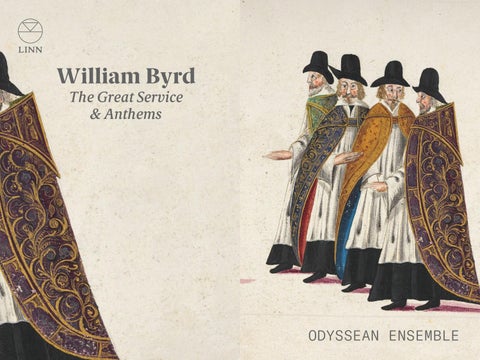
Cover Image Gentlemen of the Chappell, the funeral procession of Queen Elizabeth I to Westminster Abbey (1603), English School, (17th century) Š Bridgeman Images
59:25
William Byrd (c. 1540–1623)
The Great Service & Anthems
ODYSSEAN ENSEMBLE COLM CAREY director CHRISTIAN WILSON organ
The Great Service
1 — Venite 4:30 2 — Te Deum 9:08 3 — Benedictus 9:02 4 — O God, the proud are risen against me 2:44 5 — Creed 5:09 6 — Fantasia, BK 62 8:27 7 — Sing joyfully 2:27 8 — Magnificat 8:34 9 — Nunc dimittis 5:27 10 — Exalt thyself, O God 3:53
Additional spoken texts by David Suchet available on Linnrecords.com 4
MENU
William Byrd
MENU
The Great Service & Anthems
The well-worn idea that the English Reformation obliged church composers abruptly to switch their musical language from the sumptuous to the austere does scant justice to the more ambitious achievements of the period. It is true that in a letter of 1544 concerning the use of the vernacular, Thomas Cranmer declared to Henry VIII that ‘the song that should be made thereunto would not be full of notes, but, as near as may be, for every syllable a note, so that it may be sung distinctly and devoutly’; it is also true that Cranmer’s aspiration would be amply fulfilled – most influentially by Thomas Tallis – in much of the church music written during the reigns of Henry’s two Protestant children, Edward VI and Elizabeth I. Yet the same letter intimates that composers’ styles are not necessarily to be cramped: ‘nevertheless,’ writes the Archbishop, ‘they that be cunning in singing can make a much more solemn note thereto’. In the whole Tudor period, no musician would prove more cunning than William Byrd, in whose youth the business of providing elaborate music for the new liturgy of the Book of Common Prayer had been eagerly taken up by John Sheppard, William Mundy and Robert Parsons. It was on the death of the last of these mentors that Byrd gained his place as a full member of Elizabeth’s household chapel choir early in 1572; in eventually making his own contribution to the elaborate liturgical genre, the younger composer would not neglect to pay due homage to all three of its founders, selectively alluding to their melodic patterns, vocal combinations and musical metaphors. 5
Settings of the Prayer Book liturgies, or ‘Services’ as those settings have always been termed, were the natural musical successors to the preReformation genre of the polyphonic Mass ordinary. Arguably, however, the new liturgical medium posed greater challenges. As well as having to adapt their techniques from the qualitative accentuation of Latin to the still relatively untried quantitative accentuation of English, composers were faced with a barrage of prolix texts that had previously been sung wholly or partly to plainsong (the Venite, Te Deum, Benedictus and Magnificat). Nor could they any longer appropriate their musical scaffolding (the traditional cantus firmus of the tenor part) from the rich old repertory of Latin chants. The musical resources were thus almost entirely new: a chordal technique derived from the French polyphonic chanson, the dividing of the choir into the complementary or opposing forces of decani and cantoris (respectively the singers of the dean’s side and those of the cantor’s or precentor’s side), the further dividing of those forces into a variety of contrasting sub-groups, the standardization of a predominantly five-part texture (with two ‘contratenor’ or alto parts), and the use of fugue, canon, and other contrapuntal ornaments. Up to the 1590s, the Services of Sheppard, Mundy and Parsons fulfilled their purpose of impressing foreign visitors to Elizabeth’s chapel on those few feast days that had not been abrogated by the Protestant reformers, and of satisfying the queen’s well-known and suspectedly crypto-Catholic taste for ritual and ceremony. At this time – while at work on a considerable body of instrumental music, and publishing important collections of songs and motets – Byrd’s contributions to the vernacular sacred repertory were comparatively modest: a largely syllabic ‘Short Service’ in which Tallis’s example looms large, half a dozen church anthems, and a handful of assorted liturgical works. 6
MENU
It is hard not to connect this apparent reticence with the well-known circumstances of Byrd’s religion, for despite serving in a Protestant royal chapel, the composer, in common with a significant minority of the English upper crust, had never subscribed to the tenets of the Elizabethan religious settlement. While in the early years of her reign the queen could afford to turn a blind eye to lingering pockets of Catholicism, it became increasingly difficult for her to do so in the face of a darkening series of political events: the Northern Rebellion of 1569, her excommunication by the Pope in 1570, the perceived threat posed by Catholic missionaries from 1576, and Catholic plots to depose her in the mid 1580s. In an atmosphere of growing intolerance and brutal retribution, Byrd – when not on duty at court – and his family were repeatedly charged with recusancy, the statutory crime of not attending one’s parish church. It was only with the intervention of friends in high places – in one case of Elizabeth herself – that the composer could walk free. Despite Byrd’s apparent immunity to religious prosecution, in the mid 1590s he appears to have withdrawn from active life at court, settling in Essex within easy reach of aristocratic Catholic friends. Already he had begun to print his three settings of the ordinary of the Latin Mass, publications so likely to be deemed seditious that they were issued with blank cover pages and no identifying information other than their composer’s name. Following James I’s accession in 1603, Byrd would go on to publish two stout collections of Latin propers, forming with the three ordinaries a vast compendium of music for all the major feasts of the Roman calendar. It thus testifies to his political savvy, not to say his ecumenism, that whilst engaged on this arch-Catholic project he occupied himself also with a Prayer Book Service in the grand manner of his mid-Tudor forbears.
7
MENU
The Great Service appears to have taken shape slowly, Byrd perhaps releasing the movements piecemeal as a means of prolonging his relations with the royal household chapel during his long Essex retirement. The Venite and portions of the Te Deum and Benedictus make their earliest appearances in manuscripts of the late 1590s and early 1600s, where they are entitled ‘New Service’ or ‘Long Service’. Those scribes who in the years following Byrd’s death copied the work in its entirety were clearly struck by its unparalleled proportions and inexhaustible variety, and dubbed it his ‘Great Service’, a title attached to no other such composition in the vocal manuscripts of the period. Thanks to a crucial injunction issued by Elizabeth in 1559, musicians of the reformed English church have always been at liberty to perform nonliturgical sacred works or ‘anthems’, the words of which were not prescribed by the Prayer Book but were chosen by their composers (as often as not from the psalter). In some twenty pre-Restoration cases the composer clearly intended an anthem as a companion piece for one of his Services, the family likeness being obvious from a common key, shared musical material, and the use of similar vocal resources. The earliest examples of such bespoke anthems are those Byrd wrote to match his Great Service, all three of which can be dated to the last two decades of his long life. Culminating in a blatant invocation of ‘the God of Jacob’, Sing joyfully seems pointedly loaded with the Latinized name of King James, presumably soon after his accession to the English throne in 1603. At any rate, the earliest documented performance took place at the christening of the king’s daughter, Mary, in May 1605. Six months later, the narrowly avoided horrors of the Gunpowder Plot may well have given Byrd his cue to set O God, the proud are risen against me, a text promising the reconciliation that, to English Catholics loyal to the Crown in 8
MENU
the wake of that divisive event, must have seemed further than ever out of reach. And although Exalt thyself, O God has yet to be associated with a specific event, its unusually scant representation in the manuscript sources suggests the twilight of Byrd’s composing career, when all except a few ardent admirers had ceased to take an active interest in his music. Perhaps with an eye to the nascent ritualist faction within the Church of England (which, encouraged by the late Elizabethan apologist Richard Hooker, would seek to ‘worship the Lord in the beauty of holiness’), Byrd ornamented his new Service and its anthems with a host of contrapuntal artifices articulated by no fewer than thirty-nine different combinations of voices. While he ensured in the best traditions of religious reform that the verbal text would always be clearly presented to the listener’s ears, his treatment of the words goes a stage further in that the text is at every opportunity also vividly represented to the listener’s imagination. Byrd’s musical depictions may be purely objective, as in the antiphonal writing cued by the Venite’s reference to psalm singing (a red rag to those Puritans who complained of choirs that ‘tossed [the verses] back and forth like tennis balls’); they may be symbolic, as in the use of musical canons to depict lawgiving in Sing joyfully; they may be bold statements of doctrine, such as the Te Deum’s unmistakably anti-Calvinist threefold assertion that Christ’s death opened the kingdom of heaven ‘to all believers’; they may be subtle technicalities apparent only through analytical observation, such as the use of fragments of perpetual canon to emblematize a ‘world without end’. The product is a design of sacred music far beyond Cranmer’s imaginings, yet one that had surely been envisioned by the Archbishop’s contempo9
MENU
rary and religious nemesis Thomas More. The music of Utopia, More had written, ‘renders and expresses natural feelings, and perfectly matches the sound to the subject. Whether the words of the hymn are cheerful, supplicatory, troubled, mournful, or angry, the music represents the meaning through the melody so admirably that it penetrates and inspires the minds of the ardent hearers.’ For William Byrd, the Catholic composer both of Latin Masses and English Services, this was an ideal that could be realized on both sides of the new confessional divide. © Andrew Johnstone, 2019
10
MENU
The organ
MENU
The organ accompaniments played on this recording result from more literal reading of the relevant seventeenth-century manuscripts than has been customary since the revival of pre-Restoration church music began in earnest in the 1920s. Typically, the organ books of the 1620s and ’30s supply only the outer voices of passages for full chorus, a hollow texture that editors and organists have long felt obliged to flesh out by doubling some or all of the inner voices. Contrary to modern assumptions, however, the organs built to Tudor specifications in recent years by Goetze & Gwynn (including the St Teilo organ heard here) have revealed not only that the doubling of inner voices is by no means necessary, but also that the two-note or ‘bicinium’ texture of the manuscripts readily enables doubling of the vocal bass at the octave below. Given that the requisite 10-foot stops were prized components of pre-Restoration church organs, such doubling seems more likely than not to have been common practice in the accompanying of choirs. Its effects on the massive polyphony of Byrd’s Great Service will surely speak for themselves.
© Andrew Johnstone, 2019
11
MENU
12
The Great Service
MENU
decani
cantoris
Amy Wood treble David Gould contratenor 1 Kate Symonds-Joy contratenor 2 Hugo Hymas tenor James Holliday bass
ZoĂŤ Brookshaw treble Daniel Collins contratenor 1 Simon Ponsford contratenor 2 Steven Harrold tenor William Gaunt bass
Anthems Angela Hicks, Emilia Morton soprano 1 ZoĂŤ Brookshaw, Amy Wood soprano 2 Daniel Collins, David Gould contratenor 1 Simon Ponsford, Kate Symonds-Joy contratenor 2 Steven Harrold, Hugo Hymas tenor William Gaunt, James Holliday bass
13
MENU
© Jamie Wright
14
1  —
Venite
MENU
O come, let us sing unto the Lord: let us heartily rejoice in the strength of our salvation. Let us come before his presence with thanksgiving: and show ourselves glad in him with psalms. For the Lord is a great God: and a great King above all gods. In his hand are all the corners of the earth: and the strength of the hills is his also. The sea is his, and he made it: and his hands prepared the dry land. O come, let us worship, and fall down: and kneel before the Lord our Maker. For he is the Lord our God: and we are the people of his pasture, and the sheep of his hand. Today if ye will hear his voice, harden not your hearts: as in the provocation, and as in the day of temptation in the wilderness; When your fathers tempted me: proved me, and saw my works. Forty years long was I grieved with this generation, and said: It is a people that do err in their hearts, for they have not known my ways. Unto whom I swore in my wrath: that they should not enter into my rest. Glory be to the Father, and to the Son: and to the Holy Ghost; As it was in the beginning, and is now, and ever shall be: world without end. Amen. Psalm 95
15
2 —
Te Deum
MENU
We praise thee, O God: we knowledge thee to be the Lord. All the earth doth worship thee: the Father everlasting. To thee all Angels cry aloud: the heavens and all the powers therein. To thee Cherubim and Seraphim: continually do cry, Holy, Holy, Holy: Lord God of Sabaoth; Heaven and earth are full of the Majesty: of thy Glory. The glorious company of the Apostles: praise thee. The noble army of Martyrs: praise thee. The holy Church throughout all the world: doth knowledge thee; The Father: of an infinite Majesty; Thine honourable, true: and only Son; Also the Holy Ghost: the Comforter. Thou art the King of Glory: O Christ. Thou art the everlasting Son: of the Father. When thou tookest upon thee to deliver Man: thou didst not abhor the Virgin’s womb. When thou hadst overcome the sharpness of death: thou didst open the Kingdom of Heaven to all believers. Thou sittest at the right hand of God: in the glory of the Father. We believe that thou shalt come: to be our Judge. We therefore pray thee, help thy servants: whom thou hast redeemed with thy precious blood. Make them to be numbered with thy Saints: in glory everlasting. 16
MENU
O Lord, save thy people: and bless thine heritage. Govern them: and lift them up for ever. Day by day: we magnify thee; And we worship thy Name: ever world without end. Vouchsafe, O Lord: to keep us this day without sin. O Lord, have mercy upon us: have mercy upon us. O Lord, let thy mercy lighten upon us: and our trust is in thee. O Lord, in thee have I trusted: let me never be confounded.
17
3 —
Benedictus
MENU
Blessed be the Lord God of Israel: for he hath visited and redeemed his people; And hath raised up a mighty salvation for us: in the house of his servant David; As he spake by the mouth of his holy Prophets: which have been since the world began; That we should be saved from our enemies: and from the hands of all that hate us; To perform the mercy promised to our forefathers: and to remember his holy covenant; To perform the oath which he sware to our forefather Abraham: that he would give us; That we being delivered out of the hands of our enemies: might serve him without fear; In holiness and righteousness before him: all the days of our life. And thou, child, shalt be called the Prophet of the Highest: for thou shalt go before the face of the Lord to prepare his ways; To give knowledge of salvation unto his people: for the remission of their sins; Through the tender mercy of our God: whereby the day-spring from on high hath visited us; To give light to them that sit in darkness, and in the shadow of death: and to guide our feet into the way of peace. Glory be to the Father, and to the Son: and to the Holy Ghost; As it was in the beginning, and is now, and ever shall be: world without end. Amen. Luke 1: 68–79
18
4 —
O God, the proud are risen against me
O God, the proud are risen against me, and the assemblies of violent men have sought my soul and have not set thee before them. But thou, O Lord, art a pitiful God and a merciful, slow to anger and great in kindness and truth. Psalm 86: 14–15
19
MENU
5  —
Creed
MENU
I believe in one God the Father Almighty, Maker of heaven and earth, and of all things visible and invisible: And in one Lord Jesus Christ, the only-begotten Son of God, Begotten of his Father before all worlds, God of Gods, Light of Light, Very God of very God, Begotten, not made, Being of one substance with the Father, By whom all things were made: Who for us men and for our salvation came down from heaven. And was incarnate by the Holy Ghost of the Virgin Mary, And was made man, And was crucified also for us under Pontius Pilate. He suffered and was buried, And the third day he rose again according to the Scriptures, And ascended into heaven, And sitteth at the right hand of the Father. And he shall come again with glory to judge both the quick and the dead: Whose kingdom shall have no end. And I believe in the Holy Ghost, the Lord and giver of life, Who proceedeth from the Father and the Son, Who with the Father and the Son together is worshipped and glorified, Who spake by the Prophets. And I believe one Catholick and Apostolick Church. I acknowledge one Baptism for the remission of sins. And I look for the Resurrection of the dead, And the life of the world to come. Amen. 20
7 —
Sing joyfully
MENU
Sing joyfully unto God our strength. Sing loud unto the God of Jacob. Take the song and bring forth the timbrel, the pleasant harp and the viol. Blow the trumpet in the new moon, even in the time appointed and at our feast day. For this is a statute for Israel, and a law of the God of Jacob. Psalm 81: 1–4
21
8  —
Magnificat
MENU
My soul doth magnify the Lord: and my spirit rejoiceth in God my Saviour. For he hath regarded: the lowliness of his hand-maiden. For behold, from henceforth: all generations shall call me blessed. For he that is mighty hath magnified me: and holy is his Name. And his mercy is on them that fear him: throughout all generations. He hath shewed strength with his arm: he hath scattered the proud in the imagination of their hearts. He hath put down the mighty from their seat: and hath exalted the humble and meek. He hath filled the hungry with good things: and the rich he hath sent empty away. He remembering his mercy hath holpen his servant Israel: As he promised to our forefather Abraham and to his seed for ever. Glory be to the Father, and to the Son: and to the Holy Ghost; As it was in the beginning, and is now, and ever shall be: world without end. Amen. Luke 1: 46–55
22
9 —
Nunc dimittis
MENU
Lord, now lettest thou thy servant depart in peace: according to thy word. For mine eyes have seen: thy salvation, Which thou hast prepared: before the face of all people; To be a light to lighten the Gentiles: and to be the glory of thy people Israel. Glory be to the Father, and to the Son: and to the Holy Ghost; As it was in the beginning, and is now, and ever shall be: world without end. Amen. Luke 2: 29–32
23
10 — Exalt thyself, O God
MENU
Exalt thyself, O God, above the heavens, and let thy glory be upon the earth. Awake my tongue, awake viol and harp. I will awake right early. I will praise thee, O Lord, among the people, and I will sing unto thee among the nations. For thy mercy is great unto the heavens, and thy truth unto the clouds. Amen. Psalm 57: 6, 9–12
24
Odyssean Ensemble
MENU
Š Jamie Wright
The Odyssean Ensemble is made up of some of the best consort singers and musicians in the UK, brought together to explore music in a vibrant way, through innovative programmes and bold performances. Known for its vibrant and characterful interpretations, the ensemble has given concerts to critical acclaim. Individually the singers perform around the globe as soloists and with many of the leading groups in the UK such as The Tallis Scholars, the Monteverdi Choir, Tenebrae and The Sixteen.
25
Colm Carey
MENU
Director
Already well known for his career as concert organist, which has taken him all over Europe, as well as to the USA, Canada and Australia, Colm Carey has more recently been focussing on choral conducting. His imaginative and stimulating programming led to the formation of the Odyssean Ensemble. Master of Music of the Chapels Royal, HM Tower of London, Carey directs the choir in the two historic Chapels Royal and in regular concerts. Together they toured in South Africa, Italy and Ireland, released recordings, and broadcast music ranging from medieval times to contemporary commissions. Born in Dublin, Carey began his musical career as a choirboy in St Fin Barre’s Cathedral in Cork; he won a scholarship to study at the Royal Academy of Music in London and, subsequently, at the Conservatoire de Musique de Genève, where he won top performing awards. From 2003 to 2016 he was Belfast City Organist, curating the famous Mulholland Grand Organ in the Ulster Hall, and performing many recitals and concerti, including those of Poulenc, Parker, Handel, Haydn, Rheinberger, Jongen, Leighton and Guilmant. Many of his performances from the Ulster Hall were broadcast, and in 2005 he wrote and presented four programmes on the history of the organ for the BBC radio.
26
MENU
© Jamie Wright
Carey has collaborated with many artists, especially brass players and singers; as recording artist, he has appeared as soloist, chamber musician and director. He was the featured organist on Paul McCartney’s classical album, Ecce Cor Meum, which was premiered at the Royal Albert Hall in London and Carnegie Hall in New York. His interpretation of Bach’s The Art of Fugue has been widely admired for its originality and scholarship.
27
Christian Wilson
MENU
Organ
Christian Wilson has forged a unique path as an organist, combining trailblazing virtuosity with serious scholarship and championing rarely-heard or forgotten masterpieces. His inspiring and unorthodox programmes celebrate both the historic roots and central repertoire of the instrument whilst engaging audiences with his own transcriptions in numerous genres, ranging from medieval dances to the music of Piazzolla and Frank Zappa. His performances have met with critical acclaim at major concert venues across Europe, the USA, Russia, South Africa and Australia. Wilson’s musical career began at Westminster Abbey, where he was Head Chorister and became interested in the numinous quality and orchestral colour of the organ. He later spent a year as Sub-Organist at Perth Cathedral (Western Australia) before taking up the Organ Scholarship at Christ Church, Oxford. Following a research degree investigating the pre-Reformation English organ, Wilson was awarded various prizes and scholarships to study for the solo postgraduate degree at the Hochschule für Musik und Darstellende Kunst, Stuttgart (with Jon Laukvik and Ludger Lohmann) from where he embarked upon a career as a concert organist. In 2012, he became the eighth person in the world to perform Francis Pott’s epic organ symphony Christus (sometimes considered the ‘Everest’ of organ repertory) with performances in Germany and the UK.
28
In addition to his role as Assistant Master of Music at the Chapels Royal, HM Tower of London, Wilson is Director of Music at Brasenose College, in Oxford, and Lecturer in Music at Christ Church, Oxford. He is also busy as a pianist and musicologist, appearing regularly on the BBC radio or television. His recordings of organ music from the interwar period, Commotio, and the organ works of Francis Pott (both on Acis Productions), have been particularly well received.
29
MENU
Acknowledgements
MENU
This recording was made possible through the generosity of Sheelagh O’Neill, Louise Hicks, Mary Ena Pyle and Hilary Carey. Grateful thanks go to Goetze and Gwynn organ builders and restorers, and especially Dominic Gwynn, for their transportation and preparation of the St Teilo organ. Without air, an organ is impotent, and thanks must go to Huw Lloyd, Phoebe Butler and Angela Hicks for giving the St Teilo organ breath through the bellows. My enormous thanks must also go to Andrew Johnstone for his support, wisdom and encouragement.
30
Also available on Linn
MENU
CKD 518 Richard Egarr One Byrde in Hande
CKD 447 Magnificat The Tudors At Prayer
CKD 417 Magnificat Parsons, White & Byrd: Where late the sweet birds sang
CKD 372 Phantasm Byrd: Complete Consort Music
31
MENU
CKD 518
CKD 447
CKD 417
CKD 372
32
MENU
FOR EVEN MORE GREAT MUSIC VISIT LINNRECORDS.COM