MENU
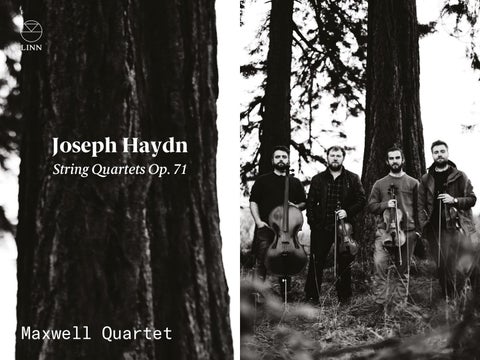
Joseph Haydn String Quartets Op. 71
Maxwell Quartet 1
Credits Tracklist Programme note Biography
Joseph Haydn String Quartets Op. 71
MAXWELL QUARTET
Recorded in The Menuhin Hall, Stoke D’Abernon, Surrey, UK, on 11–14 April 2018
3
Design Stoempstudio Cover & inside Images © Louise Mather
Recording Producer & Engineer Philip Hobbs Post-production Julia Thomas
MENU
MENU
Thank you To our families who have supported us since day one, with living rooms, beds, hot meals, and more love than you can imagine. To the music promoters and organizations who took a chance on us in the early days. To the teachers who have inspired us. To Levon. To Hatto. To our brilliant producer Phil for his expert guidance. To our friends and supporters who come to our concerts, buy our recordings, believe in us and cheer us on. This album is for you all! — Maxwell Quartet
73:53
Joseph Haydn (1732–1809) String Quartets Op. 71
MAXWELL QUARTET COLIN SCOBIE violin 1 ▫ GEORGE SMITH violin 2 ○ ELLIOTT PERKS viola DUNCAN STRACHAN cello
String Quartet in B flat major, Op. 71 No. 1
1 2 3 4
Allegro 6:57 Adagio 4:37 Menuetto: Allegretto – Trio 3:02 Vivace 5:04
— — — —
5 — The Beauty of the North Captain Simon Fraser (1773–1852) Miss Dumbreck Niel Gow (1727–1807) 5:58 arr. Maxwell Quartet
String Quartet in D major, Op. 71 No. 2
6 7 8 9
Adagio – Allegro 6:12 Adagio cantabile 5:08 Menuetto: Allegro – Trio 2:24 Finale: Allegretto 3:21
— — — —
10 — The Rosebud of Allenvale James Scott Skinner (1843–1927) Guardswell and Truly George Smith The Hurricane James Scott Skinner 5:49 arr. Maxwell Quartet
String Quartet in E flat major, Op. 71 No. 3
11 12 13 14
Vivace 6:25 Andante con moto 6:13 Menuetto – Trio 3:34 Finale: Vivace 4:31
— — — —
15 — Griogal Cridhe ‘Gregor’s Lament’ Lady MacGregor 4:00 arr. Maxwell Quartet
▫ ○
5
violin 2 on tracks 5, 10, 15 violin 1 on tracks 5, 10, 15
MENU
MENU
6
Joseph Haydn
MENU
String Quartets Op. 71
We’ve always been drawn to Haydn’s music; not just because his quartets mark the starting point for a genre that has become the central focus of our lives, but because his music seems to express a profound sense of openness, of understanding, and of equality. For Haydn, the son of an amateur folk musician (not terms which Haydn would have thought belittling in any way), music could say something universal to us all; it could provide a voice for the common man that was often unheard or suppressed, and moreover, by placing different musical ‘worlds’ alongside one another, Haydn could dissolve those socio-cultural boundaries that have long confined people to their groups. As Matthew Head rightly points out in his insightful essay ‘Haydn’s Exoticisms: “Difference” and the Enlightenment’, Haydn does not crudely incorporate ‘other’ national, popular and folk melodies in his music; rather, ‘he treats them as topics … that can participate fully in the musical discourse’. In exactly this way, we always felt an instant connection with the directness of Haydn’s quartets. Growing up surrounded by a strong folk music culture in Scotland, we have always heard every melody in classical music as a folksong, every rhythm as a dance; and our recording aims to try and paint that picture by pairing each of Haydn’s Op. 71 quartets with a tune, or set of traditional tunes, from our homeland.
7
The Op. 71, along with the Op. 74 quartets, date from 1793, and were written when Haydn returned home to Vienna after a visit to London which had cemented his international fame as a composer and public figure. He was now an international celebrity and, relishing that success, set about composing quartets that put virtuosity to the fore, and began to play with one new ‘topic’: the concert-hall style. All three quartets open with an attention-grabber, a ‘beginning before the beginning’: the first, in B flat major, begins with a rich I - IIb - Ic - V - I progression, the most boisterous and classical opening imaginable; the second, in D major, starts with a kind of extended slow hymn with a question, followed by an answer, leading to a delightful suspension and a pregnant dominant cadence; the third, in E flat major, opens in the most efficient and humorous way of all, by simply stating one solitary, warm tonic chord, before going on its merry way. The String Quartet in B flat major, Op. 71 No. 1, is an overwhelmingly joyful work. From its bright, orchestral opening chords, there is an energy and playfulness with various musical topics that gives the feeling of music bursting at the seams throughout the first movement. The second movement is a hushed sicilienne, Haydn all the time poking and playing at the space in the music (at the return of the theme in the ternary structure, Haydn fills the slow siciliano rhythm with grace notes, in all instruments) – it has the air of an Irish planxty, with its lilting, plaintive quality. The Menuetto and Trio exercise that wonderful upward third beat, giving a strong sense of folk dance, but harmonically toying with the minor all the while. The finale is the most witty of all, with its flying semiquavers allowing for shared virtuosity across the ensemble, and its antiphonal one-upmanship, before ending in the most unexpected pianissimo
8
MENU
utterance that seems to poke fun at the audience’s expectations (especially after that enormous beginning). The String Quartet in D major, Op. 71 No. 2, is at turns the most lyrical and romantic of the set, and also feels the most virtuosic. The quartet’s Adagio introduction tells us straight away that we are in for something more heartfelt, more contemplative than the previous quartet. Even as it launches into a playful, octave-jumping sports arena, we are constantly reminded of the beauty of lyricism in different ways, the most touching of which occurs six bars before the movement’s close with a whispered series of descending suspensions in the lower voices, as the violins affectionately share little turns with one another – even in times of sporting battles, there is a quiet moment for reflection among friends. The sublime meditation of the Adagio cantabile seems beautifully genuine, with a natural lyrical flow in the midst of a forest of playful activity; it has the feeling of an aria, but with variations on the theme appearing in majestic C major (dropping down to the cello’s lowest bass note), as a gorgeous improvisatory canzona, and with the gentle flow of triplet semiquavers as the movement draws to its close. In the Menuetto, Haydn returns to the sporting virtuosity of the octave leap, both rising and falling but this time filled in with the arpeggio, with both first violin and cello leaping around their instruments in playful dialogue. Something so intervallically wideranging then becomes the complete opposite in the Trio, with a cheeky grin, as an upward semitone figure lurches around the ensemble, as if it were the only rhythmic and thematic material that Haydn had left. If that contrast doesn’t make you smile, the Finale then springs into action with an undeniably folk-like melody, and the most simple accompaniment imaginable, rattling through every topic, from folksong, to storm, to church music, before giving the audi9
MENU
ence what they craved but never received in Quartet No. 1: an accelerating and spectacular ending. The String Quartet in E flat major, Op. 71 No. 3, is perhaps the most compositionally innovative of the set, with both first and last movements being highly motivically composed out of one short single theme; and yet it seems to reference the sound world of the past more than the other two quartets, with its almost Bach-like long pedal notes over winding harmonic progressions. The three pianissimo staccato quavers that permeate the first movement are at once a brazen joke, and a device that Haydn uses to confirm to the audience that he has cadenced in unexpected, non-tonic keys. The second movement, a playful variation/rondo form on a melody you might hear someone whistle on his way to work, takes us to lightest and darkest extremes of the quartet, with a very deep variation in the tonic minor starring a running continuo bass underneath agonizing harmonic suspensions, before immediately turning to a staccato semiquaver variation in the highest possible register for the upper strings, with the cello removed from the equation completely. The Menuetto and Trio again hark back to the opening movement’s refusal to resolve to the tonic, with a fantastic waltzlike section in its middle that feels like it would be best heard with a pint of beer in one’s hand. By the time we reach the Finale, the beers are in full flow, with the swinging fast waltz feel that seems to hiccup its way along in the style of a drinking song. But, as ever, Haydn juxtaposes that simple, rustic feel with contrapuntal exercises that could have been penned by Bach (including passagework straight from the Brandenburg Concerto No. 3) – this is sophisticated and reverent fun.
10
MENU
We love the Op. 71 quartets, and are in awe of Haydn’s audacity, and his ability to confound expectations rather than to simply satisfy his audience’s tastes. He chose to take the string quartet in yet another new direction, inviting his musicians to experiment in ways they would not be familiar, asking the audience to distrust all of their preconceptions about what they were hearing, and poking fun at the concert-going arena even in its very early days. And yet, Haydn never seems to insult, or to deliberately create uproar; his music speaks earnestly to all, placing at the fore a sense of the conviviality of man, and the equality of all society’s arenas. On our album we have chosen to end each Haydn quartet with a Scottish epilogue. Quartet No. 1 is paired here with two tunes from the eighteenth century; the first, The Beauty of the North, is by Captain Simon Fraser, of Ardachie in Inverness-shire. He became a talented fiddler, like his father and grandfather. It was from them that he learned and collected more than 230 tunes which were published in ‘The Airs and Melodies Peculiar to the Highlands of Scotland’ in 1816, one of which is this beautiful slow strathspey noted for its strong dotted rhythm. The title seems fitting for a wintry, frozen scene in Inverness-shire, and as such we play this in a way that seems to transcend time and pulse, with the beautiful harmonies of the tune appearing frozen in mid-air as they are played. There follows a gentle, effortless sort of reel called Miss Dumbreck, found in the ‘Sixth Collection of Strathspey, Reels and Slow Tunes’ by Niel Gow. Its composer is unknown, but Gow might well have composed this tune, as it is characterized by a strong offbeat on the up-bow, for which the great fiddler from Inver was renowned.
11
MENU
The Quartet No. 2 is followed by a set of three tunes, the first and last of which are composed by Aberdeenshire fiddler James Scott Skinner, perhaps the most celebrated Scots fiddler of the nineteenth century. The Rosebud of Allenvale is a lilting tune in , described by the composer as a ‘pastoral melody’, and begins with the very same figure as Haydn’s Finale that precedes it. The second tune is a fleeting jig, composed by the quartet’s own George Smith, called Guardswell and Truly; George composed it for his wife Fiona, and it was performed on their wedding day at Guardswell Farm in Perthshire in 2017. The set concludes with The Hurricane, one of Scott Skinner’s most celebrated reels, which is virtuosic and full of running scales and arpeggios building to a frenzy, much as the title suggests. We decided to finish the album with one of the oldest and most beautiful Gaelic songs we know. Griogal Cridhe (‘Gregor’s Lament’) dates from around 1570, when it was sung by Lady MacGregor of Glenstrae upon the death of her husband in battle. The way this song speaks to us, and to our audiences, says everything that is needed when it comes to describing the power of folk music; it is music forged straight from the heart, and like so much ‘folk music’, transcends categorization – it could be a hymn, a lullaby, or a lament, as easily as a folksong. Just like Haydn’s quartets, this is music that is capable of speaking to everyone, and fundamentally, that is what binds us together as a string quartet, and informs everything that we do.
© Maxwell Quartet, 2019
12
MENU
Maxwell Quartet
MENU
Colin Scobie violin 1 George Smith violin 2 Elliott Perks viola Duncan Strachan cello
MA XWELLSTRINGQUARTET.COM
13
The Maxwell Quartet consists of four close friends who grew up playing classical and folk music together in youth orchestras and music schools across Scotland. The group officially began in 2010 at the Royal Conservatoire of Scotland, where its founding members met as postgraduate students. The very next year, the Quartet was appointed as the Conservatoire’s Young Artists in Residence and selected for Enterprise Music Scotland’s Residency Programme. In 2014, the line-up changed to include Colin Scobie and Elliott Perks on violin and viola respectively. Since then, the Quartet has developed a unique, fresh and genuine voice of its own in the world of chamber music. In 2017, the Quartet received the First Prize and Audience Prize at the Trondheim International Chamber Music Competition, and their performances were hailed as ‘superb storytelling by four great communicators’ by The Strad and as ‘brilliantly fresh, unexpected and exhilarating’ by The Herald. Now based across the UK and touring regularly in Europe and the United States, the Quartet’s performances are set apart by the tribute they pay to their Scottish folk music heritage. From 2019 to 2021, the Quartet is Associate Artist at both the Royal Conservatoire of Scotland and the Music at Paxton festival. Always keen to take the possibilities of the string quartet in new directions, the Quartet has worked with musicians including Kari Kriikku, Jonathan Kelly, Benjamin Grosvenor, David Watkin, Anna Meredith, Herman Kolgen, Lunir and the Danish String Quartet. The Quartet has studied with Hatto Beyerle of the Alban Berg Quartett and members of the Endellion String Quartet.
14
MENU
MENU
COLIN SCOBIE 15
MENU
GEORGE SMITH 16
MENU
ELLIOTT PERKS 17
MENU
DUNCAN STRACHAN 18
Also available on Linn
MENU
CKD 500 Robin Ticciati Scottish Chamber Orchestra Haydn: Symphonies Nos. 31, 70 & 101
CKD 308 Sir Charles Mackerras Scottish Chamber Orchestra Mozart: Symphonies 38-41
CKD 464 Gottlieb Wallisch Haydn: The London Sonatas
CKD 572 Scottish Chamber Orchestra Wind Soloists Beethoven: Music for Winds
CKD 401 Boston Baroque Martin Pearlman Haydn: The Creation
CKR 465 Dougie MacLean Royal Scottish National Orchestra Till Tomorrow
19
MENU
CKD 500
CKD 464
CKD 401
CKD 308
CKD 572
CKR 465
20
MENU
FOR EVEN MORE GREAT MUSIC VISIT LINNRECORDS.COM