MENU
Henry Purcell The Cares of Lovers
ROWAN PIERCE RICHARD EGARR WILLIAM CARTER 1
Credits Tracklist Programme note Sung texts Biographies
Henry Purcell The Cares of Lovers
ROWAN PIERCE RICHARD EGARR WILLIAM CARTER
MENU
Recorded in De Doopsgezinde Gemeente, Haarlem, Holland, on 16–18 January 2018
Recording Producer & Engineer Philip Hobbs
Design stoempstudio.com
Post-production Julia Thomas
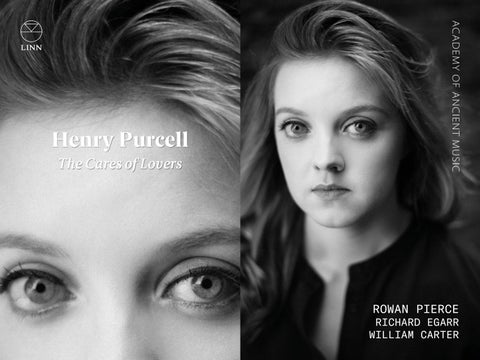
Cover Image Photograph of Rowan Pierce by Gerard Collett 3
Henry Purcell (1659–1695) The Cares of Lovers
59:47 ROWAN PIERCE RICHARD EGARR WILLIAM CARTER
1 — The cares of lovers (from The History of Timon of Athens, The Man-Hater, Z. 632) 1:59 2 — Sweeter than roses (from Pausanias, the Betrayer of his Country, Z. 585) 3:07 3 — From silent shades ‘Bess of Bedlam’, Z. 370 4:16 4 — Retir’d from mortal’s sight (from The History of King Richard the Second, Z. 581) 3:05 5 — Celia has a thousand charms (from The Rival Sisters, or The Violence of Love, Z. 609) 2:36 6 — Dear pretty youth (from The Tempest, Z. 631) 2:11 7 — A Ground in Gamut, Z. 645 2:27 8 — If music be the food of love, Z. 379c 3:29 9 — O solitude, my sweetest choice, Z. 406 5:33
10 — Hears not my Phillis ‘The Knotting Song’, Z. 371 3:00 11 — O lead me to some peaceful gloom (from Bonduca, or The British Heroine, Z. 574) 2:37 12 — She loves and she confesses too, Z. 413 2:49 13 — Ground, ZD. 222 2:12 14 — Tell me, some pitying angel ‘The Blessed Virgin’s Expostulation’, Z. 196 7:05 15 — Music for a while (from Oedipus, King of Thebes, Z. 583) 3:06 16 — The fatal hour comes on apace, Z. 421 3:40 17 — Thou wakeful shepherd ‘A morning hymn’, Z. 198 2:39 18 — Now that the sun hath veiled his light ‘An evening hymn on a ground’, Z. 193 3:50
MENU
Henry Purcell
MENU
The Cares of Lovers
‘The Author’s extraordinary Talent in all sorts of Musick is sufficiently known, but he was especially admir’d for the Vocal, having a peculiar Genius to express the Energy of English Words, whereby he mov’d the Passions of all his Auditors.’ Henry Playford (preface to Orpheus Britannicus, 1698)
What is it about Henry Purcell’s music that makes it so uniquely excellent in a seventeenth century already crowded with great composers? Benjamin Britten loved its ‘mixture of clarity, brilliance, tenderness and strangeness’. If pressed, I would offer the observation that he is the only composer of the Baroque to write counterpoint on the same level as Bach but also to display an interest in the human condition equal to that of Monteverdi or Handel. I have no doubt that had he been granted a few decades past his thirty-six years, he would today be giving Shakespeare a run for his money as the supreme English cultural icon. The works on the present recording come from all periods of his brief career, from She loves and she confesses too, one of his very first published pieces (1683), to Sweeter than roses from his final months (1695), but they all 2
display the same matchless ingenuity and uncanny ability to set English words to music. These songs were all published in collections for music lovers to perform at home but at least half of them were originally written for the stage, so perhaps it is useful to take a short look at the English musical theatre before discussing the songs themselves. There were only two theatres in Purcell’s London: Drury Lane and Dorset Garden. Henry Misson visited Drury Lane in 1698: ‘The Pit is an Amphitheater, fill’d with Benches without Backboards, and adorn’d and cover’d with green Cloth. Men of Quality, particularly the younger Sort, some Ladies of Reputation and Vertue, and abundance of Damsels that hunt for Prey, sit all together in this Place, Higgledy-piggledy, chatter, toy, play, hear, hear not. Farther up … rises another Amphitheater, which is taken up by Persons of the best Quality, among whom are generally very few Men.’ From what we can reconstruct of the size of the theatre and the size of the audience, the seating on benches must have been crowded, approximately 18 inches wide and 24 inches deep per person; even less space than on a budget airline! Lighting was provided by chandeliers and candles and it never occurred to anyone to sit in darkness as we do today; a big part of the experience was seeing and being seen. Musical drama was relatively new in England at this time and there was some experimentation with the placement of the orchestra. Samuel Pepys complains about one common set up: ‘… the musique, being below … sounding under the very stage, there is no hearing of the bases at all, nor very well of the trebles’. This led to problems of ensemble which Purcell’s friend Roger North complained about: ‘… what a fulsome thing it is to see a performer upon a stage not know when to begin, but the basso continuo must stay or skip for them, which, by the way, they are not very good at: and then a flute [recorder] must be at the lasses 3
MENU
ear to give her the tone, and that often thro’ the whole air, or else she would fall a semitone and sing on as assuredly as if she were in no fault …’ Purcell avoided these situations by working regularly with a few trusted singers and almost never joining the soloist on stage with the orchestra but rather having them accompanied by the continuo seated near the singers as described in a libretto from a production of The Tempest in 1674 – ‘the Harpsicals and Theorbo’s which accompany the Voices˚, are plac’d between the Pit and the Stage’. This explains the shape of countless numbers in Purcell’s output in which a melody will be introduced by full orchestra alone, then sung by the soloist with just the continuo and then repeated by the chorus (above the stage) with the orchestra. Moments when the singer is actually accompanied by the orchestra (like Dido’s lament, or the frost scene from King Arthur) are so rare because presumably they would have taken much extra rehearsal. Another interesting period practice that we would be well advised to avoid is described by Roger North: ‘Come into the theater or musick-meeting, and you shall have a woman sing like a mouse in a cheese, scarce to be heard, and for the most part her teeth shutt. Weomen are fearfull of the distortion of the face, which is their sanctum sanctorum, therefore check the sound.’ But elsewhere he tells us: ‘I remember in Purcell’s excellent opera of King Arthur, when Mrs. Butler, in the person of Cupid … had the liberty to turn her back to the theater. She was in no concern for her face, but sang a recitativo of calling towards the place where Genius was to arise, and performed it admirably, even beyond any thing I ever heard upon the English stage. And I could ascribe it to nothing so much as the liberty she had of concealing her face, which she could not endure should be so contorted as is necessary to sound well, before her gallants or at least her envious sex.’ 4
MENU
Now with a picture of Purcell’s lively (if imperfect) theatrical world, we can turn our attention to the songs recorded here. A late work from a mask added to Shakespeare’s Timon of Athens, The cares of lovers was sung by Jemmy Bowen (‘the boy’), a boy treble who was one of Purcell’s favourite singers. Anthony Aston tells us: ‘The Boy … practicing a song set by Mr. Purcell, some of the Music(ians) told him to grace and run a Division in such a Place. O let him alone, said Mr. Purcell; he will grace it more naturally than you, or I, can teach him!’ Also a late work Sweeter than roses comes from the play Pausanias (1695). It is a supreme example of the musical illustration of a few, well-chosen words. From silent shades is an early work and a fine example of the ‘Mad Song’ genre, in which the singer portrays an insane character. ‘Mad Bess’ as this song is also known, in just a few minutes, contains no fewer than twelve different sections (as well as metres) as Bess veers from one extreme to the other. This song stayed popular long after Purcell’s death and gets an admiring mention in Charles Burney’s ‘A General History of Music’ (1789): ‘Mad Bess is a song so celebrated, that it needs no panegyric, or renewal of public attention, as every captivating English singer, in my memory, has revived its favour.’ Retir’d from mortal’s sight dates from a revival of King Richard the Second in 1680. Richard hears this song in prison just before his murder. This strange and timeless melody would not be out of place in one of Cecil Sharp’s anthologies of English folk song.
5
MENU
A song from Purcell’s final year, Celia has a thousand charms was also written for ‘the boy’. Burney mentions this song as one which was ‘favourite … during my youth’, but is more condescending about it than he is about ‘Mad Bess’. ‘The first movement … embellished with the fashionable volate or flourishes of the times, which are now as antiquated as the curls of his [Purcell’s] own peruque, or the furbelows and flounces of Queen Elizabeth.’ He is a bit easier on the closing section which he admits is ‘plaintive and graceful’. Dear pretty youth was first published in 1695 with the rubric ‘A New Song in the Tempest, Sung by Mis Cross to her Lover, who is supposed Dead’. Letitia (Lucy) Cross, also known as ‘the girl’, was a favoured soprano at the end of Purcell’s career. Known as a skilful actress and dancer as well as a virtuoso singer, she also accompanied herself on stage on the spinet: impressive accomplishments which become even more impressive when we learn that in 1695 she was only twelve! There has been some debate about this, as scholars (seemingly unaware of the existence of Shirley Temple or Michael Jackson) have found it simply not credible that a twelve-year-old girl could perform on the seventeenth-century London stage, but part of a prologue to a play from 1697 spoken by ‘Mis Cross’ (‘Look to’t, ye Beaus, my Fifteen is a coming’) would seem to clinch the matter once and for all. Perhaps not strictly relevant to this present essay, but fascinating nevertheless, is the information that she received 500 guineas from Peter the Great for unnamed ‘services’ during his visit to London in 1698. The text of If music be the food of love by Henry Heveningham after William Shakespeare was obviously fascinating to Purcell as he set it a number of times. This is the most elaborate version and is one of the few songs by Purcell which seem unambiguously created for voice and harpsichord. 6
MENU
O solitude, my sweetest choice is one of Purcell’s finest compositions on a repeated bass and the text (which is taken from Katherine Philips’s translation of a French poem by Saint-Amant entitled ‘La Solitude’), while convoluted, seems to explore Purcell’s thoughts about the solitude of the artist. Hears not my Phillis is that rare thing, a comic song which actually has the potential to be funny. The lyric appears in ‘The Gentleman’s Journal’ in the August/September issue of 1694 with the preface: ‘Happy the Lover who with all his art can warm one of these cold Beauties into pity, principally now the Fit of Knotting (to speak in a Lover’s Phrase) possesses the best part of the finer half of human kind, and leaves them so unconcerned for Sighs and Vows as the fair subject of this song.’ The lover, in each verse, tries a different angle of attack, all in vain as Phillis concentrates on knotting her fringe. O lead me to some peaceful gloom is to be found in Bonduca, or The British Heroine and dates back to Purcell’s final year. This fine song for Letitia Cross gave her the opportunity to explore the pathetic side of her art as Bonvica, a British warrior princess resisting the Romans. In the production the song was performed accompanied by an onstage lutenist. As mentioned above She loves and she confesses too is an early work with an ingenious use of a repeated bass (here the Ciaconna). Tell me, some pitying angel uses the techniques of the ‘Mad Song’ to portray the Virgin Mary’s frantic despair at the disappearance of her young son in the crowds of Jerusalem during Passover. This is a triumph of dramatic composition and the equal of any cantata written in Italy at the same time. 7
MENU
Sometimes viewed simply as Purcell’s encomium on the power of music, Music for a while should rather be understood in its sinister dramatic context. From John Dryden’s version of Oedipus, the song is a musical spell which allows (on a darkened stage) the ghost of the murdered father Laius to rise from Hell and accuse his son.
The fatal hour comes on apace was only published after Purcell’s death; it is unknown when or under what circumstances it was composed. Nevertheless, these are two magical pages of music. Both Thou wakeful shepherd and Now that the sun hath veiled his light are based on texts by William Fuller, the Bishop of Lincoln. The first is an earnest prayer of repentance to begin the day and the second a serene and confident good night to the world. Purcell composes over a ground bass (something he described as ‘a very easie thing to do’) and here the irregular length of the bass (five bars), and the vocal phrases which come and go completely unrestricted by what is happening beneath them, create a fluid but inexorable sense of forward momentum which is ecstatic and unique. So here then is a selection of Purcell’s very finest songs. We hope you will enjoy listening to them as much as we did recording them! © William Carter, 2019
8
MENU
MENU
˚ In published versions of these songs the viola da gamba is sometimes mentioned as a possible accompanying instrument but this is likely only in the context of the instruments a keen amateur might have at home. It seems clear from payment records and descriptions like this one from The Tempest that the harpsichord and theorbo (and to a lesser extent the lute) were the instruments of choice for professionals in the theatre. After some discussion we decided that it would be more fun to confine ourselves to this limited palette and try to dig more from a few instruments than to add extra and possibly extraneous colours from a viol (or organ, harp, etc.).
9
1 — The cares of lovers
MENU
Rowan Pierce, Richard Egarr, William Carter
The cares of lovers, their alarms, Their sighs, their tears have pow’rful charms; And if so sweet their torment is, Ye Gods, how ravishing the bliss! So soft, so gentle is their pain, ’Tis even a pleasure to complain. Thomas Shadwell (?1642–1692)
10
2 — Sweeter than roses
MENU
Rowan Pierce, Richard Egarr, William Carter
Sweeter than roses, or cool evening breeze On a warm flowery shore, was the dear kiss, First trembling made me freeze, Then shot like fire all o’er. What magic has victorious love! For all I touch or see since that dear kiss, I hourly prove, all is love to me. Anonymous
11
3 — From silent shades Rowan Pierce, Richard Egarr, William Carter
MENU
From silent shades, and the Elysian groves, Where sad departed spirits mourn their loves; From crystal streams, and from that country where Jove crowns the fields with flowers all the year, Poor senseless Bess, cloth’d in her rags and folly, Is come to cure her lovesick melancholy. Bright Cynthia kept her revels late, While Mab, the Fairy Queen, did dance, And Oberon did sit in state When Mars at Venus ran his lance. In yonder cowslip lies my dear, Entomb’d in liquid gems of dew; Each day I’ll water it with a tear, Its fading blossom to renew. For since my love is dead and all my joys are gone, Poor Bess for his sake, A garland will make, My music shall be a groan.
12
MENU
I’ll lay me down and die within some hollow tree, The rav’n and cat, The owl and bat, Shall warble forth my elegy. Did you not see my love as he pass’d by you? His two flaming eyes, if he come nigh you, They will scorch up your hearts? Ladies, beware ye, Lest he should dart a glance that may ensnare ye. Hark! I hear old Charon bawl, His boat he will no longer stay; The Furies lash their whips and call, Come, come away. Poor Bess will return to the place whence she came, Since the world is so mad she can hope for no cure; For love’s grown a bubble, a shadow, a name, Which fools do admire and wise men endure. Cold and hungry am I grown, Ambrosia will I feed upon,
13
Drink nectar still and sing. Who is content Does all sorrow prevent, And Bess in her straw, Whilst free from the law, In her thoughts is as great as a King. Anonymous
4 — Retir’d from mortal’s sight
MENU
Rowan Pierce, William Carter
Retir’d from mortal’s sight The pensive Damon lay, He blest the discontented night And curst the smiling day. The tender sharers of his pain, His flocks no longer graze, But sadly fixt around the swain, Like silent mourners gaze.
Some ease (said he) some respite give! Why, mighty pow’rs, ah why Am I too much distrest to live, And yet forbid to dye? Such accents from the shepherd flew Whilst on the ground he lay; At last so deep a sigh he drew, As bore his life away.
He heard the musick of the wood, And with a sigh reply’d, He saw the fish sport in the flood, And wept a deeper tyde. In vain the summers bloom came on, For still the drooping swain, Like autumn winds was heard to groan, Out-wept the winters rain.
Nahum Tate (1652–1715)
14
5 — Celia has a thousand charms
Rowan Pierce, Richard Egarr, William Carter
Celia has a thousand charms: ’Tis heav’n to lie within her arms. While I stand gazing on her face Some new and some resistless Grace Fills with fresh magic all the place. But while the nymph I thus adore, I should my wretched fate deplore. For, oh, Mirtillo, have a care, Her sweetness is above compare. But then she’s false as well as fair. Have a care, Mirtillo, have a care. Robert Gould (c. 1660–1709)
15
MENU
6 — Dear pretty youth
MENU
Rowan Pierce, Richard Egarr
Dear pretty youth, unveil your eyes, How can you sleep when I am by? Were I with you all night to be, Methinks I could from sleep be free. Alas! My dear, you’re cold as stone, You must no longer lie alone, But be with me my dear, and I in each arm Will hug you close and keep you warm. Thomas Shadwell
16
8 — If music be the food of love
MENU
Rowan Pierce, Richard Egarr
If music be the food of love, Sing on till I am fill’d with joy; For then my list’ning soul you move With pleasures that can never cloy, Your eyes, your mien, your tongue declare That you are music ev’rywhere. Pleasures invade both eye and ear, So fierce the transports are, they wound, And all my senses feasted are, Tho’ yet the treat is only sound. Sure I must perish by your charms, Unless you save me in your arms. Henry Heveningham (1651–1700)
17
9 — O solitude, my sweetest choice
MENU
Rowan Pierce, William Carter
O solitude, my sweetest choice! Places devoted to the night, Remote from tumult and from noise. How ye my restless thoughts delight, O solitude, my sweetest choice! O heav’ns! what content is mine To see those trees, which have appear’d, From the nativity of time, And which all ages have rever’d, To look today as fresh and green As when their beauties first were seen.
O, how I solitude adore! That element of noblest wit, Where I have learnt Apollo’s lore, Without the pains to study it. For thy sake I in love am grown, With what thy fancy doth pursue; But when I think upon my own, I hate it for that reason too, Because it needs must hinder me From seeing and from serving thee. O solitude, O how I solitude adore!
O, how agreeable a sight These hanging mountains do appear, Which th’ unhappy would invite To finish all their sorrows here, When their hard fate makes them endure Such woes as only death can cure.
Marc-Antoine Girard de Saint-Amant (1594–1661) Translated by Katherine Philips (1632–1664)
18
10 — Hears not my Phillis
MENU
Rowan Pierce, Richard Egarr, William Carter
Hears not my Phillis how the birds Their feather’d mates salute? They tell their passion in their words, Must I alone be mute? Phillis, without a frown or smile, Sat and knotted all the while.
So many months in silence past, And yet in raging love, Might well deserve one word at last My passion should approve. Phillis, without a frown or smile, Sat and knotted all the while.
The god of love in thy bright eyes Does like a tyrant reign; But in thy heart a child he lies Without his dart or flame. Phillis, without a frown or smile, Sat and knotted all the while.
Must then your faithful swain expire, And not one look obtain, Which he to soothe his fond desire Might pleasingly explain? Phillis, without a frown or smile, Sat and knotted all the while. Sir Charles Sedley (1639–1701)
19
11 — O lead me to some peaceful gloom
Rowan Pierce, William Carter
O lead me to some peaceful gloom, Where none but sighing lovers come, Where the shrill trumpets never sound, But one eternal hush goes round. There let me soothe my pleasing pain, And never think of war again. What glory can a lover have, To conquer, yet be still a slave? John Fletcher (1579–1625)
20
MENU
12 — She loves and she confesses too
MENU
Rowan Pierce, Richard Egarr, William Carter
She loves and she confesses too, There’s then at last no more to do; The happy work’s entirely done, Enter the town which thou hast won; The fruits of conquest now begin, Io, triumph, enter in.
Noisy nothing, stalking shade, By what witchcraft wert thou made, Thou empty cause of solid harms? But I shall find out counter charms, Thy airy devilship to remove From this circle here of love.
What’s this, ye Gods! What can it be? Remains there still an enemy? Bold Honour stands up in the gate, And would yet capitulate. Have I o’ercome all real foes, And shall this phantom me oppose?
Sure I shall rid myself of thee By the night’s obscurity, And obscurer secrecy; Unlike to ev’ry other spright Thou attempt’st not men to affright Nor appear’st but in the light. Abraham Cowley (1618–1667)
21
14 — Tell me, some pitying angel
MENU
Rowan Pierce, Richard Egarr, William Carter
Tell me, some pitying angel, quickly say, Where does my soul’s sweet darling stray, In tiger’s, or more cruel Herod’s way? O! rather let his little footsteps press Unregarded through the wilderness, Where milder savages resort: The desert’s safer than a tyrant’s court. Why, fairest object of my love, Why dost thou from my longing eyes remove? Was it a waking dream that did foretell Thy wondrous birth? no vision from above? Where’s Gabriel now that visited my cell? I call; he comes not; flatt’ring hopes, farewell.
22
Me Judah’s daughters once caress’d, Call’d me of mothers the most bless’d; Now (fatal change!) of mothers most distress’d. How shall my soul its motions guide, How shall I stem the various tide, Whilst faith and doubt my lab’ring thoughts divide? For whilst of thy dear sight beguil’d, I trust the God, but oh! I fear the child. Nahum Tate
15 — Music for a while
MENU
Rowan Pierce, Richard Egarr
Music for a while Shall all your cares beguile, Wond’ring how your pains were eas’d And disdaining to be pleased, Till Alecto free the dead From their eternal band, Till the snakes drop from her head, And the whip from out her hand. John Dryden (1631–1700) & Nathaniel Lee (c. 1653–1692)
23
16 — The fatal hour comes on apace
Rowan Pierce, Richard Egarr, William Carter
The fatal hour comes on apace, Which I had rather die than see, For when fate calls you from this place, You go to certain misery. The thought does stab me to the heart, And gives me pangs no word can speak, It wracks me in each vital part, Sure when you go, my heart will break. Since I for you so much endure, May I not hope you will believe, ’Tis you alone these wounds can cure, Which are the fountains of my grief. Anonymous
24
MENU
17 — Thou wakeful shepherd
MENU
Rowan Pierce, Richard Egarr, William Carter
Thou wakeful shepherd, that does Israel keep, Rais’d by thy goodness from the bed of sleep, To thee I offer up this hymn As my best morning sacrifice; May it be gracious in thine eyes To raise me from the bed of sin. And do I live to see another day? I vow, my God, henceforth to walk thy ways, And sing thy praise All those few days Thou shalt allow.
Could I redeem the time I have misspent In sinful merriment, Could I untread Those paths I led I would so expiate each past offence, That ev’n from thence The innocent should wish themselves like me When with such crimes they such repentance see. With joy I’d sing away my breath, Yet who can die so to receive his death? Bishop William Fuller (1608–1675)
25
18 — Now that the sun hath veiled his light
Rowan Pierce, Richard Egarr, William Carter
Now that the sun hath veiled his light, And bid the world goodnight, To the soft bed my body I dispose; But where shall my soul repose? Dear God, even in thy arms; And can there be any so sweet security? Then to thy rest, O my soul, And singing, praise the mercy That prolongs thy days. Halleluia. Bishop William Fuller
26
MENU
Rowan Pierce
MENU
Soprano
Saltburn-by-the-Sea soprano Rowan Pierce was awarded the President’s Award by HRH Prince of Wales at the Royal College of Music in 2017. She won both the Song Prize and First Prize at the inaugural Grange Festival International Singing Competition, the Van Someren-Godfrey Prize at the Royal College of Music and the first Schubert Society Singer Prize in 2014. Pierce has appeared on the concert platform throughout Europe and in South America, performing with ensembles such as the Academy of Ancient Music, Orchestra of the Age of Enlightenment, Gabrieli, Scottish Chamber Orchestra, BBC Scottish Symphony Orchestra, City of Birmingham Symphony Orchestra, Early Opera Company, Rotterdam Philharmonic Orchestra, Royal Liverpool Philharmonic, Florilegium and Royal Northern Sinfonia. She made her BBC Proms debut at the Royal Albert Hall with the Orchestra of the Age of Enlightenment and her Wigmore Hall debut with the London Handel Players in 2017. As a Britten-Pears Young Artist she performed Drusilla in Monteverdi’s L’incoronazione di Poppea. Other roles include Galatea in Handel’s Acis and Galatea, Dorinda in Handel’s Orlando, Iris in Handel’s Semele, Susanna and Barbarina in Mozart’s The Marriage of Figaro, Miss Wordsworth in Britten’s Albert Herring and Princess in Ravel’s L’enfant et les sortilèges. She has also 27
performed Elsie in Gilbert & Sullivan’s The Yeomen of the Guard and various roles in Purcell’s Dido and Aeneas, The Fairy Queen and King Arthur.
© Jen Hart
Pierce is a Rising Star of the Orchestra of the Age of Enlightenment, a Harewood Artist at English National Opera and a frequent collaborator with the Academy of Ancient Music. She made her debut for English National Opera as Tiny in Britten’s Paul Bunyan.
28
Richard Egarr
MENU
Harpsichord
Richard Egarr was appointed Music Director of the Academy of Ancient Music in 2006. He was Associate Artist of the Scottish Chamber Orchestra from 2011 to 2017, and has been appointed Principal Guest Conductor of the Residentie Orkest in The Hague and Artistic Partner with The Saint Paul Chamber Orchestra, Minneapolis, from 2019. He has conducted many leading orchestras such as the London Symphony Orchestra, Royal Concertgebouw Orchestra, The Philadelphia Orchestra and period ensembles such as the Handel and Haydn Society. As well as an accomplished conductor Egarr is also a brilliant harpsichordist, and equally skilled on the organ and fortepiano. He regularly plays solo at major venues such as Wigmore Hall, London, and Carnegie Hall, New York, and has recorded many albums for Harmonia Mundi, notably of J S Bach, Couperin, Purcell and Mozart, and for Linn. Egarr trained as a choirboy at York Minster, was organ scholar at Clare College Cambridge, and later studied with Gustav and Marie Leonhardt. He is Visiting Artist at The Juilliard School in New York.
29
© Marco Borggreve
MENU
30
William Carter
MENU
Lute / Theorbo
Born in Florida, William Carter received a rigorous but conventional training as a classical guitarist with Bruce Holzman at the Florida State University before falling in love with the earlier plucked instruments and the world of historical performance. Following initial guidance from Patrick O’Brien in New York City, he travelled to London as a Fulbright Scholar where he studied the lute with Nigel North and quickly established himself as one of the leading players on old instruments. Concert tours and festival appearances followed throughout Europe, Asia and the Americas, both as an orchestral player and as a chamber musician, and soloist with his own group, The Palladian Ensemble. Carter has an extensive discography and has featured on numerous recordings of the Academy of Ancient Music and The English Concert, for both of which he acts as the principal lutenist. He is also an enthusiastic teacher and is Professor of Historical Performance and Lute at the Guildhall School of Music and Drama in London. Carter has recorded many albums of solo Baroque guitar for Linn. La Guitarre Royalle was named in Gramophone’s ‘Critics’ Choice’ end of year list. La Guitarra Española, Fernando Sor: Early Works and Bach Reimagines Bach were all Gramophone’s ‘Editor’s Choice’. Bach Reimagines Bach was selected in Gramophone’s Top 10 recent Bach recordings (2018). Le Calme: Fernando Sor Late Works was awarded an Opus d’Or and also topped Gramophone’s ‘Critics’ Choice’ list. 31
MENU
© Amit Lennon 32
MENU
Sincerest thanks to those who gave so generously their time, expertise and financial support. Thank you to Roger Mayhew and a special mention to Crawford Hall, Nancy Pierce, Vincent Evans and Betty Middleton who were, and will forever remain, a constant source of inspiration. — Rowan Pierce
33
MENU
Academy of Ancient of Music The Nicholas Boas Charitable Trust Philip Chklar and Paul Terry Ged and Gill Davies Julia Ellis Frank Harrison, Teesside Music Society Lindsay Kemp Jane Martineau Roger Mayhew Ruth and Dominic McLoughlin Philip and Christine Miles Stefan Paetke John and Joyce Reeve Saltburn Music Festival Terence Sinclair Michael Smith Mark R Stadler John and Madeleine Tattersall Janet Unwin Peter Warwick Bruce Wood and The Purcell Society Edition
34
Also available on Linn
MENU
CKD 518 Richard Egarr One Byrde in Hande
CKR 343 William Carter Fernando Sor: Early Works
CKD 445 William Carter Bach Reimagines Bach
CKD 380 William Carter Le Calme: Fernando Sor Late Works
CKD 185 William Carter La Guitarre Royalle: The Music of Francesco Corbetta
CKR 374 Retrospect Trio Purcell: Twelve Sonatas in Three Parts
35
MENU
CKD 518
CKD 445
CKD 185
CKR 343
CKD 380
CKR 374
36
MENU
FOR EVEN MORE GREAT MUSIC VISIT LINNRECORDS.COM