MENU
An English Sett for Trumpet
Jonathan Freeman-Attwood Daniel-Ben Pienaar
1
Credits Tracklist Programme note Madrigal texts Biographies Jonathan Freeman-Attwood Daniel-Ben Pienaar
An English Sett for Trumpet
To Mothers 3
Text preparation Kathleen Rule Score preparation Rosie Larkins Design stoempstudio.com
Recorded at Britten Studio, Snape Maltings, UK, on 20–22 March 2017 Recording Producer & Engineer Philip Hobbs Post-production Julia Thomas
Special thanks to the Royal Academy of Music, London
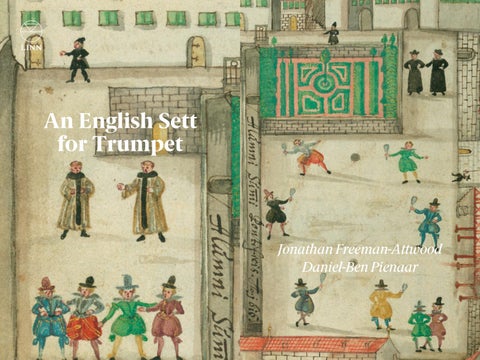
Cover Image ‘Men at play’, Liber Amicorum of Joannes Carolus Erlenwein, The Walters Art Museum MENU
58:04
An English Sett for Trumpet
JONATHAN FREEMAN-ATTWOOD trumpet DANIEL-BEN PIENAAR piano
First Sett
Second Sett
JOHN JENKINS (1592–1678) 1 — Fantasy No. 1 in G major 2:38 (from Five-Part Consorts)
WILLIAM LAWES (1602–1645) Harp Consort No. 8 in G major 5 — Pavan and divisions 5:07
WILLIAM BYRD (c. 1539/40–1623)
WILLIAM LAWES
THOMAS TOMKINS (1572–1656)
WILLIAM LAWES
2 — La verginella 2:07 (from Psalmes, sonets and songs, 1588)
Consort Sett a 6 in G minor 6 — Fantasy 2:38
3 — Oyez! Has any found a lad 1:18 (from Songs of 3, 4, 5 and 6 parts, 1622)
Consort Sett a 6 in B flat major 7 — Fantasy 3:15
ORLANDO GIBBONS (1583–1625)
4 — Go from my window
WILLIAM LAWES
Sett No. 2 a 3 in G major 8 — Almaine 1:23
3:45
1
MENU
MENU
Third Sett
Fourth Sett
ORLANDO GIBBONS 9 — O that the learned poets (from The First Set of Madrigals and Mottets, 1612)
MATTHEW LOCKE (c. 1621/3–1677) Suite No. 2 in C minor (from Consorts of Fower Parts) 15 — Fantasy 2:34 16 — Courante 1:06 17 — Ayre 1:51 18 — Sarabande 1:13
10 —
1:26
ORLANDO GIBBONS
The silver swanne 2:04 (from The First Set of Madrigals and Mottets, 1612)
JOHN WILBYE (1574–1638) 11 — Adew, sweet Amarillis 1:29 (from The First Set of English Madrigals, 1598) JOHN BENNET (c. 1575–1614) 12 — All creatures now are merry-minded 1:32 (from The Triumphs of Oriana, 1601)
WILLIAM BYRD 13 — Though I be Brown
2:18
THOMAS MORLEY (1557/8–1602)
14 — Now is the month of maying
1:48
2
MENU
Fifth Sett
JOHN JENKINS
Newark Siege 19 — Pavan 5:51
WILLIAM BYRD
20 — 21 —
The Sixth Pavan and Galliard ‘Kinbrugh Goodd’ (from My Ladye Nevells Booke, 1591) Pavan 3:13 Galliard 1:15
ORLANDO GIBBONS 22 — In nomine a 5 No. 2
3:53
JOHN DOWLAND (1563–1626) Fantasie No. 3 ‘Farewell’ 23 — Farewell 4:00
All arrangements by Timothy Jones
3
‘The Re-Imagined Trumpet’ Revisited
MENU
Re-imagining music of the past for the modern trumpet and piano duo has generated seven projects for Linn over the last decade or so: themed programmes of works whose metamorphoses range from gently modified Renaissance pavans to a fully fledged arrangement of the most ubiquitous of ‘neoclassical’ orchestral suites, Stravinsky’s Pulcinella. In over seven hours, only seven minutes has been dedicated to original music for the trumpet and piano; indeed, those seven minutes also represent the only original music. Our motivations are perhaps not quite as iconoclastic as they might seem. For a start, there is not a great deal of ‘canonic material’ for the trumpet and piano, so repertoire and programme-building are always important considerations. This is especially the case for an instrument where technical development, in both the players and their hardware, has arguably outstripped an equivalent enterprise in creating first-class solo repertoire with piano. Increasing the opportunities for performing chamber music of this kind has already resulted in editions of around 40 pieces from the Linn catalogue, published in our Resonata Music series ‘The Re-Imagined Trumpet’. Yet what really drives this adventure, as performers, arrangers and editors, is how one inhabits critical questions emerging from each of the chosen projects we have undertaken, whether defined by idiom, nationality,
4
era, fashion – even family, in the case of Bach. Such questions reach beyond merely the adaptability of a particular work in its arrangement towards the discovery of a performance practice for any single undertaking. In a decidedly unhistoric medium, the task becomes strangely liberating since there is really no existing performance practice for this type of duo – whether in the world of Byrd, Gibbons and Lawes or, indeed, Fauré and Stravinsky. Whilst the question of ‘What if Schumann had written a fantasiestück for trumpet and piano?’ will always arise (often stimulating a desire to ‘right’ history), the challenge – especially in music of the sixteenth and seventeenth centuries – is finding new and dynamic perspectives with these gleaming new tools and wondering just how ‘locked down’ or imprisoned these worlds really need to be. As part of our ongoing dialogue with the music, it is not entirely true that we have no extant performance practice. As musicians – irrespective of the tools at our disposal – we reference ‘as reflex’ an accumulated knowledge of performance practices of the period. Just as critically, we draw on interpretative instincts, inclinations and inflections gleaned from experience with later music (paradoxically, often informed by historic recordings!), and unapologetically enabled through our state-of-the-art modern instruments. There lie a few reasons why we recommend that the finest early music should enjoy just the occasional parole – especially when aided and abetted by a supremely fine judge in Timothy Jones, whose arrangements so astutely reflect our ambitions.
© Jonathan Freeman-Attwood & Daniel-Ben Pienaar, 2018
5
MENU
A Five Setter for Trumpet and Piano
MENU
Our English garland of five ‘setts’ is motivated by the belief that a national obsession with history, literature and the stage – especially in the creative yield between the death of Elizabeth I and the death of Charles II – has unwittingly obscured England’s astonishing musical accomplishments, especially in the period between 1620 and 1680. After the blossoming of the post-Reformation ‘golden age’ of Tallis and Byrd, it is generally assumed that English musical life went into temporary free fall until the miracle of Purcell in the 1680s. Ever since enjoying a period of undistinguished research in string music of the Jacobean and Caroline period, the extraordinary quality of these compositions has become a source of endless astonishment to me. In matters of technical resource, strength of compositional personality and emotional range in the context of great chamber music, I cannot understand why they fail to sit alongside the greatest achievements of the so-called classical ‘canon’. This obsession was stoked further when, over twenty years ago, my close friend and colleague, Laurence Dreyfus, asked me to produce the first ten of Phantasm’s recordings – comprising many of the great pillars of English instrumental music from Byrd to Purcell. Working ‘from the inside out’ (as producers must), the richness of the scores revealed yet further dimensions previously overlooked. The shadows of those experiences with Phantasm and the group’s emboldening artistic ambitions in this repertoire have contributed significantly to the gestation of this project. 6
‘An English Sett for Trumpet’ is not intended to be a survey of ecstasy in the refined world of viol consorts but simply a choice – a good seventeenthcentury concept of ‘mix and match’ presented in five ‘setts’, early suites which also incorporate the performer’s freedom to devise such groups of pieces as a kind of whim or conceit. Insomuch as one can generalize within the notoriously ‘ad hominem’ world of the seventeenth century, this programme celebrates many of the colliding features which define the period: stylized keyboard dances dovetailing with consort songs, ‘pop’ madrigals flirting with mixed and high-born viol consorts, a lute fantasy of studied melancholy, the unusual appearance of the Irish harp at court, an In nomine in homage to our forefathers and a devilish battaglia, just one example of where variation and division allow a golden thread of invention. We hope this selection will illuminate some of the most excellent, and also less established, pieces from the period in an unfamiliar, if not unattractive, medium. Influences reflect the bustling insinuations of ‘home versus abroad’: a ‘fairest isle’ decorum ducks and dives with the Italian frottola scraping along with the vernacular, whilst French gesture spars with indigenous angularity. And then, to cap it, the large ‘symphonic’ canvas of William Lawes starts fomenting towards some prescient notion of a romantic world.
7
MENU
The Music
MENU
John Jenkins (1592–1678) could be described as the English Haydn of his age, albeit over 100 years earlier. Both figures benefited from that rare kind of patron who acknowledges the special creative muse under his roof and the implications of what such an artist brings to mankind, beyond the daily service and recreation of their respective employment conditions. Consequently, each could confidently evolve his musical language in the relative bliss of rural quietude. Both were prolific but never composed a bad piece. The difference is that Haydn was eventually to leave the Esterházy family for the fortunes of Vienna and London, whereas Jenkins served four monarchs – and survived a revolution of a kind in the Civil War, as did Haydn in 1789 – with, by choice, only peripatetic contact with the Court and London life. Feted as a viola da gamba virtuoso by Charles I, Jenkins was content to live and work in the music-loving country houses of Norfolk, where he was widely admired. Chroniclers and diarists Roger North and Anthony à Wood portray him respectively as ‘very gentile and well bred…wherever he went Mirth and Solace attended him’ and, famously, ‘the mirror and wonder of his age’. Like Haydn, provincial life was not to hinder ambition or the stirrings of the expressive. If there is more ‘Sturm und Drang’ in Lawes than Jenkins, the latter’s surface balance, refinement and structural foresight – underpinned by a magnificent harmonic command – do not detract from an inner restlessness and questing. 8
MENU
The five-part consorts, probably from the 1620s, are arguably nonpareil in the classical scope and skill of a consort composer working in the late Jacobean and early Caroline periods at the height of his powers. Our programme opens with the Fantasy No. 1, a clarion-like call to arms where the first part leads the line of intricate points, compressed and interlocking, and at once visceral. That is until, half way through, the conceit spins on a sixpence. The lines are instantly elasticated with a poignant, subtly disorientating commentary on the bold compulsions of the exposition; ambivalence is partly created by wrong-footing the listener’s expectation of where the beat sits. But it is also the manner in which the motifs change shape and conjoin, so that by the end that rising fifth at the opening has somehow become a falling fourth. In under three minutes, Jenkins offers us a window into how the finest of abstractions speaks volumes. As tastes changed in England in the 1630s and 1640s, so the violin began to replace the treble viol as the trio and the nascent principle of the continuo bass line gradually took hold. Such an evolution is reflected in the ayres which pepper Jenkins’s catalogue for amateurs, both remedial and accomplished. The Newark Siege is certainly not for the faint-hearted. Royalist to the core, Jenkins celebrated the Second Siege in 1645, which saw the Roundheads routed, with a work of exceptional imagery. The narrative needs no elucidation save that this is a work where a flurry of old (inspired by the programmatic 9
virginals ‘battles’ of Byrd and Bull) and new musical techniques seem to symbolize the age. Deep regret for the Civil War and the losses on all sides – ‘these distracted times’ as another long-lived Elizabethan child, Thomas Tomkins (1572–1656), expressed it – is movingly conveyed at the close. Music was clearly a solace like few others and, as North expressed revealingly, ‘many chose to fiddle at home than to go out and be knocked on the head abroad’. Just a few months earlier, at the Siege of Chester, Jenkins’s friend William Lawes (1602–1645) was caught in crossfire and killed. Outpourings of grief at the time reveal a national sense of loss akin to Tallis and Purcell. After the death of Orlando Gibbons in 1625, Lawes was acknowledged by the cognoscenti as England’s finest musician, and one can imagine that with his death the cultivated and esoteric musical world of Charles I’s court seemed to have all but disappeared. Our reconditioned suite, or ‘sett’, as such groups of movements were termed, demonstrates the richness of language and an almost Turneresque feeling for dramatic moment and concentration. Each of the lines, whilst predicated on extreme contrapuntal daring, is of course inter-reliant in the traditional manner, but only up to a point. The difference is that rhythmic thrust and sensibility are gripped so closely by the craggy and adventurous melodic character that Lawes shifts the hierarchy of polyphonic decorum to the wings. The Pavan in G major (from the eighth of eleven Harp Consorts) that begins this ‘sett’ is a delectable and aromatic vignette with divisions: variations that habitually extend their influence as the piece progresses. What distinguishes these pieces from the two viol consort fantasies is how an Irish harp, 10
MENU
violin, bass viol and theorbo, in a mixed consort of seemingly anarchic role play, can create such a fresh and pungent harmonic landscape. One moment the bass viol is the protagonist, the next the harp sears its ringing dissonance through the texture or the violin carries the melody with a dominating courtly swagger. There are no rules in this spontaneous evolution. Without precedent in its own time, this group of instruments presents us with an option to redistribute the roles to suit the new medium. The two selected fantasies are taken from two of the five six-part Setts and they are as lyrical and bold as Lawes gets, a ‘bird’s-eye view’ of the composer’s iconoclastic individualism. The physical drive of the Fantasy in G minor is pure force of nature. Words cannot describe the thrill of performing such an outlandish piece of fierce contrapuntal exchange, a war game of ricocheting points and harmonic enterprise founded on big blocks of pedal notes. But, as so often with Lawes, the tempestuous is frequently infused with a closely contrasting visceral regret, in a battaglia sense not unlike Jenkins’s Newark Siege. The movement ends with insistent repeated-note figures, yearning and gasping with its neuroses only partially contained. The following Fantasy in B flat major may seem purely Arcadian, but its evolving motivic thread demands that a benign lyrical sensibility should yield to a single, resolutely nineteenth-century climax; incremental determination and disturbance is part of Lawes’s armoury of conceits. Heightened passion is alluringly softened here by a closing section of disarming resignation. The Almaine, from the early Sett No. 2 for violin, bass viol and organ, is a brief but exquisite example of Lawes’s tireless melodic distinction within the greatest economy of means. 11
MENU
As it turned out, not all was lost during the uncomfortable world of the Civil War and Protectorate. Despite propaganda against expressions of Caroline privilege and excess, Matthew Locke (c. 1621/3–1677) was not the sort of personality to conform to the gaucherie of Cromwell’s acolytes. Indeed, his rebellious nature was obvious as a teenager when he carved his name in graffiti on the screen of Exeter Cathedral and it extended to his literary observations of foreign music, which he famously called ‘not worthy of an Englishman’s transcribing’. Despite a curmudgeonly front, Locke was too good a musician not to respond to, and dictate, contemporary taste; his church and theatre music is not without French manners and Italian technical resources. The six Consorts of Fower Parts present another haven of antique tradition transported by a vibrant, at times eccentric, but deeply gifted and original musical poet. One suspects that the great ‘setts’ of consorts by the likes of Jenkins and Locke were known by relatively few aficionados but were still admired by those carrying the torch as player-composer-copyist-patrons. If these four-movement suites represent, by the mid-1650s, a kind of valediction, then Locke’s probable pupil Henry Purcell was to launch in his late teens into one final celebration of the fantasia legacy, a century after the early essays of the pioneering Byrd. The Suite No. 2 in D minor, played here in C minor, is a work of concentrated brilliance. The opening bar has a flavour of the Mannheim Rocket but the unfolding ideas are rather less patiently constructed. This often disjunct and restless music observes the quixotic turns and contradictions of human nature as much as the easily identifiable qualities of tension and release. The Fantasy defies the expectations of resolution, both in its colourful harmonic 12
MENU
shifts and sectional contrast, and yet it has this strange and magical capacity to appear deeply coherent once you reach the close. The subsequent dances are full of wit and temperament. No programme of English seventeenth-century music would be complete without a considered representation of music by William Byrd (c. 1539/40–1623) and Orlando Gibbons (1583–1625). Byrd had the most profound influence on his generation in every conceivable genre: a veritable giant of church (Latin and English), keyboard and consort music, madrigal and song. As Laurence Dreyfus perceptively writes, ‘the key to understanding Byrd lies in listening to the subtle characterizations, the modulations between expressive states of mind, all delineated with a sense of clarity and insight’. Of the three works here, The Sixth Pavan and Galliard ‘Kinbrugh Goodd’ for keyboard, from My Ladye Nevells Booke, has long been a favourite for those very reasons. The grouping of pavan and galliard had become the most stable dance pairing in English music by 1600 but what Byrd injects so exquisitely is the art of melodic variation in each reprise. In the accompanying essay to his celebrated byway into the world of Byrd and Gibbons, Glenn Gould observes in this work ‘Byrd’s uncanny exploitation of instrumental register’ in a ‘pre-eminently melodic atmosphere where supporting voices supply solid hymnlike backdrops and simultaneously squirrel away canonic imitations’. Timothy Jones uses his ingenious dialoguing in the Galliard to restore these canons to public view.
13
MENU
MENU
Elsewhere Byrd’s indigenous consort songs assume a yet more sophisticated process where the individual accompanying lines appear not only to anticipate the melody but also to add a commentary on the song to heighten its expressive world. La verginella is a classic case of the main tune – in itself a fairly unambitious and nonchalant creation – furnished by a caressing whose purity inches gradually towards the sensuous as the untouched maiden becomes the subject of open desire. Although set, unusually for Byrd, in Italian (and possibly for a wedding celebration), the expression is carried more by abstract instrumental implication than any specific word-painting: a decidedly English penchant. The same is true of the breezy impertinence of Though I be Brown (a pun on his friend Thomas Paston’s marriage to Mary Browne in 1608), a delicate, light-headed dance of considerable charm. With Orlando Gibbons, we return to Gould’s ‘favourite composer’, a love-affair for the Canadian pianist which was burgeoning at a time when only a selection of verse anthems were available on record and the execution of viol consort playing had barely emerged from the Dark Ages. Dreyfus again: ‘Sadly, Gould didn’t know Gibbons’s consort music but perhaps he’d have transcribed some for piano, that is, if the persistent cross-rhythms and dense part-writing didn’t foil him’. Perhaps the addition of a trumpet as a primus inter pares to the piano allows Gibbons’s outrageously prodigious writing to shine in a particularly telling medium? 14
Apart from the perennial beauty of Gibbons’s most celebrated vignette, The silver swanne, and the deliberately admonishing but gloriously economic O that the learned poets, the remaining couple of Gibbons pieces traverse with endless invention two of the prevailing genres, variation and In nomine. Ever sanguine, certainly compared to the febrile Byrd, Gibbons passes in Go from my window through all the gears in an irresistible compendium of references from the profane (rustic morphing to courtly cavorting) to the sacred asides always lurking just below the surface and emerging eventually in a disarming ‘Amen’. The In nomine a 5 No. 2 – a reverential genre mysteriously formed in the early sixteenth century on a cantus firmus derived from Taverner’s Missa Gloria tibi Trinitas – has long been a favourite for transcribers (many times I have played Verne Reynolds’s skilled adaptation for brass quintet), with its resigned and unfurling syncopes building to a counter-argument of galloping ecstasy, reaching up and up towards an unequivocal peroration. The short-lived Elizabethan madrigal emerging in the 1590s – resulting in a flurry of publications from that fin-de-siècle and petering out in the Jacobean period – is always ripe for instrumental rediscovery. Each madrigal here projects either a form of unadulterated figurative delight or a simple expressive conceit for ephemeral acknowledgement. Adew, sweet Amarillis by John Wilbye (1574–1638) is a miniature of bittersweet loss, marking a composer whose masterful achievements in his two madrigal collections extend no further. Now is the month of maying by Thomas Morley (1557/8–1602) is an ubiquitous favourite from the father of the ‘Englished’ madrigal, whose embellishments (‘divisions’ as they were called) are inspired by the lutenist Philip Rosseter in his Lessons for Consort of 1609, and taken a touch further by our own arranger. All creatures now are merry-minded by John Bennet (c. 1575–1614) 15
MENU
is a small wonder of that celebrated collection of panegyric madrigals to the Queen, The Triumphs of Oriana. Taken from Thomas Tomkins’s relatively late excursion (his was the last published set of English madrigals in 1622), Oyez! Has any found a lad rejoices in skillful, close-knit diatonic dialogues where the jettisoning of text is no great hardship. If asked which notable Englishman is, so far, unrepresented in this richly endowed coterie of musical luminaries from the seventeenth century, the answer would be one of its unarguable greats, John Dowland (1563–1626). Farewell for solo lute encapsulates Dowland’s individual mastery of the fashionable conceit of melancholy, which led to his quasi-patenting of a brand in his self-made epithet ‘Semper Dowland, semper dolens’. Whilst the Lachrymae Pavans and the descending chromatic tetrachord became Dowland’s musical signature, much imitated by fellow musicians, Farewell goes in the opposite direction: a six-note phrase reaches up and out towards a new world, perhaps an autobiographical statement as he faced exile as a Catholic in the shadow of mounting allegations of treason. The delicate voicing, brilliantly judged points of arrival and an emotional descent of exquisite poise leaves Dowland’s precarious world slipping into the unknown.
© Jonathan Freeman-Attwood, 2018
16
MENU
MENU
La verginella
MENU
La verginella è simil’ alla rosa, ch’in bel giardin sulla nativa spina mentre sola e sicura si riposa, nè gregge, nè pastor, se le avvicina; l’aura soave, e l’alba rugiadosa, l’acqua, la terra, al suo favor s’inchina: giovani vaghi, e donn’ innamorate amano haverne, e seni e tempie ornate.
The maiden is like the rose which rests awhile in a fine garden alone and safe on its own thorn, neither flock nor shepherd approaches it; the gentle breeze and dewy dawn, water and earth, all bow to gain her favour: pretty boys and ladies in love desire their breasts and temples so adorned.
Ludovico Ariosto (1474–1533)
© Giovanni Padroni & Laurence Dreyfus
Oyez! Has any found a lad
Oyez! Oyez! Has any found a lad With purple wings fair painted, In naked beauty clad With bow and arrows tainted? Here, alas! here close he lieth; Take him quick before he flieth. 18
All creatures now are merry-minded
MENU
All creatures now are merry, merry-minded. The shepherds’ daughters playing, The nymphs are fa-la-laing, Yond bugle was well winded. At Orianaes presence each thing smileth. The flowers themselves discover; Birds over her do hover; Music the time beguileth. See where she comes with flowery garlands crowned, Queen of all queens renowned. Then sang the shepherds and nymphs of Diana: ‘Long live fair Oriana’.
19
Though I be Brown
MENU
Though I be Brown yet am I fair As is the sable mix’d with gold; I am not parched with the air, Nor change my hue for heat or cold. This praise my brownness doth retain: No colour can my beauty stain. I am not like the fading white, A colour proper to the snow, Wherein though lovers vain delight, Yet hath it this (as all men know): That e’en as doth the silver moon, Nothing on earth doth change so soon. But Brown’s sweet favour is not so; Is it a gift of Nature’s grace Passing the rose, lily and snow, Which shine for fair in women’s face: And that which most adorns the same Is that Brown bears a virtuous name.
20
Now is the month of maying
MENU
Now is the month of maying, When merry lads are playing Each with his bonny lass Upon the greeny grass. The Spring, clad all in gladness, Doth laugh at Winter’s sadness, And to the bagpipe’s sound The nymphs tread out their ground. Fie then! why sit we musing, Youth’s sweet delight refusing? Say, dainty nymphs, and speak, Shall we play barley-break? © Oxford University Press
21
Jonathan Freeman-Attwood trumpet
Jonathan Freeman-Attwood is the fourteenth Principal of the Royal Academy of Music, London, a post he has held since 2008. His commitment to education spans over 30 years, within which time he has also established himself as a recording producer, freelance trumpet player, writer and broadcaster. In the early years of his career he was awarded the Healey Willan Memorial Scholarship at the University of Toronto, from which he graduated with First Class Honours, before embarking on research at Christ Church, Oxford. In 2001 he was conferred Professor of the University of London. From 1991 to 1995 Freeman-Attwood served as Dean of Undergraduate Studies at the Royal Academy of Music, then spent thirteen years as its Vice-Principal and Director of Studies. For over a quarter of a century in senior posts at the Academy he has played a leading role in launching pioneering programmes and fostering major international relationships. He has been instrumental in nurturing a fifteen-year collaboration with The Juilliard School in New York, as well as curating several significant artistic and professional development initiatives, including the founding of the Academy’s recording label in 1997 (now with 30 titles to its name), which introduces talented young artists to the creative challenges of the studio. He has overseen the provision of new facilities including the construction of a theatre and recital hall, completed in early 2018.
22
MENU
MENU
As a trumpet soloist Freeman-Attwood has released ten albums, the majority with pianist Daniel-Ben Pienaar for Linn, and they have attracted wide critical acclaim for their musical originality and effective ‘re-imagining’ of the trumpet as a chamber instrument in reconstructions of works from around 1600 to the twentieth century. He is Series Editor for Resonata Music’s ‘The Re-Imagined Trumpet’ in which, amongst other pieces from his catalogue, newly configured sonatas by Schumann, Mendelssohn and Fauré have been published. Freeman-Attwood has produced over 250 commercial recordings for many of the world’s most prestigious independent labels, including Naxos, BIS, Chandos, Hyperion, Harmonia Mundi USA, Linn, Channel Classics and Avie. His productions have won major awards, including several Diapason d’Or, Gramophone Awards and numerous nominations over the last twenty years with artists and ensembles such as Rachel Podger, The Cardinall’s Musick, Trevor Pinnock, Phantasm, I Fagiolini, the Orchestra of the Age of Enlightenment, and various leading cathedral choirs, including St Paul’s Cathedral and Christ Church Cathedral, Oxford. He produced Gramophone’s Record of the Year 2010 – the final volume of William Byrd’s complete Latin Church Music for Hyperion.
23
MENU
As educator and scholar he continues to be active as a lecturer, critic and contributor to journals (Gramophone since 1992) and books, including The New Grove Dictionary of Music and Musicians (second edition) and The Cambridge Companion to Recorded Music, as well as broadcasting regularly on BBC Radio 3. He is an established authority on Bach interpretation, particularly as it challenges and refocuses historical perspectives on performance practices, and writes essays regularly for Warner, Deutsche Grammophon and other major record labels. Freeman-Attwood is a trustee of Christ Church Cathedral Oxford Music, the Young Classical Artists Trust (YCAT), the Associated Board of the Royal Schools of Music and the Countess of Munster Musical Trust. He is on the board of the British Library’s SAGA Trust, as well as on the Advisory Board of the Academy of Ancient Music. He is the Vice-President of the National Youth Wind Orchestra of Great Britain, Patron of London Youth Choirs, and a trustee and Chair of the Artistic Advisory Committee of Garsington Opera. Freeman-Attwood was appointed CBE in the 2018 New Year’s Honours List.
24
MENU
Daniel-Ben Pienaar
MENU
piano
Daniel-Ben Pienaar is garnering growing international recognition for his recordings and concert appearances. Born in South Africa, he was educated at the Royal Academy of Music in London, where he is now the Curzon Lecturer in Performance Studies. His discography includes much-praised complete traversals of the keyboard music of Orlando Gibbons, Bach’s The Well-Tempered Clavier, Mozart’s eighteen Piano Sonatas, Beethoven’s thirty-two Piano Sonatas, Bach’s Goldberg Variations and Diabelli’s Variations. Concert work includes performances at the Singapore International Piano Festival, the Eilat Festival in Israel and Kings Place in London, a Mozart piano sonata cycle at the Holywell Music Room in Oxford, a Chopin and Schubert recital at Wigmore Hall in London and re-introducing South African audiences to Arnold Van Wyk’s masterpiece Night Music. Collaborations include many concert tours of Japan with violinist Narimichi Kawabata, recordings with Jonathan Freeman-Attwood and a Mozart violin sonata cycle at Wilton’s Music Hall in London with Peter Sheppard Skærved.
26
© Ondrej Bires
MENU
27
Also available on Linn
MENU
CKD 448 Jonathan Freeman-Attwood Daniel-Ben Pienaar The Neoclassical Trumpet
CKD 370 Jonathan Freeman-Attwood Daniel-Ben Pienaar Romantic Trumpet Sonatas
CKD 488 Jonathan Freeman-Attwood Daniel-Ben Pienaar Roy Howat Fauré: Lydia’s Vocalises
CKD 310 Jonathan Freeman-Attwood Daniel-Ben Pienaar Trumpet Masque
CKD 418 Jonathan Freeman-Attwood Daniel-Ben Pienaar A Bach Notebook for Trumpet
CKD 294 Jonathan Freeman-Attwood Daniel-Ben Pienaar La Trompette Retrouvée
‘This series of boundary-busting discs for Linn.’ — BBC Radio 3 Record Review ‘I revel in the sheer musicianship of this splendidly matched duo.’ — Gramophone ‘Quirky, fascinating and ear-ticklingly imaginative.’ — The Times
MENU
CKD 448
CKD 488
CKD 418
CKD 370
CKD 310
CKD 294
29
MENU
FOR EVEN MORE GREAT MUSIC VISIT LINNRECORDS.COM