MENU
Steve Reich
Drumming KUNIKO
1
Credits Tracklist Composer’s notes Programme note Biography Steve Reich
Drumming KUNIKO
Recorded in Aichi Prefectural Arts Theater, Nagoya, Japan, on 22–28 July 2017, 27 September–6 October 2017 and 5–17 January 2018
© Michiyuki Ohba 3
Mastering Bastiaan Kuijt, BK Audio
Recording Producer & Engineer Yuji Sagae
Executive Producer Philip Hobbs, Linn Records
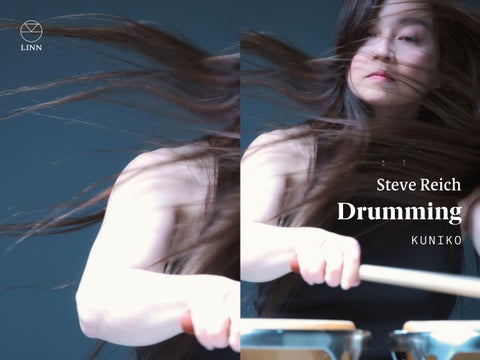
Cover Image Photograph of Kuniko by Michiyuki Ohba
Design stoempstudio.com
MENU
Steve Reich (b. 1936)
Drumming (1970–71)
70:04 Performed by
KUNIKO 1 — Part I 24:56 2 — Part II 20:20 3 — Part III 11:10
World premiere on 26–28 January 2018 at the Aichi Prefectural Arts Theater as a dance project entitled DOPE, commissioned and produced by the Aichi Prefectural Arts Theater.
4 — Part IV 13:38
Four pairs of tuned bongo drums Three marimbas Three glockenspiels Soprano and alto voices Whistling and piccolo
Technical Support Adams, Pearl, Neumann. Berlin, Sennheiser, Audio AG, Synthax Japan, RME, Sennheiser Japan Special thanks to: Seiji Murai, Takeshi Mitsuhashi, Takuro Nishizawa, Wolfgang Fraissinet, Jane Schroeder, Robert Hienerwadel, Kanta Mano, Michael Höpp, Kim Anna Knödler, Masaki Furukawa, Yoshinori Sekoguchi, Akiko Fujii, Eri Karatsu, Ai Kato, Motoko Uebayashi and APAT staff Drumming is published by Boosey & Hawkes Music Publishers Ltd.
MENU
Composer’s Notes
MENU
For one year, between the fall of 1970 and the fall of 1971, I worked on what turned out to be the longest piece I have ever composed. Drumming lasts from 55 to 75 minutes (depending on the number of repeats played) and is divided into four parts that are performed without pause. The first part is for four pairs of tuned bongo drums, stand-mounted and played with sticks; the second, for three marimbas played by nine players together with two women’s voices; the third, for three glockenspiels played by four players together with whistling and piccolo; and the fourth is for all these instruments and voices combined. While first playing the drums during the process of composition, I found myself sometimes singing with them, using my voice to imitate the sounds they made. I began to understand that this might also be possible with the marimbas and glockenspiels as well. Thus the basic assumption about the voices in Drumming was that they would not sing words, but would precisely imitate the sound of the instruments. The women’s voices sing patterns resulting from the combination of two or more marimbas playing the identical repeating pattern one of more quarter notes out of phase with each other. By exactly imitating the sound of the instruments, and by gradually fading the patterns in and out, the singers cause them to slowly rise to the surface of the music and then fade back into it, allowing the listener to hear these patterns, along with many others, actually sounding in the instruments. For the marimbas, the female voice
5
MENU
was needed, using consonants like ‘b’ and ‘d’ with a more or less ‘u’ (as in ‘you’) vowel sound. In the case of the glockenspiels, the extremely high range of the instrument precluded any use of the voice and necessitated whistling. Even this form of vocal production proved impossible when the instrument was played in its higher ranges, and this created the need for a more sophisticated form of whistle: the piccolo. In the last section of the piece these techniques are combined simultaneously with each imitating its particular instrument. The sections are joined together by the new instruments doubling the exact pattern of the instruments already playing. At the end of the drum section three drummers play the same pattern two quarter notes out of phase with each other. Three marimba players enter softly with the same pattern also played two quarter notes out of phase. The drummers gradually fade out so that the same rhythm and pitches are maintained with a gradual change of timbre. At the end of the marimba section, three marimbas played in their highest range are doubled by three glockenspiels in their lowest range so that the process of maintaining rhythm and pitch while gradually changing timbre is repeated. The sections are not set off from each other by changes in key, the traditional means of gaining extended length in Western music. Drumming shows that it is possible to keep going in the same key for quite a while if there are instead considerable rhythmic developments together with occasional, but complete, changes of timbre to supply variety.
6
MENU
I am often asked what influence my visit of Africa in summer of 1970 had on Drumming. The answer is confirmation. It confirmed my intuition that acoustic instruments could be used to produce music that was genuinely richer in sound than that produced with electronic instruments, as well as confirming my natural inclination towards percussion (I became a drummer at the age of fourteen). The transition from glockenspiels to the last section of the piece, for all instruments and voices combined, is made by a new musical process I call build-up and reduction. Drumming begins with two drummers building up the basic rhythmic pattern of the entire piece from a single drum beat, played in a cycle of twelve beats with rests on all the other beats. Gradually additional drumbeats are substituted for the rests, one at a time, until the pattern is completed. The reduction process is simply the reverse where rests are gradually substituted for the beats, one at a time, until only a section leads to a build-up for the drums, marimbas, and glockenspiels simultaneously. There is, then, only one basic rhythmic pattern for all of Drumming. This pattern undergoes changes of phase position, pitch, and timbre, but all the performers play this pattern, or some part of it, throughout the entire piece.
7
© Michiyuki Ohba
MENU
8
Steve Reich
MENU
Drumming
Reich-Freak time has come for me again. This is a phenomenon that may also recur cyclically throughout the world. It is possible to say that the recognition of contemporary music has spread all over the world with the pop ularity of Steve Reich, who created the genre of ‘minimal music’, and continues to compose groundbreaking music as of today. Going beyond percussion instruments, modern and classical circles, pop, techno and rock, his music is greatly enjoyed by many people. Fortunately Reich’s output includes plenty of pieces that can be played with percussion! It will usually be a group performance, but that too is very enjoyable. My challenge for this recording has been to play his wellknown piece Drumming. Since I began my Linn recordings with Reich’s Electric Counterpoint, Six Marimbas Counterpoint, New York Counterpoint and Vermont Counterpoint, continuing with Pärt, Xenakis and Bach, the opportunity to play his music again has come up quite naturally. That opportunity was provided by a dance project at the Aichi Arts Center in Nagoya, Japan, which is my home prefecture. The title ‘Dope’ had already been decided. I proposed Drumming as the music. Of course, if I was to do it, I wanted to do it completely by myself. I had been thinking that I wanted to do Drumming someday. But, I thought, can it actually, realistically be performed by one musician only? How is that possible in practice? While leaving the specifics to be sorted out on my 9
MENU
side, I asked Steve to see if he would allow me to do it alone at the beginning of 2017. As usual, his reply was highly respectful and came immediately! At the same time he was totally relaxed: ‘As to Drumming, I presume you mean overdubbing most all of the parts and then playing one of them live. Is that what you have in mind? That is fine with me.’ Steve Reich’s Drumming is a masterpiece for nine percussionists, two soprano/alto voices, piccolo and whistler – a total of twelve musicians – and lasts more than an hour. It is a work that is super-famous not only in the percussion world but also in the musical world in general. It is also celebrated in the dance world. Anne Teresa De Keersmaeker’s choreography of Drumming for Rosas has now become highly popular across the globe. The live version was created about twenty years ago with the contemporary ensemble Ictus, whose home since 1994 has been the Rosas dance company’s premises. In addition to the world premieres of that choreography of Drumming, and of Rain (on Music for 18 Musicians), I have performed Reich with the ensemble countless times worldwide, both on tour and in recordings; and at the Palais des Beaux-Arts in Brussels I also played with Reich himself (I will never forget the fantastic concert and the moment Steve lifted me up backstage). Even since I moved from Europe to America, Drumming has continued to be performed somewhere just about every day. There is no other work on the contemporary dance and music scenes that has been so regularly played and has been so strongly supported by fans worldwide.
10
MENU
Of course there is nothing better than a live performance by live musicians, but, because of the large number of players, problems and limitations are impossible to avoid. It is an indispensable prerequisite in Reich’s music to achieve the intended effects with the quality of each note and align them with millimetric precision. There are similar problems in performing Pléïades by Xenakis, which is very rarely given in its complete four-movement form. Knowing the difficulties and limitations of getting everything under control, I chose to find another way to face up to the challenge; and I was happy to find out that I could play the counterpoint and overcome all these difficulties by myself. Once I had committed myself, I really wanted to play the music as perfectly as possible, in a way that no one could replicate. As you read the score, you notice various things: all of a sudden one part becomes mezzo piano, or a slight difference in combination with the sound of the repeated pattern appears… Once I had recorded all the parts and examined the results I was convinced that this is the way the music is intended to be – it is all clearly calculated. In addition, assuming that Reich repeated his piece – proceeding by trial and error in the earlier stages – and identified the effect he required, I also think that he revised the score as he discovered the answers. From experience I am deeply aware of the difficulties of playing this music in live conditions. In addition to interacting with other musicians it is hard to discern clearly each and every rhythm and timbre on stage. The amplification system is another essential element to take into account (even though 11
MENU
everything is clearly marked in the score). The performance often does not work very well because of the dichotomy between the expected effect, knowledge and experience of the musicians and the actual result, particularly in classical music venues. Although I knew this vast work for twelve (or thirteen) players inside out, while I was recording it, I was surprised to discover new and impressive sounds, and a broad overall view opened out directly into my head through the headphones. I sensed that I had reached a point that cannot be experienced in any live ensemble performances. And at that moment I felt the confidence to complete this multi-tracked overdub. There was something there that could be realized as thoroughly as I had thought! When everything is fine-tuned, Reich’s music produces a tremendous effect. It is necessary for each person to listen to each other, to balance the sound and create a harmony. This may be natural for a section of wind instruments, but it can be the most difficult thing for percussion instruments to achieve. Some people may say: ‘What should we listen to, when there is no melody in percussion instruments?’ However, Reich’s music has a virtual harmony as the drums can be tuned. Of course, precision of rhythm, instantaneous sharp reactions and matching points in percussion are also satisfactory. But it is an extremely difficult technique to listen to both the sound that occurs in the moment and the vertical harmony with millimetric precision. Tempos tend to accelerate if you are just focusing on exactly matching rhythms, and there are many things that will get lost as you go beyond a certain speed. Of course playing in faster tempo may add some excitement, but on the other hand many sounds may pass 12
MENU
by without being noticed. Therefore I stuck to the tempo range 132–144 marked on the score and chose an actual tempo located between 139 and 141. Percussion instruments too have a ‘resonance’ in a single note and there is a ‘reverberation’: when the vertical harmony sounds instantaneously, there will be undulation in the rhythm, and then it becomes a groove or swing. In traditional music around the world, in Africa for example, there are modes and scales naturally derived from the land and the climate, when such melody, sound and groove are combined and undulation will happen. And then people start dancing to it. All music has rhythm and harmony. Reich’s music possesses a level beyond that. Indeed we can hear human voices in the harmony which become melodies. Reich himself actually sang out loud the sound that he heard naturally when he was composing and playing the drum parts. As a matter of fact, it has been said that this became the concept of Drumming. Such voices may tend not to be noticed but they play an important role. The soprano and alto parts in Part II are meticulously notated as far as the pronunciation is concerned. They are designed to imitate the sound of marimbas played with rubber mallets. As the voice comes in, the sound expands or stretches. I was also really surprised when I heard the piccolo and the whistling as I was playing the glockenspiel part. When you concentrate on some parts you can hear different sounds. Of course this varies with each person, and it creates a new enjoyable harmony.
13
If I may, I would like to refer here to some of my interactions with Steve, who gave me his permission to perform Drumming alone. The whole piece is well done and the marimba and glock and final sections strike me as the best. The beginning of the glock part is actually the best I’ve heard. In my ensemble years ago and in other ensembles today… I was very happy and relieved when I read this message from Steve after submitting a rough demo to him. I was also pleased to hear his compliment on the transition into Part III, being aware of all the difficulties and knowing he had performed it himself so many times. Part I is for drums (bongos) that must be tuned precisely; Part II is for marimbas; Part III is for glockenspiel. These percussion instruments are familiar to us in that they refer to the image of African music. Part IV is for all the instruments together. All the Parts progress without any breaks and that is one aspect of Reich’s magic. The transition to each new instrument is important, but it is difficult to make it successful with different material. The balance and selection of various mallets and sticks is indeed crucial. When successful the result can be breathtaking. For instance the change in tone colour made by the difference in hardness of the sticks in the last section of Part I is a truly splendid idea. In the aforementioned note, Steve Reich singled out the transition from marimba in Part II to glockenspiel in Part III. This is the most difficult section – especially when performed live as I did many times. In fact I have been seldom satisfied with the tone of this glockenspiel movement before this recor– 14
MENU
MENU
ding. Indeed, there are cases where the ensemble can struggle to play together; the metallic sounds make it hard to hear any pitches. In that respect I was very pleased to receive his compliment on this section, although I still felt the audio demo was not good enough. Then comes another difficult section, Part IV. Here all the instruments are combined, like the ritual of a festival, and summarize the piece in its entirety; this may sound easy to imagine, but it is something very few performances have managed successfully. There are only a few words marked in the score which I have tried to be faithful to so as to retain its balance and make use of all the sounds without missing any notes. As a result you can pick up some previously unheard sounds, and the construction becomes much clearer. This final movement turns into something really astonishing. At the end of his message Steve said: ‘My hope is always that people will just perform my pieces first by giving close attention to the score and then interpret them as they feel they will sound best. So, ultimately, I leave it to you and thank you for your continued devotion to my music.’ Drumming was composed in 1971. However, we will never sense that the piece is dated. Its pioneering structure, sound and blend are still remar– kable. After working on Drumming for months I believe my mission is to draw all I can out of this masterpiece, add another breath to it, and then diffuse it to the world once more.
15
MENU
If you meet Steve he will talk to you in a friendly way in his jeans and his cap, at odds with the precision of his music. It is an irreplaceable bliss that I have been able to perform his works and engage with such a great composer. I am truly happy to have worked on his masterpiece Drumming and to have challenged myself to do it all alone. I hope that with this recording I will succeed in sharing this joy with everyone in the world. Reich’s music makes me feel something like bottomless brightness, a life force and energy similar to a mandala where nature and humans coexist in sound. It would be my greatest hope to take my listeners to such an exciting and vital sound world. Finally I would like to thank the members of my recording team and the people who have lent their support, and express my respect and gratitude to Steve Reich, who has given us a wonderful work.
‘Kuniko has made the first
© Kuniko, 2018
recording of Drumming where one musician plays and sings all the parts of the piece and records them via overdubbing. The result is like a microscopic close up of the piece where all the finest details are heard with amazing clarity. I found it a remarkable pleasure to hear. Bravo!’ – Steve Reich
16
MENU
© Michiyuki Ohba
17
Kuniko
MENU
percussion
Kuniko is one of the most gifted percussionists of her generation. Her astonishing virtuosity, exquisite musical insight and expressive yet elegant performance style continue to attract not only audiences, but established conductors and composers too. She is renowned for her flawless technique when playing both keyboard and percussion instruments, which blends seamlessly with her profound musical intelligence. Kuniko studied under the legendary marimba player Keiko Abe at the Toho Gakuen School of Music in Tokyo and advanced her studies under Robert van Sice at Rotterdam Conservatorium in the Netherlands. She graduated with the highest honour (summa cum laude) as the first percussionist in the institution’s history. After graduation she was based in Europe for over ten years, winning major awards including the Kranichsteiner Musikpreis from the Internationales Musikinstitut Darmstadt in 1996 and second prize at the International Leigh Howard Stevens Marimba competition in 1996. In 1997 Kuniko recorded James Wood’s Marimba Concerto in London where her performance was highly complimented by the BBC. In addition, she was a guest soloist at the James Wood portrait concert at the 2001 Huddersfield Contemporary Music Festival which was broadcast on BBC Radio 3. In 1999 she released her first solo album To The Earth. 18
MENU
Subsequent career highlights include the Japanese premiere of the music theatre production of Wood’s The Pure Land (Jôdo) in 2005; and in May 2006 the revival of the percussion concerto Cassiopeia by Tōru Takemitsu as part of the Takemitsu Memorial Concert at Tokyo Opera City in Japan. The performance was recorded live and released on a limited edition CD. During 2008–09 Kuniko showcased a solo recital at the University of São Paulo (first International Percussion Festival), appeared at the historic Monday Evening Concert series in Los Angeles, performed a solo recital at Vancouver New Music Society and gave the Japanese premiere of Unsuk Chin’s Double Concerto at the Suntory Summer Festival. In March 2009 Kuniko created a new live performance, Sound Space Experiment – Steel Drum Works, in Tokyo. At this performance she gave the world premiere of Steve Reich’s Electric Counterpoint, transcribed for steel pans, marimba and vibraphone by the composer. In 2010 she was invited to perform concerts and masterclasses in Canada, Australia, Portugal, Congo and South Africa. Kuniko also performed Steel Drum Works in Vancouver, Saitama and Itami, and at the international music festival Les Flâneries Musicales de Reims in France in 2011. Kuniko’s critically acclaimed recording kuniko plays reich, released on Linn Records in 2011, features unique multi-tracked arrangements of classic minimalist works from the 1980s by Reich. Kuniko performed her Reich arrangements live in Tokyo, New York, Modena, Reims and at the Cheltenham Festival in England in 2011. She conducted a world tour in 2012 including multiple performances in Japan, Paris, Madrid, Barcelona and Köln, a major residency in Armenia and a tour of Australia. ‘kuniko plays reich in Kyoto’ concert which was presented at Kyoto Arts Centre in 2012, received the prestigious twelfth Keizo Saji Award by Suntory Arts Foundations. 19
MENU
In 2013 her eagerly awaited second album from Linn was globally released, featuring the premiere percussion arrangements of four of the great Estonian composer Arvo Pärt’s signature works. The album is entitled Cantus and was in the UK’s Top 10 Specialist Classical Chart. This album also received the ‘Best Recording’ Award at Japan’s Music Pen Club’s twenty-sixth Music Awards. In 2015 Kuniko released the major percussion works Pléïades and Rebonds by the great twenty-century composer Iannis Xenakis. The album was double-nominated in the ‘Best Contemporary Music’ and ‘Best Recording’ categories at the Japan Academy Awards. 2017 saw the release of Solo Works for Marimba, which saw Kuniko turn to the cello suites and violin sonatas of J. S. Bach. This album debuted at number 2 on Japan’s Classical Billboard Chart, was named the bestselling album of the year from Linn Records and received the Grand Prize at the tenth Japan’s CD Shop Award. Kuniko is strongly committed to music education through percussion workshops, masterclasses and open rehearsals whenever possible in conjunction with her solo recitals. She has been working with learning-disabled children in Japan since 2004, including a series of log drum (slit drum) workshops. Kuniko is the only Japanese artist signed to Linn Records. She is endorsed globally by Pearl and Adams (NL). She currently resides in USA.
20
© Michiyuki Ohba
MENU
21
MENU
Also available on Linn
CKD 585
CKD 432
KUNIKO Bach: Solo Works for Marimba
KUNIKO CANTUS
CKD 495
CKD 385
KUNIKO Xenakis: IX
KUNIKO kuniko plays reich
22
MENU
CKD 585
CKD 432
CKD 495
CKD 385
23
MENU
FOR EVEN MORE GREAT MUSIC VISIT LINNRECORDS.COM