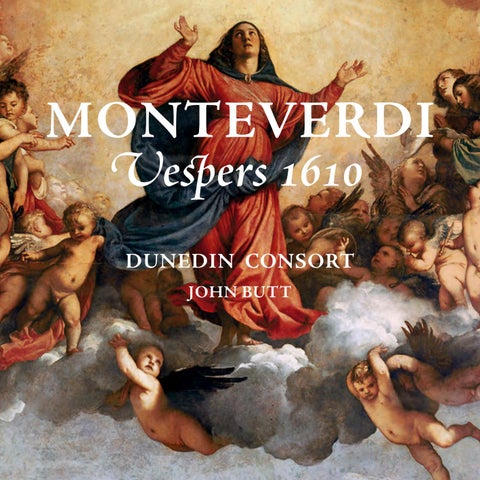
MONTEVERDI Vespers 1610 DUNEDIN CONSORT JOHN BUTT
MENU Tracklist
Programme Note
Text and Translation
Biographies
Credits
Français
Deutsch
MONTEVERDI Vespers 1610 DUNEDIN CONSORT • JOHN BUTT
Joanne Lunn, Esther Brazil soprano Amy Lyddon, Rory McCleery alto Joshua Ellicott, Matthew Long, Nicholas Mulroy, Peter Harris tenor Peter Harvey, William Gaunt bass His Majestys Sagbutts & Cornetts
Claudio Monteverdi (1567–1643)
Vespers 1610 q Deus in adiutorium............................................................................... 2:21 w Psalm Dixit Dominus.......................................................................... 8:27 e Concerto Nigra sum........................................................................... 4:18 r Psalm Laudate pueri Dominum............................................................ 6:44 t Concerto Pulchra es........................................................................... 3:50 y Psalm Laetatus sum.............................................................................. 6:50 u Concerto Duo Seraphim.................................................................... 6:16 i Psalm Nisi Dominus............................................................................ 4:53 o Concerto Audi coelum....................................................................... 9:17
2
1) Psalm Lauda Jerusalem......................................................................... 4:38 1! Sonata sopra Sancta Maria..................................................................... 7:36 1@ Hymn Ave maris stella.......................................................................... 8:55
Magnificat
f Magnificat....................................................................................... 0:44
g Et exultavit spiritus meus................................................................. 1:24
h Quia respexit humilitatem............................................................... 1:46
j Quia fecit mihi magna..................................................................... 1:13
k Et misericordia eius......................................................................... 2:17
l Fecit potentiam in brachio suo........................................................ 0:57
1( Deposuit potentes de sede............................................................... 2:22
2) Esurientes implevit bonis................................................................. 1:36
2! Suscepit Israel puerum suum........................................................... 1:25
2@ Sicut locutus est.............................................................................. 1:04
2# Gloria Patri..................................................................................... 2:27
2$ Sicut erat in principio...................................................................... 2:28
Total Running Time: 94 minutes
3
Monteverdi: Vespers 1610 By any measure, it is difficult to dispute that Monteverdi is the most significant composer in western music during the first three decades of the seventeenth century. At a time of intense experimentation and remarkable stylistic diversity, he was able to develop a compositional logic for virtually every piece he wrote: the rules he pushed to the very limit were more often than not those that he simultaneously set for the work at hand. It was Monteverdi who wrote the most significant and enduring operas, right at the beginning of the tradition, developing tremendous finesse in music drama and characterization. Simultaneously, he was operating at the very end of the madrigal genre, musically matching several types of literary achievement and developing a subtlety of musical imitation and narration that was scarcely rivalled for many years to come. The Vespers of 1610 might seem to come from the far more conservative world of church music (although the fact that Monteverdi held the position of maestro di cappella at San Marco in Venice from 1613 until the end of his life suggests that he hardly considered work for the church as a poor sideline to the increasingly prestigious world of opera). The 1610 publication also contained a Mass written in traditional church style (i.e. polyphonic and in this case based on ten melodic fragments from a motet by Nicolas Gombert), paired with the Vespers, which displays a variety of more modern styles: polychoral textures, virtuoso vocal coloratura, madrigalian vocal polyphony and expressive solo monody and duets, together with some of the most ambitious instrumental music to date.Yet the whole work is suffused with references to the church at its most traditional, with Monteverdi’s incessant use of the Gregorian psalm tones for the five extensive
4
psalm settings, the seven-part Magnificat (Monteverdi also provided a six-part version, for institutions without instrumentalists, not recorded here), the chant for the Litany, which is integrated within an exuberant instrumental sonata, and the multi-verse setting of the Latin hymn ‘Ave maris stella’. As a compendium – and indeed amalgamation – of so many of the musical sounds of the day, the Vespers must have been impressive to anyone lucky enough to have acquired the eight printed partbooks of 1610, and something of its compendious nature is surely evident even on a relatively casual hearing today. There is no doubt that Monteverdi wanted to show off his skills, perhaps in the wake of the period of intense overwork and personal trauma that he had just been experiencing at the Mantuan court, perhaps in order to impress the dedicatee (Pope Paul V) sufficiently to gain favour, together with a place for his young son in the Roman seminary. Perhaps he already had designs on prestigious posts such as that which he eventually acquired at San Marco. Another issue, to which Monteverdi alludes in his dedication, is the fact that he had faced some considerable criticism. The conservative theorist Giovanni Maria Artusi (and, later, the mysterious Antonio Braccino) attacked Monteverdi’s compositions for violating the eternal rules of counterpoint and incorporating the sort of corruptions that expressive singers regularly brought to supposedly finished compositions. Monteverdi, with the help of his brother, Giulio Cesare, defended his position by suggesting that Artusi’s criticisms related to the ‘first practice’ – the traditional polyphony of the sixteenth century, where the words were subservient to the musical structure – rather than to pieces in the ‘second practice’, where words (and their expressive content) were the ruler of the harmony rather than vice versa.
5
Nevertheless, Monteverdi went well beyond the ‘second practice’, at least in so far as that was already becoming associated with relatively simple monodic songs and operatic recitative, where music was deemed to imitate the ancient Greek subservience of music to every nuance of the text. The style is most clearly demonstrated in the first two of the motets that come between the psalm settings of the Vespers, ‘Nigra sum’ and ‘Pulchra es’. In musical style and address these settings from the Song of Songs are essentially highly impassioned love songs, full of searing dissonance and yearning vocality; but virtually everything else is an amalgam of contemporary styles, entirely subverting the notion of merely the two practices. Surprisingly little is known about how Monteverdi might have used this music in the context of his court role at Mantua (where he was not specifically a church musician), nor how he might have reused it in Venice (although manuscript copies and a single later printed source suggest that at least some of the music was known in the succeeding years). The most obvious Mantuan connection is the opening Response, which elaborates the ‘toccata’ that opens the opera Orfeo (1607), something which might have been planned to remind the Pope of his recent visit to Mantua. The dedication to the Virgin has led several scholars to look for a close association with the princely basilica of Santa Barbara in Mantua, since a dedication to that saint is easily modified into a more general Marian devotion. What speaks both for and against earlier performances is the fact that there is a difference in style between the first three psalms and the remaining two (‘Nisi Dominus’ and ‘Lauda Jerusalem’): given that the latter are in a more traditional style, alluding to Gabrieli’s polychoral idiom and presenting
6
a greater consistency of texture and rate of text. The first three settings (‘Dixit Dominus’, ‘Laudate pueri’ and ‘Laetatus sum’) are radical in their range of textures and their finely balanced and complex formal pacing; the comparative increase in errors in the original print might also point to these being later settings, perhaps put together specifically for the 1610 publication (Jeffrey Kurtzman has examined these two notional stages in some detail). Much ink has been spilled over the role of the ‘motets’ (and the ‘Sonata sopra Sancta Maria’) which follow each of the psalms, the usual supposition being that most of these are locally approved substitutes for the appropriate antiphons that would precede and follow each psalm (thus the correct antiphon might be performed before the psalm and the motet afterwards). Even here there are problems, though: the Litany inserted into the sonata seems to be an entirely different genre and ‘Duo Seraphim’ seems to relate to a Trinitarian rather than Marian feast (but this might link it to an earlier devotion to St Barbara, who was martyred for her Trinitarian beliefs). If much of this music was performed in Mantuan services it might be problematic to assume that it relates to a single and separate event. Monteverdi, in his printed dedication, notes that the music in the publication is suitable for chapels or princely chambers (something that has, surely incorrectly, sometimes been read to imply that the Mass was for churches and the Vespers for courts). Certainly, the Vespers, with the rubric that the instrumental ritornelli in ‘Dixit Dominus’ may be omitted, together with the non-instrumental alternative setting of the Magnificat, seems to have been compiled with some degree of flexibility in mind. Indeed, Roger Bowers believes that it is appropriate to describe it as a ‘miscellany’ rather than the music for a discrete service,
7
something that choir directors could choose from according to circumstances (John Whenham likewise refers to it as a ‘portfolio’).Yet the fact that the settings follow the sequence of a service and that there is only one alternative setting offered does imply that the music largely constitutes a Vespers-like sequence (obviously omitting any spoken components of a service, together with any other chanted elements). In other words, the musical aspects of the structure of Vespers form a sort of whole in their own right. We begin with the opening Response ‘Domine ad adiuvandum’, sung in a magnificent setting that impersonates repetitive falsobordone chanting on a single chord and is accompanied by the full complement of instruments, each line providing a range of fanfare motifs. The first psalm setting, ‘Dixit Dominus’, also has optional instruments and settles into a pairing of each half of the psalm tone, creating a sequence of varied vocal texture followed by a falsobordone response, which in turn becomes a sequence of brilliant sequential patterns. In all, we get a sense of the psalm chanting being impersonated (not least in the repetitive opening, which seems to imply that more than one cantor has turned up; Whenham terms this a ‘parody’ of the cantor’s initiation of the psalm). The setting is so suffused with the simplicity of the chant and the striking virtuoso devices surrounding it that there is almost an uncanny sense of a distorted sort of liturgy that impersonates itself on several levels. Exactly the same sense is evident in the next two psalms (‘Laudate pueri’ and ‘Laetatus sum’): the first begins like a motet based on syncopations of the chant and ends with a fade-out (as if we were moving away from the singers in a large building); the second is constructed out of the shuttling of three different bass patterns,
8
over which an astonishing diversity of vocal idioms surrounds the chant. Here the repetitions bring an intensification of the materials. While the last two psalms (‘Nisi Dominus’ and ‘Lauda Jerusalem’) are more conventional, there is still a sense of the impersonation of chanting and improvisation, especially in the opening of ‘Nisi Dominus’, where the bass line and psalm tone (in canon) move very slowly underneath multiple imitations between the voices. There is almost the illusion here of a large double-choir texture heard in slow motion, with the quick interchanges between voices seeming to take place against an overall sense of glacial progress. Between the psalms come the motets, all based on Marian themes, except ‘Duo Seraphim’. These show a sense of intensification, leading from monody (‘Nigra sum’) through duet (‘Pulchra es’) and a wonderfully elaborate trio of echoing tenors (‘Duo Seraphim’) to the full six-part texture that closes ‘Audi coelum’ (the opening tenor section is based around echoes that wittily change the last word of each line through echoing only the last syllables). The most concise psalm, with the fastest progress of text, is ‘Lauda Jerusalem’. It is followed by the largest insert so far, the ‘Sonata sopra Sancta Maria’, a dazzling display of instrumental virtuosity that has a symmetrical overall structure over which the repeated litany becomes increasingly fragmentary, almost stressing its redundancy within the chattering dialogue of strings and brass. A degree of calm is provided by the hymn ‘Ave maris stella’, the outer verses of which also seem to present the hymn in slow motion. The inner verses comprise simple choral harmonizations and solo verses, interspersed with instrumental ritornelli. The entire work is rounded off by the canticle for Vespers, the Magnificat, which,
9
with its short multiple verses, is rather like a distillation of the sorts of figuration we have already heard in the previous settings. It is rounded off by the tutti ‘Sicut erat’, which, with its full instrumentarium, matches the sonority of the opening response but with yet more of that sense of slow-motion polyphonic illusion. Particularly striking are the vocal and instrumental echo effects throughout the Magnificat, some of which sound out of phase with the accompanying bass lines, as if our hearing were confused by a roomy acoustic or the progress of time had suddenly become blurred. In sum, Monteverdi seems to have intuited that the music of Vespers itself forms a sort of potential event that doubles and even impersonates the actual liturgy. Hearing the work today outside an actual service renders it rather like a sort of virtual Vespers service, one which models and manipulates our experience in real time, as if our memories of various previous services were being superimposed within a single experience. Paradoxically, the sheer density of chant quotation heard in the majority of movements is the feature that seems to take it beyond an actual service, the sense of excess sometimes emphasized by hearing the tone at different pitch levels, or regularly repeating the entire psalm tone with its opening intonation (as in ‘Nisi Dominus’ – normally the intonation is omitted after the first verse and the tone begins with its reciting note). It is perhaps this excessive and self-reflexive nature of the Monteverdi Vespers, engaging our listening abilities in interesting ways, that renders the work so successful for a modern audience, since it contains so many of the structural and reflexive features of much later concert repertory. Obviously, Monteverdi could hardly have planned this as a ‘classical’ concert work, but there is surely no
10
doubt that he gave unusual attention to the overall shape of a setting that is as much ‘about’ Vespers as potential music for a service. His insights into the way we hear, remember and persist in the moment-by-moment progress of a ritual is surely outstanding, marking this out as one of the most remarkable artistic achievements of the early modern period.
Performing issues This recording goes somewhat against a tendency in much recent research and historical performance, which is towards recovering something of the liturgical origins of these Vespers settings. While it is highly likely that at least some of the music originated in services in Mantua, our starting point is the music as Monteverdi presented it to the outside world in 1610, as a representation of his compositional prowess. There is the obvious danger here of anachronistically defining the Vespers as a canonic ‘concert work’ – particularly given its great success precisely in that very modern genre.Yet, as is evident above, I do view this piece as extremely unusual, reflecting a composer’s compilation of an idealized, ‘imaginary’ vespers service, one that seems to play on the accumulated experience of hearing numerous liturgies and in turn doubling the experience of listening. What, in such circumstances, is the purpose of attempting a historically informed performance? First, in assuming that much of this music 11
began life in actual performance, it might be worthwhile exploring what some of the parameters of that performance might have been. Second, and more importantly, it must surely be important to consider how elements of the performing style, opportunities and limitations surrounding Monteverdi must have influenced the way he wrote the music in the first place. The first obvious question to ask concerns the fundamental pitch, which is impossible to determine with absolutely accuracy. Nevertheless, there is a tremendous amount of evidence from surviving organs, cornetti, treatises and written testimonials about differences in local pitch. The possibilities seem to range from something a little sharper than modern pitch at a' = 440Hz towards something over a semitone higher. Certainly, a pitch a semitone above modern concert pitch seems a reasonable inference, i.e. a' = 466Hz. Another consideration, one that has exercised scholars for several decades, is the view that two of the sections, the ‘Lauda Jerusalem’ and Magnificat, should be transposed down around a fourth on account of the high clefs (‘chiavette’ or ‘chiavi alte’) used in the notation. Jeffrey Kurtzman has provided copious evidence that this was a regular convention for pieces in which the ranges were slightly lower, and helped avoid excessive ledger lines for the printer. While most historically informed performers have accepted this convention for the Monteverdi Vespers, at least one recent scholar, Uwe Wolf, has claimed that the convention was becoming redundant in the early seventeenth century and that it did not generally apply to instrumental music in any case. However, Kurtzman reminds us that the organ score of the Mass portion of the 1610 publication presents the vocal parts transposed down. Moreover, if the ‘Lauda Jerusalem’ is indeed of
12
earlier composition, this is a piece without instruments and sounds excessively high if performed at notated pitch. In all, it does indeed seem that downwards transposition is the most plausible reading of the notation (and at a' = 466Hz the very deep bass parts of the ‘Et misericordia’ become rather more viable than at a lower fundamental pitch). Another area that has generated enormous controversy was sparked by Roger Bowers’s contention that many of the so-called ‘time signatures’ dividing contiguous sections of music were in fact intended as proportions, as indicated by numerous sources from the late Renaissance. The upshot of taking these indications literally means that some sections of the music in triple time (the first noticeable one being the section ‘Suscitans a terra’ from the ‘Laudate pueri’) come out rather slower than they have tended to in recent performance practice. Bowers’s approach has been vehemently opposed by Uwe Wolf, while Kurtzman – who opposes a literalistic interpretation of the proportions – has come out more with a middle path: some degree of proportionality is appropriate in certain sections, at least. Kurtzman makes a particularly useful contribution in noting that the length of the bars either side of a signature change in the ‘bassus generalis’ part may sometimes provide a clue as to how the tempi might relate. It has to be acknowledged that both the virtuosity and multiple styles of the music push the available notation to its very limits and that there are many different ways that tempo could have been established in the pluralistic system of the age. My approach on this recording has been to take the notated proportions as at least a starting point for tempo relations, on the assumption that the majority of Monteverdi’s performers would have been
13
brought up with this expectation in mind. It also seems important to bear in mind that the theory of ‘tactus’ revolves around a larger two-part beat, so that it is sometimes shortsighted to concentrate on the beat alone; in other words, attention to the larger grouping often makes it more ‘natural’ to derive, for instance, a 3/2 proportion within the component beats (i.e. a tactus divided into three beats is the same duration as the previous two beat one). While there is absolutely no certainty as to whether Monteverdi intended precise forms of tempo relationship, attention to this issue does have the potential to allow for a rethinking of various forms of metre, particularly triple, which, in a work of such vigour and energy, do not all have to be extremely swift (and, indeed, a relentlessly fast pulse restricts the opportunities for free vocal and instrumental ornamentation and dynamic shaping of longer notes). In the case of a piece like the ‘Sonata sopra Sancta Maria’, a proportional approach allows the sung chant of the litany to proceed at a consistent speed with a closer relationship between the length of successive iterations of the chant. Finally, the exercise of relating various components of each movement to each other contributes to the unifying of the experience and therefore to the roundedness that the Vespers as a whole might seem to exemplify. Vocal scoring is yet another question that has caused tremendous dispute within discussion of historically informed performance of music from the seventeenth and eighteenth centuries. Predictably – for a time of such change and stylistic expansion – the possibilities in Monteverdi’s age are quite broad. It was certainly possible to have several voices to a part in polyphonic performance and polychoral practice often seems to have allowed for a choir of specialist soloists
14
to be in dialogue with at least another choir comprising multiple ripienists. Given that the Monteverdi Vespers cannot easily be performed from the eight partbooks alone (there are several occasions where there is more than one vocal or instrumental part provided simultaneously), it is likely that some degree of scoring choice was anticipated. Nevertheless, the rubrics for the ‘Laudate pueri’ and ‘Audi coelum’ seem specific about the use of solo voices for the polyphonic sections, from which it could equally be inferred that the other choral sections either followed suit or indeed presupposed a larger scoring. Given the flexibility implied in the instrumental scoring, I have adopted a flexible approach to vocal scoring. Taking ‘Nisi Dominus’, which has the largest number of independent voices – ten – as the full vocal complement, the remainder of the work is either sung with single voices or, when doubling parts are available and the writing seems to allow for it, with more voices on some parts (as in the opening Response and the full sections of the Magnificat, both of which also include a large number of instruments). Again, this approach seems to contribute towards the notion of hearing the work as a unified whole, with consistent vocal sonorities, that has at least the capacity to stand alone outside the liturgy. It does seem noticeable that the instruments appear in the first two numbers and then reappear in the last third or so of the work, as if to contribute to both a rounded and a cumulative sonority. Although the possibility of instrumental doubling in some of the psalms is certainly a possibility within the practice of the day, there does seem to be a logic to the way the existing instrumental parts are provided. In this recording, the only place where we add colla parte instrumental scoring is in the closing section of the Gloria in ‘Dixit Dominus’.
15
Virtually all the decisions on performance practice, as mentioned so far, come within traditions of heated dispute. One final area, however, opens up a completely different type of dispute. This centres on finding the appropriate Italian organ to use for music such as the Monteverdi Vespers. Such organs are extremely rare in the United Kingdom, and the costs of removal or of undertaking the entire recording in Italy would be entirely prohibitive.Yet the small chest organs in common use for continuo purposes are only adequate for certain moments, particularly given that Monteverdi gave quite detailed registration instructions in the Magnificat, which clearly show the narrow-scaled principale sounds of the Italian style organ are intended. This sort of sound is wonderfully integral to the vocal and instrumental timbres and greatly enhances blend, ensemble and (meantone) tuning. The solution here (at least for the main organ – a chest organ, harpsichord and theorbo were also used for the realization of the ‘bassus generalis’) was to employ the Hauptwerk virtual organ system. This, it must be stressed, is not equivalent to an ‘electronic organ’ in its traditional sense; the system involves recording every single pipe of the organ multiple times (in this case an organ of Venetian origin from the early eighteenth century) and then making these samplings available to the player via an appropriate keyboard. In other words, this aspect of the recording is essentially a recording of another recording, as if the organist were playing the instrument in its original location and the sounds were relayed to Greyfriars Kirk in Edinburgh, where this recording took place. © John Butt, 2017 For a version of these notes with references and bibliography, see www.dunedin-consort.org.uk 16
q Deus in adiutorium
Psalm 69 (70): 2
Joshua Ellicott tenor Tutti Voices Deus in adiutorium meum intende. Domine ad adiuvandum me festina.
God, come to my help. Lord, hurry to help me.
Gloria Patri et Filio et Spiritui Sancto. Sicut erat in principio, et nunc, et semper, et in saecula saeculorum. Amen. Alleluia.
Glory be to the Father and to the Son and to the Holy Spirit. As it was in the beginning, is now, and always shall be, for ever and ever. Amen. Alleluia.
w Dixit Dominus
Psalm 109 (110)
Joanne Lunn, Esther Brazil soprano Matthew Long, Joshua Ellicott (Gloria), Nicholas Mulroy, Peter Harris tenor Peter Harvey bass Dixit Dominus Domino meo: sede a dextris meis. Donec ponam inimicos tuos scabellum pedum tuorum. Virgam virtutis tuae emittet Dominus ex Sion: dominare in medio inimicorum tuorum. Tecum principium in die virtutis tuae in splendoribus sanctorum: ex utero ante luciferum genui te. Iuravit Dominus, et non paenitebit eum: tu es sacerdos in aeternum secundum ordinem Melchisedech. Dominus a dextris tuis; confregit in die irae suae reges. Iudicabit in nationibus; implebit ruinas, conquassabit capita in terra multorum. De torrente in via bibet; propterea exaltabit caput.
The Lord said to my Lord: sit at my right hand. Until I make your foes a stool beneath your feet. The Lord will extend from Zion: the sceptre of your power rule in the midst of your foes. Yours the princely rank from your birth day in holy splendour: like dew before the day star I have begotten you. The Lord has sworn and will not repent: you are a priest forever, a priest like to Melchisedech. The Lord is at your right hand; he will shatter kings on the day of his wrath. He will judge the nations; heap up the slain, destroy the leaders far and wide. On his way, he will drink of the torrent; so that he will look up in triumph.
18
Gloria Patri et Filio et Spiritui Sancto. Sicut erat in principio, et nunc, et semper, et in saecula saeculorum. Amen.
e Nigra sum
Glory be to the Father and to the Son and to the Holy Spirit. As it was in the beginning, is now, and always shall be, for ever and ever. Amen.
Song of Songs 1: 4–5; 2: 10–12
Nicholas Mulroy tenor Nigra sum sed formosa, filiae Jerusalem. Ideo dilexit me rex et introduxit me in cubiculum suum et dixit mihi: surge, amica mea, et veni. Iam hiems transiit, imber abiit et recessit. Flores apparuerunt in terra nostra, tempus putationis advenit.
r Laudate pueri Dominum
I am black but beautiful, O daughters of Jerusalem. Therefore, the king loved me and led me to his chamber and said to me: rise, my love, and come. The winter has now passed, the rain is over and gone. Flowers have appeared in our land, the time of pruning has come.
Psalm 112 (113)
Joanne Lunn, Esther Brazil soprano Amy Lyddon, Rory McCleery alto Joshua Ellicott, Nicholas Mulroy tenor Peter Harvey, William Gaunt bass Laudate pueri Dominum, laudate nomen Domini. Sit nomen Domini benedictum, ex hoc nunc, et usque in saeculum. A solis ortu usque ad occasum, laudabile nomen Domini. Excelsus super omnes gentes Dominus, et super coelos gloria eius. Quis sicut Dominus Deus noster, qui in altis habitat, et humilia respicit in coelo et in terra? Suscitans a terra inopem, et de stercore erigens pauperem: ut collocet eum cum principibus,
Praise, ye servants, praise the Lord, praise the name of the Lord. Let the name of the Lord be praised, from now on, and forever. From the rising of the sun to its setting, the name of the Lord is to be praised. The Lord is exalted above all people, and his glory above the heavens. Who is like the Lord our God, who lives on high, and who looks down on the heavens and the earth? Lifting the needy from the ground, and raising up the poor from the dungheap: that they may be seated with princes,
19
cum principibus populi sui. Qui habitare facit sterilem in domo, matrem filiorum laetantem.
with the princes of his people. He who made the barren woman to live at home, a joyful mother of children.
Gloria Patri et Filio et Spiritui Sancto. Sicut erat in principio, et nunc, et semper, et in saecula saeculorum. Amen.
Glory be to the Father and to the Son and to the Holy Spirit. As it was in the beginning, is now, and always shall be, for ever and ever. Amen.
t Pulchra es
Song of Songs 6: 3–4
Joanne Lunn, Esther Brazil soprano Pulchra es, amica mea, suavis et decora filia Jerusalem. Pulchra es, amica mea, suavis et decora sicut Jerusalem, terribilis ut castrorum acies ordinata. Averte oculos tuos a me, quia ipsi me avolare fecerunt.
y Laetatus sum
You are beautiful, my love, a charming and graceful daughter of Jerusalem. You are beautiful, my love, charming and graceful like Jerusalem, terrible like an army arrayed for battle. Turn your eyes from me, for they make me flee.
Psalm 121 (122)
Joanne Lunn soprano Amy Lyddon, Rory McCleery alto Matthew Long, Nicholas Mulroy, Peter Harris tenor Peter Harvey bass Laetatus sum in his quae dicta sunt mihi: in domum Domini ibimus. Stantes erant pedes nostri in atriis tuis, Jerusalem. Jerusalem, quae aedificatur ut civitas: cuius participatio eius in idipsum. Illuc enim ascenderunt tribus, tribus Domini: testimonium Israel ad confitendum nomini Domini. Quia illic sederunt sedes in iudicio,
I was glad when they said to me: we will go to the house of the Lord. Our feet were standing in your halls, Jerusalem. Jerusalem, that was built as a city: that is at one with itself. For there the tribes went up, the tribes of the Lord: witnesses of Israel, to thank the name of the Lord. For there were the seats of judgement,
20
sedes super domum David. Rogate quae ad pacem sunt Jerusalem: et abundantia diligentibus te. Fiat pax in virtute tua: et abundantia in turribus tuis. Propter fratres meos et proximos meos, loquebar pacem de te; propter domum Domini Dei nostri, quaesivi bona tibi.
the seats of the house of David. Pray for peace in Jerusalem: and wealth for those who love you. May there be peace in your walls: and wealth in your palaces. On behalf of my brothers and my neighbours, I sought peace from you; on behalf of the house of the Lord our God, I sought good things for you.
Gloria Patri et Filio et Spiritui Sancto. Sicut erat in principio, et nunc, et semper, et in saecula saeculorum. Amen.
Glory be to the Father and to the Son and to the Holy Spirit. As it was in the beginning, is now, and always shall be, for ever and ever. Amen.
u Duo Seraphim
Isaiah 6: 2–3; 1 John 5: 7
Matthew Long, Joshua Ellicott, Nicholas Mulroy tenor Duo Seraphim clamabant alter ad alterum: sanctus, sanctus, sanctus Dominus Deus Sabaoth. Plena est omnis terra gloria eius. Tres sunt, qui testimonium dant in coelo: Pater,Verbum et Spiritus Sanctus. Et hi tres unum sunt.
i Nisi Dominus
Two Seraphim cried to each other: holy, holy, holy is the Lord God of Sabaoth. The whole earth is full of his glory. There are three who bear witness in heaven: the Father, the Word and the Holy Spirit. And these three are one.
Psalm 126 (127)
Tutti Voices Nisi Dominus aedificaverit domum, in vanum laboraverunt qui aedificant eam. Nisi Dominus custodierit civitatem, frustra vigilat qui custodit eam. Vanum est vobis ante lucem surgere: surgite postquam sederitis, qui manducatis panem doloris. Cum dederit dilectis suis somnum:
Unless the Lord builds a house, in vain do those who labour build it. Unless the Lord guards a city, futilely does he who watches guard it. It is vain for you to rise up early: you get up before you have gone to bed, you who eat the bread of misery. For he has granted to those he loves rest:
21
ecce haereditas Domini, filii: merces, fructus ventris. Sicut sagittae in manu potentis: ita filii excussorum. Beatus vir qui implevit desiderium suum ex ipsis: non confundetur cum loquetur inimicis suis in porta.
behold an inheritance from the Lord – sons: a reward, the fruit of the womb. As arrows in the hand of powerful man: such are sons born in your youth. Blessed is the man who has filled his desire with these: he will not be confounded when he speaks with his enemies at the gate.
Gloria Patri et Filio et Spiritui Sancto. Sicut erat in principio, et nunc, et semper, et in saecula saeculorum. Amen.
Glory be to the Father and to the Son and to the Holy Spirit. As it was in the beginning, is now, and always shall be, for ever and ever. Amen.
o Audi coelum Joanne Lunn soprano Amy Lyddon, Rory McCleery alto Matthew Long, Joshua Ellicott (echo), Peter Harris tenor Peter Harvey bass Audi coelum, verba mea, plena desiderio et perfusa gaudio … (audio) Dic, quaeso, mihi: quae est ista quae consurgens ut aurora rutilat, ut benedicam? … (dicam) Dic nam ista pulchra ut luna, electa ut sol, replet laetitia terras, coelos, maria … (Maria) Maria virgo illa dulcis, praedicata de propheta Ezechiel, porta orientalis … (talis) Illa sacra et felix porta, per quam mors fuit expulsa, introducta autem vita … (ita) Quae semper tutum est medium inter homines et Deum pro culpis remedium … (medium)
Hear, O heaven, hear my words full of longing and suffused by joy … (I hear) Tell me, I beg: who is she that shines like the rising dawn, so that I might bless her? … (I will say) Tell, for she, beautiful as the moon, exquisite as the sun, fills with joy the earth, the heavens and the seas … (Mary) Mary, that sweet virgin foretold by the prophet Ezekiel, the gate of the East … (such is she) That sacred and happy portal through which death was expelled but life brought in … (thus it is) Who is always a sure mediator between man and God, the cure for our sins … (she is that link)
22
Omnes hanc ergo sequamur qua cum gratia mereamur vitam aeternam, consequamur … (sequamur) Praestet nobis Deus, Pater hoc et Filius et Mater cuius nomen invocamus dulce miseris solamen … (Amen) Benedicta es,Virgo Maria, in saeculorum saecula.
1) Lauda Jerusalem
Let us all therefore follow her, through whose grace we may merit eternal life, let us follow together … (let us follow) May God help us, the Father and the Son and the Mother whose name we invoke, a sweet solace to the wretched … (Amen) You are blessed,Virgin Mary, for ever and ever.
Psalm 146 (147): 12–20
Tutti Voices Lauda Jerusalem Dominum: lauda Deum tuum Sion. Quoniam confortavit seras portarum tuarum; benedixit filiis tuis in te. Qui posuit fines tuos pacem: et adipe frumenti satiat te. Qui emittit eloquium suum terrae: velociter currit sermo eius. Qui dat nivem sicut lanam: nebulam sicut cinerem spargit. Mittit crystallum suam sicut buccellas: ante faciem frigoris eius quis sustinebit? Emittet verbum suum, et liquefaciet ea: flabit spiritus eius, et fluent aquae. Qui annuntiat verbum suum in Jacob: iustitias et iudicia sua Israel. Non fecit taliter omni nationi: et iudicia sua non manifestavit eis.
Extol the Lord, Jerusalem; praise your God, Zion. He strengthens the bars of your gates and blesses your people within you. He grants peace to your borders: and satisfies you with the finest of wheat. He sends his command to the earth: his word runs swiftly. He spreads the snow like wool: and scatters the frost like ashes. He hurls down his hail like pebbles: who can withstand his icy blast? He sends his word and melts them: he stirs up his breezes, and the waters flow. He has revealed his word to Jacob: his laws and decrees to Israel. He has done this for no other nation: they do not know his laws.
Gloria Patri et Filio et Spiritui Sancto. Sicut erat in principio, et nunc, et semper, et in saecula saeculorum. Amen.
Glory be to the Father and to the Son and to the Holy Spirit. As it was in the beginning, is now, and always shall be, for ever and ever. Amen.
23
1! Sonata sopra Sancta Maria Joanne Lunn, Esther Brazil soprano Sancta Maria, ora pro nobis.
1@ Ave maris stella
Holy Mary, pray for us.
Hymn at first vespers of the Blessed Virgin Mary
Esther Brazil soprano (v. 4) Amy Lyddon alto (v. 5) Joshua Ellicott tenor (v. 6) Tutti Voices Ave maris stella, Dei mater alma, Atque semper virgo, Felix coeli porta.
Hail, star of the sea, nurturing mother of God, and ever virgin, happy gate of heaven.
Sumens illud Ave Gabrielis ore, Funda nos in pace, Mutans Evae nomen.
Receiving that ‘Ave’ from the mouth of Gabriel, establish us in peace, transforming the name of ‘Eva’.
Solve vincla reis, Profer lumen caecis, Mala nostra pelle, Bona cuncta posce.
Loosen the chains of the guilty, send forth light to the blind, our evil do you dispel, entreat for us all good things.
Monstra te esse matrem: Sumat per te preces, Qui pro nobis natus, Tullit esse tuus.
Show yourself to be a mother: through you may he receive our prayer, who, being born for us, undertook to be your own son.
Virgo singularis, Inter omnes mitis, Nos culpis solutos, Mites fac et castos.
O unique virgin, meek above all others, make us set free from our sins, meek and chaste.
24
Vitam praesta puram, Iter para tutum, Ut videntes Jesum, Semper collaetemur.
Bestow a pure life, prepare a safe way: that seeing Jesus, we may ever rejoice.
Sit laus Deo Patri, Summo Christo decus, Spiritui Sancto Tribus honor unus. Amen.
Praise be to God the Father, to the most-high Christ be glory, to the Holy Spirit be honour, to the three equally. Amen.
Magnificat 1# Magnificat anima mea Dominum.
My soul proclaims the greatness of the Lord.
Joanne Lunn, Esther Brazil soprano Matthew Long, Joshua Ellicott, Peter Harris tenor Peter Harvey, William Gaunt bass
1$ Et exultavit spiritus meus in Deo salutari meo.
My spirit rejoices in God my saviour.
Amy Lyddon, Rory McCleery alto Joshua Ellicott, Nicholas Mulroy tenor
1% Quia respexit humilitatem ancillae suae: ecce enim ex hoc beatam me dicent omnes generationes.
He has looked with favour on his lowly servant: from this day all generations will call me blessed.
Matthew Long tenor
25
1^ Quia fecit mihi magna qui potens est: et sanctum nomen eius.
The Almighty has done great things for me: and holy is his name.
Joshua Ellicott tenor Peter Harvey, William Gaunt bass
1& Et misericordia eius a progenie in progenies timentibus eum.
He has mercy on those who fear him, from generation to generation.
Joanne Lunn, Esther Brazil soprano Rory McCleery alto Peter Harris tenor Peter Harvey, William Gaunt bass
1* Fecit potentiam in brachio suo: dispersit superbos mente cordis sui.
He has shown strength with his arm: and has scattered the proud in their conceit.
Rory McCleery alto
1( Deposuit potentes de sede, et exaltavit humiles.
He has cast down the mighty from their thrones, and lifted up the lowly.
Matthew Long tenor
2) Esurientes implevit bonis: et divites dimisit inanes.
He has filled the hungry with good things: and sent the rich away empty.
Amy Lyddon, Rory McCleery alto
26
2! Suscepit Israel puerum suum, recordatus misericordiae suae.
He has come to the aid of his servant Israel, remembering his promise of mercy.
Joanne Lunn, Esther Brazil soprano Nicholas Mulroy tenor
2@ Sicut locutus est ad patres nostros, Abraham et semini eius in saecula.
As he spoke to our ancestors, to Abraham and his children for ever.
Peter Harris tenor
2# Gloria Patri et Filio et Spiritui Sancto.
Glory be to the Father and to the Son and to the Holy Spirit.
Joanne Lunn, Esther Brazil soprano Nicholas Mulroy, Joshua Ellicott (echo) tenor
2$ Sicut erat in principio, et nunc, et semper, et in saecula saeculorum. Amen.
As it was in the beginning, is now, and always shall be, for ever and ever. Amen.
Tutti Voices
27
Photograph by David Barbour
John Butt - Director John Butt is Gardiner Professor of Music at the University of Glasgow and Musical Director of Edinburgh’s Dunedin Consort. As an undergraduate at Cambridge University, he held the office of organ scholar at King’s College. Continuing as a graduate student working on the music of Bach, he received his PhD in 1987. He was subsequently a lecturer at the University of Aberdeen and a Fellow of Magdalene College, Cambridge, before joining the faculty at UC Berkeley in 1989 as University Organist and Professor of Music. In autumn 1997 he returned to Cambridge as a University Lecturer and Fellow of King’s College, and in October 2001 he took up his current post at Glasgow. His books have been published by Cambridge University Press: they include Bach Interpretation (1990), a handbook on Bach’s Mass in B minor (1991), Music Education and the Art of Performance in the German Baroque (1994), Playing with History (2002) and Bach’s Dialogue with Modernity (2010). Butt is also editor or joint editor of both the Cambridge and Oxford Companions to Bach and of the Cambridge History of Seventeenth-Century Music (2005). Butt’s conducting engagements with the Dunedin Consort have included major Baroque repertory and several new commissions. He is a principal artist with the Orchestra of the Age of Enlightenment, and has been guest conductor with the English Concert, Irish Baroque Orchestra, Philharmonia Baroque Orchestra, Royal Academy of Music Bach Cantata series, Scottish Chamber Orchestra, Portland Baroque Orchestra, Orchestra of the Eighteenth Century, BBC National Orchestra of Wales and Stavanger Symphony Orchestra. Butt also continues to be active as a solo organist and harpsichordist. In addition to
29
his fourteen recordings with Linn (twelve directing the Dunedin Consort, two on solo harpsichord), he has made eleven recordings on organ, harpsichord and clavichord for Harmonia Mundi. As conductor or organist he has performed throughout the world, including trips to the US, Canada, South Korea, Hong Kong, Israel, Germany, France, Belgium, Holland, Norway, Denmark, Spain, Portugal, Poland and the Irish Republic. In 2003 Butt was elected to the Fellowship of the Royal Society of Edinburgh and received the Dent Medal of the Royal Musical Association. That year his book Playing with History was shortlisted for the British Academy’s annual book prize. In 2006 he was elected Fellow of the British Academy and began a twoyear Leverhulme Major Research Fellowship for his research on Bach’s Passions. He has recently served on the Council of the Arts and Humanities Research Council. In January 2011 he became the fifth recipient of the Royal Academy of Music/Kohn Foundation’s Bach Prize, for his work on the performance and scholarship of Bach. In 2013 Butt was awarded the medal of the Royal College of Organists and appointed OBE for services to music in Scotland.
30
Dunedin Consort The Dunedin Consort was founded in 1995 and is named after Din Eidyn, the ancient Celtic name of Edinburgh Castle. Under the musical direction of John Butt, the ensemble has established itself as the leading Scottish Baroque ensemble, performing at the nation’s major festivals and in Canada, Italy, Spain, Ireland, Germany, Belgium, Israel and France. In addition to performing Baroque and Classical repertory and researching specific historical performance projects, the ensemble has commissioned and performed works by numerous contemporary composers, including William Sweeney, Errollyn Wallen, Peter Nelson and Sally Beamish. The Dunedin Consort broadcasts frequently on BBC Radio 3 and BBC Scotland, and its discography includes the original Dublin version of Handel’s Messiah, which won the 2008 Midem Baroque Award and the 2007 Gramophone Award for Best Baroque Vocal Album; Bach’s Matthew Passion (last performing version, c.1742); Acis and Galatea (original Cannons performing version, 1718), nominated for a Gramophone Award in 2008; Bach’s Mass in B minor (Breitkopf & Härtel Edition, edited by Joshua Rifkin, 2006); Handel’s first English oratorio, Esther; Bach’s John Passion (reconstruction of Bach’s Passion liturgy) which was nominated a ‘Recording of the Year’ in both Gramophone and BBC Music Magazine; and David Black’s new edition of Mozart’s Requiem, which won a Gramophone Award and was nominated for a Grammy Award. Other recent recordings include Bach’s Violin Concertos with Dunedin’s leader, Cecilia Bernardini, and Bach’s Christmas Oratorio.
31
Photograph by David Barbour
Esther Brazil - Soprano Born in the United States and educated in Beijing, Singapore, and Sydney, Esther Brazil was a choral scholar at The Queen’s College, Oxford, where she read philosophy and theology. She gained an MA with Distinction from the Royal Academy of Music in London, where she was awarded full scholarships in both years, generously provided by the Kohn Foundation and Lucille Graham Trust. Concert highlights include appearances as a soloist with the Mahler Chamber Orchestra, Leipzig Gewandhaus Orchestra, Orchestra of the Age of Enlightenment, London Handel Orchestra, English Baroque Soloists and Orchestre Révolutionnaire et Romantique under Sir John Eliot Gardiner. Other appearances have included Handel’s Dixit Dominus with the Brook Street Band, Monteverdi’s Orfeo at King’s Place, solos in Schumann’s Manfred with the Leipzig Gewandhaus Orchestra, as well as solo appearances in Vivaldi’s Gloria and Handel’s Dixit Dominus with the Orchestra of the Age of Enlightenment. She also appeared as a soloist at the Royal Albert Hall with the English Baroque Soloists and Sir John Eliot Gardiner in the criticallyacclaimed ‘Bach Marathon’. Recordings have included Handel’s Dixit Dominus and Scarlatti’s Dixit Dominus with the Brook Street Band, Charpentier’s Reniement de Saint Pierre for Harmonia Mundi and Bach’s Ascension Cantatas with the Monteverdi Choir.
34
Photograph by Andrew Redpath
Joanne Lunn - Soprano Joanne Lunn studied at the Royal College of Music in London, where she was awarded the prestigious Tagore Gold Medal. Lunn has performed with the Orchestra of the Age of Enlightenment, Monteverdi Choir and Orchestra, Academy of Ancient Music, Les Musiciens du Louvre, Concerto Köln, Bach Collegium Japan, Akademie für Alte Musik Berlin and many others, at venues including the Conservatoire Royal, Brussels, the Tchaikovsky Concert Hall, Moscow, the Sage, Gateshead, St Paul’s Cathedral, London, and the BBC Proms. Her repertoire includes Bach’s Passions, B minor Mass, Christmas and Easter Oratorios, Haydn’s Heiligmesse, Harmoniemesse, Paukenmesse, Nelsonmesse and Creation, Handel’s Messiah, Saul and L’Allegro, Il Penseroso ed il Moderato, Purcell’s Dido and Aeneas, Fauré’s Requiem, Mozart’s C minor Mass, Mahler’s Symphony No. 4 and Zelenka’s Missa Votiva. Lunn’s extensive discography includes Vivaldi’s Laudate pueri with The King’s Consort (Hyperion), Haydn’s Masses with Sir John Eliot Gardiner and the Monteverdi Choir (Philips), John Rutter’s Mass of the Children with the City of London Sinfonia conducted by the composer (Collegium), Sir John Eliot Gardiner’s Bach Cantatas cycle recorded during the Bach Pilgrimage in 2000 (SDG), Bach’s Easter Oratorio with Frieder Bernius and the Kammerchor Stuttgart (Carus), Bach’s Motets with The Hilliard Ensemble (ECM), Handel’s Messiah with the RPO and John Rutter, and Bach’s Wedding Cantata BWV 202 with Bach Collegium Japan (BIS). With the Dunedin Consort, Lunn has recorded Mozart’s Requiem which was Gramophone Choral Album of the Year 2014.
36
Photograph by Sane Seven
Joshua Ellicott - Tenor Joshua Ellicott was born in Manchester and read music at York University before continuing his vocal studies at the Guildhall School of Music and Drama in London. Concert highlights include Bach’s John Passion with the Zurich Chamber Orchestra under Norrington at the BBC Proms, The Fairy-Queen at the Styriarte Festival, Graz, under Harnoncourt, Weill’s The Seven Deadly Sins with the Hallé Orchestra under Elder, Berg’s Wozzeck with the Philharmonia Orchestra under Salonen, Mozart’s Requiem in Japan with Harding and the Swedish Radio Symphony Orchestra, Handel’s Saul with The Sixteen and Bach’s Matthew Passion with the Handel and Haydn Society, both under Harry Christophers. Other highlights include Monteverdi’s L’incoronazione di Poppea with the Academy of Ancient Music under Richard Egarr, Beethoven’s Symphony No. 9 with the Royal Philharmonic Orchestra, Handel’s Messiah with The Sixteen under Harry Christophers, Elgar’s The Apostles with the Philharmonia Orchestra, the role of Arbace in a concert performance of Idomeneo with the City of Birmingham Symphony Orchestra and the title role in Mozart’s Lucio Silla at the Buxton Festival.
38
Matthew Long - Tenor Matthew Long studied music at the University of York and sang in the Choir of York Minster. After leaving university, he built a career as a successful consort singer, working with many of the professional ensembles based in the United Kingdom and further afield. He has been a member of the celebrated chamber choirs The Sixteen and Tenebrae and also of the solo voice ensemble I Fagiolini. Projects with these groups and others have taken him all over the world. Long has appeared as a soloist with many UK based ensembles, including the Orchestra of the Age of Enlightenment, English Concert, Hanover Band, Bournemouth Symphony Orchestra and London Philharmonic Orchestra. He made his operatic debut in 2008, creating the role of Michael in Tod Machover’s opera Skellig with the Royal Northern Sinfonia at the Sage, Gateshead. Other highlights have included Bach’s Matthew Passion with the Handel and Haydn Society, Britten’s War Requiem with Jonathan Willcocks in Salisbury Cathedral, Monteverdi’s Vespers at the Royal Albert Hall with the National Youth Choirs of Great Britain, a recording of David Matthews’s Vespers with the Bournemouth Symphony Orchestra, The Bach Choir and David Hill, and the premiere performance of David Goode’s Blitz Requiem at St Paul’s Cathedral, London, with The Bach Choir. In spring 2015 Long released his debut solo recording Till the Stars Fall. He was fortunate to work at the famous Abbey Road Studios with the London Philharmonic Orchestra, accompanist Malcolm Martineau and guitarist Rufus Miller. Exquisite songs from the English song repertoire by Butterworth, Quilter,Vaughan Williams and Finzi sit alongside the folk songs of England, Ireland, Scotland and Wales in this refreshing portrayal of some of Britain and Ireland’s finest music. 40
Photograph by Raphaelle Photography
Nicholas Mulroy - Tenor Nicholas Mulroy studied at Clare College, Cambridge, and the Royal Academy of Music in London where he is now an Associate. He regularly appears with leading ensembles throughout Europe, including the Monteverdi Choir with Sir John Eliot Gardiner, Les Musiciens du Louvre with Marc Minkowski, Le Concert d’Astrée with Emmanuelle Haïm, Gabrieli Consort with Paul McCreesh as well as concerts with the Orchestra of the Age of Enlightenment, Dunedin Consort, Staatskapelle Dresden, Saint Paul Chamber Orchestra, Royal Scottish National Orchestra, Brussels Philharmonic, Concerto Copenhagen, English Chamber Orchestra, Handel and Haydn Society, BBC Philharmonic and Symphony Orchestra, Copenhagen Phil and Wrocław Baroque Orchestra. Other conductors he has worked with include Laurence Cummings, Trevor Pinnock, Sir Colin Davis and Nicholas Kraemer. His opera engagements have included Rameau’s Hippolyte et Aricie with Emmanuelle Haïm at the Théâtre du Capitole, Toulouse, and Opéra National de Paris, Dardanus with Emmanuelle Haïm in Lille, Caen and Dijon, L’incoronazione di Poppea for Glyndebourne on Tour, Opéra de Lille and Opéra de Dijon, The Fairy-Queen with the Royal Danish Opera and Handel’s Theodora with Trevor Pinnock. Recordings include a Gramophone Award-winning Messiah with the Dunedin Consort on Linn, Bach’s Easter Oratorio and Actus Tragicus with the Monteverdi Choir and English Baroque soloists and Monteverdi’s Vespers with the Orchestra of the Age of Enlightenment.
42
Photograph by Kim Hardy
Peter Harvey - Baritone Initially a student of French and German at Magdalen College, Oxford, Peter Harvey only later changed course to music, and a love of languages has always remained at the heart of his singing. On leaving university he went on to the Guildhall School of Music and Drama in London, during which time he won prizes in numerous competitions, including the Walther Gruner International Lieder Competition, the English Song Award and the Peter Pears Award. Harvey has made over 125 recordings in repertoire spanning eight centuries, with an emphasis on the High Baroque. Along with works by Handel and Purcell he has recorded all the major vocal works of J. S. Bach and many of the cantatas with conductors including Sir John Eliot Gardiner, Philippe Herreweghe and Paul McCreesh. A fluent French speaker, his recordings also include a great many works of the French Baroque (Rameau, Campra, Gilles, Lully, Charpentier Lalande). Awards include a ‘Choc de l’année’ in Le Monde de la Musique for Fauré’s Requiem with Michel Corboz and a Grammy Award for Haydn’s Creation with the Gabrieli Consort. Apart from the Dunedin Consort, Harvey has appeared with the Netherlands Bach Society, The Sixteen, Orchestra of the Age of Enlightenment, BBC Symphony Orchestra, Scottish Chamber Orchestra, Bach Collegium Japan, Bavarian Radio Symphony Orchestra, Akademie für Alte Musik Berlin, Boston Symphony Orchestra, Budapest Festival Orchestra, Royal Concertgebouw Orchestra, Tafelmusik Toronto and Gulbenkian Orchestra.
44
His Majestys Sagbutts & Cornetts Having celebrated its thirtieth birthday in 2012, His Majestys Sagbutts & Cornetts continues in the same spirit as always: aiming to bring the sound of its noble instruments, through pan-European repertoire from the sixteenth and seventeenth centuries to the twenty-first century, attracting new audiences via recordings, radio, television and (best of the lot!) live performance. The group’s illustrious-sounding name is taken from Matthew Locke’s ‘fivepart things for His Majestys Sagbutts and Cornetts’ that were probably played during the coronation celebrations for King Charles II in 1661. Essentially a recital group comprising three cornetts, four sackbuts and chamber organ / harpsichord, His Majestys Sagbutts & Cornetts often joins with singers and string players, and is frequently asked to take part in projects with choirs: Sir John Eliot Gardiner’s Monteverdi Choir, the BBC Singers, Ex Cathedra, the choirs of Trinity, King’s and St John’s Colleges, Cambridge, as well as those of Westminster Abbey, St Paul’s and Westminster Cathedrals, London. Activities over the group’s thirty-year history have been diverse, ranging from sound and vision recordings for the BBC comedy The Two Ronnies, to appearances in the Salzburg Festival, St Mark’s,Venice, the Sydney Opera House and at the BBC Proms in the Royal Albert Hall. In 2012 His Majestys Sagbutts & Cornetts celebrated the life and inspirational work of Giovanni Gabrieli (died 1612) in a unique collaboration with Concerto Palatino and Ex Cathedra. This was marked with a new recording on Hyperion as well as performances in England and Germany and at the Edinburgh International Festival. 46
Dunedin Consort violin Cecilia Bernardini Huw Daniel
flute Graham O’Sullivan Keith McGowan
viola Alfonso Leal del Ojo Mark Braithwaite
recorder László Rózsa Keith McGowan
bass violin Jonathan Manson
harp Keith McGowan
violone William Hunt
Italian organ/harpsichord Stephen Farr
theorbo Elizabeth Kenny
chest organ John Butt
His Majestys Sagbutts & Cornetts cornett Jeremy West Jamie Savan Helen Roberts
sagbutt Stephanie Dyer Abigail Newman Stephen Saunders
47
Supporters We would like to acknowledge with grateful thanks the generous support of the following trusts and individuals that have made this recording possible: Creative Scotland
Binks Trust Monteverdi Vespers Appeal: Deus in adiutorium James Wastle Dixit Dominus Muir Russell Nigra sum Colin Mumford Pulchra es Róisín and Alan Faichney Duo Seraphim Isabel Nisbet Audi coelum Ashfield Trust Sonata sopra Sancta Maria Gavin McEwan Ave maris stella Eileen Russell The remaining movements were supported by the general recording fund: Catherine Alexander, Michael Anderson, Martin C Boyle, Christopher Dale, Leonard Esakowitz, Elwyn Evans, Alison Gregson, Sir Russell Hillhouse, Madeleine MacKenzie, Elspeth McArthur, Iain McGillivray, Damaris Micklem, Spedding Micklem, M J Nevin, Alastair Ogilvie, Noel O’Regan, Dr M E Rogers, Jenny Stewart, Alastair Weatherston, Raymond Williamson, Ruth Woodburn and various anonymous donors. 48
Recorded at Greyfriars Kirk, Edinburgh, UK 6–9 March 2017 Produced and recorded by Philip Hobbs Assistant engineering by Robert Cammidge Post-production by Julia Thomas Cover design by Gareth Jones Cover image The Assumption of the Virgin (1516–18) by Titian (c.1488–1576) Santa Maria Gloriosa dei Frari,Venice, Italy Courtesy of Bridgeman Images Design by toucari.live Pitch a' = 466Hz Temperament 5th comma meantone Tuning Keith McGowan Organ St Maria d’Alieto (Izola),Venetian School,Virtual organ (sonusparadisi.cz) Chest organ Lammermuir Pipe Organs Harpsichord Andrew Wooderson after Grimaldi Performing edition Kings Music
49
Monteverdi: Vêpres 1610 À tous points de vue, il est difficile de contester que Monteverdi fut le compositeur le plus important de la musique occidentale des trente premières années du XVIIe siècle. À une époque d’expérimentation intensive et de remarquable diversité stylistique, il fut capable de développer une logique compositionnelle particulière pour à peu près chacune des pièces qu’il écrivit : les règles qu’il poussa à leurs extrêmes limites étaient le plus souvent celles qu’il avait mises en place pour l’œuvre concernée. C’est Monteverdi qui écrivit les opéras les plus importants et durables, dès la naissance du genre, développant une extraordinaire finesse dramatique et en matière de caractérisation. Au même moment, il était actif à la toute fin du genre madrigal, réalisant l’équivalent musical de nombreux types de réalisations littéraires et développant une subtilité d’imitation et de narration musicales rarement égalées pendant de nombreuses années. Les Vêpres de 1610 semblent issues du monde bien plus conservateur de la musique d’église (bien que le fait que Monteverdi fût maestro di cappella à San Marco de Venise de 1613 jusqu’à la fin de sa vie laisse penser qu’il n’envisageait guère le travail pour l’église comme un simple à-côté du domaine de plus en plus prestigieux de l’opéra). Outre les Vêpres, la publication de 1610 contient une messe composée dans le style d’église traditionnel (polyphonique ; elle est en outre basée sur dix fragments mélodiques d’un motet de Nicolas Gombert). Les Vêpres présentent une grande variété de styles plus modernes : textures polychorales, coloratures vocales virtuoses, polyphonie vocale madrigalesque, monodie solo et duos expressifs ainsi que musique instrumentale très ambitieuse. Pourtant, l’œuvre entière est imprégnée de références à ce que l’église a de plus traditionnel, avec l’usage incessant que fait Monteverdi des tons de psaumes 50
grégoriens pour les cinq vastes mises en musique de psaumes, le Magnificat à sept voix (le compositeur en réalisa également une version à six voix, destinée aux institutions sans instrumentistes, non enregistrée ici), le chant pour la litanie, intégrée dans une sonate instrumentale exubérante, et la mise en musique de l’hymne latine « Ave maris stella ». Collection – et même amalgame – de tant de sonorités de l’époque, les Vêpres doivent avoir fait forte impression sur quiconque avait la chance d’avoir acquis les huit livrets de parties séparées publiés en 1610, et leur nature de synthèse est certainement d’une grande évidence, même pour une audience contemporaine relativement occasionnelle. Il ne fait aucun doute que Monteverdi voulait faire la preuve de ses compétences, peut-être suite à la période de travail très intense et de traumatisme personnel qu’il venait de vivre à la cour de Mantoue, ou peut-être dans le but de faire impression sur le dédicataire (le pape Paul V) afin d’obtenir ses faveurs ainsi qu’une place pour son jeune fils au séminaire romain. Peut-être encore briguait-il un poste prestigieux, comme celui qu’il obtiendrait finalement à San Marco. Dans sa dédicace, Monteverdi fait allusion aux importantes critiques auxquelles il dut faire face. Le théoricien conservateur Giovanni Maria Artusi (et, plus tard, le mystérieux Antonio Braccino) attaqua Monteverdi pour avoir violé les règles éternelles du contrepoint et pour avoir intégré à ses œuvres les altérations que les chanteurs apportaient régulièrement à des œuvres supposées finies. Monteverdi, avec l’aide de son frère Giulio Cesare, essaya de se justifier en suggérant que les critiques d’Artusi portaient sur la prima pratica – la polyphonie traditionnelle du XVIe siècle, où les mots sont subordonnés à la structure musicale – plutôt que sur la seconda pratica, où les mots (et leur contenu expressif ) dirigent l’harmonie plutôt que l’inverse. 51
Néanmoins, Monteverdi alla bien au-delà de la seconda pratica, du moins dans la mesure où celle-ci était déjà associée aux chansons monodiques relativement simples et au récitatif opératique, considéré comme imitant l’ancienne sujétion grecque de la musique à chaque nuance du texte. Ce style apparaît de la façon la plus évidente dans les deux premiers motets insérés entre les psaumes des Vêpres, « Nigra sum » et « Pulchra es » ; en matière de style et de destination musicale, ces mises en musique du Cantique des cantiques sont essentiellement des chansons d’amour très passionnées, pleines de dissonances brûlantes et d’une vocalité ardente. Mais pratiquement tout le reste est un mélange de styles contemporains, subvertissant le concept des deux pratiques. Nous en savons étonnamment peu à propos de la manière dont Monteverdi pourrait avoir utilisé cette musique dans le cadre de sa fonction à la cour à Mantoue (où il n’était pas spécifiquement un musicien d’église), ni comment il l’aurait réutilisée à Venise (bien que des copies manuscrites et une unique source imprimée ultérieure suggèrent qu’au moins une partie de cette musique était connue dans les années suivantes). Le lien le plus évident avec Mantoue est représenté par le répons d’ouverture, qui développe la « Toccata » initiale de l’opéra Orfeo (1607) ; cet élément avait peut-être pour but de rappeler au pape sa récente visite à Mantoue. La dédicace à la Vierge a conduit plusieurs spécialistes à chercher un lien avec la basilique princière Santa Barbara de Mantoue, puisque la dédicace à cette sainte peut aisément être transformée en une dévotion mariale plus générale. La différence stylistique entre les trois premiers psaumes (« Dixit Dominus », « Laudate pueri » et « Laetatus sum ») d’un côté et les deux suivants (« Nisi Dominus » et « Lauda Jerusalem ») de l’autre
52
vient à la fois renforcer et contrer l’hypothèse d’exécutions antérieures : les derniers sont écrits dans un style plus traditionnel, qui rappelle l’idiome polychoral de Gabrieli et présente une plus grande cohérence à la fois de texture et de niveau de texte. Les trois premiers sont extrêmes dans leur éventail de textures et dans leur marche formelle finement équilibrée et complexe – l’augmentation des erreurs dans l’imprimé original pourrait également indiquer que ce sont des mises en musique ultérieures, peut-être rassemblées spécifiquement pour la publication de 1610 (Jeffrey Kurtzman a examiné ces deux étapes théoriques en détail). Le rôle des « motets » (et de la « Sonata sopra Sancta Maria ») qui suivent chacun des psaumes a fait couler beaucoup d’encre – il est généralement supposé que la plupart d’entre eux sont des substituts « autorisés localement » aux antiennes qui précéderaient et suivraient logiquement chaque psaume (donc l’antienne adéquate pourrait être jouée avant le psaume et le motet après). Même là, des problèmes se posent : la litanie insérée dans la sonate est d’un genre complètement différent et le « Duo Seraphim » semble se rapporter à une fête trinitaire plutôt que mariale (mais cela pourrait le lier à une ancienne dévotion à sainte Barbe, qui fut martyrisée pour ses croyances trinitaires). Si une grande partie de cette musique fut jouée lors d’offices mantouans, cela pourrait rendre difficile la supposition qu’elle se rapporte à un événement unique et indépendant. Dans sa dédicace, Monteverdi indique que la musique du recueil convient aux chapelles et aux chambres princières (ce qui, de façon certainement incorrecte, a parfois conduit à affirmer que la messe était destinée à l’église et les Vêpres à la cour). Les Vêpres, compte tenu du fait qu’il est mentionné que les ritournelles
53
instrumentales du « Dixit Dominus » peuvent être omises et qu’il existe une mise en musique alternative non instrumentale du Magnificat, ont certainement été compilées dans l’idée d’une certaine flexibilité. En effet, selon Roger Bowers, elles doivent être considérées comme un « mélange » plutôt que comme de la musique destinée à un office, mélange dans lequel les chefs de chœur peuvent puiser selon les circonstances (John Whenham parle d’un « portfolio »). Pourtant, le fait que les pièces suivent l’ordre d’un office et qu’il n’y ait qu’une seule pièce alternative implique que la musique constitue clairement une suite du type des Vêpres (en omettant évidemment toute composante parlée d’un office ainsi que tout autre élément chanté). Autrement dit, les aspects musicaux de la structure des Vêpres forment une sorte d’ensemble à part entière. Nous commençons avec le répons d’ouverture « Domine ad adiuvandum », avec sa magnifique mise en musique qui imite le faux-bourdon répétitif sur un simple accord et accompagné par l’ensemble complet des instruments, chaque ligne fournissant un ensemble de motifs de fanfare. Le premier psaume, « Dixit Dominus », offre également une instrumentation optionnelle et présente une structure strophique où une variation sur le ton psalmodique est suivie par un répons en faux-bourdon, qui, à son tour, devient une séquence de motifs brillants, ce qui donne une impression d’imitation (notamment dans l’ouverture répétitive qui semble impliquer la présence de plus d’un chantre ; Whenham appelle cela une « parodie » de l’intonation du psaume par le chantre). La mise en musique est tellement imprégnée de la simplicité du chant et des dispositifs virtuoses qui l’entourent que l’on ressent presque le sentiment étrange d’une sorte de liturgie déformée qui s’imite elle-même à plusieurs niveaux. La même
54
impression naît dans les deux psaumes suivants (« Laudate pueri » et « Laetatus sum ») : le premier commence comme un motet basé sur des syncopes au chant et s’achève dans un grand diminuendo (comme si nous nous éloignions des chanteurs dans un grand bâtiment) ; le second est construit sur trois motifs différents à la basse, au-dessus desquels une étonnante diversité d’idiomes vocaux entoure le chant. Ici, les répétitions amènent une intensification des matériaux. Alors que les deux derniers psaumes (« Nisi Dominus » et « Lauda Jerusalem ») sont plus conventionnels, on y ressent une impression d’imitation et d’improvisation, en particulier dans l’ouverture du « Nisi Dominus » où la ligne de basse et le ton psalmodique (en canon) se déplacent très lentement sous des imitations multiples entre les voix. On a presque l’illusion d’une large texture en double chœur entendue au ralenti, où les échanges rapides entre les voix semblent aller à l’encontre de l’impression générale d’une marche extrêmement lente. Entre les psaumes viennent les motets ; tous, sauf le « Duo Seraphim », sont basés sur des thèmes marials. Ceux-ci donnent une impression d’intensification, conduisant de la monodie (« Nigra sum »), via un duo (« Pulchra es ») et un trio magnifiquement développé de ténors en écho (« Duo Seraphim »), à la texture complète à six voix qui ferme « Audi coelum » (la section d’ouverture du ténor est basée sur des échos qui transforment avec humour le dernier mot de chaque ligne en n’en reprenant que les dernières syllabes). « Lauda Jerusalem », le psaume le plus concis et où la progression du texte est la plus rapide, est suivi par ce qui constitue la plus grande insertion jusqu’à présent, la « Sonata sopra Sancta Maria », un spectacle éblouissant de virtuosité instrumentale formant une
55
structure globale symétrique dans laquelle la répétition de la litanie devient de plus en plus fragmentaire, soulignant presque sa redondance dans le dialogue des cordes et des cuivres. « Ave maris stella », dont les versets extérieurs semblent présenter l’hymne au ralenti, offre un moment de calme. Les versets intérieurs comportent des harmonisations chorales simples et des parties solos et sont entrecoupés de ritournelles instrumentales. L’œuvre se termine avec le cantique des Vêpres, le Magnificat, qui, avec ses multiples versets courts, est une espèce de condensé des différentes figurations déjà entendues dans les mouvements précédents. Il s’achève avec le tutti « Sicut erat », qui, avec son instrumentarium complet, évoque la sonorité du répons d’ouverture, avec, de façon plus marquée encore, ce sentiment d’illusion polyphonique au ralenti. Les effets d’écho vocal et instrumental sont particulièrement frappants tout au long du Magnificat, dont certains semblent ne pas être en phase avec la ligne de basse accompagnatrice, comme si notre audition était rendue confuse par une acoustique particulièrement large ou si le progrès du temps s’était soudain brouillé. En somme, Monteverdi semble avoir eu l’intuition que la musique des Vêpres elle-même formait une sorte d’événement potentiel doublant ou même imitant la liturgie réelle. Entendre l’œuvre aujourd’hui hors de l’office en fait plutôt une sorte d’office de Vêpres virtuel, qui modélise et manipule notre expérience en temps réel, comme si nos souvenirs de différents offices étaient superposés pour produire une expérience unique. Paradoxalement, la pure densité de citation du chant entendue dans la majorité des mouvements est la caractéristique qui semble aller au-delà de l’office réel, le sentiment d’excès étant parfois accentué par l’audition du ton à différentes hauteurs ou par la répétition régulière du
56
ton psalmodique entier avec son intonation de début (comme dans le « Nisi Dominus » – généralement, l’intonation est omise après le premier verset et le ton commence avec sa teneur). C’est peut-être cette nature excessive et autoréflexive des Vêpres de Monteverdi, qui engage notre capacité d’écoute de manière intéressante, qui a rendu l’œuvre si populaire aux oreilles du public moderne, puisqu’elle contient tant de caractéristiques du répertoire de concert beaucoup plus tardif. De toute évidence, Monteverdi aurait difficilement destiné l’œuvre au concert « classique », mais il ne fait aucun doute qu’il porta une attention particulière à la forme globale d’une mise en musique qui est à considérer tout autant comme « à propos » des Vêpres qu’une musique possible pour un office. Son point de vue sur la façon dont nous entendons, nous nous rappelons et persistons dans le progrès pas à pas d’un rituel est certainement exceptionnel et fait de l’œuvre qui nous occupe l’une des réalisations artistiques les plus remarquables du début de l’époque moderne.
57
Questions d’interprétation Cet enregistrement va quelque peu à l’encontre d’une tendance répandue dans les recherches les plus récentes et l’interprétation historiquement informée, qui consiste globalement à faire revivre les origines liturgiques de ces mises en musique des Vêpres. Bien qu’il soit fort probable qu’au moins une partie de cette musique fût d’abord destinée à l’office à Mantoue, notre point de départ a été la musique telle que Monteverdi la présenta au monde extérieur en 1610, en tant que témoignage de son habileté de compositeur. Ici réside le danger évident de vouloir définir de façon anachronique les Vêpres comme une « œuvre de concert » canonique – notamment vu son grand succès précisément dans ce genre très moderne. Pourtant, comme cela a été mis en évidence plus haut, je vois cette pièce comme extrêmement inhabituelle, la compilation par un compositeur d’un office de Vêpres idéalisé, « imaginaire », qui semble jouer sur l’expérience accumulée de nombreuses liturgies et à son tour doublant l’expérience d’écoute. Quel est, dans de telles circonstances, le but d’une exécution historiquement informée ? Tout d’abord, en supposant qu’une grande partie de cette musique est née dans des circonstances réelles, il pourrait être intéressant d’explorer certains éléments de cette performance fondatrice. Ensuite, il est certainement important d’observer comment des éléments du style de jeu, des opportunités et des limitations auxquels Monteverdi fut confronté influencèrent la manière dont il écrivit la musique. La première question évidente à se poser concerne le diapason, qui est impossible à déterminer avec une précision absolue. Néanmoins, les orgues, cornetti, traités et témoignages écrits conservés offrent de très nombreux indices concernant les différents diapasons locaux. Les possibilités semblent aller d’un
58
peu plus haut que le diapason moderne (la = 440 Hz) jusqu’à à peu près un demi-ton plus haut. Certes, un diapason un demi-ton au-dessus du diapason de concert moderne (la = 466 Hz) ne semble pas déraisonnable. Une autre considération, qui a occupé les spécialistes pendant plusieurs décennies, est l’idée que les clefs aiguës (« chiavette » ou « chiavi alte ») utilisées pour la notation de deux sections, le « Lauda Jerusalem » et le Magnificat, indiquent que ces parties doivent être transposées plus ou moins à la quarte inférieure. Jeffrey Kurtzman a largement prouvé qu’il s’agissait d’une convention usuelle pour les pièces dans lesquelles les ambitus étaient relativement bas, et dans le but d’éviter de trop nombreuses lignes supplémentaires à l’imprimeur. Tandis que la plupart des musiciens « historiquement informés » ont accepté cette convention pour les Vêpres de Monteverdi, au moins un récent spécialiste, Uwe Wolf, a affirmé que la convention était devenue obsolète au début du XVIIe siècle et qu’elle ne s’appliquait en aucun cas à la musique instrumentale. Cependant, Kurtzman nous rappelle que les parties vocales de la partition d’orgue de la portion de messe de la publication de 1610 sont transposées plus bas. De plus, si le « Lauda Jerusalem » est effectivement une composition antérieure, il s’agit d’une pièce sans instruments qui sonne vraiment très aigu si elle est exécutée à la hauteur indiquée. Au final, il semble en effet que la transposition vers le bas est la lecture la plus probable de la partition (et, à la = 466 Hz, les parties graves les plus profondes d’« Et misericordia » sont plus réalisables qu’à un diapason plus grave). Une énorme controverse a été déclenchée par l’affirmation de Roger Bowers selon laquelle beaucoup des « indications de mesure » qui séparent les sections sont en fait des proportions, comme renseigné par de nombreuses sources de la
59
fin de la Renaissance. Prendre cette affirmation à la lettre implique que certaines sections à trois temps (la section « Suscitans a terra » du « Laudate pueri », par exemple) sont plus lentes que dans les réalisations récentes. L’approche de Bowers a été violemment critiquée par Uwe Wolf, tandis que Kurtzman – qui s’oppose à une interprétation littérale des proportions – a proposé une voie médiane : selon lui, il est effectivement approprié, dans certaines sections du moins, d’appliquer des proportions. Ce dernier a apporté une contribution particulièrement utile en notant que la longueur des mesures de chaque côté du changement de mesure dans la partie de bassus generalis peut parfois fournir une idée de la façon dont les tempi sont liés. Il faut reconnaître que la virtuosité ainsi que les différents styles poussent la notation musicale à ses extrêmes limites et que, dans le système pluraliste de l’époque, le tempo pouvait sans doute être établi de différentes manières. Pour cet enregistrement, j’ai décidé de prendre les proportions notées au moins comme point de départ, en supposant que c’est ce que la majorité des musiciens de Monteverdi auraient fait. Il semble également important de garder à l’esprit que la théorie du « tactus » s’applique à un temps long binaire, de sorte qu’il est parfois réducteur de se concentrer sur le seul temps ; en d’autres termes, porter son attention sur des groupements de battements plus larges rend plus « naturel » le passage d’un battement à deux temps à un battement à trois temps, par exemple (c’est-àdire qu’un tactus subdivisé en trois battements est de même durée que les deux battements précédents). Alors qu’il n’y a absolument aucune certitude quant à savoir si Monteverdi voulait des relations de tempo précises, l’attention portée à cette question permet de repenser différentes formes de mètres, en particulier la mesure ternaire, qui, dans une œuvre d’une telle vigueur et d’une telle
60
énergie, ne doivent pas tous être extrêmement rapides (et, en effet, une mesure implacablement rapide restreint les opportunités d’une ornementation vocale et instrumentale libre et de la formation des longues notes). Dans le cas d’une pièce comme la « Sonata sopra Sancta Maria », une approche proportionnelle permet au chant de la litanie de progresser à une vitesse constante, avec une relation étroite entre la longueur des itérations successives du chant. Finalement, l’exercice de relier différents éléments de chaque mouvement au suivant contribue à l’unification de l’expérience et donc à la profondeur de ce que les Vêpres dans leur ensemble semblent illustrer. La notation vocale est un autre sujet qui a causé une terrible dispute dans le cadre de la discussion sur la performance historiquement informée de la musique du XVIIe et du XVIIIe siècle. Évidemment – à une époque de tels changements et d’une telle expansion stylistique –, les possibilités du temps de Monteverdi étaient assez nombreuses. Dans une exécution polyphonique, il était certainement possible d’avoir plusieurs voix par partie et la pratique polychorale semble avoir souvent permis à un chœur de solistes spécialisés d’être en dialogue avec au moins un autre chœur aux multiples ripiénistes. Les Vêpres de Monteverdi ne pouvant que difficilement être jouées à partir des seuls livrets de parties séparées (en plusieurs endroits, différentes voix sont présentes dans un même livret), il est probable qu’un certain niveau de mise en partition ait été prévu. Néanmoins, les indications dans le « Laudate pueri » et l’« Audi coelum » semblent précises quant à l’usage de voix solos pour les sections polyphoniques, d’où l’on peut supposer que les autres sections chorales soit exigeaient le même usage, soit en effet présupposaient une mise en partition plus large.
61
Vu la flexibilité impliquée par la mise en partition instrumentale, j’ai également adopté une approche flexible pour les voix. Prenant le « Nisi Dominus », qui présente le plus grand nombre de voix – dix –, comme exemple d’effectif vocal complet, le reste de l’œuvre est soit chanté par des voix individuelles, soit, lorsque des parties doublées sont disponibles et lorsque l’écriture semble le permettre, en doublant certaines voix (comme dans le répons d’ouverture et la section complète du Magnificat, tous deux comportant un grand nombre d’instruments). À nouveau, cette approche semble contribuer à l’idée que l’œuvre est un tout unifié, avec des sonorités vocales cohérentes, qui a au moins la capacité de fonctionner en dehors de la liturgie. Il semble remarquable que les instruments apparaissent dans les deux premiers mouvements puis réapparaissent dans le dernier tiers environ de l’œuvre, comme si cela contribuait à la fois à une sonorité épanouie et cumulative. Bien que les doublures instrumentales dans certains psaumes soient certainement en accord avec la pratique de l’époque, il semble y avoir une logique dans la façon dont les parties instrumentales ont été prévues. Dans cet enregistrement, la seule section dans laquelle nous ajoutons une partie instrumentale colla parte est la section finale du Gloria dans le « Dixit Dominus ». Comme il a été mentionné précédemment, pratiquement toutes les décisions d’interprétation sont soumises à une tradition d’ardent conflit. Un dernier domaine, cependant, ouvre à un type de discussion totalement différent : comment trouver l’orgue italien approprié pour une musique comme les Vêpres de Monteverdi ? De telles orgues sont extrêmement rares en Grande-Bretagne et le coût d’un déplacement d’instrument ou de l’enregistrement complet en
62
Italie aurait été totalement prohibitif. Et les petites orgues coffres généralement utilisées pour le continuo ne sont adéquates que pour certains passages, d’autant plus que Monteverdi a donné des instructions de registration assez détaillées pour le Magnificat, ce qui montre clairement que les sons des tuyaux à perce étroite du principale de l’orgue de style italien sont recherchés. Ce type de sonorité s’intègre merveilleusement aux timbres vocaux et instrumentaux et améliore grandement le mélange, l’ensemble et l’accord (mésotonique). La solution ici (du moins pour l’orgue principal – orgue coffre, clavecin et théorbe ont été utilisés pour la réalisation du bassus generalis) fut d’adopter le système d’orgue virtuel Hauptwerk. Ceci, il faut le souligner, n’est pas l’équivalent d’un « orgue électronique » au sens traditionnel du terme ; le système consiste à enregistrer chaque tuyau de l’orgue concerné (dans ce cas, un orgue d’origine vénitienne du début du XVIIIe siècle) puis de mettre ces échantillons à la disposition du musicien grâce à un clavier approprié. Il s’agit en quelque sorte de l’enregistrement d’un autre enregistrement, comme si l’organiste jouait l’instrument dans son lieu original et que le son était relayé à Greyfriars Kirk à Édimbourg, où a eu lieu cet enregistrement. © John Butt, 2017 Traduction : Catherine Meeùs
63
Monteverdi: Vesper 1610 Es ist de facto schwer zu bestreiten, dass Monteverdi der bedeutendste Komponist westlicher Musik während der ersten drei Jahrzehnte des siebzehnten Jahrhunderts ist. In einer Zeit intensiven Experimentierens und bemerkenswerter stilistischer Vielfalt war er dazu in der Lage, eine satztechnische Stringenz für praktisch jedes Stück zu entwickeln, das er schrieb: die Regeln, die er bis zum Limit ausreizte, waren meist nicht diejenigen, die er gleichzeitig für das gerade aktuell vorliegende Werk festlegte. Monteverdi war es, der gleich am Beginn der Tradition die bedeutendsten und beständigsten Opern schrieb, um darin eine enorme Gewandtheit in Sachen musikalisches Drama und Charakterisierung zu entwickeln. Gleichzeitig arbeitete er am äußersten Ende des Madrigal-Genre, was musikalisch verschiedenen Arten von literarischen Errungenschaften entsprach, und entwickelte eine Geschicklichkeit bei der musikalischen Nachahmungs- und Erzählkunst, die in den kommenden Jahren ohne Konkurrenz blieb. Die Vesper von 1610 scheint aus der weit konservativeren Welt der Kirchenmusik zu kommen (auch wenn die Tatsache, dass Monteverdi die Position des maestro di cappella am Markusdom in Venedig von 1613 bis zum Ende seines Lebens innehatte, vermuten lässt, dass er die Arbeit für die Kirche kaum als armseligen Nebenerwerb in Vergleich zur zusehends prestigeträchtigen Welt der Oper angesehen hat). Die Publikation von 1610 enthielt auch eine Messe im traditionellen Kirchenstil (d.h. polyphon und in diesem Fall auf zehn melodischen Fragmenten einer Motette von Nicolas Gombert basierend), die mit der Vesper gekoppelt ist und die eine Vielzahl von moderneren Stilelementen aufweist: mehrchörige Texturen, virtuose
64
Koloraturen, madrigalartige Vokalpolyphonie, expressive Solomonodie und Duette zusammen mit der bis zu diesem Zeitpunkt wohl ambitioniertesten Instrumentalmusik. Dennoch ist sein ganzes Werk durchzogen von traditionellsten Bezügen zur Kirche dank Monteverdis unablässiger Verwendung der gregorianischen Psalm-Töne für die fünf umfangreichen Psalmvertonungen, dem siebenstimmigen Magnificat (Monteverdi hat auch eine sechsstimmige Version für Einrichtungen ohne Instrumentalisten geschaffen, hier nicht aufgenommen), dem Litanei-Gesang, der in eine überschwängliche Instrumentalsonate eingebettet ist, und der mehrstrophigen Vertonung der lateinischen Hymne „Ave maris stella“. Als Kompendium – und natürlich Vereinigung – von so vielen musikalischen Klängen ihrer Zeit muss die Vesper jeden beeindruckt haben, der glücklich genug war, die acht gedruckten Stimmbücher von 1610 erworben zu haben, und etwas von ihrer zusammenfassenden Beschaffenheit ist sicherlich noch heute beim relativ beiläufigen Hören wahrnehmbar. Es besteht kein Zweifel daran, dass Monteverdi mit seinen Fähigkeiten prahlen wollte, vielleicht infolge einer Periode von starker Arbeitsüberlastung und traumatischer Erfahrungen, die er schon beim Hof von Mantua gemacht hatte, oder vielleicht um den Widmungsträger (Papst Paul V.) hinreichend zu beeindrucken, um seine Gunst zu erlangen zusammen mit einem Platz für seinen jungen Sohn im römischen Priesterseminar. Möglicherweise hatte er auch schon ein Auge auf prestigeträchtige Posten geworfen wie etwa den, den er schließlich an San Marco übernahm. Eine anderes Thema, auf das Monteverdi in seinen Widmungen anspielt, ist die Tatsache, dass er sich manch beträchtlicher Kritik
65
ausgesetzt sah. Der konservative Theoretiker Giovanni Maria Artusi (und später der mysteriöse Antonio Braccino) griffen Monteverdis Kompositionen dafür an, dass er die heiligen Regeln des Kontrapunkts verletze und die Arten von Bestechungen einbaute, die ausdrucksstarke Sänger regelmäßig zu vermeintlich abgeschlossenen Kompositionen brachten. Mit der Hilfe seines Bruders Giulio Cesare versuchte Monteverdi sich vor sich selbst zu rechtfertigen, indem er darauf hinwies, dass sich Artusis Kritik eher auf die prima pratica beziehe – die traditionelle Polyphonie des sechzehnten Jahrhunderts, wo sich die Worte der musikalischen Struktur unterordnen – als auf Stücke der seconda pratica, wo die Worte (und ihr Ausdrucksgehalt) über die Harmonie herrschen und nicht umgekehrt. Dennoch ging Monteverdi ein gutes Stück über die seconda pratica hinaus, zumindest insofern, als dass das bereits mit relativ schlichten monodischen Gesängen oder opernhaften Rezitativen einherging, wo die Musik dazu die Aufgabe hatte, die antike Unterwürfigkeit der Musik in jeder Nuance des Textes zu imitierten. Dieser Stil lässt sich besonders deutlich in den ersten zwei Motetten veranschaulichen, die zwischen den Psalmvertonungen „Nigra sum“ und „Pulchra es“ der Vesper eingeschoben sind; vom musikalischen Stil und der Ansprache her sind diese Vertonungen des Hoheliedes eigentlich höchst leidenschaftliche Liebeslieder, voll von schneidenden Dissonanzen und erregender Klangrede. Alles andere ist aber praktisch eine Mischung aus zeitgenössischen Stilen, die den bloßen Begriff von beiden Praktiken völlig untergräbt.
66
Überraschenderweise ist nur wenig darüber bekannt, wie Monteverdi diese Musik im Kontext seiner Funktion am Hof von Mantua verwendet haben könnte (wo er nicht ausdrücklich Kirchenmusiker war), noch wie er sie in Venedig wiederverwendet haben könnte (obwohl Manuskriptkopien und eine einzige später gedruckte Quelle nahelegen, dass zumindest ein Teil der Musik in den folgenden Jahren bekannt war). Die offensichtlichste Verbindung nach Mantua knüpft das eröffnende Responsorium, in dem die „Toccata“ aufgegriffen wird, die die Oper Orfeo (1607) eröffnet, was beabsichtigt gewesen sein könnte, um den Papst an seinen jüngsten Besuch in Mantua zu erinnern. Die Widmung an die Jungfrau Maria hat mehrere Wissenschaftler dazu gebracht, eine enge Verbindung zu der fürstlichen Basilika Santa Barbara in Mantua zu suchen, denn eine Widmung an diese Heilige lässt sich leicht in eine allgemeinere Marienverehrung umwandeln. Was sowohl für als auch gegen frühere Aufführungen spricht, ist die Tatsache, dass es eine stilistische Differenz zwischen den ersten drei Psalmen und den verbleibenden zwei gibt („Nisi Dominus“ und „Lauda Jerusalem“), wenn man bedenkt, dass die letzteren in einem traditionelleren Stil geschrieben sind, damit auf Gabrielis mehrchöriges Idiom verweisen und eine stärkere Konsistenz von Textur und Textrate aufweisen. Die ersten drei Vertonungen („Dixit Dominus“, „Laudate pueri“ und „Laetatus sum“) sind radikal in ihrer strukturellen Bandbreite und ihrem fein ausbalancierten und komplexen formalen Verlauf – der vergleichsweise hohe Anstieg der Anzahl von Fehlern im Originaldruck könnte darauf hindeuten, dass dies späteren Vertonungen sind, die vielleicht eigens für die Veröffentlichung von 1610 zusammengestellt wurden (Jeffrey Kurtzman hat diese zwei hypothetischen Stadien genau untersucht).Viel Tinte ist schon über
67
die Rolle der „Motetten“ (und die „Sonata sopra Sancta Maria“) vergossen worden, die jedem Psalm folgen, wobei die gängige Vermutung ist, dass die meisten von ihnen vor Ort erprobte Ersatzstücke für die entsprechenden Antiphone sind, die sonst jedem Psalm vorausgehen und folgen würden (deshalb könnte die korrekte Antiphon vor dem Psalm und die Motette danach aufgeführt worden sein). Aber auch hier gibt es Probleme: die Litanei, die in die Sonate eingefügt ist, scheint einem völlig anderen Genre anzugehören und „Duo Seraphim“ scheint eher mit einem Trinitäts- als mit einem Marienfest in Zusammenhang zu stehen (das aber könnte es mit einer früheren Verehrung von Santa Barbara verbinden, die wegen ihrer trinitarischen Glaubensvorstellungen den Märtyrertod gestorben ist). Wenn ein Großteil dieser Musik in mantuanischen Gottesdiensten aufgeführt wurde, dann könnte es problematisch sein davon auszugehen, dass es sich dabei um ein einzelnes einmaliges Ereignis handelte. In seiner gedruckten Widmung merkt Monteverdi an, dass die Musik dieser Veröffentlichung für Kapellen oder die fürstliche Kammer geeignet sei (etwas, das sicherlich fälschlicherweise gelegentlich so verstanden wurde, dass die Messe für die Kirche und die Vespern für den Hof gedacht seien). Sicherlich scheint die Vesper mit der liturgischen Anweisung, dass das instrumentale Ritornell im „Dixit Dominus“ ausgelassen werden kann, zusammen mit der nicht-instrumentalen alternativen Fassung des Magnificat mit einem gewissen Grad an Flexibilität im Hinterkopf zusammengestellt worden zu sein. Roger Bowers glaubt tatsächlich, dass es angemessen sei, es eher als „lose Sammlung“ denn als Musik für einen einzelnen Gottesdienst zu beschreiben, etwas,
68
woraus Chorleiter entsprechend der Gegebenheiten auswählen können (John Whenham bezieht sich ebenfalls darauf als ein „Portfolio“). Dennoch bedeutet die Tatsache, dass die Sätze dem Ablauf eines Gottesdienstes folgen und nur eine alternative Fassung geboten wird, dass die Musik in weiten Teilen eine Vesperartige Abfolge darstellt (wobei sie offensichtlich alle gesprochenen Teile eines Gottesdienstes auslässt, zusammen mit allen anderen gesungenen Elementen). In anderen Worten, die musikalischen Aspekte der Struktur der Vesper formen aus eigener Kraft heraus eine Art geschlossenes Ganzes. Wir beginnen mit dem eröffnenden Responsorium „Domine ad adiuvandum“, dargeboten in einer prachtvollen Vertonung, die den sich periodisch wiederholenden Falsobordone-Gesang auf einem einzigen Akkord nachahmt und dabei vom vollen Instrumentarium begleitet wird, wobei jede Zeile eine Reihe von Fanfaren-Motiven bietet. Die erste Psalmvertonung „Dixit Dominus“ weist ebenfalls optionale Instrumentalstimmen auf und lässt sich in einer Paarung von jeder Hälfe des Psalmtones nieder. Dabei erzeugt sie eine Reihe unterschiedlichster vokaler Strukturen, denen ein FalsobordoneErwiderung folgt, die wiederum zu einer Folge von brillanten Sequenzmustern wird. Alles in allem bekommt man ein Gefühl davon, wie der Psalmgesang imitiert worden ist (nicht zuletzt in dem sich wiederholenden Beginn, der anzudeuten scheint, dass mehr als ein Kantor aufgetaucht ist; Whenham nennt das eine „Parodie“ der Intonation des Psalms durch den Kantor). Der Satz ist so durchdrungen von der Schlichtheit des Gesangs und den eindrucksvollen virtuosen Einfällen, die ihn umgeben, dass sich beinahe ein unheimliches Gefühl einer verzerrten Form der Liturgie einstellt, das sich selbst auf verschiedenen
69
Ebenen niederschlägt. Genau dasselbe Gefühl stellt sich auch in den nächsten beiden Psalmen ein („Laudate pueri“ und „Laetatus sum“): der erste beginnt wie eine Motette, die auf Synkopierungen des Gesangs basiert, und endet mit einem Fade-out (als ob wir uns von den Sängern in einem großen Gebäude wegbewegen); der zweite baut auf einer Pendelbewegung von drei verschiedenen Bass-Modellen auf, über denen eine erstaunliche Vielfalt an vokalen Idiomen den Gesang umgibt. Hier bewirken die Wiederholungen eine Intensivierung der Materialien. Obwohl die letzten beiden Psalmen („Nisi Dominus“ und „Lauda Jerusalem“) konventioneller ausgeführt sind, ist dort dennoch ein Sinn für die Nachahmung des Gesangs und der Improvisation vorhanden, vor allem am Beginn des „Nisi Dominus“, wo sich die Basslinie und der Psalmton sehr langsam (im Kanon) unterhalb vielfacher Imitationen der Stimmen bewegen. Es entsteht hier beinahe die Illusion einer großen, doppelchörigen Textur im Zeitlupentempo, wobei der schnelle Austausch zwischen den Stimmen scheinbar gegen einen übergreifenden Sinn für extrem langsamen Fortschritt abzulaufen scheint. Zwischen den Psalmen kommen die Motetten, die außer „Duo Seraphim“ auf marianischen Themen basieren. Diese zeigen einen Sinn für Intensivierung auf, der von der Monodie („Nigra sum“) über das Duett („Pulchra es“), ein wunderbar ausgearbeitetes Trio mit widerhallenden Tenören („Duo Seraphim“) bis zum vollen sechsstimmigen Satz reicht, der „Audi coelum“ beschließt (der eröffnende Tenor-Abschnitt basiert auf Echos, die das letzte Wort jeder Zeile auf witzige Weise verändern, indem nur die letzten Silben nachklingen). Dem prägnantesten Psalm mit dem schnellsten Fortschreiten des Textes, „Lauda
70
Jerusalem“, folgt der bis dahin umfangreichste Einschub, die „Sonata sopra Sancta Maria“, eine schillernde Zurschaustellung von instrumentaler Virtuosität, die eine symmetrische Gesamtstruktur aufweist, über der die wiederholte Litanei zunehmend fragmentarisch erscheint, weil sie ihre Redundanz innerhalb des schnatternden Dialogs zwischen Streichern und Blechbläsern geradezu hervor streicht. Ein gewisses Maß an Ruhe wird von der Hymne „Ave maris stella“ ausgestrahlt, deren äußere Verse auch einen Hymnus in Zeitlupentempo darstellen. Die inneren Verse enthalten schlichte Chor-Harmonisierungen und Solo-Verse, die von Instrumentalritornellen durchsetzt sind. Das gesamte Werk wird von einem Vesper-Lobgesang abgerundet, dem Magnificat, das mit seinen kurzen, multiplen Versen eher die Essenz der Art von Figurationen bietet, die wir schon in den vorherigen Sätzen gehört haben. Es wird durch das Tutti „Sicut erat“ abgerundet, das mit seinem vollen Instrumentarium der Klangfülle des eröffnenden Responsoriums entspricht, aber mit noch mehr Sinn für polyphone Illusion in Slow motion. Besonders auffällig sind die vokalen und instrumentalen Echo-Effekte, die sich durch das gesamte Magnificat ziehen, von denen sich einige zusammen mit der begleitenden Basslinie ziemlich unkoordiniert anhören, so als ob unser Gehör von der geräumigen Akustik verwirrt oder der zeitliche Verlauf plötzlich eingetrübt wäre. Kurz gesagt, es scheint, als ob Monteverdi gewusst hat, dass die Musik der Vesper selbst großes Ereignispotential hat, das die eigentliche Liturgie umschifft und sich sogar selbst für sie ausgibt. Wenn man das Werk heute außerhalb eines Gottesdienstes anhört, dann erweist es sich eher als eine Art virtueller Vespergottesdienst, einer, der unsere Erfahrungen in Echtzeit formt und
71
beeinflusst, so als ob unsere Erinnerungen an verschiedene vorhergehende Gottesdienste von einer einzigen Erfahrung überlagert würden. Seltsamerweise ist die schiere Dichte des Angebots an Gesang in den meisten der Sätze das Merkmal, das es über den eigentlichen Gottesdienst hinauszuheben scheint, dieses Gefühl des Überflusses, manchmal hervorgehoben durch das Hören des Tons in verschiedenen Höhen oder durch die regelmäßigen Wiederholungen des gesamten Psalmtons mit seiner eröffnenden Intonation (wie bei „Nisi Dominus“ wird die Intonation normalerweise nach dem ersten Vers weggelassen und der Ton beginnt mit seiner Rezitationsnote).Vielleicht ist es diese exzessive und selbstreflexive Natur von Monteverdis Vesper, die unsere Fähigkeiten zum Zuhören auf interessante Weise beschäftigt, was dieses Werk bei einem modernen Publikum so erfolgreich macht, weil es so viele der strukturellen und reflexiven Merkmale des viel späteren Konzertrepertoires enthält. Offensichtlich konnte Monteverdi dies kaum als „klassisches“ Konzertwerk geplant haben, aber es gibt sicher keinen Zweifel daran, dass er der Gesamtgestalt der Vertonung außergewöhnliche Aufmerksamkeit geschenkt hat, die genauso sehr „über“ Vesper geht wie sie auch potentielle Musik für einen Gottesdienst ist. Seine Einblicke in die Art und Weise, wie wir im Moment des Augenblicks eines Rituals hören, uns erinnern und innehalten, sind sicherlich herausragend und kennzeichnen diese als eine der bemerkenswertesten künstlerischen Errungenschaften der frühen Neuzeit.
72
Aufführungspraktische Aspekte Diese Aufnahme wendet sich ein bisschen gegen eine Tendenz in der jüngsten Forschung und historischen Aufführungspraxis, die sich an die Wiederherstellung von einem Teil der liturgischen Ursprünge dieser VesperVertonungen richtet. Während es sehr wahrscheinlich ist, dass zumindest ein Teil dieser Musik für Gottesdienste in Mantua entstanden ist, ist hier der Ausgangspunkt die Musik so, wie sie Monteverdi der Außenwelt zur Darstellung seiner kompositorischen Fähigkeiten im Jahr 1610 vorgestellt hat. Es besteht hier die offensichtliche Gefahr, die Vesper in anachronistischer Weise zum kanonischen „Konzertwerk“ zu erklären – insbesondere angesichts ihres großen Erfolgs gerade in diesem sehr modernen Genre. Dennoch sehe ich, wie oben nachgewiesen, dieses Stück als äußerst ungewöhnlich an, das eine Zusammenstellung eines idealisierten, „imaginären“ Vespergottesdienstes des Komponisten widerspiegelt, eines, das die gesammelten Erfahrung des Hörens zahlreicher Liturgien auszunutzen scheint und wiederum die Hörerfahrung verdoppelt. Wo liegt unter solchen Umständen der Zweck, eine historisch informierte Aufführung in Angriff zu nehmen? Vorausgesetzt, dass ein Großteil dieser Musik erst in gegenwärtigen Aufführungen zum Leben erweckt wird, könnte es zunächst lohnenswert sein zu erforschen, was einige der Rahmenbedingungen dieser Aufführung gewesen sein könnten. Zweitens, und noch wesentlicher, muss es sicherlich wichtig sein zu untersuchen, wie Grundelemente des Aufführungs-Stils, Möglichkeiten und Einschränkungen, die Monteverdi umgaben, die Art und Weise beeinflusst haben, wie er seine Musik überhaupt erst geschrieben hat.
73
Die erste offenkundige Frage, die es zu beantworten gilt, betrifft die Grundstimmung, die absolut unmöglich genau festzulegen ist. Dennoch gibt es eine enorme Menge an Hinweisen, die von erhaltenen Orgeln, Zinken, Abhandlungen und niedergeschriebenen Zeugnissen über Abweichungen von lokalen Stimmtonhöhen kommen. Die Möglichkeiten scheinen von leicht erhöht gegenüber modernen Stimmungen bei a’ = 440 Hz bis zu etwas über einen Halbton höher zu reichen. Sicherlich scheint eine Stimmung einen Halbton über der modernen Konzertstimmung eine vernünftige Folgerung zu sein, die auf diese Weise ein a’ = 466 Hz liefert. Eine andere Überlegung, die Wissenschaftler schon seit mehreren Jahrzehnten beschäftigt, ist die Auffassung, dass zwei der Abschnitte, das „Lauda Jerusalem“ und das Magnificat, wegen der hohen in der Notation verwendeten Schlüssel („chiavette“ oder „chiavi alte“) um ungefähr eine Quarte nach unten transponiert werden sollten. Jeffrey Kurtzman hat den umfassenden Nachweis erbracht, dass dies reguläre Konvention für Stücke war, in denen der Stimmumfang etwas tiefer lag, um übermäßig viele Hilfslinien für den Drucker zu vermeiden. Während die meisten historisch informierten Musiker diese Konvention für Monteverdis Vesper akzeptiert haben, hat zumindest ein Wissenschaftler, Uwe Wolf, in jüngster Zeit behauptet, dass die Konvention im frühen siebzehnten Jahrhundert überflüssig geworden war und dass sie ohnehin nicht generell jeden Fall von Instrumentalmusik betraf. Kurtzman erinnert uns jedoch daran, dass in der Orgelpartitur des Messen-Anteils der Publikation von 1610 der Vokalpart nach unten transponiert erscheint. Darüber hinaus, wenn das „Lauda Jerusalem“ wirklich früher komponiert worden ist, ist dies ein Stück ohne Instrumente und klingt erheblich zu hoch, wenn es in der notierten Tonlage aufgeführt wird.
74
Alles in allem scheint es tatsächlich so zu sein, dass Herunter transponieren die höchst wahrscheinlichste Lesart der Notation ist (und bei a’ = 466 Hz ist die sehr tiefe Bassstimme von „Et misericordia“ viel leichter machbar als bei einer tieferen Grundstimmung). Ein weiterer Bereich, der eine enorme Kontroverse verursacht hat, wurde von Roger Bowers Behauptung angeheizt, dass viele der so genannten „Taktbezeichnungen“, die benachbarte Musikabschnitte teilen, tatsächlich als Proportionen gedacht waren, wie es in zahlreichen Quellen der Spätrenaissance erkennbar ist. Das Fazit, diese Angaben wörtlich zu nehmen, bedeutet, dass einige Abschnitte der Musik im Dreiertakt (der erste auffällige befindet sich im Abschnitt „Suscitans a terra“ aus dem „Laudate pueri“) deutlich langsamer daherkommen, als sie dazu neigen in der Aufführungspraxis der jüngsten Zeit gespielt werden. Bowers Ansatz ist von Uwe Wolf vehement abgelehnt worden, während Kurtzman, der eine buchstabengetreue Interpretation der Proportionslehre ablehnt, eher einen Mittelweg vorschlägt: Ein gewisses Maß an Proportion ist zumindest in bestimmten Abschnitten angebracht. Kurtzman leistet dazu einen besonders wertvollen Beitrag, indem er zur Kenntnis nimmt, dass die Länge der Takte vor und nach einem Taktwechsel im bassus generalis-Teil einen Hinweis darauf geben könnte, in welchem Zusammenhang die Tempi zueinander stehen. Es muss eingeräumt werden, dass sowohl die Virtuosität wie auch die verschiedenen Stile der Musik die vorhandene Notation an ihre Grenzen bringen und dass es verschiedene Möglichkeiten gibt, wie sich das Tempo im pluralistischen System des Zeitalters etabliert hat. Bei dieser Aufnahme
75
war es mein Ansatz, die notierten Proportionen zumindest als Ausgangspunkt für die Tempo-Beziehungen zu nehmen, unter der Annahme, dass die Mehrheit von Monteverdis Interpreten mit dieser Erwartung im Hinterkopf aufgewachsen sein dürfte. Es scheint auch wichtig zu berücksichtigen, dass die Theorie des „tactus“ um einen größeren zweiteiligen Takt kreist, so dass es manchmal kurzsichtig ist, sich nur auf den Takt zu konzentrieren; mit anderen Worten, Aufmerksamkeit auf die übergeordnete Gliederung macht es oft „natürlicher“, z.B. ein 3/2-Verhältnis innerhalb der Teiltakte abzuleiten (d.h. ein auf drei Schläge aufgeteilter Tactus ist von gleicher Länge wie die vorherigen: zwei schlägt eins). Auch wenn es absolut keine Gewissheit darüber gibt, ob Monteverdi genaue Bezeichnungen der Tempobeziehungen beabsichtigt hat, so hat doch die Aufmerksamkeit für dieses Thema das Potential, ein Umdenken der verschiedenen Formen von Metren anzustoßen, vor allem Dreier-Metren, die in einem Werk von solcher Durchschlagskraft und Energie nicht alle besonders rasch sein müssen (und tatsächlich schränkt ein unnachgiebig schneller Puls die Möglichkeiten für freie vokale wie Instrumentale Verzierungen und dynamische Gestaltung längerer Noten ein). Im Falle eines Stückes wie der „Sonata sopra Sancta Maria“ erlaubt ein Proportions-Ansatz, die gesungene Litanei mit gleichbleibender Geschwindigkeit und einer engeren Beziehung zwischen der Länge der aufeinander folgenden Wiederholungen des Gesangs fortschreiten zu lassen. Schließlich trägt die Aufgabe, verschiedene Einzelteile eines Satzes miteinander zu verbinden, zur Vereinheitlichung der Erfahrung und folglich zur Abrundung bei, für die die Vesper als Ganzes als Beispiel zu dienen scheint.
76
Die Vokalbesetzung ist noch eine weitere Frage, die großen Streit innerhalb der Diskussion über historisch informierte Aufführungspraxis von Musik des siebzehnten und achtzehnten Jahrhunderts verursacht hat. Wie für eine solche Zeit des Umbruchs und der stilistischen Expansion nicht anders zu erwarten, war die Bandbreite an Möglichkeiten im Zeitalter Monteverdis entsprechend groß. Es war sicherlich möglich, innerhalb einer mehrstimmigen Aufführung mehrere Sänger für eine Stimme einzusetzen, und die mehrchörige Praxis hat es sicherlich einem Solistenchor erlaubt, mit mindestens einem aus mehreren Ripienisten bestehenden Chor in Dialog zu treten. Angesichts der Tatsache, dass die Monteverdi-Vesper nicht leicht aus den acht Stimmbüchern allein aufgeführt werden kann (es gibt mehrere Gelegenheiten, wo mehr als eine vokale oder instrumentale Stimme gleichzeitig vorgeschrieben ist), ist es wahrscheinlich, dass in gewissem Maße eine Wahlmöglichkeit bei der Besetzung erwartet wurde. Dennoch scheinen die Titel für „Laudate pueri“ und „Audi coelum“ sehr genau im Hinblick auf den Gebrauch von Solostimmen für die mehrstimmigen Abschnitte bezeichnet zu sein, woraus geschlossen werden kann, dass die anderen chorischen Abschnitte entweder diesem Beispiel folgten oder tatsächlich eine größere Besetzung voraussetzten. Angesichts der bei der instrumentalen Besetzung vorausgesetzten Flexibilität habe ich einen ebenso flexiblen Ansatz für die Vokalbesetzung gewählt. Nimmt man „Nisi Dominus“, das die größte Zahl an unabhängigen Stimmen – zehn – aufweist, als das volle vokale Gegenstück, dann wird der Rest des Werkes entweder von einzelnen Stimmen gesungen oder, wenn doppelte Stimmbücher verfügbar sind und die Schreibart es zu erlauben scheint, einige Stimmen mit mehr Sänger besetzt (wie im Eröffnungs-Responsorium und in den voll-stimmigen Abschnitten
77
des Magnificat, die beide auch eine große Zahl von Instrumenten beinhalten). Auch hier scheint dieser Ansatz dazu beizutragen, die Auffassung vom Hören des Werkes als ein einheitliches Ganzes mit durchgängiger vokaler Klangfülle zu vermitteln, das jedenfalls die Befugnis hat, außerhalb der Liturgie einzigartig zu sein. Es scheint wirklich auffällig zu sein, dass die Instrumente in den ersten zwei Nummern auftauchen und dann wieder im letzten Drittel des Werkes, so als ob sie zu einer runden und allmählich zunehmenden Klangfülle ihren Beitrag leisten wollten. Obwohl die Möglichkeiten zur instrumentalen Verdopplung in einigen Psalmen sicherlich der Praxis der Zeit entsprechen, scheint es eine Logik der Art und Weise zu geben, wie die vorhandenen Instrumentalstimmen eingesetzt werden. Bei dieser Aufnahme ist der einzige Ort, wo wir Instrumentalstimmen colla parte hinzugefügt haben, der Schlussabschnitt des Gloria in „Dixit Dominus“. Nahezu alle Entscheidungen zur Aufführungspraxis kommen, wie bisher erwähnt, aus traditionell hitzigen Debatten. Ein letzter Bereich eröffnet allerdings eine völlig andere Art von Auseinandersetzung. Hier geht es darum, die passende italienische Orgel für Musik wie Monteverdis Vesper zu finden. Solche Orgeln sind im Vereinigten Königreich äußerst selten, und die Kosten für den Abbau oder die Durchführung der gesamten Aufnahme in Italien wären völlig untragbar. Jedoch sind die kleinen Truhenorgeln für die allgemeine Verwendung im Continuo nur in bestimmten Momenten geeignet, vor allem in Anbetracht der Tatsache, dass Monteverdi im Magnificat ziemlich detaillierte Registrierungsanweisungen gegeben hat, die eindeutig erkennen lassen, dass die schmalbrüstigen principale-Klänge der Orgeln im italienischen
78
Stil intendiert sind. Diese Art von Klang lässt sich wunderbar mit vokalen und instrumentalen Farben kombinieren und wertet die Klangmischung, das Ensemble und die (mitteltönige) Stimmung in hohem Maße auf. Die Lösung hier war (zumindest für die Hauptorgel – eine Truhenorgel, Cembalo und Theorbe wurden ebenfalls für die Ausführung des bassus generalis verwendet), das virtuellen Orgelsystem Hauptwerk zu nutzen. Dieses ist, das muss hier betont werden, nicht mit einer „elektronischen Orgel“ im traditionellen Sinne zu verwechseln; das System beinhaltet mehrfache Aufnahmen jeder einzelnen Pfeife der Orgel (in diesem Fall einer Orgel venezianischen Ursprungs aus dem frühen achtzehnten Jahrhundert), um dann dem Spieler diese gesampleten Klänge über eine entsprechende Klaviatur zur Verfügung zu stellen. Mit anderen Worten, dieser Aspekt der Aufnahme ist im Wesentlichen eine Aufnahme einer anderen Aufnahme, so als ob der Organist das Instrument an seinem ursprünglichen Standort gespielt hätte und die Klänge in die Greyfriars Kirk in Edinburgh übertragen worden wären, wo diese Aufnahme stattfand. © John Butt, 2017 Übersetzung: Jan Ritterstaedt
79
Dunedin Consort Bach: Christmas Oratorio
Dunedin Consort
Bach: Six Brandenburg Concertos
Dunedin Consort Bach: Magnificat & Christmas Cantata
Dunedin Consort Bach: John Passion
CKD 569
ALSO AVAILABLE ON LINN
Cecilia Bernardini Dunedin Consort
Dunedin Consort
Dunedin Consort
Dunedin Consort
Bach: Violin Concertos
Bach: Matthew Passion
For even more great music visit linnrecords.com Glasgow Road, Waterfoot, Eaglesham, Glasgow, G76 0EQ T: +44 (0)141 303 5027 | E: info@linnrecords.co.uk
Mozart: Requiem
Handel: Acis and Galatea