MENU
The Dufay Spectacle
Gothic Voices 1
Credits Tracklist Programme note Sung texts Biography
The Dufay Spectacle Gothic Voices
3
Design stoempstudio.com Post-production Julia Thomas
Recorded in Boxgrove Priory, West Sussex, UK, on 10–13 March 2016 Recording Producer & Engineer Philip Hobbs
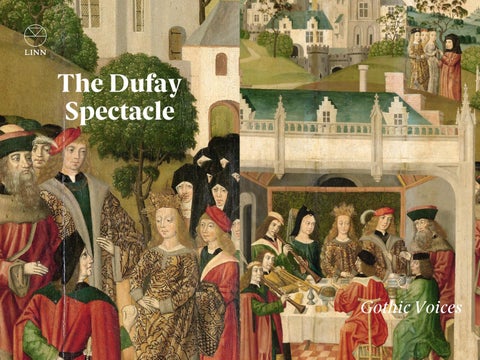
Cover Image Wedding Feast of Saint Elizabeth of Hungary and Louis of Thuringia in the Wartburg, Master of the St Elizabeth Panels (c. 1490–c. 1495)
MENU
67:07
Guillaume Dufay (c. 1397–1474) The Dufay Spectacle Motets and Chansons
GOTHIC VOICES
The Welcome
A Ref lection
1 — Ce jour de l’an (monophonic) 0:36 Stephen Charlesworth baritone
4 — Et pour certain (monophonic) 0:37 Catherine King mezzo-soprano
2 — Vasilissa, ergo gaude / Concupivit rex decorem 2:45 Clare Wilkinson mezzo-soprano
5 — Je requier a tous amoureux 2:31 Catherine King mezzo-soprano
Catherine King mezzo-soprano Julian Podger tenor Stephen Charlesworth baritone Jane Achtman vihuela d’arco Andrew Lawrence-King organ Keith McGowan douçaine Emily White sackbut
Andrew Lawrence-King bray harp
6 — Je vous pri / Tant que mon argent / Ma tres douce amie 1:26 Catherine King mezzo-soprano
Steven Harrold tenor Julian Podger tenor Stephen Charlesworth baritone
7 — Je me complains piteusement 1:36 Steven Harrold tenor
3 — Entre vous, gentils amoureux 2:50 Catherine King mezzo-soprano
Steven Harrold tenor Jane Achtman vihuela d’arco
Julian Podger tenor Stephen Charlesworth baritone Andrew Lawrence-King regal
8 — Las, que feray? ne que je devenray? 4:32 Catherine King mezzo-soprano
1
Steven Harrold tenor Julian Podger tenor
MENU
MENU
Solemn Celebration 14 — Salve flos Tuscae gentis / Vos nunc Etruscae / Viri mendaces 5:39
9 — Ce jour de l’an (improvisation) 0:36 Jane Achtman vihuela d’arco
Catherine King mezzo-soprano Julian Podger tenor Steven Harrold tenor Stephen Charlesworth baritone Andrew Lawrence-King organ Keith McGowan douçaine Emily White sackbut
15 —
Portigaler (arr. Anonymous, from ‘Or me veult bien Esperance mentir’ by Dufay [?], Buxheimer Orgelbuch) 3:12
Andrew Lawrence-King organ
16 —
Ecclesiae militantis / Sanctorum arbitrio / Bella canunt / Gabriel / Ecce nomen domini 4:37
10 — O sancte Sebastiane / O martyr Sebastiane / O quam mira / Gloria et honore 4:39 Catherine King mezzo-soprano
Clare Wilkinson mezzo-soprano Julian Podger tenor Stephen Charlesworth baritone Jane Achtman vihuela d’arco Andrew Lawrence-King organ Keith McGowan douçaine Emily White sackbut
11 —
Se le fatze ay pale (arr. Anonymous, from ‘Se la face ay pale’ by Dufay [?], Buxheimer Orgelbuch) 1:51
12 —
Jane Achtman fiddle Andrew Lawrence-King organ
Se la phase pale (arr. Anonymous, from ‘Se la face ay pale’ by Dufay [?], Buxheimer Orgelbuch) 1:49
Jane Achtman fiddle Andrew Lawrence-King bray harp
13 — Vergene bella 3:41 Catherine King mezzo-soprano
Steven Harrold tenor Julian Podger tenor
2
Catherine King mezzo-soprano Clare Wilkinson mezzo-soprano Steven Harrold tenor Julian Podger tenor Stephen Charlesworth baritone Jane Achtman vihuela d’arco Andrew Lawrence-King organ Keith McGowan douçaine Emily White sackbut
MENU
17 — Resvelliés vous et faites chiere lye 5:00
21 — Quel fronte signorille 1:47
Catherine King mezzo-soprano Jane Achtman vihuela d’arco Andrew Lawrence-King psaltery
Andrew Lawrence-King bray harp
22 — Estrinez moy, je vous estrineray 2:46
18 — Apostolo glorioso / Cum tua doctrina / Andreas, Christi famulus 3:14
Clare Wilkinson mezzo-soprano Catherine King mezzo-soprano Steven Harrold tenor Julian Podger tenor Stephen Charlesworth baritone Jane Achtman fiddle Andrew Lawrence-King organ Keith McGowan shawm Emily White sackbut
23 — Ce jour de l’an 0:38
Jane Achtman vihuela d’arco Andrew Lawrence-King bray harp
24 — Puisque vous estez campieur 2:48
Catherine King mezzo-soprano Steven Harrold tenor Jane Achtman vihuela d’arco
25 — Ce jour de l’an 2:43
Playful Celebration
19 — Ce jour de l’an (improvisation) 0:44
Catherine King mezzo-soprano Steven Harrold tenor Jane Achtman vihuela d’arco Andrew Lawrence-King psaltery
Andrew Lawrence-King psaltery
20 — Mon bien, m’amour 4:27 Steven Harrold tenor Julian Podger tenor Stephen Charlesworth baritone
3
Catherine King mezzo-soprano Clare Wilkinson mezzo-soprano Steven Harrold tenor Julian Podger tenor Stephen Charlesworth baritone Jane Achtman vihuela d’arco Andrew Lawrence-King regal Keith McGowan shawm Emily White sackbut
The Dufay Spectacle
MENU
It is New Year’s Day, and a special wedding is happening. In a magnificent banqueting hall the noble guests are gathering and exchanging courtesies, musicians are taking their places, keen to enhance the occasion with their fine voices and newly invented instruments. Guest of honour: France’s greatest proto-Renaissance composer, Guillaume Dufay. In this spectacle of his musical versatility this sequence of chansons and motets stages an imaginary scene, set maybe somewhere in northern Italy, maybe sometime in the 1470s, at the end of his life. It is a dreamlike scene, perhaps it is even Dufay’s own dream, as it conjures vibrant images of various decorous occasions of his lifetime in the motets, whilst playfully acting out age-old themes that drive human emotions in the chansons. One moment we are at the grand wedding of nobleman Carlo II Malatesta and Vittoria Colonna in 1423, for which Dufay wrote the chanson Resvelliés vous, and at another celebrating the people of Florence in Salve flos Tuscae gentis or even the coronation of Pope Eugene IV in Ecclesiae militantis some years later, or finding ourselves in the almost legendary world of unassuming troubadours in the chansons. It would certainly have been the stuff of dreams if Dufay really had been the guest of honour. Respected in high places as he was and confident enough to hail himself in the last line of text in the contratenor part of Salve flos Tuscae gentis, composers and musicians would at best only have had an elevated servant status. But his cultural status is clear enough historically, and his genius by posterity at the least. Having started musical life as a choirboy at Cambrai Cathedral, his renown in adulthood led him to various 4
prestigious posts of employment, with noble families in Italy and at the papal chapel in Rome, for extensive periods at a time. Eventually he was heralded as the most prominent musician of his day, and his resulting close ties with various dignitaries of state and church supported his central role in Burgundian culture. With the perspective of posterity we can observe how Dufay will have grown up with the legacies of musical creativity in all the late mediaeval compositional genres – of the formidable imagination of the great Guillaume de Machaut and the Ars Nova in general, of the fragrant complexity of the Ars Subtilior later in the fourteenth century, of the sweet melodies and smooth rhythms of English music in the so-called Contenance Angloise. Like all great artists, he will have drawn on this musical heritage to generate his own innovative style, his musical ideas and invention adding sophistication to the final flourish of the Mediaeval era; but, at the same time, the newly conscious deliberation in his composing concepts spawning the musical Renaissance, rendering his contribution to the cultural drive towards the burst into the new era immeasurable, and that with a quintessentially Burgundian flavour. Our imaginary wedding feast has four parts: a welcoming introduction with a festive veneration of the imagined bride in Vasilissa, ergo gaude; a delve into the human emotions of despair, anger and hope in the second part; a resolution of these by the solemn expressions of faith and honour in the third, with the motet Vergene bella reflecting admiration of the bride, and by merry-making in the fourth, with the programme’s theme, ‘Ce jour de l’an voudray joye mener’ (‘This new year’s day I would like to rejoice’) finding its musical climax in a spirited finale. The music chosen for this event – the chansons, here written in the mediaeval formes fixes of rondeau and ballade, their musical structure governed by the poetry; the motets, mostly isorhythmic, with the lower parts moving slowly and with a repeated rhythm sequence below the virtuosic upper voices; and one freely composed, non-isorythmic motet, the previously-mentioned Vergene bella – exemplifies not only Dufay’s versatility within a compositional style but also his confidence of variety of musical expression 5
MENU
within the different genres, and furthermore the originality and virtuosity of composition within a single piece. We have particularly ambitious rhythmic progressive diminutions in the motets; note especially the exhilarating, mathematically complex cross-rhythms that are still somehow understandable to the ear in Ecclesiae militantis, slow sombreness in the motet Salve flos Tuscae gentis and upbeat cascades of melody in the motet Vasilissa, ergo gaude. The frolicking and passionate robustness in the chanson Ce jour de l’an makes us dance, the plaintive devotional ardour in Mon bien, m’amour makes us weep, and the highly virtuosic moments in Resvelliés vous contrasting with the still fermata, a feature also found in mass movements and Ars Subtilior chansons at devotional moments, could just leave us agape, listener and performer alike. In terms of poetic content the various numbers explore the relationship between the optimism and vision of this New Year’s Day wedding feast and, inversely, some human emotional hardship, whether this would be interpreted as ‘real’ or as just a tease. But with the central chanson continuously ringing out its New Year’s promise throughout the feast, ce jour de l’an does indeed become the day to cast away fear and celebrate the occasion.
© Julian Podger, 2018
6
MENU
MENU
GOTHIC VOICES CATHERINE KING mezzo-soprano STEVEN HARROLD tenor JULIAN PODGER tenor STEPHEN CHARLESWORTH baritone with CLARE WILKINSON mezzo-soprano JANE ACHTMAN vihuela d’arco / fiddle ANDREW LAWRENCE-KING organ / regal / bray harp / psaltery KEITH McGOWAN douçaine / shawm EMILY WHITE sackbut
7
1 — Ce jour de l’an
MENU
Ce jour de l’an voudray joye mener,
This new year’s day I would like to rejoice,
chanter, danser, et mener chiere lie,
to sing, to dance, and show a happy face,
pour maintenir la coutume jolye
so to maintain the joyful appearance
que tous amants sont tenus de garder.
that all lovers are required to maintain.
8
2  — Vasilissa, ergo gaude / Concupivit rex decorem
Cantus I, Cantus II Vasilissa, ergo gaude,
Queen you are, therefore rejoice,
quia es digna omni laude,
because you are worthy of all praise,
Cleophe, clara gestis
Cleopha, shining by the deeds
a tuis de Malatestis,
by yours of Malatesta,
in Italia principibus
princes in Italy,
magnis et nobilibus.
great and noble.
Ex tuo viro clarior,
By your husband more famous,
quia cunctis est nobilior,
as he is more noble than everyone else,
Romeorum est despotus,
of the Romans he is lord,
quem colit mundus totus,
whom the whole world honours,
in porphyro est genitus,
in regal purple he was born,
a Deo missus caelitus.
from God sent from heaven.
Iuvenili aetate
In your era of youth
polles et formositate,
you are great, and in your beauty,
multum ingenio fecunda
with much talent, fruitful
et utraque lingua facunda
and in both languages eloquent,
ac clarior es virtutibus
yet more famous you are by your virtues,
prae aliis homnibus.
ahead of all these people.
9
MENU
MENU
Resolutio Vasilissa, ergo gaude,
Queen you are, therefore rejoice,
quia es digna omni laude.
because you are worthy of all praise.
Contratenor, Tenor Concupivit rex decorem tuum
The king has desired your beauty
quoniam ipse est dominus tuus.
for he is your lord.
10
3 — Entre vous, gentils amoureux
Entre vous, gentils amoureux,
Enter, gentle lovers,
ce jour de l’an soyés songneus
this new year’s day be careful
de bien servir chascum s’amie
to serve well, each his girl,
et de fuir merancolie,
and to flee from melancholy
se vous volés estre joieux.
if you wish to be joyful.
Ne soiés de riens curieux
Only be interested
que de faire gales et jeux
in merry-making and games
et de mener tres bone vie.
and in affecting a very good time.
Entre vous, gentils amoureux,
Enter, gentle lovers,
ce jour de l’an soyés songneus
this new year’s day be careful
de bien servir chascum s’amie.
to serve well, each his girl.
Et ne vous chaut des envieux,
And the jealous need not matter to you,
qui sont felons et despiteus.
who are false and contemptuous.
Chantés, dansés, quoi que nul die,
Sing, dance, whatever anyone says,
et qui ne peut chanter, se rie,
and whoever cannot sing should laugh,
je ne vous ay consilier mieulx.
I have no better advice.
Entre vous, gentils amoureux,
Enter, gentle lovers,
ce jour de l’an soyés songneus
this new year’s day be careful
de bien servir chascum s’amie
to serve well, each his girl,
et de fuir merancolie,
and to flee from melancholy
se vous volés estre joieux.
if you wish to be joyful. 11
MENU
4 — Et pour certain
MENU
Et pour certain tant me voudray poier
And for certain, so much I would like to put myself
que je puisse choisir nouvelle amie.
in a position to choose a new lover.
Hé, dieus d’amours, syés de ma partie,
Ah, gods of love, be with me,
que Fortune si ne me puist grever.
that Fortune may thus not grieve me.
12
5 — Je requier a tous amoureux
MENU
Je requier a tous amoureux
I ask of all lovers
qui jugent par leur courtoisie,
who judge by their courtesy,
ceux qui n’osent pas dire « amye »,
those who dare not say ‘lover’,
sont en amours bien heureux.
whether they are happy in their love.
A ce jour de l’an gracieux
On this pleasant new year’s day
me treuve de celle partye.
I find myself one of them.
Je requier a tous amoureux
I ask of all lovers
qui jugent par leur courtoisie.
who judge by their courtesy.
Mais vray Espoir, qui est songneux
But true Hope, who is eager
de moy garir ma maladie,
to cure my sickness,
me dist que je ne me soussye,
says to me that I should not worry,
que l’an a venir avray mieux.
for the coming year will be better.
Je requier a tous amoureux
I ask of all lovers
qui jugent par leur courtoisie,
who judge by their courtesy,
ceux qui n’osent pas dire « amye »,
those who dare not say ‘lover’,
sont en amours bien heureux.
whether they are happy in their love.
13
6 — Je vous pri / Tant que mon argent / Ma tres douce amie Superius Je vous pri, mon tres doulx ami,
I beg you, my very sweet love,
que briefment vuelliez revenir,
that shortly you may return,
affin que tost voye advenir
so that soon I see to happen
ce que promis avés a mi.
that which you have promised to me.
Contratenor I Tant que mon argent dura,
As long as my money lasts,
que tantost fauldra,
which so soon will run out,
nous menrons joieuse vie.
we will lead a happy life.
Or est mon argent fali.
Now my money has run out.
Adieu, mon ami!
Farewell, my love!
Adieu ma tres douce amie!
Farewell my very sweet love!
Helas, mon ami!
Alas, my love!
Et quant revenerés vous?
And when will you return?
…ce que promis avés a mi.
…that which you have promised to me.
Contratenor II Ma tres douce amie!
My very sweet love!
Mon cuer prent congiet
My heart takes its leave
maintenant de vous.
now of you.
Belle, ce poise moy.
Beauty, this weighs heavily on me. 14
MENU
MENU
Adieu, mon ami!
Farewell, my love!
Helas, mon ami!
Alas, my love!
Et quant revenerés vous?
And when will you return?
…ce que promis avés a mi.
…that which you have promised to me.
Tenor Je vous pri, mon tres doulx ami,
I beg you, my very sweet love,
que briefment vuelliez revenir.
that shortly you may return.
Adieu, mon ami!
Farewell, my love!
Helas, mon ami!
Alas, my love!
Et quant revenerés vous?
And when will you return?
…ce que promis avés a mi.
…that which you have promised to me.
15
7 — Je me complains piteusement
Je me complains piteusement,
I complain pityfully
a moi tout seul plus qu’a nullui,
to myself, all alone, more than to anyone,
de la griesté, paine e tourment,
of the difficulty, pain and torment,
que je souffre plus que ne di.
which I suffer more than I say.
Dangier me tient en tel soussi
This power keeps me in such worrying
qu’eschever ne puis sa rudesse,
that escape I cannot from its harshness,
et Fortune le veult aussi,
and Fortune wishes this too,
mais, par ma foy, ce fait jonesse.
but, by my faith, this is what youth does.
16
MENU
8 — Las, que feray? ne que je devenray?
Las, que feray? ne que je devenray?
Alas, what will I do? and what will become of me?
Est il nesun qui me puist consoler?
Is there nobody who can comfort me?
ny aligier des maulx qu’ay a porter
or alleviate the harm which I have to bear
et nuit et jour, sans que deservy l’ay?
both night and day, without my having deserved it?
J’ay bien cause se je crye hahay,
I have good reason to cry ah-ah,
quant mon amy me veult abandoner.
when my lover wishes to abandon me.
Las, que feray? ne que je devenray?
Alas, what will I do? and what will become of me?
Est il nesun qui me puist consoler?
Is there nobody who can comfort me?
Je l’ay amé leyaulment de cuer vray,
I have loved her loyally, of a true heart,
mais cest amer me sera moult amer,
but this love will to me be very bitter,
car qui aime sans partye trouver,
for he who loves without finding any return,
en verité il n’est pas sans esmay.
in truth he is not without fear.
Las, que feray? ne que je devenray?
Alas, what will I do? and what will become of me?
Est il nesun qui me puist consoler?
Is there nobody who can comfort me?
ny aligier des maulx qu’ay a porter
or alleviate the harm which I have to bear
et nuit et jour, sans que deservy l’ay?
both night and day, without my having deserved it?
17
MENU
10  — O sancte Sebastiane / O martyr Sebastiane / O quam mira / Gloria et honore
Cantus I O sancte Sebastiane,
O Saint Sebastian,
semper, vespere et mane,
always, at evening and morning,
horis cunctis et momentis,
at all hours and moments,
dum adhuc sum sanae mentis,
as long as I am of a sound mind,
me protege et conserva
protect and preserve me,
et a me, martyr, enerva
and, O martyr, weaken
infirmitatem noxiam
the cruel illness,
vocatam epidemiam.
called epidemic.
Tu de peste huiusmodi
May you from this kind of plague
me defende et custodi
defend and keep me
et omnes amicos meos,
and all of my friends,
qui nos confitemur reos
we who acknowledge ourselves as sinners
Deo et sanctae Mariae
to God and to holy Mary
et tibi, O martyr pie.
and to you, O pious martyr.
Tu Mediolanus civis
You, O citizen of Milan,
hanc pestilentiam, si vis,
this plague, if you wish,
potes faces cessare
these causes of ruin can restrain
et ad Deum impetrare,
and ask this of God,
quia a multis est scitum,
for to many it is known,
quod de hoc habes meritum.
that for this you have great value.
Zoe mutam tu sanasti
Zoe the mute you cured 18
MENU
MENU
et sanatam restaurasti
and cured you returned her
Nicostratos eius viro,
to her husband Nicostratus,
hoc faciens modo miro.
this so doing as a miracle.
In agone consolabas
In their suffering you consoled
martyres et promittebas
the martyrs and promised
eis sempiternam vitam
them eternal life,
et martyribus debitam.
and what is due to martyrs.
Amen.
Amen.
Resolutio O sancte Sebastiane,
O Saint Sebastian,
semper, vespere et mane,
always, at evening and morning,
horis cunctis et momentis,
at all hours and moments,
dum adhuc sum sanae mentis.
as long as I am of a sound mind.
Cantus II O martyr Sebastiane,
O martyr Sebastian,
tu semper nobiscum mane
always with us stay
atque per tua merita
and also, by your merits,
nos, qui sumus in hac vita
us, who are in this life,
custodi, sana et rege
keep, heal, and rule
19
MENU
et a peste nos protege,
and from the plague protect us,
praesentans nos trinitati
presenting us to the trinity
et virgini sanctae matri.
and to the virgin holy mother.
Et sic vitam finiamus,
And thus we may finish life,
quod mercedem habeamus
that we may receive mercy
et martyrum consortium
and have the company of martyrs
et Deum videre pium.
and the vision of the holy God.
Amen.
Amen.
Contratenor O quam mira refulsit gratia
O how with wonderful grace shone
Sebastianus, martyr inclitus,
Sebastian, the famous martyr,
qui militis portans insignia,
who, carrying military emblems,
sed de fratrum palma sollicitus
but, by the palm of the brethren, caring,
confortavit corda pallentia
comforted the weakening hearts
verbo sibi collatus caelitus.
with words to them given from heaven.
Amen.
Amen.
Tenor Gloria et honore.
In glory and honour.
Amen.
Amen.
20
13 — Vergene bella
MENU
Vergene bella, che di sol vestita,
Beautiful virgin, who are dressed in the sun,
coronata di stelle al sommo sole
crowned with stars the highest sun
piacesti si, che’n te sua luce ascose,
you so much pleased that he hid his light in you,
amor mi spigne a dir di te parole,
love compels me to speak words of you,
ma non so’n cominciar senza tu’ aita,
but I know not to begin without your help,
e di colui ch’amando in te si pose.
and that of him who, lovingly, placed himself in you.
Invoco lei che ben sempre rispose
I invoke her who without fail answered
chi la chiamo con fede.
whoever called her with faith.
Vergene, s’a mercede
Virgin, if you have mercy,
miseria estrema de l’humane cose,
extreme pity for human things,
gia mai ti volse, al mio prego t’inchina,
never turn away, to my prayers incline yourself,
soccorri alla mia guerra,
help with my strife,
bench’i’ sia terra,
even though I would be of earth,
e tu del ciel regina.
and you of heaven the queen.
Petrarch (1304–1374)
21
14 — Salve f los Tuscae gentis / Vos nunc Etruscae / Viri mendaces Cantus Salve flos Tuscae gentis,
Hail flower of the Tuscan people,
Florentia, salve,
O Florence, hail,
O salve,
O hail,
Italici gloria magna soli.
great glory of Italy’s soil.
Salve, quae doctos felix
Hail, happy mother,
tot mater alumnos,
you who so many learned disciples,
tot generas magnos
so many great people
consilio atque fide,
produce in counsel and faith,
quae tot praestantes
who such excellent wonderful
mira integritudine,
people of integrity,
quae tot praestantes
who such excellent men
generas religione viros.
of conscientiousness yield.
Salve, cui debet quodcumque
Hail, city to which
est artis honestae,
any true art is owing,
ingenii quicquid,
any talent,
quicquid et eloquii est.
and any eloquence.
Salve, quae fama totum
Hail, you, whose fame
diffusa per orbem
is dispersed throughout the globe,
et vehere et natos
both are conveyed and your children
mittis ad astra tuos.
send to your stars.
Nunc cecini et grato
Now I have sung and melodious
voces placuere canorae
voices have been pleasing, 22
MENU
MENU
praemia, mercedes
not demanding rewards or wages,
nec periere simul.
nor have they faded.
Fessus ego
Tired I am
haud cantu,
by no means with having recited,
vox est defessa
the voice is exhausted
canendo,
with singing,
sed tu carminibus
but may you live to be sung
vive canenda meis.
in my songs.
Contratenor Vos nunc Etruscae
You now, maidens of Etruria,
iubeo salvere puellae.
I bid hail.
Sic sedet hoc animo
Thus remains my spirit,
nec sine amore moror.
nor without love do I stay.
Stant foribus nymphis similes,
They stand at the gates like nymphs,
stant naiades
they stand like naiads
utquae aut ut amazonides
or even like amazons
aut proca diva Venus.
or the godly Venus.
Fervet in amplexus
Ardent for their embraces
atque oscula dulcia quisque,
and sweet kisses is every man,
si semel has viderit,
if once he has seen these,
23
MENU
captus amore cadet.
of love a captive he will fall.
Ista, deae mundi,
These things, O goddesses of the world,
vester per saecula cuncta,
yours through all ages,
Guillermus cecini
I, Guillaume, have sung,
natus et ipse Fay.
born and himself Fay.
Tenor I Viri mendaces.
Lying men.
Tenor II Viri mendaces.
Lying men.
24
16 — Ecclesiae militantis / Sanctorum arbitrio / Bella canunt / Gabriel / Ecce nomen domini Cantus I Ecclesiae militantis
Of the church militant,
Roma sedes triumphantis
let the seat, Rome, of the triumphing
patris sursum sidera
father above the stars,
carmen cleri resonantis
a song of the resounding clergy,
laudem pontifici dantis
of praise-giving to the pope,
promat voce libera.
bring forth with a free voice.
Gabrielem quem vocavit,
Gabriel, thus called
dum paternum crimen lavit,
when the ancestral sin was washed away
baptismatis sumptio,
by the taking-up of baptism,
Eugenium revocavit,
was renamed Eugenius,
bonum genus quod notavit,
which marked his good race,
pontificis lectio.
by the papal election.
Quod consulta contio
Which the well advised assembly
– qua nam sancta ratio –
– what holy reasoning –
sic deliberavit,
has so determined,
ut sola devotio
that devotion alone
regnet in palatio
may reign in the palace
quod Deus beavit.
that God blessed.
Certe Deus voluit
Certainly God willed it,
et in hoc complacuit
and in this gave pleasure 25
MENU
MENU
Venetorum proli,
to the Venetian descendants,
sed demon indoluit,
but the devil was grieved
quod peccatum defuit
that sin was lacking
tantae rerum moli.
from such an event.
Dulcis pater populi,
Sweet father of the people,
qui dulcorem poculi,
you who the sweetness of the cup,
crapulam perhorres,
drunkenness, abhor,
pone lento consuli
assign to a tenacious counsellor
rem gregis pauperculi,
the matter of your poor little flock,
ne nescius erres.
lest you by ignorance go astray.
Pater haerens filio
Let the father, adhering to the son,
spiritus confinio
allied with the spirit,
det prece sollemni
give by our solemn prayer
gaudium Eugenio,
joy to Eugenius,
perfecto dominio,
his dominion completed,
in vita perenni.
in eternal life.
Amen.
Amen.
Cantus II Sanctorum arbitrio
By the judgment
clericorum proprio
of the holy clerks
corde meditanti,
with a thinking heart,
aequum genus atrio
the just race the hall
accedit ludibrio
approaches, to the mockery
umbrae petulanti.
of the impudent shade. 26
Nam torpens inertia,
For stupefying laziness,
longa quaerens otia,
seeking a long idleness,
nescivit Eugenium,
was not known by Eugenius,
sed iuris peritia
but proficiency in law
cum tota iustitia
and total justice
sunt eius ingenium.
are his nature.
Hinc est testimonium:
This is the evidence:
pacem quaerit omnium,
peace he seeks for all,
exosus piaculi,
he is hating of sin,
et trinum dominium
and his triple dominion
daemonis et carnium
of the devil and the flesh
pompam vincit saeculi.
defeats the pomp, and that of the world.
Quam color ipse poli
As the very colour of heaven,
dic scutum quod attuli
say, is the shield that I have brought
tibi, pater optime,
to you, O best father,
sacrum dat, quod oculi
it renders a holy thing, in which your eyes
tui instar speculit
a likeness see and
cernunt nitidissime.
discern, O brightest one.
Eia tu, pulcherrime,
Ah, you most beauteous,
quaerimus, tenerrime,
we question, O most tender one,
moram longi temporis.
the delay of a long time.
Ducimur asperrime
We are led most harshly,
nescio quo ferrime
I know not what we have suffered
ad fulmentum corporis.
to the support of the body. 27
MENU
MENU
Una tibi trinitas
One trinity,
vera Deus unitas
the true unity, may God
det caeli fulgorem,
grant you the glow of heaven,
quem linea bonitas,
you whom linen goodness,
argentea castitas,
and silver chastity
secta vis in morem.
powerfully distinguish.
Amen.
Amen.
Contratenor Bella canunt gentes,
Wars sound the nations,
quaerimur, pater optime, tempus.
we complain, O best father, of our time.
Expediet multos,
Many will be brought to freedom,
si cupis, una dies.
if you desire, in one day.
Nummus et hora fluunt
Money and time flow away,
magnumque iter
and the great journey
orbis agendum
over the globe is to be made,
nec suus in toto noscitur orbe deus.
yet in the whole world his god is not known.
Amen.
Amen.
Tenor I Gabriel.
Gabriel.
Tenor II Ecce nomen domini.
This is the name of the lord.
28
17 — Resvelliés vous et faites chiere lye
Resvelliés vous et faites chiere lye
Awake and make you a happy face,
tous amoureux qui gentillesse amés,
all lovers who love honour,
esbatés vous, fuyés merancolye,
amuse yourselves, flee melancholy,
de bien servir point ne soyés hodés.
to serve well do not be weary.
Car au jour d’ui sera li espousés,
For today they will be married,
par grant honneur et noble seignourie,
by great honour and nobility,
se vous convient ung chascum faire feste,
if you please, each of you, make it a feast,
pour bien grignier la belle compagnye.
to mind well the fine entourage.
Il a dame belle et bonne choysie,
He has chosen a beautiful and good lady,
dont il sera grandement honnourés,
by whom he will be greatly honoured,
car elle vient de tres noble lignie
for she comes from a very noble line,
et de barons qui sont mult renommés.
and from barons who are much renowned.
Son propre nom est Victore clamés,
Her name is stated as Victoria,
de la Colonne vient sa progenie.
from Colonna come her family.
C’est bien rayson qu’a vascule requeste
It is certain that in the hunt for the cup,
de ceste dame mainne bonne vie
by this lady would prevail a good life
Charle gentil,
of Charles the noble,
c’on dit de Maleteste.
of whom one says is of Malatesta.
29
MENU
18 — Apostolo glorioso / Cum tua doctrina / Andreas, Christi famulus Cantus I, Contratenor I Apostolo glorioso, da Dio electo
Glorious apostle, chosen by God
a evangelegiare al populo greco
to preach to the Greek people
la sua incarnazion, che v’era ceco,
his incarnation, who to this were blind,
et cusi festi senza alcun suspecto.
and so you did, without any doubt.
Et eligisti a Patrasso per tuo lecto
And you chose Patras for your place of rest
et per sepulcro questo sancto speco.
and for your tomb this holy cave.
Prego te, preghi me retrove teco,
I pray you, pray for me that I may find you again,
per li tuoi merci, nel devin conspecto.
through your mercies, in the divine presence.
Cantus II, Contratenor II Cum tua doctrina convertisti a Christo
With your doctrine you converted to Christ
tuto el paese, et cum la passione et morte
the whole land, and with the suffering and death
che qui portasti in croce in su lo olivo.
that you bore on a cross up on the olive grove.
Ma é prolasso in errore et facto tristo.
But it has reverted to sin and is made sad.
Si che rempetraglie gracia si forte
May it receive such strong grace
che recognoscano a Dio vero et vivo.
that they may recognize God, true and living.
Tenor Andreas, Christi famulus.
Andrew, servant of Christ.
30
MENU
20 — Mon bien, m’amour
MENU
Mon bien, m’amour et ma maistresse,
My delight, my love and my mistress,
esse ce que m’avés promis?
would this be what you promised me?
Mis m’avés hors du sens rassis,
You have put me out of my calm sense,
six foys m’avés fait grande rudesse.
six times you have done to me a great cruelty.
De ce vous requiers, ma princesse,
Because of this I ask you, my princess,
cesser, a vous seray toudis.
cease, I will be with you forever.
Mon bien, m’amour et ma maistresse,
My delight, my love and my mistress,
esse ce que m’avés promis?
would this be what you promised me?
Dix ans a que vostre noblesse
Ten years it is since your nobility
blessié m’a au cuer et soupris,
wounded me in my heart and surprised me,
pris m’a trop fort a mon advis,
it has seized me too strongly in my view,
advisez que j’aye lyesse.
consider that I should be happy.
Mon bien, m’amour et ma maistresse,
My delight, my love and my mistress,
esse ce que m’avés promis?
would this be what you promised me?
Mis m’avés hors du sens rassis,
You have put me out of my calm sense,
six foys m’avés fait grande rudesse.
six times you have done to me a great cruelty.
31
22 — Estrinez moy, je vous estrineray
Estrinez moy, je vous estrineray,
Give me something, I will give you something,
ma seulle amour. De quoy ? Du cuer que j’ay
my only love. What? The heart that I have
pour vous donner ce jour de l’an nouvel,
to give you, on this day of the new year,
prenés en gré ! Si fai je, amis tres bel,
take it gladly! So I do, very beautiful lover,
aussy le mien a tous jours vous donray.
I will also give you mine forever.
Tres grant mercy, pourtant vous serviray,
Much thanks, and so I will serve you,
sans departir. Or bien. Dont sans delay
without leaving. So yes. So without delay,
a che bon jour de joye et de revel.
on this good day of joy and revelry.
Estrinez moy, je vous estrineray,
Give me something, I will give you something,
ma seulle amour. De quoy ? Du cuer que j’ay
my only love. What? The heart that I have
pour vous donner ce jour de l’an nouvel.
to give you, on this day of the new year.
Et allegiés mez maulx, ou je morray
And relieve my ills, or I will die
par desespoir. Et quant ? Las, je ne scay,
by despair. But when? Alas, I do not know,
je sui feru ja mieulx que d’un coutel
I am wounded ever worse than with a knife
de vos doulx yeulx. Et vous fait donques tel
by your sweet eyes. And you act then as
en verité ? Se vous conforteray.
in truth? So I will comfort you.
32
MENU
MENU
Estrinez moy, je vous estrineray,
Give me something, I will give you something,
ma seulle amour. De quoy ? Du cuer que j’ay
my only love. What? The heart that I have
pour vous donner ce jour de l’an nouvel,
to give you, on this day of the new year,
prenés en gré ! Si fai je, amis tres bel,
take it gladly! So I do, very beautiful lover,
aussy le mien a tous jours vous donray.
I will also give you mine forever.
33
24  — Puisque vous estez campieur
Puisque vous estez campieur,
Since you are a fighter,
voulentiers a vous campiroye,
willingly with you would I fight,
a savoir mon, se je pourroye
to know for myself whether I could
a vous, pour estre bon pieur.
with you, and to be a good boozer.
Et si vous estez sapieur,
And if you were a guzzler,
contre vous aussi sapiroye.
against you would I also eat,
Puisque vous estez campieur,
Since you are a fighter,
voulentiers a vous campiroye.
willingly with you would I fight.
Vous me cuidez maulvais pieur,
You suppose me to be a bad boozer,
mais pour trois pos bien les piroye,
but three pots, well would I drink them,
vrayment, ou je me tapiroye
truly, or else I would hide myself
comme du monde le pieur.
as though of the world the worst.
Puisque vous estez campieur,
Since you are a fighter,
voulentiers a vous campiroye,
willingly with you would I fight,
a savoir mon, se je pourroye
to know for myself whether I could
a vous, pour estre bon pieur.
with you, and to be a good boozer.
34
MENU
25 — Ce jour de l’an
MENU
Ce jour de l’an voudray joye mener,
This new year’s day I would like to rejoice,
chanter, danser, et mener chiere lie,
to sing, to dance, and show a happy face,
pour maintenir la coutume jolye
so to maintain the joyful appearance
que tous amants sont tenus de garder.
that all lovers are required to maintain.
Et pour certain tant me voudray poier
And for certain, so much I would like to put
que je puisse choisir nouvelle amie.
myself in a position to choose a new lover.
Ce jour de l’an voudray joye mener,
This new year’s day I would like to rejoice,
chanter, danser, et mener chiere lie.
to sing, to dance, and show a happy face.
A laquelle je puisse presenter
To whom I could offer heart,
cuer, corps et biens, sans faire despartie.
body and good things, without failing to share.
Hé, dieus d’amours, syés de ma partie,
Ah, gods of love, be with me,
que Fortune si ne me puist grever.
that Fortune may thus not grieve me.
Ce jour de l’an voudray joye mener,
This new year’s day I would like to rejoice,
chanter, danser, et mener chiere lie,
to sing, to dance, and show a happy face,
pour maintenir la coutume jolye
so to maintain the joyful appearance
que tous amants sont tenus de garder.
that all lovers are required to maintain.
Translation: Julian Podger 35
Gothic Voices
MENU
For more than thirty-five years Gothic Voices has been world-renowned for the excellence, refinement and spirituality of its performances of mediaeval music. Gothic Voices remains firmly wedded to its long-standing principle of bringing mediaeval works into the musical mainstream by means of world-class performances and a thought-provoking range of well-researched programmes. Using their voices in richly varying combinations to produce performances of great beauty, liveliness and integrity, they continue to win the appreciation of audiences all over the world. The group also enjoys performing contemporary music, particularly pieces with mediaeval associations such as in its Mary Star of the Sea (Linn CKD 541) programme (with new compositions on old texts by Joanne Metcalf and Andrew Smith). Their innovative performances which combine contemporary and old music complement their more traditional programmes. Gothic Voices has recorded over twenty-five albums, three of which won the coveted Gramophone Early Music Award. Its first recording A feather on the breath of God – Sequences and Hymns by Saint Hildegard of Bingen still remains one of the bestselling recordings of pre-Classical music ever. They appear frequently in all parts of Great Britain and in Festivals across Europe and beyond. www.gothicvoices.co.uk 36
MENU
© Eric Richmond
37
Also available on Linn
MENU
CKD 541 Gothic Voices Mary Star of the Sea
CKD 529 Sollazzo Ensemble Parle qui veut: Moralizing Songs of the Middle Ages
CKD 569 Dunedin Consort Monteverdi: Vespers 1610
38
CKD 517 Magnificat Scattered Ashes
MENU
CKD 541
CKD 529
CKD 569
CKD 517
39
MENU
FOR EVEN MORE GREAT MUSIC VISIT LINNRECORDS.COM