C
H
R
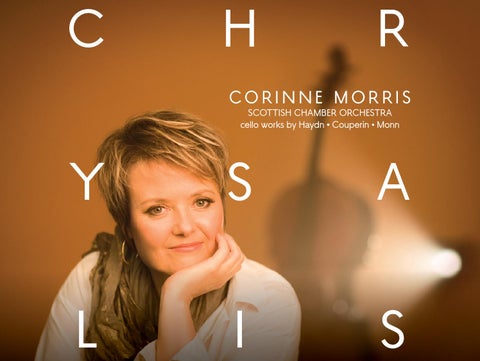
CORINNE MORRIS SCOTTISH CHAMBER ORCHESTRA cello works by Haydn • Couperin • Monn
Y
S
A
L
I
S
C O R I N N E M O R R I S SCOTTISH CHAMBER ORCHESTRA LEADER: STEPHANIE GONLEY François Couperin (arr. Bazelaire) Pièces en Concert 1. Prélude .................................................................................................. 2:12 2. Siciliène ................................................................................................2:24 3. La Tromba.........................................................................................1:26 4. Plainte ....................................................................................................5:43 5. Air de diable ....................................................................................1:43 Georg Matthias Monn Cello Concerto in G minor 6. Allegro ...................................................................................................6:37 7. Adagio..................................................................................................7:08 8. Allegro non tanto ....................................................................4:54 Joseph Haydn Cello Concerto No. 1 in C major, Hob. VIIb: 1* 9. Moderato ..........................................................................................10:17 10. Adagio.................................................................................................9:09 11. Allegro molto ...............................................................................6:38 *cadenzas by Corinne Morris Total Running Time: 58 minutes
Recorded at Usher Hall Edinburgh, UK 26–27 July 2016 and 22 January 2017 Produced and recorded by Philip Hobbs Assistant engineering by Robert Cammidge Post-production by Julia Thomas Design by Paul Harpin Photography by Benjamin Ealovega
C
H
R
Y
S
A
L
I
S
C O R I N N E
M O R R I S
The title of this album, Chrysalis, feels apt both for me and for this music. It suggests the process whereby things change, develop, progress their form and yet stay somehow intrinsically the same. The Monn Concerto lay dormant for many years, the manuscript discovered only in the early twentieth century. This concerto and Haydn’s, too, took another era, the trappings of another context, to find its moment and sing to a wider public.
grew; my playing eventually came back and was able to articulate some of the new understandings I had been shown. There was also a new energy, the same kind of underlying energy that propels all the works on this album. I’m the same; I’m different. So I feel a particular kinship to these works, and to that evocative word, ‘chrysalis’. An artist is nothing without an audience — similarly, a musician cannot flourish without support and nurturing. I am immensely grateful to all who have contributed in helping me become who I am today, and to those who stand by me as I re-emerge on the musical scene.
And I…? Well I changed during my enforced time away due to injury. I suffered, but I
C
H
R
Y
S
A
With special thanks to: Adam GreenwoodByrne, Rita Gregory, Susan and Peter Haisman, Annie Lynn, Anne Furneaux and William Morton, Rod Marten and Howard Shepherdson, Fanny Schulman, Scott Yarwood.
© Corinne Morris, 2017
L
I
S 5
CORINNE MORRIS PLAYS HAYDN, COUPERIN AND MONN
comfortable and understand the musical language and stylistic requirements of each era. When you understand and perform Baroque music, even if you don’t do it on period instruments (which I don’t), it still makes you approach later music in a different way. So the journey on this recording really starts in the Baroque. The version of the Couperin that we’ve chosen here has been arranged by a famous French cellist and teacher, Paul Bazelaire (1886– 1958), who – typically for the time – allowed himself certain liberties, but I do think that the Couperin pieces are interesting in these transcriptions. And I grew up listening to them played by Pierre Fournier, for whom they were transcribed, so there’s a personal preference to my choosing them.
Haydn’s First Cello Concerto, the C major, recorded here, sits Janus-like in the cellist’s repertoire – looking back towards the Baroque but also forward to the ‘modern’ cello concerto repertoire. It’s a milestone for players, as Corinne Morris explained to James Jolly. Corinne Morris: Haydn is the arrival point on this musical journey, with Couperin – in the Baroque style – being the start, and Monn occupying the short transitional period between both eras. So when we arrive at Haydn we’re well established in the Classical period. Of course, there’s no rigid wall between different styles: it doesn’t make sense to me to say that if you play in a Baroque style you can’t play Classical or even Romantic repertoire, or vice versa, or that if you play Romantic music you can’t go back into earlier styles.
When you’re using a modern instrument with a modern orchestra, albeit an incredibly flexible and adaptable modern orchestra, do you have to take a decision as to how far you’re going to go towards some kind of authenticity?
So where do you sit in regard to this repertoire and its stylistic demands?
Absolutely. And the line is not clear at all. Where do we stop? How do we apply ornamentation? Talking about sound production, how far can we go with the
I don’t consider myself a ‘Baroque performer’. A musician, I believe, has to be 6
modern tools that we have (the modern bow doesn’t allow us to do certain things that the Baroque would)? And the strings we play on are going to affect the sound in a huge way. I feel that we don’t live in that era anymore and we’ve moved on. So while it’s interesting to hear sounds as they heard them back then – with their different pitch – I still think there’s a need for us ‘modern players’ to interpret it in the light of everything that’s happened since, going back in time with today’s tools and all our understanding, as well as the knowledge of the evolution that has taken place since. You can’t erase that.
the orchestra and myself. Establishing from the start that we’re not a Baroque band meant that we couldn’t go any further down that path, because that would draw in questions of pitch, strings and the rest of it. So we went as far as we could with the tools that we were using, knowing that you can only go so far with the modern set-up before it becomes a sort of pastiche, or falls between two playing styles – the modern and the Baroque. I hope we struck a good balance. And no conductor? That was one of my wishes from the start – to have this project without a conductor – not because I don’t like them (!) but because I feel this music’s essence is fundamentally chamber music and, although the input of a conductor could have been very rewarding, it would have changed the dynamics of the group. I was keen for us to work as a chamber-music group does, discussing, elaborating and coming to a stylistic agreement. Artistically it was important to me that we do it like that because I wanted to keep us all using our ears, so that the ensemble playing remained really tight. When we performed in concert we formed
So, is that why you chose the Scottish Chamber Orchestra for this recording? Yes, I like their versatility, and I was looking for a chamber orchestra that was open for a project like this, and they certainly were, and keen, from the start. It was interesting to work with Stephanie Gonley, who was leading the orchestra. She’s done a fair amount of Baroque work, and we got on very well in the sense of gauging a style for this music – we adapted the vibrato, and coloured ornamentation in a meaningful way, and there was a good rapport between 7
transforming things in his own writing, and developing sonata form. Haydn then picked up some of that and developed it further himself afterwards. When you put these two concertos side by side you can feel a real sense of one handing on to the other.
a semi-circle and I was in the middle, which was lovely – and that’s how we recorded too. It felt good to be surrounded by the orchestra, and having the violins on either side gave it a stereo effect for me. That was especially noticeable in the Monn where there’s a lot of dialogue between first and second violins, and I heard it in a way that I’d never heard it before.
Do you feel a development in the way the composers actually used the cello as this programme moves forward in time?
It’s always struck me as magical that for years the D major Concerto was ‘the’ Haydn concerto but when the C major was discovered in 1961 a major work was added to the cello concerto repertoire overnight. And it was immediately embraced by players.
If I think of other composers of the time – someone like Boccherini, who was a cellist – I’m not sure that the use of the instrument changed so dramatically. Haydn obviously was writing for a fine player and he knew what he could make him do. I think that the first big change for cellists comes later on in the Romantic period. The use of fast passagework, typical of this earlier repertoire – both Classical and Baroque – is quite similar. Perhaps the expressivity of the thematic work is more pronounced in the Haydn concerto. It’s more expanded: the ideas are there with Couperin and Monn, but Haydn develops them further in terms of the thematic expression.
Yes, it’s extraordinary how the manuscript just appeared. I know a lot of people questioned its authenticity back then – actually when I was recording it there were moments when I too was wondering if it were genuine Haydn, but then it’s got to be! It’s so different to the D major work, which dates from some 20 years later. But this C major Concerto is early Haydn, and that’s why I wanted it to end this journey. I felt that the Monn concerto would lead the listener so well into early Haydn. Monn was already
Let’s talk about Georg Matthias Monn, who is best known for two cello concertos: one that 8
C
H
R
Y
S
A
L
I
S
Arnold Schoenberg made for Pablo Casals from a harpsichord concerto, and the one you’ve recorded here, but which is usually performed in Schoenberg’s realization.
of the manuscript – which is where you step away from ‘pure’ authenticity, but I believe you can still make something credible. They are a lovely set of pieces if you respect the style and tempi of that period. When we were recording them there were mixed feelings as to whether we should go full out and do it in a nineteenth-century style with luscious vibrato and sound, but I was keen to tame the ‘excesses’ and produce something in keeping with the stylistic demands of the original. After we’d finished recording I think we agreed that was the right decision.
When I was trying to assemble a programme to record, I was looking for a work that would lead up to the early Haydn. I toyed with music by Leopold Hoffmann but I really love this Monn and thought it would work very nicely. I remember hearing the famous Jacqueline Du Pré recording, which is of Schoenberg’s version. But then I found an edition that was far ‘purer’ than the Schoenberg, basically just Monn’s notes, and that’s what I decided to go for, partly in a desire to be more stylistically correct.
You can trace your musical lineage to Paul Tortelier, so would you consider yourself a cellist in the French tradition?
And the Couperin pieces?
I think the concept of cello schools that used to be very strong – Russian or French or American, where you could identify players easily – is somewhat disappearing as we become more connected and therefore more open to other influences. So although I would say that, yes, I am from that school, I’ve already been ‘influenced’ (in a good way) by other ways of playing. But I think I have developed my own way, too. I did also work a little bit with Rostropovich and
There was quite a strong tradition in France of taking Baroque music and re-arranging it for a twentieth-century audience, albeit in a rather nineteenth-century performing style – both J. C. Bach and Boccherini received this treatment. Paul Bazelaire selected some numbers from Couperin’s Les Goûtsréunis to make a suite and then essentially harmonized them based on the figured bass 10
that, coming from my musical upbringing, was quite a cultural shock. There was an intensity to his sound, not only in the bow, but in the left-hand vibrato, that was always present. Whether he was playing Bach or Prokofiev, the intensity was very similar. For me this intensity in the sound works for the Romantic repertoire and later, but not in Bach. In a very different way, Tortelier was the same. The language and outcome was totally different, but there was a power and ability to communicate that felt like it was coming from deep inside his soul.
I could borrow. I made some phone calls and got in touch with the luthier in France, where I’d sold my cello. I explained what had happened to me and he told me that he knew the person who had bought my instrument. ‘He’s an investor in Paris and he lends out his instruments to prominent musicians. I’ll put you in touch – go and see him.’ I did, and told him my story. He lends his instruments to players with big careers and I was essentially starting again from nowhere. He told me that ‘my cello’ had just returned from being on loan for the last six years. ‘But after hearing your story and everything you’ve been through,’ he said, ‘this cello really does belong with you, even if not to you’. So I got my cello back! I never thought I’d see this instrument again. My best friend had just returned into my life…
This recording marks your return to playing after an eight-year pause brought about by a shoulder injury, and it also marks a reunion with your cello… Having to sell my cello during that long period because I just couldn’t keep up with the payments was one of the worst things – it felt so final. It was bad enough having to cancel all my concerts and being in such pain, but having to part with the cello was truly terrible for me. However, there’s a beautiful story of it coming back to me. After my therapy and when I was looking to get going again I needed a cello. So I started looking for an instrument that
James Jolly is a writer, broadcaster and the editor-in-chief of Gramophone
11
C
H
R
Y
S
A
L
I
S
CORINNE MORRIS
acclaim up until that point, to be expected from a clearly quite remarkable musician (one with music in her genes — her pianistancestor Wilhelm Kloss was teacher to the Prince of Saxe-Coburg’s children, and had played for Queen Victoria).
Returning to the platform after a debilitating shoulder injury that brought her career to a halt for more than five years, British/ French cellist Corinne Morris self-published an album, Macedonian Sessions (with the Macedonian Radio Symphony Orchestra), that was described as ‘a triumphant assertion’ by Classical Music magazine. Her return to a high level of performing was all the more remarkable given the nature of the condition but perhaps, given her early
Having been a prize-winner of the Maria Canals International Cello Competition in Spain, and at the International French Music Competition in Paris, Corinne was chosen by Mstislav Rostropovich to perform at his festival in Evian (where he affectionately
C O R I N N E
M O R R I S 12
nicknamed her ‘Corinotchka’). When she took part in one of his masterclasses, she recalls, he applauded her playing, embraced her and simply said, ‘I have nothing to say!’ But, she says, she learnt from Rostropovich the fascinating idea that one should first imagine the sound-world one needs to conjure, and then work out the technique to do it, rather than the other way around. Another early and regular presence in her career was Paul Tortelier, introduced by her teacher Raphael Sommer. At their first session, Tortelier, whom Sommer had warned her could be very severe, started by extensively praising the then-teenager’s technique. ‘But…!’ he continued, and there started a learning relationship that lasted until the end of Tortelier’s life.
She was also invited to perform and take part in the Verbier Academy in Switzerland, as well as the International Cello Festival in Kronberg in Germany. Corinne has appeared throughout Europe and beyond, including in chamber music performances with Schlomo Mintz at the Jerusalem Conservatory. She has made several recordings for France Musique, Bayerischer Rundfunk (Germany) and ORF (Austria). Her BBC debut recital was broadcast on Radio 3, and she was included in their prestigious list of preferred broadcast artists. Corinne’s comeback story has inspired many in the music industry and beyond. She has been featured in publications including The Times Times, Gramophone Gramophone, International Arts Manager, Classical Music and Australia’s Manager Limelight magazine. Corinne was also featured on BBC Radio 3’s In Tune. She has recently given highly successful London recitals at St Martin in the Fields, Fairfield Halls and Blackheath Halls. The composer Nimrod Borenstein is currently writing a concerto for her, which she plans to record in the near future. Corinne plays a cello by C. A. Miremont dated 1876 on loan to her by a private investor.
At age 16, she obtained an ARCM with honours (Royal College of Music, London) and continued her training at the prestigious Conservatoire in Paris where she graduated with a first prize in both cello and chamber music. She then completed a postgraduate degree in cello performance at the University of Music and Performing Arts in Vienna, Austria.
www.corinnemorris.com 13
SCOTTISH CHAMBER ORCHESTRA LEADER: STEPHANIE GONLEY
has travelled throughout Europe, the Far East, India and the USA. The SCO has made a significant contribution to Scottish life, not just in what it provides culturally, but in what it gives back to the community. Outside the concert hall, SCO players inspire people of all ages in schools, universities, hospitals, care homes, places of work, and other community settings through the work of SCO Connect, the SCO’s creative learning team. The SCO’s discography exceeds 150 recordings. With its Principal Conductor Robin Ticciati, the orchestra has released five recordings: Berlioz’s Symphonie fantastique (2012), Berlioz’s Les Nuits d’été and La Mort de Cléopâtre (2013), Wagner’s Siegfried Idyll (2014), Schumann’s Symphonies (2014) and Haydn’s Symphonies Nos. 31, 70 and 101 (2015), all on Linn. The orchestra’s long-standing relationship with its former Conductor Laureate, the late Sir Charles Mackerras, resulted in many exceptional performances and recordings, including two multi-award-winning albums for Linn of Mozart’s late symphonies.
The internationally celebrated Scottish Chamber Orchestra is made up of a unique collection of talented musicians who inspire and connect with people of all ages. The SCO aims to provide as many opportunities as possible for people to hear their music by touring the length and breadth of Scotland and around the world as proud ambassadors for Scottish cultural excellence. In recent years, the orchestra 14
The SCO has strong relationships with many eminent guest conductors, including its Principal Guest Conductor Emmanuel Krivine and Conductor Emeritus Joseph Swensen, Olari Elts, Andrew Manze, John Storgårds, and Oliver Knussen; regular soloist-directors include Christian Zacharias and Piotr Anderszewski. The orchestra enjoys close relationships with many leading composers and has commissioned more than 100 new works, including pieces by the late Sir Peter Maxwell Davies, Sir James MacMillan, Judith Weir, Sally Beamish, Karin Rehnqvist, Hafliði Hallgrímsson, Lyell Cresswell, Mark-Anthony Turnage, Einojuhani Rautavaara, John McLeod, Rolf Martinsson, Toshio Hosokawa, and Martin Suckling, who is SCO Associate Composer. The Scottish Chamber Orchestra receives core funding from the Scottish Government as one of Scotland’s five National Performing Arts Companies.
1st Violin Stephanie Gonley Ruth Crouch Marciana Buta Emily Dellit Imbert Amira BedrushMcDonald Sarah Bevan-Baker Ruth Slater Esther Kim Aisling O’Dea Lorna McLaren
Cello Philip Higham Donald Gillan Eric de Wit Christoff Fourie Robert Anderson Sarah McMahon
2nd Violin Bas Treub Laura Comini Robert McFall Niamh Lyons Stewart Webster Catherine James Marcus Barcham Stevens Gordon Bragg
Oboe Robin Williams Rosie Staniforth
Viola Kimi Makino Brian Schiele Steve King Nicola Boag Jessica Beeston Felix Tanner 15
Bass Matthias Beltinger Adrian Bornet Nikita Naumov
Horn Patrick Broderick Harry Johnstone Harpsichord David Gerrard
C
H
R
Y
S
A
L
I
S
ALSO AVAILABLE
Richard Tunniclie J.S. Bach: Cello Suites
Robin Ticciati Scottish Chamber Orchestra Haydn: Symphonies Nos. 31. 70 & 101
Markku LuolajanMikkola
William Conway Peter Evans
J.S. Bach: Complete Sonatas & Partitas, BWV 1001–1006
Rachmaninov, Lutoslawski and Webern
Scottish Chamber Orchestra Wind Soloists
Trevor Pinnock Royal Academy of Music Soloists Ensemble
Mozart: Divertimenti
Mozart: Gran Partita
Glasgow Road, Waterfoot, Eaglesham, Glasgow, G76 0EQ T: +44 (0)141 303 5027 | E: info@linnrecords.co.uk
Claire Martin Montpellier Cello Quartet Time & Place
Fitzwilliam String Quartet Bruckner: Quintet & Quartet