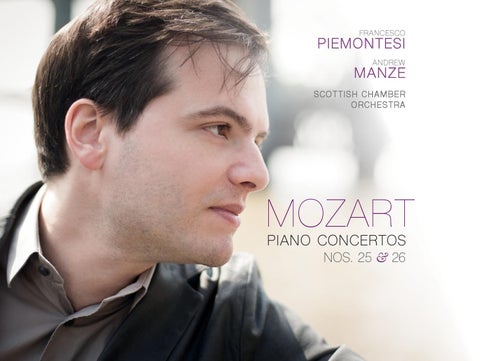
FRANCESCO
PIEMONTESI ANDREW
MANZE SCOTTISH CHAMBER ORCHESTRA
MOZART PIANO CONCERTOS NOS. 25 & 26
WOLFGANG AMADEUS
MOZART
PIANO CONCERTOS NOS. 25 & 26 FRANCESCO
PIEMONTESI ANDREW
MANZE SCOTTISH CHAMBER ORCHESTRA
PIANO CONCERTO NO. 26 IN D MAJOR, K. 537 ‘CORONATION’
1. Allegro* 14:45 2. (Larghetto) 5:15 3. (Allegretto)+ 10:19
PIANO CONCERTO NO. 25 IN C MAJOR, K. 503
*
Cadenzas by Paul Badura-Skoda (K. 537) Friedrich Gulda (K. 503)
+ Lead-ins by
Francesco Piemontesi
4. Allegro maestoso* 14:41 5. Andante 7:22 6. Allegretto 8:49 Total Running Time: 61 minutes
RECORDED AT
Usher Hall, Edinburgh, UK 6–8 February 2016 PRODUCED AND RECORDED BY Philip Hobbs ASSISTANT ENGINEERING BY Robert Cammidge POST-PRODUCTION BY Julia Thomas COVER IMAGE BY Benjamin Ealovega DESIGN BY toucari.live This recording was made possible with support from the SCO Sir Charles Mackerras Fund and the Usher Hall, Edinburgh.
MOZART’S PIANO CONCERTOS NOS. 25 & 26 After moving to Vienna in spring 1781, Mozart achieved remarkable success with his piano concertos. He wrote a new rondo Finale (K. 382) for an old concerto, K. 175 in C, to play first at a concert at the high-profile Burgtheater in early 1782 and soon described it as a ‘favourite’ of the musical public. He then produced a grand total of fifteen original works between late 1782 and the end of 1786. While the first three, K. 413 in F, K. 414 in A and K. 415 in C, were intended primarily for sale to amateurs in manuscript copy, the rest were written specifically for first performance by Mozart himself in Vienna. He held concerts at a hall in a residential building, the Trattnerhof, to which over 170 of Vienna’s great and good subscribed, and then at the Mehlgrube Casino typically frequented by the bourgeoisie, as well as giving an annual academy at the Burgtheater. At each of these events, Mozart included one of his new piano concertos, works that simultaneously promoted his skills as a performer and a composer. Leopold Mozart witnessed his son playing one of his concertos on 13 February 1785, reporting to daughter Nannerl: ‘I…had the pleasure of hearing so splendidly all the interplay of the instruments that tears filled my eyes from sheer delight. When your brother left, the Emperor passed down a compliment hat-in-hand and shouted out “Bravo, Mozart!” When he came back to play, he was applauded.’ And experiencing Mozart the performer-composer in action in a piano concerto was overwhelming for others too. According to a reviewer of a performance in Augsburg of the Concerto for three pianos in F, K. 242, with Mozart as one of the soloists: 4
The work is thorough, fiery, varied and simple; the harmony so full, so powerful, so unexpected, so elevating; the melody so agreeable, so playful, and everything so new; the performance on the fortepiano so nice, so clear, so full of expression and yet at the same time so extraordinarily fast, that we hardly knew what we should pay attention to first, and all the listeners were enraptured with delight. We saw here mastery in the thoughts, mastery in the performance, mastery in the instruments, all combined together. One thing always elevated another so that the numerous assembly was displeased with nothing but that their pleasure did not last still longer. The Piano Concerto No. 25 in C, K. 503, was the last in the sequence of works from the golden period of 1782–6. Mozart dated it 3 December 1786 in his Thematic Catalogue, the Verzeichnßss, and probably first performed it at a concert in Advent. (He may also have played it in Leipzig in 1789.) But Mozart actually began the work around two years earlier, when he composed part of the first movement. And it was not the first time that a piano concerto had remained an incomplete fragment for a lengthy period: both K. 449 in E flat and K. 488 in A were begun well ahead of their dates in the Thematic Catalogue and left in unfinished states between two main phases of compositional work. While Mozart has acquired a reputation for writing music in a rapid, smooth and trouble-free fashion, the reality was often very different, informed by compositional re-thinking and by the practicalities of performance. It is possible that Mozart started K. 503, as well as those earlier concertos K. 449 and K. 488, with specific performances in mind, but then set them aside when plans failed to materialize and returned to them only once other concert opportunities arose.
5
The C major Concerto, alongside the piano concerto that immediately precedes it, K. 491 in C minor, is Mozart’s most imposing work in the genre, especially the first movement. The passage from the piano’s initial solo entry to the re-statement of the main theme by piano and orchestra at the opening of the solo exposition offers a good illustration of its scale and scope. The piano enters in a delicate exchange with the strings, elaborating its own material, before assuming a virtuosic pose with sweeping semiquaver scales and angular figures. After the orchestra brings back the weighty main theme, the piano drifts ethereally above in semiquavers before piano and wind participate in a transformation of the theme from a momentous unified statement to a quiet, pristine locus of exchange. The qualities of grandeur, virtuosic brilliance and intimacy characteristic of Mozart’s piano concerto style are configured and reconfigured at a key juncture (the first solo participation by the piano), setting the tone for the remainder of the movement. The solo exposition and recapitulation carry some of the most adventurously virtuosic writing in Mozart’s concerto oeuvre as well as tightly interwoven passages for soloist and orchestra, and the development section offers contrapuntal equality among the piano, wind and strings before demonstrative solo material takes hold towards the end. While the first movement is a hard act to follow, Mozart continues in the Andante and the Allegretto to negotiate imposing and delicate material. In the Andante, a slow-movement sonata form (progressing directly from the exposition to the recapitulation without a development section), the piano receives a greater quantity of virtuosic decoration, embellishment and elaboration than in most of Mozart’s concerto middle movements, and the wind are more prominent 6
than in most corresponding movements as well, both as quasi-soloists and as accompanists. The finale, a long sonata rondo preceded by a substantial orchestral ritornello, brings proceedings to a memorable close with virtuosic fireworks and interactive, timbrally prominent wind.
As with K. 503, initial work on the ‘Coronation’ Concerto – so-called on account of Mozart’s rendition of it at an event in Frankfurt in October 1790 shortly after the coronation of the new Emperor, Leopold II – probably predates by a while the Thematic Catalogue entry denoting its completion (24 February 1788); it is possible that Mozart began it in spring 1787. Mozart certainly played the concerto in Dresden on 14 April 1789 while on tour in northern Germany and may also have performed it in 1788. The incomplete solo part in the autograph score, where much left-hand material is missing, is a reminder of Mozart’s powers of memory and penchant for elaboration and improvisation, as well as the time pressures often experienced in the run-up to a concert. Mozart did not perform his concertos exactly as conveyed in the autographs: he introduced many decorations and embellishments, including to concertos that appear to be substantively complete. This concerto is an extreme case of where written text and performance act would have differed: for example, no music at all accrues to the left hand in the slow movement, and would have had to be either extemporized or memorized by Mozart for early renditions.
7
The work contains many stylistically striking passages, especially in the outer movements. After the second theme in the solo exposition, where Mozart usually builds immediately towards a virtuosic climax for the piano culminating in a cadential trill in the dominant key to mark the end of the first half of the movement, here he introduces ruminative contrapuntal contemplation for the piano by itself. The demonstration of solo virtuosity is thereby made to wait. And close to the end of the movement a dramatic passage new to the recapitulation relative to the exposition, shunts the music temporarily to G minor and includes terse diminished chords before harmonic preparation for the end of the recapitulation is resumed. The finale, another sonata rondo, initiates its development section with a compact, audacious move from the dominant of B minor to a confirmation of B flat major just a few bars later, invoking a comparable harmonic process at the onset of the development section of the first movement of the final piano concerto, K. 595 in B flat. The middle movement, in ABA form, is a more modest affair, including a central section in which piano interaction with the orchestra is minimal and opportunities to promote (and embellish) the aria-like melody can be exploited by the soloist. Neither K. 503 nor K. 537 has enjoyed the highest critical reputation among Mozart’s concertos. The C major concerto is often admired by musicologists and analysts, but also has its detractors: according to Joseph Kerman, Mozart’s previous work in the genre, the C minor Concerto, documents alienation from his audience while K. 503 is ‘strangely cold…[registering] a clear change in mood in the sequence of Mozart concertos’. But both concertos on this recording are more profitably understood as examples of stylistic experimentation than as evidence of a putative lowering of musical standards or loss of interest in the genre. 8
Mozart produced only three piano concertos in the five and a half years after April 1786 in comparison to fourteen in the previous four years, a fact no doubt in part attributable to burgeoning operatic commitments. (Le nozze di Figaro, Don Giovanni, Così fan tutte, Die Zauberflöte and La clemenza di Tito were all first staged between 1786 and 1791.) But he remained popular and warmly appreciated as a performer and writer of piano concertos after 1786, with no diminishment in the remarkable quality of his playing; one critic stated that ‘everybody admired [Mozart’s] art, in composition as well as execution’ during a rendition of the final concerto, K. 595, in spring 1791. Changes witnessed in K. 503 and K. 537 reflect stylistic re-invention in his piano concertos following the high point of the C minor concerto: after the interactive intensity and formal and structural complexity of the first movement of that work in particular, which goes further than concertos earlier in the 1782–6 sequence, Mozart felt the need to move in a different direction, which explains some of the aforementioned passages in K. 503 and K. 537. There is every reason to believe that had Mozart lived beyond December 1791, a further protracted period of success as a performer and composer of piano concertos would have come to pass. © Simon P. Keefe, 2017
9
Photograph by Benjamin Ealovega
FRANCESCO PIEMONTESI Francesco Piemontesi appears with major ensembles worldwide: Los Angeles Philharmonic, London Philharmonic, Czech Philharmonic, Vienna Symphony, Pittsburgh Symphony, Dallas Symphony, Cleveland Orchestra, Philharmonia Orchestra, Leipzig Gewandhaus Orchestra, Budapest Festival Orchestra, Munich Philharmonic, NHK Symphony, Israel Philharmonic, Oslo Philharmonic, Bavarian Radio Symphony, DSO and RSB Berlin, SWR, NDR and Frankfurt Radio Orchestras, Swedish Radio Symphony Orchestra, Orchestre de Paris, Orchestre de la Suisse Romande, Danish National Symphony, Chamber Orchestra of Europe, and Scottish Chamber Orchestra. He has performed with conductors such as Zubin Mehta, Ivan Fischer, Vladimir Ashkenazy, Charles Dutoit, Manfred Honeck, Marek Janowski, Neeme Järvi, Sir Mark Elder, Ton Koopman, and Sir Roger Norrington. Piemontesi is a natural chamber musician, playing with a variety of partners, including the Emerson Quartet, Renaud and Gautier Capuçon, Clemens Hagen, Angelika Kirchschlager, and Daniel Müller-Schott. In solo recital he has appeared in prestigious venues including London Wigmore Hall, Amsterdam Concertgebouw, Carnegie Hall and Avery Fisher Hall in New York, Berlin Philharmonie, Zürich Tonhalle, Vienna Konzerthaus and Musikverein. Born in Locarno, Piemontesi studied with Arie Vardi before working with Alfred Brendel, Murray Perahia, Cécile Ousset, and Alexis Weissenberg. He rose to international prominence with prizes at major competitions including the 2007 Queen Elisabeth Competition, and was a BBC New Generation Artist from 2009 to 2011.
11
Photograph by Benjamin Ealovega
ANDREW MANZE Andrew Manze is widely celebrated as one of the most stimulating and inspirational conductors of his generation. His extensive and scholarly knowledge of the repertoire mark him out, together with his rare skill as a communicator and his boundless energy. As a guest conductor, Manze has regular relationships with a number of leading international orchestras, including the Munich Philharmonic, Leipzig Gewandhaus, Los Angeles Philharmonic Orchestra, Royal Stockholm Philharmonic, Gothenburg Symphony, Oslo Philharmonic, Mahler Chamber Orchestra, Camerata Salzburg, and the Scottish and Swedish Chamber Orchestras. He is also a regular guest at the Mostly Mozart Festival in New York City. From 2006 to 2014, Manze was Principal Conductor and Artistic Director of the Helsingborg Symphony Orchestra. He was Associate Guest Conductor of the BBC Scottish Symphony Orchestra from 2010 to 2014, and Principal Guest Conductor of the Norwegian Radio Symphony Orchestra from 2008 to 2011. In September 2014 he became the Principal Conductor of the NDR Radiophilharmonie in Hannover. In November 2011 he received the prestigious Rolf Schock Prize in Stockholm. Previous winners include Ligeti, Kagel, Saariaho, Panula, Gidon Kremer, and Anne Sofie von Otter.
13
Photograph by Marco Borggreve
SCOTTISH CHAMBER ORCHESTRA The internationally celebrated Scottish Chamber Orchestra is made up of a unique collection of talented musicians who inspire and connect with people of all ages. The SCO aims to provide as many opportunities as possible for people to hear their music by touring the length and breadth of Scotland and around the world as proud ambassadors for Scottish cultural excellence. In recent years, the Orchestra has travelled throughout Europe, the Far East, India and the USA. The SCO has made a significant contribution to Scottish life, not just in what it provides culturally, but in what it gives back to the community. Outside the concert hall, SCO players inspire people of all ages in schools, universities, hospitals, care homes, places of work, and other community settings through the work of SCO Connect, the SCO’s creative learning team. The SCO’s discography exceeds 150 recordings. With its Principal Conductor Robin Ticciati, the orchestra has released five recordings: Berlioz’s Symphonie Fantastique (2012), Berlioz’s Les nuits d’été and La mort de Cléopâtre (2013), Wagner’s Siegfried Idyll (2014), Schumann’s Symphonies (2014) and Haydn’s Symphonies Nos. 31, 70 and 101 (2015), all on Linn. The orchestra’s longstanding relationship with its former Conductor Laureate, the late Sir Charles Mackerras, resulted in many exceptional performances and recordings, including two multi-award-winning albums for Linn of Mozart’s late symphonies. 15
The SCO has strong relationships with many eminent guest conductors, including its Principal Guest Conductor Emmanuel Krivine and Conductor Emeritus Joseph Swensen, Olari Elts, Andrew Manze, John Storgårds, and Oliver Knussen; regular soloist-directors include Christian Zacharias and Piotr Anderszewski. The orchestra enjoys close relationships with many leading composers and has commissioned more than 100 new works, including pieces by the late Sir Peter Maxwell Davies, Sir James MacMillan, Judith Weir, Sally Beamish, Karin Rehnqvist, Hafliði Hallgrímsson, Lyell Cresswell, Mark-Anthony Turnage, Einojuhani Rautavaara, John McLeod, Rolf Martinsson, Toshio Hosokawa, and Martin Suckling, who is SCO Associate Composer. The Scottish Chamber Orchestra receives core funding from the Scottish Government as one of Scotland’s five National Performing Arts Companies.
16
SCOTTISH CHAMBER ORCHESTRA SCOTTISH CHAMBER ORCHESTRA
VIOLIN I
4 Royal Terrace Edinburgh EH7 5AB, UK
Thomas Fheodoroff Ruth Crouch Marciana Buta Emily Dellit Imbert Lorna McLaren Amira Bedrush-McDonald Sarah Bevan-Baker Ruth Slater
T: +44 (0)131 557 6800 E: info@sco.org.uk www.sco.org.uk PRINCIPAL CONDUCTOR
Robin Ticciati
VIOLIN II
Sonja Starke Laura Comini Robert McFall Niamh Lyons Rachel Smith Catherine James
PRINCIPAL GUEST CONDUCTOR
Emmanuel Krivine
CONDUCTOR EMERITUS
Joseph Swensen CHIEF EXECUTIVE
Gavin Reid
17
OBOE
VIOLA
Rachel Roberts Ann Beilby Brian Schiele Steve King
Robin Williams Rosie Staniforth BASSOON
Peter Whelan Alison Green
CELLO
Joris van den Berg Su-a Lee Donald Gillan Eric de Wit
HORN
Alec Frank-Gemmill Harry Johnstone
BASS
TRUMPET
Nikita Naumov Adrian Bornet
Peter Franks Shaun Harrold
FLUTE
TIMPANI
Matthew Hardy
Alison Mitchell
18
LES CONCERTOS POUR PIANO DE MOZART NOS 25 & 26 Au printemps 1781, après s’être installé à Vienne, Mozart connut un succès remarquable avec ses concertos pour piano. Il écrivit un nouveau Finale en rondo (K. 382) pour un précédent concerto, K. 175 en do majeur, qu’il joua pour la première fois lors d’un concert au très en vue Burgtheater début 1782 ; très vite, l’œuvre fut décrite comme la « favorite » du public musical. Mozart composa au total quinze œuvres originales entre la fin 1782 et la fin 1786. Tandis que les trois premières, K. 413 en fa majeur, K. 414 en la majeur et K. 415 en do majeur, furent initialement destinées à être vendues en copies manuscrites aux amateurs, les autres furent écrites spécifiquement pour être jouées à Vienne d’abord par Mozart lui-même. Celui-ci donna des concerts dans le hall d’un bâtiment résidentiel, le Trattnerhof, auxquels près de 170 Viennois de la haute société souscrivirent, puis au Mehlgrube Casino, habituellement fréquenté par la bourgeoisie, tout en donnant une académie annuelle au Burgtheater. À chacune de ces occasions, Mozart jouait l’un de ses nouveaux concertos pour piano, ce qui lui permettait de faire la preuve de ses capacités à la fois d’interprète et de compositeur. Leopold Mozart assista à l’un de ces concerts le 13 février 1785 et rapporta à sa fille Nannerl : « J’ai…eu le plaisir d’entendre si magnifiquement le dialogue entre tous les instruments que j’en eus les larmes aux yeux de plaisir. Lorsque ton frère partit, l’Empereur décrocha un compliment, chapeau à la main, et cria : ‘Bravo, Mozart !’. Lorsqu’il revint pour jouer, il fut applaudi. » Entendre Mozart, l’interprète-compositeur, dans un concerto pour piano était un enchantement pour tout le monde. Voici ce que dit la critique d’une présentation à Augsbourg du Concerto pour trois pianos en fa majeur, K. 242, avec Mozart parmi les solistes : 19
L’œuvre est profonde, fougueuse, variée et simple ; l’harmonie si pleine, si puissante, si inattendue, si élevée ; la mélodie si agréable, si légère et tout est si nouveau ; le jeu sur le pianoforte si beau, si clair, si expressif et en même temps si extraordinairement rapide qu’il était difficile de savoir sur quoi porter d’abord son attention et tous les auditeurs furent transportés de joie. Nous avons vu une maîtrise de pensée, d’interprétation, des instruments, tout ensemble. Une chose en élevait toujours une autre, de sorte que la nombreuse assistance n’avait rien à redire sauf au sujet du fait que son plaisir ne dure pas plus longtemps. Le Concerto pour piano no 25 en do majeur, K. 503, est la dernière des œuvres écrites durant la période dorée de 1782–6. Dans son catalogue thématique, le Verzeichnüss, Mozart le date du 3 décembre 1786 ; il le joua probablement pour la première fois lors d’un concert de l’avent (et doit l’avoir également joué à Leipzig en 1789). Mais en réalité, Mozart commença l’œuvre près de deux ans plus tôt et composa alors une partie du premier mouvement. Ce n’était pas la première fois qu’un concerto pour piano restait incomplet pendant longtemps : K. 449 en mi bémol majeur et K. 488 en la majeur furent entamés bien avant les dates reprises au catalogue thématique et restèrent inachevés entre deux phases de travail. Tandis que Mozart s’était forgé une réputation de rapidité, de fluidité et d’aisance d’écriture, la réalité était souvent très différente, influencée par la réflexion et par les aspects pratiques du jeu. Il est possible que Mozart commençât K. 503, tout comme les concertos K. 449 et K. 488, dans un objectif précis, mais il les laissa de côté quand ses plans ne se concrétisèrent pas et n’y retourna qu’après avoir trouvé de nouvelles occasions de les jouer.
20
Tout comme le concerto pour piano qui le précède immédiatement, K. 491 en do mineur, le Concerto en do majeur, K. 503, est l’une des œuvres de Mozart les plus imposantes du genre, en particulier le premier mouvement. Le passage qui sépare la première entrée solo du piano et le retour du thème principal par le piano et l’orchestre, au début de l’exposition, offre une bonne illustration de son ampleur. Le piano ouvre un délicat dialogue avec les cordes, élabore son propre matériau avant d’adopter une attitude virtuose avec des gammes en doubles croches et des figures anguleuses. Après le retour du pesant thème principal par l’orchestre, le piano dérive de façon éthérée en doubles croches avant de participer, avec les vents, à une transformation du thème depuis un exposé unifié jusqu’à un lieu d’échange calme et cristallin. Les caractéristiques de grandeur, de virtuosité brillante et d’intimité typiques du style concertant pour piano de Mozart sont sculptées et resculptées à un moment clé (la première entrée solo du piano), déterminant ainsi la sonorité pour le reste du mouvement. L’exposition et la réexposition sont un exemple de l’écriture la plus audacieusement virtuose dans l’œuvre concertante pour piano du compositeur, tout comme les passages étroitement entrelacés pour le soliste et l’orchestre ainsi que le développement, qui offre une égalité contrapuntique entre le piano, les vents et les cordes avant que le matériel solo ne prenne le pas jusqu’à la fin. Tandis que l’action du premier mouvement est difficile à suivre, Mozart continue, dans l’Andante et l’Allegretto, à utiliser un matériau à la fois imposant et délicat. Dans l’Andante, un mouvement lent de forme sonate (progressant directement de l’exposition à la réexposition, sans développement), le piano a à jouer plus d’embellissements, d’ornements et d’élaborations virtuoses que dans la plupart des mouvements centraux 21
des concertos du compositeur ; par ailleurs, les vents sont particulièrement présents, dans un rôle à la fois quasi-soliste et d’accompagnement. Le mouvement final, un long rondo précédé par une importante ritournelle orchestrale, mène à une fin remarquable avec des feux d’artifice virtuoses et des vents sonores et en interaction.
Tout comme pour K. 503, la première ébauche du Concerto « Couronnement », K. 537 – ainsi nommé en raison du fait qu’il fut joué par Mozart lors d’un événement à Francfort en octobre 1790, peu après le couronnement du nouvel empereur, Léopold II – est probablement antérieure à l’entrée au catalogue thématique, qui indique la date de son achèvement (24 février 1788) ; il est possible que Mozart l’ait commencée au printemps 1787. Le concerto fut certainement joué à Dresde le 14 avril 1789 lors d’une tournée en Allemagne du Nord, ainsi probablement qu’en 1788. La partie solo incomplète de la partition autographe, où la main gauche est très lacunaire, vient nous rappeler les capacités mémorielles de Mozart et son penchant pour l’élaboration et l’improvisation, mais aussi l’importante pression souvent ressentie lors de la préparation d’un concert. Mozart ne jouait pas ses concertos strictement selon la partition : il introduisait de nombreux ornements et embellissements, y compris dans les concertos qui nous semblent les plus complets. Ce concerto illustre cette différence entre notation et exécution : par exemple, rien n’apparaît à la main gauche dans le mouvement lent, ce qui implique que la musique dut être soit improvisée soit jouée de mémoire par Mozart lors des premières représentations. L’œuvre contient de nombreux passages remarquables sur le plan stylistique, en particulier dans les mouvements extérieurs. Après le second thème de l’exposition, où, généralement, l’on se dirige immédiatement vers le climax virtuose avec un trille cadentiel à la dominante pour marquer la fin de la première partie du 22
mouvement, Mozart introduit une contemplation contrapuntique méditative au piano. La démonstration de virtuosité se fait ainsi attendre. Vers la fin du mouvement, un passage dramatique, qui apporte un matériau nouveau, mène temporairement à sol mineur et comporte des accords diminuées tendus avant que soit reprise la préparation harmonique pour la fin de la réexposition. Le mouvement final, également un rondo, initie son développement avec un mouvement compact et audacieux de la dominante de si mineur jusqu’à la confirmation de si bémol majeur quelques mesures plus loin, faisant appel à un processus harmonique comparable à celui du début du développement du premier mouvement du dernier concerto pour piano, K. 595 en si bémol. Le mouvement central, de forme ABA, est de facture plus modeste, où, dans la section centrale, l’interaction du piano et de l’orchestre est minimale et les opportunités de mettre en valeur (et d’embellir) la mélodie de type aria peuvent être exploitées par le soliste. Parmi les concertos de Mozart, ni K. 503 ni K. 537 ne bénéficièrent de la plus grande réputation critique. Le concerto en do majeur est souvent admiré par les musicologues et les analystes, mais possède également ses détracteurs : selon Joseph Kerman, le concerto qui le précède, en do mineur, témoigne de l’aliénation de Mozart à son public tandis que K. 503 est « étrangement froid…[témoignant] d’un changement d’esprit clair dans la série des concertos ». Les deux concertos de cet enregistrement sont à voir comme des exemples d’expérimentation stylistique plutôt que comme la preuve d’une réduction présumée des standards musicaux ou d’une perte d’intérêt pour le genre. Durant les cinq années et demie qui suivirent avril 1786, Mozart n’écrivit que trois concertos pour piano, alors qu’il en avait composé quatorze dans les quatre années précédentes. Ce fait est sans doute à attribuer en partie à 23
des engagements de plus en plus nombreux à l’opéra. (Le nozze di Figaro, Don Giovanni, Così fan tutte, Die Zauberflöte et La clemenza di Tito furent tous présentés pour la première fois entre 1786 et 1791.) Mais il resta populaire et apprécié comme interprète et compositeur de concertos pour piano après 1786, sans qu’aucune diminution de la remarquable qualité de son jeu fût observée ; lors d’une interprétation de son dernier concerto, K. 595, au printemps 1791, un critique affirma que « tout le monde admirait l’art [de Mozart], aussi bien dans le domaine de la composition que dans celui de l’exécution ». Les changements observés dans K. 503 et K. 537 témoignent d’une réinvention stylistique dans ses concertos pour piano après le sommet que constitue le concerto en do mineur : après l’intensité interactive et formelle et la complexité structurelle du premier mouvement de cette œuvre en particulier, qui va plus loin que les concertos écrits entre 1782 et 1786, Mozart sentit le besoin d’expérimenter d’autres voies, ce qui explique certains des passages susmentionnés dans K. 503 et K. 537. Il y a toutes les raisons de croire que si Mozart avait vécu au-delà de décembre 1791, il aurait connu une autre période de succès en tant qu’interprète et compositeur de concertos pour piano. © Simon P. Keefe, 2017 Traduction : Catherine Meeùs
24
MOZARTS KLAVIERKONZERTE NR. 25 & 26 Nach seinem Umzug nach Wien im Frühjahr 1781 erzielte Mozart mit seinen Klavierkonzerten außerordentliche Erfolge. Er schrieb ein neues Rondo-Finale (KV 382) für ein altes Konzert, KV 175 in C-Dur, um es zunächst Anfang 1782 in einem Konzert im renommierten Burgtheater zu spielen und bezeichnete es schon bald als „Favoriten“ des Publikums. Zwischen Ende 1782 und Ende 1786 schuf er dann in der Summe funfzehn Originalwerke. Während die ersten drei, KV 413 in F-Dur, KV 414 in A-Dur und KV 415 in C-Dur, vorrangig zum Verkauf an Laien in Manuskriptkopie bestimmt waren, wurde der Rest ausdrücklich zur Erstaufführung durch Mozart selbst in Wien geschrieben. In einem Saal eines Wohnhauses, dem Trattnerhof, hielt er Konzerte ab, die von über 170 von Wiens Reichen und Mächtigen abonniert wurden, und dann im Mehlgrube-Kasino, was üblicherweise von der bürgerlichen Gesellschaft frequentiert wurde, und er gab außerdem eine jährliche Akademie im Burgtheater. Bei jeder dieser Veranstaltungen hat Mozart eines seiner neuen Klavierkonzerte eingeplant, Werke, die gleichzeitig seine Fähigkeiten als Interpret wie als Komponist beförderten. Leopold Mozart erlebte seinen Sohn am 13. Februar 1785 mit einem seiner Konzerte und berichtete seiner Tochter Nannerl: „Ich…hatte das Vergnügen gehabt, alle Abwechslungen der Instrumente so vortrefflich zu hören, daß mir vor Vergnügen die thränen in den augen standen. Als dein Bruder weg gieng, machte ihm der kayser mit dem Hut in der Hand ein compliment hinab und schrie ‘Bravo Mozart!’. Als er herauskam zum spielen, wurde ihm ohnehin zugeklatscht.“ Auch für andere muss die Erfahrung überwältigend gewesen sein, den Interpreten-Komponisten Mozart einmal bei einem Klavierkonzert in Aktion zu erleben. So schreibt etwa ein Kritiker einer 25
Augsburger Aufführung des Konzerts für drei Klaviere F-Dur KV 242 mit Mozart als einem der Solisten: Die Composition gründlich, feurig, mannigfaltig und einfach: die Harmonie so voll, so kräftig, so unerwartet, so erhebend; die Melodie so angenehm, so tändelnd, und alles so neu; der Vortrag auf dem Forte-Piano so nett, so rein, so voll Ausdruck, und doch zugleich so außerordentlich geschwinde, daß man kaum wußte, worauf man zuerst merken sollte, und alle Zuhörer zum Entzücken hingerissen wurden. Man sah hier Meisterstücke in der Gedanken, Meisterstücke in dem Vortrag, Meisterstücke in den Instrumenten, alles zusammen vereinigt. Eins erhob immer das andere so sehr, dass die zahlreiche Versammlung über nichts mißvergnügt war, als daß nicht ihr Vergnügen noch länger dauerte. Das Klavierkonzert Nr. 25 in C-Dur KV 503 war das letzte einer Reihe von Werken aus der goldenen Periode von 1782–6. Mozart datierte es in seinem thematischen Katalog, dem Verzeichnüss, auf den 3. Dezember 1786 und hat es wahrscheinlich erstmals bei einem Konzert im Advent aufgeführt. (Er kann es auch im Jahr 1789 in Leipzig gespielt haben.) Mozart begann das Werk aber schon zwei Jahre früher, wo er einen Teil des ersten Satzes komponierte. Und es war auch nicht das erste Mal, dass ein Klavierkonzert für einen längeren Zeitraum ein unvollständiges Fragment blieb: sowohl KV 449 in Es-Dur als auch KV 488 in A-Dur sind schon deutlich vor ihren Datierungen im thematischen Katalog begonnen worden und blieben zwischen zwei Hauptphasen der Kompositionsarbeit in unvollendetem Zustand liegen. Obwohl sich Mozart den Ruf erworben hatte, Musik schnell, geschmeidig und mühelos zu schreiben, sah die Realität oft anders aus, geprägt von kompositorischem Überdenken und aufführungspraktischen Erwägungen. Es ist möglich, dass Mozart ganz bestimmte Aufführungen im Kopf hatte, als er KV 503, aber auch die früheren 26
Konzerte KV 449 und KV 488 begann, sie dann aber zur Seite legte als Pläne zur Verwirklichung scheiterten, und er zu diesen erst wieder zurückkehrte, als sich neue Konzertmöglichkeiten ergaben.
Das C-Dur-Konzert ist, neben dem Klavierkonzert, das ihm unmittelbar vorausging, KV 491 in c-Moll, Mozarts imposanteste Arbeit dieser Gattung, vor allem der erste Satz. Die Passage vom ersten Solo-Eintritt des Klaviers bis zur Wiederkehr des Hauptthemas in Klavier und Orchester am Beginn der Solo-Exposition illustriert gut dessen Größe und Umfang. Das Klavier tritt in einen zärtlichen Dialog mit den Streichern ein und arbeitet sein eigenes Material heraus, bevor es eine virtuose Haltung mit ausladenden Sechzehntelläufen und kantigen Phrasen annimmt. Nachdem das Orchester das gewichtige Hauptthema zurückgebracht hat, driftet das Klavier ätherisch in Sechzehnteln nach oben ab, bevor sich Klavier und Holzbläser an einer Umwandlung des Themas von einer einheitlichen, bedeutenden Aussage zu einem ruhigen, unberührten Ort des Austausches beteiligen. Qualitäten wie Pracht, virtuose Brillanz und Intimität, die für den Klavierkonzertstil Mozarts charakteristisch sind, werden an einer Schlüsselstelle (der ersten solistischen Beteiligung des Klaviers) gestaltet und neu gestaltet und geben den Ton für den restlichen Teil des Satzes an. Die Soloexposition und -reprise bringen nicht nur einige der abenteuerlichsten Beispiele virtuoser Schreibweise in Mozarts KlavierkonzertSchaffen, sondern auch dicht miteinander verwobene Passagen für Solist und Orchester, und der Durchführungsteil bietet kontrapunktische Gleichbehandlung zwischen dem Klavier, den Holzbläsern und den Streichern, bevor sich dann bis zum Ende hin demonstratives Solo-Material breitmacht. 27
Während der erste Satz nur schwer zu überbieten ist, fährt Mozart im Andante und dem Allegretto damit fort, repräsentatives und zartes Material zu bewältigen. Im Andante, einem langsamen Sonatensatz (direkt ohne Durchführungsteil von der Exposition in die Reprise fortschreitend), erhält das Klavier eine größere Menge von virtuoser Dekoration, Verzierung und Ausschmückung als in den meisten Binnensätzen von Mozarts Konzerten, und auch die Holzbläser werden prominenter eingesetzt als in den meisten entsprechenden Sätzen, sowohl als Quasi-Solisten wie auch als Begleiter. Das lange Sonatenrondo-Finale, dem ein bedeutendes Orchesterritornell vorausgeht, bringt das Geschehen mit virtuosen Feuerwerken und sich gegenseitig beflügelnden, farblich hervorstechenden Holzbläsern zu einem unvergesslichen Abschluss.
Wie bei KV 503 hatte Mozart mit den ersten Arbeiten am „Krönungskonzert“ – so genannt wegen Mozarts Aufführung bei einer Veranstaltung in Frankfurt im Oktober 1790 kurz nach der Krönung des neuen Kaisers Leopolds II. – vermutlich schon eine ganze Weile vor dem Eintrag im thematischen Katalog mit dem Fertigstellungsdatum (24. Februar 1788) begonnen; möglicherweise im Frühjahr 1787. Mozart spielte das Konzert sicher am 14. April 1789 in Dresden während einer Konzerttournee in Norddeutschland und kann es auch schon 1788 aufgeführt haben. Der unvollständige Solopart in der autografen Partitur, wo einiges an Material in der linken Hand fehlt, weist auf Mozarts Gedächtnisleistung und seine Neigung zur Ausgestaltung und Improvisation hin, genauso wie auf den oft von ihm erfahrenen Zeitdruck im Vorfeld eines Konzerts. Mozart hat seine Konzerte nicht genau so gespielt wie sie in den Autografen überliefert sind: er hat ihnen viele Ausschmückungen und Verzierungen hinzugefügt und das auch bei Konzerten, die im Wesentlichen vollständig zu sein scheinen. Dieses Konzert ist ein Extremfall, in dem sich geschriebener Notentext und der Akt der Aufführung unterschieden haben könnten: z.B. erwächst aus der linken Hand im langsamen Satz 28
keinerlei Musik und hätte entweder improvisiert werden müssen oder Mozart von früheren Aufführungen im Gedächtnis geblieben sein. Das Werk enthält viele stilistisch auffällige Passagen, vor allem in den Ecksätzen. Nach dem zweiten Thema in der Solo-Exposition, wo Mozart in der Regel sofort einen virtuoser Höhepunkt für das Klavier im Blick hat, der in einem Kadenztriller auf der Dominante gipfelt, um das Ende der ersten Hälfte des Satzes zu markieren, führt er hier grüblerische, kontrapunktische Kontemplation für das Klavier allein ein. Die Darstellung der solistischen Virtuosität muss erst einmal warten. Und nahe dem Ende des Satzes in der Reprise führt eine im Vergleich zur Exposition neue dramatische Passage die Musik zeitweise nach g-Moll und enthält knappe verminderte Akkorde, bevor die harmonische Vorbereitung auf das Ende der Reprise wieder aufgenommen wird. Das Finale, wiederum ein Sonatenrondo, eröffnet seinen Durchführungsteil mit einer kompakten, kühnen Wendung von der Dominante von h-Moll zur Festigung von B-Dur nur wenige Takte später und weckt Erinnerungen an einen vergleichbaren harmonischen Prozess am Beginn des Durchführungsteils des ersten Satzes des letzten Klavierkonzerts KV 595. Der Mittelsatz in ABA-Form ist eine etwas einfachere Angelegenheit, die einen zentralen Abschnitt umfasst, in dem die Interaktion zwischen dem Klavier und dem Orchester auf ein Minimum reduziert ist, und wo der Solist alle Möglichkeiten ausschöpfen kann, die arienhafte Melodie hervorzuheben (und auszugestalten). Weder KV 503 noch KV 537 konnten sich innerhalb von Mozarts Konzerten größter Beliebtheit erfreuen. Das C-Dur-Konzert wird meist von Musikwissenschaftlern und Analytikern bewundert, hat aber auch seine Gegner: nach Joseph Kerman dokumentiert das vorhergehende Werk dieses Genres, das c-Moll-Konzert, die Entfremdung von seinem Publikum, während KV 503 „seltsam kalt“ ist und „eine deutliche Veränderung der Stimmung in der Abfolge von Mozarts Konzerten“ 29
erkennen lässt. Aber beide Konzerte auf dieser Aufnahme können eher als Beispiele für stilistische Experimente verstanden werden als als Beleg für eine vermeintliche Senkung der musikalischen Standards oder den Verlust an Interesse an der Gattung. Mozart schuf nur drei Klavierkonzerte in den fünfeinhalb Jahren nach dem April 1786 im Vergleich zu den vierzehn in den vergangenen vier Jahren, was sicherlich zum Teil auf die wachsende Zahl von Opernverpflichtungen zurückzuführen ist. (Le nozze di Figaro, Don Giovanni, Così fan tutte, Die Zauberflöte und La clemenza di Tito wurden alle zwischen 1786 und 1791 erstmals auf die Bühne gebracht.) Aber er blieb auch nach 1786 als Interpret und Schreiber von Klavierkonzerten beliebt und hoch geschätzt, ohne Abstriche bei der außergewöhnlichen Qualität seines Spiels; ein Kritiker konstatierte während einer Aufführung des letzten Konzerts KV 595 im Frühjahr 1791, dass „jeder Mozarts Kunst bewunderte, in der Komposition wie auch in der Ausführung“. Veränderungen, die in KV 503 und KV 537 beobachtet wurden, spiegeln die stilistische Neuerfindung in seinen Klavierkonzerten nach dem Höhepunkt des c-Moll-Konzerts wider: nach der interaktiven Intensität und formalen wie strukturellen Komplexität insbesondere des ersten Satzes dieses Werkes, die weiter geht als in den Konzerten aus der Serie von 1782–6, spürte Mozart die Notwendigkeit, sich in eine andere Richtung zu bewegen, was einige der erwähnten Passagen in KV 503 und KV 537 erklärt. Es gibt sogar allen Grund zu der Annahme, dass, wenn Mozart noch über den Dezember 1791 hinaus gelebt hätte, sich eine weitere lang anhaltende Serie des Erfolgs als Interpret wie als Komponist von Klavierkonzerten eingestellt hätte. © Simon P. Keefe, 2017 Übersetzung: Jan Ritterstaedt 30
ALSO AVAILABLE
Ingrid Fliter Antonio MĂŠndez Scottish Chamber Orchestra
Schumann & Mendelssohn: Piano Concertos
Ingrid Fliter Jun Märkl Scottish Chamber Orchestra
Chopin: Piano Concertos
Artur Pizarro Charles Mackerras Scottish Chamber Orchestra
Sean Shibe Ben Gernon Scottish Chamber Orchestra
Robin Ticciati Scottish Chamber Orchestra
Robin Ticciati Scottish Chamber Orchestra
Maxwell Davies: An Orkney Wedding, With Sunrise
Haydn: Symphonies 31, 70 & 101
Beethoven: Piano Concertos 3, 4 & 5
Schumann: The Symphonies
Glasgow Road, Waterfoot, Eaglesham, Glasgow, G76 0EQ T: +44 (0)141 303 5027 | E: info@linnrecords.co.uk
Alexander Janiczek Scottish Chamber Orchestra
Mozart: Wind Concertos
Robin Ticciati Charles Mackerras Joseph Swensen Scottish Chamber Orchestra
40th Anniversary Edition