MENU
Welcome home, Mr Dubourg
IRISH BAROQUE ORCHESTRA PETER WHELAN 1
Credits Tracklist Programme note Sung texts Biographies
IRISH BAROQUE ORCHESTRA PETER WHELAN
Welcome home, Mr Dubourg
© Marshall Light Studio 3
Recording Producer & Engineer Philip Hobbs
Recorded in North Leith Parish Church, Edinburgh, and St Jude-on-the-Hill, Hampstead Garden Suburb, London, UK, on 2–3 May 2018 and 13–15 August 2018
Design stoempstudio.com
Post-production Julia Thomas
Edition prepared by Brian Clark, Prima la Musica
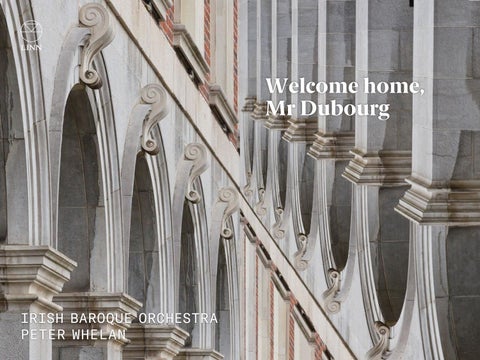
Cover image by Mark Reddy, Trinity Digital Studios, courtesy of the Office of Public Works, Dublin Castle
MENU
Matthew Dubourg (1703–1767)
60:58 IRISH BAROQUE ORCHESTRA PETER WHELAN artistic director
1 — Hibernia’s sons, your voices raise 4:00 (from Ode for Dublin Castle, 1753)
Antonio Vivaldi (1678–1741)
Concerto in A major for two violins, RV 519
SOPHIE GENT, CLAIRE DUFF violin solo
2 — Allegro 2:50 3 — Largo 1:29 4 — Allegro 2:34 5 — Dubourg’s Maggot 1:55
SOPHIE GENT, CLAIRE DUFF, HUW DANIEL violin solo
Violin Concerto in D major
SOPHIE GENT violin solo
6 — Adagio 1:17 7 — Allegro 3:25 8 — Adagio 1:57 9 — Allegro 1:42
MENU
MENU
10 — Eileen Aroon, with variations set by Mr Dubourg 2:14
PHILIPPE GRISVARD harpsichord solo
11 — Ciste nó stór 1:34
SOPHIE GENT violin solo
Arcangelo Corelli (1653–1713), ornamentation by Dubourg
Violin Sonata in A major, Op. 5 No. 9
SOPHIE GENT violin, PHILIPPE GRISVARD harpsichord
12 — Preludio: Largo 4:40 13 — Giga: Allegro 3:00 14 — Adagio 0:31 15 — Tempo di Gavotta: Allegro 2:45 16 — Now the mingling hosts engage 3:47 (from Ode for Dublin Castle, 1740)
EDWARD GRINT bass solo, SARAH McMAHON cello solo,
CARLES CRISTOBAL bassoon solo
17 — Soft breathes the melting flute 2:54 (from Ode for Dublin Castle, 1743)
ANNA DEVIN soprano 5
MENU
18 — Trumpet tune (from Ode for Dublin Castle, 1741?) 0:50
SIMON MUNDAY trumpet
Ode for Dublin Castle, 1739 ‘Crowned with a more illustrious light’
19 — Chorus: Crowned with a more illustrious light 1:39 20 — Air: From hour to hour 2:22
ANNA DEVIN soprano
21 — Chorus: Still may his praise 1:14 22 — Air: Where e’er the sun 2:26
RACHEL KELLY mezzo-soprano
23 — Sinfonia 0:45 24 — Air: George’s empire 1:45
ANNA DEVIN soprano
25 — Air: Born to glory 2:27
ANNA DEVIN soprano, SARAH McMAHON cello solo
26 — Duet: Pleased with our state 2:19
ANNA DEVIN soprano, RACHEL KELLY mezzo-soprano
27 — Chorus: And thou dejected Ireland 1:02 28 — ‘Welcome home, Mr Dubourg’ 1:29
SOPHIE GENT violin
6
Matthew Dubourg
MENU
A Musical Portrait
The name of Matthew Dubourg is known today primarily as the result of a series of colourful anecdotes arising from Handel’s famous visit to Dublin. This should not blind us to Dubourg’s contemporary reputation as a charismatic virtuoso and composer in his own right. This recording rescues from obscurity the overlooked genius of Dubourg as one of Ireland’s most influential musicians. With minor exceptions, the works of Dubourg are presented here for the first time, having never been published before, let alone recorded. Yet Dubourg was, in his own day, an immensely popular composer whose music is shot-through with humanity, charm, virtuosity and wit. It was Dubourg who gave musical expression to the elegance and splendour of Dublin under the Georges.
7
MENU
The first part of this recording focuses on Dubourg the violinist, while the second explores the Royal Birthday Odes he composed for the annual ceremonies at Dublin Castle. This serves as a taster for a vast collection of such ceremonial music, much of which remains to be catalogued and explored beginning with three movements from miscellaneous odes which demonstrate the virtuosity and diversity of Dubourg’s Viceregal Band. This is followed by the world premiere recording of ‘Crowned with a more illustrious light’, one of the few complete odes it is currently possible to identify and reconstruct. The chorus ‘Hibernia’s sons, your voices raise’ – with the influence of Handel strongly in evidence – is a fitting way to open this recording of Dubourg’s music. Many thanks to David Rhodes, Peter Linnitt (Royal College of Music Library), Mary Heffernan, Rosemary Collier (Dublin Castle/OPW), Niall Doyle, the Irish Arts Council, Brian Clark, Grant O’Brien and the National Library of Ireland for their help in the preparation for this project.
© Peter Whelan, 2019
8
Welcome home, Mr Dubourg
Dubourg! Thy power is near divine! Sweet harmony, and taste, are thine! Play on; th’inanimate inspire! Till brutes shall gaze, and fools admire! Then, in some wild, and tuneless strain, Play tricks – and fix ’em – fools again! On Mr. Dubourg’s excellent performance on the violin (1743)
As Benjamin Victor’s witty epigram suggests, Matthew Dubourg (1703–1767) was chiefly celebrated during his own lifetime as a performer. An extraordinarily gifted violinist, his playing not only delighted and at times astonished audiences but also led to a slew of other poetic tributes from the likes of Henry Carey, Matthew Pilkington, Laurence Whyte and John Winstanley. Indeed, Dubourg’s fame was such that his name even featured in popular ballads, including the much reproduced On the Buck Hunt in the County of Limerick, a hunting song that, in summoning up the sound of horns and joyously ‘whooping’ participants, proclaimed: ‘Dubourg were he there / Such sweet music to hear / Would leave his Cremona [i.e. his violin] and follow.’ 9
MENU
MENU
Dubourg’s family background is somewhat shrouded in mystery. He was repor tedly the natural son of Mr Isaac, a highly successful dancer and dancing master active at the court of Queen Anne, who also performed in theatres, gave private dancing lessons to the elite of London society and published copies of the dance that he choreographed each year for the Queen’s birthday ball. Recent research by Jennifer Thorp has revealed that Mr Isaac was probably Edward (or Edmund) Isaac, a Catholic dancing master who lived for a time in the London parish of St Clement Danes. The identity of Dubourg’s mother is even more shadowy; according to the Irish antiquarian and writer Joseph Cooper Walker, she was ‘an Irishwoman’. Dubourg clearly excelled on his chosen instrument from an early age. While still a child – probably in around 1712 – he performed a solo at the celebrated concert series hosted by Thomas Britton in Clerkenwell, ‘standing upon a joint-stool, but so terribly awed at the sight of so splendid an assembly, that he was near falling to the ground’ (London Magazine, February 1777). He then went on to study with renowned violinist and composer Francesco Geminiani, who had settled in England in 1714. Soon Dubourg was appearing regularly in public as a soloist, including at his own benefit concerts which took place in London every year between 1714 and 1720. His long-standing celebrity was evidently established early on: according to John Hawkins, a picture of Dubourg painted when he was a boy was a key feature in the large music room of one Mrs Martin, a rich Dutch woman who frequently hosted concerts during the capital’s winter season. In strong contrast to his teacher Geminiani’s style of playing, which was ‘tender and pathetic’, Hawkins recorded Dubourg’s performance on the violin to have been ‘very bold and rapid’. His apparent fondness for virtuoso display even led 10
MENU
to a cameo appearance in Francis Fleming’s novel The Life and Extraordinary Adventures, The Perils and Critical Escapes of Timothy Ginnadrake (1771), in which the eponymous protagonist is taught music by ‘a famous musician, one Dubourg’. In this (albeit fictional) account, Dubourg is linked to a specific musical work – Antonio Vivaldi’s dazzling Concerto in A major for two violins, RV 519, from his ever-popular 1711 collection L’estro armonico: The 5th Concerto of Vivaldi was often performed on the stage at the theatre by Tim’s master with great applause, as it was thought at that time it was not in the power of any human being, to execute a piece of music more difficult. This excited great emulation in our hero, who usually got up at four o’clock in the morning to practise the 5th of Vivaldi. It was presumably also Dubourg, or possibly his pupil (and another child p rodigy) Jackie (John) Clegg, who – in a trial of skill that took place at the home of an Irish nobleman – performed this same concerto, only to have the blind harpist Turlough O’Carolan play ‘the whole piece after him, without missing a note’. Yet, although Dubourg was associated with the Italian music fashionable in early eighteenth-century England, while still a teenager he had also begun to showcase his own works. Newspaper advertisements reveal, for example, that his benefit concert at Drury Lane’s Theatre Royal on 8 April 1720 featured ‘several Concertos and Solos of his own Composition’. Strikingly, however, rather than publishing these works Dubourg reserved them for himself to play. Sadly, only one has survived: Dubourg’s Concerto in D major for solo violin, two violins, viola and basso continuo. Somehow a manuscript copy of this four-movement work ascribed to ‘Sig.nor Doubor’ found its way into the music collection of the renowned musical 11
MENU
establishment of the electoral court in Dresden, where it remains today in the Saxon State and University Library. When writing about Dubourg for his General History of Music (1776), Burney had the advantage of having met the violinist in person, in Chester in 1744. As he recalled, upon that occasion he ‘had the pleasure of accompanying him [Dubourg] in the fifth solo of Corelli, which he performed in a manner so superior to any one I had then heard, that I was equally astonished and delighted; particularly with the fullness of his tone and spirit of his execution’. As a pupil of Geminiani, who in turn had been a pupil of Arcangelo Corelli, Dubourg’s rendition of this sonata from Corelli’s Op. 5 set (Rome, 1700) no doubt reflected the performance practices of a second generation in a direct line of violinists going back to the work’s composer. Luckily, the survival of a microfilm copy of a (now lost) manuscript dating from the 1720s allows us a taste of how Dubourg would have performed these much admired sonatas. Entitled ‘Correllis Solos Grac’d by Doburg’, while the fugal movements remain free from ornamentation and the other fast movements contain only minimal graces, the slow movements are amply decorated with florid embellishments, requiring the liberal adoption of tempo rubato in performance. By 1721 (if not earlier), Dubourg was leading orchestras at concerts presented by some of London’s foremost musicians. He was clearly also willing to play with amateurs – at least with aristocratic ones – as Philip Perceval wrote to his brother John (later Earl of Egmont) from Bath on 1 September 1718:
12
MENU
Du Bourg the famous Violinist is here and so we have a little Musick, which will create you some trouble for I left some things behind that I now want – there are seven green books bound in green and gold paper covers which I must desire you to send me, six of them are a set of Concertis and one is a Serenata of [Johann Hugo von] Wilderers. It may well be that it was Perceval who first invited Dubourg to visit Ireland, since in December 1721, in a further letter to his brother, this time from his home in Dublin, Philip reported on preparations for a concert to be given by his amateur music club, noting that ‘Dubourg has not fail’d us one night, & you must believe he is no small addition to the performance’. Almost two years later, in October 1723, Perceval, who held the position of Director and Supervisor of the Irish State Music, was successful in engaging the young violinist as a member of the orchestra based at Dublin Castle, proclaiming that Dubourg was ‘a better Master in his way than any of the kings Musitians in England, & is really the best performer of an English Man that has ever yet been known’. The extent to which Dubourg continued to visit England in the 1720s is unclear, although he was certainly in London in May 1727 when several newspapers reported that he had been robbed ‘of a great Quantity of Gold’ (worth roughly £50) while walking from the theatre at Lincoln’s Inn Fields in the early hours of the morning. He was certainly also in London the following month, when he married Frances Gates, daughter of the composer and bass singer Bernard Gates. In 1728, after the death of John Sigismond Cousser, Dubourg was appointed ‘Chief Composer and Master of His Majesty’s Musick attending the State in Ireland’ – reportedly after his teacher Geminiani had to decline the offer, his Roman Catholicism making him ineligible for the post. 13
MENU
Like many musicians active in Anglo-Irish society at the time, including Cousser and the Italian cellist Lorenzo Bocchi, Dubourg appears to have maintained a strong interest in traditional Irish music. On one occasion, while visiting a country fair at Dunboyne, he is even reported to have successfully disguised himself by performing as a country fiddler. In 1746, Dubourg’s set of harpsichord variations on Eileen Aroon (Eibhlín a Rún) was published in a collection of Select Minuets, Collected from the Castle Balls, and the Publick Assemblies in Dublin; this proved a particular favourite and remained in print for some decades. A copy of the traditional Irish song Ciste nó stór – a re-worked version of which exists as O’Carolan’s Fairy Queen – can be found in Dubourg’s hand among the manuscripts of his court odes now held in the library of London’s Royal College of Music. Dubourg’s Maggot – ‘maggot’ being a popular English title for a whimsical dance tune – appeared in 1727 in a volume issued by the Dublin-based publishers John and William Neale as A Third Collection for the Violin of the Newest English Airs and Minuets. Following his 1728 appointment, Dubourg appears to have commuted between Ireland and England for the remainder of his career, since, according to Hawkins, the ‘duties of his employment did not require his constant residence’ in Dublin. Certainly it was reported in London newspapers in 1731 that he had ‘obtain’d Leave of his Grace the Duke of Dorset, Lord Lieutenant of that Kingdom [Ireland], to reside here next Winter, to the real Joy of all true Lovers of Harmony’. From at least 1748 Dubourg appears to have held official positions in both Dublin and London – with the printed libretto of his 1748 Dublin ode for King George II’s birthday adding the title of ‘Master of His Royal Highness the Prince of Wales’s Chamber Music’ to his Irish post of Chief Composer and Master of the Music. Hawkins also notes that Dubourg had given music lessons to the Prince of Wales, as well as to his brother, the Duke of Cumberland. 14
MENU
In September 1761, Dubourg was appointed Master of the Queen’s Chamber Concert (also known as ‘Her Majesty’s Band of Musick’ or, alternatively, as the ‘Royal Family’s Chamber Concert’). An item in Lloyd’s Evening Post and British Chronicle in 1762 listed the ensemble’s ten members as Dubourg at the head of four violinists, two oboists (including his son-in-law Redmond Simpson), a viola player, a cellist, a double bassist and a harpsichordist. The Irish State band of musicians appears to have been roughly the same size, with Perceval noting in 1723 that the ensemble included ‘a good Violoncello & Bassoon: [with] most of the rest of the Musitians sure & readie performers on several instruments’. By the time George Frideric Handel visited Dublin in 1741–42, he was able to report back to Charles Jennens regarding his performances at Neale’s new music hall in Fishamble Street: ‘as for the Instruments they are really excellent, Mr Dubourg being at the Head of them, and the Musick sounds delightfully in this charming Room’. It was these same musicians who were responsible for providing the orchestral accompaniment for the annual performances of royal birthday odes that formed a major part of Dubourg’s responsibilities as Chief Composer at Dublin Castle. Written and performed for the birthdays of the king, his queen and sometimes their sons as well, these were settings of texts commissioned from a variety of poets, including Lewis Burroughs, William Chaigneau, Matthew Pilkington, Thomas Sheridan and Benjamin Victor. Generally scored for two or three voices, chorus, string orchestra with minimal wind instruments (and sometimes featu ring trumpets and drums), these works largely comprise a series of recitatives and arias, with the occasional chorus. Unlike the equivalent performances at the English court, female singers sometimes took part as soloists, as happened with the visiting English soprano Eleanor Oldmixon, who appears to have been one of Dubourg’s favourite performers. 15
MENU
Only a selection of Dubourg’s music for his Dublin odes survives – in four manu script volumes kept at the Royal College of Music in London. These seem to be Dubourg’s working scores and, unfortunately, the material is in some disarray, the individual folios having been bound together out of order. Peter Whelan’s identification of the anonymous libretto of Dubourg’s 1739 ode for George II’s birthday – through the text printed in the Daily Gazetteer of 10 November 1739 – has allowed for this premiere recording of ‘Crowned with a more illustrious light’. As this newspaper item also reveals, the work was first performed at Dublin Castle at noon on the king’s birthday (30 October 1739), before the Duke of Devonshire (Lord Lieutenant of Ireland) and ‘a vast Concourse of Nobility and other Persons of Distinction of both Sexes’. Dubourg clearly had specific performers from the Irish State band in mind when composing these works, since a feature of his writing is the number of striking obbligato parts for solo instruments, including flute, bassoon and cello. On his score for the 1739 aria ‘Born to glory’, Dubourg even noted the cellist’s name: Sprackling Dowdall. The remaining instrumental movements, recitatives and arias heard on this recording are a selection from the Royal College of Music manuscripts and include items from Dubourg’s odes for George II in 1740 (‘Now the mingling hosts engage’; text: Burroughs), 1743 (‘Soft breathes the melting flute’; librettist unknown) and 1753 (‘Hibernia’s sons, your voices raise’; text: Victor).
16
MENU
For those Dubliners not fortunate enough to be invited to the Castle for these annual festive performances, Dubourg sometimes repeated these works for the public, most often at the request of Dublin’s several Charitable Musical Societies. The early decades of the eighteenth century had witnessed the emergence of a vibrant public concert scene in the city, a situation that Dubourg’s friend Handel made the most of when he visited in the early 1740s. (Dubourg was, incidentally, the only musician who was left money in Handel’s will.) It was during this stay – almost certainly during the aria ‘Ingrata mai non fui’ from Handel’s Hymen (a serenata version of his opera Imeneo, given in Dublin on 24 March 1742) – that a well-known event occurred that ties together the two celebrated men in performance, as related by Burney: One night, while Handel was in Dublin, Dubourg having a solo part in a song, and a close to make, ad libitum, he wandered about in diffe rent keys a great while, and seemed indeed a little bewildered, and uncertain of his original key … but, at length, coming to the shake, which was to terminate this long close, Handel, to the great delight of the audience, and augmentation of applause, cried out loud enough to be heard in the most remote parts of the theatre: ‘You are welcome home, Mr. Dubourg!’
© Samantha Owens, 2019
17
1 — Hibernia’s sons, your voices raise
Hibernia’s sons, your voices raise! Exalt your notes to Caesar’s praise! Let the glad sounds ascend to heav’n! This day a second George is giv’n! Benjamin Victor (c. 1704–1778)
18
MENU
16 — Now the mingling hosts engage
Now the mingling hosts engage! Britain rouzes all her rage! Sees her dreadless chief advance Foremost on the lines of France! Swift to ev’ry quarter turning! Round him all the battle burning! Numbers pouring! Ruin show’ring! War whole armed ranks devouring! Lewis Burroughs
19
MENU
17  — Soft breathes the melting f lute
Soft breathes the melting flute in concert with the lute, And makes sweet musick from the lyre; While vocal lays of tuneful praise in swelling harmony conspire. Anonymous
20
MENU
19 — Crowned with a more illustrious light
Crowned with a more illustrious light, Again, the welcome day appears; Th’auspicious morn th’expected sight: The fruit of all our hopes and prayers: The happy day of George’s birth, O! hail the day with general mirth. Anonymous
21
MENU
20 — From hour to hour
MENU
From hour to hour, from year to year, More lov’d our monarch grows, more dear: And studious, still, of righteous fame, Each act, each word, his glory shows; Albion’s best kings excell ev’n those, That rival’d godlike Alfred’s name. Anonymous
22
21 — Still may his praise
MENU
Still may his praise and years increase, Still, rise the beauteous works of peace, And wealth and plenty rise; If this deny’d, and war’s alarms Disturb that bliss, long skill’d in arms, Our fame shall reach the skies. Anonymous
23
22 — Where e’er the sun
MENU
Where e’er the sun extends his sway, There Britain’s glory’s known: Earth’s various realms concern’d survey One state unlike their own: With valour, justice, learning crown’d, For arts and industry renown’d: All nations else obey the chain, But England’s liberties remain. Anonymous
24
24 — George’s empire
MENU
George’s empire then enduring, All our blessings thus securing, Joyful, confess your grateful hearts; Former times and these comparing And your honest thoughts declaring, Only be true to his deserts. Anonymous
25
25 — Born to glory
MENU
Born to glory, sprung from praise, Friend to science, temp’rance, truth, Well he rules; his justice sways; He’s wise as age, and warm as youth. Anonymous
26
26 — Pleased with our state
MENU
Pleased with our state we gladly sing, A happy realm, a gracious king, Blest prince! blest people, long conspire To grant what mutual wants require. And thou dejected Ireland, rise, Thy much-lov’d Devonshire appears, Friend to distress, he wipes thine eyes; And thy long drooping spirits cheers. Anonymous
27
27 — And thou dejected Ireland
MENU
And thou dejected Ireland, rise, Thy much-lov’d Devonshire appears, Friend to distress, he wipes thine eyes; And thy long drooping spirits cheers. With humble thanks, thy humblest duty pay, And wish him long to live, and grace this joyful day. Anonymous
28
Sophie Gent
MENU
Violin
Born in Perth, Western Australia, Sophie Gent studied with Ryo Terakado at the Royal Conservatorium of the Hague. She was professor of baroque violin at the Conservatorium of Amsterdam from 2011 to 2014 and has also taught at the Vannes Early Music Institute, the Abbaye aux Dames in Saintes, the Pôle Supérieur d’Enseignement Artistique of Paris Boulogne-Billancourt and in various masterclasses. Gent has performed and recorded with numerous chamber ensembles such as Arcangelo, Ricercar Consort, Ensemble Masques, and with musicians such as Bertrand Cuiller, Kristian Bezuidenhout and Jean Rondeau. She has also performed as the leader of numerous larger ensembles, notably Pygmalion, Collegium Vocale Gent and the Freiburg Baroque Orchestra. She plays a violin by Jacob Stainer from 1676.
29
© Marco Borggreve
Anna Devin
MENU
Soprano
Irish soprano Anna Devin is an alumna of the Royal Opera House’s Jette Parker Young Artists Programme, the Royal Irish Academy of Music, the Guildhall School of Music and Drama and the National Opera Studio. Her operatic roles have included Rosane in La verità in cimento, Calisto in La Calisto, Celia in Lucio Silla, Pamina in Die Zauberflöte, Tusnelda in Arminio, Michal in Saul and Cleopatra in Giulio Cesare. She is a passionate educator, giving masterclasses at the RIAM, Dublin, as well as coaching at the Royal Academy Opera Course, London.
30
© Victoria Cadisch
Rachel Kelly
MENU
Mezzo-Soprano
Rachel Kelly is a graduate of the Royal Opera House’s Jette Parker Young Artists Programme where she attracted considerable attention for her portrayals of Zaida in Il turco in Italia, Javotte in Manon, Mercédès in Carmen and Pisana in I due Foscari. Her performance as Mirinda in Kasper Holten’s L’Ormindo was singled out by Opera Today for its ‘rich sensuality of voice’ and ‘glowing warmth’. Her appearance as the Cat in El gato con botas at the Linbury Theatre was described by The Telegraph as ‘a special delight’ and she earned unanimous praise for her Proserpina in L’Orfeo at London’s Roundhouse. 31
© Gerard Collett
Edward Grint
MENU
Bass
© Jan Rebuschat
Edward Grint is a graduate of the International Opera School at the Royal College of Music and a former choral scholar of King’s College, Cambridge. A regular performer in Dublin, Grint has appeared as Polyphemus in Acis and Galatea and Rè di Scozia in Ariodante. Other highlights include Handel’s Messiah, Vaughan Williams’ Sea Symphony and the world premiere of The Cool Web: A Robert Graves Oratorio by Jools Scott. 32
© Marshall Light Studio
MENU
33
Irish Baroque Orchestra
MENU
Irish Baroque Orchestra is one of Ireland’s most dynamic and versatile ensembles. It draws on the artistry and vibrancy of each member to perform music from the seventeenth and eighteenth centuries to the highest standards. Its annual concert season embraces a wide variety of genres to bring the sublime beauty of baroque music into a contemporary context. Irish Baroque Orchestra has received great critical acclaim for its tours and recordings. In 2010, Flights of Fantasy was heralded as one of The New Yorker’s most memorable moments in music. In 2016, BBC Music Magazine reviewed Concerti Bizarri as ‘… virtuosic razzle-dazzle … deliciously alert, spirited, and free from affectation, its clarity is beautifully matched by the recording’. In 2018, the acclaimed Irish director, bassoonist and harpsichordist, Peter Whelan, has begun his tenure as Artistic Director. Whelan’s research into the Golden Age of eighteenth-century Irish music, and musicians, will be a key strand of Irish Baroque Orchestra’s artistic mission in the coming years.
34
Peter Whelan
MENU
Artistic Director
Irish-born Peter Whelan is among the most exciting and versatile exponents of historical performance of his generation, having forged a remarkable career as conductor, keyboardist and virtuoso bassoonist. He is Artistic Director of the Irish Baroque Orchestra and founding Artistic Director of Ensemble Marsyas, and has been dubbed ‘as exciting a live wire as Ireland has produced in the world of period performance’ (The Irish Times). Whelan has conducted Gluck’s Orfeo ed Euridice with the Irish Baroque Orchestra and Mozart’s Die Zauberflöte with the Irish Chamber Orchestra. Other directing engagements include Bach Cantatas at the Concertgebouw, Brugge, Handel’s Radamisto with English Touring Opera and Mozart’s Le nozze di Figaro with Irish National Opera. He has also conducted the Portland Baroque Orchestra and performed at the Edinburgh International Festival, Kilkenny Arts Festival, Bath Festival and Wigmore Hall. 35
MENU
As Artistic Director of Ensemble Marsyas, Whelan has led the group to critical acclaim and established an impressive and award-winning discography. The Barsanti album was named Editor’s Choice in Gramophone and Recording of the Year in MusicWeb International (2017), as well as reaching second place in the Official UK Specialist Classical Chart.
© Marshall Light Studio
Whelan’s artistic direction in live performance and the recording studio has been praised for its ‘stylish verve’ (BBC Music Magazine), its ‘style and charisma’ (The Guardian), and its ‘buoyant style’ (Financial Times).
36
Irish Baroque Orchestra
direction / harpsichord Peter Whelan violin Claire Duff Leader Huw Daniel Anita Vedres Henry Tong Leonie Curtin Therese Timoney viola Alfonso Leal del Ojo cello Sarah McMahon Jonathan Byers Gulrim Choi
MENU
double bass Malachy Robinson Christine Sticher
trumpet Simon Munday timpani Alex Petcu
lute Elizabeth Kenny Alex McCartney
Irish Baroque Orchestra Chorus Charlotte Trepess soprano Martha McLorinan mezzo-soprano Michael Bell tenor Toby Ward tenor Brian McAlea bass
harpsichord & organ Philippe Grisvard Jan Waterfield flute Katy Bircher Miriam Kaczor bassoon Carles Cristobal
37
MENU
Patron The President of Ireland / Uachtarรกn na hร ireann, Michael D Higgins Irish Baroque Orchestra is proudly supported by the Arts Council of Ireland, Dublin City Council and is a resident company of the National Concert Hall, Dublin. Chief Executive Officer Cian Elliott Orchestra Manager Vicky Shilling Production Assistant Peter Mullen
W W W.IRISHBAROQUEORCHESTR A.COM
38
Also available on Linn
MENU
CKD 526 Irish Baroque Orchestra Monica Huggett Concerti Bizarri
CKD 543 Ensemble Marsyas Peter Whelan Handel: Apollo e Dafne
CKD 567 Ensemble Marsyas Peter Whelan Edinburgh 1742: Barsanti & Handel
CKD 285 Dunedin Consort John Butt Handel: Messiah (Dublin Version, 1742)
39
MENU
CKD 526
CKD 567
CKD 543
CKD 285
40
MENU
FOR EVEN MORE GREAT MUSIC VISIT LINNRECORDS.COM