MORALIZING SONGS OF THE
MIDDLE AGES
PARLE QUI VEUT MORALIZING SONGS OF THE MIDDLE AGES
Yukie Sato, Perrine Devillers soprano Vivien Simon tenor Sophia Danilevskaia vielle Vincent Kibildis harp Anna Danilevskaia vielle and direction 1.
Niccolò da Perugia (fl. second half of the 14th century): Il megli’ è pur tacere 1:51
2.
Giovanni da Firenze (fl. 1340–50): Angnel son biancho
3.
Francesco Landini (c. 1325–1397): Musicha son/Già furon/Ciascun vuol 4:18
4.
Andrea da Firenze (died c. 1415): Dal traditor
5.
Anonymous: Va, Fortune
6.
Solage (fl. late 14th century): Le basile
7.
Anonymous: Hont paur
8.
Anonymous: Parle qui veut
9.
Anonymous: Pour che que je ne puis
3:04
2:40
2:50 5:24
4:09 3:01 6:05
10. Paolo da Firenze (c. 1355–after 1435): Perché vendecta 11. Anonymous: O pensieri vani
2:36
3:20
12. Johannes Ciconia (c. 1370–1412): Ligiadra donna
3:11
13. Antonio ‘Zacara’ da Teramo (c. 1350/60–between 1413/16): Cacciando per gustar/Ai cinci, ai toppi 3:33 Total Running Time: 46 minutes
Recorded at National Centre for Early Music, York, UK 17–20 July 2016 Produced and recorded by Philip Hobbs Post-production by Julia Thomas
Design by toucari.live Vielle Richard Earl, 2010 Robert Foster, 2014 Harp Eric Kleinmann, 2003
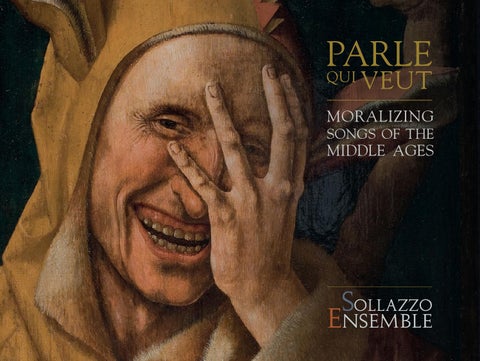
Cover image Laughing Fool (c. 1500) by Jacob Cornelisz van Oostsanen (c. 1475–1533) Davis Museum at Wellesley College, Wellesley, MA This album forms part of the Sollazzo Ensemble’s prize as winners of the 2015 York Early Music International Young Artists Competition. The biennial competition for early music ensembles takes place as part of the York Early Music Festival and is recognized as a major international platform for emerging talent in the early music world. The competition is supported by the Creative Europe programme through the Eeemerging project. This recording was made at the National Centre for Early Music, which is housed in the converted church of St Margaret’s, York. The NCEM offers excellent recording facilities to musicians of all kinds.
PARLE QUI VEUT MORALIZING SONGS OF THE MIDDLE AGES Folios 121v–122 of the sumptuously illuminated songbook known as the Squarcialupi Codex contain a lament in the voice of the personified Music, deploring the way she is being abused and neglected by people who ‘grow accustomed to ignorance and vice’. While knights, barons and nobles used to praise her, now their noble hearts have been corrupted. Music’s moral outrage is such that she speaks in triplicate: that is, in the musical setting by Francesco Landini, Musicha son/Già furon/Ciascun vuol, the three-stanza poem that records Music’s grief is sung simultaneously by three different singers, greatly intensifying the text’s urgent message. This text participates in a wider tradition of complaining about the debasement of music, but in other cases the lamenting poetic voice is identified as that of the composer. The illumination on the manuscript page where this madrigal appears, however, merges the identities of the composer and the personified Music: it contains two images, one in the top initial, showing the composer at the keyboard, and the second, smaller image at the bottom margin, showing Lady Music in an identical stance at a keyboard of her own. The illustrations make it clear that the composer has adopted the persona of Music to make his own moralizing statements. Magister Franciscus de Florentia, called ‘Landini’, was probably the most famous musician in Italy of his time. He is the subject of an extraordinary biographical account by his younger contemporary Filippo Villani, who included him in his Lives of Illustrious Florentines written in the early 1380s. Villani described with amazement Landini’s accomplishments in music, despite ‘the fear of being accused of making up stories’. Franciscus, he wrote:
4
was hardly past the middle of his childhood when unjust fate suddenly struck him blind with the smallpox; music, however, re-formed him with the lights of fame…when he was grown, and when he understood the sweetness of melody, he began to first sing with his voice and then to play string instruments and the organ. And then, having perfected the art astonishingly, to everyone’s amazement, he handled a number of musical instruments which he had never seen as readily as if he could still see; he began to play the organ, with such great dexterity, but always following the measuring of time, and with such ability and sweetness that he far surpassed any organist in memory. In addition to his fame as an organist he was a prolific composer of more than 150 surviving songs. He was also known as an intellectual, the author of a philosophical dream-vision text on William of Ockham and a commentary on Dante’s Divina Commedia. Musicha son/Già furon/Ciascun vuol is likely the most serious of the moralizing songs collected on this album, most of which concern affairs of the heart, some in French and some in Italian. Both traditions grew from the Occitan poetry of the twelfth-century troubadours and the Old French trouvères of the thirteenth century. While the majority of their songs were love songs, (‘canso’ in Occitan and ‘chanson’ in Old French), typically lamenting the unattainability of a lady, or occasionally a man, a significant number treated politics, daily life, and morality, seemingly giving us a glimpse of issues that occupied everyday people. A common subtheme of troubadour and trouvère song was that of the harm done by slanderers, people whose gossip would damage the reputations of lovers. The theme of slanderers is taken up in a number of songs recorded here: in Le basile, the act of slander is compared to the fatal glance of the basilisk, and in Pour che que je ne puis, the poetic speaker is forced to leave his lover behind and move to a different city to escape the rumours put out by slanderers. The album’s title song, Parle qui veut, takes a more lighthearted approach 5
to the problem: the speaker of this rondeau invites slanderers to say what they will but he determines to remain loyal to his sweetheart, who alone has the power to keep him from grief. Troubadour and trouvère songs were sung monophonically (one voice singing a melody), and only a small number of the melodies were written down, since the poet-composers composed and performed largely from memory. By the second half of the thirteenth century, though, their songs became so culturally prized that they began to be collected in large and often sumptuous manuscripts so that they might be preserved. By the fourteenth century, a new system of musical notation permitted the writing down of elaborate polyphonic music, and a number of beautifully executed manuscripts, like the Squarcialupi Codex, survive that collect hundreds of polyphonic songs of both French and Italian composers. These songs range widely in affect and tone, in musical style, and in social register. All these songs followed new formal constraints, most involving a refrain; in French these forms were known as the ‘formes fixes’. In the Italian tradition, the madrigal and the ballata were both refrain forms. In the madrigal, the refrain is found at the end of the poem, and it contrasts in rhyme, form and musical meter to the (typically three) stanzas of the poem, while in the ballata, as well as the French virelai, the refrain begins the poem, is followed by one or more verses, and then returns at its end. The album begins with a tiny song, Il megli’ è pur tacere, a so-called ‘ballata minima’, in which the refrain and verse are each only one verse long. Its main conceit, ‘He who speaks too much often errs’, is a well-known proverb, and it may be that originally this proverb was set to a simple tune that is now found as the composition’s tenor; on this recording the performers sing the tenor melody alone first before adding the highly ornamented cantus voice that it accompanies. The idea to use a maxim or a proverb as a starting point for poetry and oratory was a commonplace 6
of medieval rhetorical training in both the Italian and the French traditions, and we often see it carried over into lyric composition as well. The composer Niccolò da Perugia is not very well documented in the historical record, but he seems to have been well acquainted with a circle of Florentine poets in the second half of the fourteenth century; he set a number of texts by the poets Niccolò Solderini and Franco Sacchetti. In light of his association with these authors of many more extended poetic forms, his preference for the diminutive form of the ‘ballata minima’ is intriguing. Two other composers represented on this album had well-documented careers in and around Florence: Andrea and Paolo da Firenze. Andrea, a Servite monk, was prior of the monastery of Santissima Annunziata in Florence and later became the head of the Servite community. His 30 surviving compositions are all ballatas, and all are found in the Squarcialupi manuscript. This composer set a large number of moralizing and / or satirical texts, and his Dal traditor is composed in what appears to be a uniquely conflated genre, the ‘caccia ballata’. The caccia (‘hunt’) was composed of two canonic voices supported by a tenor, and they often set texts that onomatopoetically described hunting scenes, complete with the barking of dogs and shouting of hunters. The canonic structure, in which the second voice imitates the first at a short interval, normally gives the song a dialogic cast. Here, the form of the ballata is superimposed upon the canonic caccia, and the energy and excitement of the hunt is replaced by an excoriation of those who pretend to be good friends but then betray one’s trust. While most of the poem is couched as a general warning against this type of false person, the poetic speaker at one point confides that he himself has been the victim of such a traitor, whom he compares with a touch of hyperbole to Judas. The original listeners to this song must have been struck by its generic novelty, and possibly amused by the transfer of affect from the hunt to the decrying of traitors.
7
Paolo da Firenze, one of the great masters of polyphonic song writing at the turn of the fifteenth century, was another cleric of high station in the environs of Florence: he was rector of the church of Santa Maria Annunziata Virgine in Florence and abbot of the Benedictine monastery of San Martino al Pino near Arezzo from 1401 until well into the 1430s. His ballata Perché vendecta demonstrates the salient features of late trecento style: extremely florid writing, with expressive short sequential phrasing and long cascading melismas on the penultimate syllable of poetic lines, creating a driving feeling toward phrase endings. The madrigal was the earliest genre of song cultivated in Italy, and as the author of the early fourteenth-century treatise Capitulum de vocibus applicatis verbis explains, their texts were rustic and pastoral: ‘de villanellis, de floribus, arbustis, sertis, utere…’ (‘concerning village life, flowers, trees, planting, animal hides…’). The author further suggests that the upper part be set in fast notes. The charming madrigal Angnel son biancho by Giovanni da Firenze does use pastoral imagery, but with a twist: the text is in the voice of a lamb, rather than the usual voice of a person in the countryside, and it comes complete with mimetic bleating sounds (‘bleating go, baa!’). Its innocent surface, however, is a screen for a clearly political intent: to send a moralizing message about proper comportment for the nobility. A much more serious approach to morality is found in the anonymous ballata O pensieri vani, found uniquely in the early fifteenth-century Lucca Codex, a source that was begun in Padova but likely finished in Florence around 1410. This source contains a number of songs by the masters of the early fifteenth century: Johannes Ciconia, ‘Zacara’ da Teramo, and Paolo da Firenze. Although O pensieri vani is transmitted anonymously, its high poetic register and sophisticated musical style make it possible to imagine it as a composition by any one of these, or by a near contemporary. This piece has some of the affective gestures that we see in Johannes 8
Ciconia’s Italian songs, such as Ligiadra donna, and its scoring for two equal voices is also reminiscent of that composer. The ballata’s refrain, the opening line ‘O pensieri vani, O sperança fallace’, is an Italian translation of an oft-cited line of Cicero, a phrase that seems to have had a long life as a proverb and as an example of the rhetorical device of apostrophe, a direct address to an imaginary interlocutor. The anonymous poet here continues the apostrophic mode of his quotation, giving the text a serious tone throughout. The two voices are equal in importance and trade off phrases in imitation in a number of places. The rhythmic intricacy between them is remarkable: the sophisticated use of syncopation to create a dialogic relationship between the two voices, as well as a memorable moment where the minim is texted, causing extremely rapid declamation, are rhythmic innovations that mark the song as having been composed likely in the early fifteenth century. Antonio ‘Zacara’ da Teramo is another composer for whom we have a surprisingly vivid biographical account, from an eighteenth-century necrology from his home territory of Abruzzo. According to this notice, Zacara was famous throughout Europe, was small of stature, and was missing digits on his fingers and toes, only having ten in total between both. This account is corroborated by Zacara’s portrait in the Squarcialupi Codex, where he is shown with his arm in a sling and with prominently missing fingers. Cacciando per gustar/Ai cinci, ai toppi is a tour de force of caccia writing. It opens as expected with a narrator describing how he is hunting (‘Cacciando’) through harsh mountains and dangerous forests, but no sooner has the expected second canonic voice entered than the tenor bursts in with a second, unrelated, text that depicts a noisy marketplace, comically undermining the scene underway in the upper voices. Within moments the two higher voices have given up the hunt and join in the depiction of the market scene, to brilliantly humorous effect. Two earlier examples of the ‘marketplace caccia’ exist, both by Vincenzo da Rimini, but Zacara’s is even more inventive, not only using the tenor 9
as a third singing voice to add to the din, but employing hocket (‘hiccups’, an alternation of notes and rests), very short texted notes, and clever dialoguing within the three parts. The French songs on this album present a significant contrast in musical style to the Italian ones, even while their texts explore similar themes. The French ‘formes fixes’ include the virelai, whose form is shared with the balata; the rondeau, whose refrain begins and ends the song, and punctuates the middle with a half-refrain; and the ballade, the most elevated of the genres, comprising three stanzas whose shared last line serves as a refrain. The anonymous ballade Va, Fortune survives uniquely in the Chantilly Codex, a manuscript copied in Florence but containing elaborate French songs in the so-called ars subtilior style from the turn of the fifteenth century. The long syncopated lines and the frequent shifts from 3/4 to 6/8 time are indicative of the French style, but the careful phrasing and the sequential statements of a sighing gesture that so beautifully match the mournful text are reminiscent of the style of Italian composers of the early fifteenth century. The anonymous ballade Pour che que je ne puis survives in a fragmentary manuscript in Cambrai containing French works from the middle of the fourteenth century. Scored unusually for two high voices that cross continually, this song provides unusually poignant harmonies and carefully notated phrasing on the words ‘Au departir’, with rests breaking up the word as if to depict a sob; similarly at the very end, the technique of hocket breaks up the final melody of the refrain in an unusually expressive way. Nothing is known about the enigmatic composer Solage (whose name may be either a pseudonym meaning ‘solace’ or indicate that he hails from one of the myriad villages called Soulages in the Auvergne), except that he composed ten songs found 10
uniquely in the luxurious Chantilly Codex. The ballade Le basile contains a cornucopia of personifications and mythological references. The first stanza is devoted to the drastic image of the basilisk, a fantastic creature that frequented ancient Roman and medieval bestiaries. Said to be a cross between a rooster and a venomous snake, the basilisk was so deadly that it killed with its gaze. In an elaborate metaphor, the basilisk is likened to envy, which motivates slanderers to destroy the happiness of lovers. The refrain invokes Barat, the deceiving trickster of medieval French literature, and claims that he dominates the world. The second stanza of the ballade changes metaphor to that of the law, imagining a scene in which the ‘King of Love’ officiates at the ‘palace of Righteousness’, condemning slanderers who jeopardize true love. The torturous harmonies and generally low tessitura of this ballade are hallmarks of Solage’s style, and well suited to the extravagance of the text’s imagery. We know from numerous literary sources of the fourteenth century that songs like those found here were performed by and for noble men and women seeking leisure and also perhaps a bit of instruction. Boccaccio’s Decameron describes the singing and playing of songs by members of the brigata at the end of each of its ten days. At the end of the third day, one of the women performs a moving song describing the grief a widow who remarries unhappily, to which her companions ‘listened raptly and construed in different ways. There were those who took it in the Milanese fashion, to imply that a good fat pig was better than a comely wench. But others gave it a loftier, more subtle and truer meaning.’ We might imagine the songs collected here to have been similarly pondered for their apparent and hidden meanings, as well as for their delightful deployment of musical effects, from the bleating of the lamb and the cries of the marketplace to the polyphonic lament of Lady Music and the declamatory eloquence of the various lovers betrayed by slanderers. © Anne Stone, 2017 11
1. IL MEGLI’ È PUR TACERE Yukie Sato, Perrine Devillers, Vivien Simon Anna Danilevskaia, Sophia Danilevskaia, Vincent Kibildis Il megli’ è pur tacere. Colui che troppo parla: Ispesse volte falla.
It is best to be silent. He who speaks too much often errs.
Et poi non val pentere, I’ mi fidai di tale Che di me dice male.
Then again it is of no value to repent, trusting the one who speaks badly of me.
E ben già non vol dile Colui assai più vale.
But that does not mean that he is worth more.
Squarcialupi Codex, f. 81v
2. ANGNEL SON BIANCHO Yukie Sato, Perrine Devillers Anna Danilevskaia, Sophia Danilevskaia, Vincent Kibildis Angnel son biancho, e vo’ belando, be! E per ingiuria di chapra superba Belar convegno, e perd’ un boccon d’erba.
A white lamb am I, and bleating go, baa! because of the injustices of the haughty goat I must bleat and lose a bite of grass.
Il danno è di colui, i’ dico in fè, Che grasso mi de’ aver cho’ llana bionda, Se capra turba che non m’abbi tonda.
He will suffer damage – I swear it – who would have me fat with fair wool, if the goat causes such disturbance that he cannot shear me.
Or non so bene che di me serà, Ma pur giusto signor men mal vorrà.
Now I don’t quite know what will become of me, but surely a just lord would wish less evil.
Panciatichi Codex, f. 48v–49r
12
3.
MUSICHA SON/GIÀ FURON/CIASCUN VUOL
Yukie Sato, Perrine Devillers, Vivien Simon Vincent Kibildis Cantus I Musicha son, che mi dolgo piangendo Veder gli effecti mie dolci e profecti Lasciar per frottol’ i vagh’ intellecti.
Music am I, and weeping I regret to see pleasant minds abandon sweet and perfect qualities for frottole*.
Perché’n ’gnorantia’n viçi’ ongn’ uom chostuma, Lasciasi ’l buon e pigliasi la schiuma.
For everyone grows accustomed to ignorance and vice, passing up the good and taking the scum.
Cantus II Già furon le dolceççe mie pregiate Da chavalieri, baroni e gran signori; Or sono ’nbastarditi ’n genti chori.
Once my beauties were praised by knights, barons and great lords; now the noble hearts have become corrupted.
Ma i’, Musicha, sol non mi lamento, Ch’ancor l’altre virtù lasciate sento.
But not only I Music, lament, for I hear that the other virtues have been abandoned as well.
Tenor Ciascun vuol innarrar musical note E compor madria, chaccie, ballate, Tenend’ ognun le sue autenticate.
Everyone wants to fabulate with musical notes and compose madrigals, caccie and ballate considering his own to be authentic.
Chi vuol d’una virtù venire ’n loda, Conviengli prima giungner alla proda.
Whoever would be praised for a virtue should first reach the shore.
Panciatichi Codex 26, f. 89v–90r
*poetical-musical genre emerging in this period, as well as ‘nonsense’ or ‘trifles’
13
4.
DAL TRADITOR
Yukie Sato, Perrine Devillers, Vivien Simon Sophia Danilevskaia, Vincent Kibildis Dal traditor non si può l’uom guardare, Che mostri buona faccia Con sagaci costumi e falsa traccia.
One cannot protect oneself from the traitor who, by means of shrewd customs and false guidance presents a kind face.
Pessima pestilença certamente; Familiar nimico, E sopra tutte l’altr’ aspr’e mortale. Questa malvagia torma frodolente Fece già per antico A molti buoni non pensato male.
Without doubt they are the worst plague; a familiar enemy fierce and deadly above all others. Already in old times this malicious, deceitful mob did unthinkable evil to many a good person.
Simile a Giuda un traditor cotale Pien d’infinita laccia Tradito m’a con dimostrar bonaccia.
Similar to Judas, such a traitor betrayed me by displaying kindness full of infinite snares.
Però si guardi ciascun com’ si fida E come crede altrui, Benc’altri el parlar abbia pien di mèle. Che tal si finge amico e par che rida, Dicendo: «I’ sono e fui E sarò sempre servidor fedele.»
Thus everyone is on their guard as to how they trust and believe others, even if those speak with honeyed tongues. They present themselves as friends and smile, saying: ‘I am and was and always will be your faithful servant.’
Che poi ascoso vento alle suo vele E con inganni allaccia Chi più sicuro dorme in le suo braccia.
And then with unforeseen wind destroy their sails and ensnare him with deceit who sleeps securely in their arms.
Dal traditor…
One cannot protect…
Squarcialupi Codex, f. 185v
14
5. VA,
FORTUNE
Yukie Sato Anna Danilevskaia, Sophia Danilevskaia, Vincent Kibildis Va, Fortune, trop as vers moy grant tort, Que lons temps a chascun jorn m’es contrayre : Car il n’est nul qui creüst de confort, Que mon trist’ cuer as fet soffrir detrayre. Et fais tous jours : mes se ire ma vie iblouie. La mort m’atent, las ! je me garde fenie.
Go, Fortune, you have wronged me too much, who every day, for so long have been contrary to me: no one would believe the loss of comfort, which you forced upon my poor heart. As you still do; but this suffering illuminates my life. Death is waiting for me, alas! I consider myself ended.
Chantilly Codex, f. 29v
6. LE BASILE Vivien Simon, Vivien Simon Anna Danilevskaia, Sophia Danilevskaia, Vincent Kibildis Le basile de sa propre nature Tous ceulz qu’il voit tue soubdaynement ; Car son venin est mortel sanz mesure, Sanz remède et sanz alégement. Ainsi tue Envie Les bonz par trez sanglante ialousie, Tant que chascun voit son per a grant payne, Car Barat tient le monde en son demaine.
The basilisk by its own nature kills suddenly, whomever it sees; for his venom is deadly without measure, without remedy or relief. Thus Envy kills good people by way of most bloodthirsty jealousy, so that everyone sees his peers in great suffering, for Barat holds the world in his grip.
Le Roy d’Amours ou palais de Droyture Si a douné sentense et iugement Contre ennemi qui par fause morsure A vrays amans font painne et tourment ; Maudite soit leur vie, Et leur iangler plain de tres grant foulie Per cui ie pers l’amour fine et hauteine, Car Barat tient le monde en son demaine.
The King of Love in the palace of Righteousness has passed sentence and judgement upon enemies who bring suffering and torment to true lovers by malicious biting; cursed be their lives and their jeering full of greatest insanity, which causes me to lose courtly and lofty love, for Barat holds the world in his grip.
Chantilly Codex, f. 49v
15
8. PARLE QUI VEUT Perrine Devillers Anna Danilevskaia, Sophia Danilevskaia, Vincent Kibildis Parle qui veut, je veuil loiaument vivre ; C’est tout mon cuer et mon parfait voloir. En loiauté metrai tout mon savoir Tant que vivrai a qui du tout me livre.
Say what you will, I would live loyally; it is my true desire and my perfect will. I will devote all my skill to loyalty as long as I live – to her, to whom I am dedicated.
Ja ne serai onques escrit au livre Des deloiaus pourquoi a mon pooir. Parle qui veut, je veuil loiaument vivre ; C’est tout mon cuer et mon parfait voloir.
I will not be entered in the book of the disloyal should it be within my power. Say what you will, I would live loyally; it is my true desire and my perfect will.
Car vraiement elle est qui me delivre De tout ce qui me peut faire doloir, Et qui me fait dire sans decevoir, De loiauté trestout plain et tout ivre :
Because truly it is she who delivers me from all that could grieve me, and who makes me say without deceit, completely full and drunken with loyalty:
Parle qui veut…
Say what you will…
Torino/Cyprus Codex, f. 158r
9. POUR CHE QUE JE NE PUIS Yukie Sato, Perrine Devillers Anna Danilevskaia Pour che que je ne puis, mie, Demourer en douls payis Où vous manes, douche amie ; Pour les mesdisans hayïs Je m’en depars trop envis : Mais puis qu’en sus de vous me trais, Au departir mon cuer vous lais.
Because I cannot, my dear, remain in that sweet country where you reside, sweet friend; because of the despised slanderers I depart against my will: but while parting from you, in leaving, I leave my heart to you.
16
Dure m’est la departie, Qu’a cheus oncques ne meffis Qui de douce compaignie Me toillent par leur mesdis. Adieu, tres douls cuers gentils, Car congiés est pour tous jours mais ; Au departir mon cuer vous lais.
My departure weighs heavily on me, because I was never wary of those who tear me from sweet company by their slandering. Farewell, sweet, lovely heart, because my departure is forever but; in leaving, I leave my heart to you.
Cambrai, MS B 1328, f. 8r
10. PERCHÉ VENDECTA Yukie Sato Anna Danilevskaia, Vincent Kibildis Perché vendecta far or non si pò, Aspecto tempo ch’i’ farla potrò
Since taking revenge is not possible now, I await the moment in which I can
Di tal che da mme senpre ben sentì. El contrario farò di quel ch’i’ fù Perchè lla sua alla mie fè mentì Con, minacciandò farmi quello o più.
take it on him, to whom I was always kind. I will do the contrary of what I once was because his faith betrayed mine, threatening to do the same to me or worse.
Dunque non guarderò all’esser su Di sopra in rota ch’i’ pur si farò.
So I will not try to be on top of the wheel around which I will go in any case.
Perché vendecta…
Since taking revenge…
MS Pit 568, f. 83v
11. O PENSIERI VANI Perrine Devillers, Vivien Simon O pensieri vani, O sperança fallace, O mente ciecha,
Oh vain thoughts, oh fallacious hope, oh blind mind,
17
O core che tardi, Non t’acorgi del focho in che tu ardi.
oh weak heart, you do not know in which fire you burn.
El tempo in futuro May non s’aspecta. Et tu, vechio, inutele ay fermeçça Et non t’avedi che morte t’enfreçça.
The future can never been foreseen. And you, old and useless, go steadily on and do not realize that death has you in his sights.
Ay lasso! ben veço ogni mio male; Valesse el pentir come non vale.
Alas! I see all my sins; they would be worthy of repent, but it is not worth it.
Lucca/Mancini Codex, f. XCVIr (63, 20b)
13. CACCIANDO PER GUSTAR/AI CINCI, AI TOPPI Yukie Sato, Perrine Devillers, Vivien Simon Anna Danilevskaia, Sophia Danilevskaia, Vincent Kibildis Cantus Cacciando per gustar de quel tesoro, Per aspri monti et boschi pericolosi, D’uno boschecto d’alborselli d’oro De fiurj trova’ assay, operti et chiusi, Tastando et odorando li più belli; Et una voce crida:
Hunting to get a taste of that treasure, over bare mountains and through dangerous forests, I found within a golden grove flowers aplenty, open and closed, smelling and touching the most beautiful ones; and a voice cried out:
«Alli gammarielli, a l’argentarielli, Alle lactalini fieschi!» «Fieschi, fieschi so’ che anche frecciano!» «A le telline, fieschi!» «Tucte giectano la lingua fore!» «Et so’ fieschi quessi lactalini?» «Damme .II. derrate de gamarielli!» «Et so’ fieschi como dice?»
‘Shrimps, sardines, fresh anchovies!’ ‘They are so fresh, they’re still wriggling!’ ‘Fresh clams!’ ‘They’re all sticking their tongues out!’ ‘Are these anchovies fresh?’ ‘Give me two portions of the shrimps!’ ‘Are they as fresh as you say?’
«A l’anfusaglia dolce!» «O tu da l’uolglio, che bal lu petecto?»
‘Sweet, pickled lupini beans!’ ‘Hey, you with the oil, how much for a measure?’
18
«Vòyne cinque.» «Alle bone melangole!» «Una ad denaro!» «Custa .VI. suollj lu centinaro!» «Et buòn’j .II. !» «Saçço cha fora trista.» «Se ne buò .III. per .II. denarj!» «Tolli!» «Tilli!» «Vòil, vòile! Vòil, vòil, vòil, vòil.» «Vòyne dare .II. ?»
‘I want five.’ ‘Good sour oranges!’ ‘A florin for each of them!’ ‘One pound for six shillings!’ ‘I’ll take two!’ ‘I already know I’ll end up sad.’ ‘I’ll give you three for two florins!’ ‘Take it!’ ‘Keep it!’ ‘I want, I want, I want!’ ‘Will you give me two?’
«Chi vuò’ li cavalcasi? Allu caso sardenale, Allu caso de la forma!» «Allu bono lacte!» «No, no, no, no, no, no no.» «AIIu bono caso fiescho!» «Non è fiescha como dice!» «Ed è bono?» «Ed è chiaro?»
‘Who wants caciocavallo? Sardinian cheese, formed cheese!’ ‘Good milk!’ ‘No, no, no!’ ‘Good, fresh cheese!’ ‘Not as fresh as you claim!’ ‘Is it good?’ ‘Is it clear?’
«E chi le vòl le bone scafe?» «Et chi le vòl le bone vìsciole?» «Alla recocta fiescha!» «AIIo bono oglio…» «Como l’unto…» «Più che l’ambra!» «A le bon cerase! Et chi le vòl le bone ficora?» «Et chi le vòl le bone pèrseca?» «Alle castagne remonne, femmene!» «Anna chà, vè’ chà, famme bene ciò!» E forte: «Compare, vòyme cernere?»
‘And who wants good beans?’ ‘And who wants good sour cherries?’ ‘Fresh ricotta!’ ‘Good oil…’ ‘As good as fat…’ ‘Clearer than amber!’ ‘Good cherries! And who wants good figs?’ ‘And who wants good fish?’ ‘Cooked and peeled chestnuts, ladies!’ ‘Come, come here and make me feel good!’ and loud: ‘Mister, do you want to churn with me?’
Chi altro, chi farina compra, vende, Chi dorme, chi astuta, e chi accende?
Who else, who buys flour, who sells it, who sleeps, who blows out the candle, who sets it aflame?
19
Tenor «Ai cinci, ai toppi, ai bretti!» «Ai ferri, ai rame rocto!» «All’àcore, fuse, Alla merciaria menuda, madonna!» «Chi à della rasina?» «Chi à frexi’ et çagane vecchie?» «Sals’, sals’, salsa verde! Mostarda!» «Chi à dell’ova?» «Chi à della semola?» «Et so’ fieschi quessi?» «A l’uoglio, a l’uoglio!» «Cy, ci, sta, che si’ scorticatu!» «Volgliune!» «Sey suolli!» «Anna, va, for, che te scortiche!» «Non è, no!» «Como le day?» «Vòyne dare duy.» «A I’algli, a l’agli! Chi le vò’, le bon’ cepolle?» «Avante, avante chi se vò ciarmare?» «Chi vòl secar li piectine?» «Chi vòl aconciar piectine da capo?» «Al dent al dent! Chi à’l mal dente à’l mal parente, Et chi à’l mal vecino à’l mal matino!» «Chi vol conciar caldari, Centrarj et capisterj Et conparare treppìdi et coverchi?» «AII’ acito, all’ acito!» «Como lo tuosico!» «Chi vòl cernere?» «Sì, maduonna, sì, sallo su!»
‘Rags, patches, old scraps!’ ‘Iron, bits of copper!’ ‘Needles, spindles, all sorts of notions, milady!’ ‘Who has fine silk?’ ‘Who has cord, who has old neck ruffs?’ ‘Green sauce, mustard!’ ‘Who has eggs?’ ‘Who has semolina?’ ‘And are they really fresh?’ ‘Oil, oil!’ ‘Here, here! Hold still so you can be beat!’ ‘I want one!’ ‘Six shilling!’ ‘Move it, go, come out so I can beat you!’ ‘No, it isn’t!’ ‘For how much will you give them?’ ‘I’ll give you two.’ ‘Garlic! Who wants good onions?’ ‘Step up, who wants to have their fortune told?’ ‘Who wants to have a comb cut?’ ‘Who wants to have their comb repaired?’ ‘Teeth, teeth! Where there are bad teeth, there are bad parents, where there are bad neighbours, there are bad mornings!’ ‘Who wants their kettles, barrels and bowls, tripods and pot lids repaired?’ ‘Vinegar!’ ‘Bitter as poison!’ ‘Who wants to churn the butter?’ ‘Yes, milady, yes, I’ll jump on!’
Modena Codex, f. 16v-17r English translations by Michele Silberman, 2017
20
SOLLAZZO ENSEMBLE Founded in Basel the Sollazzo Ensemble brings together musicians with a strong interest in late medieval and early renaissance repertoires. The ensemble is directed by fiddle player Anna Danilevskaia and benefits from the diverse musical backgrounds of its members. The members of Sollazzo have benefitted from studies in institutions renowned for their specialization in early music such as the Schola Cantorum Basiliensis, the ESMUC in Barcelona, and the CNSM in Paris and Lyon. This exposure to a wealth of ideas and influences plus a curriculum which presented diverse ways of approaching medieval repertoire guided Sollazzo to their future musical projects. In 2014 Sollazzo entered the Eeemerging programme, supported by Creative Europe, which presented the opportunity to attend several artistic residencies throughout Europe. In 2015 the ensemble won the York Early Music International Young Artists Prize, while being also awarded the Friends of York Early Music Festival Prize by the public, and the Cambridge Early Music Prize. Apart from its concert activity, the ensemble has collaborated with the Italian Fondazione Ezio Franceschini (Florence) and Fondazione Giorgio Cini (Venice) in the context of international seminars and symposiums bringing together musicologists, philologists, and specialists on Italian medieval music. In 2017 Sollazzo collaborated with the Alamire Foundation on the presentation of a newly discovered source, the Leuven Chansonnier, and premiered its heretofore unknown repertory in New York.
21
Photograph by Martin Chiang
ALSO AVAILABLE
Thalia Ensemble
Reicha: Wind Quintets
Theatre of the Ayre
The Masque of Moments
Ensemble Meridiana Tastes of Europe
Phantasm
Dowland: Lachrimae or Seven Tears
Glasgow Road, Waterfoot, Eaglesham, Glasgow, G76 0EQ T: +44 (0)141 303 5027 | E: info@linnrecords.co.uk
Profeti della Quinta
Rossi: Il Mantovano Hebreo
Gothic Voices
Mary Star Of The Sea